Accounts
Users of Accounts
The following stakeholders have an interest in a limited
company’s accounting records:
Shareholders – need to know the profit and loss the
company makes. They will want to know if the business is
worth more at the end of the year than the beginning.
Creditors – businesses (other than banks) that have lent
money to the business or have supplied goods without
receiving payment yet. They will want to know if the
business can pay them back.
Users of Accounts
The following stakeholders have an interest in a limited
company’s accounting records:
Government – the government and the tax office will want
to check on profits to know how much tax the business
needs to pay. The government can also check output to
measure GDP for the economy.
Other companies – the managers of other companies may
be considering a bid to take over the business or they may
wish to compare performances of their competitors.
Users of Accounts
Managers use them for
taking decisions
Managers use them for controlling
the operations of a business
Used by shareholders, creditors,
government, to check on company
performance
Usually computerised
Every business – however small or large – aims to make a profit.
For a business to be able to calculate whether it has made a profit,
it must keep a profit and loss account.
Profit and loss accounts
A profit and loss account
summarizes all of a business’s
revenue and costs over a period
of time, usually a year. The
business then uses the figures in
it to work out how much profit or
loss it made.
A business produces a profit and loss account because:
Profit and loss
it is a legal requirement
it sums up the performance of a business to its
stakeholders
it can be compared with the previous year’s
performance
investors or lenders need to see one before making
deals
it can help to forecast future profits and helps with
planning.
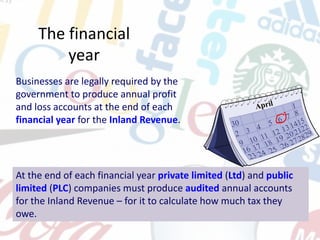
The financial
year
Businesses are legally required by the
government to produce annual profit
and loss accounts at the end of each
financial year for the Inland Revenue.
At the end of each financial year private limited (Ltd) and public
limited (PLC) companies must produce audited annual accounts
for the Inland Revenue – for it to calculate how much tax they
owe.
PROFIT
What is profit?
• Profit is the amount of money a business is
left with after it has sold the goods or services
and paid for all the costs associated with the
business. It is important to remember that it is
not the same as cash.
• There are two types of profit that you will
need to be aware of. They are Gross Profit and
Net Profit.
Gross Profit
• Gross profit is the amount of money made when
the cost of the goods sold is taken from the sales
revenue.
• For example a baker has sold 100 loaves of bread
and sold them for $1.
• His sales revenue is $100.
• To produce these loaves he spent $0.50 per loaf.
Therefore his Gross Profit is $50
Gross Profit = Sales Revenue – Cost of goods
Net Profit
• Net profit is the profit made by a business
after all costs have been deducted from the
sales revenue. It is calculated by subtracting
overhead costs from the gross profit.
Net profit = Gross Profit – Expenses
Profit can be increased by:
• Increasing sales revenue by more than cost
– How could this be done?
• Reducing cost of making the products
– How could this be done?
• A combination of both
Why is profit important for a
business?
Why is profit important for a
business?
• Reward for enterprise and risk taking – this
provides an incentive for investment into a
business. If a business is profitable then its
shareholders will benefit financially
• Source of finance – profits can be retained to be
reinvested into the business
• Indicator of success – shows how successful a
particular business or industry is
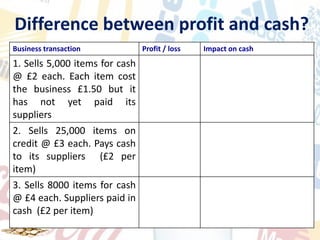
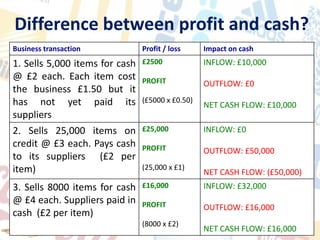
Difference between profit and cash?
Business transaction Profit / loss Impact on cash
1. Sells 5,000 items for cash
@ £2 each. Each item cost
the business £1.50 but it
has not yet paid its
suppliers
2. Sells 25,000 items on
credit @ £3 each. Pays cash
to its suppliers (£2 per
item)
3. Sells 8000 items for cash
@ £4 each. Suppliers paid in
cash (£2 per item)
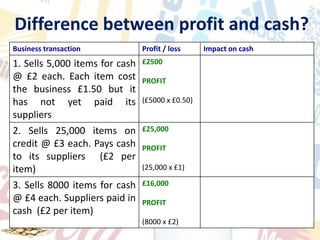
Business transaction Profit / loss Impact on cash
1. Sells 5,000 items for cash
@ £2 each. Each item cost
the business £1.50 but it
has not yet paid its
suppliers
£2500
PROFIT
(£5000 x £0.50)
2. Sells 25,000 items on
credit @ £3 each. Pays cash
to its suppliers (£2 per
item)
£25,000
PROFIT
(25,000 x £1)
3. Sells 8000 items for cash
@ £4 each. Suppliers paid in
cash (£2 per item)
£16,000
PROFIT
(8000 x £2)
Difference between profit and cash?
Business transaction Profit / loss Impact on cash
1. Sells 5,000 items for cash
@ £2 each. Each item cost
the business £1.50 but it
has not yet paid its
suppliers
£2500
PROFIT
(£5000 x £0.50)
INFLOW: £10,000
OUTFLOW: £0
NET CASH FLOW: £10,000
2. Sells 25,000 items on
credit @ £3 each. Pays cash
to its suppliers (£2 per
item)
£25,000
PROFIT
(25,000 x £1)
INFLOW: £0
OUTFLOW: £50,000
NET CASH FLOW: (£50,000)
3. Sells 8000 items for cash
@ £4 each. Suppliers paid in
cash (£2 per item)
£16,000
PROFIT
(8000 x £2)
INFLOW: £32,000
OUTFLOW: £16,000
NET CASH FLOW: £16,000
Difference between profit and cash?
Profit and loss account
A profit and loss account can be presented in different ways, but
many businesses divide it into three distinct sections:
the trading account
the profit and loss account
the appropriation account.
It can be recorded by hand into
an accounts ledger, or entered
into a computer spreadsheet or
accounts package.
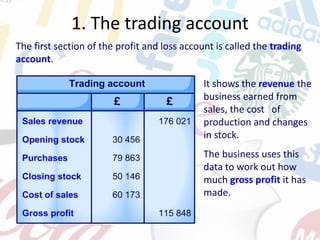
1. The trading account
The first section of the profit and loss account is called the trading
account.
It shows the revenue the
business earned from
sales, the cost of
production and changes
in stock.
The business uses this
data to work out how
much gross profit it has
made.
Calculating the trading account
Sales revenue 67 865
£ £
Opening stock 24 514
Purchases 47 865
Closing stock 34 217
Cost of sales 38 162
Gross profit 29 703
opening stock +
purchases -
closing stock =
cost of sales
sales revenue -
cost of sales =
gross profit
2. The profit and loss account
The second section is called the profit and loss account as it is
where the net profit before tax (or loss) is calculated.
The profit and loss
account records the
business’s expenses or
overheads so that the
operating profit can be
calculated.
Calculating a profit and loss account
Gross profit
£ £
Expenses
Salaries/wages
29 703
8 246
Rent
Utilities
Equipment
Other
Operating Profit
Interest on loans
Net profit before tax
3 456
1 897
965
587
Total expenses 15 151
14 552
1 216
13 336
Total expenses =
the sum of all the
expenses
Gross profit -
total expenses =
operating profit
Operating profit -
interest on loans
= net profit
before tax
3. The appropriation account
The third section of the profit and loss account is the
appropriation account. It shows exactly what has happened to
the net profit before tax the business made.
It shows the tax the
business had to pay
(corporation tax if
it is a company or income
tax if not).
Then it shows the
dividends it paid to its
shareholders and any
retained profit it kept for
reinvestment.
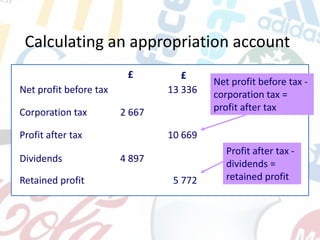
Calculating an appropriation account
Net profit before tax
£ £
Corporation tax
Profit after tax
Dividends
Retained profit
Net profit before tax -
corporation tax =
profit after tax
Profit after tax -
dividends =
retained profit
13 336
2 667
10 669
4 897
5 772
Profit and loss account activity
Sales revenue 178 650
Opening stock 14 000
Purchases 65 000
Closing stock 18 000
Cost of sales
Gross profit
Expenses
Wages 35 000
Rent 20 000
Utilities 12 000
Other 4 500
Total expenses
Operating profit
Interest on loans 12 500
Net profit before tax
Corporation tax 5 750
Profit after tax
Dividends 12 000
Retained profit
Complete this profit and loss account by entering the missing values into the coloured cells
£ £
Sales revenue 178 650
Opening stock 14 000
Purchases 65 000
Closing stock 18 000
Cost of sales 61 000
Gross profit 117 650
Expenses
Wages 35 000
Rent 20 000
Utilities 12 000
Other 4 500
Total expenses 71 500
Operating profit 46 150
Interest on loans 12 500
Net profit before tax 33 650
Corporation tax 5 750
Profit after tax 27 900
Dividends 12 000
Retained profit 15 900
Balance sheet
Basic principles of a balance sheet
A balance sheet explains two main financial factors:
where a business has got its money from
where a business has spent its money.
Like profit and loss accounts, balance sheets are usually produced
on an annual basis at the end of each financial year. However,
whereas a profit and loss account summarizes a company’s
activities over a period of time, the information on a balance sheet
refers only to the day on which it is produced.
Every single penny that has been borrowed and every single penny
that has been spent must be accounted for.
Basic principles of a balance sheet
Balance sheets have two main sections:
liabilities – how much money has been borrowed
or invested and where this money has come from
assets – where the money has been spent.
As the name suggests,
it is essential that balance
sheets ‘balance’ out, so all
liabilities must be accurately
and clearly accounted for in
the assets section.
where money
has been spent
where money
came from
The key principle of a balance sheet
all assets all liabilities
must equal
must equal
Accurate balance sheets must obey the following principle:
Which means that:
Why is it so crucial assets and liabilities balance?
Fixed assets
Fixed assets are those which the business
in question actually owns and which are
therefore ‘fixed’ into the company. These
include buildings and furniture fittings,
machinery and company vehicles.
They generally cost a lot of money and represent a large
investment for the business.
They usually last for a long period of time.
They can be sold to increase capital (i.e. the money
invested in the business).
They more often than not depreciate in value over time.
However, owing to their nature, fixed assets often prove quite
difficult to sell on. Why do you think this might be?
For example, in a shop, the value of
the stock is a current asset. Similarly,
for an interior designer working on a
job for a client, that work in progress is
a current asset. Computer equipment
is also increasingly being seen as a
current asset because it needs to be
updated and replaced so often.
Current assets
Current assets are those which the business holds temporarily or
that are always changing.
The final main types of current asset are customers who owe
money for goods bought (debtors) and also the amount of money
in a company’s current bank account.
Current liabilities, like current assets, are short-term and always
changing. However, this is money that a business actually owes.
The people or companies that the business owes money to are
known as creditors.
Common current liabilities include:
short-term loans
bank overdrafts
interest to debenture holders
share dividend payments.
All current liabilities on a balance sheet must be addressed before
the next one is produced.
Current liabilities
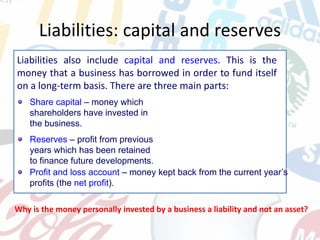
Liabilities: capital and reserves
Liabilities also include capital and reserves. This is the
money that a business has borrowed in order to fund itself
on a long-term basis. There are three main parts:
Why is the money personally invested by a business a liability and not an asset?
Share capital – money which
shareholders have invested in
the business.
Reserves – profit from previous
years which has been retained
to finance future developments.
Profit and loss account – money kept back from the current year’s
profits (the net profit).
Balance sheet structure: assets
What are the total
fixed assets?
What are the total
current assets?
10,000
+ 38,000
1,000
49,000
160,000
+ 47,000
207,000
Balance sheet structure: assets
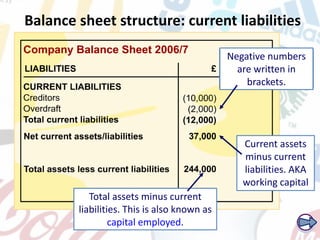
Balance sheet structure: current liabilities
Negative numbers
are written in
brackets.
Current assets
minus current
liabilities. AKA
working capital
Total assets minus current
liabilities. This is also known as
capital employed.
Balance sheet structure: capital and reserves
This is the total
amount in capital
and reserves. It
must equal total
assets less current
liabilities.
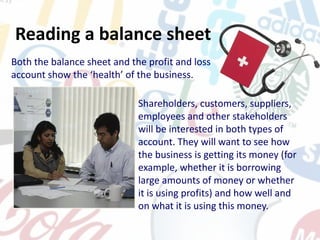
Both the balance sheet and the profit and loss
account show the ‘health’ of the business.
Shareholders, customers, suppliers,
employees and other stakeholders
will be interested in both types of
account. They will want to see how
the business is getting its money (for
example, whether it is borrowing
large amounts of money or whether
it is using profits) and how well and
on what it is using this money.
Reading a balance sheet
Important balance sheet considerations
It is important for companies to bear in mind the following considerations when
preparing balance sheets:
Fixed assets – is there enough money secured in items
which could be sold to raise capital? Or is there too large
an investment in fixed assets and not enough liquidity
(the ability to meet current liabilities) in the business?
Cash in bank – is there enough to cover a short-term
crisis?
Net current assets/liabilities or working capital – if this
figure is negative, the business hasn’t enough money to
pay all its debts in a reasonable time, if required.
Shareholders’ funds – are these increasing?
Shareholders will want their investment to grow.
Using the following information you must
produce a draft version of the company’s
balance sheet.
Golding’s Department Store
ASSETS
Fixed assets
Buildings
Equipment
Total fixed assets 0
Current assets
Stock
Debtors
Bank
Total current assets 0
LIABILITIES
Current liabilities
Creditors
Net current assets/liabilities 0
Total assets minus current liabilities 0
Capital and reserves
Share capital
Reserves
Profit and loss account
Shareholders' funds 0
Golding's Department Store
Balance Sheet 2006/7
£
Using the following information you must
produce a draft version of the company’s
balance sheet.
Golding’s Department Store
ASSETS
Fixed assets
Buildings 74,000
Equipment 42,000
Total fixed assets 116,000
Current assets
Stock 64,000
Debtors 34,000
Bank 24,000
Total current assets 122,000
LIABILITIES
Current liabilities
Creditors 32,000
Net current assets/liabilities 90,000
Total assets minus current liabilities 206,000
Capital and reserves
Share capital 126,000
Reserves 60,000
Profit and loss account 20,000
Shareholders' funds 206,000
Golding's Department Store
Balance Sheet 2006/7
£
Ratios
Once a business has its financial documents completed it will
need to analyse the information within them.
In order to do this it can perform a set of calculations that will
enable it to analyse its performance as well as it liquidity.
Liquidity ratios:
• Current ratio
• Acid test ratio
Performance ratios:
• ROCE (return on capital employed)
• Gross profit margin
• Net profit margin
ROCE
The ROCE (return on capital employed) is used to help monitor
how efficiently a business is being managed. It also indicates to
shareholders the profitability of their investments. It is
calculated using the following formula and expressed as a
percentage:
Businesses use the information present in a balance sheet in
formulae which help them to calculate overall performance.
Net profit
Capital employed
x 100
Based on the figures from your balance sheet, work out the ROCE
Gross Profit Margin
The Gross profit margin calculates the gross profit as a
percentage of the sales turnover of the business. This result
needs to be compared with other years and other companies.
Gross Profit
Sales turnover
x 100
Based on the figures from your balance sheet,
work out the Gross profit margin
Net Profit Margin
The Net profit margin calculates the net profit as a percentage
of the sales turnover of the business. The higher the result the
more successful the managers are at making net profits from
sales. This result also needs to be compared with other years
and other companies.
Net Profit
Sales turnover
x 100
Based on the figures from your balance sheet,
work out the Net profit margin
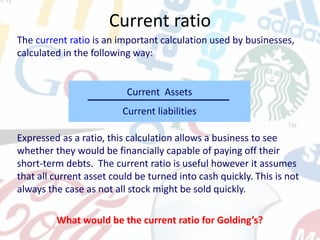
Current ratio
The current ratio is an important calculation used by businesses,
calculated in the following way:
Expressed as a ratio, this calculation allows a business to see
whether they would be financially capable of paying off their
short-term debts. The current ratio is useful however it assumes
that all current asset could be turned into cash quickly. This is not
always the case as not all stock might be sold quickly.
What would be the current ratio for Golding’s?
Current Assets
Current liabilities
Acid test ratio
The acid test ratio is another important calculation used by
businesses. It serves to measure liquidity (the ability to meet
current liabilities) using the following formula:
Expressed as a ratio, this calculation allows a business to see
whether they would be financially capable of paying off their
short-term debts without having to sell off any stock. This
information is important because stock is the least liquid current
asset, so deducting it gives a business a better idea of their
liquidity.
What would be the acid test ratio for Golding’s?
Current assets - closing stock
Current liabilities
During 2014 Youssef has recorded the following figures for his takeaway meals business:
He sold £529,300 worth of takeaway meals. Unfortunately Youssef had one bad week where some
customers were complaining of sickness after eating his meals so he had to make customer refunds of
£300.
At the start of the year he had burgers, buns, chicken etc in the freezer to the value of £40,500. He
spent £270,000 on raw materials during the year. At the end of the year the value of the stock in his
freezer was £20,000.
At the end of the year he has worked out that the value of his café building is £245,000, of which
£132,000 is owed to the bank as mortgage. His equipment is worth £17,500 and his fixtures and
fittings are worth £23, 025. He has £8,010 in his bank account. He has £965 in his cash register.
He is owed £49,600 by customers that he provided catering for parties. He owes £12,150 to his
suppliers. He also owes £26,000 in VAT.
Youssef provided £265,000 at the start to finance his business. He pays himself £26,000 at the end of
the year. His other expenses are Light and Heating for which he pays £3,600 as well as rent and rates
for which he pays £7,200. His final expense is his general administration charges which come up to
£2,250 per year.
Complete a trading profit and loss account and balance sheet using this information
and work out the ROCE, gross profit margin, net profit margin as well as the current
ratio and the acid test ratio.
ROCE: (199,450/464,450) x 100 = 42.94%
Gross profit margin: (238,500/529,000) x 100 = 45.09%
Net profit margin: (199,450/529,000) x 100 = 37.7%
Current ratio: (349,075/38,150) 9.15:1
Acid test ratio: [(348,075-290,500)/38,150] = 1.54:1

accounts_presentation_notes management business

  • 1.
  • 2.
    Users of Accounts Thefollowing stakeholders have an interest in a limited company’s accounting records: Shareholders – need to know the profit and loss the company makes. They will want to know if the business is worth more at the end of the year than the beginning. Creditors – businesses (other than banks) that have lent money to the business or have supplied goods without receiving payment yet. They will want to know if the business can pay them back.
  • 3.
    Users of Accounts Thefollowing stakeholders have an interest in a limited company’s accounting records: Government – the government and the tax office will want to check on profits to know how much tax the business needs to pay. The government can also check output to measure GDP for the economy. Other companies – the managers of other companies may be considering a bid to take over the business or they may wish to compare performances of their competitors.
  • 4.
    Users of Accounts Managersuse them for taking decisions Managers use them for controlling the operations of a business Used by shareholders, creditors, government, to check on company performance Usually computerised
  • 5.
    Every business –however small or large – aims to make a profit. For a business to be able to calculate whether it has made a profit, it must keep a profit and loss account. Profit and loss accounts A profit and loss account summarizes all of a business’s revenue and costs over a period of time, usually a year. The business then uses the figures in it to work out how much profit or loss it made.
  • 6.
    A business producesa profit and loss account because: Profit and loss it is a legal requirement it sums up the performance of a business to its stakeholders it can be compared with the previous year’s performance investors or lenders need to see one before making deals it can help to forecast future profits and helps with planning.
  • 7.
    The financial year Businesses arelegally required by the government to produce annual profit and loss accounts at the end of each financial year for the Inland Revenue. At the end of each financial year private limited (Ltd) and public limited (PLC) companies must produce audited annual accounts for the Inland Revenue – for it to calculate how much tax they owe.
  • 8.
  • 9.
    What is profit? •Profit is the amount of money a business is left with after it has sold the goods or services and paid for all the costs associated with the business. It is important to remember that it is not the same as cash. • There are two types of profit that you will need to be aware of. They are Gross Profit and Net Profit.
  • 10.
    Gross Profit • Grossprofit is the amount of money made when the cost of the goods sold is taken from the sales revenue. • For example a baker has sold 100 loaves of bread and sold them for $1. • His sales revenue is $100. • To produce these loaves he spent $0.50 per loaf. Therefore his Gross Profit is $50 Gross Profit = Sales Revenue – Cost of goods
  • 11.
    Net Profit • Netprofit is the profit made by a business after all costs have been deducted from the sales revenue. It is calculated by subtracting overhead costs from the gross profit. Net profit = Gross Profit – Expenses
  • 12.
    Profit can beincreased by: • Increasing sales revenue by more than cost – How could this be done? • Reducing cost of making the products – How could this be done? • A combination of both
  • 13.
    Why is profitimportant for a business?
  • 14.
    Why is profitimportant for a business? • Reward for enterprise and risk taking – this provides an incentive for investment into a business. If a business is profitable then its shareholders will benefit financially • Source of finance – profits can be retained to be reinvested into the business • Indicator of success – shows how successful a particular business or industry is
  • 15.
  • 16.
    Difference between profitand cash? Business transaction Profit / loss Impact on cash 1. Sells 5,000 items for cash @ £2 each. Each item cost the business £1.50 but it has not yet paid its suppliers 2. Sells 25,000 items on credit @ £3 each. Pays cash to its suppliers (£2 per item) 3. Sells 8000 items for cash @ £4 each. Suppliers paid in cash (£2 per item)
  • 17.
    Business transaction Profit/ loss Impact on cash 1. Sells 5,000 items for cash @ £2 each. Each item cost the business £1.50 but it has not yet paid its suppliers £2500 PROFIT (£5000 x £0.50) 2. Sells 25,000 items on credit @ £3 each. Pays cash to its suppliers (£2 per item) £25,000 PROFIT (25,000 x £1) 3. Sells 8000 items for cash @ £4 each. Suppliers paid in cash (£2 per item) £16,000 PROFIT (8000 x £2) Difference between profit and cash?
  • 18.
    Business transaction Profit/ loss Impact on cash 1. Sells 5,000 items for cash @ £2 each. Each item cost the business £1.50 but it has not yet paid its suppliers £2500 PROFIT (£5000 x £0.50) INFLOW: £10,000 OUTFLOW: £0 NET CASH FLOW: £10,000 2. Sells 25,000 items on credit @ £3 each. Pays cash to its suppliers (£2 per item) £25,000 PROFIT (25,000 x £1) INFLOW: £0 OUTFLOW: £50,000 NET CASH FLOW: (£50,000) 3. Sells 8000 items for cash @ £4 each. Suppliers paid in cash (£2 per item) £16,000 PROFIT (8000 x £2) INFLOW: £32,000 OUTFLOW: £16,000 NET CASH FLOW: £16,000 Difference between profit and cash?
  • 19.
    Profit and lossaccount A profit and loss account can be presented in different ways, but many businesses divide it into three distinct sections: the trading account the profit and loss account the appropriation account. It can be recorded by hand into an accounts ledger, or entered into a computer spreadsheet or accounts package.
  • 20.
    1. The tradingaccount The first section of the profit and loss account is called the trading account. It shows the revenue the business earned from sales, the cost of production and changes in stock. The business uses this data to work out how much gross profit it has made.
  • 21.
    Calculating the tradingaccount Sales revenue 67 865 £ £ Opening stock 24 514 Purchases 47 865 Closing stock 34 217 Cost of sales 38 162 Gross profit 29 703 opening stock + purchases - closing stock = cost of sales sales revenue - cost of sales = gross profit
  • 22.
    2. The profitand loss account The second section is called the profit and loss account as it is where the net profit before tax (or loss) is calculated. The profit and loss account records the business’s expenses or overheads so that the operating profit can be calculated.
  • 23.
    Calculating a profitand loss account Gross profit £ £ Expenses Salaries/wages 29 703 8 246 Rent Utilities Equipment Other Operating Profit Interest on loans Net profit before tax 3 456 1 897 965 587 Total expenses 15 151 14 552 1 216 13 336 Total expenses = the sum of all the expenses Gross profit - total expenses = operating profit Operating profit - interest on loans = net profit before tax
  • 24.
    3. The appropriationaccount The third section of the profit and loss account is the appropriation account. It shows exactly what has happened to the net profit before tax the business made. It shows the tax the business had to pay (corporation tax if it is a company or income tax if not). Then it shows the dividends it paid to its shareholders and any retained profit it kept for reinvestment.
  • 25.
    Calculating an appropriationaccount Net profit before tax £ £ Corporation tax Profit after tax Dividends Retained profit Net profit before tax - corporation tax = profit after tax Profit after tax - dividends = retained profit 13 336 2 667 10 669 4 897 5 772
  • 26.
    Profit and lossaccount activity Sales revenue 178 650 Opening stock 14 000 Purchases 65 000 Closing stock 18 000 Cost of sales Gross profit Expenses Wages 35 000 Rent 20 000 Utilities 12 000 Other 4 500 Total expenses Operating profit Interest on loans 12 500 Net profit before tax Corporation tax 5 750 Profit after tax Dividends 12 000 Retained profit Complete this profit and loss account by entering the missing values into the coloured cells
  • 27.
    £ £ Sales revenue178 650 Opening stock 14 000 Purchases 65 000 Closing stock 18 000 Cost of sales 61 000 Gross profit 117 650 Expenses Wages 35 000 Rent 20 000 Utilities 12 000 Other 4 500 Total expenses 71 500 Operating profit 46 150 Interest on loans 12 500 Net profit before tax 33 650 Corporation tax 5 750 Profit after tax 27 900 Dividends 12 000 Retained profit 15 900
  • 28.
  • 29.
    Basic principles ofa balance sheet A balance sheet explains two main financial factors: where a business has got its money from where a business has spent its money. Like profit and loss accounts, balance sheets are usually produced on an annual basis at the end of each financial year. However, whereas a profit and loss account summarizes a company’s activities over a period of time, the information on a balance sheet refers only to the day on which it is produced. Every single penny that has been borrowed and every single penny that has been spent must be accounted for.
  • 30.
    Basic principles ofa balance sheet Balance sheets have two main sections: liabilities – how much money has been borrowed or invested and where this money has come from assets – where the money has been spent. As the name suggests, it is essential that balance sheets ‘balance’ out, so all liabilities must be accurately and clearly accounted for in the assets section.
  • 31.
    where money has beenspent where money came from The key principle of a balance sheet all assets all liabilities must equal must equal Accurate balance sheets must obey the following principle: Which means that: Why is it so crucial assets and liabilities balance?
  • 32.
    Fixed assets Fixed assetsare those which the business in question actually owns and which are therefore ‘fixed’ into the company. These include buildings and furniture fittings, machinery and company vehicles. They generally cost a lot of money and represent a large investment for the business. They usually last for a long period of time. They can be sold to increase capital (i.e. the money invested in the business). They more often than not depreciate in value over time. However, owing to their nature, fixed assets often prove quite difficult to sell on. Why do you think this might be?
  • 33.
    For example, ina shop, the value of the stock is a current asset. Similarly, for an interior designer working on a job for a client, that work in progress is a current asset. Computer equipment is also increasingly being seen as a current asset because it needs to be updated and replaced so often. Current assets Current assets are those which the business holds temporarily or that are always changing. The final main types of current asset are customers who owe money for goods bought (debtors) and also the amount of money in a company’s current bank account.
  • 34.
    Current liabilities, likecurrent assets, are short-term and always changing. However, this is money that a business actually owes. The people or companies that the business owes money to are known as creditors. Common current liabilities include: short-term loans bank overdrafts interest to debenture holders share dividend payments. All current liabilities on a balance sheet must be addressed before the next one is produced. Current liabilities
  • 35.
    Liabilities: capital andreserves Liabilities also include capital and reserves. This is the money that a business has borrowed in order to fund itself on a long-term basis. There are three main parts: Why is the money personally invested by a business a liability and not an asset? Share capital – money which shareholders have invested in the business. Reserves – profit from previous years which has been retained to finance future developments. Profit and loss account – money kept back from the current year’s profits (the net profit).
  • 36.
    Balance sheet structure:assets What are the total fixed assets? What are the total current assets?
  • 37.
  • 38.
    Balance sheet structure:current liabilities Negative numbers are written in brackets. Current assets minus current liabilities. AKA working capital Total assets minus current liabilities. This is also known as capital employed.
  • 39.
    Balance sheet structure:capital and reserves This is the total amount in capital and reserves. It must equal total assets less current liabilities.
  • 40.
    Both the balancesheet and the profit and loss account show the ‘health’ of the business. Shareholders, customers, suppliers, employees and other stakeholders will be interested in both types of account. They will want to see how the business is getting its money (for example, whether it is borrowing large amounts of money or whether it is using profits) and how well and on what it is using this money. Reading a balance sheet
  • 41.
    Important balance sheetconsiderations It is important for companies to bear in mind the following considerations when preparing balance sheets: Fixed assets – is there enough money secured in items which could be sold to raise capital? Or is there too large an investment in fixed assets and not enough liquidity (the ability to meet current liabilities) in the business? Cash in bank – is there enough to cover a short-term crisis? Net current assets/liabilities or working capital – if this figure is negative, the business hasn’t enough money to pay all its debts in a reasonable time, if required. Shareholders’ funds – are these increasing? Shareholders will want their investment to grow.
  • 42.
    Using the followinginformation you must produce a draft version of the company’s balance sheet. Golding’s Department Store ASSETS Fixed assets Buildings Equipment Total fixed assets 0 Current assets Stock Debtors Bank Total current assets 0 LIABILITIES Current liabilities Creditors Net current assets/liabilities 0 Total assets minus current liabilities 0 Capital and reserves Share capital Reserves Profit and loss account Shareholders' funds 0 Golding's Department Store Balance Sheet 2006/7 £
  • 43.
    Using the followinginformation you must produce a draft version of the company’s balance sheet. Golding’s Department Store ASSETS Fixed assets Buildings 74,000 Equipment 42,000 Total fixed assets 116,000 Current assets Stock 64,000 Debtors 34,000 Bank 24,000 Total current assets 122,000 LIABILITIES Current liabilities Creditors 32,000 Net current assets/liabilities 90,000 Total assets minus current liabilities 206,000 Capital and reserves Share capital 126,000 Reserves 60,000 Profit and loss account 20,000 Shareholders' funds 206,000 Golding's Department Store Balance Sheet 2006/7 £
  • 44.
    Ratios Once a businesshas its financial documents completed it will need to analyse the information within them. In order to do this it can perform a set of calculations that will enable it to analyse its performance as well as it liquidity. Liquidity ratios: • Current ratio • Acid test ratio Performance ratios: • ROCE (return on capital employed) • Gross profit margin • Net profit margin
  • 45.
    ROCE The ROCE (returnon capital employed) is used to help monitor how efficiently a business is being managed. It also indicates to shareholders the profitability of their investments. It is calculated using the following formula and expressed as a percentage: Businesses use the information present in a balance sheet in formulae which help them to calculate overall performance. Net profit Capital employed x 100 Based on the figures from your balance sheet, work out the ROCE
  • 46.
    Gross Profit Margin TheGross profit margin calculates the gross profit as a percentage of the sales turnover of the business. This result needs to be compared with other years and other companies. Gross Profit Sales turnover x 100 Based on the figures from your balance sheet, work out the Gross profit margin
  • 47.
    Net Profit Margin TheNet profit margin calculates the net profit as a percentage of the sales turnover of the business. The higher the result the more successful the managers are at making net profits from sales. This result also needs to be compared with other years and other companies. Net Profit Sales turnover x 100 Based on the figures from your balance sheet, work out the Net profit margin
  • 48.
    Current ratio The currentratio is an important calculation used by businesses, calculated in the following way: Expressed as a ratio, this calculation allows a business to see whether they would be financially capable of paying off their short-term debts. The current ratio is useful however it assumes that all current asset could be turned into cash quickly. This is not always the case as not all stock might be sold quickly. What would be the current ratio for Golding’s? Current Assets Current liabilities
  • 49.
    Acid test ratio Theacid test ratio is another important calculation used by businesses. It serves to measure liquidity (the ability to meet current liabilities) using the following formula: Expressed as a ratio, this calculation allows a business to see whether they would be financially capable of paying off their short-term debts without having to sell off any stock. This information is important because stock is the least liquid current asset, so deducting it gives a business a better idea of their liquidity. What would be the acid test ratio for Golding’s? Current assets - closing stock Current liabilities
  • 50.
    During 2014 Youssefhas recorded the following figures for his takeaway meals business: He sold £529,300 worth of takeaway meals. Unfortunately Youssef had one bad week where some customers were complaining of sickness after eating his meals so he had to make customer refunds of £300. At the start of the year he had burgers, buns, chicken etc in the freezer to the value of £40,500. He spent £270,000 on raw materials during the year. At the end of the year the value of the stock in his freezer was £20,000. At the end of the year he has worked out that the value of his café building is £245,000, of which £132,000 is owed to the bank as mortgage. His equipment is worth £17,500 and his fixtures and fittings are worth £23, 025. He has £8,010 in his bank account. He has £965 in his cash register. He is owed £49,600 by customers that he provided catering for parties. He owes £12,150 to his suppliers. He also owes £26,000 in VAT. Youssef provided £265,000 at the start to finance his business. He pays himself £26,000 at the end of the year. His other expenses are Light and Heating for which he pays £3,600 as well as rent and rates for which he pays £7,200. His final expense is his general administration charges which come up to £2,250 per year. Complete a trading profit and loss account and balance sheet using this information and work out the ROCE, gross profit margin, net profit margin as well as the current ratio and the acid test ratio.
  • 53.
    ROCE: (199,450/464,450) x100 = 42.94% Gross profit margin: (238,500/529,000) x 100 = 45.09% Net profit margin: (199,450/529,000) x 100 = 37.7% Current ratio: (349,075/38,150) 9.15:1 Acid test ratio: [(348,075-290,500)/38,150] = 1.54:1