What We Can Learn
from Scenario
Planning at Shell Oil
Leslie Martel Baer
President, Energy Intersections, LLC
Herb Rubenstein
Executive Director, The LEEEGH
ASP 2012
1
 Global Energy Management (GEM) Program
Business School
University of Colorado, Denver
 Peter Snowdon
Head of Communications
Shell Chemicals
 Cintia Gavay
Senior Research Analyst
Global Energy Modeling
IHS
Acknowledgements
2ASP 2012 Conference Presentation  Scenario Planning at Shell Oil  Rubenstein, Baer 5/1/2012
Today’s Presenters
Leslie Martel Baer
 President, Energy Intersections
 Research, analysis, strategic planning
 Energy Intersections blog
 Strategy
 Cross-sector collaboration
 Experience
 business management, communications, and
project management
 renewable energy, socially responsible
investing and materials recovery industries.
 Education
 MS, Global Energy Management, CU Denver,
Business School
 MA, English, University of Michigan.
 BA, biochemistry, CU Boulder
Herb Rubenstein
 Executive Director, THE LEEEGH,
 Non-profit
 “Leadership in education, energy,
environment, governance and health”
 President, Sustainable Business Group
 consulting firm to businesses
 Adjunct professor of strategic
management, Global Energy
Management, CU Denver
 Founder of the Colorado Chapter,
Association for Strategic Planning
 Member of the national board of
directors of ASP
 Author
 Breakthrough, Inc.: High Growth Strategies
for Entrepreneurial Organizations,
 Leadership Development for Educators
 Leadership for Lawyers
 Over 100 articles and over 80 videos on
business strategy, entrepreneurship,
leadership, and improving organizations
3ASP 2012 Conference Presentation  Scenario Planning at Shell Oil  Rubenstein, Baer 5/1/2012
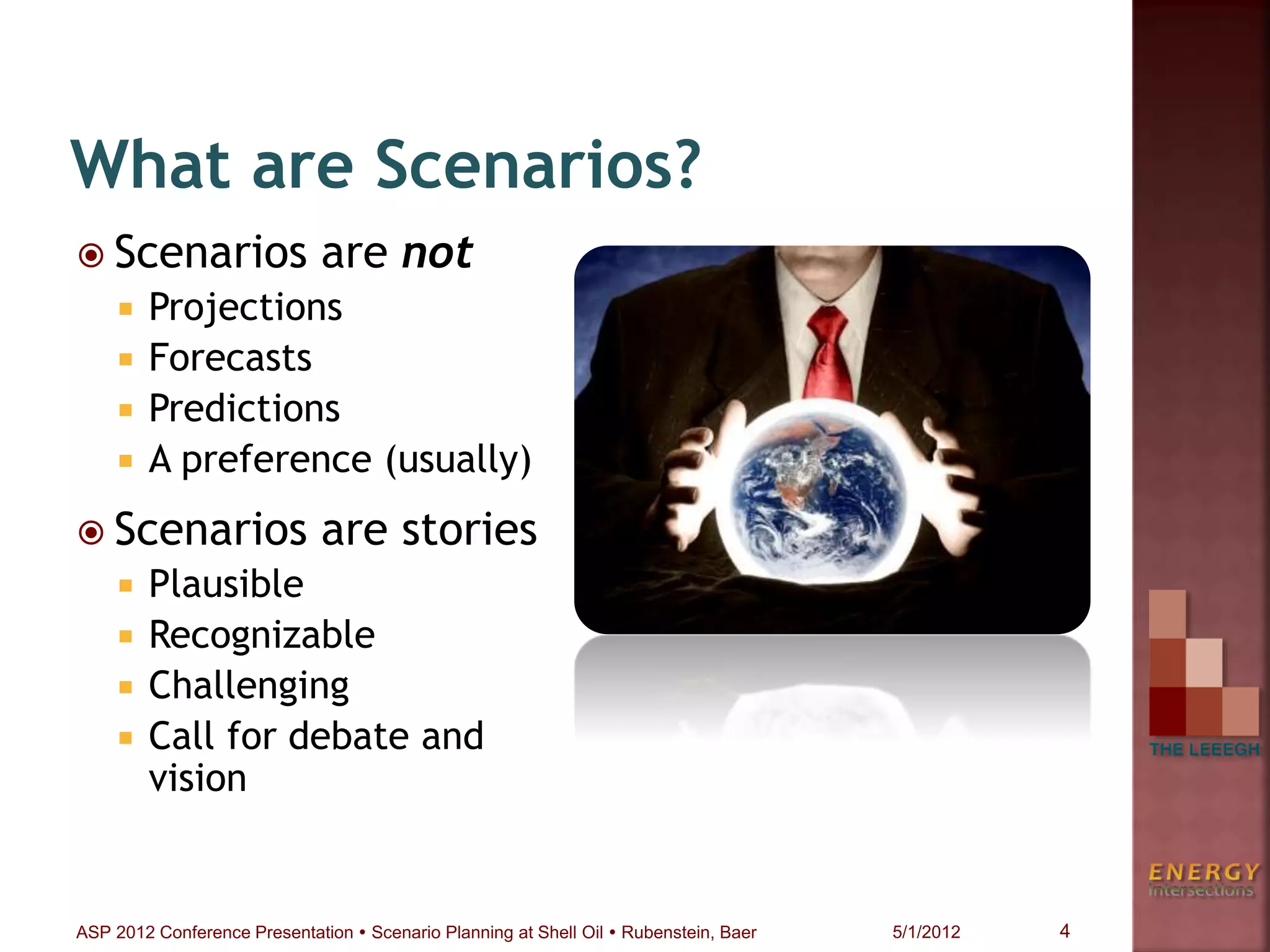
What are Scenarios?
 Scenarios are not
 Projections
 Forecasts
 Predictions
 A preference (usually)
 Scenarios are stories
 Plausible
 Recognizable
 Challenging
 Call for debate and
vision
4ASP 2012 Conference Presentation  Scenario Planning at Shell Oil  Rubenstein, Baer 5/1/2012
 Allow an organization to answer “What If?”
 Creates awareness of future possibilities
 Allows for response preparation
 Encourages engagement and discussion
 Diverse viewpoints are gathered
 Best ideas, practices are identified
 Permits deeper assessment of risk
 Economic
 Political
 Resource (energy)
Why Develop Scenarios?
5ASP 2012 Conference Presentation  Scenario Planning at Shell Oil  Rubenstein, Baer 5/1/2012
Shell’s Approach to
Scenarios
6ASP 2012 Conference Presentation  Scenario Planning at Shell Oil  Rubenstein, Baer 5/1/2012
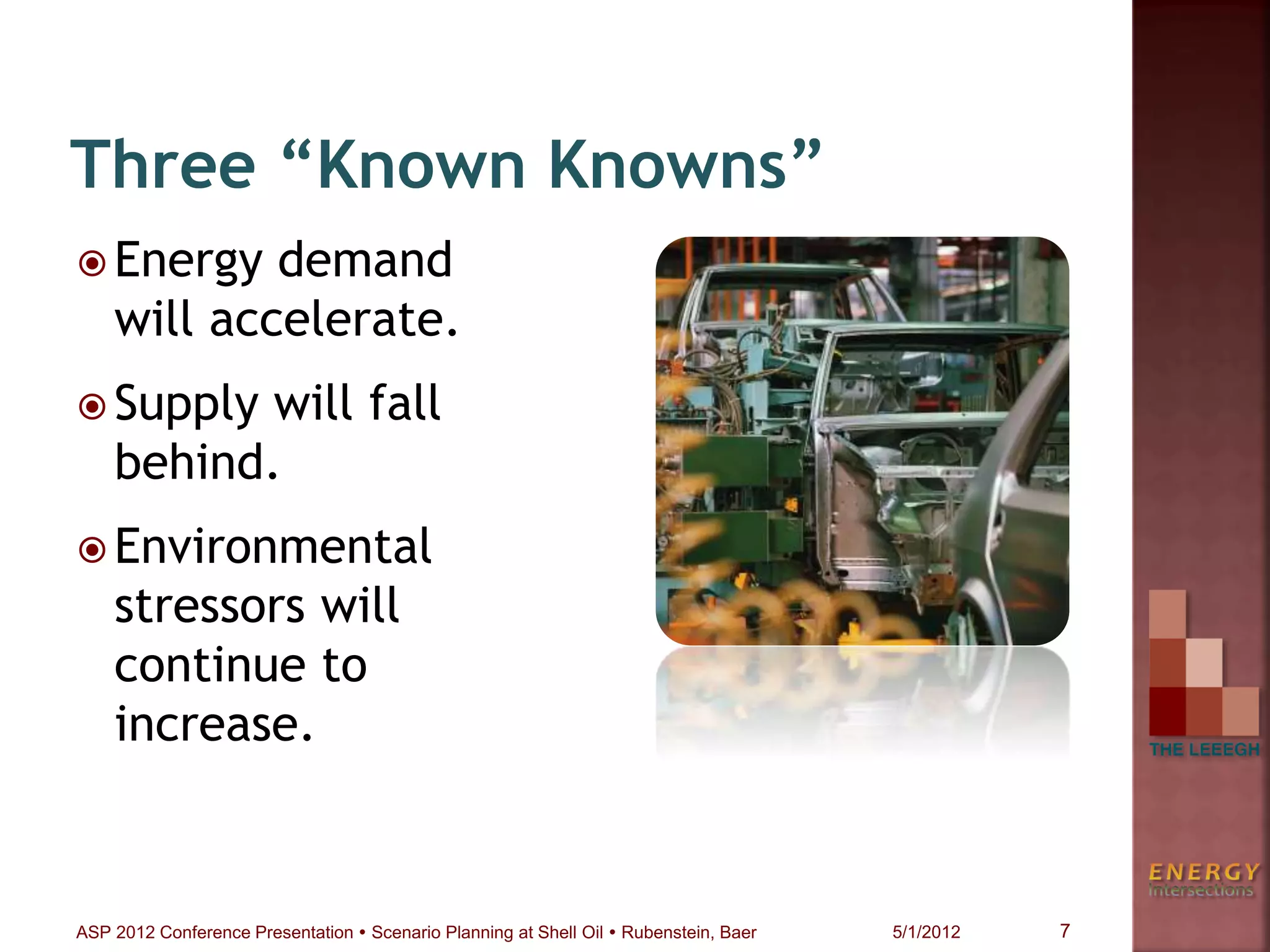
Three “Known Knowns”
 Energy demand
will accelerate.
 Supply will fall
behind.
 Environmental
stressors will
continue to
increase.
7ASP 2012 Conference Presentation  Scenario Planning at Shell Oil  Rubenstein, Baer 5/1/2012
 How will we respond to environmental
changes?
 What energy technologies will be deployed?
 Do the molecules exist to meet supply
without worsening environmental stressors?
 Are they technologically accessible?
 Are there political barriers to them?
Identify “Known Unknowns”
8ASP 2012 Conference Presentation  Scenario Planning at Shell Oil  Rubenstein, Baer 5/1/2012
 Scenarios show multiple paths to multiple
possible outcomes (more than one story is
required).
 Corollary: production of a scenarios does not
imply a probability of or preference for that
scenario (usually).
 Scenarios do not constitute mandates.
 Scenario planning does not tell you what to do.
 It tells you what the world around you might do.
 You can prepare and respond accordingly.
Two Keys to Scenario Development
9ASP 2012 Conference Presentation  Scenario Planning at Shell Oil  Rubenstein, Baer 5/1/2012
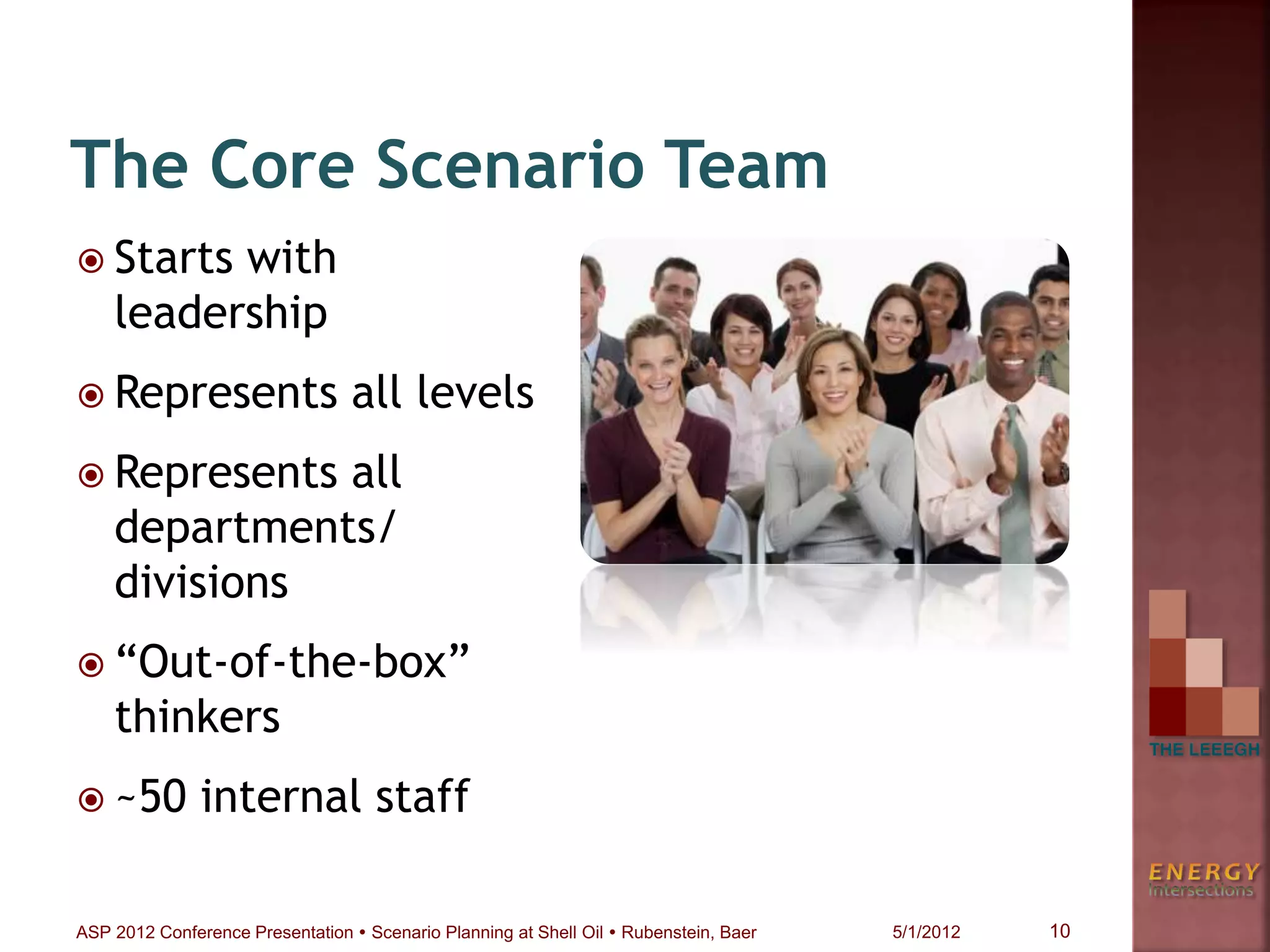
The Core Scenario Team
 Starts with
leadership
 Represents all levels
 Represents all
departments/
divisions
 “Out-of-the-box”
thinkers
 ~50 internal staff
10ASP 2012 Conference Presentation  Scenario Planning at Shell Oil  Rubenstein, Baer 5/1/2012
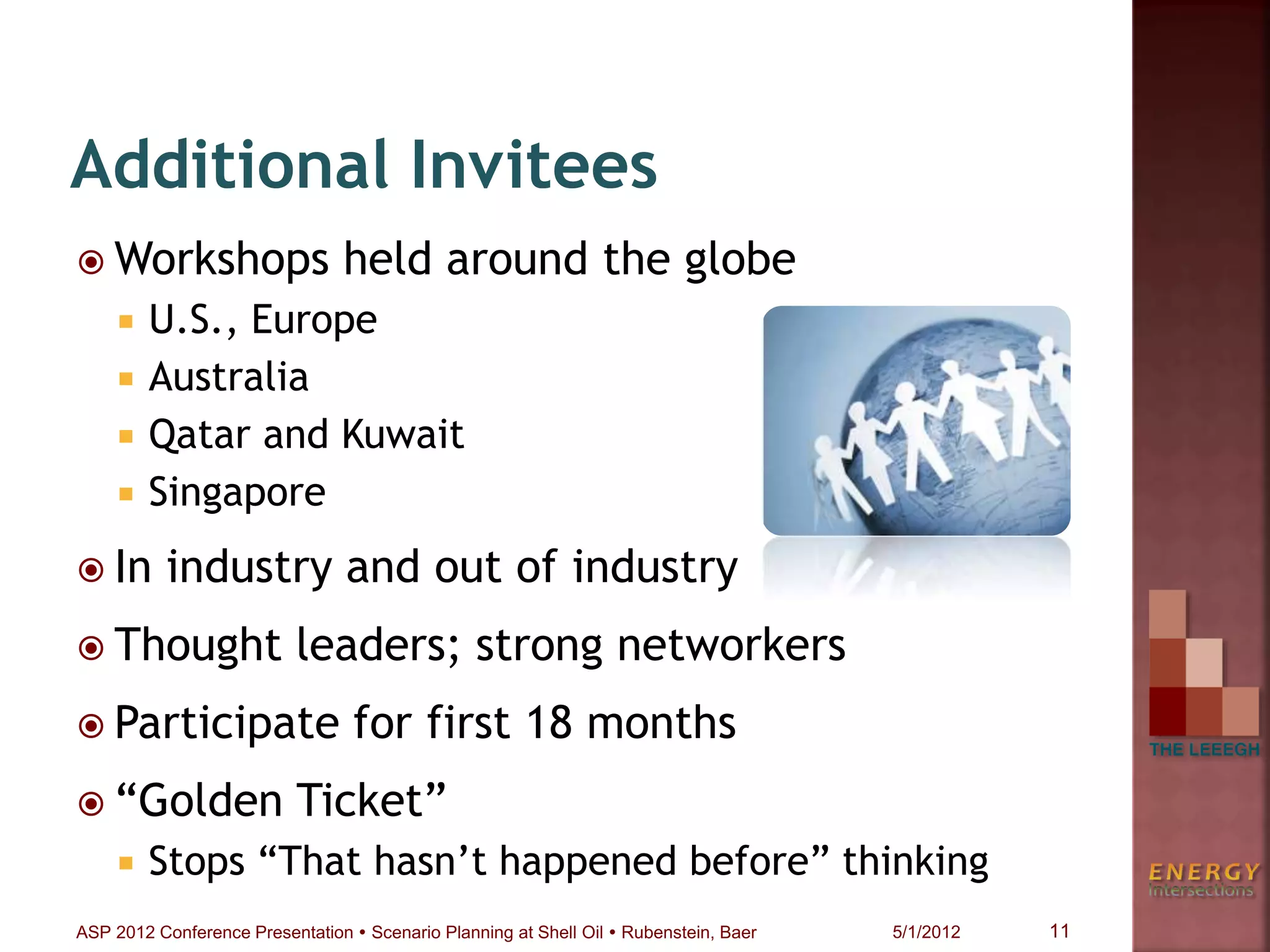
 Workshops held around the globe
 U.S., Europe
 Australia
 Qatar and Kuwait
 Singapore
 In industry and out of industry
 Thought leaders; strong networkers
 Participate for first 18 months
 “Golden Ticket”
 Stops “That hasn’t happened before” thinking
Additional Invitees
11ASP 2012 Conference Presentation  Scenario Planning at Shell Oil  Rubenstein, Baer 5/1/2012
 Ask, “What are we together to answer?”
 Create a replicable workshop process
 Gather existing data
 Workshop participants tell stories on data
 Fact check draft stories against data, models
 Identify the most consistent stories
 Brand final scenarios to aid assimilation
 Build strategies in response to the stories
The Process
12ASP 2012 Conference Presentation  Scenario Planning at Shell Oil  Rubenstein, Baer 5/1/2012
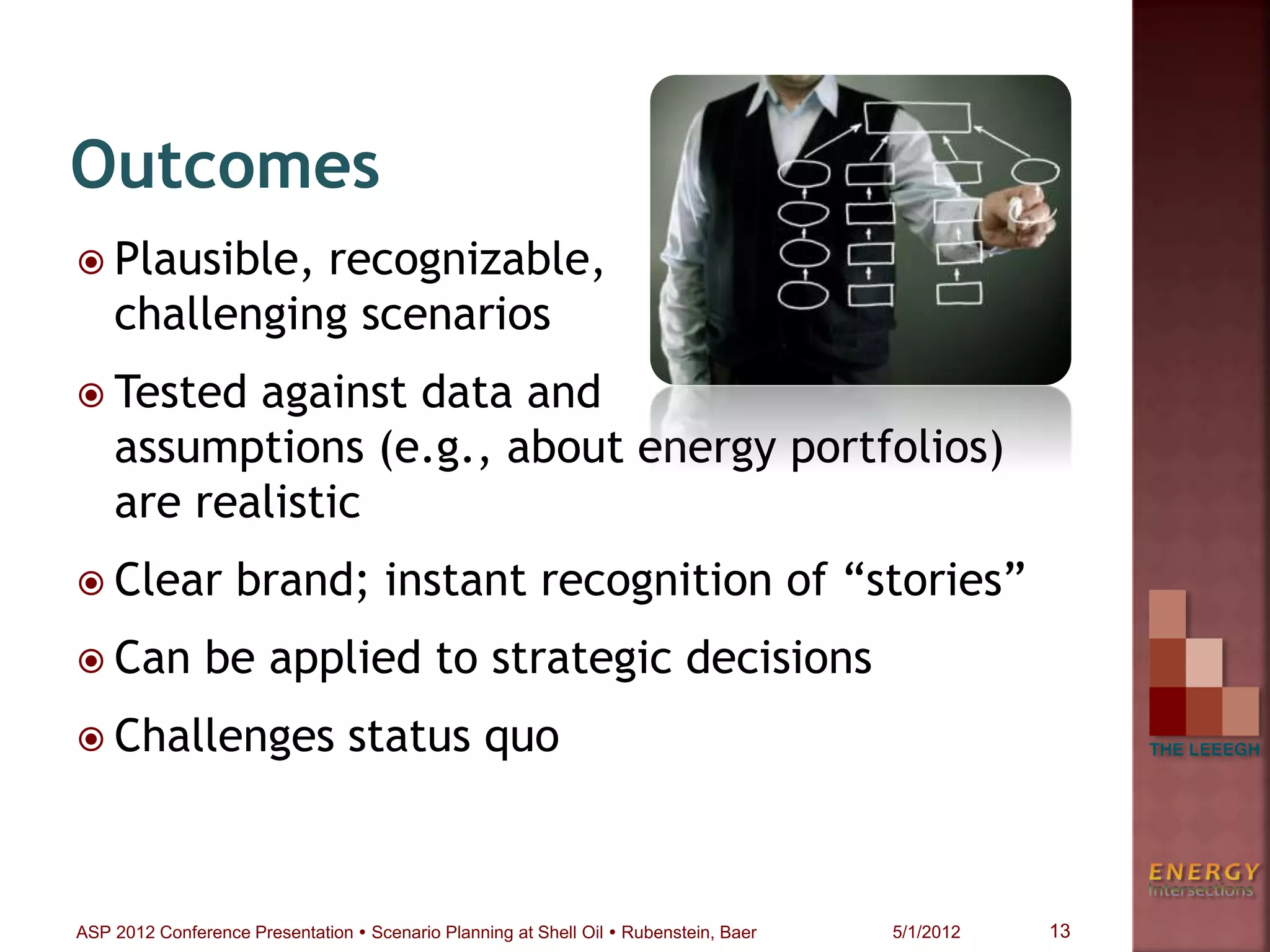
 Plausible, recognizable,
challenging scenarios
 Tested against data and
assumptions (e.g., about energy portfolios)
are realistic
 Clear brand; instant recognition of “stories”
 Can be applied to strategic decisions
 Challenges status quo
Outcomes
13ASP 2012 Conference Presentation  Scenario Planning at Shell Oil  Rubenstein, Baer 5/1/2012
Shell’s Current
Scenarios
Blueprints and Scramble
14ASP 2012 Conference Presentation  Scenario Planning at Shell Oil  Rubenstein, Baer 5/1/2012
Blueprints Scramble
See the three known knowns as a
challenge
Short term: overwhelmed by
known knowns
Focus: develop solution suites Focus: keep the lights on today
Leaders—starting local, mayors—
share best
Governments—due to supply/
demand, environment—become
nationalistic and competitive
A price on carbon evolves,
eventually globally
Focus on coal, “bad” biofuels:
independence, nationalism
Greater electrification of the
vehicle fleet
Electrification is largely
unpursued
Supply-demand gap, but
transition is relatively smooth
The gap between supply and
demand becomes painful
Highlights of Two Paths:
Blueprints & Scramble
15ASP 2012 Conference Presentation  Scenario Planning at Shell Oil  Rubenstein, Baer 5/1/2012
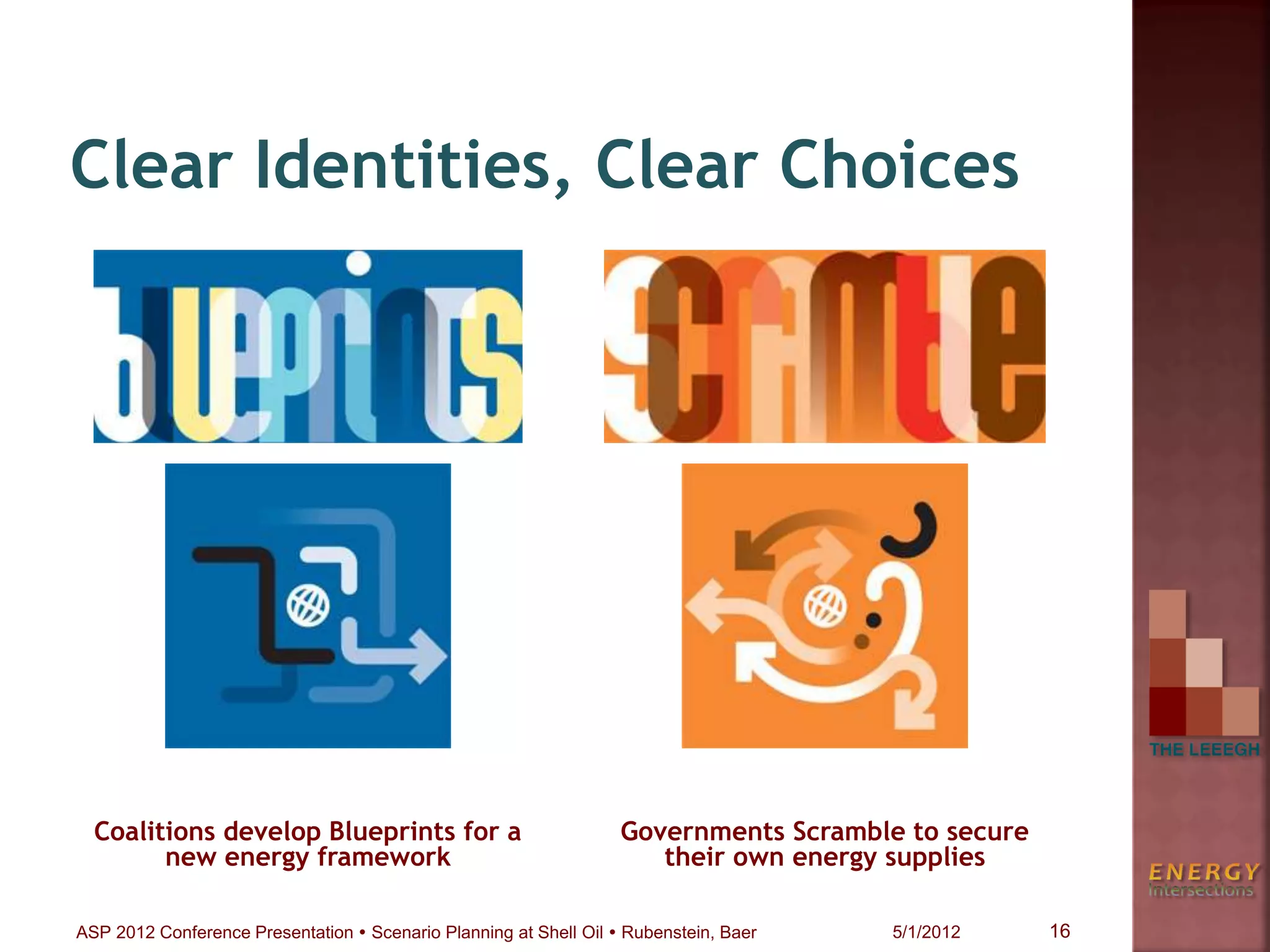
Clear Identities, Clear Choices
Coalitions develop Blueprints for a
new energy framework
Governments Scramble to secure
their own energy supplies
16ASP 2012 Conference Presentation  Scenario Planning at Shell Oil  Rubenstein, Baer 5/1/2012
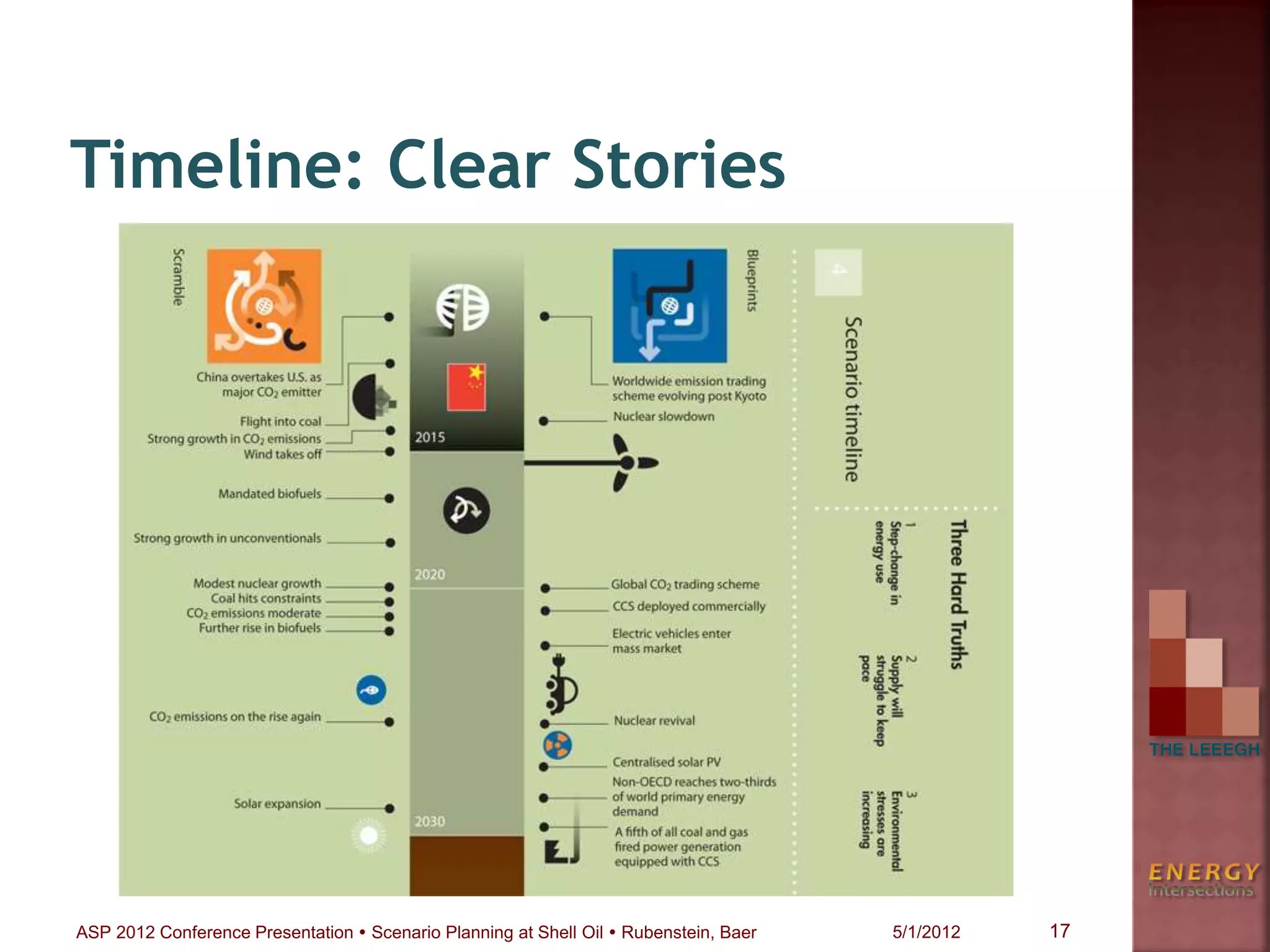
Timeline: Clear Stories
17ASP 2012 Conference Presentation  Scenario Planning at Shell Oil  Rubenstein, Baer 5/1/2012
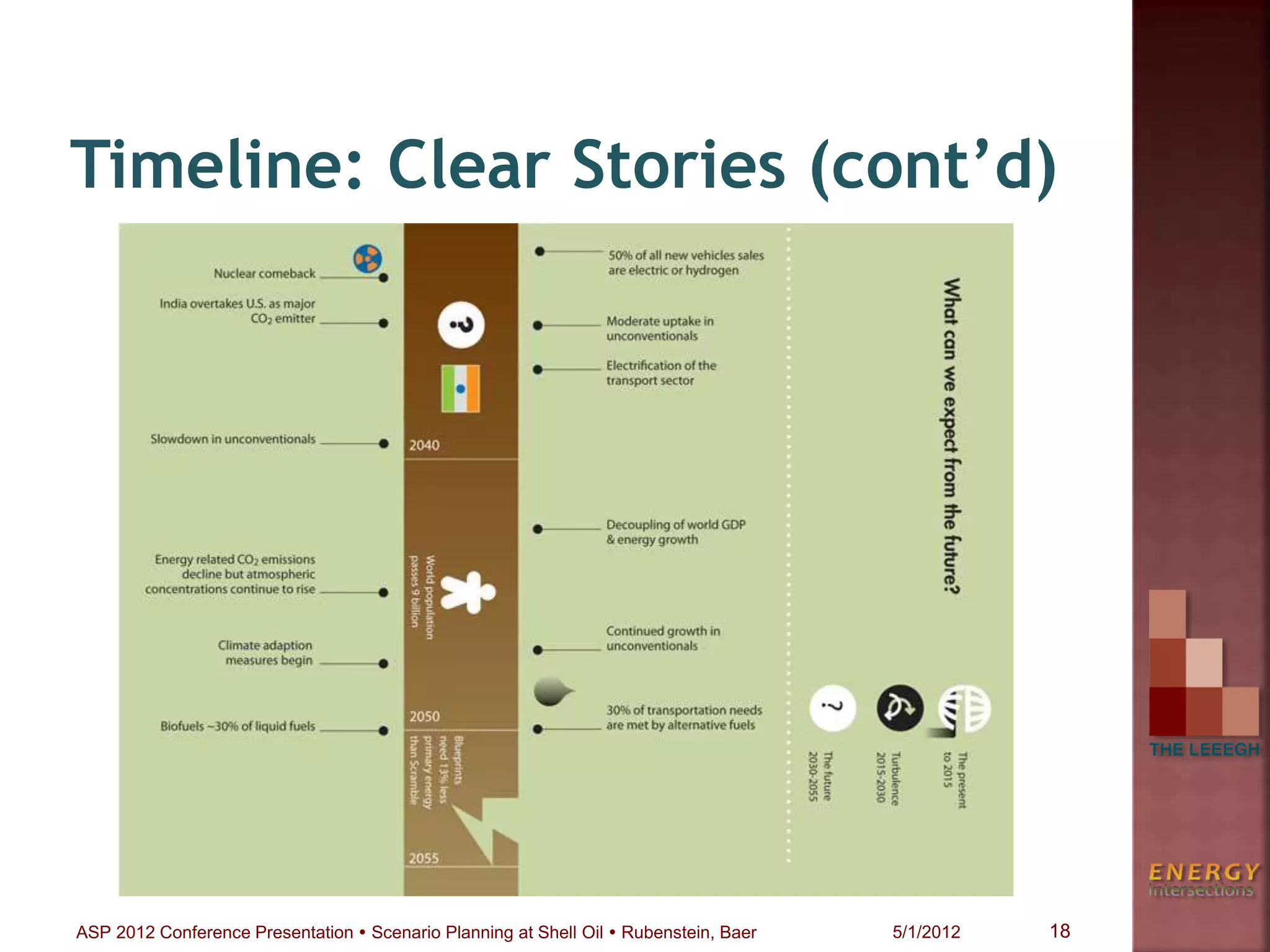
Timeline: Clear Stories (cont’d)
18ASP 2012 Conference Presentation  Scenario Planning at Shell Oil  Rubenstein, Baer 5/1/2012
How Shell Applies the
Energy Scenarios
Impacting Strategic Decisions
19ASP 2012 Conference Presentation  Scenario Planning at Shell Oil  Rubenstein, Baer 5/1/2012
 1970s oil Crisis
 Growth in unconventional natural gas
 Slow down in key market GDPs
 OPEC response to rising oil prices
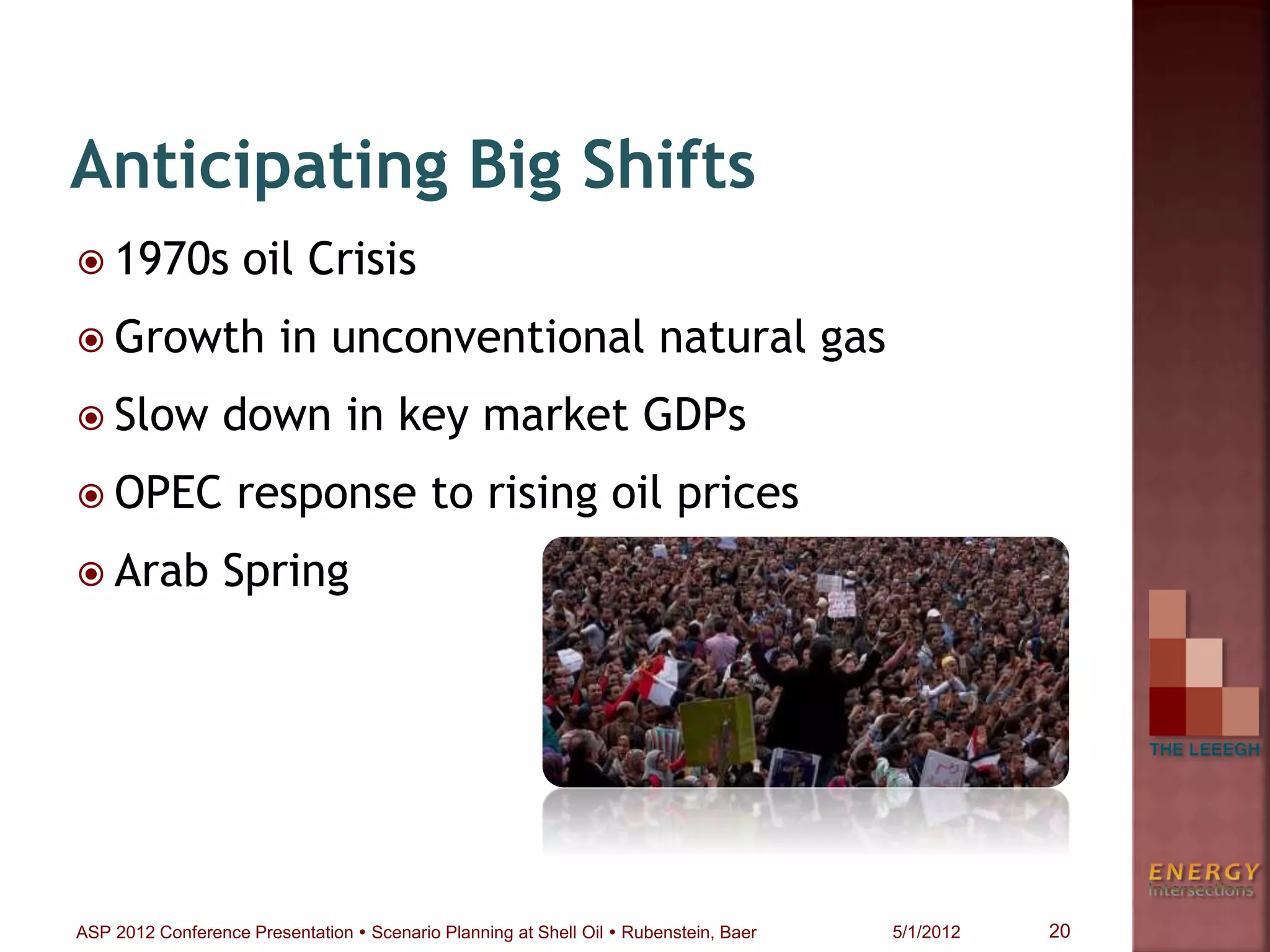
 Arab Spring
Anticipating Big Shifts
20ASP 2012 Conference Presentation  Scenario Planning at Shell Oil  Rubenstein, Baer 5/1/2012
 Pull out of Mackenzie (Alaska to lower 48)
pipline
 What will energy prices look like with/without?
 Sell large UK refinery
 A First: Shell actively prefers “Blueprints”
and is pursue strategies to move markets in
that direction
Apply Scenarios to Strategy
21ASP 2012 Conference Presentation  Scenario Planning at Shell Oil  Rubenstein, Baer 5/1/2012
Embarking on Scenario
Planning
22ASP 2012 Conference Presentation  Scenario Planning at Shell Oil  Rubenstein, Baer 5/1/2012
 Spectrum of voices; events inside and outside of industry
 Clear budgets, timelines, personnel; support from the top
 Information flows in all directions; continually collect data
 Number of scenarios for your purpose, from draft stories
 Shell typically produces two
 IHS operates with three: Global Redesign, Metamorphosis
Vortex
 Determine the audience of your scenario products
 Internal market
 Public (value add?)
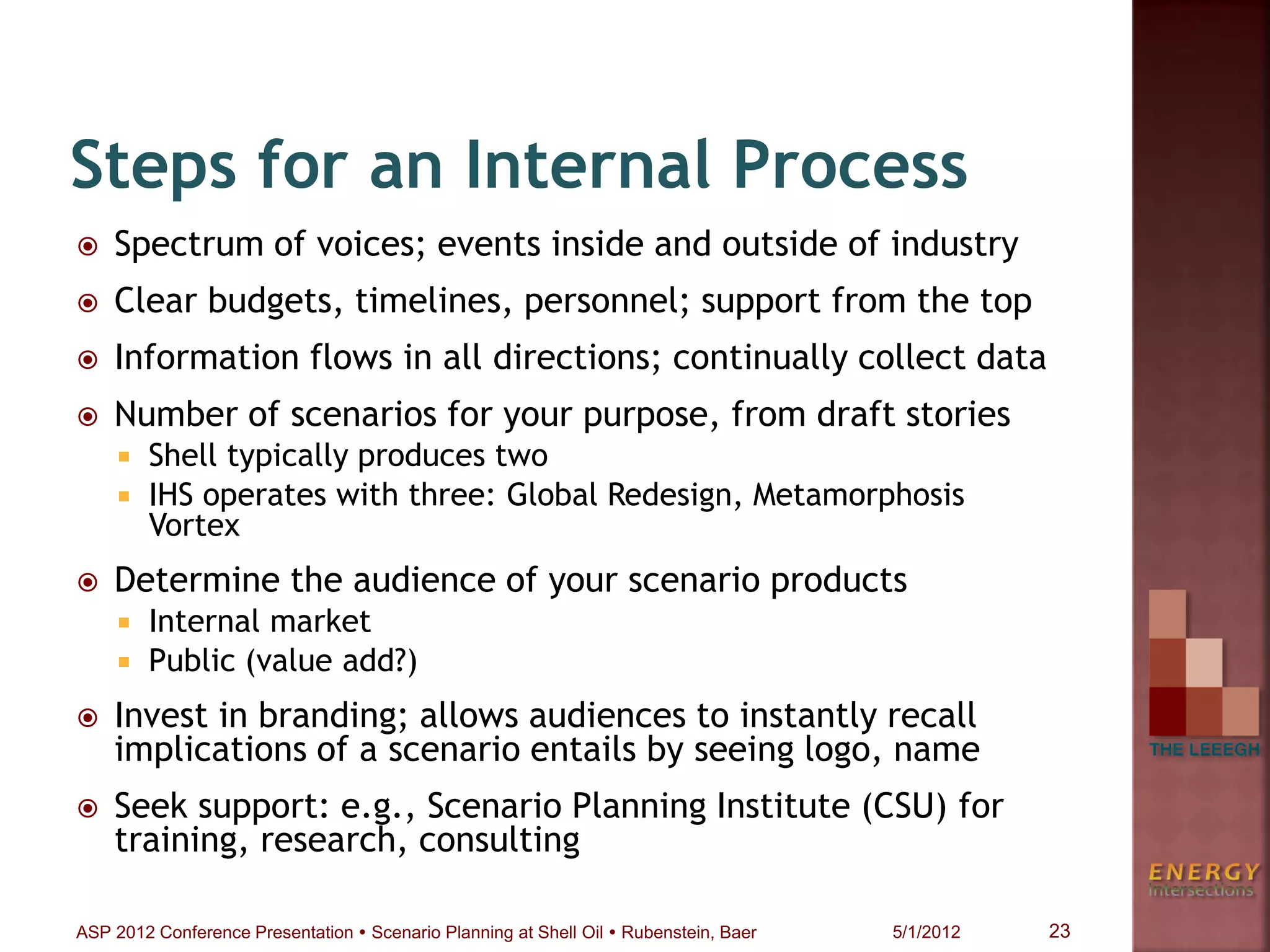
 Invest in branding; allows audiences to instantly recall
implications of a scenario entails by seeing logo, name
 Seek support: e.g., Scenario Planning Institute (CSU) for
training, research, consulting
Steps for an Internal Process
23ASP 2012 Conference Presentation  Scenario Planning at Shell Oil  Rubenstein, Baer 5/1/2012
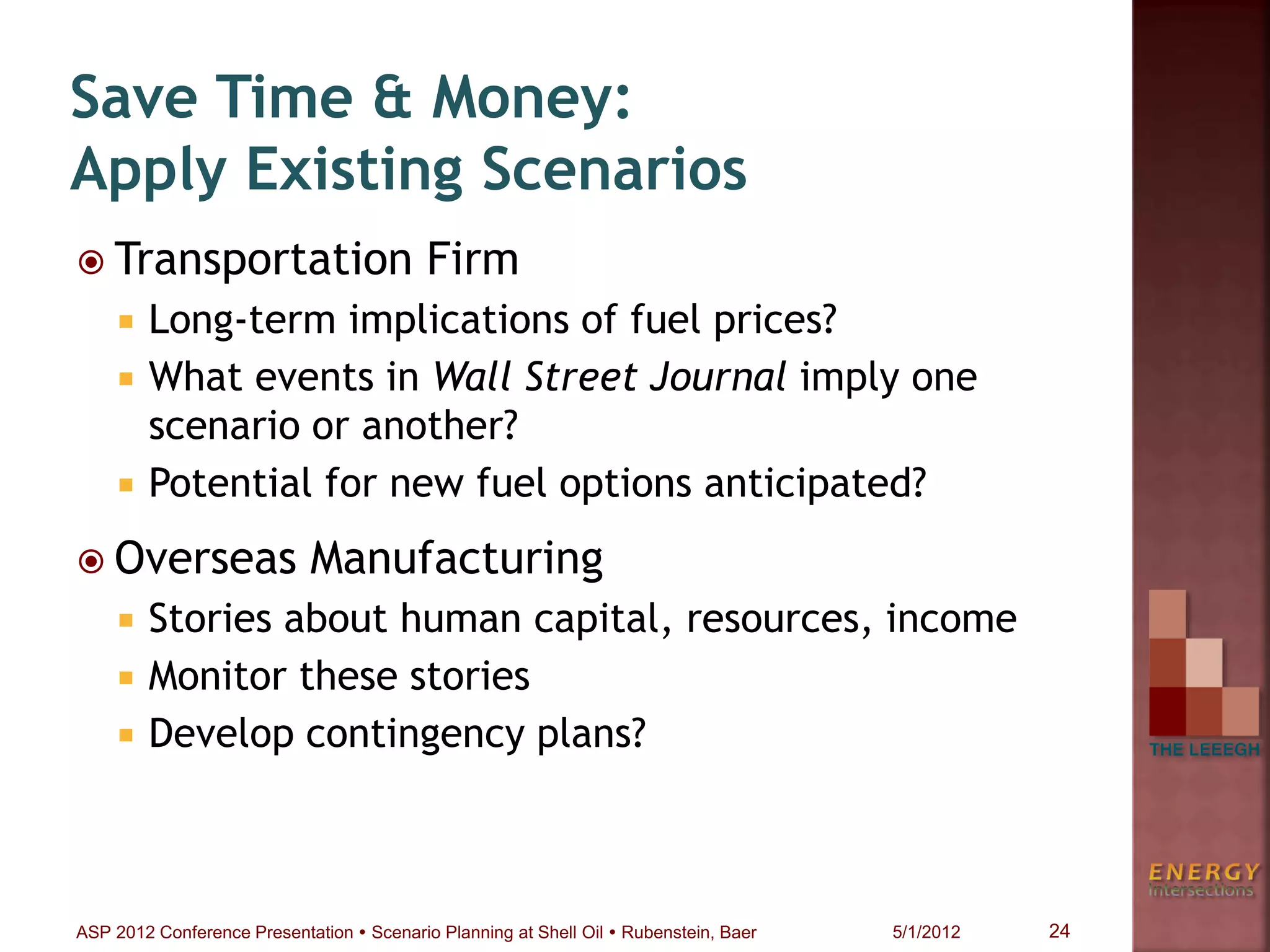
 Transportation Firm
 Long-term implications of fuel prices?
 What events in Wall Street Journal imply one
scenario or another?
 Potential for new fuel options anticipated?
 Overseas Manufacturing
 Stories about human capital, resources, income
 Monitor these stories
 Develop contingency plans?
Save Time & Money:
Apply Existing Scenarios
24ASP 2012 Conference Presentation  Scenario Planning at Shell Oil  Rubenstein, Baer 5/1/2012
 Plausible, recognizable, yet challenging stories
 Well researched and verified with data
 Based on today’s realities
 Describe potential realistic, unfolding realities
 High stakes stories
 Guiding the allocation of billions and trillions of
dollars
 Describe multiple possible future realities
 Need multiple pathways
 Result in multiple scenarios
 Might end up “bracketing” reality (e.g., Shell’s
“Recession & Recovery)
Scenarios: Vision for Value
5/1/2012 25ASP 2012 Conference Presentation Scenario Planning at Shell Oil Rubenstein, Baer
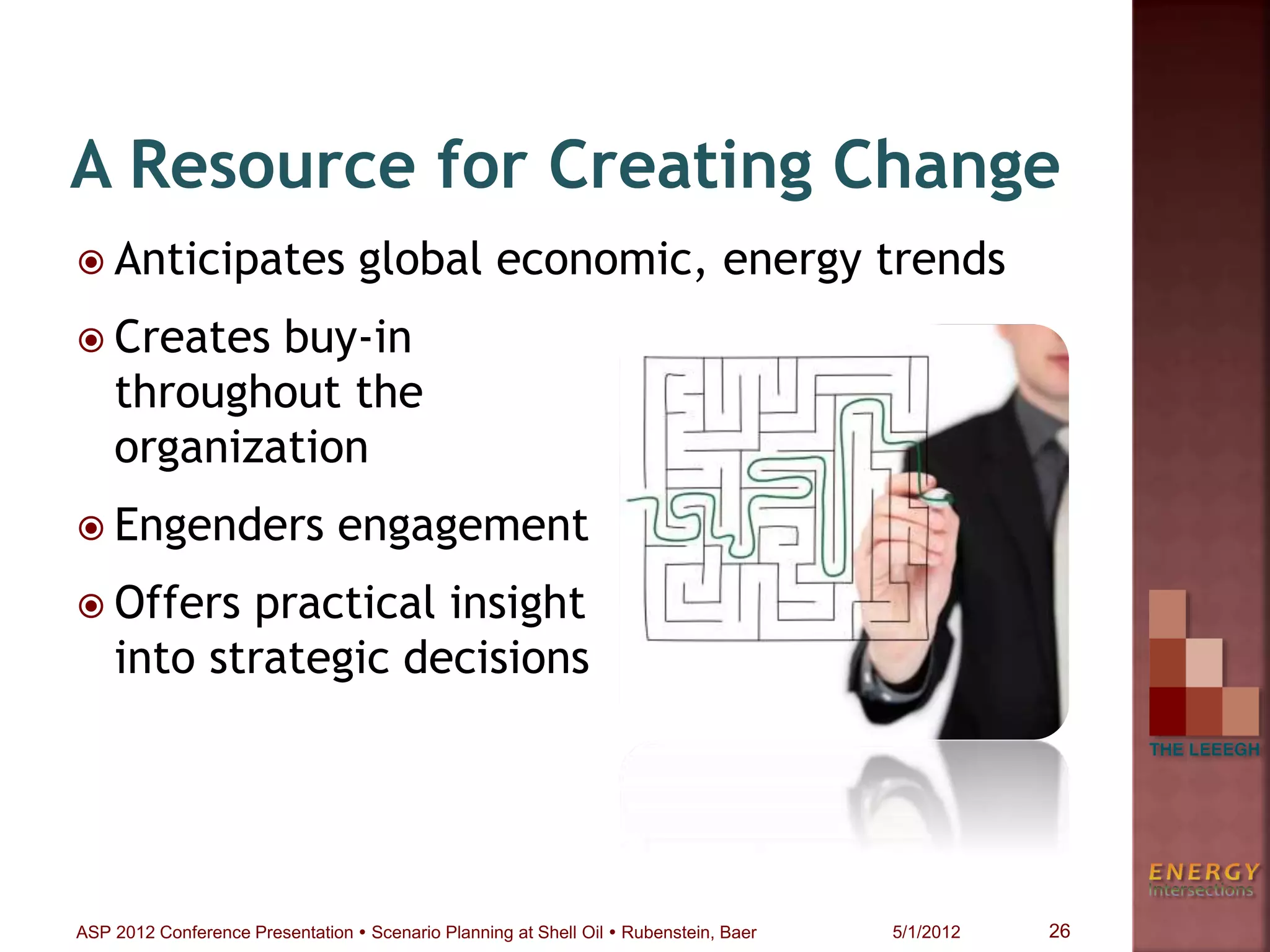
 Anticipates global economic, energy trends
 Creates buy-in
throughout the
organization
 Engenders engagement
 Offers practical insight
into strategic decisions
A Resource for Creating Change
26ASP 2012 Conference Presentation  Scenario Planning at Shell Oil  Rubenstein, Baer 5/1/2012
Thank you!
Questions? Contact Us:
Leslie Martel Baer
Energy Intersections  303.377.5006
leslie.baer@energyintersections.com
Herb Rubenstein
The LEEEGH  303.592.4084
herb@sbizgroup.com
www.theleeegh.org
www.sbizgroup.com
www.leadershipforeducators.org
www.leadershipforlawyers.org
27

What Can We Learn from Scenario Planning at Shell Oil

  • 1.
    What We CanLearn from Scenario Planning at Shell Oil Leslie Martel Baer President, Energy Intersections, LLC Herb Rubenstein Executive Director, The LEEEGH ASP 2012 1
  • 2.
     Global EnergyManagement (GEM) Program Business School University of Colorado, Denver  Peter Snowdon Head of Communications Shell Chemicals  Cintia Gavay Senior Research Analyst Global Energy Modeling IHS Acknowledgements 2ASP 2012 Conference Presentation  Scenario Planning at Shell Oil  Rubenstein, Baer 5/1/2012
  • 3.
    Today’s Presenters Leslie MartelBaer  President, Energy Intersections  Research, analysis, strategic planning  Energy Intersections blog  Strategy  Cross-sector collaboration  Experience  business management, communications, and project management  renewable energy, socially responsible investing and materials recovery industries.  Education  MS, Global Energy Management, CU Denver, Business School  MA, English, University of Michigan.  BA, biochemistry, CU Boulder Herb Rubenstein  Executive Director, THE LEEEGH,  Non-profit  “Leadership in education, energy, environment, governance and health”  President, Sustainable Business Group  consulting firm to businesses  Adjunct professor of strategic management, Global Energy Management, CU Denver  Founder of the Colorado Chapter, Association for Strategic Planning  Member of the national board of directors of ASP  Author  Breakthrough, Inc.: High Growth Strategies for Entrepreneurial Organizations,  Leadership Development for Educators  Leadership for Lawyers  Over 100 articles and over 80 videos on business strategy, entrepreneurship, leadership, and improving organizations 3ASP 2012 Conference Presentation  Scenario Planning at Shell Oil  Rubenstein, Baer 5/1/2012
  • 4.
    What are Scenarios? Scenarios are not  Projections  Forecasts  Predictions  A preference (usually)  Scenarios are stories  Plausible  Recognizable  Challenging  Call for debate and vision 4ASP 2012 Conference Presentation  Scenario Planning at Shell Oil  Rubenstein, Baer 5/1/2012
  • 5.
     Allow anorganization to answer “What If?”  Creates awareness of future possibilities  Allows for response preparation  Encourages engagement and discussion  Diverse viewpoints are gathered  Best ideas, practices are identified  Permits deeper assessment of risk  Economic  Political  Resource (energy) Why Develop Scenarios? 5ASP 2012 Conference Presentation  Scenario Planning at Shell Oil  Rubenstein, Baer 5/1/2012
  • 6.
    Shell’s Approach to Scenarios 6ASP2012 Conference Presentation  Scenario Planning at Shell Oil  Rubenstein, Baer 5/1/2012
  • 7.
    Three “Known Knowns” Energy demand will accelerate.  Supply will fall behind.  Environmental stressors will continue to increase. 7ASP 2012 Conference Presentation  Scenario Planning at Shell Oil  Rubenstein, Baer 5/1/2012
  • 8.
     How willwe respond to environmental changes?  What energy technologies will be deployed?  Do the molecules exist to meet supply without worsening environmental stressors?  Are they technologically accessible?  Are there political barriers to them? Identify “Known Unknowns” 8ASP 2012 Conference Presentation  Scenario Planning at Shell Oil  Rubenstein, Baer 5/1/2012
  • 9.
     Scenarios showmultiple paths to multiple possible outcomes (more than one story is required).  Corollary: production of a scenarios does not imply a probability of or preference for that scenario (usually).  Scenarios do not constitute mandates.  Scenario planning does not tell you what to do.  It tells you what the world around you might do.  You can prepare and respond accordingly. Two Keys to Scenario Development 9ASP 2012 Conference Presentation  Scenario Planning at Shell Oil  Rubenstein, Baer 5/1/2012
  • 10.
    The Core ScenarioTeam  Starts with leadership  Represents all levels  Represents all departments/ divisions  “Out-of-the-box” thinkers  ~50 internal staff 10ASP 2012 Conference Presentation  Scenario Planning at Shell Oil  Rubenstein, Baer 5/1/2012
  • 11.
     Workshops heldaround the globe  U.S., Europe  Australia  Qatar and Kuwait  Singapore  In industry and out of industry  Thought leaders; strong networkers  Participate for first 18 months  “Golden Ticket”  Stops “That hasn’t happened before” thinking Additional Invitees 11ASP 2012 Conference Presentation  Scenario Planning at Shell Oil  Rubenstein, Baer 5/1/2012
  • 12.
     Ask, “Whatare we together to answer?”  Create a replicable workshop process  Gather existing data  Workshop participants tell stories on data  Fact check draft stories against data, models  Identify the most consistent stories  Brand final scenarios to aid assimilation  Build strategies in response to the stories The Process 12ASP 2012 Conference Presentation  Scenario Planning at Shell Oil  Rubenstein, Baer 5/1/2012
  • 13.
     Plausible, recognizable, challengingscenarios  Tested against data and assumptions (e.g., about energy portfolios) are realistic  Clear brand; instant recognition of “stories”  Can be applied to strategic decisions  Challenges status quo Outcomes 13ASP 2012 Conference Presentation  Scenario Planning at Shell Oil  Rubenstein, Baer 5/1/2012
  • 14.
    Shell’s Current Scenarios Blueprints andScramble 14ASP 2012 Conference Presentation  Scenario Planning at Shell Oil  Rubenstein, Baer 5/1/2012
  • 15.
    Blueprints Scramble See thethree known knowns as a challenge Short term: overwhelmed by known knowns Focus: develop solution suites Focus: keep the lights on today Leaders—starting local, mayors— share best Governments—due to supply/ demand, environment—become nationalistic and competitive A price on carbon evolves, eventually globally Focus on coal, “bad” biofuels: independence, nationalism Greater electrification of the vehicle fleet Electrification is largely unpursued Supply-demand gap, but transition is relatively smooth The gap between supply and demand becomes painful Highlights of Two Paths: Blueprints & Scramble 15ASP 2012 Conference Presentation  Scenario Planning at Shell Oil  Rubenstein, Baer 5/1/2012
  • 16.
    Clear Identities, ClearChoices Coalitions develop Blueprints for a new energy framework Governments Scramble to secure their own energy supplies 16ASP 2012 Conference Presentation  Scenario Planning at Shell Oil  Rubenstein, Baer 5/1/2012
  • 17.
    Timeline: Clear Stories 17ASP2012 Conference Presentation  Scenario Planning at Shell Oil  Rubenstein, Baer 5/1/2012
  • 18.
    Timeline: Clear Stories(cont’d) 18ASP 2012 Conference Presentation  Scenario Planning at Shell Oil  Rubenstein, Baer 5/1/2012
  • 19.
    How Shell Appliesthe Energy Scenarios Impacting Strategic Decisions 19ASP 2012 Conference Presentation  Scenario Planning at Shell Oil  Rubenstein, Baer 5/1/2012
  • 20.
     1970s oilCrisis  Growth in unconventional natural gas  Slow down in key market GDPs  OPEC response to rising oil prices  Arab Spring Anticipating Big Shifts 20ASP 2012 Conference Presentation  Scenario Planning at Shell Oil  Rubenstein, Baer 5/1/2012
  • 21.
     Pull outof Mackenzie (Alaska to lower 48) pipline  What will energy prices look like with/without?  Sell large UK refinery  A First: Shell actively prefers “Blueprints” and is pursue strategies to move markets in that direction Apply Scenarios to Strategy 21ASP 2012 Conference Presentation  Scenario Planning at Shell Oil  Rubenstein, Baer 5/1/2012
  • 22.
    Embarking on Scenario Planning 22ASP2012 Conference Presentation  Scenario Planning at Shell Oil  Rubenstein, Baer 5/1/2012
  • 23.
     Spectrum ofvoices; events inside and outside of industry  Clear budgets, timelines, personnel; support from the top  Information flows in all directions; continually collect data  Number of scenarios for your purpose, from draft stories  Shell typically produces two  IHS operates with three: Global Redesign, Metamorphosis Vortex  Determine the audience of your scenario products  Internal market  Public (value add?)  Invest in branding; allows audiences to instantly recall implications of a scenario entails by seeing logo, name  Seek support: e.g., Scenario Planning Institute (CSU) for training, research, consulting Steps for an Internal Process 23ASP 2012 Conference Presentation  Scenario Planning at Shell Oil  Rubenstein, Baer 5/1/2012
  • 24.
     Transportation Firm Long-term implications of fuel prices?  What events in Wall Street Journal imply one scenario or another?  Potential for new fuel options anticipated?  Overseas Manufacturing  Stories about human capital, resources, income  Monitor these stories  Develop contingency plans? Save Time & Money: Apply Existing Scenarios 24ASP 2012 Conference Presentation  Scenario Planning at Shell Oil  Rubenstein, Baer 5/1/2012
  • 25.
     Plausible, recognizable,yet challenging stories  Well researched and verified with data  Based on today’s realities  Describe potential realistic, unfolding realities  High stakes stories  Guiding the allocation of billions and trillions of dollars  Describe multiple possible future realities  Need multiple pathways  Result in multiple scenarios  Might end up “bracketing” reality (e.g., Shell’s “Recession & Recovery) Scenarios: Vision for Value 5/1/2012 25ASP 2012 Conference Presentation Scenario Planning at Shell Oil Rubenstein, Baer
  • 26.
     Anticipates globaleconomic, energy trends  Creates buy-in throughout the organization  Engenders engagement  Offers practical insight into strategic decisions A Resource for Creating Change 26ASP 2012 Conference Presentation  Scenario Planning at Shell Oil  Rubenstein, Baer 5/1/2012
  • 27.
    Thank you! Questions? ContactUs: Leslie Martel Baer Energy Intersections  303.377.5006 leslie.baer@energyintersections.com Herb Rubenstein The LEEEGH  303.592.4084 herb@sbizgroup.com www.theleeegh.org www.sbizgroup.com www.leadershipforeducators.org www.leadershipforlawyers.org 27

Editor's Notes

  • #2 Intro by Herb
  • #3 Thank ASP, everyone here. Last December, I was one of several students in the University of Colorado Denver Business School Global Energy Management Program’s International Course, which was a unique opportunity to meet in a small group setting with key personnel from across the energy value chain on their home turf in the London area. One of the people with whom we met was Peter Snowdon, Head of Communications at Shell Chemicals in the U.K. and one of the people deeply involved in their scenario planning process. Peter walked us through Shell’s process as well as the most recent iteration of their energy scenarios, and we’ll summarize that information here today. During that trip we also had the opportunity meet with staff from IHS, at which time Cintia Gavay walked us through IHS’s scenarios, allowing us to introduce a cursory comparison here. Thank you to all of the orgs.
  • #4 Scan Energy newbie, long-time strategist Herb – knows lots about strategy, energy industries, ribbons Fascinated by scenario planning Who’s in the room? I let you scan through these mini bios on myself and Herb to get a feel for whose up here today. I think the key take-away for me is that – other than my recent MS and extensive pro bono work for renewable energy industry associations, I’m a newbie in energy. But, what I discovered through the degree is that I’ve been providing strategic planning in space within or near to energy for a very long time… I just didn’t know enough to call it that, so it was either indiscriminately ignored at my client’s peril or was gladly obtained by other clients at absurdly low fees. In regard to Herb, you’ll want to know that this guy knows a tremendous amount about both strategic planning and the energy industries – not to mention he is a very entertaining speaker – so you have to get through me hear all of the valuable things Herb has to say. I do think it is safe to say that both of us are fascinated by scenario planning, take it very seriously and believe deeply that it is a powerful tool – whether you are generating your own scenarios in house or adapting those of other firm’s, like Shell’s to your own use. So, who is in the room today? How many of you have professional experience with scenario planning? How many have explored the concept? How many are here to explore it for the first time?
  • #5 Ask for definition What they are not What they are Exceptional stories: data, modeling, diverse views Allocations for staff, schedules, budget: but they will tell you that the recession and the Arab Spring are coming Would anyone here like give me their definition of scenarios – we’ll get to the why we conduct scenario planning in a minute…. Okay, great… we seem to be on the same page here; we’re employing similar vocabulary: they are not projections or forecasts and MOST of the time they do not express a preference by the team that develops them, although we will see an exception to that later; they do need to be plausible, recognizable, challenging stories that demand debate and vision from the developers. And, these are exceptional stories, requiring a great deal of data modeling, fact checking and input from both inside and outside the firm to develop, with narratives developed to fit the facts and the remodeled and adjusted to fit again – which means they require allocations for scheduling, personnel and budget. Stories that help you see the potential of an Arab Spring or a global recession.
  • #6 Ask “Why” Scenario planning? Ask & answer “what if” Energy producers and energy consumers often have to make 20 or 30 year decisions mid-continent natural gas producer… do you make a long term contract? Infrastructure? Regulation? Chemical company? Where does the plant go? Diverse viewpoints; helps best practices to pop out – talk to the people on shop floor. Leads to deeper understanding of economic, political and resource risks and opportunities So, now, let’s get to that “why” issue: who has some thoughts as to why a firm may want to conduct scenario planning? Good, good… let’s roll with that: the process itself allows a firm to ask and answer “What if” questions about those potential combinations and pathways. For example, what if mid-continent natural gas prices stay low but prices start to rebound on the coasts? If you are a smaller producer in Colorado, would it make sense for you to join make a 30-year investment with competitors in infrastructure to move your product out? Or, is the risk of long-term regulation of hydraulic fracturing likely to make long-term production to cost prohibitive? And, what happens long term to those coastal markets if you make that investment or that regulation is or is not implemented? Or, what if you are a chemical company: does it make sense to site a new facility near one of the gas plays that is producing at low cost to obtain a cheap feedstock? Or, do you want to invest in that long term infrastructure? And, of course, these types of questions are being answered Because the process demands broad engagement and discussion in order to produce viable scenarios – remember, these are plausible, reliable and challenging stories about the future – it will inherently require the gather of diverse viewpoints. It will also help make best practices from the people “on the shop floor,” so to speak, pop out. The scenario planning team can begin to collect these practices, gathering them together for future analysis application. Overall, what a company should expect from conducting scenario planning – either from scratch or by applying a third-party’s scenarios (like Shell’s) to their own interests and circumstances – is to have a much deeper assessment of the opportunities and risks ahead with respect to economics, politics and resources.
  • #7 Established the sense of what scenarios are and their benefits Look at how Shell does it Arguably, most robust and comprehensive set of scenarios Publicly available Good tool for understanding scenarios Useful to apply to own firm So, given what scenarios are in a broad sense and what benefits a firm might expect from conducting scenario planning, let’s take a closer look at how Shell goes about doing this. Shell, arguably, produces some of the most comprehensive sets of scenarios, and they publish the fundamental findings of those scenarios, so they are a great resource to both understand and apply.
  • #8 When Shell team sits down – talk about team in a minute They establish known knowns Doing this for energy scenarios, related to but more focused than global scenarios These three How do they know? The automotive assembly line: everybody wants it (iconic) Development hockey stick of energy use (IHS graphs, BRIC) – demand and impacts on supply Yes, alternatives are coming, but most are not here We’ll use fossil fuels for many years, so carbon emissions will rise, global warming will advance, environmental impacts continue w/ the economic implications that brings Well established known knowns understood and accepted by the industry Crucial foundation for scenario planning process for your industry or company, as Diane Meister said yesterday When the Shell team sits down to generate the next iteration of scenarios – and we’ll get to the make up of that team in a minute – they begin by establishing a set of “known knowns” to which they can all agree. For their most recent energy scenarios – and, keep in mind that Shell’s energy scenarios are essentially a subsidiary product of their global scenarios, the later taking into account political activities, cultural shifts and so on – so for their energy scenarios, they determined that the team definitively knew three things: energy demand will accelerate, supply will fall behind, environmental stressors will continue to increase. I’m showing an automobile assembly line because it is iconically representative of what this century will be about and what that means for business: everybody wants this. The entire world wants what Americans and other developed countries have. Each person wants to have a car and the independence to go where they what when they want. They want the economic and energy freedom to buy what they want, use whatever technology they want, just like we do. IHS, whom will discuss a little more later, has produced some astonishing graphs about how energy use changes as countries hit the development hockey stick. The implications for energy supply and demand are phenomenal, particularly as we watch the BRIC countries approach the angle in the stick. And, right now, we have a wide array of alternative technologies in the pipeline to help us eventually meet the demand – from increased efficiency to new fuels and new generation sources – but most of them are not truly ready today. That means we will remain enormously dependent on fossil fuels for many years to come. That means that carbon emissions will continue to rise and global warming will continue to progress, resulting in increasing environmental impacts that bear with them economic effects. (scientific paradigm.) So, that’s how Shell can rely on these “known knowns” – they are pretty well understood and accepted within the industry, based on economic and resource modeling, for example. It is equally important for your team to start with the relevant known knowns for your industry; maybe it’s these, maybe it’s something else.
  • #9 Obviously, the next step is identifying the known unknowns… Representative list Environment What will companies do (Duke energy) What will countries do (local, national, international – 2/3 of US population lives under an RPS) Look at past responses to crises, existing plans, proposed plans, public sentiment Technology Could be efficiency (51/49; RMI/BMW – carbon fiber car bodies) Look at what’s in the pipeline, “Moore’s Law” Molecules Can we find or make them? Can we get to them (tech/econ) Can we get to them (political; France, Germany) Look at the past; model the future Collect data around these questions, do the modeling where needed, start developing the stories. So, once they’ve laid out what they know, the Shell team looks what they know they don’t know. In this case, the list is pretty darn long, but much of it is quickly identifiable. These questions represent just a short list of some of the key known unknowns. Obviously, Shell can’t predict exactly how companies and countries – on the local, national and international levels – will respond to our environmental challenges. However, they can examine past action, proposed action, public sentiment, historical responses to crises and so forth to assess the possible responses. The same is true regarding game-changing – or even incremental – technologies. According to the U.S. Energy Information Service, over half of the primary energy that we use in this country is simply lost. So, new efficiency technologies, such as the carbon fiber auto body espoused by the Rocky Mountain Institute and going into production my BMW, could dramatically change that supply and demand equation in certain sectors. The same is true of new fuels or generation technologies? But, again, which ones? So, Shell factors in what they know about technologies in various stages of development. They apply model that illustrate historically how many of these come to fruition and how quickly – sort of the “Moore’s law” of energy technologies – and they identify the most likely pathways that the world will follow. Note that I said “pathways” plural, because this is not a single solution problem, and they want to see all of the likely possibilities so that they can prepare for them. Just as it is a legitimate question to ask whether or not the molecules actually exist – thinking here in terms of environmentally sound fuels – or could be made to exist, it is equally legitimate for companies like Shell and other’s impacted by energy issues to ask whether or not we can get to them if they do? And, of course, one of the greatest known unknowns is what political barriers there may be to accessing the molecules – whether synthesized or innately in natural resources, or political barriers to technologies, or to adoption and so forth. These are the types of questions that must be explored in depth, with thought leader across and outside of the value chain, through modeling, and so forth. Through analyzing these questions, Shell forms the stories that become their scenarios.
  • #10 Go back to “usually”; 50 years; influence There are two key realities about scenarios as understood by Shell that I want to draw your attention to. First, as I’ve already emphasized, this mass of information does not lead to a single conclusion. Instead, it shows you the multiple possible pathways ahead, each leading to a different destination. As a result, more than one story – more than one scenario – is required to explain the possible different outcomes. A corollary to the previous fact is that, just because you end up with multiple stories does not mean that you get to express a preference for one of them. That’s because of the second key, which is that scenarios are not a mandate developed by your firm. They are instead telling you what the world might and how you might prepare accordingly. So, generally, you don’t get to pick which scenario you like. You need to be prepared for whichever path the world follows. Except, you’ll note that I said “usually” above, about not imply a preference. Well, we’ll see that Shell – for the first time in 50 years of scenario planning – does have a preference for one of its energy scenarios. And, because they know that they can at least influence which of the paths are followed, and other energy producers and users can also influence those paths, they are recommending actions that will direct the world toward one scenario over another… which is a very interesting development as Herb will explain later.
  • #11 Team Leaders need to support, believe it benefits long-term strategy; allocations, budget, talk it up (get people on board) Members from every unit and level; helps to get best practices to come to the top; gets more objective answers to questions Out of box: want the person who say, “Mid-continent @ $1” “Yeah, volatile” “What if” 50 internal who fit criteria So, in Shell, who does all of this discussion and debate, modeling, interviewing, analysis, etc? Well, it has to start with leadership, or – as Peter warned us – it doesn’t get done. And, that means leadership at the top of the organization, at each division and business group. Those folks have to believe that scenario planning benefits the long-term strategy of the firm and they have to support the allocations and budgeting for it… and they need to talk it up. Once leadership is onboard and ready to make it happen, the team requires membership from every unit and every level of the organization. That’s the only way to get those best practices I mentioned previously to rise to the surface, and it is the only way to draw objective conclusions about the known unknowns. It also helps a great deal if these representatives are out-of-the box thinkers and enthusiastic about the assignment. You need people who will say, “What if mid-continent natural gas prices stay at $1 for the next 10 years?” Because someone will always say, “Oh, that will never happen. It never has before. Gas prices are always volatile.” You need someone who will come back and say, “Yeah, but what if?” So, Shell finds about 50 internal staff who make up the core team and who fit these qualifications of representing the entire firm, top to bottom, left to right, and can pursue those what ifs.
  • #12 150 more people in workshops everywhere In and out of industry See, hear, think: energy usage; technologies; resources; politics; culture Workshop with core and these men and women for 1.5 years Diversity of participants is golden ticket (and time, Peter Sorenson) Only past “that hasn’t happened before” can you create viable scenarios Then, they hold workshops – everywhere they can. They end up bringing in about 150 more people, from in and out of the industry, who are thought leaders and who have really strong networks. That’s because these thought leaders – scattered all over the globe and in all different industries – are talking to people. And, they see, hear and think things – about energy usage, about technologies, about resources, about politics, about culture – to which the folks inside of Shell may not be exposed. So, the core team workshops with these men and women for about a year and a half. And, this process – with this diversity of participants – is what Peter calls their golden ticket to stopping the “that hasn’t happened before” thinking that I already mention. Shell knows that it is crucial to get beyond that to create viable scenarios.
  • #13 Fundamentally, the planning process is about asking, “what have we come together to answer?” So that the question at hand is clear, defined and keeps the group focused. Setting a defined question to answer also helps them to create a replicable workshop process. It all comes back to answering that question. The existing data are gathered together and present to the participants, and then the folks in the room begin to tell stories on and around these data… asking and answering the what ifs? These draft stories are then fact checked: do they make sense given the data? Do they fit with the models? Adjustments are made to ensure that they fit all the data that can be applied, and the most consistent stores are selected and assembled into final scenarios. These scenarios are then branded – which is a surprisingly important step in facilitating assimilation of the scenarios within the organization that Herb will discuss. Then, naturally, the scenarios, these stories, are used to develop the company’s strategies for the coming years. These strategies are the manner in which the firm will respond to the stories.
  • #14 So, the result is that Shell ends up with scenarios – two, in fact, that Herb will walk through – that are plausible, recognizable yet challenging and have been rigorously tested against actual data and the assumptions in which for example about the way energy portfolios may evolve can be deemed realistic. The stories are instantly recognized through branding They have a robust tool to add to their strategy development toolbox And, most importantly, Shell has challenged the status quo in their thinking. As we all know, NOT challenging the status quo is when firms – especially leaders – get themselves into trouble. Given that foundation, I’ll turn it over to Herb for a discussion of Shell’s current scenarios, and how they might be applied.