Powerful strategies can
significantly boost rewards.
However, companies say
strategy formulation is
increasingly difficult.
Take a look at strategy trends,
challenges, and opportunities
revealed in our 2014 Strategy Study.
A.T. Kearney Strategy Study, 2014; sample size: 2,010 global executives
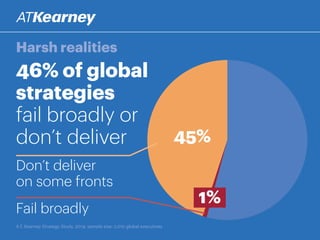
Harsh realities
46% of global
strategies
fail broadly or
don’t deliver
A.T. Kearney Strategy Study, 2014; sample size: 2,010 global executives
Don’t deliver
on some fronts
Fail broadly
45%
1%
Harsh realities
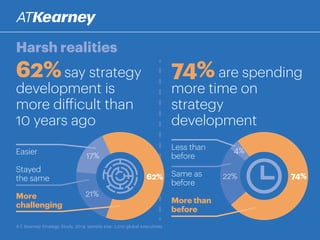
62%say strategy
development is
more difficult than
10 years ago
Easier
Stayed
the same
More
challenging
Less than
before
Same as
before
More than
before
74% are spending
more time on
strategy
development
17%
21%
62%
4%
22% 74%
A.T. Kearney Strategy Study, 2014; sample size: 2,010 global executives
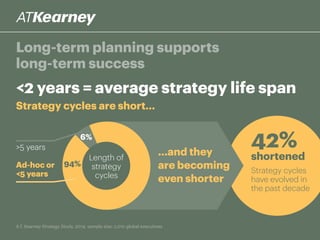
>5 years
Ad-hoc or
<5 years
>5 years
Ad-hoc or
<5 years
<2 years = average strategy life span
Long-term planning supports
long-term success
Strategy cycles are short…
…and they
are becoming
even shorter
Length of
strategy
cycles
42%
shortened
Strategy cycles
have evolved in
the past decade
94%
6%
Note: Successful companies are those that meet all expectations, exceed some expectations on some fronts, or exceed all expectations
when deploying the strategic initiatives; unsuccessful companies are those that do not deliver on some initiatives or fail broadly when
deploying the strategic initiatives.
Source: A.T. Kearney Strategy Study, 2014; sample size: 2,010 global executives
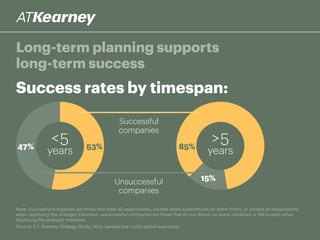
Success rates by timespan:
Long-term planning supports
long-term success
<5
years
>5
years53%47%
15%
85%
Successful
companies
Unsuccessful
companies
C-SuiteExpectations: Management
Satisfaction rates of strategies
C-suite blindness
A.T. Kearney Strategy Study, 2014; sample size: 2,010 global executives
Exceeds all 18%
33%
30%
19%
1%
4%
26%
22%
47%
1%
Exceeds some
Meets all
Fails to deliver on some
Fails broadly
C-suite satisfaction 81% Only 52% of management
agrees
A.T. Kearney Strategy Study, 2014; sample size: 2,010 global executives
Root cause for strategy failure
The weak link in strategy: handover
between formulation and deployment
6% 29% 39% 19% 7%
Primarily in
strategy
deployment
More in
strategy
deployment
Equally in strategy
formulation and
strategy deployment
More in
strategy
formulation
Primarily in
strategy
formulation
Top reasons for failure
Formulation failure
A.T. Kearney Strategy Study, 2014; sample size: 2,010 global executives
Strategic planning quite often occurs in an
‘Ivory Tower’ by individuals who haven’t a clue
what happens at the implementation level.
Lack of understanding
of future trends
Lack of understanding of
internal capabilities
Primarily a top down
approach
Deployment failure
Lack of internal understanding
of the strategy
Lack of internal capabilities
to execute strategy
Lack of ownership
90%
90%
86%
88%
87%
84%
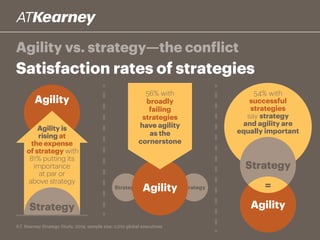
54% with
successful
strategies
say strategy
and agility are
equally important
A.T. Kearney Strategy Study, 2014; sample size: 2,010 global executives
Satisfaction rates of strategies
Agility vs. strategy—the conflict
Agility
Agility
Strategy
Strategy StrategyAgility =
56% with
broadly
failing
strategies
have agility
as the
cornerstone
Strategy
Agility is
rising at
the expense
of strategy with
81% putting its
importance
at par or
above strategy
A.T. Kearney Strategy Study, 2014; sample size: 2,010 global executives
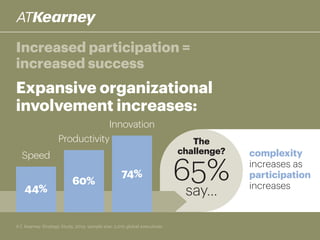
Expansive organizational
involvement increases:
Increased participation =
increased success
Innovation
complexity
increases as
participation
increases
The
challenge?
65%
say...44%
60%
74%
Productivity
Speed
A.T. Kearney Strategy Study, 2014; sample size: 2,010 global executives
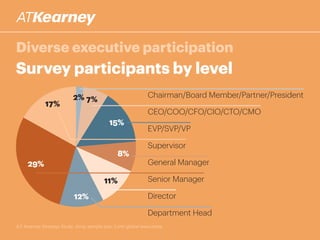
Survey participants by level
Diverse executive participation
29%
12%
11%
8%
15%
7%2%
17%
Chairman/Board Member/Partner/President
CEO/COO/CFO/CIO/CTO/CMO
EVP/SVP/VP
Supervisor
General Manager
Senior Manager
Director
Department Head
A.T. Kearney Strategy Study, 2014; sample size: 2,010 global executives
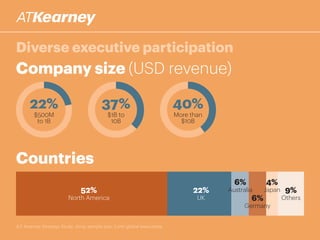
Company size (USD revenue)
Countries
Diverse executive participation
22%
$500M
to 1B
37%
$1B to
10B
40%
More than
$10B
52%
North America
22%
UK
4%
Japan 9%
Others
6%
Australia
6%
Germany
A.T. Kearney Strategy Study, 2014; sample size: 2,010 global executives
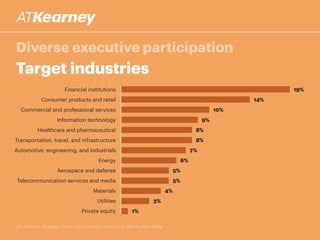
Target industries
Diverse executive participation
Consumer products and retail
Commercial and professional services
Information technology
Healthcare and pharmaceutical
Transportation, travel, and infrastructure
Automotive, engineering, and industrials
Financial institutions
Energy
Aerospace and defense
Telecommunication services and media
Materials
Utilities
Private equity
14%
10%
9%
8%
8%
7%
19%
6%
5%
5%
4%
3%
1%
For more information
about A.T. Kearney’s
2014 Strategy Study,
please visit:
www.atkearney.com/strategy/futureproof-strategy

Strategy Study 2014 | A.T. Kearney

  • 1.
    Powerful strategies can significantlyboost rewards. However, companies say strategy formulation is increasingly difficult. Take a look at strategy trends, challenges, and opportunities revealed in our 2014 Strategy Study. A.T. Kearney Strategy Study, 2014; sample size: 2,010 global executives
  • 2.
    Harsh realities 46% ofglobal strategies fail broadly or don’t deliver A.T. Kearney Strategy Study, 2014; sample size: 2,010 global executives Don’t deliver on some fronts Fail broadly 45% 1%
  • 3.
    Harsh realities 62%say strategy developmentis more difficult than 10 years ago Easier Stayed the same More challenging Less than before Same as before More than before 74% are spending more time on strategy development 17% 21% 62% 4% 22% 74% A.T. Kearney Strategy Study, 2014; sample size: 2,010 global executives
  • 4.
    A.T. Kearney StrategyStudy, 2014; sample size: 2,010 global executives >5 years Ad-hoc or <5 years >5 years Ad-hoc or <5 years <2 years = average strategy life span Long-term planning supports long-term success Strategy cycles are short… …and they are becoming even shorter Length of strategy cycles 42% shortened Strategy cycles have evolved in the past decade 94% 6%
  • 5.
    Note: Successful companiesare those that meet all expectations, exceed some expectations on some fronts, or exceed all expectations when deploying the strategic initiatives; unsuccessful companies are those that do not deliver on some initiatives or fail broadly when deploying the strategic initiatives. Source: A.T. Kearney Strategy Study, 2014; sample size: 2,010 global executives Success rates by timespan: Long-term planning supports long-term success <5 years >5 years53%47% 15% 85% Successful companies Unsuccessful companies
  • 6.
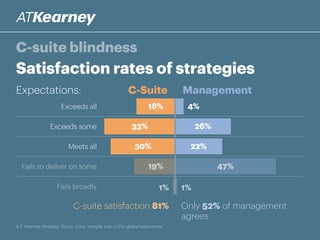
    C-SuiteExpectations: Management Satisfaction ratesof strategies C-suite blindness A.T. Kearney Strategy Study, 2014; sample size: 2,010 global executives Exceeds all 18% 33% 30% 19% 1% 4% 26% 22% 47% 1% Exceeds some Meets all Fails to deliver on some Fails broadly C-suite satisfaction 81% Only 52% of management agrees
  • 7.
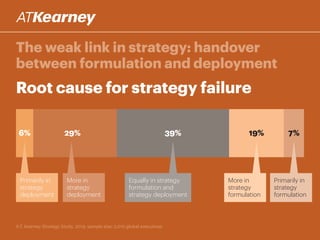
    A.T. Kearney StrategyStudy, 2014; sample size: 2,010 global executives Root cause for strategy failure The weak link in strategy: handover between formulation and deployment 6% 29% 39% 19% 7% Primarily in strategy deployment More in strategy deployment Equally in strategy formulation and strategy deployment More in strategy formulation Primarily in strategy formulation
  • 8.
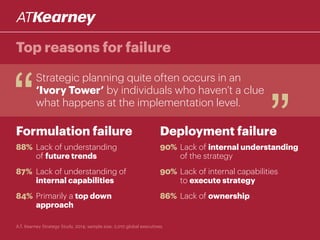
    Top reasons forfailure Formulation failure A.T. Kearney Strategy Study, 2014; sample size: 2,010 global executives Strategic planning quite often occurs in an ‘Ivory Tower’ by individuals who haven’t a clue what happens at the implementation level. Lack of understanding of future trends Lack of understanding of internal capabilities Primarily a top down approach Deployment failure Lack of internal understanding of the strategy Lack of internal capabilities to execute strategy Lack of ownership 90% 90% 86% 88% 87% 84%
  • 9.
    54% with successful strategies say strategy andagility are equally important A.T. Kearney Strategy Study, 2014; sample size: 2,010 global executives Satisfaction rates of strategies Agility vs. strategy—the conflict Agility Agility Strategy Strategy StrategyAgility = 56% with broadly failing strategies have agility as the cornerstone Strategy Agility is rising at the expense of strategy with 81% putting its importance at par or above strategy
  • 10.
    A.T. Kearney StrategyStudy, 2014; sample size: 2,010 global executives Expansive organizational involvement increases: Increased participation = increased success Innovation complexity increases as participation increases The challenge? 65% say...44% 60% 74% Productivity Speed
  • 11.
    A.T. Kearney StrategyStudy, 2014; sample size: 2,010 global executives Survey participants by level Diverse executive participation 29% 12% 11% 8% 15% 7%2% 17% Chairman/Board Member/Partner/President CEO/COO/CFO/CIO/CTO/CMO EVP/SVP/VP Supervisor General Manager Senior Manager Director Department Head
  • 12.
    A.T. Kearney StrategyStudy, 2014; sample size: 2,010 global executives Company size (USD revenue) Countries Diverse executive participation 22% $500M to 1B 37% $1B to 10B 40% More than $10B 52% North America 22% UK 4% Japan 9% Others 6% Australia 6% Germany
  • 13.
    A.T. Kearney StrategyStudy, 2014; sample size: 2,010 global executives Target industries Diverse executive participation Consumer products and retail Commercial and professional services Information technology Healthcare and pharmaceutical Transportation, travel, and infrastructure Automotive, engineering, and industrials Financial institutions Energy Aerospace and defense Telecommunication services and media Materials Utilities Private equity 14% 10% 9% 8% 8% 7% 19% 6% 5% 5% 4% 3% 1%
  • 14.
    For more information aboutA.T. Kearney’s 2014 Strategy Study, please visit: www.atkearney.com/strategy/futureproof-strategy