New epicenters
of consumption.
New opportunities for
consumer goods growth.
2
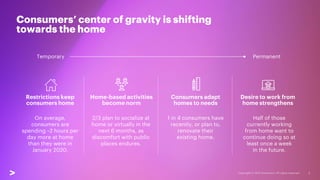
Consumers’ center of gravity is shifting
towards the home
Restrictions keep
consumers home
1 in 4 consumers have
recently, or plan to,
renovate their
existing home.
Half of those
currently working
from home want to
continue doing so at
least once a week
in the future.
Home-based activities
become norm
Consumers adapt
homes to needs
Desire to work from
home strengthens
On average,
consumers are
spending ~2 hours per
day more at home
than they were in
January 2020.
2/3 plan to socialize at
home or virtually in the
next 6 months, as
discomfort with public
places endures.
Temporary Permanent
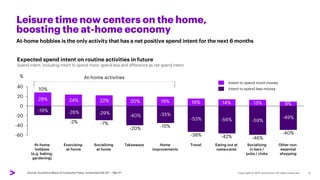
Leisure time now centers on the home,
boosting the at-home economy
Expected spend intent on routine activities in future
Spend intent, including intent to spend more, spend less and difference as net spend intent
At-home hobbies is the only activity that has a net positive spend intent for the next 6 months
Source: Accenture Wave 10 Consumer Pulse, conducted Feb 25th – Mar 5th
-60
-40
-20
0
20
40
-19%
-7%
-35%
28%
-46%
At-home
hobbies
(e.g. baking,
gardening)
-38%
-29%
22% 16%
24%
-26%
Exercising-
at-home
Socializing
at home
-15%
9%
20%
-40%
Takeaways
19%
Home
improvements
10%
Other non-
essential
shopping
-53%
Travel
14%
-56%
Eating out at
restaurants
13%
-59%
-42%
Socializing
in bars /
pubs / clubs
-49%
-2%
-20%
-40%
Intent to spend more money
Intent to spend less money
% At-home activities
3
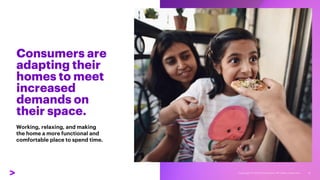
Consumers are
adapting their
homes to meet
increased
demands on
their space.
Working, relaxing, and making
the home a more functional and
comfortable place to spend time.
4
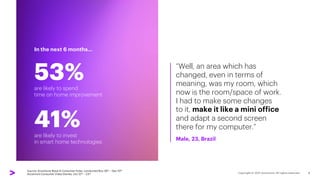
“Well, an area which has
changed, even in terms of
meaning, was my room, which
now is the room/space of work.
I had to make some changes
to it, make it like a mini office
and adapt a second screen
there for my computer.”
Male, 23, Brazil
In the next 6 months…
41%
are likely to invest
in smart home technologies
53%
are likely to spend
time on home improvement
Source: Accenture Wave 9 Consumer Pulse, conducted Nov 26th – Dec 10th
Accenture Consumer Video Diaries, Oct 12th – 23rd 5
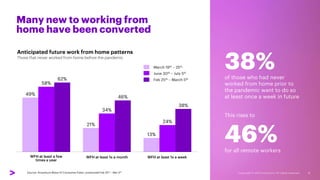
Many new to working from
home have been converted
Anticipated future work from home patterns
Those that never worked from home before the pandemic
49%
21%
13%
58%
34%
24%
62%
46%
38%
WFH at least 1x a month
WFH at least a few
times a year
WFH at least 1x a week
March 19th – 25th
June 30th – July 5th
Feb 25th – March 5th
38%
of those who had never
worked from home prior to
the pandemic want to do so
at least once a week in future
This rises to
46%
for all remote workers
Source: Accenture Wave 10 Consumer Pulse, conducted Feb 25th – Mar 5th
6
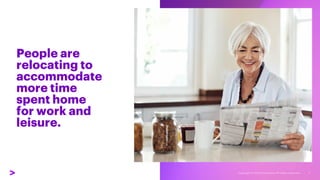
People are
relocating to
accommodate
more time
spent home
for work and
leisure.
7
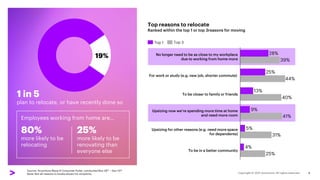
19%
1 in 5
plan to relocate, or have recently done so
Top reasons to relocate
Ranked within the top 1 or top 3reasons for moving
28%
25%
13%
9%
5%
4%
39%
44%
40%
41%
31%
25%
To be in a better community
For work or study (e.g. new job, shorter commute)
No longer need to be as close to my workplace
due to working from home more
To be closer to family or friends
Upsizing now we’re spending more time at home
and need more room
Upsizing for other reasons (e.g. need more space
for dependents)
Top 1 Top 3
25%
more likely to be
renovating than
everyone else
Employees working from home are…
80%
more likely to be
relocating
Source: Accenture Wave 9 Consumer Pulse, conducted Nov 26th – Dec 10th
Note: Not all reasons to locate shown for simplicity 8
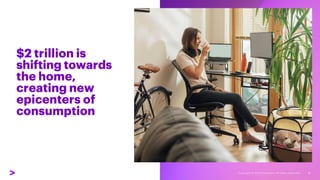
$2 trillion is
shifting towards
the home,
creating new
epicenters of
consumption
9
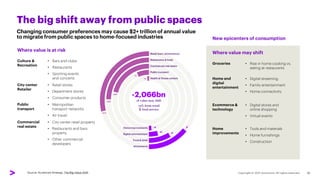
Source: Accenture Strategy, The Big Value Shift
The big shift away from public spaces
Changing consumer preferences may cause $2+ trillion of annual value
to migrate from public spaces to home-focused industries
Where value is at risk
Culture &
Recreation
• Bars and clubs
• Restaurants
• Sporting events
and concerts
City center
Retailer
• Retail stores
• Department stores
• Consumer products
Public
transport
• Metropolitan
transport networks
• Air travel
Commercial
real estate
• City center retail property
• Restaurants and bars
property
• Other commercial
developers
Where value may shift
Groceries • Rise in home cooking vs.
eating at restaurants
Home and
digital
entertainment
• Digital streaming
• Family entertainment
• Home connectivity
Ecommerce &
technology
• Digital stores and
online shopping
• Virtual events
Home
improvements
• Tools and materials
• Home furnishings
• Construction
New epicenters of consumption
10
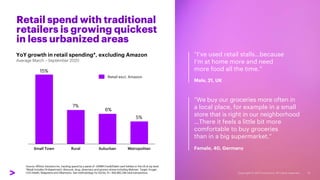
Retail spend with traditional
retailers is growing quickest
in less urbanized areas
YoY growth in retail spending*, excluding Amazon
Average March – September 2020
Small Town Metropolitan
Rural Suburban
“We buy our groceries more often in
a local place, for example in a small
store that is right in our neighborhood
…There it feels a little bit more
comfortable to buy groceries
than in a big supermarket.”
Female, 40, Germany
“I’ve used retail stalls…because
I’m at home more and need
more food all the time.”
Male, 21, UK
Source: Affinity Solutions Inc, tracking spend by a panel of ~20MM Credit/Debit card holders in the US at zip level.
*Retail includes 19 department, discount, drug, pharmacy and grocery stores including Walmart, Target, Kroger,
CVS Health, Walgreens and Albertsons. See methodology for full list. N = 493,882,246 total transactions.
6%
15%
7%
5%
Retail excl. Amazon
11
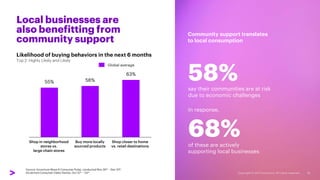
Local businesses are
also benefitting from
community support
Likelihood of buying behaviors in the next 6 months
Top 2: Highly Likely and Likely
Source: Accenture Wave 9 Consumer Pulse, conducted Nov 26th – Dec 10th.
Accenture Consumer Video Diaries, Oct 12th – 23rd
58%
say their communities are at risk
due to economic challenges
In response,
68%
of these are actively
supporting local businesses
Community support translates
to local consumption
55% 56%
63%
Global average
Shop in neighborhood
stores vs.
large chain stores
Buy more locally
sourced products
Shop closer to home
vs. retail destinations
12
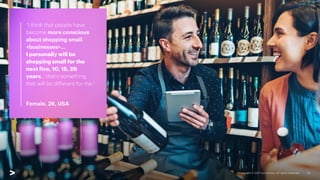
“I think that people have
become more conscious
about shopping small
<businesses>…
I personally will be
shopping small for the
next five, 10, 15, 20
years… that's something
that will be different for me.”
Female, 26, USA
13
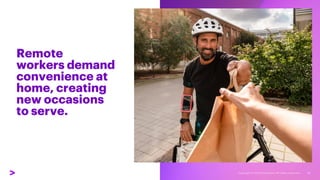
Remote
workers demand
convenience at
home, creating
new occasions
to serve.
14
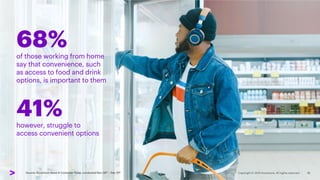
68%
of those working from home
say that convenience, such
as access to food and drink
options, is important to them
41%
however, struggle to
access convenient options
Source: Accenture Wave 9 Consumer Pulse, conducted Nov 26th – Dec 10th
15
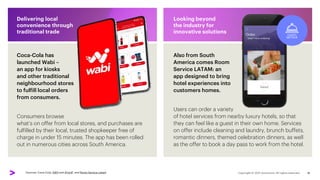
Consumers browse
what’s on offer from local stores, and purchases are
fulfilled by their local, trusted shopkeeper free of
charge in under 15 minutes. The app has been rolled
out in numerous cities across South America.
Delivering local
convenience through
traditional trade
Users can order a variety
of hotel services from nearby luxury hotels, so that
they can feel like a guest in their own home. Services
on offer include cleaning and laundry, brunch buffets,
romantic dinners, themed celebration dinners, as well
as the offer to book a day pass to work from the hotel.
Looking beyond
the industry for
innovative solutions
Coca-Cola has
launched Wabi –
an app for kiosks
and other traditional
neighbourhood stores
to fulfill local orders
from consumers.
Also from South
America comes Room
Service LATAM: an
app designed to bring
hotel experiences into
customers homes.
Sources: Coca-Cola, AWS and iProUP, and Room Service Latam 16
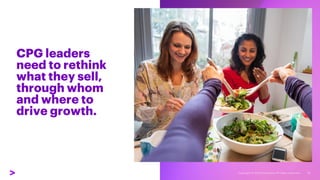
CPG leaders
need to rethink
what they sell,
through whom
and where to
drive growth.
17
Linked to
broader
innovation
The home will be a hotspot for
value creation, so CPGs need
to be actively innovating to meet
the new consumption occasions
emerging. Success requires real-
time insight on local patterns and
consumer behaviour that can
then be forensically interrogated.
Innovation should not just be in
products and offerings though,
but also in how these can be
developed, delivered and
deployed profitably at scale.
What:
Create innovations
powered by data
Through whom:
Re-evaluate
priority channels
18
Local stores in residential
areas will play an increasingly
important role in their
communities, and they
therefore need to be prioritized
as part of a holistic channel
strategy. CPGs need to
redefine their customer
segmentation and service
strategy to reflect localized
needs and new value potential.
The home will be a hotspot for
value creation, so CPGs need
to be actively innovating to meet
the new consumption occasions
emerging. Success requires real-
time insight on local patterns and
consumer behaviour that can
then be forensically interrogated.
Innovation should not just be in
products and offerings though,
but also in how these can be
developed, delivered and
deployed profitably at scale.
What:
Create innovations
powered by data
Through whom:
Re-evaluate
priority channels
19
What:
Create innovations
powered by data
Through whom:
Re-evaluate
priority channels
Where and how:
Build agile operating
models and supply chains
The home will be a hotspot for
value creation, so CPGs need
to be actively innovating to meet
the new consumption occasions
emerging. Success requires real-
time insight on local patterns and
consumer behaviour that can
then be forensically interrogated.
Innovation should not just be in
products and offerings though,
but also in how these can be
developed, delivered and
deployed profitably at scale.
Local stores in residential
areas will play an increasingly
important role in their
communities, and they
therefore need to be prioritized
as part of a holistic channel
strategy. CPGs need to
redefine their customer
segmentation and service
strategy to reflect localized
needs and new value potential.
As new epicenters emerge,
CPGs need to follow their
consumers. That means
advanced modelling to map
out the physical redistribution
of demand, to identify and
prioritize the new areas of
growth. CPGs need to create
agile operating models –
processes, capabilities, teams
and culture, that can intelligently
flex to accommodate the shifts
and unlock new value pools.
20
408
India
Indonesia
456
805
811
1,020
Switzerland
815
812
France
802
813
408
430
Australia
813
425
412
409 Sweden
404
1,010
412
1,022
Brazil
Canada
China
12,487
Germany
Ireland
Italy
Japan
Russia
Saudi Arabia
Spain
UAE
UK
USA
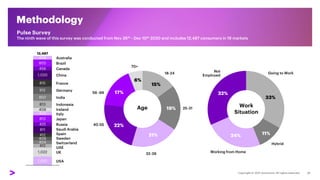
Pulse Survey
The ninth wave of this survey was conducted from Nov 26th - Dec 10th 2020 and includes 12,487 consumers in 19 markets
15%
19%
21%
22%
17%
6%
70+
25-31
18-24
32-39
40-55
56 -69
33%
11%
24%
32%
Going to Work
Not
Employed
Hybrid
Working from Home
Age Work
Situation
Methodology
21
22
Disclaimer: This document refers to marks owned by third parties. All such third-party marks are the property of their
respective owners. No sponsorship, endorsement or approval of this content by the owners of such marks is intended,
expressed or implied. This document is intended for general informational purposes only and does not take into account the
reader’ specific circumstances, and may not reflect the most current developments. Accenture disclaims, to the fullest extent
permitted by applicable law, any and all liability for the accuracy and completeness of the information in this presentation and
for any acts or omissions made based on such information. Accenture does not provide legal, regulatory, audit, or tax advice.
Readers are responsible for obtaining such advice from their own legal counsel or other licensed professionals.
Copyright © 2021 Accenture.
All rights reserved.
Accenture and its logo are
trademarks of Accenture.
About Accenture
Accenture is a global professional services company with leading capabilities
in digital, cloud and security. Combining unmatched experience and specialized
skills across more than 40 industries, we offer Strategy and Consulting, Interactive,
Technology and Operations services — all powered by the world’s largest network
of Advanced Technology and Intelligent Operations centers. Our 569,000 people
deliver on the promise of technology and human ingenuity every day, serving clients
in more than 120 countries. We embrace the power of change to create value and
shared success for our clients, people, shareholders, partners and communities.
Visit us at www.accenture.com
Learn more: Visit www.Accenture.com/consumergoods
Contact us:
Oliver Wright
Consumer Goods Industry Sector Lead
Emma Blackburn
Consumer Research Lead