Ian Miles Manchester Institute of Innovation Research,  MBS [email_address] Foresight and Business Futures MBA course Manchester April 2008
Overview Foresight  Foresight in Business Some examples
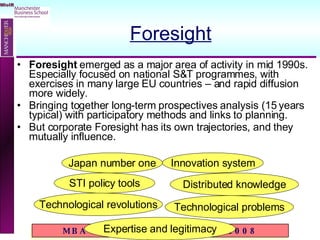
Foresight Foresight  emerged as a major area of activity in mid 1990s.  Especially focused on national S&T programmes, with exercises in many large EU countries – and rapid diffusion more widely. Bringing together long-term prospectives analysis (15 years typical) with participatory methods and links to planning. But corporate Foresight has its own trajectories, and they mutually influence. Japan number one STI policy tools Innovation system Technological revolutions Technological problems Distributed knowledge Expertise and legitimacy
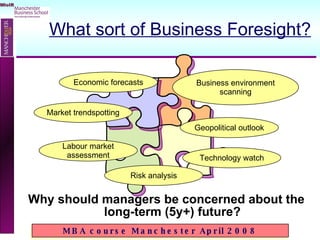
What sort of Business Foresight? Why should managers be concerned about the long-term (5y+) future? Economic forecasts Market trendspotting Technology watch Business environment scanning Geopolitical outlook Labour market assessment Risk analysis
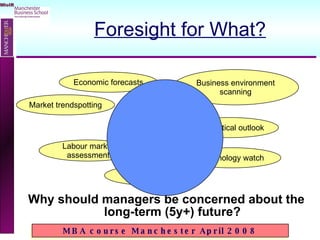
Foresight for What? Why should managers be concerned about the long-term (5y+) future? Economic forecasts Market trendspotting Technology watch Business environment scanning Geopolitical outlook Labour market assessment Risk analysis
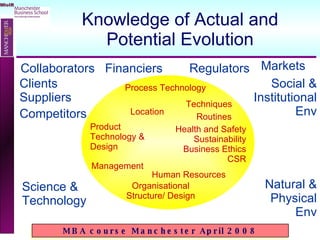
Knowledge of Actual and Potential Evolution Competitors Clients Suppliers Collaborators Regulators Financiers Markets Social & Institutional Env Natural & Physical Env Process Technology Management Organisational Structure/ Design Routines Techniques Human Resources Product Technology & Design Health and Safety  Sustainability Business Ethics CSR Science & Technology Location
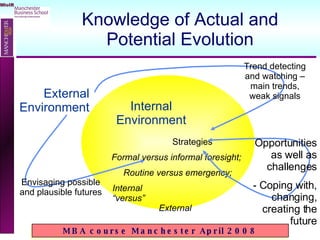
Knowledge of Actual and Potential Evolution Internal Environment External Environment Strategies Formal versus informal foresight; Routine versus emergency; Internal “versus” External   Trend detecting and watching – main trends, weak signals Envisaging possible and plausible futures Opportunities as well as challenges - Coping with, changing, creating the future
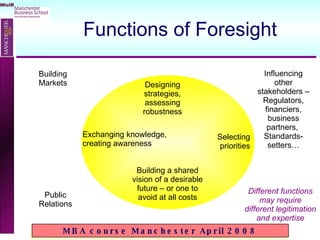
Functions of Foresight Public Relations Building Markets Influencing other stakeholders – Regulators, financiers, business partners,  Standards-setters… Building a shared vision of a desirable future – or one to avoid at all costs Selecting priorities Designing strategies, assessing robustness Different functions may require different legitimation and expertise Exchanging knowledge, creating awareness
Some examples
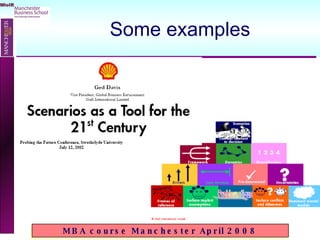
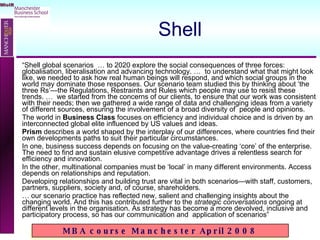
Shell “ Shell global scenarios  … to 2020 explore the social consequences of three forces: globalisation, liberalisation and advancing technology. …  to understand what that might look like, we needed to ask how real human beings will respond, and which social groups in the world may dominate those responses. Our scenario team studied this by thinking about ‘the three Rs’—the Regulations, Restraints and Rules which people may use to resist these trends. …  we started from the concerns of our clients, to ensure that our work was consistent with their needs; then we gathered a wide range of data and challenging ideas from a variety of different sources, ensuring the involvement of a broad diversity of  people and opinions. The world in  Business Class  focuses on efficiency and individual choice and is driven by an interconnected global elite influenced by US values and ideas.  Prism  describes a world shaped by the interplay of our differences, where countries find their own developments paths to suit their particular circumstances.  In one, business success depends on focusing on the value-creating ‘core’ of the enterprise. The need to find and sustain elusive competitive advantage drives a relentless search for efficiency and innovation.  In the other, multinational companies must be ‘local’ in many different environments. Access depends on relationships and reputation.  Developing relationships and building trust are vital in both scenarios—with staff, customers, partners, suppliers, society and, of course, shareholders. …  our scenario practice has reflected new, salient and challenging insights about the changing world. And this has contributed further to the  strategic conversations  ongoing at different levels in the organisation. As strategy has become a more devolved, inclusive and participatory process, so has our communication and  application of scenarios”
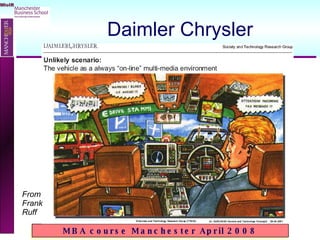
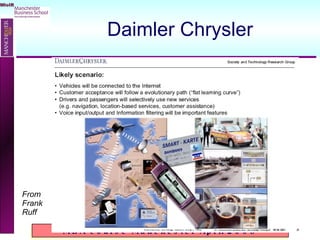
Daimler Chrysler From Frank Ruff
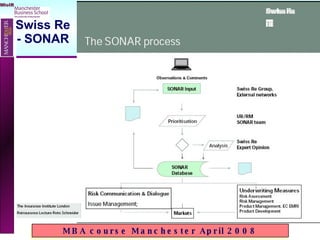
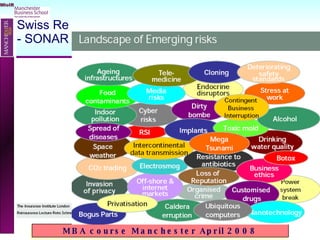
Swiss Re - SONAR
Swiss Re - SONAR
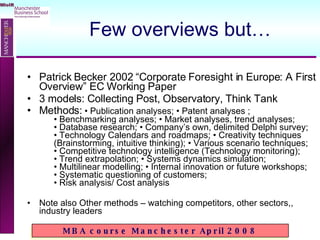
Few overviews but… Patrick Becker 2002 “Corporate Foresight in Europe: A First Overview” EC Working Paper 3 models: Collecting Post, Observatory, Think Tank Methods:   • Publication analyses; • Patent analyses ;  • Benchmarking analyses; • Market analyses, trend analyses;  • Database research; • Company’s own, delimited Delphi survey;  • Technology Calendars and roadmaps; • Creativity techniques  (Brainstorming, intuitive thinking); • Various scenario techniques;  • Competitive technology intelligence (Technology monitoring);  • Trend extrapolation; • Systems dynamics simulation;  • Multilinear modelling; • Internal innovation or future workshops;  • Systematic questioning of customers;  • Risk analysis/ Cost analysis Note also Other methods – watching competitors, other sectors,, industry leaders
Can managers afford NOT to? Dynamic changing environment, even for “mature” goods and services Opportunities to change and create futures Entrepreneurship needs Foresight: the only question is what sorts of Foresight, when and how!
End of Presentation

corporate foresight - an introduction

  • 1.
    Ian Miles ManchesterInstitute of Innovation Research, MBS [email_address] Foresight and Business Futures MBA course Manchester April 2008
  • 2.
    Overview Foresight Foresight in Business Some examples
  • 3.
    Foresight Foresight emerged as a major area of activity in mid 1990s. Especially focused on national S&T programmes, with exercises in many large EU countries – and rapid diffusion more widely. Bringing together long-term prospectives analysis (15 years typical) with participatory methods and links to planning. But corporate Foresight has its own trajectories, and they mutually influence. Japan number one STI policy tools Innovation system Technological revolutions Technological problems Distributed knowledge Expertise and legitimacy
  • 4.
    What sort ofBusiness Foresight? Why should managers be concerned about the long-term (5y+) future? Economic forecasts Market trendspotting Technology watch Business environment scanning Geopolitical outlook Labour market assessment Risk analysis
  • 5.
    Foresight for What?Why should managers be concerned about the long-term (5y+) future? Economic forecasts Market trendspotting Technology watch Business environment scanning Geopolitical outlook Labour market assessment Risk analysis
  • 6.
    Knowledge of Actualand Potential Evolution Competitors Clients Suppliers Collaborators Regulators Financiers Markets Social & Institutional Env Natural & Physical Env Process Technology Management Organisational Structure/ Design Routines Techniques Human Resources Product Technology & Design Health and Safety Sustainability Business Ethics CSR Science & Technology Location
  • 7.
    Knowledge of Actualand Potential Evolution Internal Environment External Environment Strategies Formal versus informal foresight; Routine versus emergency; Internal “versus” External Trend detecting and watching – main trends, weak signals Envisaging possible and plausible futures Opportunities as well as challenges - Coping with, changing, creating the future
  • 8.
    Functions of ForesightPublic Relations Building Markets Influencing other stakeholders – Regulators, financiers, business partners, Standards-setters… Building a shared vision of a desirable future – or one to avoid at all costs Selecting priorities Designing strategies, assessing robustness Different functions may require different legitimation and expertise Exchanging knowledge, creating awareness
  • 9.
  • 10.
    Shell “ Shellglobal scenarios … to 2020 explore the social consequences of three forces: globalisation, liberalisation and advancing technology. … to understand what that might look like, we needed to ask how real human beings will respond, and which social groups in the world may dominate those responses. Our scenario team studied this by thinking about ‘the three Rs’—the Regulations, Restraints and Rules which people may use to resist these trends. … we started from the concerns of our clients, to ensure that our work was consistent with their needs; then we gathered a wide range of data and challenging ideas from a variety of different sources, ensuring the involvement of a broad diversity of people and opinions. The world in Business Class focuses on efficiency and individual choice and is driven by an interconnected global elite influenced by US values and ideas. Prism describes a world shaped by the interplay of our differences, where countries find their own developments paths to suit their particular circumstances. In one, business success depends on focusing on the value-creating ‘core’ of the enterprise. The need to find and sustain elusive competitive advantage drives a relentless search for efficiency and innovation. In the other, multinational companies must be ‘local’ in many different environments. Access depends on relationships and reputation. Developing relationships and building trust are vital in both scenarios—with staff, customers, partners, suppliers, society and, of course, shareholders. … our scenario practice has reflected new, salient and challenging insights about the changing world. And this has contributed further to the strategic conversations ongoing at different levels in the organisation. As strategy has become a more devolved, inclusive and participatory process, so has our communication and application of scenarios”
  • 11.
  • 12.
  • 13.
  • 14.
  • 15.
    Few overviews but…Patrick Becker 2002 “Corporate Foresight in Europe: A First Overview” EC Working Paper 3 models: Collecting Post, Observatory, Think Tank Methods: • Publication analyses; • Patent analyses ; • Benchmarking analyses; • Market analyses, trend analyses; • Database research; • Company’s own, delimited Delphi survey; • Technology Calendars and roadmaps; • Creativity techniques (Brainstorming, intuitive thinking); • Various scenario techniques; • Competitive technology intelligence (Technology monitoring); • Trend extrapolation; • Systems dynamics simulation; • Multilinear modelling; • Internal innovation or future workshops; • Systematic questioning of customers; • Risk analysis/ Cost analysis Note also Other methods – watching competitors, other sectors,, industry leaders
  • 16.
    Can managers affordNOT to? Dynamic changing environment, even for “mature” goods and services Opportunities to change and create futures Entrepreneurship needs Foresight: the only question is what sorts of Foresight, when and how!
  • 17.