PRO Green Expo
Colorado Convention Center
January 15, 2015, 1:00 PM
115 January 2015 2015 PRO Green Expo | L. M. Baer | How Thermal Renewable Energy Can Benefit Your Greenhouse Operations
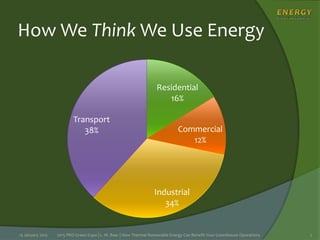
How We Think We Use Energy
Residential
16%
Commercial
12%
Industrial
34%
Transport
38%
15 January 2015 2015 PRO Green Expo | L. M. Baer | How Thermal Renewable Energy Can Benefit Your Greenhouse Operations 2
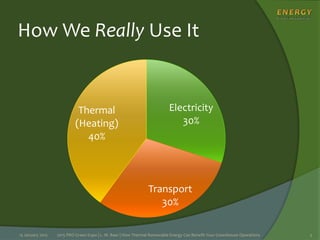
How We Really Use It
Electricity
30%
Transport
30%
Thermal
(Heating)
40%
15 January 2015 2015 PRO Green Expo | L. M. Baer | How Thermal Renewable Energy Can Benefit Your Greenhouse Operations 3
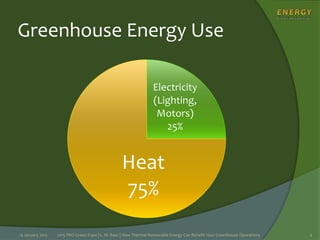
Greenhouse Energy Use
Electricity
(Lighting,
Motors)
25%
Heat
75%
15 January 2015 2015 PRO Green Expo | L. M. Baer | How Thermal Renewable Energy Can Benefit Your Greenhouse Operations 4
Energy Resources: Today
 Sun! (for Better or
Worse)
 Urban Centers
 Electricity
 Natural Gas (by Contract)
 Rural Regions
 Electricity
(Electricity AND Heat?)
 Propane
 Diversified Energy
Portfolio = Reduced
Volatility Exposure
15 January 2015 2015 PRO Green Expo | L. M. Baer | How Thermal Renewable Energy Can Benefit Your Greenhouse Operations 5
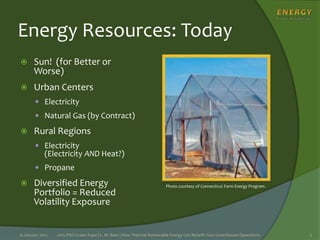
Photo courtesy of Connecticut Farm Energy Program.
Energy Resources: Diversify
 Energy Efficiency: The Mighty Negawatt
 Weatherization (Air Sealing, Including Fans)
 Appropriate Ventilation
 Double Roof/Walls (IR/Anti-Condensation)
 Movable Insulating Curtains/Blankets
 Foundation Isolation/Insulation
 Side/North Wall Insulation
 Electricity: Motors, Lights, Etc.
15 January 2015 2015 PRO Green Expo | L. M. Baer | How Thermal Renewable Energy Can Benefit Your Greenhouse Operations 6
Energy Resources: Diversify
 Renewable Thermals (Heating)
 Biomass Combustion
 Passive Solar Thermal
 Active Solar Thermal
 Geothermal
15 January 2015 2015 PRO Green Expo | L. M. Baer | How Thermal Renewable Energy Can Benefit Your Greenhouse Operations 7
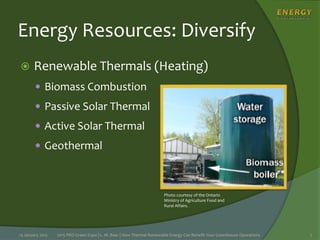
Photo courtesy of the Ontario
Ministry of Agriculture Food and
Rural Affairs.
Passive Solar Thermal
 Passive Solar is About
Design
 Energy Efficiency
(e.g., insulation)
 Orientation: Long
and Narrow Face
South
 Heat
Storage/Thermal
Mass
 Water
 Masonry, Rock15 January 2015 2015 PRO Green Expo | L. M. Baer | How Thermal Renewable Energy Can Benefit Your Greenhouse Operations 8
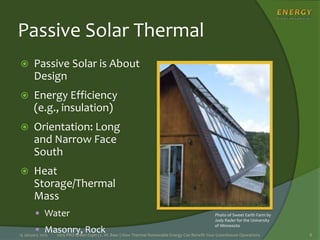
Photo of Sweet Earth Farm by
Jody Rader for the University
of Minnesota
Active Solar Thermal: Air
 Hot Air Use for Heat
 Collected at Top of
Greenhouse
 Pumped to Pipes in Soil
 Maybe Better for Smaller
to Mid-Sized Installations
 Works Well for Cold-
Weather Greenhouses
15 January 2015 2015 PRO Green Expo | L. M. Baer | How Thermal Renewable Energy Can Benefit Your Greenhouse Operations 9
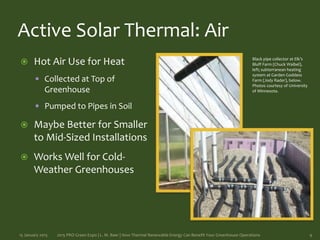
Black pipe collector at Elk’s
Bluff Farm (Chuck Waibel),
left; subterranean heating
system at Garden Goddess
Farm (Jody Rader), below.
Photos courtesy of University
of Minnesota.
Active Solar Thermal: Liquid
 Hot Liquid for Heat
 Solar Collector on Ground
 Piped to Different
Applications in Structure
○ Radiant Soil/Bench Heat
○ Hot Water
○ Snow/Ice Melt
 Controls
 Larger Applications, Too
 Replace Propane, Elec.
15 January 2015 2015 PRO Green Expo | L. M. Baer | How Thermal Renewable Energy Can Benefit Your Greenhouse Operations 10
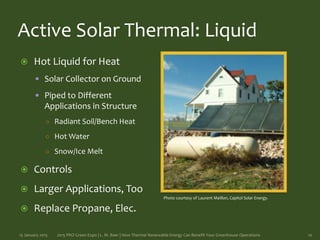
Photo courtesy of Laurent Meillon, Capitol Solar Energy.
Active Solar Thermal: Liquid
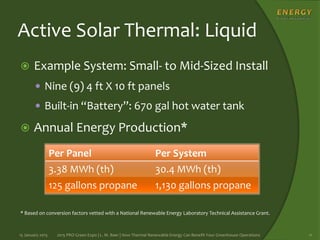
 Example System: Small- to Mid-Sized Install
 Nine (9) 4 ft X 10 ft panels
 Built-in “Battery”: 670 gal hot water tank
 Annual Energy Production*
* Based on conversion factors vetted with a National Renewable Energy Laboratory Technical Assistance Grant.
15 January 2015 2015 PRO Green Expo | L. M. Baer | How Thermal Renewable Energy Can Benefit Your Greenhouse Operations 11
Per Panel Per System
3.38 MWh (th) 30.4 MWh (th)
125 gallons propane 1,130 gallons propane
Active Solar Thermal: Liquid
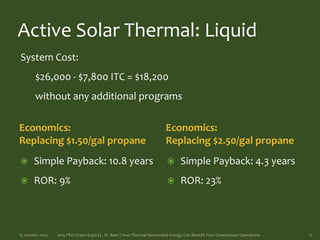
Economics:
Replacing $1.50/gal propane
Economics:
Replacing $2.50/gal propane
 Simple Payback: 10.8 years
 ROR: 9%
 Simple Payback: 4.3 years
 ROR: 23%
15 January 2015 2015 PRO Green Expo | L. M. Baer | How Thermal Renewable Energy Can Benefit Your Greenhouse Operations 12
System Cost:
$26,000 - $7,800 ITC = $18,200
without any additional programs
Cutting Greenhouse Costs
 It’s Almost All About Heat
 It’s Also About Scale, Location, Situation
 The Order to Add Resources
 Energy Efficiency (Don’t Forget Electricity!)
 Renewables
○ Passive Designs & Retrofits
○ Active Solutions
 Biomass Combustion with a Good Feedstock
 Active Solar Thermal: Air & Water
 Geothermal…
15 January 2015 2015 PRO Green Expo | L. M. Baer | How Thermal Renewable Energy Can Benefit Your Greenhouse Operations 13
Resources
American Solar. “Solar Heating and Solar Heat Recovery for Greenhouses.” Available at
http://www.americansolar.com/resources/papers/Solar%20heating%20and%20solar%20heat%20recovery%20for%20
greenhouses%208%2006.pdf
Colorado Department of Agriculture. Colorado Agriculture Renewable Heating & Cooling Roadmap. 2013. Available
at https://www.colorado.gov/pacific/agconservation/renewableheatingcooling
Connecticut Farm Energy Program. Energy Best Management Practices Guide. Available at
http://www.CTFarmEnergy.org
Extension.org. “Geothermal Heat for Greenhouses.” 2014. Available at
http://www.extension.org/pages/27790/geothermal-heat-for-greenhouses/print/#.VHYQu4vF-So
Garden & Greenhouse. “Harnessing Solar Energy for Greenhouse Operations.” Available at
http://www.gardenandgreenhouse.net/index.php/past-issues-mainmenu-18/111-2012-garden-greenhouse/march-
2012/1294-harnessing-solar-energy-for-greenhouse-operations--thermal-mass
Greenhouse Grower. “Can You Afford Free Heat?” 2008. http://www.greenhousegrower.com/structures-
equipment/equipment/can-you-afford-free-heat/
Meillon, Laurent. Capitol Solar Energy. 2014. Information at http://www.capitolsolarenergy.com/contact.html
Ontario Ministry of Agriculture, Food and Rural Affairs. “Small Biomass Boiler Technology.” 2014. Available at
http://www.omafra.gov.on.ca/english/engineer/facts/14-009.htm
University of Connecticut. “Greenhouse Energy Conservation Checklist.” Available at
http://www.hort.uconn.edu/ipm/greenhs/bartok/htms/Greenhouse%20Energy%20Conservation%20Checklist.htm
University of Minnesota. Cold-Climate Greenhouse Resource. 2013. Available at
http://csbr.umn.edu/publications/reports.html
15 January 2015 2015 PRO Green Expo | L. M. Baer | How Thermal Renewable Energy Can Benefit Your Greenhouse Operations 14
Leslie Martel Baer, MS, MA
Energy Strategist
leslie.baer@energyintersections.com
303.887.0440
15 January 2015 152015 PRO Green Expo | L. M. Baer | How Thermal Renewable Energy Can Benefit Your Greenhouse Operations

How Thermal Renewable Energy Can Benefit Your Greenhouse Operations and Bottom Line

  • 1.
    PRO Green Expo ColoradoConvention Center January 15, 2015, 1:00 PM 115 January 2015 2015 PRO Green Expo | L. M. Baer | How Thermal Renewable Energy Can Benefit Your Greenhouse Operations
  • 2.
    How We ThinkWe Use Energy Residential 16% Commercial 12% Industrial 34% Transport 38% 15 January 2015 2015 PRO Green Expo | L. M. Baer | How Thermal Renewable Energy Can Benefit Your Greenhouse Operations 2
  • 3.
    How We ReallyUse It Electricity 30% Transport 30% Thermal (Heating) 40% 15 January 2015 2015 PRO Green Expo | L. M. Baer | How Thermal Renewable Energy Can Benefit Your Greenhouse Operations 3
  • 4.
    Greenhouse Energy Use Electricity (Lighting, Motors) 25% Heat 75% 15January 2015 2015 PRO Green Expo | L. M. Baer | How Thermal Renewable Energy Can Benefit Your Greenhouse Operations 4
  • 5.
    Energy Resources: Today Sun! (for Better or Worse)  Urban Centers  Electricity  Natural Gas (by Contract)  Rural Regions  Electricity (Electricity AND Heat?)  Propane  Diversified Energy Portfolio = Reduced Volatility Exposure 15 January 2015 2015 PRO Green Expo | L. M. Baer | How Thermal Renewable Energy Can Benefit Your Greenhouse Operations 5 Photo courtesy of Connecticut Farm Energy Program.
  • 6.
    Energy Resources: Diversify Energy Efficiency: The Mighty Negawatt  Weatherization (Air Sealing, Including Fans)  Appropriate Ventilation  Double Roof/Walls (IR/Anti-Condensation)  Movable Insulating Curtains/Blankets  Foundation Isolation/Insulation  Side/North Wall Insulation  Electricity: Motors, Lights, Etc. 15 January 2015 2015 PRO Green Expo | L. M. Baer | How Thermal Renewable Energy Can Benefit Your Greenhouse Operations 6
  • 7.
    Energy Resources: Diversify Renewable Thermals (Heating)  Biomass Combustion  Passive Solar Thermal  Active Solar Thermal  Geothermal 15 January 2015 2015 PRO Green Expo | L. M. Baer | How Thermal Renewable Energy Can Benefit Your Greenhouse Operations 7 Photo courtesy of the Ontario Ministry of Agriculture Food and Rural Affairs.
  • 8.
    Passive Solar Thermal Passive Solar is About Design  Energy Efficiency (e.g., insulation)  Orientation: Long and Narrow Face South  Heat Storage/Thermal Mass  Water  Masonry, Rock15 January 2015 2015 PRO Green Expo | L. M. Baer | How Thermal Renewable Energy Can Benefit Your Greenhouse Operations 8 Photo of Sweet Earth Farm by Jody Rader for the University of Minnesota
  • 9.
    Active Solar Thermal:Air  Hot Air Use for Heat  Collected at Top of Greenhouse  Pumped to Pipes in Soil  Maybe Better for Smaller to Mid-Sized Installations  Works Well for Cold- Weather Greenhouses 15 January 2015 2015 PRO Green Expo | L. M. Baer | How Thermal Renewable Energy Can Benefit Your Greenhouse Operations 9 Black pipe collector at Elk’s Bluff Farm (Chuck Waibel), left; subterranean heating system at Garden Goddess Farm (Jody Rader), below. Photos courtesy of University of Minnesota.
  • 10.
    Active Solar Thermal:Liquid  Hot Liquid for Heat  Solar Collector on Ground  Piped to Different Applications in Structure ○ Radiant Soil/Bench Heat ○ Hot Water ○ Snow/Ice Melt  Controls  Larger Applications, Too  Replace Propane, Elec. 15 January 2015 2015 PRO Green Expo | L. M. Baer | How Thermal Renewable Energy Can Benefit Your Greenhouse Operations 10 Photo courtesy of Laurent Meillon, Capitol Solar Energy.
  • 11.
    Active Solar Thermal:Liquid  Example System: Small- to Mid-Sized Install  Nine (9) 4 ft X 10 ft panels  Built-in “Battery”: 670 gal hot water tank  Annual Energy Production* * Based on conversion factors vetted with a National Renewable Energy Laboratory Technical Assistance Grant. 15 January 2015 2015 PRO Green Expo | L. M. Baer | How Thermal Renewable Energy Can Benefit Your Greenhouse Operations 11 Per Panel Per System 3.38 MWh (th) 30.4 MWh (th) 125 gallons propane 1,130 gallons propane
  • 12.
    Active Solar Thermal:Liquid Economics: Replacing $1.50/gal propane Economics: Replacing $2.50/gal propane  Simple Payback: 10.8 years  ROR: 9%  Simple Payback: 4.3 years  ROR: 23% 15 January 2015 2015 PRO Green Expo | L. M. Baer | How Thermal Renewable Energy Can Benefit Your Greenhouse Operations 12 System Cost: $26,000 - $7,800 ITC = $18,200 without any additional programs
  • 13.
    Cutting Greenhouse Costs It’s Almost All About Heat  It’s Also About Scale, Location, Situation  The Order to Add Resources  Energy Efficiency (Don’t Forget Electricity!)  Renewables ○ Passive Designs & Retrofits ○ Active Solutions  Biomass Combustion with a Good Feedstock  Active Solar Thermal: Air & Water  Geothermal… 15 January 2015 2015 PRO Green Expo | L. M. Baer | How Thermal Renewable Energy Can Benefit Your Greenhouse Operations 13
  • 14.
    Resources American Solar. “SolarHeating and Solar Heat Recovery for Greenhouses.” Available at http://www.americansolar.com/resources/papers/Solar%20heating%20and%20solar%20heat%20recovery%20for%20 greenhouses%208%2006.pdf Colorado Department of Agriculture. Colorado Agriculture Renewable Heating & Cooling Roadmap. 2013. Available at https://www.colorado.gov/pacific/agconservation/renewableheatingcooling Connecticut Farm Energy Program. Energy Best Management Practices Guide. Available at http://www.CTFarmEnergy.org Extension.org. “Geothermal Heat for Greenhouses.” 2014. Available at http://www.extension.org/pages/27790/geothermal-heat-for-greenhouses/print/#.VHYQu4vF-So Garden & Greenhouse. “Harnessing Solar Energy for Greenhouse Operations.” Available at http://www.gardenandgreenhouse.net/index.php/past-issues-mainmenu-18/111-2012-garden-greenhouse/march- 2012/1294-harnessing-solar-energy-for-greenhouse-operations--thermal-mass Greenhouse Grower. “Can You Afford Free Heat?” 2008. http://www.greenhousegrower.com/structures- equipment/equipment/can-you-afford-free-heat/ Meillon, Laurent. Capitol Solar Energy. 2014. Information at http://www.capitolsolarenergy.com/contact.html Ontario Ministry of Agriculture, Food and Rural Affairs. “Small Biomass Boiler Technology.” 2014. Available at http://www.omafra.gov.on.ca/english/engineer/facts/14-009.htm University of Connecticut. “Greenhouse Energy Conservation Checklist.” Available at http://www.hort.uconn.edu/ipm/greenhs/bartok/htms/Greenhouse%20Energy%20Conservation%20Checklist.htm University of Minnesota. Cold-Climate Greenhouse Resource. 2013. Available at http://csbr.umn.edu/publications/reports.html 15 January 2015 2015 PRO Green Expo | L. M. Baer | How Thermal Renewable Energy Can Benefit Your Greenhouse Operations 14
  • 15.
    Leslie Martel Baer,MS, MA Energy Strategist leslie.baer@energyintersections.com 303.887.0440 15 January 2015 152015 PRO Green Expo | L. M. Baer | How Thermal Renewable Energy Can Benefit Your Greenhouse Operations

Editor's Notes

  • #2 Thanks to mediator (if there is one); briefly introduce Joel, Sam, self if needed. We are here to talk about renewable thermal—or renewable heating—technologies with which you may not be familiar and, depending upon the situation, can be an part of an overall energy strategy that improves your operation’s bottom line. I want to start by getting a feel for how many of you own or are interested in small greenhouse… say under 1,000 sq ft. Okay, now how about large, multi structure greenhouse operations? And, how many of you would describe your operation or your interest as mid-sized? Ask about location Great. That gives the three of us a good feel for your various scales. The reason I ask is because, when it comes to energy management—especially thermal energy management—there is no one size fits all or single solution. As an all-technologies energy strategist, I look at how and why an operation consumes energy, what resources are being used today—or what your energy portfolio is right now—and what resources may be underutilized. I also look at what changes may be coming—in prices, in policies, and so forth—that might suggest a long-term move to different resources or more diversified resources to keep costs down or permanently eliminate some costs over the long term. To do that, we have to look at different regions, different scales and different situations to find the best mix of technologies for that operation. To set the stage for what that kind of analysis might look like for a greenhouse operation, I’m going to start with a very fast primer on energy use and resources in general, then drill down to how that applies to greenhouse operations and then talk about a couple of specific technologies. I’ll briefly introduce biomass and then solar heating in more detail. Then, Joel will talk about geothermal technologies and Sam will discuss the multitude of financing and technical support options.
  • #3 The conventional way to talk about energy consumption in the U.S. is the break down that you see here… residential use, commercial use, industrial use and transportation. I’ve never really understood that, because the first three categories are WHERE we use the energy—in our homes and factories--and the last is HOW we use the energy—to move people and things from point A to point B. So, some colleagues and I got together to look at energy consumption—and I should qualify that this is within Colorado—to break it down purely from the HOW angle.
  • #4 This chart looks quite different. Across all sectors in Colorado—and I’m sure this would be similar in other states at or above our latitude—heating applications of energy constitute the greatest use. And, this break down does not consider the fact that a portion of the electricity consumption is actually being used to cool, which is just another thermal use of energy and can be met without use electricity… so, our thermal use of energy is actually greater than shown here and illustrates that thermal energy—or moving heat around—is the big, oft ignored elephant in the energy conversation.
  • #5 What percentage of energy used to run a greenhouse goes to heating? And, of course, for greenhouse operations, heat is an even bigger elephant, averaging about 75% of energy use. That why I push making heating applications a bigger part of our energy strategy conversation.
  • #6 Where is that energy coming from, today? What do you all think? Obviously, anyone with a green house is using the sun as a key resource, with pros and cons relating to that fact: sometimes too much energy, sometimes too little—especially at night—and it is not a resource, at least in direct form, that can be precisely controlled. Today, greenhouse operations along the front range and other urban corridors purchase electricity from investor owed utilities like Xcel. And, many are leveraging our natural gas boom and taking care of their heating needs with low-priced natural gas contracts. That’s a good thing, for now. But, as those of you with those contracts know, those prices can be extremely volatile and can half or double in price year-over-year. And, although the conventional wisdom is that these prices will stay low for the foreseeable future, I just read a wonderful op-ed by a WSJ energy reporter who observed that the best conventional wisdom is that the conventional wisdom is always wrong… especially when it comes to energy. That means it would be wise to take a least modest steps to buffer against volatility for the longer term. In rural areas, again the sun is the primary resource for both light and heat. There also may be good access to electricity through our wonderful network of rural electric associations or REAs. But for heat, a greenhouse may have to use electricity from their REA or use propane. Both of those options are expensive relative to other resources. And, propane is extremely volatile—even more so than natural gas and it no longer appears to be linked to gasoline pricing. Volatility costs money. Even when fuel prices are down, the exposure to that volatility bears an economic cost on operations. Diversifying the energy resources, the energy portfolio that a greenhouse operation relies upon reduces that volatility exposure and buffers against fuel price spikes over the long haul.
  • #7 What energy efficiency measures have some of you taken? The first resource to make sure you have fully incorporated into your energy portfolio is energy efficiency. A megawatt or BTU never used is one that doesn’t require addition equipment or capital and doesn’t have to be paid for. That’s what the Rocky Mountain Institute would call a “negawatt.” Not an exhaustive list. Making sure that even small crevices are sealed and fan louvers function properly can measureable reduce energy bills. At the same time, appropriate ventilation with adequate controls (manual or otherwise) is essential to temperature control. You’ll see creative ventilation in some of the photos in this presentation. A secondary, interior layer of IR-resistant and anti-condensation sheeting can save over 15% on energy bills. Payback is often 2-3 month. Polycarbonate multicell glazing has a longer payback but is a particularly effective and energy efficient glazing solution. Properly installed and deployed thermal blankets (to keep heat out in the summer and heat in in the winter) can save over 20% and have a payback of 2-3 years. Isolating the foundation from the surrounding soil by installing rigid board insulation to a depth of 18 inches can increase temperatures near the side walls by 10 degrees. Carrying that insulation up the side walls to bench height and fully insulating the north wall can further save hundreds of gallons of fuel. Maintain, upgrade, replace electric draws as appropriate. Implementing these and other efficiency measures can benefit an operation of any scale, and will reduce the required size of any heating system, whether using conventional fuels or alternatives.
  • #8 Once you have installed—or planned into new construction—the efficiency components, it is worthwhile to look at other resources to see if there is a good fit for your operation, location and situation. Again, this is about diversifying your energy portfolio to mitigate the risk of volatility… and to save money today. We are not going to go into great detail on biomass combustion heating options because it is a very complex topic (feedstock, conversion or replacement of existing heating equipment, emissions, water storage or other system, etc.). However, I do want to point out that if you identify an obvious and reliable biomass feedstock—something easy and inexpensive to get regularly—then biomass combustion becomes an option to investigate investigate. Particularly if that feedstock is or can be pelletized or otherwise made easy to handle. In this particular illustration, the idea is to heat water—much as would be done with a solar thermal system—and store it for heating during the night and other cold times. So, now let’s talk a bit about both passive and active solar approaches, then Joel fill you in on geothermal.
  • #9 Leveraging solar energy for a greenhouse in a passive way—in other words, there are no active, mechanical systems like pumps or fans, is all about design. Does anyone currently have a passive greenhouse? If energy efficiency has been fully addressed, it is possible to develop a small greenhouse that is heated entirely by passive solar energy. That means a long, narrow structure with the glazing to the south as shown here (if you are in the northern hemisphere, of course). It also means building in a thermal mass: a component of the design that will absorb solar energy during the day and release it back into the greenhouse as the structure cools off at night. That can be as simple as 55-gallon drums filled with water and stood along the north wall. Such drums can also be buried in the soil of the greenhouse. A thermal mass can also be constructed from masonry, rock and other materials built into the north wall, provide that portion of the structure will get direct sun exposure. With today’s materials and technologies, structures that can operate completely passively not only need to have good ventilation controls, but they also will be smaller structures. However, the principles can be applied to larger operations and doing so would reduce the heating system requirements in much the same way that energy efficiency measures reduces heating systems requirements. Essentially, this means looking at the large greenhouse as two flat-plate heating elements: the floor or soil is one and serves as the thermal mass, the roof is the other. Heat transfers back and forth between the two, and thermal blankets and the right kind of glazing can go a long way to make the best use of this heat.
  • #10 Now let’s take a look at active solar thermal systems that use air as the heat exchange medium. Does anyone have a system like this? Again, this approach may be best suited to small installations that, with proper efficiency and passive design components, may not require any system beyond a solar thermal air system. However, these systems may be capable of reducing heating system requirements in somewhat larger operations. In the top picture, we can see a black pipe, which is perforated and collects hot hair from the top of the structure during the day. This air would then be pumped by fans—which is the component that makes this an active system—and that air goes into a subterranean pipe system, show in the lower photo, that release the heat into the soil inside the greenhouse. The soil will then release that heat into the greenhouse over the course of the night. A very simple system, there is not a lot to control here other than turning the fan on and off, so it is not the most precise system.
  • #11 Last but definitely not least on my list of energy resources to add to the portfolio is the liquid-based active solar thermal system. Who has a liquid-based solar thermal system today? This technology is one that both small and mid-sized operations could benefit from—preferably in combination with efficiency and passive design—and it offers much more precise control than efficiency, passive design and most air-based systems. In this photo we can see some panels next to a propane tank. These solar thermal panels help the owner reduce their propane usage, but they can also be of use in operations where electricity is being used to heat. The panels or collectors would be positioned either on the ground or on the roof of a structure on than a green house. Inside the panels, a liquid is circulated and heated by the sun’s energy—one of the great things about solar thermal technologies is that it collects heat even on a cloudy day. And, when it snows, the panels begin to absorb heat at the top and even through the snow, so they provide their own snow melt function, usually within a few minutes of exposure to sunlight. The heated liquid is piped to the applications, such as radiant heat in the soil or in benches, hot water, and even snow and ice melt, for example for gutters where lots of icicles might form and block sunlight to the greenhouse. And, with a liquid based active solar thermal system, it is possible to install thermostats and other automated temperature controls, and even a BTU or therm meter that would measure the actual energy produced by the system, much the same way that a second meter for a solar PV system shows how much electricity is being produced.
  • #12 That might all sound great, but what does it cost? Let’s look at an example, from Capitol Solar Energy. They installed a 9-panel liquid-based active solar thermal system on a small Colorado greenhouse at high altitude, using 4 foot by 10 foot panels. The system also included a 670 gallon hot water storage tank. The tank is a key component of the system, acting like a battery: it gathers heat from the collectors during the day and releases it back into the system when needed at night. Each of these 9 panels will produce a bit over 3 MWh of heat energy per year, for a total of 30 MWh annually for the system, which is equivalent to about eleven hundred gallons of propane.
  • #13 How economically viable that is depends largely on the original system cost and the price of propane or electricity that is being replaced. A system of this size would typically cost around $26,000 and, if the buyer had an adequate tax burden, it would be eligible for the 30% Federal investment tax credit, which currently expires at the end of 2016. So, this system would have an upfront cost of $18,200 without the support of any of the additional programs and offerings that Sam is going to review. With that system cost, we can see at propane prices of $1.50/gal, there is a payback period just under 11 years and a rate of return of 9% annually. That is a little bit of a long payback, but a nice rate of return and, with support from additional programs, the payback should improve. With propane at $2.50/gal, payback drops to 4 years 4 months and rate of return soars to over 20%. I did not model these figures for natural gas because in most situations it simply is not economic to replace natural gas right now. That said, when natural gas returns to double digits per MMBTU—and SOMEday it will—it will be worth looking at replacing some natural gas with liquid-based active solar thermal heating.
  • #14 You can do a portion… don’t feel this is all or nothing (an isolated system, support for a boiler)
  • #15 If you download the presentation, you can explore these links
  • #16 Now Joel will talk about geothermal applications in greenhouse operations.