What are can-do 
statements, why do we 
want to use them, and 
how do we do it?
What are can do 
statements? 
• Things that a student (I) can do in 
English 
• “I can understand short conversations 
about familiar topics (e.g. hobbies, 
sports, club activities), provided they are 
delivered in slow and clear speech. 
• ”
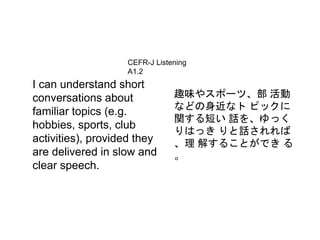
CEFR-J Listening 
A1.2 
I can understand short 
conversations about 
familiar topics (e.g. 
hobbies, sports, club 
activities), provided they 
are delivered in slow and 
clear speech. 
趣味やスポーツ、部活動 
などの身近なトピックに 
関する短い話を、ゆっく 
りはっきりと話されれば 
、理解することができる 
。
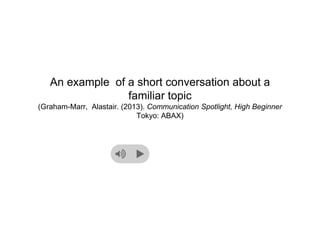
An example of a short conversation about a 
familiar topic 
(Graham-Marr, Alastair. (2013). Communication Spotlight, High Beginner 
Tokyo: ABAX)
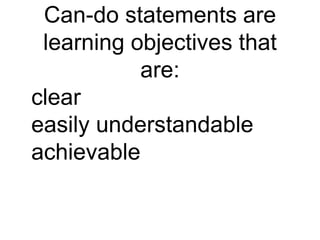
Can-do statements are 
learning objectives that 
are: 
clear 
easily understandable 
achievable
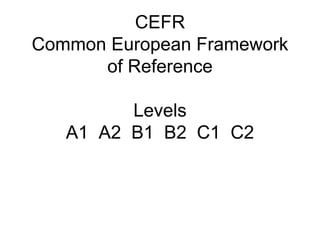
CEFR 
Common European Framework 
of Reference 
Levels 
A1 A2 B1 B2 C1 C2
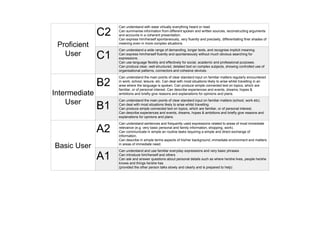
Proficient 
User 
C2 
Can understand with ease virtually everything heard or read. 
Can summarise information from different spoken and written sources, reconstructing arguments 
and accounts in a coherent presentation. 
Can express him/herself spontaneously, very fluently and precisely, differentiating finer shades of 
meaning even in more complex situations. 
C1 
Can understand a wide range of demanding, longer texts, and recognise implicit meaning. 
Can express him/herself fluently and spontaneously without much obvious searching for 
expressions. 
Can use language flexibly and effectively for social, academic and professional purposes. 
Can produce clear, well-structured, detailed text on complex subjects, showing controlled use of 
organisational patterns, connectors and cohesive devices. 
Intermediate 
User 
B2 
Can understand the main points of clear standard input on familiar matters regularly encountered 
in work, school, leisure, etc. Can deal with most situations likely to arise whilst travelling in an 
area where the language is spoken. Can produce simple connected text on topics, which are 
familiar, or of personal interest. Can describe experiences and events, dreams, hopes & 
ambitions and briefly give reasons and explanations for opinions and plans. 
B1 
Can understand the main points of clear standard input on familiar matters (school, work etc). 
Can deal with most situations likely to arise whilst travelling 
Can produce simple connected text on topics, which are familiar, or of personal interest. 
Can describe experiences and events, dreams, hopes & ambitions and briefly give reasons and 
explanations for opinions and plans. 
Basic User 
A2 
Can understand sentences and frequently used expressions related to areas of most immediate 
relevance (e.g. very basic personal and family information, shopping, work). 
Can communicate in simple an routine tasks requiring a simple and direct exchange of 
information. 
Can describe in simple terms aspects of his/her background, immediate environment and matters 
in areas of immediate need. 
A1 
Can understand and use familiar everyday expressions and very basic phrases 
Can introduce him/herself and others 
Can ask and answer questions about personal details such as where he/she lives, people he/she 
knows and things he/she has 
(provided the other person talks slowly and clearly and is prepared to help)
Basic User 
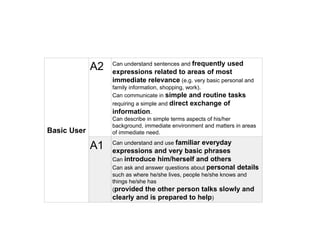
A2 Can understand sentences and frequently used 
expressions related to areas of most 
immediate relevance (e.g. very basic personal and 
family information, shopping, work). 
Can communicate in simple and routine tasks 
requiring a simple and direct exchange of 
information. 
Can describe in simple terms aspects of his/her 
background, immediate environment and matters in areas 
of immediate need. 
A1 Can understand and use familiar everyday 
expressions and very basic phrases 
Can introduce him/herself and others 
Can ask and answer questions about personal details 
such as where he/she lives, people he/she knows and 
things he/she has 
(provided the other person talks slowly and 
clearly and is prepared to help)
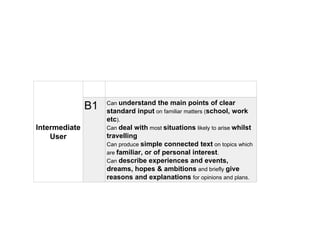
Intermediate 
User 
B1 Can understand the main points of clear 
standard input on familiar matters (school, work 
etc). 
Can deal with most situations likely to arise whilst 
travelling 
Can produce simple connected text on topics which 
are familiar, or of personal interest. 
Can describe experiences and events, 
dreams, hopes & ambitions and briefly give 
reasons and explanations for opinions and plans.
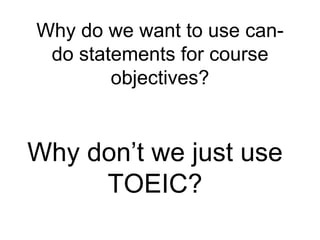
Why do we want to use can-do 
statements for course 
objectives? 
Why don’t we just use 
TOEIC?
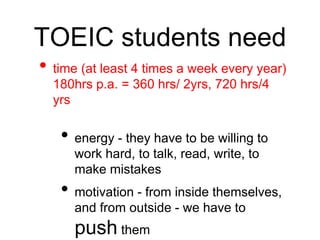
TOEIC students need 
• time (at least 4 times a week every year) 
180hrs p.a. = 360 hrs/ 2yrs, 720 hrs/4 
yrs 
• energy - they have to be willing to 
work hard, to talk, read, write, to 
make mistakes 
• motivation - from inside themselves, 
and from outside - we have to 
push them
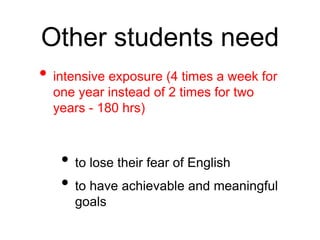
Other students need 
• intensive exposure (4 times a week for 
one year instead of 2 times for two 
years - 180 hrs) 
• to lose their fear of English 
• to have achievable and meaningful 
goals
TOEIC objectives are appropriate for 
higher level students and those who 
are motivated to achieve a useful 
TOEIC score (600 ++) 
Most students will see little increase in 
TOEIC scores, but can see 
improvement through can-do 
statements
What do we need to 
do? 
the teachers need to .... 
• agree to achievable and meaningful 
goals - teach to ‘can-do’ standards (the 
European framework - Japan) 
• choose textbooks that address these 
standards
the Language Centre needs to .... 
• trial can-do statements 
• produce or collect materials 
• recommend (or require?) textbooks 
• support teachers in standardising 
assessment 
• get rid of distinction between Japanese 
and non-Japanese teacher roles
Opinions please 
• can-do statements 
• support from Language Centre 
• required texts or recommended texts?

What are can do statements

  • 1.
    What are can-do statements, why do we want to use them, and how do we do it?
  • 2.
    What are cando statements? • Things that a student (I) can do in English • “I can understand short conversations about familiar topics (e.g. hobbies, sports, club activities), provided they are delivered in slow and clear speech. • ”
  • 3.
    CEFR-J Listening A1.2 I can understand short conversations about familiar topics (e.g. hobbies, sports, club activities), provided they are delivered in slow and clear speech. 趣味やスポーツ、部活動 などの身近なトピックに 関する短い話を、ゆっく りはっきりと話されれば 、理解することができる 。
  • 4.
    An example ofa short conversation about a familiar topic (Graham-Marr, Alastair. (2013). Communication Spotlight, High Beginner Tokyo: ABAX)
  • 5.
    Can-do statements are learning objectives that are: clear easily understandable achievable
  • 6.
    CEFR Common EuropeanFramework of Reference Levels A1 A2 B1 B2 C1 C2
  • 7.
    Proficient User C2 Can understand with ease virtually everything heard or read. Can summarise information from different spoken and written sources, reconstructing arguments and accounts in a coherent presentation. Can express him/herself spontaneously, very fluently and precisely, differentiating finer shades of meaning even in more complex situations. C1 Can understand a wide range of demanding, longer texts, and recognise implicit meaning. Can express him/herself fluently and spontaneously without much obvious searching for expressions. Can use language flexibly and effectively for social, academic and professional purposes. Can produce clear, well-structured, detailed text on complex subjects, showing controlled use of organisational patterns, connectors and cohesive devices. Intermediate User B2 Can understand the main points of clear standard input on familiar matters regularly encountered in work, school, leisure, etc. Can deal with most situations likely to arise whilst travelling in an area where the language is spoken. Can produce simple connected text on topics, which are familiar, or of personal interest. Can describe experiences and events, dreams, hopes & ambitions and briefly give reasons and explanations for opinions and plans. B1 Can understand the main points of clear standard input on familiar matters (school, work etc). Can deal with most situations likely to arise whilst travelling Can produce simple connected text on topics, which are familiar, or of personal interest. Can describe experiences and events, dreams, hopes & ambitions and briefly give reasons and explanations for opinions and plans. Basic User A2 Can understand sentences and frequently used expressions related to areas of most immediate relevance (e.g. very basic personal and family information, shopping, work). Can communicate in simple an routine tasks requiring a simple and direct exchange of information. Can describe in simple terms aspects of his/her background, immediate environment and matters in areas of immediate need. A1 Can understand and use familiar everyday expressions and very basic phrases Can introduce him/herself and others Can ask and answer questions about personal details such as where he/she lives, people he/she knows and things he/she has (provided the other person talks slowly and clearly and is prepared to help)
  • 8.
    Basic User A2Can understand sentences and frequently used expressions related to areas of most immediate relevance (e.g. very basic personal and family information, shopping, work). Can communicate in simple and routine tasks requiring a simple and direct exchange of information. Can describe in simple terms aspects of his/her background, immediate environment and matters in areas of immediate need. A1 Can understand and use familiar everyday expressions and very basic phrases Can introduce him/herself and others Can ask and answer questions about personal details such as where he/she lives, people he/she knows and things he/she has (provided the other person talks slowly and clearly and is prepared to help)
  • 9.
    Intermediate User B1Can understand the main points of clear standard input on familiar matters (school, work etc). Can deal with most situations likely to arise whilst travelling Can produce simple connected text on topics which are familiar, or of personal interest. Can describe experiences and events, dreams, hopes & ambitions and briefly give reasons and explanations for opinions and plans.
  • 10.
    Why do wewant to use can-do statements for course objectives? Why don’t we just use TOEIC?
  • 11.
    TOEIC students need • time (at least 4 times a week every year) 180hrs p.a. = 360 hrs/ 2yrs, 720 hrs/4 yrs • energy - they have to be willing to work hard, to talk, read, write, to make mistakes • motivation - from inside themselves, and from outside - we have to push them
  • 12.
    Other students need • intensive exposure (4 times a week for one year instead of 2 times for two years - 180 hrs) • to lose their fear of English • to have achievable and meaningful goals
  • 13.
    TOEIC objectives areappropriate for higher level students and those who are motivated to achieve a useful TOEIC score (600 ++) Most students will see little increase in TOEIC scores, but can see improvement through can-do statements
  • 14.
    What do weneed to do? the teachers need to .... • agree to achievable and meaningful goals - teach to ‘can-do’ standards (the European framework - Japan) • choose textbooks that address these standards
  • 15.
    the Language Centreneeds to .... • trial can-do statements • produce or collect materials • recommend (or require?) textbooks • support teachers in standardising assessment • get rid of distinction between Japanese and non-Japanese teacher roles
  • 16.
    Opinions please •can-do statements • support from Language Centre • required texts or recommended texts?