THE COMMON EUROPEAN 
FRAMEWORK OF 
REFERENCE FOR LANGUAGES: 
Learning, Teaching, Assessment 
MARCIA BENTO ZANOTELI
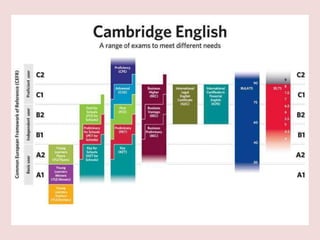
WHAT IS THE CEFR? 
The Common European Framework of Reference for Languages: Learning, 
teaching, assessment (CEFR) was created by the Council of Europe to provide ‘a
It describes in a comprehensive way what language learners 
have to learn to do in order to use a language for communication 
communication and what knowledge and skills they have to 
develop so as to be able to act effectively. The description also 
covers the cultural context in which language is set. The 
Framework also defines levels of proficiency which allow learners’ 
progress to be measured at each stage of learning and on a life-long 
basis. 
Common European Framework Of Reference For Languages: Learning, Teaching, Assessment (P.10)
IT DESCRIBES LANGUAGE LEARNERS’ ABILITY IN TERMS OF SPEAKING, 
READING, LISTENING AND WRITING AT SIX REFERENCE LEVELS. These six
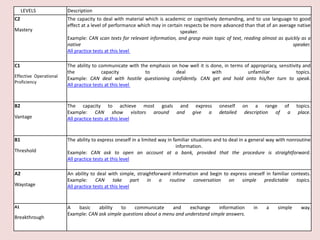
LEVELS Description 
C2 
Mastery 
The capacity to deal with material which is academic or cognitively demanding, and to use language to good 
effect at a level of performance which may in certain respects be more advanced than that of an average native 
speaker. 
Example: CAN scan texts for relevant information, and grasp main topic of text, reading almost as quickly as a 
native speaker. 
All practice tests at this level 
C1 
Effective Operational 
Proficiency 
The ability to communicate with the emphasis on how well it is done, in terms of appropriacy, sensitivity and 
the capacity to deal with unfamiliar topics. 
Example: CAN deal with hostile questioning confidently. CAN get and hold onto his/her turn to speak. 
All practice tests at this level 
B2 
Vantage 
The capacity to achieve most goals and express oneself on a range of topics. 
Example: CAN show visitors around and give a detailed description of a place. 
All practice tests at this level 
B1 
Threshold 
The ability to express oneself in a limited way in familiar situations and to deal in a general way with nonroutine 
information. 
Example: CAN ask to open an account at a bank, provided that the procedure is straightforward. 
All practice tests at this level 
A2 
Waystage 
An ability to deal with simple, straightforward information and begin to express oneself in familiar contexts. 
Example: CAN take part in a routine conversation on simple predictable topics. 
All practice tests at this level 
A1 
Breakthrough 
A basic ability to communicate and exchange information in a simple way. 
Example: CAN ask simple questions about a menu and understand simple answers.
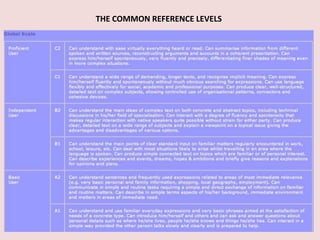
THE COMMON REFERENCE LEVELS
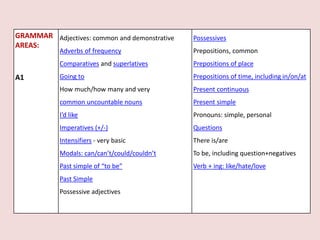
GRAMMAR 
AREAS: 
A1 
Adjectives: common and demonstrative 
Adverbs of frequency 
Comparatives and superlatives 
Going to 
How much/how many and very 
common uncountable nouns 
I’d like 
Imperatives (+/-) 
Intensifiers - very basic 
Modals: can/can’t/could/couldn’t 
Past simple of “to be” 
Past Simple 
Possessive adjectives 
Possessives 
Prepositions, common 
Prepositions of place 
Prepositions of time, including in/on/at 
Present continuous 
Present simple 
Pronouns: simple, personal 
Questions 
There is/are 
To be, including question+negatives 
Verb + ing: like/hate/love
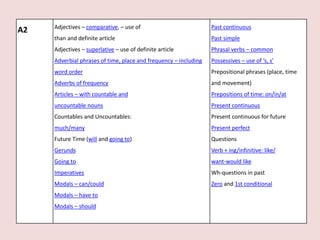
A2 Adjectives – comparative, – use of 
than and definite article 
Adjectives – superlative – use of definite article 
Adverbial phrases of time, place and frequency – including 
word order 
Adverbs of frequency 
Articles – with countable and 
uncountable nouns 
Countables and Uncountables: 
much/many 
Future Time (will and going to) 
Gerunds 
Going to 
Imperatives 
Modals – can/could 
Modals – have to 
Modals – should 
Past continuous 
Past simple 
Phrasal verbs – common 
Possessives – use of ‘s, s’ 
Prepositional phrases (place, time 
and movement) 
Prepositions of time: on/in/at 
Present continuous 
Present continuous for future 
Present perfect 
Questions 
Verb + ing/infinitive: like/ 
want-would like 
Wh-questions in past 
Zero and 1st conditional
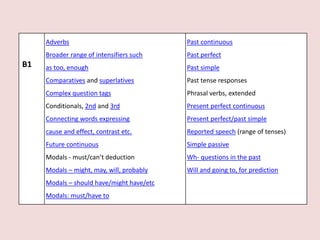
B1 
Adverbs 
Broader range of intensifiers such 
as too, enough 
Comparatives and superlatives 
Complex question tags 
Conditionals, 2nd and 3rd 
Connecting words expressing 
cause and effect, contrast etc. 
Future continuous 
Modals - must/can’t deduction 
Modals – might, may, will, probably 
Modals – should have/might have/etc 
Modals: must/have to 
Past continuous 
Past perfect 
Past simple 
Past tense responses 
Phrasal verbs, extended 
Present perfect continuous 
Present perfect/past simple 
Reported speech (range of tenses) 
Simple passive 
Wh- questions in the past 
Will and going to, for prediction
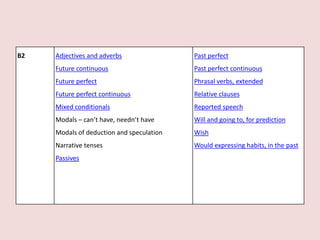
B2 Adjectives and adverbs 
Future continuous 
Future perfect 
Future perfect continuous 
Mixed conditionals 
Modals – can’t have, needn’t have 
Modals of deduction and speculation 
Narrative tenses 
Passives 
Past perfect 
Past perfect continuous 
Phrasal verbs, extended 
Relative clauses 
Reported speech 
Will and going to, for prediction 
Wish 
Would expressing habits, in the past
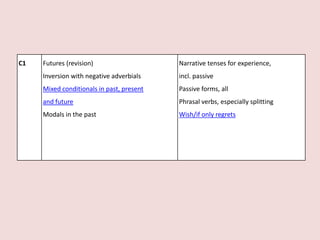
C1 Futures (revision) 
Inversion with negative adverbials 
Mixed conditionals in past, present 
and future 
Modals in the past 
Narrative tenses for experience, 
incl. passive 
Passive forms, all 
Phrasal verbs, especially splitting 
Wish/if only regrets
THE COMMUNICATIVE APPROACH 
The CEFR invites readers to be explicit about their own beliefs 
about the process of learning; which teaching approaches they
The text of the CEFR emphasises learners’ 
‘communicative needs’, including dealing with the business of 
business of everyday life, exchanging information and ideas, 
and ideas, and achieving wider and deeper intercultural 
understanding. This is to be achieved by ‘basing language 
language teaching and learning on the needs, motivations, 
characteristics and resources of learners.’ (2001a:3) 
This conveys the CEFR’s communicative, action-oriented approach

Cefr presentation

  • 1.
    THE COMMON EUROPEAN FRAMEWORK OF REFERENCE FOR LANGUAGES: Learning, Teaching, Assessment MARCIA BENTO ZANOTELI
  • 2.
    WHAT IS THECEFR? The Common European Framework of Reference for Languages: Learning, teaching, assessment (CEFR) was created by the Council of Europe to provide ‘a
  • 3.
    It describes ina comprehensive way what language learners have to learn to do in order to use a language for communication communication and what knowledge and skills they have to develop so as to be able to act effectively. The description also covers the cultural context in which language is set. The Framework also defines levels of proficiency which allow learners’ progress to be measured at each stage of learning and on a life-long basis. Common European Framework Of Reference For Languages: Learning, Teaching, Assessment (P.10)
  • 5.
    IT DESCRIBES LANGUAGELEARNERS’ ABILITY IN TERMS OF SPEAKING, READING, LISTENING AND WRITING AT SIX REFERENCE LEVELS. These six
  • 6.
    LEVELS Description C2 Mastery The capacity to deal with material which is academic or cognitively demanding, and to use language to good effect at a level of performance which may in certain respects be more advanced than that of an average native speaker. Example: CAN scan texts for relevant information, and grasp main topic of text, reading almost as quickly as a native speaker. All practice tests at this level C1 Effective Operational Proficiency The ability to communicate with the emphasis on how well it is done, in terms of appropriacy, sensitivity and the capacity to deal with unfamiliar topics. Example: CAN deal with hostile questioning confidently. CAN get and hold onto his/her turn to speak. All practice tests at this level B2 Vantage The capacity to achieve most goals and express oneself on a range of topics. Example: CAN show visitors around and give a detailed description of a place. All practice tests at this level B1 Threshold The ability to express oneself in a limited way in familiar situations and to deal in a general way with nonroutine information. Example: CAN ask to open an account at a bank, provided that the procedure is straightforward. All practice tests at this level A2 Waystage An ability to deal with simple, straightforward information and begin to express oneself in familiar contexts. Example: CAN take part in a routine conversation on simple predictable topics. All practice tests at this level A1 Breakthrough A basic ability to communicate and exchange information in a simple way. Example: CAN ask simple questions about a menu and understand simple answers.
  • 7.
  • 8.
    GRAMMAR AREAS: A1 Adjectives: common and demonstrative Adverbs of frequency Comparatives and superlatives Going to How much/how many and very common uncountable nouns I’d like Imperatives (+/-) Intensifiers - very basic Modals: can/can’t/could/couldn’t Past simple of “to be” Past Simple Possessive adjectives Possessives Prepositions, common Prepositions of place Prepositions of time, including in/on/at Present continuous Present simple Pronouns: simple, personal Questions There is/are To be, including question+negatives Verb + ing: like/hate/love
  • 9.
    A2 Adjectives –comparative, – use of than and definite article Adjectives – superlative – use of definite article Adverbial phrases of time, place and frequency – including word order Adverbs of frequency Articles – with countable and uncountable nouns Countables and Uncountables: much/many Future Time (will and going to) Gerunds Going to Imperatives Modals – can/could Modals – have to Modals – should Past continuous Past simple Phrasal verbs – common Possessives – use of ‘s, s’ Prepositional phrases (place, time and movement) Prepositions of time: on/in/at Present continuous Present continuous for future Present perfect Questions Verb + ing/infinitive: like/ want-would like Wh-questions in past Zero and 1st conditional
  • 10.
    B1 Adverbs Broaderrange of intensifiers such as too, enough Comparatives and superlatives Complex question tags Conditionals, 2nd and 3rd Connecting words expressing cause and effect, contrast etc. Future continuous Modals - must/can’t deduction Modals – might, may, will, probably Modals – should have/might have/etc Modals: must/have to Past continuous Past perfect Past simple Past tense responses Phrasal verbs, extended Present perfect continuous Present perfect/past simple Reported speech (range of tenses) Simple passive Wh- questions in the past Will and going to, for prediction
  • 11.
    B2 Adjectives andadverbs Future continuous Future perfect Future perfect continuous Mixed conditionals Modals – can’t have, needn’t have Modals of deduction and speculation Narrative tenses Passives Past perfect Past perfect continuous Phrasal verbs, extended Relative clauses Reported speech Will and going to, for prediction Wish Would expressing habits, in the past
  • 12.
    C1 Futures (revision) Inversion with negative adverbials Mixed conditionals in past, present and future Modals in the past Narrative tenses for experience, incl. passive Passive forms, all Phrasal verbs, especially splitting Wish/if only regrets
  • 13.
    THE COMMUNICATIVE APPROACH The CEFR invites readers to be explicit about their own beliefs about the process of learning; which teaching approaches they
  • 14.
    The text ofthe CEFR emphasises learners’ ‘communicative needs’, including dealing with the business of business of everyday life, exchanging information and ideas, and ideas, and achieving wider and deeper intercultural understanding. This is to be achieved by ‘basing language language teaching and learning on the needs, motivations, characteristics and resources of learners.’ (2001a:3) This conveys the CEFR’s communicative, action-oriented approach