Common European Framework of Reference for Languages: learning, teaching, assessment 
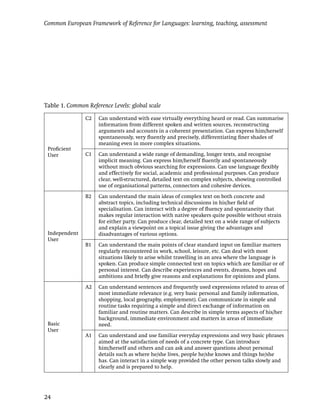
Table 1. Common Reference Levels: global scale 
C2 Can understand with ease virtually everything heard or read. Can summarise 
information from different spoken and written sources, reconstructing 
arguments and accounts in a coherent presentation. Can express him/herself 
spontaneously, very fluently and precisely, differentiating finer shades of 
Proficient 
meaning even in more complex situations. 
User C1 Can understand a wide range of demanding, longer texts, and recognise 
implicit meaning. Can express him/herself fluently and spontaneously 
without much obvious searching for expressions. Can use language flexibly 
and effectively for social, academic and professional purposes. Can produce 
clear, well-structured, detailed text on complex subjects, showing controlled 
use of organisational patterns, connectors and cohesive devices. 
B2 Can understand the main ideas of complex text on both concrete and 
abstract topics, including technical discussions in his/her field of 
specialisation. Can interact with a degree of fluency and spontaneity that 
makes regular interaction with native speakers quite possible without strain 
for either party. Can produce clear, detailed text on a wide range of subjects 
and explain a viewpoint on a topical issue giving the advantages and 
Independent disadvantages of various options. 
User 
B1 Can understand the main points of clear standard input on familiar matters 
regularly encountered in work, school, leisure, etc. Can deal with most 
situations likely to arise whilst travelling in an area where the language is 
spoken. Can produce simple connected text on topics which are familiar or of 
personal interest. Can describe experiences and events, dreams, hopes and 
ambitions and briefly give reasons and explanations for opinions and plans. 
A2 Can understand sentences and frequently used expressions related to areas of 
most immediate relevance (e.g. very basic personal and family information, 
shopping, local geography, employment). Can communicate in simple and 
routine tasks requiring a simple and direct exchange of information on 
familiar and routine matters. Can describe in simple terms aspects of his/her 
background, immediate environment and matters in areas of immediate 
Basic need. 
User 
A1 Can understand and use familiar everyday expressions and very basic phrases 
aimed at the satisfaction of needs of a concrete type. Can introduce 
him/herself and others and can ask and answer questions about personal 
details such as where he/she lives, people he/she knows and things he/she 
has. Can interact in a simple way provided the other person talks slowly and 
clearly and is prepared to help. 
24
Common Reference Levels 
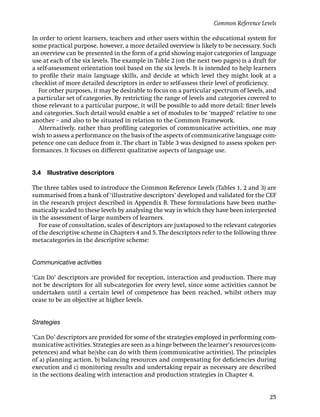
In order to orient learners, teachers and other users within the educational system for 
some practical purpose, however, a more detailed overview is likely to be necessary. Such 
an overview can be presented in the form of a grid showing major categories of language 
use at each of the six levels. The example in Table 2 (on the next two pages) is a draft for 
a self-assessment orientation tool based on the six levels. It is intended to help learners 
to profile their main language skills, and decide at which level they might look at a 
checklist of more detailed descriptors in order to self-assess their level of proficiency. 
For other purposes, it may be desirable to focus on a particular spectrum of levels, and 
a particular set of categories. By restricting the range of levels and categories covered to 
those relevant to a particular purpose, it will be possible to add more detail: finer levels 
and categories. Such detail would enable a set of modules to be ‘mapped’ relative to one 
another – and also to be situated in relation to the Common Framework. 
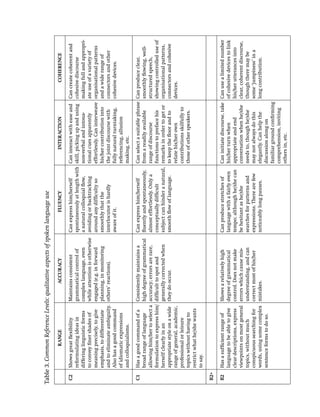
Alternatively, rather than profiling categories of communicative activities, one may 
wish to assess a performance on the basis of the aspects of communicative language com-petence 
one can deduce from it. The chart in Table 3 was designed to assess spoken per-formances. 
It focuses on different qualitative aspects of language use. 
3.4 Illustrative descriptors 
The three tables used to introduce the Common Reference Levels (Tables 1, 2 and 3) are 
summarised from a bank of ‘illustrative descriptors’ developed and validated for the CEF 
in the research project described in Appendix B. These formulations have been mathe-matically 
scaled to these levels by analysing the way in which they have been interpreted 
in the assessment of large numbers of learners. 
For ease of consultation, scales of descriptors are juxtaposed to the relevant categories 
of the descriptive scheme in Chapters 4 and 5. The descriptors refer to the following three 
metacategories in the descriptive scheme: 
Communicative activities 
‘Can Do’ descriptors are provided for reception, interaction and production. There may 
not be descriptors for all sub-categories for every level, since some activities cannot be 
undertaken until a certain level of competence has been reached, whilst others may 
cease to be an objective at higher levels. 
Strategies 
‘Can Do’ descriptors are provided for some of the strategies employed in performing com-municative 
activities. Strategies are seen as a hinge between the learner’s resources (com-petences) 
and what he/she can do with them (communicative activities). The principles 
of a) planning action, b) balancing resources and compensating for deficiencies during 
execution and c) monitoring results and undertaking repair as necessary are described 
in the sections dealing with interaction and production strategies in Chapter 4. 
25
Common European Framework of Reference for Languages: learning, teaching, assessment 
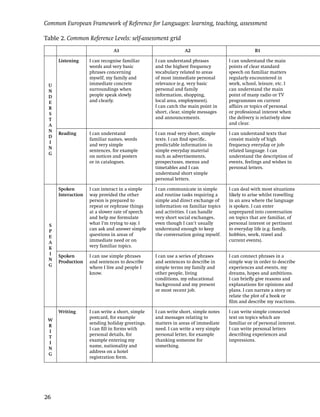
Table 2. Common Reference Levels: self-assessment grid 
26 
A1 A2 B1 
Listening I can recognise familiar I can understand phrases I can understand the main 
words and very basic and the highest frequency points of clear standard 
phrases concerning vocabulary related to areas speech on familiar matters 
myself, my family and of most immediate personal regularly encountered in 
immediate concrete relevance (e.g. very basic work, school, leisure, etc. I 
surroundings when personal and family can understand the main 
people speak slowly information, shopping, point of many radio or TV 
and clearly. local area, employment). programmes on current 
I can catch the main point in affairs or topics of personal 
short, clear, simple messages or professional interest when 
and announcements. the delivery is relatively slow 
and clear. 
Reading I can understand I can read very short, simple I can understand texts that 
familiar names, words texts. I can find specific, consist mainly of high 
and very simple predictable information in frequency everyday or job-sentences, 
for example simple everyday material related language. I can 
on notices and posters such as advertisements, understand the description of 
or in catalogues. prospectuses, menus and events, feelings and wishes in 
timetables and I can personal letters. 
understand short simple 
personal letters. 
Spoken I can interact in a simple I can communicate in simple I can deal with most situations 
Interaction way provided the other and routine tasks requiring a likely to arise whilst travelling 
person is prepared to simple and direct exchange of in an area where the language 
repeat or rephrase things information on familiar topics is spoken. I can enter 
at a slower rate of speech and activities. I can handle unprepared into conversation 
and help me formulate very short social exchanges, on topics that are familiar, of 
what I’m trying to say. I even though I can’t usually personal interest or pertinent 
can ask and answer simple understand enough to keep to everyday life (e.g. family, 
questions in areas of the conversation going myself. hobbies, work, travel and 
immediate need or on current events). 
very familiar topics. 
Spoken I can use simple phrases I can use a series of phrases I can connect phrases in a 
Production and sentences to describe and sentences to describe in simple way in order to describe 
where I live and people I simple terms my family and experiences and events, my 
know. other people, living dreams, hopes and ambitions. 
conditions, my educational I can briefly give reasons and 
background and my present explanations for opinions and 
or most recent job. plans. I can narrate a story or 
relate the plot of a book or 
film and describe my reactions. 
Writing I can write a short, simple I can write short, simple notes I can write simple connected 
postcard, for example and messages relating to text on topics which are 
sending holiday greetings. matters in areas of immediate familiar or of personal interest. 
I can fill in forms with need. I can write a very simple I can write personal letters 
personal details, for personal letter, for example describing experiences and 
example entering my thanking someone for impressions. 
name, nationality and something. 
address on a hotel 
registration form. 
U 
N 
D 
E 
R 
S 
T 
A 
N 
D 
I 
N 
G 
S 
P 
E 
A 
K 
I 
N 
G 
W 
R 
I 
T 
I 
N 
G
Common Reference Levels 
27 
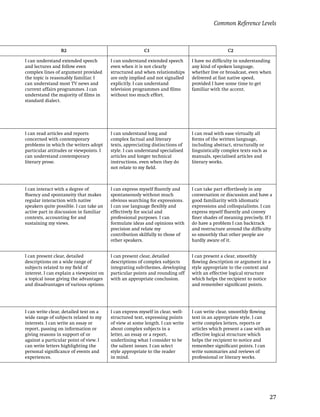
B2 C1 C2 
I can understand extended speech I can understand extended speech I have no difficulty in understanding 
and lectures and follow even even when it is not clearly any kind of spoken language, 
complex lines of argument provided structured and when relationships whether live or broadcast, even when 
the topic is reasonably familiar. I are only implied and not signalled delivered at fast native speed, 
can understand most TV news and explicitly. I can understand provided I have some time to get 
current affairs programmes. I can television programmes and films familiar with the accent. 
understand the majority of films in without too much effort. 
standard dialect. 
I can read articles and reports I can understand long and I can read with ease virtually all 
concerned with contemporary complex factual and literary forms of the written language, 
problems in which the writers adopt texts, appreciating distinctions of including abstract, structurally or 
particular attitudes or viewpoints. I style. I can understand specialised linguistically complex texts such as 
can understand contemporary articles and longer technical manuals, specialised articles and 
literary prose. instructions, even when they do literary works. 
not relate to my field. 
I can interact with a degree of I can express myself fluently and I can take part effortlessly in any 
fluency and spontaneity that makes spontaneously without much conversation or discussion and have a 
regular interaction with native obvious searching for expressions. good familiarity with idiomatic 
speakers quite possible. I can take an I can use language flexibly and expressions and colloquialisms. I can 
active part in discussion in familiar effectively for social and express myself fluently and convey 
contexts, accounting for and professional purposes. I can finer shades of meaning precisely. If I 
sustaining my views. formulate ideas and opinions with do have a problem I can backtrack 
precision and relate my and restructure around the difficulty 
contribution skilfully to those of so smoothly that other people are 
other speakers. hardly aware of it. 
I can present clear, detailed I can present clear, detailed I can present a clear, smoothly 
descriptions on a wide range of descriptions of complex subjects flowing description or argument in a 
subjects related to my field of integrating sub-themes, developing style appropriate to the context and 
interest. I can explain a viewpoint on particular points and rounding off with an effective logical structure 
a topical issue giving the advantages with an appropriate conclusion. which helps the recipient to notice 
and disadvantages of various options. and remember significant points. 
I can write clear, detailed text on a I can express myself in clear, well- I can write clear, smoothly flowing 
wide range of subjects related to my structured text, expressing points text in an appropriate style. I can 
interests. I can write an essay or of view at some length. I can write write complex letters, reports or 
report, passing on information or about complex subjects in a articles which present a case with an 
giving reasons in support of or letter, an essay or a report, effective logical structure which 
against a particular point of view. I underlining what I consider to be helps the recipient to notice and 
can write letters highlighting the the salient issues. I can select remember significant points. I can 
personal significance of events and style appropriate to the reader write summaries and reviews of 
experiences. in mind. professional or literary works.
Table 3. Common Reference Levels: qualitative aspects of spoken language use 
RANGE ACCURACY FLUENCY INTERACTION COHERENCE 
C2 Shows great flexibility Maintains consistent Can express him/herself Can interact with ease and Can create coherent and 
reformulating ideas in grammatical control of spontaneously at length with skill, picking up and using cohesive discourse 
differing linguistic forms complex language, even a natural colloquial flow, non-verbal and intona- making full and appropri-to 
convey finer shades of while attention is otherwise avoiding or backtracking tional cues apparently ate use of a variety of 
meaning precisely, to give engaged (e.g. in forward around any difficulty so effortlessly. Can interweave organisational patterns 
emphasis, to differentiate planning, in monitoring smoothly that the his/her contribution into and a wide range of 
and to eliminate ambiguity. others’ reactions). interlocutor is hardly the joint discourse with connectors and other 
Also has a good command aware of it. fully natural turntaking, cohesive devices. 
of idiomatic expressions referencing, allusion 
and colloquialisms. making, etc. 
C1 Has a good command of a Consistently maintains a Can express him/herself Can select a suitable phrase Can produce clear, 
broad range of language high degree of grammatical fluently and spontaneously, from a readily available smoothly flowing, well-allowing 
him/her to select a accuracy; errors are rare, almost effortlessly. Only a range of discourse structured speech, 
formulation to express him/ difficult to spot and conceptually difficult functions to preface his showing controlled use of 
herself clearly in an generally corrected when subject can hinder a natural, remarks in order to get or organisational patterns, 
appropriate style on a wide they do occur. smooth flow of language. to keep the floor and to connectors and cohesive 
range of general, academic, relate his/her own devices. 
professional or leisure contributions skilfully to 
topics without having to those of other speakers. 
restrict what he/she wants 
to say. 
B2+ 
B2 Has a sufficient range of Shows a relatively high Can produce stretches of Can initiate discourse, take Can use a limited number 
language to be able to give degree of grammatical language with a fairly even his/her turn when of cohesive devices to link 
clear descriptions, express control. Does not make tempo; although he/she can appropriate and end his/her utterances into 
viewpoints on most general errors which cause mis- be hesitant as he/she conversation when he/she clear, coherent discourse, 
topics, without much understanding, and can searches for patterns and needs to, though he/she though there may be 
conspicuous searching for correct most of his/her expressions. There are few may not always do this some ‘jumpiness’ in a 
words, using some complex mistakes. noticeably long pauses. elegantly. Can help the long contribution. 
sentence forms to do so. discussion along on 
familiar ground confirming 
comprehension, inviting 
others in, etc.
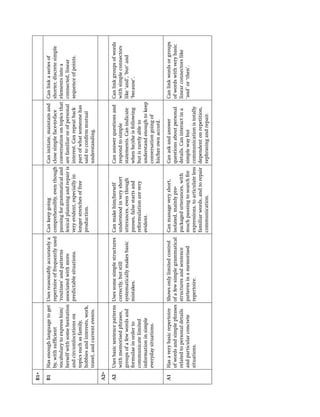
B1+ 
B1 Has enough language to get Uses reasonably accurately a Can keep going Can initiate, maintain and Can link a series of 
by, with sufficient repertoire of frequently used comprehensibly, even though close simple face-to-face shorter, discrete simple 
vocabulary to express him/ ‘routines’ and patterns pausing for grammatical and conversation on topics that elements into a 
herself with some hesitation associated with more lexical planning and repair is are familiar or of personal connected, linear 
and circumlocutions on predictable situations. very evident, especially in interest. Can repeat back sequence of points. 
topics such as family, longer stretches of free part of what someone has 
hobbies and interests, work, production. said to confirm mutual 
travel, and current events. understanding. 
A2+ 
A2 Uses basic sentence patterns Uses some simple structures Can make him/herself Can answer questions and Can link groups of words 
with memorised phrases, correctly, but still understood in very short respond to simple with simple connectors 
groups of a few words and systematically makes basic utterances, even though statements. Can indicate like ‘and’, ‘but’ and 
formulae in order to mistakes. pauses, false starts and when he/she is following ‘because’. 
communicate limited reformulation are very but is rarely able to 
information in simple evident. understand enough to keep 
everyday situations. conversation going of 
his/her own accord. 
A1 Has a very basic repertoire Shows only limited control Can manage very short, Can ask and answer Can link words or groups 
of words and simple phrases of a few simple grammatical isolated, mainly pre- questions about personal of words with very basic 
related to personal details structures and sentence packaged utterances, with details. Can interact in a linear connectors like 
and particular concrete patterns in a memorised much pausing to search for simple way but ‘and’ or ‘then’. 
situations. repertoire. expressions, to articulate less communication is totally 
familiar words, and to repair dependent on repetition, 
communication. rephrasing and repair.

CEFR

  • 1.
    Common European Frameworkof Reference for Languages: learning, teaching, assessment Table 1. Common Reference Levels: global scale C2 Can understand with ease virtually everything heard or read. Can summarise information from different spoken and written sources, reconstructing arguments and accounts in a coherent presentation. Can express him/herself spontaneously, very fluently and precisely, differentiating finer shades of Proficient meaning even in more complex situations. User C1 Can understand a wide range of demanding, longer texts, and recognise implicit meaning. Can express him/herself fluently and spontaneously without much obvious searching for expressions. Can use language flexibly and effectively for social, academic and professional purposes. Can produce clear, well-structured, detailed text on complex subjects, showing controlled use of organisational patterns, connectors and cohesive devices. B2 Can understand the main ideas of complex text on both concrete and abstract topics, including technical discussions in his/her field of specialisation. Can interact with a degree of fluency and spontaneity that makes regular interaction with native speakers quite possible without strain for either party. Can produce clear, detailed text on a wide range of subjects and explain a viewpoint on a topical issue giving the advantages and Independent disadvantages of various options. User B1 Can understand the main points of clear standard input on familiar matters regularly encountered in work, school, leisure, etc. Can deal with most situations likely to arise whilst travelling in an area where the language is spoken. Can produce simple connected text on topics which are familiar or of personal interest. Can describe experiences and events, dreams, hopes and ambitions and briefly give reasons and explanations for opinions and plans. A2 Can understand sentences and frequently used expressions related to areas of most immediate relevance (e.g. very basic personal and family information, shopping, local geography, employment). Can communicate in simple and routine tasks requiring a simple and direct exchange of information on familiar and routine matters. Can describe in simple terms aspects of his/her background, immediate environment and matters in areas of immediate Basic need. User A1 Can understand and use familiar everyday expressions and very basic phrases aimed at the satisfaction of needs of a concrete type. Can introduce him/herself and others and can ask and answer questions about personal details such as where he/she lives, people he/she knows and things he/she has. Can interact in a simple way provided the other person talks slowly and clearly and is prepared to help. 24
  • 2.
    Common Reference Levels In order to orient learners, teachers and other users within the educational system for some practical purpose, however, a more detailed overview is likely to be necessary. Such an overview can be presented in the form of a grid showing major categories of language use at each of the six levels. The example in Table 2 (on the next two pages) is a draft for a self-assessment orientation tool based on the six levels. It is intended to help learners to profile their main language skills, and decide at which level they might look at a checklist of more detailed descriptors in order to self-assess their level of proficiency. For other purposes, it may be desirable to focus on a particular spectrum of levels, and a particular set of categories. By restricting the range of levels and categories covered to those relevant to a particular purpose, it will be possible to add more detail: finer levels and categories. Such detail would enable a set of modules to be ‘mapped’ relative to one another – and also to be situated in relation to the Common Framework. Alternatively, rather than profiling categories of communicative activities, one may wish to assess a performance on the basis of the aspects of communicative language com-petence one can deduce from it. The chart in Table 3 was designed to assess spoken per-formances. It focuses on different qualitative aspects of language use. 3.4 Illustrative descriptors The three tables used to introduce the Common Reference Levels (Tables 1, 2 and 3) are summarised from a bank of ‘illustrative descriptors’ developed and validated for the CEF in the research project described in Appendix B. These formulations have been mathe-matically scaled to these levels by analysing the way in which they have been interpreted in the assessment of large numbers of learners. For ease of consultation, scales of descriptors are juxtaposed to the relevant categories of the descriptive scheme in Chapters 4 and 5. The descriptors refer to the following three metacategories in the descriptive scheme: Communicative activities ‘Can Do’ descriptors are provided for reception, interaction and production. There may not be descriptors for all sub-categories for every level, since some activities cannot be undertaken until a certain level of competence has been reached, whilst others may cease to be an objective at higher levels. Strategies ‘Can Do’ descriptors are provided for some of the strategies employed in performing com-municative activities. Strategies are seen as a hinge between the learner’s resources (com-petences) and what he/she can do with them (communicative activities). The principles of a) planning action, b) balancing resources and compensating for deficiencies during execution and c) monitoring results and undertaking repair as necessary are described in the sections dealing with interaction and production strategies in Chapter 4. 25
  • 3.
    Common European Frameworkof Reference for Languages: learning, teaching, assessment Table 2. Common Reference Levels: self-assessment grid 26 A1 A2 B1 Listening I can recognise familiar I can understand phrases I can understand the main words and very basic and the highest frequency points of clear standard phrases concerning vocabulary related to areas speech on familiar matters myself, my family and of most immediate personal regularly encountered in immediate concrete relevance (e.g. very basic work, school, leisure, etc. I surroundings when personal and family can understand the main people speak slowly information, shopping, point of many radio or TV and clearly. local area, employment). programmes on current I can catch the main point in affairs or topics of personal short, clear, simple messages or professional interest when and announcements. the delivery is relatively slow and clear. Reading I can understand I can read very short, simple I can understand texts that familiar names, words texts. I can find specific, consist mainly of high and very simple predictable information in frequency everyday or job-sentences, for example simple everyday material related language. I can on notices and posters such as advertisements, understand the description of or in catalogues. prospectuses, menus and events, feelings and wishes in timetables and I can personal letters. understand short simple personal letters. Spoken I can interact in a simple I can communicate in simple I can deal with most situations Interaction way provided the other and routine tasks requiring a likely to arise whilst travelling person is prepared to simple and direct exchange of in an area where the language repeat or rephrase things information on familiar topics is spoken. I can enter at a slower rate of speech and activities. I can handle unprepared into conversation and help me formulate very short social exchanges, on topics that are familiar, of what I’m trying to say. I even though I can’t usually personal interest or pertinent can ask and answer simple understand enough to keep to everyday life (e.g. family, questions in areas of the conversation going myself. hobbies, work, travel and immediate need or on current events). very familiar topics. Spoken I can use simple phrases I can use a series of phrases I can connect phrases in a Production and sentences to describe and sentences to describe in simple way in order to describe where I live and people I simple terms my family and experiences and events, my know. other people, living dreams, hopes and ambitions. conditions, my educational I can briefly give reasons and background and my present explanations for opinions and or most recent job. plans. I can narrate a story or relate the plot of a book or film and describe my reactions. Writing I can write a short, simple I can write short, simple notes I can write simple connected postcard, for example and messages relating to text on topics which are sending holiday greetings. matters in areas of immediate familiar or of personal interest. I can fill in forms with need. I can write a very simple I can write personal letters personal details, for personal letter, for example describing experiences and example entering my thanking someone for impressions. name, nationality and something. address on a hotel registration form. U N D E R S T A N D I N G S P E A K I N G W R I T I N G
  • 4.
    Common Reference Levels 27 B2 C1 C2 I can understand extended speech I can understand extended speech I have no difficulty in understanding and lectures and follow even even when it is not clearly any kind of spoken language, complex lines of argument provided structured and when relationships whether live or broadcast, even when the topic is reasonably familiar. I are only implied and not signalled delivered at fast native speed, can understand most TV news and explicitly. I can understand provided I have some time to get current affairs programmes. I can television programmes and films familiar with the accent. understand the majority of films in without too much effort. standard dialect. I can read articles and reports I can understand long and I can read with ease virtually all concerned with contemporary complex factual and literary forms of the written language, problems in which the writers adopt texts, appreciating distinctions of including abstract, structurally or particular attitudes or viewpoints. I style. I can understand specialised linguistically complex texts such as can understand contemporary articles and longer technical manuals, specialised articles and literary prose. instructions, even when they do literary works. not relate to my field. I can interact with a degree of I can express myself fluently and I can take part effortlessly in any fluency and spontaneity that makes spontaneously without much conversation or discussion and have a regular interaction with native obvious searching for expressions. good familiarity with idiomatic speakers quite possible. I can take an I can use language flexibly and expressions and colloquialisms. I can active part in discussion in familiar effectively for social and express myself fluently and convey contexts, accounting for and professional purposes. I can finer shades of meaning precisely. If I sustaining my views. formulate ideas and opinions with do have a problem I can backtrack precision and relate my and restructure around the difficulty contribution skilfully to those of so smoothly that other people are other speakers. hardly aware of it. I can present clear, detailed I can present clear, detailed I can present a clear, smoothly descriptions on a wide range of descriptions of complex subjects flowing description or argument in a subjects related to my field of integrating sub-themes, developing style appropriate to the context and interest. I can explain a viewpoint on particular points and rounding off with an effective logical structure a topical issue giving the advantages with an appropriate conclusion. which helps the recipient to notice and disadvantages of various options. and remember significant points. I can write clear, detailed text on a I can express myself in clear, well- I can write clear, smoothly flowing wide range of subjects related to my structured text, expressing points text in an appropriate style. I can interests. I can write an essay or of view at some length. I can write write complex letters, reports or report, passing on information or about complex subjects in a articles which present a case with an giving reasons in support of or letter, an essay or a report, effective logical structure which against a particular point of view. I underlining what I consider to be helps the recipient to notice and can write letters highlighting the the salient issues. I can select remember significant points. I can personal significance of events and style appropriate to the reader write summaries and reviews of experiences. in mind. professional or literary works.
  • 5.
    Table 3. CommonReference Levels: qualitative aspects of spoken language use RANGE ACCURACY FLUENCY INTERACTION COHERENCE C2 Shows great flexibility Maintains consistent Can express him/herself Can interact with ease and Can create coherent and reformulating ideas in grammatical control of spontaneously at length with skill, picking up and using cohesive discourse differing linguistic forms complex language, even a natural colloquial flow, non-verbal and intona- making full and appropri-to convey finer shades of while attention is otherwise avoiding or backtracking tional cues apparently ate use of a variety of meaning precisely, to give engaged (e.g. in forward around any difficulty so effortlessly. Can interweave organisational patterns emphasis, to differentiate planning, in monitoring smoothly that the his/her contribution into and a wide range of and to eliminate ambiguity. others’ reactions). interlocutor is hardly the joint discourse with connectors and other Also has a good command aware of it. fully natural turntaking, cohesive devices. of idiomatic expressions referencing, allusion and colloquialisms. making, etc. C1 Has a good command of a Consistently maintains a Can express him/herself Can select a suitable phrase Can produce clear, broad range of language high degree of grammatical fluently and spontaneously, from a readily available smoothly flowing, well-allowing him/her to select a accuracy; errors are rare, almost effortlessly. Only a range of discourse structured speech, formulation to express him/ difficult to spot and conceptually difficult functions to preface his showing controlled use of herself clearly in an generally corrected when subject can hinder a natural, remarks in order to get or organisational patterns, appropriate style on a wide they do occur. smooth flow of language. to keep the floor and to connectors and cohesive range of general, academic, relate his/her own devices. professional or leisure contributions skilfully to topics without having to those of other speakers. restrict what he/she wants to say. B2+ B2 Has a sufficient range of Shows a relatively high Can produce stretches of Can initiate discourse, take Can use a limited number language to be able to give degree of grammatical language with a fairly even his/her turn when of cohesive devices to link clear descriptions, express control. Does not make tempo; although he/she can appropriate and end his/her utterances into viewpoints on most general errors which cause mis- be hesitant as he/she conversation when he/she clear, coherent discourse, topics, without much understanding, and can searches for patterns and needs to, though he/she though there may be conspicuous searching for correct most of his/her expressions. There are few may not always do this some ‘jumpiness’ in a words, using some complex mistakes. noticeably long pauses. elegantly. Can help the long contribution. sentence forms to do so. discussion along on familiar ground confirming comprehension, inviting others in, etc.
  • 6.
    B1+ B1 Hasenough language to get Uses reasonably accurately a Can keep going Can initiate, maintain and Can link a series of by, with sufficient repertoire of frequently used comprehensibly, even though close simple face-to-face shorter, discrete simple vocabulary to express him/ ‘routines’ and patterns pausing for grammatical and conversation on topics that elements into a herself with some hesitation associated with more lexical planning and repair is are familiar or of personal connected, linear and circumlocutions on predictable situations. very evident, especially in interest. Can repeat back sequence of points. topics such as family, longer stretches of free part of what someone has hobbies and interests, work, production. said to confirm mutual travel, and current events. understanding. A2+ A2 Uses basic sentence patterns Uses some simple structures Can make him/herself Can answer questions and Can link groups of words with memorised phrases, correctly, but still understood in very short respond to simple with simple connectors groups of a few words and systematically makes basic utterances, even though statements. Can indicate like ‘and’, ‘but’ and formulae in order to mistakes. pauses, false starts and when he/she is following ‘because’. communicate limited reformulation are very but is rarely able to information in simple evident. understand enough to keep everyday situations. conversation going of his/her own accord. A1 Has a very basic repertoire Shows only limited control Can manage very short, Can ask and answer Can link words or groups of words and simple phrases of a few simple grammatical isolated, mainly pre- questions about personal of words with very basic related to personal details structures and sentence packaged utterances, with details. Can interact in a linear connectors like and particular concrete patterns in a memorised much pausing to search for simple way but ‘and’ or ‘then’. situations. repertoire. expressions, to articulate less communication is totally familiar words, and to repair dependent on repetition, communication. rephrasing and repair.