1
Communicative activities in
large, multi-level classes:
involving all students
Michael Carroll
Momoyama Gakuin University, Osaka
carroll@andrew.ac.jp
http://www.slideshare.net/tokutaisei/mixed-level-
teaching
2
Abstract
How can we ensure that all students have opportunities to speak and
listen when class sizes are large? This presentation will demonstrate
various ways of using alternative dictation methods to involve
students in information exchange and, through communication, to
focus on grammatical awareness-raising.
3
Nobody likes mixed level classes
4
What the teachers say
about same-level classes
If all the students are at the same level, I can really see them learning
fast. I can prepare the material just right, and I can really see the
students learning from it. These kinds of classes have a great
atmosphere. (Teacher)
5
What the teachers say
about mixed-level classes
When the students are at different levels I know that whatever I do will
either be too easy for some, so they’ll get bored, or too difficult for
some, so they’ll get lost. It’s really not a good way to organize a
class. (Teacher)
6
What the students say
about mixed-level classes
Some people in this class are so good, it makes me feel ashamed!
I can’t follow the class, it’s just too hard!
I like English, but this class is just too slow and easy. I’m
bored.(Students)
7
So what can we do?
Interesting activities
Helpful group atmosphere
Use our imagination to organise the material
8
interesting activities
To introduce variety into large class pedagogy requires some
imaginationand a little effort, but the benefits are at once
apparent: Interestingactivities(create) a
warmer classroom climate, increase participation,
raise levels of motivation, and enhance learning.
(David Cross 1995 Large Classes in Action. Prentice Hall.p 3)
9
effective groups
Student motivation tends to increase in cohesive class
groups. This is due to the fact that in such groups students
sharean increased responsibility for achieving group goals, they
‘pull each other along’, and the positive relations
among them make the learning process
more enjoyablein general.
(Zoltan Dornyei, 2001 Motivational strategies in the language
classroom. CUP p 43.)
10
well-organised material
In the large class we sometimes feel trapped in the problems of
management.
[But …] Work in a large multilevel class truly forces us to invent and
develop new ways of organising material.
(Natalie Hess 2001 Teaching large multilevel classes CUP pp 4,5)
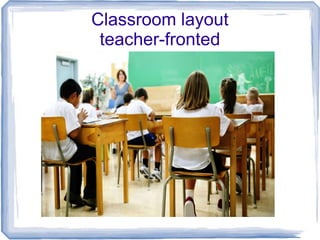
Classroom layout
teacher-fronted
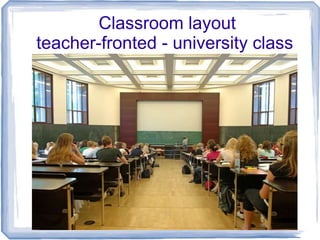
Classroom layout
teacher-fronted - university class
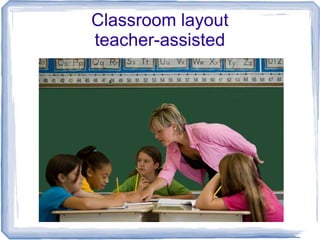
Classroom layout
teacher-assisted
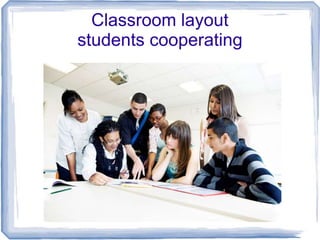
Classroom layout
students cooperating
15
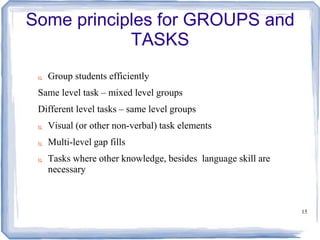
Some principles for GROUPS and
TASKS
 Group students efficiently
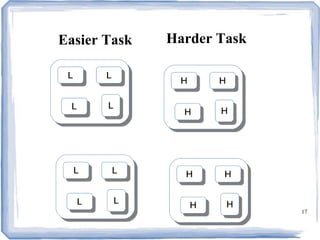
Same level task – mixed level groups
Different level tasks – same level groups
 Visual (or other non-verbal) task elements
 Multi-level gap fills
 Tasks where other knowledge, besides language skill are
necessary
16
Same Task
17
Easier Task Harder Task
16
Some example tasks
• Does it mean anything?
(meaningful - iffy – meaningless)
• Translating ambiguity
(The cat feels cold/he put his foot down/police found drunk in street)
• Quantifying sentences
(he has large shoes/ he's quite fat/they are very good at using computers
17
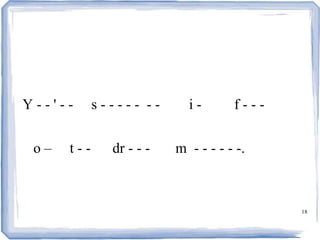
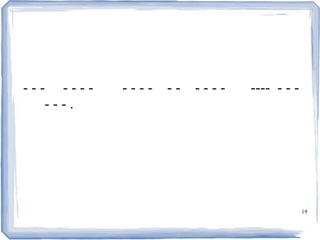
The drinks machine round the
corner
• Dictation
• But no writing at first, only actions
• Clues from other students
• Layers of listening, progressively more precise
18
Y - - ' - - s - - - - - - - i - f - - -
o – t - - dr - - - m - - - - - -.
19
- - - - - - - - - - - - - - - - - ---- - - -
- - - .
20
Students work in pairs. One person is the writer; the other is the
runner. The teacher waits outside the classroom, and reads a
short text.
The runner
1.The runner has to run outside, listen to a few words each time,
come back to their partner and tell them what to write. The
runners should ask the teacher questions such as ‘what comes
after …?’ or ‘what was the word before ….?’
2. Of course it’s impossible to remember more than a few words
each time, so the runner has to run back and forwards many
times.
Running Dictation
21
The writer
3. The writer writes down what the runner tells him or her, and also asks
questions to check that they have understood.
4. Afterwards, both people check together, and perhaps with another
pair to see that their texts make sense.
22
Running dictation text
Today I have talked about the problem of teaching mixed ability
students in the same class. I said that we can address the problem
in three ways: by creating activities that interest students, by
grouping students so that they support each other, and by
organising our material effectively.
References
Davis, P. and Rinvolucri, M. 1988. Dictation: New methods, new possibilities.
Cambridge University Press.

Mixed level teaching

  • 1.
    1 Communicative activities in large,multi-level classes: involving all students Michael Carroll Momoyama Gakuin University, Osaka carroll@andrew.ac.jp http://www.slideshare.net/tokutaisei/mixed-level- teaching
  • 2.
    2 Abstract How can weensure that all students have opportunities to speak and listen when class sizes are large? This presentation will demonstrate various ways of using alternative dictation methods to involve students in information exchange and, through communication, to focus on grammatical awareness-raising.
  • 3.
    3 Nobody likes mixedlevel classes
  • 4.
    4 What the teacherssay about same-level classes If all the students are at the same level, I can really see them learning fast. I can prepare the material just right, and I can really see the students learning from it. These kinds of classes have a great atmosphere. (Teacher)
  • 5.
    5 What the teacherssay about mixed-level classes When the students are at different levels I know that whatever I do will either be too easy for some, so they’ll get bored, or too difficult for some, so they’ll get lost. It’s really not a good way to organize a class. (Teacher)
  • 6.
    6 What the studentssay about mixed-level classes Some people in this class are so good, it makes me feel ashamed! I can’t follow the class, it’s just too hard! I like English, but this class is just too slow and easy. I’m bored.(Students)
  • 7.
    7 So what canwe do? Interesting activities Helpful group atmosphere Use our imagination to organise the material
  • 8.
    8 interesting activities To introducevariety into large class pedagogy requires some imaginationand a little effort, but the benefits are at once apparent: Interestingactivities(create) a warmer classroom climate, increase participation, raise levels of motivation, and enhance learning. (David Cross 1995 Large Classes in Action. Prentice Hall.p 3)
  • 9.
    9 effective groups Student motivationtends to increase in cohesive class groups. This is due to the fact that in such groups students sharean increased responsibility for achieving group goals, they ‘pull each other along’, and the positive relations among them make the learning process more enjoyablein general. (Zoltan Dornyei, 2001 Motivational strategies in the language classroom. CUP p 43.)
  • 10.
    10 well-organised material In thelarge class we sometimes feel trapped in the problems of management. [But …] Work in a large multilevel class truly forces us to invent and develop new ways of organising material. (Natalie Hess 2001 Teaching large multilevel classes CUP pp 4,5)
  • 11.
  • 12.
  • 13.
  • 14.
  • 15.
    15 Some principles forGROUPS and TASKS  Group students efficiently Same level task – mixed level groups Different level tasks – same level groups  Visual (or other non-verbal) task elements  Multi-level gap fills  Tasks where other knowledge, besides language skill are necessary
  • 16.
  • 17.
  • 18.
    16 Some example tasks •Does it mean anything? (meaningful - iffy – meaningless) • Translating ambiguity (The cat feels cold/he put his foot down/police found drunk in street) • Quantifying sentences (he has large shoes/ he's quite fat/they are very good at using computers
  • 19.
    17 The drinks machineround the corner • Dictation • But no writing at first, only actions • Clues from other students • Layers of listening, progressively more precise
  • 20.
    18 Y - -' - - s - - - - - - - i - f - - - o – t - - dr - - - m - - - - - -.
  • 21.
    19 - - -- - - - - - - - - - - - - - ---- - - - - - - .
  • 22.
    20 Students work inpairs. One person is the writer; the other is the runner. The teacher waits outside the classroom, and reads a short text. The runner 1.The runner has to run outside, listen to a few words each time, come back to their partner and tell them what to write. The runners should ask the teacher questions such as ‘what comes after …?’ or ‘what was the word before ….?’ 2. Of course it’s impossible to remember more than a few words each time, so the runner has to run back and forwards many times. Running Dictation
  • 23.
    21 The writer 3. Thewriter writes down what the runner tells him or her, and also asks questions to check that they have understood. 4. Afterwards, both people check together, and perhaps with another pair to see that their texts make sense.
  • 24.
    22 Running dictation text TodayI have talked about the problem of teaching mixed ability students in the same class. I said that we can address the problem in three ways: by creating activities that interest students, by grouping students so that they support each other, and by organising our material effectively. References Davis, P. and Rinvolucri, M. 1988. Dictation: New methods, new possibilities. Cambridge University Press.