Weather
 Temporary behavior of atmosphere
(what’s going on at any certain time)
 Small geographic area
 Can change rapidly
Weather
--The study of weather is
meteorology
--Someone who studies weather
is called a meteorologist
Climate
 Long-term behavior of atmosphere
(100+ years)
 Large geographic area
• Very slow to change
Climatology
The study of Earth’s climate and the
factors that affect past, present, and
future climatic changes
Normals
Standard values for a
location
Average values over a
long period of time
What Factors Affect Weather
& Climate?
1. The Sun
2. The Water Cycle
3. The Atmosphere
4. The Ocean
5. Ice
6. Landforms (Topography)
7. Latitude and Altitude
8. Living Things
How Does the Sun Affect
Weather and Climate?
It warms the atmosphere & oceans
(causing wind, ocean currents,
temperature changes, etc.)
It creates climate zones
• (ie. Tropics, temperate, polar)
It keeps the water cycle going
It affects weather patterns
The Water Cycle
All the water on the planet is recycled in
this manner!
Parts of the Cycle
Evaporation—Water going
from a liquid to a gas (gains
energy from the sun)
Parts of the Cycle
Transpiration—evaporation of water
from/out of plants. Locate this on the
diagram!
transpiration
Parts of the Cycle
Condensation—Water going from a gas to a
liquid (cools or loses energy)
 When this happens in the atmosphere,
CLOUDS form.
Clouds by Brainpop
Parts of the Cycle
Precipitation—when water falls out of
the atmosphere. Forms when the water
droplets in clouds become too heavy to
stay up.
Precipitation
Liquid water = rain
Frozen water = snow or sleet or
hail
Rain Clip
The Water Cycle
WaterCycle by Brainpop
WaterCycle Advanced by Brainpop
The Water Cycle by Brainpop
1) What process must happen
for clouds to form?
2) What is “collection”?
3) Name one way to conserve
water.
How does the atmosphere affect
weather?
The atmosphere is a mixtureof gases thatsurrounds the
Earth
Has five different layers; each has differentproperties
We’lllabeltheminjustaminute…
Air Temperature and Pressure change withaltitude
(lower temperatureand less pressure as altitude
increases)
Weather occurs in thelayer closest to Earth (troposphere)
Troposphere
Stratosphere
Mesosphere
Ionosphere
Exosphere
Thermosphere
Write in the labels!
Ozone layer
Atmosphere: Air Masses
= body of air with a certain
temperature and moisture level
Can be warm or cold
Can contain a lot of moisture or not a
lot of moisture
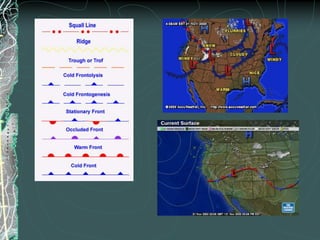
Fronts
=places where air
masses meet
4 Types: Warm, Cold,
Occluded,Stationary
Each kindcan bring
different kinds of
weather
Occluded Front: Stationary Front:
Thunderstorms ahead of this front:
then weather will become cold
Severe weather:
Then weather will become
warm and humid
Less severe weather
Rain, snow, or fog for several days
How does Air Pressure affect weather?
How muchthe earth’satmosphere is pressing down on us
Measured witha BAROMETER
If itCHANGES, thennew weatheris on the way:
FallingAir Pressure (Low pressure)= associated with warm air rising;
stormy weather coming
Rising Air Pressure (High pressure) = associated with cold airsinking;
fair weather coming
Steady Air Pressure = nochange is coming
Winds
created from differences in air pressure
Moves from areas of HIGH to LOW
pressure
Greater the difference in pressure, the
FASTER the wind blows
Measured with wind vanes and
anemometers or you can estimate with
the Beaufort Wind Scale
Global Winds
Thousands of kilometers long;
can cause weather to move in
different directions
Examples: Jet stream,
prevailing westerlies, doldrums,
horse latitudes, trade winds
Global Winds
Caused by the temperature
difference in different regions
 Hot Tropical Regions—causes air
to rise
 Cold polar Regions—causes air to
sink
Global Winds
Also affected by Earth’s Spin
 Coriolis Effect = causes winds to
curve to the right in the N.
Hemisphere; to the left in the S.
Hemisphere
How does the Ocean affect weather?
Ocean currents affect thetemperature of the land they
pass by
Cold ocean currents = coolingeffect
Warm ocean currents = warmingeffect
Temperaturechangesaffectpressure – whichthencreates
WINDS
Winds blow this cooling or warming effectover the land
Ocean currents distribute heat from the equator to the
poles.
http://earth.rice.edu/MTPE/hydro/hydrosphere/topics/Ocean_Atm_Circ_ElNino.mov
http://www.wunderground.com/MAR/
Science Saurus Sections 203-204-205-206
How Does Ice (the Cryosphere)
Affect Weather and Climate?
Ice in the arctic is white and so it reflects almost
all of the sunlight that hits it. This reflection of
the sun is what keeps the artic regions cold
because the sun’s rays never reach the surface
to heat it.
In other words, ice (the cryosphere) keeps the
Earth from getting too warm.
Changes in snow and ice cover affect air and
surface temperatures: less ice= warmer air and
surface
How Does Topography Affect Weather
and Climate?
Topography
Mountain also affect climate of an area.
Since the mountains act as a barrier to air
movements and moisture (such as rain clouds),
one side of the mountain may be desert-like,
while the other receives lots of rain and is lush
with vegetation.
How Does Topography Affect Weather
and Climate?
Topography
Coastal Regions, areas near water, are warmer
in the winter and cooler in the summer
This is because seasonal changes affect oceans
more slowly than land.
Therefore, oceans heat up more slowly in the
summer and produce cooler temperatures.
Likewise, oceans cool down more slowly in the
winter and produce warmer temperatures.
Equator
Tropic of Capricorn
Tropic of Cancer
Arctic Circle
Antarctic Circle
66.5° N
23.5° N
23.5° S
66.5° S
0°
How Does Latitude Affect Climate?
Tropics
Tropics
Temperate
Polar
Polar
Temperate
Climate Zones
Tropics (warmest because most direct sun
rays hit here)
Most solar radiation, generally warm
Between Tropics of Capricorn and Cancer
Temperate (warm summers and cold
winters)
Between 23.5 and 66.5 North and South
Mild temperatures
Polar (coldest because receives least direct
sun rays)
66.5 North and South to the Poles
Cold Temperatures
How Do Living Things Affect
Weather and Climate?
Trees and other plants can actually help keep climates
cooler by providing shade and using carbon dioxide gas
from the atmosphere.
Since carbon dioxide gas is a greenhouse gas that
traps heat near the surface of the Earth, when trees,
algae, and other plants remove it from our atmosphere,
they are helping to keep our planet cooler.
How Do Living Things Affect
Weather and Climate?
Farm animals, microbes, and humans produce
lots of methane and carbon dioxide, both of
which are greenhouse gases.
Thus, many living things, mainly humans, are
causing climates across the globe to grow
warmer.
Long-Term Climatic Change
Climates change over extremely long
periods of time
Ice Ages – Periods of extensive glacial
coverage
Most recent ended
10,000 years ago
Temps dropped 5°C
Short-Term Climatic Change
Caused by regular
variations in
daylight, temp, and
weather patterns
Examples:
Seasons
El Nino (Warm
ocean current)
Why do we
have
seasons?
Earth’s rotation
The Earth rotates on its axis
(imaginary vertical line
around which Earth spins)
every 23 hours & 56
minutes.
One day on Earth is one
rotation of the Earth.
One Day on Earth is when
our side of the Earth faces
the sun.
Night on Earth is when the
side of Earth we are on
faces away from the sun.
Earth’s revolution
It takes the Earth 365.25
days (or rotations) to travel
or revolve around the Sun
once.
This is called a year.
Orbit
Motion Terminology
Rotation – to spin on an axis
Motion Terminology
Revolution – the motion of a body around
another body
Motion Terminology
Orbit – the path that is followed around another
body in space
Why do we have seasons?
The Earth’s orbit around the
sun is NOT a perfect circle. It is
an ellipse.
Seasons are not caused by
how close the Earth is to the
sun.
In fact, the Earth is closest to
the sun around January 3 and
farthest away from the sun
around July 4.
Ellipse
Why do we have seasons?
Seasons are the result of the
tilt of the Earth's axis.
Earth’s axis is tilted 23.5°.
This tilting is why we have
SEASONS like fall, winter,
spring, summer.
The number of daylight
hours is greater for the
hemisphere, or half of Earth,
that is tilted toward the Sun.
Seasons Interactive
Why do we have seasons?
Summer is warmer than winter (in each hemisphere)
because the Sun's rays hit the Earth at a more direct angle
during summer than during winter
Why do we have seasons?
Also the days are much longer than the nights during
the summer.
During the winter, the Sun's rays hit the Earth at an
extreme angle, and the days are very short. These
effects are due to the tilt of the Earth's axis.
Seasons…in a nut shell
Solstices
Occur twice a year, when the tilt of the Earth's axis is oriented at its
extremes. Tilted the farthest or closest
Winter solstice is the shortest day of the year. In the Northern
Hemisphere. It occurs on December 21 or 22 and marks the
beginning of winter.
The Summer Solstice is the longest day of the year. It occurs on
June 20 or 21 and marks the beginning of summer.
Equinoxes
A day lasts 12 hours and a
night lasts 12 hours at all
latitudes.
Equinox literally means "equal
night".
Sunlight strikes the earth most
directly at the equator.
This occurs twice a year.
Equinox
The vernal (spring)
equinox occurs March 20.
The autumnal (fall)
equinox occurs September
22 or 23.
The Earth's seasons are not caused by the
differences in the distance from the Sun
throughout the year.
Review
Look closely at where the Sun is hitting the Earth during
each season:
Weather.climate edited

Weather.climate edited

  • 2.
    Weather  Temporary behaviorof atmosphere (what’s going on at any certain time)  Small geographic area  Can change rapidly
  • 3.
    Weather --The study ofweather is meteorology --Someone who studies weather is called a meteorologist
  • 4.
    Climate  Long-term behaviorof atmosphere (100+ years)  Large geographic area • Very slow to change
  • 5.
    Climatology The study ofEarth’s climate and the factors that affect past, present, and future climatic changes
  • 6.
    Normals Standard values fora location Average values over a long period of time
  • 7.
    What Factors AffectWeather & Climate? 1. The Sun 2. The Water Cycle 3. The Atmosphere 4. The Ocean 5. Ice 6. Landforms (Topography) 7. Latitude and Altitude 8. Living Things
  • 8.
    How Does theSun Affect Weather and Climate? It warms the atmosphere & oceans (causing wind, ocean currents, temperature changes, etc.) It creates climate zones • (ie. Tropics, temperate, polar) It keeps the water cycle going It affects weather patterns
  • 9.
    The Water Cycle Allthe water on the planet is recycled in this manner!
  • 10.
    Parts of theCycle Evaporation—Water going from a liquid to a gas (gains energy from the sun)
  • 11.
    Parts of theCycle Transpiration—evaporation of water from/out of plants. Locate this on the diagram! transpiration
  • 12.
    Parts of theCycle Condensation—Water going from a gas to a liquid (cools or loses energy)  When this happens in the atmosphere, CLOUDS form.
  • 13.
  • 14.
    Parts of theCycle Precipitation—when water falls out of the atmosphere. Forms when the water droplets in clouds become too heavy to stay up.
  • 15.
    Precipitation Liquid water =rain Frozen water = snow or sleet or hail Rain Clip
  • 16.
    The Water Cycle WaterCycleby Brainpop WaterCycle Advanced by Brainpop
  • 17.
    The Water Cycleby Brainpop 1) What process must happen for clouds to form? 2) What is “collection”? 3) Name one way to conserve water.
  • 18.
    How does theatmosphere affect weather? The atmosphere is a mixtureof gases thatsurrounds the Earth Has five different layers; each has differentproperties We’lllabeltheminjustaminute… Air Temperature and Pressure change withaltitude (lower temperatureand less pressure as altitude increases) Weather occurs in thelayer closest to Earth (troposphere)
  • 19.
  • 20.
    Atmosphere: Air Masses =body of air with a certain temperature and moisture level Can be warm or cold Can contain a lot of moisture or not a lot of moisture
  • 21.
    Fronts =places where air massesmeet 4 Types: Warm, Cold, Occluded,Stationary Each kindcan bring different kinds of weather
  • 22.
    Occluded Front: StationaryFront: Thunderstorms ahead of this front: then weather will become cold Severe weather: Then weather will become warm and humid Less severe weather Rain, snow, or fog for several days
  • 24.
    How does AirPressure affect weather? How muchthe earth’satmosphere is pressing down on us Measured witha BAROMETER If itCHANGES, thennew weatheris on the way: FallingAir Pressure (Low pressure)= associated with warm air rising; stormy weather coming Rising Air Pressure (High pressure) = associated with cold airsinking; fair weather coming Steady Air Pressure = nochange is coming
  • 25.
    Winds created from differencesin air pressure Moves from areas of HIGH to LOW pressure Greater the difference in pressure, the FASTER the wind blows Measured with wind vanes and anemometers or you can estimate with the Beaufort Wind Scale
  • 26.
    Global Winds Thousands ofkilometers long; can cause weather to move in different directions Examples: Jet stream, prevailing westerlies, doldrums, horse latitudes, trade winds
  • 27.
    Global Winds Caused bythe temperature difference in different regions  Hot Tropical Regions—causes air to rise  Cold polar Regions—causes air to sink
  • 28.
    Global Winds Also affectedby Earth’s Spin  Coriolis Effect = causes winds to curve to the right in the N. Hemisphere; to the left in the S. Hemisphere
  • 30.
    How does theOcean affect weather? Ocean currents affect thetemperature of the land they pass by Cold ocean currents = coolingeffect Warm ocean currents = warmingeffect Temperaturechangesaffectpressure – whichthencreates WINDS Winds blow this cooling or warming effectover the land Ocean currents distribute heat from the equator to the poles. http://earth.rice.edu/MTPE/hydro/hydrosphere/topics/Ocean_Atm_Circ_ElNino.mov
  • 31.
  • 32.
    Science Saurus Sections203-204-205-206
  • 33.
    How Does Ice(the Cryosphere) Affect Weather and Climate? Ice in the arctic is white and so it reflects almost all of the sunlight that hits it. This reflection of the sun is what keeps the artic regions cold because the sun’s rays never reach the surface to heat it. In other words, ice (the cryosphere) keeps the Earth from getting too warm. Changes in snow and ice cover affect air and surface temperatures: less ice= warmer air and surface
  • 34.
    How Does TopographyAffect Weather and Climate? Topography Mountain also affect climate of an area. Since the mountains act as a barrier to air movements and moisture (such as rain clouds), one side of the mountain may be desert-like, while the other receives lots of rain and is lush with vegetation.
  • 35.
    How Does TopographyAffect Weather and Climate? Topography Coastal Regions, areas near water, are warmer in the winter and cooler in the summer This is because seasonal changes affect oceans more slowly than land. Therefore, oceans heat up more slowly in the summer and produce cooler temperatures. Likewise, oceans cool down more slowly in the winter and produce warmer temperatures.
  • 36.
    Equator Tropic of Capricorn Tropicof Cancer Arctic Circle Antarctic Circle 66.5° N 23.5° N 23.5° S 66.5° S 0° How Does Latitude Affect Climate?
  • 37.
  • 38.
    Climate Zones Tropics (warmestbecause most direct sun rays hit here) Most solar radiation, generally warm Between Tropics of Capricorn and Cancer Temperate (warm summers and cold winters) Between 23.5 and 66.5 North and South Mild temperatures Polar (coldest because receives least direct sun rays) 66.5 North and South to the Poles Cold Temperatures
  • 39.
    How Do LivingThings Affect Weather and Climate? Trees and other plants can actually help keep climates cooler by providing shade and using carbon dioxide gas from the atmosphere. Since carbon dioxide gas is a greenhouse gas that traps heat near the surface of the Earth, when trees, algae, and other plants remove it from our atmosphere, they are helping to keep our planet cooler.
  • 40.
    How Do LivingThings Affect Weather and Climate? Farm animals, microbes, and humans produce lots of methane and carbon dioxide, both of which are greenhouse gases. Thus, many living things, mainly humans, are causing climates across the globe to grow warmer.
  • 41.
    Long-Term Climatic Change Climateschange over extremely long periods of time Ice Ages – Periods of extensive glacial coverage Most recent ended 10,000 years ago Temps dropped 5°C
  • 42.
    Short-Term Climatic Change Causedby regular variations in daylight, temp, and weather patterns Examples: Seasons El Nino (Warm ocean current)
  • 43.
  • 44.
    Earth’s rotation The Earthrotates on its axis (imaginary vertical line around which Earth spins) every 23 hours & 56 minutes. One day on Earth is one rotation of the Earth. One Day on Earth is when our side of the Earth faces the sun. Night on Earth is when the side of Earth we are on faces away from the sun.
  • 45.
    Earth’s revolution It takesthe Earth 365.25 days (or rotations) to travel or revolve around the Sun once. This is called a year. Orbit
  • 46.
  • 47.
    Motion Terminology Revolution –the motion of a body around another body
  • 48.
    Motion Terminology Orbit –the path that is followed around another body in space
  • 49.
    Why do wehave seasons? The Earth’s orbit around the sun is NOT a perfect circle. It is an ellipse. Seasons are not caused by how close the Earth is to the sun. In fact, the Earth is closest to the sun around January 3 and farthest away from the sun around July 4. Ellipse
  • 50.
    Why do wehave seasons? Seasons are the result of the tilt of the Earth's axis. Earth’s axis is tilted 23.5°. This tilting is why we have SEASONS like fall, winter, spring, summer. The number of daylight hours is greater for the hemisphere, or half of Earth, that is tilted toward the Sun. Seasons Interactive
  • 51.
    Why do wehave seasons? Summer is warmer than winter (in each hemisphere) because the Sun's rays hit the Earth at a more direct angle during summer than during winter
  • 52.
    Why do wehave seasons? Also the days are much longer than the nights during the summer. During the winter, the Sun's rays hit the Earth at an extreme angle, and the days are very short. These effects are due to the tilt of the Earth's axis.
  • 53.
  • 54.
    Solstices Occur twice ayear, when the tilt of the Earth's axis is oriented at its extremes. Tilted the farthest or closest Winter solstice is the shortest day of the year. In the Northern Hemisphere. It occurs on December 21 or 22 and marks the beginning of winter. The Summer Solstice is the longest day of the year. It occurs on June 20 or 21 and marks the beginning of summer.
  • 56.
    Equinoxes A day lasts12 hours and a night lasts 12 hours at all latitudes. Equinox literally means "equal night". Sunlight strikes the earth most directly at the equator. This occurs twice a year.
  • 57.
    Equinox The vernal (spring) equinoxoccurs March 20. The autumnal (fall) equinox occurs September 22 or 23.
  • 58.
    The Earth's seasonsare not caused by the differences in the distance from the Sun throughout the year.
  • 59.
    Review Look closely atwhere the Sun is hitting the Earth during each season: