World Regional Geography Chapter 2:   Physical Processes That   Shape World Regions
Lithosphere Earth’s outer “rind” of rock Varies in thickness from about 50 to 125 miles Subdivided into categories of continental and oceanic Hydrosphere Comprised of oceans and other water features Atmosphere Layer of gases, primarily nitrogen and oxygen Surrounds the earth to roughly 60 miles out Spheres Making Up Earth’s Habitable Environment
Continental Drift Theory by Alfred Wegener, 1912 Continents once joined as supercontinent of “Pangaea” but they “drifted apart” over time Earth’s lithosphere is made up of several plates that move in various directions Seafloor Spreading Process of two plates moving away from each other Few impacts on people Converging Plates Trigger some of the planet’s greatest natural hazards Subduction (one plate “dives” below another) 2.1.1  Plate Tectonics
Seismic Activity Refers to the earth’s vibrations when plates collide Can result in earthquakes, tsunamis, and volcanism Earthquakes Measured on the Richter Scale World’s Largest Recorded Earthquakes Magnitude 9.5 Chile, 1960 Magnitude 9.2 United States, 1964 Magnitude 9.1 Indonesia, 2004 Tsunamis  (Tidal Waves) Volcanism Movement of molten earth material Generally occurs along / near subduction zones 2.1.1  Plate Tectonics  (continued)
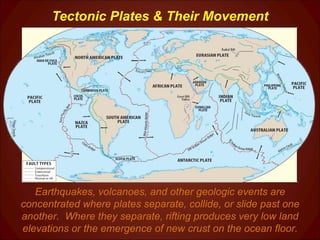
Tectonic Plates & Their Movement Earthquakes, volcanoes, and other geologic events are concentrated where plates separate, collide, or slide past one another.  Where they separate, rifting produces very low land elevations or the emergence of new crust on the ocean floor.
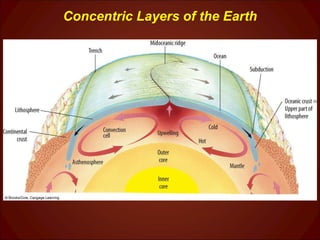
Concentric Layers of the Earth
Hill Lands and Mountains High and steep features No formal distinction between “hills” and “mountains” Usage of terms based on local perceptions Most mountain areas are sparsely populated Tend to be near areas of tectonic plate convergence Plains Relatively level areas of slight elevation Most of the world’s population lives on plains Plateaus Elevated plains at an elevation above 2,000 feet Typically terminated on one side by an escarpment that marks a sharp boundary with lower elevation 2.1.2  Major Landform Types
Weather Atmospheric conditions occurring at a given time & place Climate Average weather of an area over a long period of time Forces shaping the environment and human interaction with it include: Precipitation Aridity Seasons Climate & Vegetation Types 2.2  Patterns of Climate and Vegetation
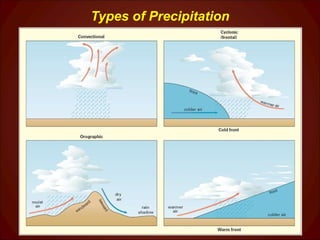
Precipitation Result of processes that cool the air to release moisture Types of precipitation include: Rain, Snow, Sleet & Hail Processes of Precipitation Convectional Orographic Mountain-Associated Cyclonic Frontal Cold Front Warm Front 2.2.1  Precipitation
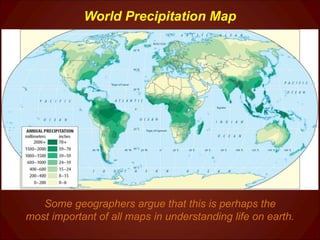
World Precipitation Map Some geographers argue that this is perhaps the most important of all maps in understanding life on earth.
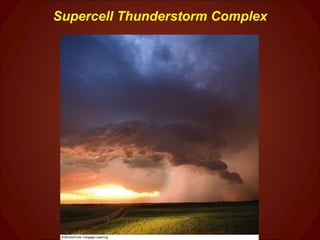
Supercell Thunderstorm Complex
Types of Precipitation
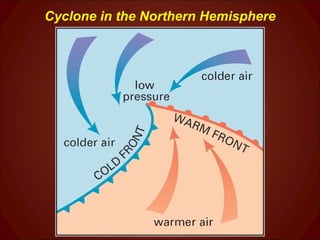
Cyclone in the Northern Hemisphere
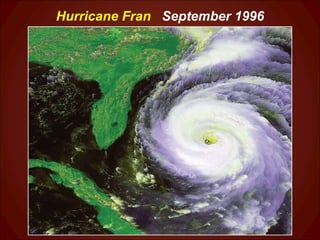
Hurricane Fran  September 1996
Aridity Refers to low precipitation Drought or any other significant shortages in rainfall High Pressure  (Anticyclones) Air descends, becomes warmer, can hold more water vapor Atmospheric Stability in Coastal Regions Caused by cold ocean waters Examples:  Atacama Desert (Chile), Namib Desert (Africa) Rain Shadow Windward Side much wetter than Leeward Side Examples:  Sierra Nevada, Atlas Mountains 2.2.2  Aridity
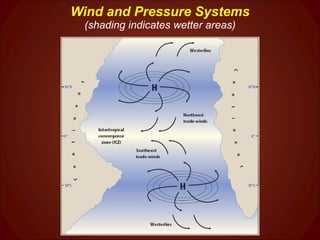
Wind and Pressure Systems (shading indicates wetter areas)
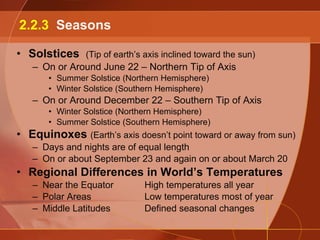
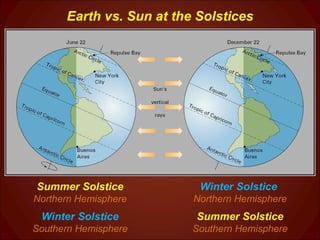
Solstices  (Tip of earth’s axis inclined toward the sun) On or Around June 22 – Northern Tip of Axis Summer Solstice (Northern Hemisphere) Winter Solstice (Southern Hemisphere) On or Around December 22 – Southern Tip of Axis Winter Solstice (Northern Hemisphere) Summer Solstice (Southern Hemisphere) Equinoxes   (Earth’s axis doesn’t point toward or away from sun) Days and nights are of equal length On or about September 23 and again on or about March 20 Regional Differences in World’s Temperatures Near the Equator High temperatures all year Polar Areas Low temperatures most of year Middle Latitudes Defined seasonal changes 2.2.3  Seasons
Earth vs. Sun at the Solstices Summer Solstice Northern Hemisphere Winter Solstice Southern Hemisphere Winter Solstice  Northern Hemisphere  Summer Solstice  Southern Hemisphere
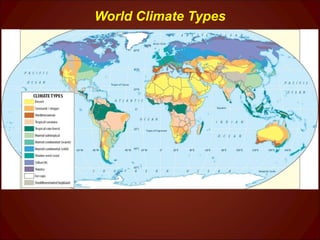
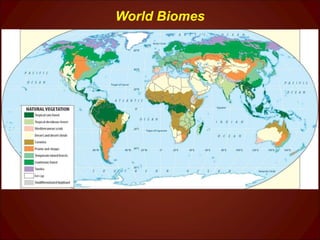
Climates are a product of precipitation, temperature, latitude, and elevation Biomes Terrestrial ecosystems categorized by dominant types of natural vegetation Major Climate Types Ice Cap, Tundra & Subarctic Desert & Semiarid / Steppe Tropical Rain Forest & Tropical Savanna Marine West Coast Mediterranean Humid Subtropical & Humid Continental Undifferentiated Highland Climate 2.2.4  Climate and Vegetation Types
World Climate Types
World Biomes
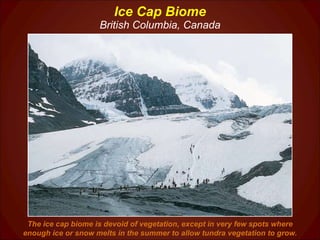
Ice Cap Biome British Columbia, Canada The ice cap biome is devoid of vegetation, except in very few spots where enough ice or snow melts in the summer to allow tundra vegetation to grow.
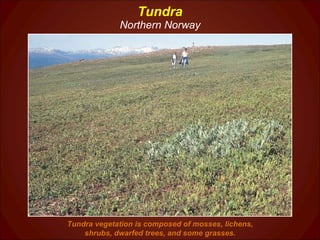
Tundra Northern Norway Tundra vegetation is composed of mosses, lichens, shrubs, dwarfed trees, and some grasses.
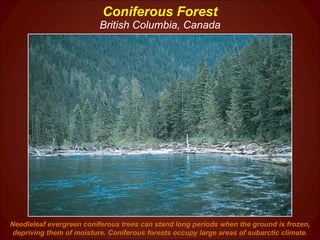
Coniferous Forest British Columbia, Canada Needleleaf evergreen coniferous trees can stand long periods when the ground is frozen, depriving them of moisture. Coniferous forests occupy large areas of subarctic climate.
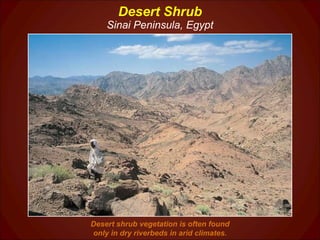
Desert Shrub Sinai Peninsula, Egypt Desert shrub vegetation is often found only in dry riverbeds in arid climates.
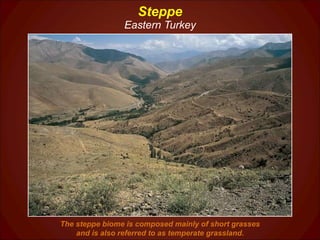
Steppe Eastern Turkey The steppe biome is composed mainly of short grasses and is also referred to as temperate grassland.
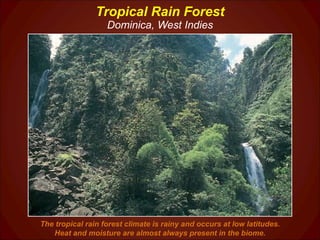
Tropical Rain Forest Dominica, West Indies The tropical rain forest climate is rainy and occurs at low latitudes. Heat and moisture are almost always present in the biome.
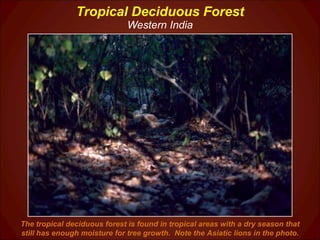
Tropical Deciduous Forest Western India The tropical deciduous forest is found in tropical areas with a dry season that still has enough moisture for tree growth.  Note the Asiatic lions in the photo.
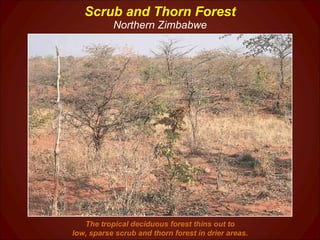
Scrub and Thorn Forest Northern Zimbabwe The tropical deciduous forest thins out to low, sparse scrub and thorn forest in drier areas.
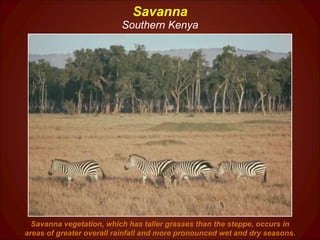
Savanna Southern Kenya Savanna vegetation, which has taller grasses than the steppe, occurs in areas of greater overall rainfall and more pronounced wet and dry seasons.
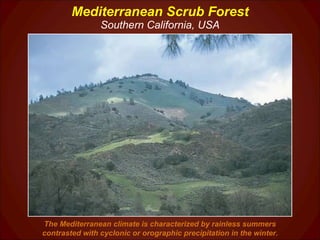
Mediterranean Scrub Forest Southern California, USA The Mediterranean climate is characterized by rainless summers contrasted with cyclonic or orographic precipitation in the winter.
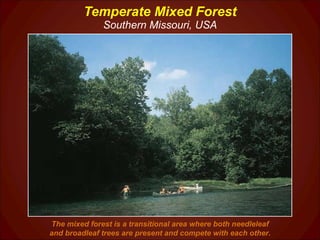
Temperate Mixed Forest Southern Missouri, USA The mixed forest is a transitional area where both needleleaf and broadleaf trees are present and compete with each other.
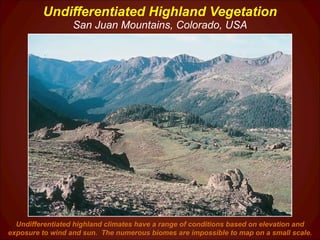
Undifferentiated Highland Vegetation San Juan Mountains, Colorado, USA Undifferentiated highland climates have a range of conditions based on elevation and exposure to wind and sun.  The numerous biomes are impossible to map on a small scale.
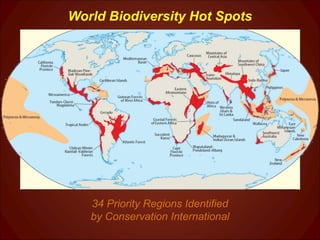
Biological Diversity Number of plant and animal species present and the variety of genetic materials these organisms contain Most diverse biome is the tropical rain forest Struggling to Protect Biodiversity Human removal of rain forests and natural ecosystems depletes biodiversity Controversy of the Green Revolution On one hand, puts more food on the global table But may render crops more vulnerable to pests and diseases Establishment of National Parks and Protected Areas Conservation International’s “Biodiversity Hot Spots” 2.3.1  The Importance of Biodiversity
World Biodiversity Hot Spots 34 Priority Regions Identified by Conservation International
Water comprises about 71% of world’s surface Life on earth would not be possible without the resources of the Hydrosphere: Oceans Freshwater Sources 2.4  The World’s Oceans
Oceans have the largest role in the hydrologic cycle Seawater is converted into usable freshwater precipitation Oceans are a large source of food for humans 15 percent of world’s population relies primarily on fish as their source of protein They provide energy & raw materials for human use They play important roles in trade and commerce 2.4.1  Why Should We Care About Oceans?
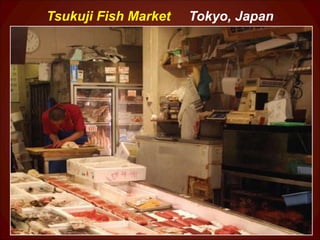
Tsukuji Fish Market  Tokyo, Japan
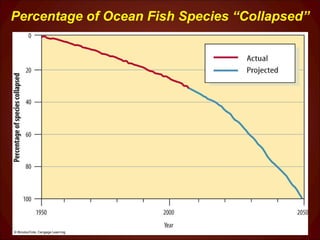
Percentage of Ocean Fish Species “Collapsed”
Although governments have been doing more in recent years to protect the earth’s biodiversity, atmospheric changes have profound impacts on natural systems These atmospheric changes are largely attributable to human activities 2.5  Global Environmental Change
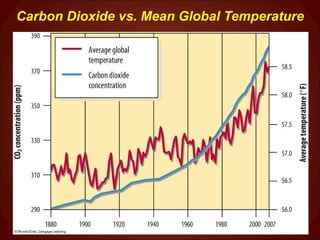
Human activities are responsible for a documented warming of the earth’s surface Intergovernmental Panel on Climate Change 2007 report c oncluded that global warming is “unequivocal” Global Warming Global mean temperature has increased 1.4 degrees F since late 19 th  century Result of human production of greenhouse gases, such as Carbon Dioxide 2.5.1  Climatic Change
Carbon Dioxide vs. Mean Global Temperature
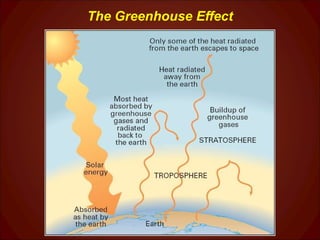
Concept established in 1827 by French mathematician Jean-Baptiste Fourier Fourier noted that the earth’s atmosphere acts like the transparent glass cover of a greenhouse, allowing visible sunlight to pass through, and trapping some of the heat In our atmosphere, naturally occurring greenhouse gases make earth habitable by trapping heat from sunlight Concern over global warming focuses on human-derived sources of greenhouse gases, which trap abnormal amounts of heat Particularly problematic are human-produced methane, nitrous-oxide, and chlorofluorocarbons (CFCs) 2.5.2  The Greenhouse Effect
The Greenhouse Effect
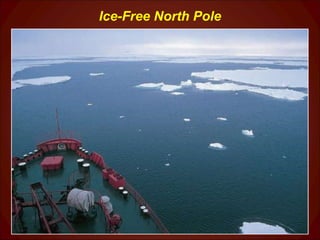
Effects of Global Warming on the Earth Increase in global temperatures More precipitation overall, but also more pronounced drought Pronounced warming in the polar regions Shifting biomes, with species extinction Rising sea levels Geopolitical instability 2.5.3  The Effects of Global Warming
Ice-Free North Pole
Is the damage irreversible? Some scientists urge dramatic steps be taken to mitigate global warming: Negotiate and implement international treaties to reduce greenhouse gas emissions Montreal Protocol Cut emissions through market-based incentives Increase carbon sequestration 2.5.4  Global Climate Change: What Can Be Done?

Chapter2

  • 1.
    World Regional GeographyChapter 2: Physical Processes That Shape World Regions
  • 2.
    Lithosphere Earth’s outer“rind” of rock Varies in thickness from about 50 to 125 miles Subdivided into categories of continental and oceanic Hydrosphere Comprised of oceans and other water features Atmosphere Layer of gases, primarily nitrogen and oxygen Surrounds the earth to roughly 60 miles out Spheres Making Up Earth’s Habitable Environment
  • 3.
    Continental Drift Theoryby Alfred Wegener, 1912 Continents once joined as supercontinent of “Pangaea” but they “drifted apart” over time Earth’s lithosphere is made up of several plates that move in various directions Seafloor Spreading Process of two plates moving away from each other Few impacts on people Converging Plates Trigger some of the planet’s greatest natural hazards Subduction (one plate “dives” below another) 2.1.1 Plate Tectonics
  • 4.
    Seismic Activity Refersto the earth’s vibrations when plates collide Can result in earthquakes, tsunamis, and volcanism Earthquakes Measured on the Richter Scale World’s Largest Recorded Earthquakes Magnitude 9.5 Chile, 1960 Magnitude 9.2 United States, 1964 Magnitude 9.1 Indonesia, 2004 Tsunamis (Tidal Waves) Volcanism Movement of molten earth material Generally occurs along / near subduction zones 2.1.1 Plate Tectonics (continued)
  • 5.
    Tectonic Plates &Their Movement Earthquakes, volcanoes, and other geologic events are concentrated where plates separate, collide, or slide past one another. Where they separate, rifting produces very low land elevations or the emergence of new crust on the ocean floor.
  • 6.
  • 7.
    Hill Lands andMountains High and steep features No formal distinction between “hills” and “mountains” Usage of terms based on local perceptions Most mountain areas are sparsely populated Tend to be near areas of tectonic plate convergence Plains Relatively level areas of slight elevation Most of the world’s population lives on plains Plateaus Elevated plains at an elevation above 2,000 feet Typically terminated on one side by an escarpment that marks a sharp boundary with lower elevation 2.1.2 Major Landform Types
  • 8.
    Weather Atmospheric conditionsoccurring at a given time & place Climate Average weather of an area over a long period of time Forces shaping the environment and human interaction with it include: Precipitation Aridity Seasons Climate & Vegetation Types 2.2 Patterns of Climate and Vegetation
  • 9.
    Precipitation Result ofprocesses that cool the air to release moisture Types of precipitation include: Rain, Snow, Sleet & Hail Processes of Precipitation Convectional Orographic Mountain-Associated Cyclonic Frontal Cold Front Warm Front 2.2.1 Precipitation
  • 10.
    World Precipitation MapSome geographers argue that this is perhaps the most important of all maps in understanding life on earth.
  • 11.
  • 12.
  • 13.
    Cyclone in theNorthern Hemisphere
  • 14.
    Hurricane Fran September 1996
  • 15.
    Aridity Refers tolow precipitation Drought or any other significant shortages in rainfall High Pressure (Anticyclones) Air descends, becomes warmer, can hold more water vapor Atmospheric Stability in Coastal Regions Caused by cold ocean waters Examples: Atacama Desert (Chile), Namib Desert (Africa) Rain Shadow Windward Side much wetter than Leeward Side Examples: Sierra Nevada, Atlas Mountains 2.2.2 Aridity
  • 16.
    Wind and PressureSystems (shading indicates wetter areas)
  • 17.
    Solstices (Tipof earth’s axis inclined toward the sun) On or Around June 22 – Northern Tip of Axis Summer Solstice (Northern Hemisphere) Winter Solstice (Southern Hemisphere) On or Around December 22 – Southern Tip of Axis Winter Solstice (Northern Hemisphere) Summer Solstice (Southern Hemisphere) Equinoxes (Earth’s axis doesn’t point toward or away from sun) Days and nights are of equal length On or about September 23 and again on or about March 20 Regional Differences in World’s Temperatures Near the Equator High temperatures all year Polar Areas Low temperatures most of year Middle Latitudes Defined seasonal changes 2.2.3 Seasons
  • 18.
    Earth vs. Sunat the Solstices Summer Solstice Northern Hemisphere Winter Solstice Southern Hemisphere Winter Solstice Northern Hemisphere Summer Solstice Southern Hemisphere
  • 19.
    Climates are aproduct of precipitation, temperature, latitude, and elevation Biomes Terrestrial ecosystems categorized by dominant types of natural vegetation Major Climate Types Ice Cap, Tundra & Subarctic Desert & Semiarid / Steppe Tropical Rain Forest & Tropical Savanna Marine West Coast Mediterranean Humid Subtropical & Humid Continental Undifferentiated Highland Climate 2.2.4 Climate and Vegetation Types
  • 20.
  • 21.
  • 22.
    Ice Cap BiomeBritish Columbia, Canada The ice cap biome is devoid of vegetation, except in very few spots where enough ice or snow melts in the summer to allow tundra vegetation to grow.
  • 23.
    Tundra Northern NorwayTundra vegetation is composed of mosses, lichens, shrubs, dwarfed trees, and some grasses.
  • 24.
    Coniferous Forest BritishColumbia, Canada Needleleaf evergreen coniferous trees can stand long periods when the ground is frozen, depriving them of moisture. Coniferous forests occupy large areas of subarctic climate.
  • 25.
    Desert Shrub SinaiPeninsula, Egypt Desert shrub vegetation is often found only in dry riverbeds in arid climates.
  • 26.
    Steppe Eastern TurkeyThe steppe biome is composed mainly of short grasses and is also referred to as temperate grassland.
  • 27.
    Tropical Rain ForestDominica, West Indies The tropical rain forest climate is rainy and occurs at low latitudes. Heat and moisture are almost always present in the biome.
  • 28.
    Tropical Deciduous ForestWestern India The tropical deciduous forest is found in tropical areas with a dry season that still has enough moisture for tree growth. Note the Asiatic lions in the photo.
  • 29.
    Scrub and ThornForest Northern Zimbabwe The tropical deciduous forest thins out to low, sparse scrub and thorn forest in drier areas.
  • 30.
    Savanna Southern KenyaSavanna vegetation, which has taller grasses than the steppe, occurs in areas of greater overall rainfall and more pronounced wet and dry seasons.
  • 31.
    Mediterranean Scrub ForestSouthern California, USA The Mediterranean climate is characterized by rainless summers contrasted with cyclonic or orographic precipitation in the winter.
  • 32.
    Temperate Mixed ForestSouthern Missouri, USA The mixed forest is a transitional area where both needleleaf and broadleaf trees are present and compete with each other.
  • 33.
    Undifferentiated Highland VegetationSan Juan Mountains, Colorado, USA Undifferentiated highland climates have a range of conditions based on elevation and exposure to wind and sun. The numerous biomes are impossible to map on a small scale.
  • 34.
    Biological Diversity Numberof plant and animal species present and the variety of genetic materials these organisms contain Most diverse biome is the tropical rain forest Struggling to Protect Biodiversity Human removal of rain forests and natural ecosystems depletes biodiversity Controversy of the Green Revolution On one hand, puts more food on the global table But may render crops more vulnerable to pests and diseases Establishment of National Parks and Protected Areas Conservation International’s “Biodiversity Hot Spots” 2.3.1 The Importance of Biodiversity
  • 35.
    World Biodiversity HotSpots 34 Priority Regions Identified by Conservation International
  • 36.
    Water comprises about71% of world’s surface Life on earth would not be possible without the resources of the Hydrosphere: Oceans Freshwater Sources 2.4 The World’s Oceans
  • 37.
    Oceans have thelargest role in the hydrologic cycle Seawater is converted into usable freshwater precipitation Oceans are a large source of food for humans 15 percent of world’s population relies primarily on fish as their source of protein They provide energy & raw materials for human use They play important roles in trade and commerce 2.4.1 Why Should We Care About Oceans?
  • 38.
    Tsukuji Fish Market Tokyo, Japan
  • 39.
    Percentage of OceanFish Species “Collapsed”
  • 40.
    Although governments havebeen doing more in recent years to protect the earth’s biodiversity, atmospheric changes have profound impacts on natural systems These atmospheric changes are largely attributable to human activities 2.5 Global Environmental Change
  • 41.
    Human activities areresponsible for a documented warming of the earth’s surface Intergovernmental Panel on Climate Change 2007 report c oncluded that global warming is “unequivocal” Global Warming Global mean temperature has increased 1.4 degrees F since late 19 th century Result of human production of greenhouse gases, such as Carbon Dioxide 2.5.1 Climatic Change
  • 42.
    Carbon Dioxide vs.Mean Global Temperature
  • 43.
    Concept established in1827 by French mathematician Jean-Baptiste Fourier Fourier noted that the earth’s atmosphere acts like the transparent glass cover of a greenhouse, allowing visible sunlight to pass through, and trapping some of the heat In our atmosphere, naturally occurring greenhouse gases make earth habitable by trapping heat from sunlight Concern over global warming focuses on human-derived sources of greenhouse gases, which trap abnormal amounts of heat Particularly problematic are human-produced methane, nitrous-oxide, and chlorofluorocarbons (CFCs) 2.5.2 The Greenhouse Effect
  • 44.
  • 45.
    Effects of GlobalWarming on the Earth Increase in global temperatures More precipitation overall, but also more pronounced drought Pronounced warming in the polar regions Shifting biomes, with species extinction Rising sea levels Geopolitical instability 2.5.3 The Effects of Global Warming
  • 46.
  • 47.
    Is the damageirreversible? Some scientists urge dramatic steps be taken to mitigate global warming: Negotiate and implement international treaties to reduce greenhouse gas emissions Montreal Protocol Cut emissions through market-based incentives Increase carbon sequestration 2.5.4 Global Climate Change: What Can Be Done?

Editor's Notes