Chapter 4, Section
                                        World Geography


                                           Chapter 4
    Resources and Land Use


  Copyright © 2003 by Pearson Education, Inc., publishing as Prentice Hall, Upper Saddle River, NJ. All rights reserved.
Chapter 4, Section
                                        World Geography


                             Chapter 4: Resources and Land Use


ction 1: World Resources

ction 2: World Economic Activity


  Copyright © 2003 by Pearson Education, Inc., publishing as Prentice Hall, Upper Saddle River, NJ. All rights reserved.
Chapter 4, Section 1

World Resources

         • How do renewable resources and
           nonrenewable resources differ?
         • What energy sources are available to
           individuals and nations?
Chapter 4, Section 1

Natural Resources

         •   Natural resources are materials in the natural environment
             that people value and use to satisfy their needs.
         •   Renewable resources are natural resources that are
             constantly being replaced or regenerated by the
             environment.
         •   Soil and fresh water are constantly being replenished by
             natural processes.
         •   Nonrenewable resources are resources that cannot be
             replaced once they have been used.
         •   Nonrenewable resources are minerals that formed within
             the earth’s crust over millions of years.
         •   Coal, oil, and natural gas are nonrenewable fossil fuels
             that formed from the remains of ancient plants and
             animals.
         •   Recycling and reduction of consumption are ways of
             stretching limited supplies of nonrenewable resources.
Chapter 4, Section 1

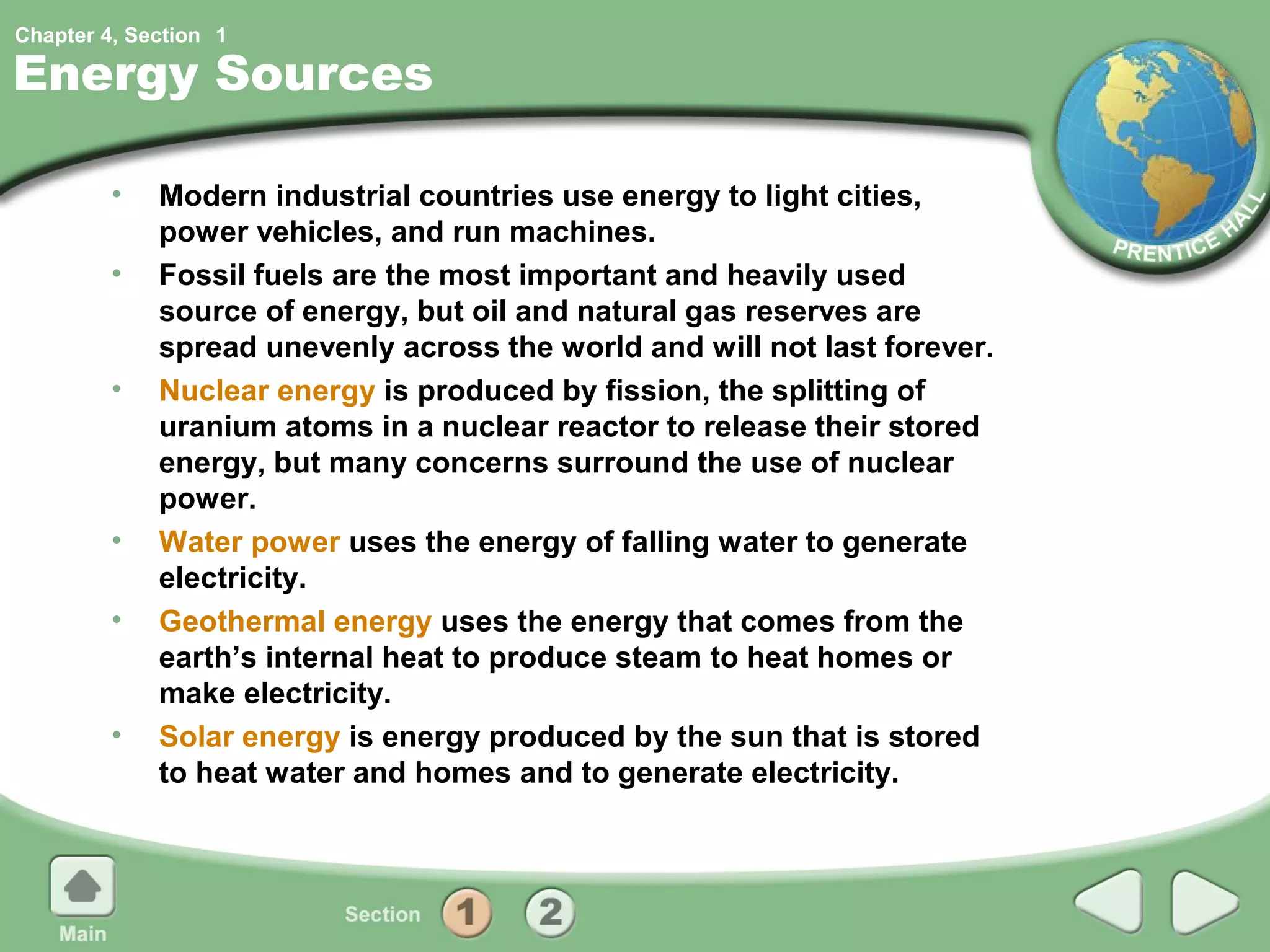
Energy Sources

         •   Modern industrial countries use energy to light cities,
             power vehicles, and run machines.
         •   Fossil fuels are the most important and heavily used
             source of energy, but oil and natural gas reserves are
             spread unevenly across the world and will not last forever.
         •   Nuclear energy is produced by fission, the splitting of
             uranium atoms in a nuclear reactor to release their stored
             energy, but many concerns surround the use of nuclear
             power.
         •   Water power uses the energy of falling water to generate
             electricity.
         •   Geothermal energy uses the energy that comes from the
             earth’s internal heat to produce steam to heat homes or
             make electricity.
         •   Solar energy is energy produced by the sun that is stored
             to heat water and homes and to generate electricity.
Chapter 4, Section 1

Section 1 Review

         What kind of resource are fossil fuels?
            a) a renewable resource
            b) a nonrenewable resource
            c) a recycled resource
            d) a metallic resource

         Fission produces energy from
              a) falling water.
              b) the burning of fossil fuels.
              c) the splitting of uranium atoms.
              d) the earth’s internal heat.


         Want to connect to the World Geography link for this section? Click Here!
Chapter 4, Section 1

Section 1 Review

         What kind of resource are fossil fuels?
            a) a renewable resource
            b) a nonrenewable resource
            c) a recycled resource
            d) a metallic resource

         Fission produces energy from
              a) falling water.
              b) the burning of fossil fuels.
              c) the splitting of uranium atoms.
              d) the earth’s internal heat.


         Want to connect to the World Geography link for this section? Click Here!
Chapter 4, Section 2

World Economic Activity

         • What are four different categories of
           economic activities?
         • Why are global trade patterns changing
           today?
         • What kinds of data indicate a country’s
           level of development?
Chapter 4, Section 2

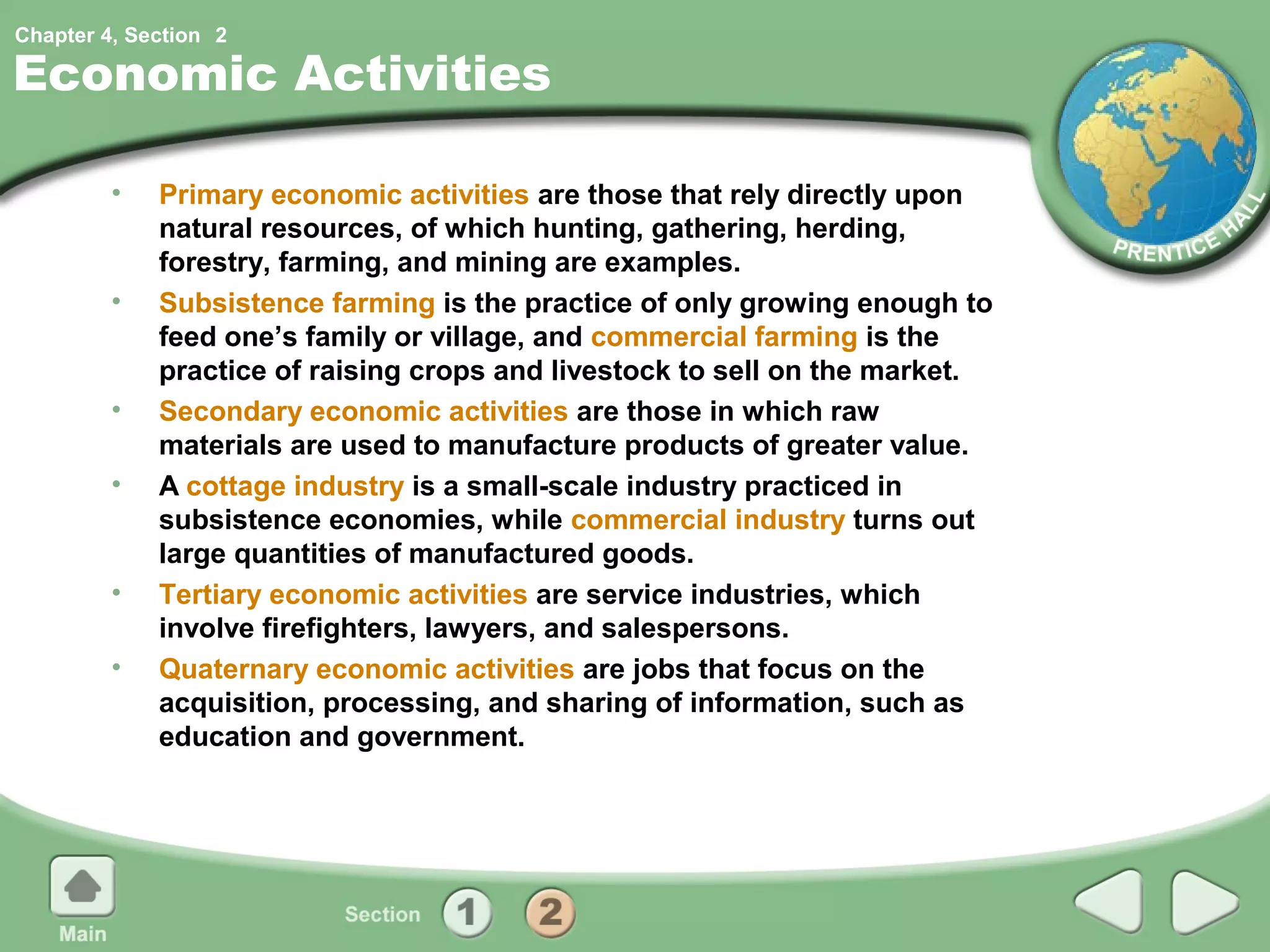
Economic Activities

         •   Primary economic activities are those that rely directly upon
             natural resources, of which hunting, gathering, herding,
             forestry, farming, and mining are examples.
         •   Subsistence farming is the practice of only growing enough to
             feed one’s family or village, and commercial farming is the
             practice of raising crops and livestock to sell on the market.
         •   Secondary economic activities are those in which raw
             materials are used to manufacture products of greater value.
         •   A cottage industry is a small-scale industry practiced in
             subsistence economies, while commercial industry turns out
             large quantities of manufactured goods.
         •   Tertiary economic activities are service industries, which
             involve firefighters, lawyers, and salespersons.
         •   Quaternary economic activities are jobs that focus on the
             acquisition, processing, and sharing of information, such as
             education and government.
Chapter 4, Section 2

Global Trade Patterns

         •   Nations set up trade networks when they do not have
             all the resources and goods they want.
         •   Goods that are sent out of a country are called exports,
             and goods that are brought into a country are imports.
         •   Governments seek a favorable balance of imports and
             exports because too many imports can be damaging to
             a nation’s economy by increasing unemployment and
             the nation’s debt.
         •   Trade routes are determined by geography,
             transportation technology, and international relations.
         •   Modern technology is changing the nature of global
             trade, as computer and satellite networks allow
             business deals and payment transactions to be
             conducted electronically.
Chapter 4, Section 2

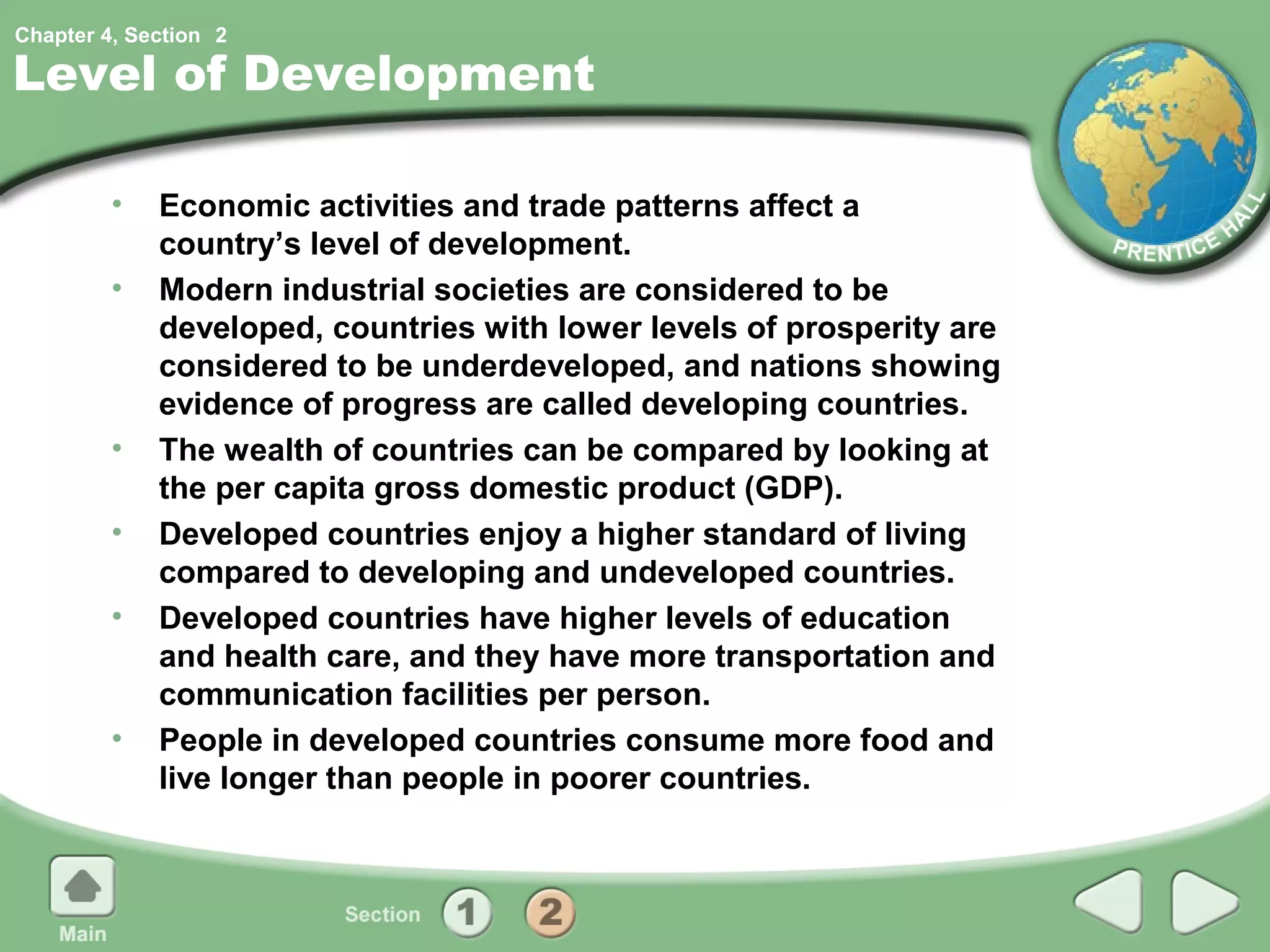
Level of Development

         •   Economic activities and trade patterns affect a
             country’s level of development.
         •   Modern industrial societies are considered to be
             developed, countries with lower levels of prosperity are
             considered to be underdeveloped, and nations showing
             evidence of progress are called developing countries.
         •   The wealth of countries can be compared by looking at
             the per capita gross domestic product (GDP).
         •   Developed countries enjoy a higher standard of living
             compared to developing and undeveloped countries.
         •   Developed countries have higher levels of education
             and health care, and they have more transportation and
             communication facilities per person.
         •   People in developed countries consume more food and
             live longer than people in poorer countries.
Chapter 4, Section 2

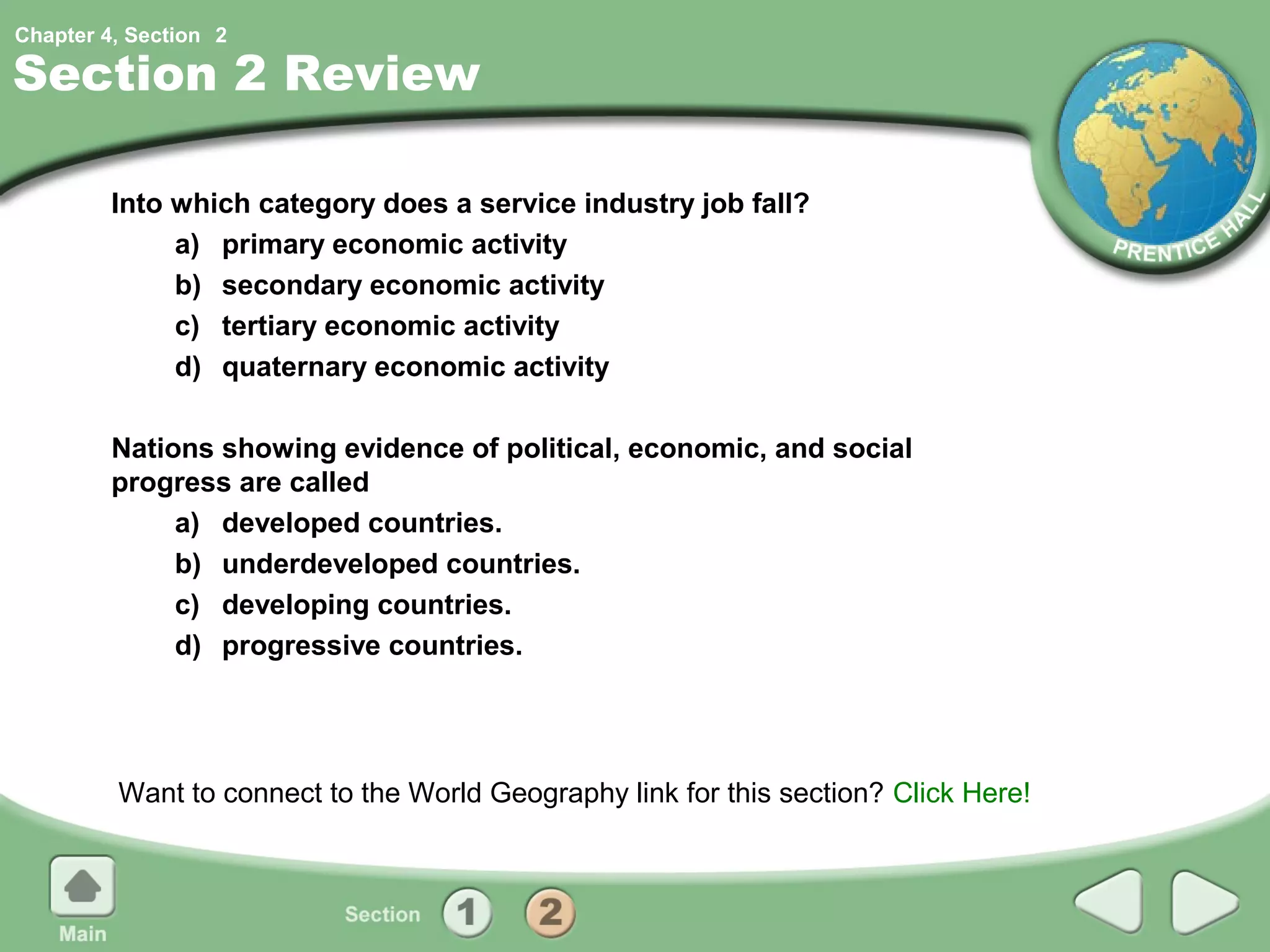
Section 2 Review

         Into which category does a service industry job fall?
              a) primary economic activity
              b) secondary economic activity
              c) tertiary economic activity
              d) quaternary economic activity

         Nations showing evidence of political, economic, and social
         progress are called
              a) developed countries.
              b) underdeveloped countries.
              c) developing countries.
              d) progressive countries.


         Want to connect to the World Geography link for this section? Click Here!
Chapter 4, Section 2

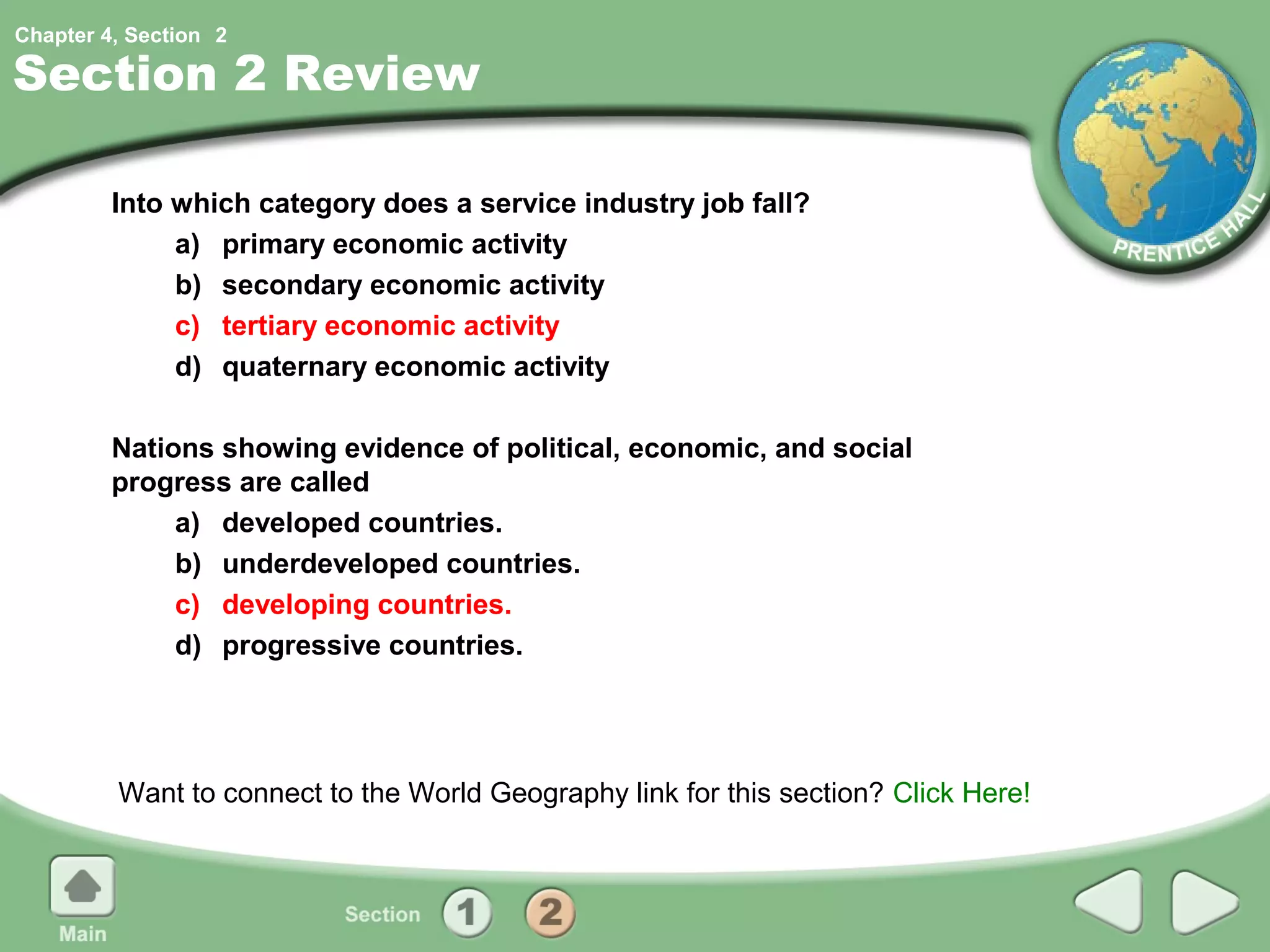
Section 2 Review

         Into which category does a service industry job fall?
              a) primary economic activity
              b) secondary economic activity
              c) tertiary economic activity
              d) quaternary economic activity

         Nations showing evidence of political, economic, and social
         progress are called
              a) developed countries.
              b) underdeveloped countries.
              c) developing countries.
              d) progressive countries.


         Want to connect to the World Geography link for this section? Click Here!

Wg ch04

  • 1.
    Chapter 4, Section World Geography Chapter 4 Resources and Land Use Copyright © 2003 by Pearson Education, Inc., publishing as Prentice Hall, Upper Saddle River, NJ. All rights reserved.
  • 2.
    Chapter 4, Section World Geography Chapter 4: Resources and Land Use ction 1: World Resources ction 2: World Economic Activity Copyright © 2003 by Pearson Education, Inc., publishing as Prentice Hall, Upper Saddle River, NJ. All rights reserved.
  • 3.
    Chapter 4, Section1 World Resources • How do renewable resources and nonrenewable resources differ? • What energy sources are available to individuals and nations?
  • 4.
    Chapter 4, Section1 Natural Resources • Natural resources are materials in the natural environment that people value and use to satisfy their needs. • Renewable resources are natural resources that are constantly being replaced or regenerated by the environment. • Soil and fresh water are constantly being replenished by natural processes. • Nonrenewable resources are resources that cannot be replaced once they have been used. • Nonrenewable resources are minerals that formed within the earth’s crust over millions of years. • Coal, oil, and natural gas are nonrenewable fossil fuels that formed from the remains of ancient plants and animals. • Recycling and reduction of consumption are ways of stretching limited supplies of nonrenewable resources.
  • 5.
    Chapter 4, Section1 Energy Sources • Modern industrial countries use energy to light cities, power vehicles, and run machines. • Fossil fuels are the most important and heavily used source of energy, but oil and natural gas reserves are spread unevenly across the world and will not last forever. • Nuclear energy is produced by fission, the splitting of uranium atoms in a nuclear reactor to release their stored energy, but many concerns surround the use of nuclear power. • Water power uses the energy of falling water to generate electricity. • Geothermal energy uses the energy that comes from the earth’s internal heat to produce steam to heat homes or make electricity. • Solar energy is energy produced by the sun that is stored to heat water and homes and to generate electricity.
  • 6.
    Chapter 4, Section1 Section 1 Review What kind of resource are fossil fuels? a) a renewable resource b) a nonrenewable resource c) a recycled resource d) a metallic resource Fission produces energy from a) falling water. b) the burning of fossil fuels. c) the splitting of uranium atoms. d) the earth’s internal heat. Want to connect to the World Geography link for this section? Click Here!
  • 7.
    Chapter 4, Section1 Section 1 Review What kind of resource are fossil fuels? a) a renewable resource b) a nonrenewable resource c) a recycled resource d) a metallic resource Fission produces energy from a) falling water. b) the burning of fossil fuels. c) the splitting of uranium atoms. d) the earth’s internal heat. Want to connect to the World Geography link for this section? Click Here!
  • 8.
    Chapter 4, Section2 World Economic Activity • What are four different categories of economic activities? • Why are global trade patterns changing today? • What kinds of data indicate a country’s level of development?
  • 9.
    Chapter 4, Section2 Economic Activities • Primary economic activities are those that rely directly upon natural resources, of which hunting, gathering, herding, forestry, farming, and mining are examples. • Subsistence farming is the practice of only growing enough to feed one’s family or village, and commercial farming is the practice of raising crops and livestock to sell on the market. • Secondary economic activities are those in which raw materials are used to manufacture products of greater value. • A cottage industry is a small-scale industry practiced in subsistence economies, while commercial industry turns out large quantities of manufactured goods. • Tertiary economic activities are service industries, which involve firefighters, lawyers, and salespersons. • Quaternary economic activities are jobs that focus on the acquisition, processing, and sharing of information, such as education and government.
  • 10.
    Chapter 4, Section2 Global Trade Patterns • Nations set up trade networks when they do not have all the resources and goods they want. • Goods that are sent out of a country are called exports, and goods that are brought into a country are imports. • Governments seek a favorable balance of imports and exports because too many imports can be damaging to a nation’s economy by increasing unemployment and the nation’s debt. • Trade routes are determined by geography, transportation technology, and international relations. • Modern technology is changing the nature of global trade, as computer and satellite networks allow business deals and payment transactions to be conducted electronically.
  • 11.
    Chapter 4, Section2 Level of Development • Economic activities and trade patterns affect a country’s level of development. • Modern industrial societies are considered to be developed, countries with lower levels of prosperity are considered to be underdeveloped, and nations showing evidence of progress are called developing countries. • The wealth of countries can be compared by looking at the per capita gross domestic product (GDP). • Developed countries enjoy a higher standard of living compared to developing and undeveloped countries. • Developed countries have higher levels of education and health care, and they have more transportation and communication facilities per person. • People in developed countries consume more food and live longer than people in poorer countries.
  • 12.
    Chapter 4, Section2 Section 2 Review Into which category does a service industry job fall? a) primary economic activity b) secondary economic activity c) tertiary economic activity d) quaternary economic activity Nations showing evidence of political, economic, and social progress are called a) developed countries. b) underdeveloped countries. c) developing countries. d) progressive countries. Want to connect to the World Geography link for this section? Click Here!
  • 13.
    Chapter 4, Section2 Section 2 Review Into which category does a service industry job fall? a) primary economic activity b) secondary economic activity c) tertiary economic activity d) quaternary economic activity Nations showing evidence of political, economic, and social progress are called a) developed countries. b) underdeveloped countries. c) developing countries. d) progressive countries. Want to connect to the World Geography link for this section? Click Here!