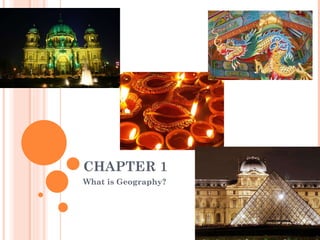
CHAPTER 1 What is Geography?
GEOGRAPHY Comes from Greek word, Geographia Earth description What do geographers study? Describe earth’s physical features Describe human features Describe interactions of people, places, and environments
WORLD IN SPATIAL TERMS Location Specific place on the earth Absolute location Exact spot where a place is found on the globe Relative location Most people locate a place in relation to other places i.e.  New Orleans is located NEAR the mouth of the Mississippi River This can be used to help one orient oneself in space and develop an awareness of the world around you Hemispheres Equator Line circling the earth midway between the North and South poles Divides Earth into north and south hemispheres Prime Meridian (aka the Meridian of Greenwich) Runs through Greenwich, England Divides Earth into East and West Longitude and Latitude lines cross one another to form the grid system (look at map)
 
PLACES AND REGIONS Place A particular space with physical and human meaning Every place has unique characteristics that are determined by the surrounding and the people who live there Region Area united by specific factors Physical or human factors Soil type, vegetation, river systems, climate Language, culture, customs Are used to interpret earth’s complexity Formal/Uniform Region Defined by a common characteristic Corn Belt (Iowa-Illinois, corn is a major crop) Functional Region A Central place and the surrounding area linked to it  i.e.  Metropolitan areas like Los Angeles and Tokyo Ports, such as Laredo Perceptual Region Defined by popular feelings and images rather than by objective data i.e.  Heartland of America/The West/The North East Implies that this is the central area in which values are believed to predominate
DIFFERENT SYSTEMS Physical Systems Natural phenomenon can shape the earth’s surface Physical features interact with plant and animal life to create, support, or change ecosystems Ecosystems are communities of plants and animals that depend one each other and their surroundings for survival Human Systems People shape the world There is constant MOVEMENT of people, goods, and ideas People compete or cooperate to change or control various aspects of the earth to meet their needs Food crops, man-made lakes, dams, etc. Human-environment interaction Study of the interrelationship between people and their physical environment People use and change their environment Physical environment affects human activities Mountains and deserts pose barriers to humans Do humans change the environment, or does the environment cause humans to change?
BRANCHES OF GEOGRAPHY Geographers divide their subject area into different branches to make their work easier Physical Geography Focuses on physical features Climate, land, water, plants, and animal life in terms of their relationships to one another and humans Human Geography (aka Cultural Geography) Focuses on human activities and their relationship to the cultural and physical environments Political, economic, cultural factors Population density, urban development, economic production, ethnicity Sub-branches include Meteorology Study of weather and weather forecasting Historical geography Study of places and human activities over time
RESEARCH METHODS Direct Observation Aerial photographs and satellite images i.e. Using images to see how air pollution affects forests Mapping Many geographic findings can be shown on maps better than they can be explained in text Cartography Study of maps and map-making Interviewing Geographers must go beyond observation Geographers might want to find out How people’s beliefs and attitudes have led to changes in the physical environment A sample of the community of interest is selected to represent the entire population Statistics Statistical methods are used to test data This helps geographers analyze findings to find patterns and relationships between different variables i.e. Muslim immigration to France Technology Satellites and computers are important in gathering data about the earth’s environment This has made cartography easier
GEOGRAPHY AND OTHER SUBJECTS History and Government History is used to help geographers understand the differences between the past and present i.e.  Difference between colonial Boston, MA, and current day Boston, MA Government is used to help one understand how people in different places are governed and how political boundaries have formed and changed Culture Sociology and anthropology is used to examine people’s way in different parts of the world Economics Locations of resources affect the ways people make, transport, and use goods Locations are chosen for various economic activities Farming, mining, manufacturing
CHAPTER 2 The Earth
SOLAR SYSTEM Sun is the center of the solar system Sun’s mass creates gravity Solar System also consists of planets (8) Inner planets Mercury Venus Earth 5 th  largest Mars Outer planets Jupiter Largest planet Saturn Uranus Neptune Pluto (recently demoted to a dwarf planet) All planets but Mercury and Venus have moons, smaller spheres, or satellites Terrestrial planets have solid, rocky crusts Mercury, Venus, Earth, Mars Gas giant planets are much more gaseous and less dense than terrestrial planets Jupiter, Saturn, Uranus,  Neptune
ASTEROIDS, COMETS, AND METEOROIDS There are other objects in the solar system Asteroids Small, irregularly shaped, planet like objects Found mainly between the asteroid belt region which lies between Mars and Jupiter Comets Made of icy dust particles and frozen gas Look like bright balls of fire with long, feathery tails Meteoroids Pieces of space debris Usually chunks of rock and iron Friction usually burns them up when they enter earth’s atmosphere Meteoroids that collide with earth are meteorites Can affect the landscape by leaving a crater
EARTH Hydrosphere Composed of oceans, lakes, rivers, and other bodies of water Covers 70 % of earth Lithosphere This is composed of land, including continents and islands, ocean basins, and land beneath ocean 30 % of earth is covered by land Atmosphere Layer of gas extending about 1,000 miles above the surface 78% Nitrogen 21% Oxygen 1% other gases Biosphere The part of earth that supports life
LANDFORMS Four major landforms Mountains, hills, plateaus, plains These usually contain rivers, lakes, and streams Most visible major landforms are continents Australia and Antarctica Stand alone Europe and Asia Parts of one huge landmass called Eurasia North America and South America Connected by the Isthmus of Panama, a narrow neck of land Africa Mount Everest The highest point on earth, found in Asia Dead Sea shore Lowest dry land point
EARTH’S STRUCTURE Surface of the earth has been in slow, constant motion Wind and water can change surface of the earth Earthquakes and volcanic eruptions originate deep within the earth Earth is composed of 3 layers Core Inner Core Iron and nickel under enormous pressure Outer Core Band of iron and nickel surrounding inner core Mantle Thick layer of hot, dense rock and various elements (oxygen, iron, etc.) Crust Rocky shell that forms the earth’s surface
PLATE MOVEMENT Scientists believe that all land masses were once combined Pangaea This broke off into smaller continents, drifted away, and recombined in some places Continental Drift Theory that continents were once joined and DRIFTed apart This could have caused the many mountain ranges Plate Tectonics Describes activities of continental drift  and magma flow which created many of the earth’s physical features
INTERNAL FORCES OF CHANGE Colliding and Spreading Plates Subduction can create mountains Heavier sea plate dives beneath the lighter continental plate The Andes in South America formed like this Folds and Faults Squeezing the earth’s surface until it buckles can create folds, which are bends, in layers of rock Sometimes they create faults, which are cracks Earthquakes Formed by the sudden, violent movements of plates Ring of fire is one of the earth’s most earthquake-prone zone which is found in the Pacific Ocean Volcanic Eruptions Volcanoes are mountains formed by lava Usually formed along plate boundaries
EXTERNAL FORCES OF CHANGE Surface can be changed by various elements Weathering Physical weathering Large masses of rock are physically broken into smaller pieces  Chemical weathering the chemical makeup of rocks can change, whereby the minerals of the rock are changed or combined with new elements Water with carbon dioxide in air dissolves certain types of rock, such as limestone Erosion The wearing away of the earth’s surface by wind, glaciers, and water Wind Erosion Involves the movement of dust, sand, and soil from one place to another Plants help protect against wind erosion Glacial Erosion Glaciers pick up rocks and soil in their path, changing landscapes, destroying forests, and cutting out valleys Water Erosion Fast-moving water, such as rain, rivers, streams, and oceans cause erosion As water flows, water cuts into the land This usually first forms a gully, then a v shaped valley Grand Canyon in Colorado
EARTH AND WATER Total amount of water does not change, but it’s always moving Water cycle Sun’s heat causes evaporation The changing of liquid water into vapor, or gas Condensation As the air cools, excess water vapor changes into liquid water Precipitation After the vapor is changed into water, it is released as rain, snow, or sleet, depending on the air temperature and wind conditions
SALT WATER VS FRESH WATER Fresh water makes up only a small percentage of the earth’s water Salt water Oceans Pacific, Atlantic, Indian, Arctic Seas, Gulfs, Bays Smaller than oceans and are usually partially enclosed by land Fresh Water Makes up only about 3 % of earth’s water Lakes, streams, rivers Most lakes contain freshwater, but those that used to be ancient seas will contain salt water (Utah’s Great Salt Lake) Groundwater Freshwater that lies beneath the earth’s surface Wells and springs tap into groundwater Aquifers are underground porous rock layers that usually contain water
CHAPTER 3 Climates of the Earth
CLIMATES OF THE EARTH Weather Condition of the atmosphere in one place during a limited time period Looking outside to see if it’s raining or sunny Climate Term used for weather patterns that an area typically experiences over a long period of time People living in Seattle, WA usually carry an umbrella because the Seattle has a wet climate Earth’s axis is tilted at an angle of 23 ½ degrees The Axis is an imaginary line running from the North Pole to the South Pole through the planet’s center This causes variations in sunlight This tilt affect temperature Temperature is how hot or cold a place is Most common scales for measuring temperature are Fahrenheit and Celsius Earth makes one complete rotation every 24 hours, rotating from west to east
THE EARTH Earth also experiences a revolution Revolutions take 365, whereby it orbits around the sun The seasons are reversed north and south of the equator When it’s summer in the north, it’s winter in the south Earth experiences an equinox The night is normally as long as the day during the equinox March 21 Tropic of Cancer  North-most point to receive direct sun rays, usually around June 21 This also leads to the longest day of sunlight north Known as the Summer SOLstice (sol = sun) Tropic of Capricorn South-most point to receive direct sun rays, usually  around December 22 This leads to the shortest day of sunlight in the north Known as the Winter Solstice
THE EARTH Poles For 6 months, one pole is tilted towards the sun and receives continuous sunlight, while the other receives little or no sunlight Greenhouse Effect Only part of the sun’s radiation passes through the earth’s atmosphere Greenhouse gasses warm the earth and makes it possible for plants to grow Water vapor and carbon dioxide  However, carbon dioxide has risen rapidly due to the burning of fossil fuels, which has led to a rise in global temperatures known as global warming Without the greenhouse effect, the earth would be too cold
LATITUDE AND CLIMATE Earth-sun relationship is important Low Latitude Are between Tropic of Cancer and Tropic of Capricorn This includes the equator Portions of this area receive direct rays of the sun year-round  High Latitudes Consist the world’s polar areas For about 6 months each, these regions experience either continuous, but indirect, sunlight, OR twilight Mid-Latitudes Area between the Tropic of Cancer and the Arctic Circle as well as the Tropic of Capricorn and the Antarctic Circle These experience dramatic climate differences Elevation and Climate Latitude elevations affect climate Earth’s atmosphere thins as altitude increases Thinner air retains less heat Places on mountaintops are cooler than lowlands
WIND AND OCEAN CURRENTS Wind Patterns Prevailing winds Winds that blow in fairly constant patterns These directions are determined by latitude Coriolis effect Effect that causes prevailing winds to blow diagonally rather than along strict north-south or east-west lines Horse Latitudes At the equator, there is a nearly windless band called the DOLDRUMS 2 other similar bands can be found just north of the Tropic of Cancer and just south of the Tropic of Capricorn Ocean Currents Ocean currents affect climate in the coastal lands Cold oceans cool the lands they pass, while warm currents bring warmer temperatures Cold water comes from the polar areas, while warm water comes from the tropics El Nino Periodic reversal of the pattern of ocean currents and water temperatures in the mid-Pacific region Does not occur every year, however it has become more frequent This causes increased precipitation  along the coasts of North and South America
LANDFORMS AND CLIMATE Physical features can also cause climate Large bodies of water are slower to heat and to cool than land Water temperatures are more uniform than land temperatures Coastal lands receive less changeable weather Mountain ranges influence precipitation and affect climate Windward side  Side of the mountain facing wind Receives precipitation Leeward side Warmer and dryer side of the mountain  Receives rain shadow A light precipitation effect
CLIMATE REGIONS Natural vegetation Plant life that grows in an area where the natural environment is unchanged by human activity This is affected by climate regions Climate regions Tropical Climates Found near low latitudes Usually hot and wet throughout the year Wildlife is abundant and there’s lush vegetation Dry Climates Desert Climates Desert and Steppe climate are subcategories Sparse plant and animal life Occurs in around 1/5 th  of the earth’s land area Steppe Climates Usually borders desert Dry and treeless grasslands
CLIMATE REGIONS Mid-Latitude Climates Marine West Coast Pacific coast of NA, much of Europe Cool summers and damp winters Mediterranean Around the Mediterranean Sea, Southern California Mild, rainy winters and hot, sunny summers Humid Subtropical South Eastern US and parts of South America Mild winters and nearly year-round rain Humid Continental Northeastern China, southern Canada, western Russia Farther north one travels, the longer and more severe are the snowy winters and the shorter and cooler are the summers High Latitude Climates Normally freezing temperatures Summers are short and cool, winters are bitterly cold, with permafrost, or frozen subsoil Highlands Climates Determined by elevation The higher the elevation, the cooler the temperatures are
CLIMATIC CHANGES Climate changes over time During the last 1 to 2 million years, the earth has gone through more than 4 ice ages Human interaction with environment affects climate Burning fossil fuels releases gases and acid that can fall in the form of rain or snow Smog  Visible chemical haze Endangers people’s lives
CHAPTER 4 World Population
POPULATION GROWTH On 2003 there were 6.2 billion people on earth Population of earth more than doubled between 1800 and 1950 Population grows when birthrates pass death rates Population growth occurs at different rates in various parts of the world Improved health care and food abundance has brought down death rate Many industrialized countries also experience Zero population growth When the birthrate and death rate are equal Many countries in Asia, Africa, and Latina America experience high birthrates Rapid population grown can present many challenges Food production Lack of resources Most people are young and cannot contribute to the production of food and services Negative Population Growth Death rate exceeds birthrate Germany and Hungary This has economic consequences
POPULATION DISTRIBUTION Population Distribution The pattern of human settlement There is an uneven distribution Most of the earth’s land is inhospitable High mountain peaks, frozen tundra, barren deserts Most people live where the soil is fertile, water is available, and climate is not extreme Asia contains more than 60% of world’s population Many people live in metropolitan/urban areas Geographers check Population Density to figure out how crowded an area is This is determined by dividing the total population of the country by its total land area The average number of people living on a square mile or kilometer Canada has low population density, while Bangladesh has one of the highest
POPULATION MOVEMENT Migration Movement of people from place to place Many people moved from rural areas to suburb/city areas Urbanization Growth of city populations brought by migration Caused by the desire of rural people to find jobs About half of the world’s people live in cities Some people also immigrate to other countries Immigrants  Some people flee from their countries due to wars and other problems Refugees
CULTURE Culture Way of life of a group of people who share similar beliefs and customs Language Key element of culture Used to communicate and pass on cultural values One of the strongest unifying force of one’s culture Linguists Study languages Religion Enables people to find a sense of identity Influences aspects of daily life and moral values Major religions Hinduism, Buddhism, Judaism, Christianity, Islam
CULTURE Social Groups Family is normally the most important group Ethnic group Made up of people who share a common language, history, place of origin, or combination of elements Government Government maintains order within country Provides protection from outside dangers Supplies people with services Economic Activities Some cultures rely on farming, industry, or service to make profits Different regions utilize natural resources differently Culture Regions Includes many different countries that have certain common traits North America and Canada, Latin America, Europe, Middle East and Northern Africa
CULTURAL CHANGE Cultural diffusion The process of spreading new knowledge and skills from one culture to another Agricultural revolution The shift from gathering food to producing food Earliest humans were nomads No fixed homes and moved from place to place Many nomads settled in river valleys and on fertile plains as the earth warmed (10,000 years ago) They then became farmers and settled in permanent villages
CULTURAL CHANGE Culture Hearths Origins of the first civilizations Places include Egypt, Iraq, Pakistan, China, Mexico All emerged from farming settlements with mild climate and fertile lands near rivers or sources of water Specialization and Civilization Surplus of food allowed the rise of cities and civilization More food meant people could develop other ways of living This led to the rise of technology Metalworking and shipbuilding spurred long-distance trade Wealth from trade led to rise of cities Cultural contact Contact with other civilizations promoted change of ideas and practices Immigration has fostered cultural diffusion Industrial and Information Revolution New production methods changed economies due to the production of quicker and cheaper goods Industrial revolution led to social changes Computers have increased the access to information
THE GOVERNMENT Levels of government Unitary System All key powers to the central government France, United Kingdom Federal System Divides power between national government and state governments United States, Brazil, Australia Types of government Autocracy Oldest and one of the most common forms of government One person rule Nazi Germany Monarchy King or queen exercises absolute power Saudi Arabia Oligarchy Small group of people holds the power Governments of Communist countries like China Derives power from wealth, military power, social position, and religion Democracy Leaders rule with consent of the citizens Comes from Greek Demos Kratia meaning “The people rule” Countries have representative democracies United States, France, United Kingdom (Constitutional Monarchy)
ECONOMIC SYSTEMS Traditional Economy Habit and custom determine the rules for all economic activity Individuals are not free to make decisions based on what they would like to have Exists in very few parts of the world Market Economy Individuals and private groups make decisions about what to produce Based on Free Enterprise Idea that private individuals or groups have the right to own property or businesses to make profit with LIMITED government interference Mixed market economy Government supports and regulates free enterprise through decisions that affect the market place Command Economy Government owns or directs means of production Citizens have no voice in how taxes are spent Communism Requires strict government control

Unit 1

  • 1.
    CHAPTER 1 Whatis Geography?
  • 2.
    GEOGRAPHY Comes fromGreek word, Geographia Earth description What do geographers study? Describe earth’s physical features Describe human features Describe interactions of people, places, and environments
  • 3.
    WORLD IN SPATIALTERMS Location Specific place on the earth Absolute location Exact spot where a place is found on the globe Relative location Most people locate a place in relation to other places i.e. New Orleans is located NEAR the mouth of the Mississippi River This can be used to help one orient oneself in space and develop an awareness of the world around you Hemispheres Equator Line circling the earth midway between the North and South poles Divides Earth into north and south hemispheres Prime Meridian (aka the Meridian of Greenwich) Runs through Greenwich, England Divides Earth into East and West Longitude and Latitude lines cross one another to form the grid system (look at map)
  • 4.
  • 5.
    PLACES AND REGIONSPlace A particular space with physical and human meaning Every place has unique characteristics that are determined by the surrounding and the people who live there Region Area united by specific factors Physical or human factors Soil type, vegetation, river systems, climate Language, culture, customs Are used to interpret earth’s complexity Formal/Uniform Region Defined by a common characteristic Corn Belt (Iowa-Illinois, corn is a major crop) Functional Region A Central place and the surrounding area linked to it i.e. Metropolitan areas like Los Angeles and Tokyo Ports, such as Laredo Perceptual Region Defined by popular feelings and images rather than by objective data i.e. Heartland of America/The West/The North East Implies that this is the central area in which values are believed to predominate
  • 6.
    DIFFERENT SYSTEMS PhysicalSystems Natural phenomenon can shape the earth’s surface Physical features interact with plant and animal life to create, support, or change ecosystems Ecosystems are communities of plants and animals that depend one each other and their surroundings for survival Human Systems People shape the world There is constant MOVEMENT of people, goods, and ideas People compete or cooperate to change or control various aspects of the earth to meet their needs Food crops, man-made lakes, dams, etc. Human-environment interaction Study of the interrelationship between people and their physical environment People use and change their environment Physical environment affects human activities Mountains and deserts pose barriers to humans Do humans change the environment, or does the environment cause humans to change?
  • 7.
    BRANCHES OF GEOGRAPHYGeographers divide their subject area into different branches to make their work easier Physical Geography Focuses on physical features Climate, land, water, plants, and animal life in terms of their relationships to one another and humans Human Geography (aka Cultural Geography) Focuses on human activities and their relationship to the cultural and physical environments Political, economic, cultural factors Population density, urban development, economic production, ethnicity Sub-branches include Meteorology Study of weather and weather forecasting Historical geography Study of places and human activities over time
  • 8.
    RESEARCH METHODS DirectObservation Aerial photographs and satellite images i.e. Using images to see how air pollution affects forests Mapping Many geographic findings can be shown on maps better than they can be explained in text Cartography Study of maps and map-making Interviewing Geographers must go beyond observation Geographers might want to find out How people’s beliefs and attitudes have led to changes in the physical environment A sample of the community of interest is selected to represent the entire population Statistics Statistical methods are used to test data This helps geographers analyze findings to find patterns and relationships between different variables i.e. Muslim immigration to France Technology Satellites and computers are important in gathering data about the earth’s environment This has made cartography easier
  • 9.
    GEOGRAPHY AND OTHERSUBJECTS History and Government History is used to help geographers understand the differences between the past and present i.e. Difference between colonial Boston, MA, and current day Boston, MA Government is used to help one understand how people in different places are governed and how political boundaries have formed and changed Culture Sociology and anthropology is used to examine people’s way in different parts of the world Economics Locations of resources affect the ways people make, transport, and use goods Locations are chosen for various economic activities Farming, mining, manufacturing
  • 10.
  • 11.
    SOLAR SYSTEM Sunis the center of the solar system Sun’s mass creates gravity Solar System also consists of planets (8) Inner planets Mercury Venus Earth 5 th largest Mars Outer planets Jupiter Largest planet Saturn Uranus Neptune Pluto (recently demoted to a dwarf planet) All planets but Mercury and Venus have moons, smaller spheres, or satellites Terrestrial planets have solid, rocky crusts Mercury, Venus, Earth, Mars Gas giant planets are much more gaseous and less dense than terrestrial planets Jupiter, Saturn, Uranus, Neptune
  • 12.
    ASTEROIDS, COMETS, ANDMETEOROIDS There are other objects in the solar system Asteroids Small, irregularly shaped, planet like objects Found mainly between the asteroid belt region which lies between Mars and Jupiter Comets Made of icy dust particles and frozen gas Look like bright balls of fire with long, feathery tails Meteoroids Pieces of space debris Usually chunks of rock and iron Friction usually burns them up when they enter earth’s atmosphere Meteoroids that collide with earth are meteorites Can affect the landscape by leaving a crater
  • 13.
    EARTH Hydrosphere Composedof oceans, lakes, rivers, and other bodies of water Covers 70 % of earth Lithosphere This is composed of land, including continents and islands, ocean basins, and land beneath ocean 30 % of earth is covered by land Atmosphere Layer of gas extending about 1,000 miles above the surface 78% Nitrogen 21% Oxygen 1% other gases Biosphere The part of earth that supports life
  • 14.
    LANDFORMS Four majorlandforms Mountains, hills, plateaus, plains These usually contain rivers, lakes, and streams Most visible major landforms are continents Australia and Antarctica Stand alone Europe and Asia Parts of one huge landmass called Eurasia North America and South America Connected by the Isthmus of Panama, a narrow neck of land Africa Mount Everest The highest point on earth, found in Asia Dead Sea shore Lowest dry land point
  • 15.
    EARTH’S STRUCTURE Surfaceof the earth has been in slow, constant motion Wind and water can change surface of the earth Earthquakes and volcanic eruptions originate deep within the earth Earth is composed of 3 layers Core Inner Core Iron and nickel under enormous pressure Outer Core Band of iron and nickel surrounding inner core Mantle Thick layer of hot, dense rock and various elements (oxygen, iron, etc.) Crust Rocky shell that forms the earth’s surface
  • 16.
    PLATE MOVEMENT Scientistsbelieve that all land masses were once combined Pangaea This broke off into smaller continents, drifted away, and recombined in some places Continental Drift Theory that continents were once joined and DRIFTed apart This could have caused the many mountain ranges Plate Tectonics Describes activities of continental drift and magma flow which created many of the earth’s physical features
  • 17.
    INTERNAL FORCES OFCHANGE Colliding and Spreading Plates Subduction can create mountains Heavier sea plate dives beneath the lighter continental plate The Andes in South America formed like this Folds and Faults Squeezing the earth’s surface until it buckles can create folds, which are bends, in layers of rock Sometimes they create faults, which are cracks Earthquakes Formed by the sudden, violent movements of plates Ring of fire is one of the earth’s most earthquake-prone zone which is found in the Pacific Ocean Volcanic Eruptions Volcanoes are mountains formed by lava Usually formed along plate boundaries
  • 18.
    EXTERNAL FORCES OFCHANGE Surface can be changed by various elements Weathering Physical weathering Large masses of rock are physically broken into smaller pieces Chemical weathering the chemical makeup of rocks can change, whereby the minerals of the rock are changed or combined with new elements Water with carbon dioxide in air dissolves certain types of rock, such as limestone Erosion The wearing away of the earth’s surface by wind, glaciers, and water Wind Erosion Involves the movement of dust, sand, and soil from one place to another Plants help protect against wind erosion Glacial Erosion Glaciers pick up rocks and soil in their path, changing landscapes, destroying forests, and cutting out valleys Water Erosion Fast-moving water, such as rain, rivers, streams, and oceans cause erosion As water flows, water cuts into the land This usually first forms a gully, then a v shaped valley Grand Canyon in Colorado
  • 19.
    EARTH AND WATERTotal amount of water does not change, but it’s always moving Water cycle Sun’s heat causes evaporation The changing of liquid water into vapor, or gas Condensation As the air cools, excess water vapor changes into liquid water Precipitation After the vapor is changed into water, it is released as rain, snow, or sleet, depending on the air temperature and wind conditions
  • 20.
    SALT WATER VSFRESH WATER Fresh water makes up only a small percentage of the earth’s water Salt water Oceans Pacific, Atlantic, Indian, Arctic Seas, Gulfs, Bays Smaller than oceans and are usually partially enclosed by land Fresh Water Makes up only about 3 % of earth’s water Lakes, streams, rivers Most lakes contain freshwater, but those that used to be ancient seas will contain salt water (Utah’s Great Salt Lake) Groundwater Freshwater that lies beneath the earth’s surface Wells and springs tap into groundwater Aquifers are underground porous rock layers that usually contain water
  • 21.
    CHAPTER 3 Climatesof the Earth
  • 22.
    CLIMATES OF THEEARTH Weather Condition of the atmosphere in one place during a limited time period Looking outside to see if it’s raining or sunny Climate Term used for weather patterns that an area typically experiences over a long period of time People living in Seattle, WA usually carry an umbrella because the Seattle has a wet climate Earth’s axis is tilted at an angle of 23 ½ degrees The Axis is an imaginary line running from the North Pole to the South Pole through the planet’s center This causes variations in sunlight This tilt affect temperature Temperature is how hot or cold a place is Most common scales for measuring temperature are Fahrenheit and Celsius Earth makes one complete rotation every 24 hours, rotating from west to east
  • 23.
    THE EARTH Earthalso experiences a revolution Revolutions take 365, whereby it orbits around the sun The seasons are reversed north and south of the equator When it’s summer in the north, it’s winter in the south Earth experiences an equinox The night is normally as long as the day during the equinox March 21 Tropic of Cancer North-most point to receive direct sun rays, usually around June 21 This also leads to the longest day of sunlight north Known as the Summer SOLstice (sol = sun) Tropic of Capricorn South-most point to receive direct sun rays, usually around December 22 This leads to the shortest day of sunlight in the north Known as the Winter Solstice
  • 24.
    THE EARTH PolesFor 6 months, one pole is tilted towards the sun and receives continuous sunlight, while the other receives little or no sunlight Greenhouse Effect Only part of the sun’s radiation passes through the earth’s atmosphere Greenhouse gasses warm the earth and makes it possible for plants to grow Water vapor and carbon dioxide However, carbon dioxide has risen rapidly due to the burning of fossil fuels, which has led to a rise in global temperatures known as global warming Without the greenhouse effect, the earth would be too cold
  • 25.
    LATITUDE AND CLIMATEEarth-sun relationship is important Low Latitude Are between Tropic of Cancer and Tropic of Capricorn This includes the equator Portions of this area receive direct rays of the sun year-round High Latitudes Consist the world’s polar areas For about 6 months each, these regions experience either continuous, but indirect, sunlight, OR twilight Mid-Latitudes Area between the Tropic of Cancer and the Arctic Circle as well as the Tropic of Capricorn and the Antarctic Circle These experience dramatic climate differences Elevation and Climate Latitude elevations affect climate Earth’s atmosphere thins as altitude increases Thinner air retains less heat Places on mountaintops are cooler than lowlands
  • 26.
    WIND AND OCEANCURRENTS Wind Patterns Prevailing winds Winds that blow in fairly constant patterns These directions are determined by latitude Coriolis effect Effect that causes prevailing winds to blow diagonally rather than along strict north-south or east-west lines Horse Latitudes At the equator, there is a nearly windless band called the DOLDRUMS 2 other similar bands can be found just north of the Tropic of Cancer and just south of the Tropic of Capricorn Ocean Currents Ocean currents affect climate in the coastal lands Cold oceans cool the lands they pass, while warm currents bring warmer temperatures Cold water comes from the polar areas, while warm water comes from the tropics El Nino Periodic reversal of the pattern of ocean currents and water temperatures in the mid-Pacific region Does not occur every year, however it has become more frequent This causes increased precipitation along the coasts of North and South America
  • 27.
    LANDFORMS AND CLIMATEPhysical features can also cause climate Large bodies of water are slower to heat and to cool than land Water temperatures are more uniform than land temperatures Coastal lands receive less changeable weather Mountain ranges influence precipitation and affect climate Windward side Side of the mountain facing wind Receives precipitation Leeward side Warmer and dryer side of the mountain Receives rain shadow A light precipitation effect
  • 28.
    CLIMATE REGIONS Naturalvegetation Plant life that grows in an area where the natural environment is unchanged by human activity This is affected by climate regions Climate regions Tropical Climates Found near low latitudes Usually hot and wet throughout the year Wildlife is abundant and there’s lush vegetation Dry Climates Desert Climates Desert and Steppe climate are subcategories Sparse plant and animal life Occurs in around 1/5 th of the earth’s land area Steppe Climates Usually borders desert Dry and treeless grasslands
  • 29.
    CLIMATE REGIONS Mid-LatitudeClimates Marine West Coast Pacific coast of NA, much of Europe Cool summers and damp winters Mediterranean Around the Mediterranean Sea, Southern California Mild, rainy winters and hot, sunny summers Humid Subtropical South Eastern US and parts of South America Mild winters and nearly year-round rain Humid Continental Northeastern China, southern Canada, western Russia Farther north one travels, the longer and more severe are the snowy winters and the shorter and cooler are the summers High Latitude Climates Normally freezing temperatures Summers are short and cool, winters are bitterly cold, with permafrost, or frozen subsoil Highlands Climates Determined by elevation The higher the elevation, the cooler the temperatures are
  • 30.
    CLIMATIC CHANGES Climatechanges over time During the last 1 to 2 million years, the earth has gone through more than 4 ice ages Human interaction with environment affects climate Burning fossil fuels releases gases and acid that can fall in the form of rain or snow Smog Visible chemical haze Endangers people’s lives
  • 31.
    CHAPTER 4 WorldPopulation
  • 32.
    POPULATION GROWTH On2003 there were 6.2 billion people on earth Population of earth more than doubled between 1800 and 1950 Population grows when birthrates pass death rates Population growth occurs at different rates in various parts of the world Improved health care and food abundance has brought down death rate Many industrialized countries also experience Zero population growth When the birthrate and death rate are equal Many countries in Asia, Africa, and Latina America experience high birthrates Rapid population grown can present many challenges Food production Lack of resources Most people are young and cannot contribute to the production of food and services Negative Population Growth Death rate exceeds birthrate Germany and Hungary This has economic consequences
  • 33.
    POPULATION DISTRIBUTION PopulationDistribution The pattern of human settlement There is an uneven distribution Most of the earth’s land is inhospitable High mountain peaks, frozen tundra, barren deserts Most people live where the soil is fertile, water is available, and climate is not extreme Asia contains more than 60% of world’s population Many people live in metropolitan/urban areas Geographers check Population Density to figure out how crowded an area is This is determined by dividing the total population of the country by its total land area The average number of people living on a square mile or kilometer Canada has low population density, while Bangladesh has one of the highest
  • 34.
    POPULATION MOVEMENT MigrationMovement of people from place to place Many people moved from rural areas to suburb/city areas Urbanization Growth of city populations brought by migration Caused by the desire of rural people to find jobs About half of the world’s people live in cities Some people also immigrate to other countries Immigrants Some people flee from their countries due to wars and other problems Refugees
  • 35.
    CULTURE Culture Wayof life of a group of people who share similar beliefs and customs Language Key element of culture Used to communicate and pass on cultural values One of the strongest unifying force of one’s culture Linguists Study languages Religion Enables people to find a sense of identity Influences aspects of daily life and moral values Major religions Hinduism, Buddhism, Judaism, Christianity, Islam
  • 36.
    CULTURE Social GroupsFamily is normally the most important group Ethnic group Made up of people who share a common language, history, place of origin, or combination of elements Government Government maintains order within country Provides protection from outside dangers Supplies people with services Economic Activities Some cultures rely on farming, industry, or service to make profits Different regions utilize natural resources differently Culture Regions Includes many different countries that have certain common traits North America and Canada, Latin America, Europe, Middle East and Northern Africa
  • 37.
    CULTURAL CHANGE Culturaldiffusion The process of spreading new knowledge and skills from one culture to another Agricultural revolution The shift from gathering food to producing food Earliest humans were nomads No fixed homes and moved from place to place Many nomads settled in river valleys and on fertile plains as the earth warmed (10,000 years ago) They then became farmers and settled in permanent villages
  • 38.
    CULTURAL CHANGE CultureHearths Origins of the first civilizations Places include Egypt, Iraq, Pakistan, China, Mexico All emerged from farming settlements with mild climate and fertile lands near rivers or sources of water Specialization and Civilization Surplus of food allowed the rise of cities and civilization More food meant people could develop other ways of living This led to the rise of technology Metalworking and shipbuilding spurred long-distance trade Wealth from trade led to rise of cities Cultural contact Contact with other civilizations promoted change of ideas and practices Immigration has fostered cultural diffusion Industrial and Information Revolution New production methods changed economies due to the production of quicker and cheaper goods Industrial revolution led to social changes Computers have increased the access to information
  • 39.
    THE GOVERNMENT Levelsof government Unitary System All key powers to the central government France, United Kingdom Federal System Divides power between national government and state governments United States, Brazil, Australia Types of government Autocracy Oldest and one of the most common forms of government One person rule Nazi Germany Monarchy King or queen exercises absolute power Saudi Arabia Oligarchy Small group of people holds the power Governments of Communist countries like China Derives power from wealth, military power, social position, and religion Democracy Leaders rule with consent of the citizens Comes from Greek Demos Kratia meaning “The people rule” Countries have representative democracies United States, France, United Kingdom (Constitutional Monarchy)
  • 40.
    ECONOMIC SYSTEMS TraditionalEconomy Habit and custom determine the rules for all economic activity Individuals are not free to make decisions based on what they would like to have Exists in very few parts of the world Market Economy Individuals and private groups make decisions about what to produce Based on Free Enterprise Idea that private individuals or groups have the right to own property or businesses to make profit with LIMITED government interference Mixed market economy Government supports and regulates free enterprise through decisions that affect the market place Command Economy Government owns or directs means of production Citizens have no voice in how taxes are spent Communism Requires strict government control