WESTERN
PHILOSOPIES
BY
Dr.S.JERSLIN
IDEALISM
.
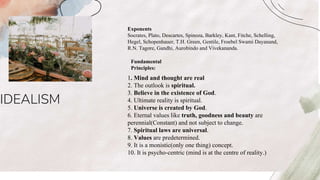
Exponents
Socrates, Plato, Descartes, Spinoza, Barkley, Kant, Fitche, Schelling,
Hegel, Schopenhauer, T.H. Green, Gentile, Froebel Swami Dayanand,
R.N. Tagore, Gandhi, Aurobindo and Vivekananda.
Fundamental
Principles:
1. Mind and thought are real
2. The outlook is spiritual.
3. Believe in the existence of God.
4. Ultimate reality is spiritual.
5. Universe is created by God.
6. Eternal values like truth, goodness and beauty are
perennial(Constant) and not subject to change.
7. Spiritual laws are universal.
8. Values are predetermined.
9. It is a monistic(only one thing) concept.
10. It is psycho-centric (mind is at the centre of reality.)
Educational Principles:
1. Spiritual is at the base of education.
Emphasis is on the spiritual and moral
environment.
2. Teacher and curriculum are the centres of
education.
3. Emphasizes book learning.
4. Attaches emphasis on discipline of the child.
5. Emphasizes on thinking and reasoning.
6. Believes in positive education.
7. Education is the dynamic side of philosophy.
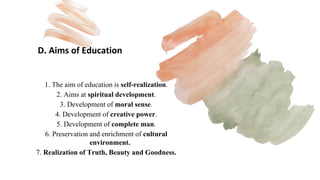
D. Aims of Education
1. The aim of education is self-realization.
2. Aims at spiritual development.
3. Development of moral sense.
4. Development of creative power.
5. Development of complete man.
6. Preservation and enrichment of cultural
environment.
7. Realization of Truth, Beauty and Goodness.
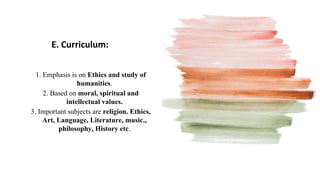
E. Curriculum:
1. Emphasis is on Ethics and study of
humanities.
2. Based on moral, spiritual and
intellectual values.
3. Important subjects are religion. Ethics,
Art, Language, Literature, music.,
philosophy, History etc.
• F. Methods of
Teaching:
• 1. Advocating a lot
of methods. Not
advocated a single
method.
• 2. Questioning,
conversation,
Dialogue,
Discussion,
Lecture, Inductive
and Deductive,
Play-way, Story-
telling, Exercise or
practice,
Argumentation,
Book study etc..
• G. Discipline:
• 1. Unrestrained
freedom is not
allowed.
• 2. Emphasizes
regulated
freedom.
• 3. Emphasizes
impres-
sionistic(sugges
tive) discipline.
• 4. Self-
discipline.
• H. Teacher:
• 1. Teacher’s
position is very
high.
• 2. He guides,
directs, suggests
and controls the
situation. He is
like a gardener
whose function is
to carefully tend
the little plants
under his
disposition.(chara
cter)
• I. School:
• 1. It is the only
place for
regular and
effective
education.
• 2. It is a place
for carrying
pleasant and
joyful
activities.
NATURALISM
• A. Exponents:
• Aristotle, August
Comte, Hobbes, Bacon,
Darwin, Lamarck,
Huxley, Spencer, G.B.
Shaw, Pestalozzi, J.J.
Rousseau, Samuel
Butler.
• B. Fundamental Principles:
• 1. Nature alone is entire reality, it is
ready-made.
• 2. The outlook is materialistic.
• 3. Do not believe in existence of God.
• 4. Ultimate reality is physical.
• 5. Universe is the natural creation.
• 6. There is no spiritual values.
• 7. Do not believe in value, soul, God,
religion and divine spirit.
• 8. Physical and natural laws are
universal.
• 9. It is a monistic concept.
• 10. It is nature-centric (nature is at the
centre).
• C. Educational Principles:
• 1. Based on psychology. Child is the center
of education.
• 2. It emphasizes basic instincts, interests and
tendencies.
• 3. Nature is the base. “Follow Nature” is the
slogan.
• 4. Puts emphasis on unrestrained freedom.
• 5. Opposes bookish knowledge.
• 6. Believes in negative education.
• 7. Education is the dynamic side of
philosophy.
• D. Aims of Education:
• 1. The aim of education is self-expression.
• 2. Emphasizes the autonomous development of
personality.
• 3. Adjustment to environment.
• 4. Preparation for struggle of existence.
• 5. Attainment of present and future happiness.
• E. Curriculum:
• 1. Emphasis on Science
• 2. It is based on need, ability,
aptitude and the nature of the
child
• 3. Humanities occupy
subsidiary place in the
curriculum.
• 4. Main subjects are Games
and Sports, Physical sciences,
Physiology, Hygiene, Physics,
Chemistry, Biology,
Sociology, Domestic science.
• F. Methods of Teaching:
• 1. Learning by doing, learning
through experience, play-way
method, observation, Dalton Plan,
Direct method, Heuristic,
Montessori. Kindergarten methods.
• G. Discipline:
• 1. Unrestrained(not controlled)
freedom, discipline through natural
consequences(values).
• 2. Emphasizes emancipatory (social
freedom)discipline
• H. Teacher:
• 1. Teacher is behind
the scene.
• 2. He is hot to
interfere in the
child’s activities
• 3. His role is
subsidiary.
• 4. He is a stage-setter,
setting the stage.
• I. School:
• 1. Nature is the
best school.
• 2. School should
be a natural and
spontaneous field
for undertaking
free activities by
children.
Realism
• A. Exponentsno of
times)
• Aristotle, Iramus,
Rebellias, Milton, Lord
Montaigne, Locke,
Bacon, Commenius,
White-head, Bertrand
Russell Mulcaster,
Ratke.
• B. Fundamental Principles:
• 1. Physical world is real.
• 2. Importance on material world which is
real.
• 3. Cause-effect relationship is universal
and universally accepted.
• 4. Fully scientific attitude.
• 5. Do not believe in the existence of God.
• 6. Matter is the centre of reality, (matter-
centric).
• 7. Believe in material prosperity and
comfortable living.
• 8. It is a pluralistic concept
• 9. Physical laws are universal.
• 10. It is reality-centred.
• C. Educational Principles:
• 1. Based on science only
material world is the base.
• 2. Emphasises child- centered
education. Education is to be
imparted in accordance with the
interests of the child.
• 3. Emphasises observation,
experimentation, and
experience.
• 4. Opposes bookish learning.
• 5. It is liable to change
according to a change in life.
• 6. Attaches due importance to
discipline.
• 7. Philosophy is developed
from education.
• D. Aims of Education:
• 1. Preparing the child
for a real life.
• 2. Development of
physical and mental
powers of the child.
• 3. Development and
training of senses.
• 4. Development of a
complete man.
• 5. Adjustment with
physical and social
environment.
• 6. Imparting
vocational education.
• E. Curriculum:
• 1. Subjects concerning day-to-
day life are included.
• 2. Emphasis on practical and
utilitarian subjects.
• 3. Main subjects are Natural
science, Biological science,
Physical sciences, Health,
Culture, Math’s, Geography,
History, Astronomy, Sports
and Vocational education.
• F. Methods of Teaching:
• 1. Inductive method,
objective methods, learning
by walking and by
experience, correlation
teaching, experimental
method and heuristic method
etc..
• G. Discipline:
• 1. Restricted freedom.
• 2. Self-discipline.
• 3. Emphasises a synthetic type of
impressionistic(un focused) and
emancipating (freeing)discipline.
• H. Teacher:
• 1. Teacher’s role is supreme.
• 2. He should present facts in the real
form in an intelligent way. He should
not add any thing of his own.
• 3. He should provide opportunities for
observation and experimentation.
• I. School:
• 1. It is a socially
well-planned
institution.
• 2. It is a mirror
of society.
PRAGMATISM
• A. Exponents:
• William James,
Charles Pierce,
Schiller, John j
Dewey,
Kilpatrick.
• B. Fundamental Principles:
• 1. Reality is in process, it is still in making
and not read-made.
• 2. The outlook is social.
• 3. Believe in the existence of God to an
extent.
• 4. Ultimate reality is utility.
• 5. Universe has been created by man.
• 6. Values are changeable which are created
by man.
• 7.It is anthropos-centric. Human experience
at the centre of reality.
• 8. It is pluralistic.
• 9. No law is universal. Society is the base.
• 10. It is anthropo-centric.
• C. Educational Principles:
• 1. Emphasises on social and physical
environment.
• 2. Attaches importance on experimentation,
experience and utility.
• 3. Child is at the centre of all educational
activities.
• 4. Opposes bookish learning.
• 5. Philosophy is developed from education.
• 6. Supports restricted freedom of the child.
• 7. Education is a dynamic and active process.
• D. Aims of Education:
• 1. The aim of education is
dynamic in nature.
• 2. Aims at social efficiency
• 3. Adjustment with present
and to change the present.
• 4. Aim is more education.
• 5. Creation of new values.
• 6. Educational aims change
according to times, places
and circumstances.
• 7. No pre-determined or
fixed aims.
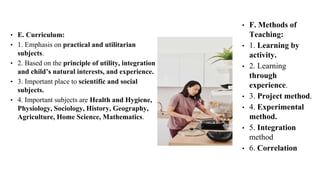
• E. Curriculum:
• 1. Emphasis on practical and utilitarian
subjects.
• 2. Based on the principle of utility, integration
and child’s natural interests, and experience.
• 3. Important place to scientific and social
subjects.
• 4. Important subjects are Health and Hygiene,
Physiology, Sociology, History, Geography,
Agriculture, Home Science, Mathematics.
• F. Methods of
Teaching:
• 1. Learning by
activity.
• 2. Learning
through
experience.
• 3. Project method.
• 4. Experimental
method.
• 5. Integration
method
• 6. Correlation
G. Discipline:
1. Restricted freedom.
2. Social discipline
• H. Teacher:
• 1. Teacher occupies an
important place in education.
• 2. He puts the pupil in the
position of a discoverer or
experimenter.
• 3. He is not to impose anything
on the child.
• 4. He is a friend, philosopher
and guide.
• 5.He helps the child to solve his
problems himself.
• I. School:
• 1. School is a
laboratory for
experimentation.
• 2. It is society in
miniature
• https://www.yourarticl
elibrary.com/educatio
n/idealism-naturalism-
realism-and-
pragmatism/76829
WESTERN Philosopies.pptx

WESTERN Philosopies.pptx

  • 1.
  • 2.
    IDEALISM . Exponents Socrates, Plato, Descartes,Spinoza, Barkley, Kant, Fitche, Schelling, Hegel, Schopenhauer, T.H. Green, Gentile, Froebel Swami Dayanand, R.N. Tagore, Gandhi, Aurobindo and Vivekananda. Fundamental Principles: 1. Mind and thought are real 2. The outlook is spiritual. 3. Believe in the existence of God. 4. Ultimate reality is spiritual. 5. Universe is created by God. 6. Eternal values like truth, goodness and beauty are perennial(Constant) and not subject to change. 7. Spiritual laws are universal. 8. Values are predetermined. 9. It is a monistic(only one thing) concept. 10. It is psycho-centric (mind is at the centre of reality.)
  • 3.
    Educational Principles: 1. Spiritualis at the base of education. Emphasis is on the spiritual and moral environment. 2. Teacher and curriculum are the centres of education. 3. Emphasizes book learning. 4. Attaches emphasis on discipline of the child. 5. Emphasizes on thinking and reasoning. 6. Believes in positive education. 7. Education is the dynamic side of philosophy.
  • 4.
    D. Aims ofEducation 1. The aim of education is self-realization. 2. Aims at spiritual development. 3. Development of moral sense. 4. Development of creative power. 5. Development of complete man. 6. Preservation and enrichment of cultural environment. 7. Realization of Truth, Beauty and Goodness.
  • 5.
    E. Curriculum: 1. Emphasisis on Ethics and study of humanities. 2. Based on moral, spiritual and intellectual values. 3. Important subjects are religion. Ethics, Art, Language, Literature, music., philosophy, History etc.
  • 6.
    • F. Methodsof Teaching: • 1. Advocating a lot of methods. Not advocated a single method. • 2. Questioning, conversation, Dialogue, Discussion, Lecture, Inductive and Deductive, Play-way, Story- telling, Exercise or practice, Argumentation, Book study etc.. • G. Discipline: • 1. Unrestrained freedom is not allowed. • 2. Emphasizes regulated freedom. • 3. Emphasizes impres- sionistic(sugges tive) discipline. • 4. Self- discipline.
  • 7.
    • H. Teacher: •1. Teacher’s position is very high. • 2. He guides, directs, suggests and controls the situation. He is like a gardener whose function is to carefully tend the little plants under his disposition.(chara cter) • I. School: • 1. It is the only place for regular and effective education. • 2. It is a place for carrying pleasant and joyful activities.
  • 8.
    NATURALISM • A. Exponents: •Aristotle, August Comte, Hobbes, Bacon, Darwin, Lamarck, Huxley, Spencer, G.B. Shaw, Pestalozzi, J.J. Rousseau, Samuel Butler. • B. Fundamental Principles: • 1. Nature alone is entire reality, it is ready-made. • 2. The outlook is materialistic. • 3. Do not believe in existence of God. • 4. Ultimate reality is physical. • 5. Universe is the natural creation. • 6. There is no spiritual values. • 7. Do not believe in value, soul, God, religion and divine spirit. • 8. Physical and natural laws are universal. • 9. It is a monistic concept. • 10. It is nature-centric (nature is at the centre).
  • 9.
    • C. EducationalPrinciples: • 1. Based on psychology. Child is the center of education. • 2. It emphasizes basic instincts, interests and tendencies. • 3. Nature is the base. “Follow Nature” is the slogan. • 4. Puts emphasis on unrestrained freedom. • 5. Opposes bookish knowledge. • 6. Believes in negative education. • 7. Education is the dynamic side of philosophy. • D. Aims of Education: • 1. The aim of education is self-expression. • 2. Emphasizes the autonomous development of personality. • 3. Adjustment to environment. • 4. Preparation for struggle of existence. • 5. Attainment of present and future happiness.
  • 10.
    • E. Curriculum: •1. Emphasis on Science • 2. It is based on need, ability, aptitude and the nature of the child • 3. Humanities occupy subsidiary place in the curriculum. • 4. Main subjects are Games and Sports, Physical sciences, Physiology, Hygiene, Physics, Chemistry, Biology, Sociology, Domestic science. • F. Methods of Teaching: • 1. Learning by doing, learning through experience, play-way method, observation, Dalton Plan, Direct method, Heuristic, Montessori. Kindergarten methods. • G. Discipline: • 1. Unrestrained(not controlled) freedom, discipline through natural consequences(values). • 2. Emphasizes emancipatory (social freedom)discipline
  • 11.
    • H. Teacher: •1. Teacher is behind the scene. • 2. He is hot to interfere in the child’s activities • 3. His role is subsidiary. • 4. He is a stage-setter, setting the stage. • I. School: • 1. Nature is the best school. • 2. School should be a natural and spontaneous field for undertaking free activities by children.
  • 12.
    Realism • A. Exponentsnoof times) • Aristotle, Iramus, Rebellias, Milton, Lord Montaigne, Locke, Bacon, Commenius, White-head, Bertrand Russell Mulcaster, Ratke. • B. Fundamental Principles: • 1. Physical world is real. • 2. Importance on material world which is real. • 3. Cause-effect relationship is universal and universally accepted. • 4. Fully scientific attitude. • 5. Do not believe in the existence of God. • 6. Matter is the centre of reality, (matter- centric). • 7. Believe in material prosperity and comfortable living. • 8. It is a pluralistic concept • 9. Physical laws are universal. • 10. It is reality-centred.
  • 13.
    • C. EducationalPrinciples: • 1. Based on science only material world is the base. • 2. Emphasises child- centered education. Education is to be imparted in accordance with the interests of the child. • 3. Emphasises observation, experimentation, and experience. • 4. Opposes bookish learning. • 5. It is liable to change according to a change in life. • 6. Attaches due importance to discipline. • 7. Philosophy is developed from education. • D. Aims of Education: • 1. Preparing the child for a real life. • 2. Development of physical and mental powers of the child. • 3. Development and training of senses. • 4. Development of a complete man. • 5. Adjustment with physical and social environment. • 6. Imparting vocational education.
  • 14.
    • E. Curriculum: •1. Subjects concerning day-to- day life are included. • 2. Emphasis on practical and utilitarian subjects. • 3. Main subjects are Natural science, Biological science, Physical sciences, Health, Culture, Math’s, Geography, History, Astronomy, Sports and Vocational education. • F. Methods of Teaching: • 1. Inductive method, objective methods, learning by walking and by experience, correlation teaching, experimental method and heuristic method etc..
  • 15.
    • G. Discipline: •1. Restricted freedom. • 2. Self-discipline. • 3. Emphasises a synthetic type of impressionistic(un focused) and emancipating (freeing)discipline. • H. Teacher: • 1. Teacher’s role is supreme. • 2. He should present facts in the real form in an intelligent way. He should not add any thing of his own. • 3. He should provide opportunities for observation and experimentation. • I. School: • 1. It is a socially well-planned institution. • 2. It is a mirror of society.
  • 16.
    PRAGMATISM • A. Exponents: •William James, Charles Pierce, Schiller, John j Dewey, Kilpatrick. • B. Fundamental Principles: • 1. Reality is in process, it is still in making and not read-made. • 2. The outlook is social. • 3. Believe in the existence of God to an extent. • 4. Ultimate reality is utility. • 5. Universe has been created by man. • 6. Values are changeable which are created by man. • 7.It is anthropos-centric. Human experience at the centre of reality. • 8. It is pluralistic. • 9. No law is universal. Society is the base. • 10. It is anthropo-centric.
  • 17.
    • C. EducationalPrinciples: • 1. Emphasises on social and physical environment. • 2. Attaches importance on experimentation, experience and utility. • 3. Child is at the centre of all educational activities. • 4. Opposes bookish learning. • 5. Philosophy is developed from education. • 6. Supports restricted freedom of the child. • 7. Education is a dynamic and active process. • D. Aims of Education: • 1. The aim of education is dynamic in nature. • 2. Aims at social efficiency • 3. Adjustment with present and to change the present. • 4. Aim is more education. • 5. Creation of new values. • 6. Educational aims change according to times, places and circumstances. • 7. No pre-determined or fixed aims.
  • 18.
    • E. Curriculum: •1. Emphasis on practical and utilitarian subjects. • 2. Based on the principle of utility, integration and child’s natural interests, and experience. • 3. Important place to scientific and social subjects. • 4. Important subjects are Health and Hygiene, Physiology, Sociology, History, Geography, Agriculture, Home Science, Mathematics. • F. Methods of Teaching: • 1. Learning by activity. • 2. Learning through experience. • 3. Project method. • 4. Experimental method. • 5. Integration method • 6. Correlation
  • 19.
    G. Discipline: 1. Restrictedfreedom. 2. Social discipline • H. Teacher: • 1. Teacher occupies an important place in education. • 2. He puts the pupil in the position of a discoverer or experimenter. • 3. He is not to impose anything on the child. • 4. He is a friend, philosopher and guide. • 5.He helps the child to solve his problems himself. • I. School: • 1. School is a laboratory for experimentation. • 2. It is society in miniature • https://www.yourarticl elibrary.com/educatio n/idealism-naturalism- realism-and- pragmatism/76829