TYPES, LEVELS &
APPROACHES IN LEARNING
BY
DR.S.JERSLIN
TYPES OF LEARNING
• As our experience shows, not all learning is the same. Learning keeps
differing depending on the internal and external conditions that prevail.
Internal conditions, as Gagne notes, are the learner’s prior knowledge,
physical stamina, emotions and mental makeup. External conditions are
things and elements in the environment that enhance learning from the
inside. Only when these internal and external conditions are properly
organized, good learning can take place. After having meticulously studied,
Gagne divided human learning into eight categories. According to him,
classical conditioning or signal learning is the simplest way of learning. It is
followed by stimulus- response learning. Gagne, thus, arranged the different
types of learning from the simplest to the most complex one which happens
to be problem solving. This hierarchical way of arranging human learning is
quite useful to everyone of us especially to those who are students of
education. Let us therefore, take up each one of them and discuss briefly
SIGNAL LEARNING
• Signal Learning The Russian physiologist Pavlov through his
experiment on a hungry dog developed signal learning, commonly
known as classical conditioning. He offered the dog food following
the ringing of a bell. This process of ringing the bell and giving food
continued for quite a number of times. Thereafter, when the bell was
rung, although no food was given, the dog was seen salivating. This
process of eliciting saliva through the association of a neutral stimulus
is called conditioning. In other words, classical conditioning is a
form of associated learning in which a neutral stimulus become
associated with a meaningful stimulus and acquires the capacity to
elicit a similar response
SR LEARNING
• Stimulus – Response (S.R.) Learning This way of learning has its
origin from the puzzle-box experiment carried out by Thorndike on
a cat. He placed a hungry cat inside a box and a dish of food outside
the box. To get the good, the cat had to manipulate a lever within the
box. B.F.Skinner, using this type of learning, conducted a series of
experiments and made it suitable for human learning known as operant
conditioning. The word operant refers to voluntary behaviour of
emission by a person. Stimulus-response reinforcement or operant
conditioning is a type of learning in which voluntary behaviour is
strengthened by consequences.
CHAIN LEARNING
In chain learning two or more stimulus-response connections are
joined together. Such connections may be of words or motor activities.
Boy-girl, daddy-mummy are examples of word chaining. Similarly, the
unlocking of a door with a key which involves a number of motor
activities such as facing the lock, holding the key right side-up, inserting
it into the key-hole, turning the key, etc. are examples of motor
chaining.
Verbal Association Learning &
Discrimination Learning
Verbal Association Learning In this type of learning, the child learns
to link an object and its name. As the child plays with the ball, mother
tells “ball”. As a result of listening to her a number of times, the child
learns to associate the object ball and its name. Even in the absence of
the object, the child would be in a position to associate the object and its
name.
Discrimination Learning This type of learning has to do with
the ability to respond differently to similar but not identical stimuli. For
example, when a child is able to discriminate a feeding bottle from other
types of bottles, he has learned to discriminate. Discrimination involves
ability to look at things analytically (systematically).
Concept Learning
• When we deal with countless objects, events, and people around
us, we have to first simplify things by organizing specific items into
general cognitive categories called concepts. In other words, concepts
are categories that group objects, events, and characteristics on
the basis of common properties. For example, let’s take up the
concept “fruits”. This mental grouping sums up a variety of items such
as apple, grapes, pear, banana, guava, papaya, etc. Thus, when we use
a word such as “vegetables”, “tree”, etc, we refer to a general category
of things. Conceptual understanding is a key aspect of learning.
Rule Learning
Another name for rule learning is learning of principles. We need to
master a large number of principles, rules, and formulas to make life
easeful. For example, learning of rules is very important in the learning
of languages. The rule “Nouns are naming words” will enable us to
distinguish nouns from all other categories of words. Similarly, learning
of formulas will help us a lot in the learning of mathematics, science,
etc.
Problem-Solving
The word “problem” refers to any situation that we find difficult to
overcome. Problem-solving involves finding a solution to the
problem. In solving a problem, it should be studied analytically, all
possible ways of solving it need to be thought out and listed, out of
which the one that seems to be the best need to be selected and acted
upon and evaluated to find whether or not the solution has been
achieved. Problem-solving is considered to be the most complex way
of learning mainly because it involves all the higher order skills such as
analysis, synthesis and evaluation.
Con…
Gagne, thus, found that no human learning is the same. He categorized
learning into eight types and ordered them hierarchically. He believed
that children naturally follow this order and that each one of them is a
prerequisite(requirement) for the learning of the next level. He
emphasized that, in learning, the lower steps must be mastered before
moving to the higher levels. Gagne’s theory of learning has, thus,
provided a genuine basis for the process of teaching and learning.
• chrome-
extension://efaidnbmnnnibpcajpcglclefindmkaj/https://egyankosh.ac.in
/bitstream/123456789/80493/1/Unit-5.pdf
Learning on Multiple Levels
• You may have noticed that you are now expected to do more than
memorize information. You are expected to think and process material
at higher levels. If you are left feeling that there is simply too much
information to cover, you may want to think about how you are
learning information.
• While high school testing primarily asked you to remember and
understand information, often college testing asks you to
understand, apply, analyze, and evaluate it. In order to test well at
higher levels, you need to study at these higher levels.
Con…
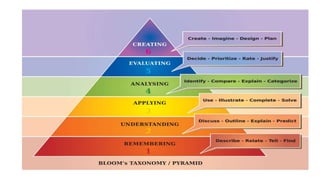
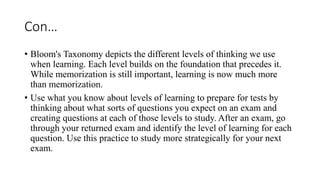
• Bloom's Taxonomy depicts the different levels of thinking we use
when learning. Each level builds on the foundation that precedes it.
While memorization is still important, learning is now much more
than memorization.
• Use what you know about levels of learning to prepare for tests by
thinking about what sorts of questions you expect on an exam and
creating questions at each of those levels to study. After an exam, go
through your returned exam and identify the level of learning for each
question. Use this practice to study more strategically for your next
exam.
Con…
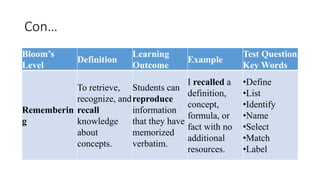
Bloom’s
Level
Definition
Learning
Outcome
Example
Test Question
Key Words
Rememberin
g
To retrieve,
recognize, and
recall
knowledge
about
concepts.
Students can
reproduce
information
that they have
memorized
verbatim.
I recalled a
definition,
concept,
formula, or
fact with no
additional
resources.
•Define
•List
•Identify
•Name
•Select
•Match
•Label
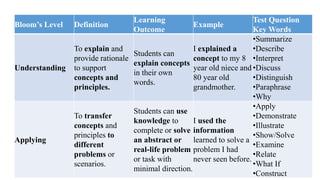
Bloom’s Level Definition
Learning
Outcome
Example
Test Question
Key Words
Understanding
To explain and
provide rationale
to support
concepts and
principles.
Students can
explain concepts
in their own
words.
I explained a
concept to my 8
year old niece and
80 year old
grandmother.
•Summarize
•Describe
•Interpret
•Discuss
•Distinguish
•Paraphrase
•Why
Applying
To transfer
concepts and
principles to
different
problems or
scenarios.
Students can use
knowledge to
complete or solve
an abstract or
real-life problem
or task with
minimal direction.
I used the
information
learned to solve a
problem I had
never seen before.
•Apply
•Demonstrate
•Illustrate
•Show/Solve
•Examine
•Relate
•What If
•Construct
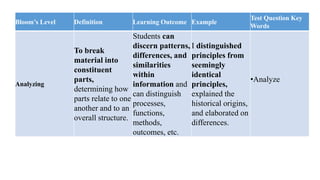
Bloom’s Level Definition Learning Outcome Example
Test Question Key
Words
Analyzing
To break
material into
constituent
parts,
determining how
parts relate to one
another and to an
overall structure.
Students can
discern patterns,
differences, and
similarities
within
information and
can distinguish
processes,
functions,
methods,
outcomes, etc.
I distinguished
principles from
seemingly
identical
principles,
explained the
historical origins,
and elaborated on
differences.
•Analyze
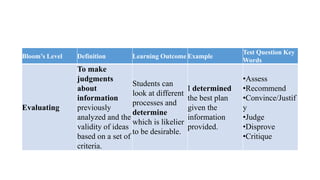
Bloom’s Level Definition Learning Outcome Example
Test Question Key
Words
Evaluating
To make
judgments
about
information
previously
analyzed and the
validity of ideas
based on a set of
criteria.
Students can
look at different
processes and
determine
which is likelier
to be desirable.
I determined
the best plan
given the
information
provided.
•Assess
•Recommend
•Convince/Justif
y
•Judge
•Disprove
•Critique
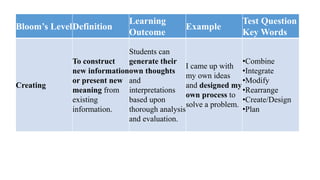
Bloom’s LevelDefinition
Learning
Outcome
Example
Test Question
Key Words
Creating
To construct
new information
or present new
meaning from
existing
information.
Students can
generate their
own thoughts
and
interpretations
based upon
thorough analysis
and evaluation.
I came up with
my own ideas
and designed my
own process to
solve a problem.
•Combine
•Integrate
•Modify
•Rearrange
•Create/Design
•Plan
Reference
• https://sites.rhodes.edu/academic-and-learning-resources/learning-
tips/learning-on-multiple-levels
Learner and Learning -Types of learning.

Learner and Learning -Types of learning.

  • 1.
    TYPES, LEVELS & APPROACHESIN LEARNING BY DR.S.JERSLIN
  • 2.
    TYPES OF LEARNING •As our experience shows, not all learning is the same. Learning keeps differing depending on the internal and external conditions that prevail. Internal conditions, as Gagne notes, are the learner’s prior knowledge, physical stamina, emotions and mental makeup. External conditions are things and elements in the environment that enhance learning from the inside. Only when these internal and external conditions are properly organized, good learning can take place. After having meticulously studied, Gagne divided human learning into eight categories. According to him, classical conditioning or signal learning is the simplest way of learning. It is followed by stimulus- response learning. Gagne, thus, arranged the different types of learning from the simplest to the most complex one which happens to be problem solving. This hierarchical way of arranging human learning is quite useful to everyone of us especially to those who are students of education. Let us therefore, take up each one of them and discuss briefly
  • 3.
    SIGNAL LEARNING • SignalLearning The Russian physiologist Pavlov through his experiment on a hungry dog developed signal learning, commonly known as classical conditioning. He offered the dog food following the ringing of a bell. This process of ringing the bell and giving food continued for quite a number of times. Thereafter, when the bell was rung, although no food was given, the dog was seen salivating. This process of eliciting saliva through the association of a neutral stimulus is called conditioning. In other words, classical conditioning is a form of associated learning in which a neutral stimulus become associated with a meaningful stimulus and acquires the capacity to elicit a similar response
  • 4.
    SR LEARNING • Stimulus– Response (S.R.) Learning This way of learning has its origin from the puzzle-box experiment carried out by Thorndike on a cat. He placed a hungry cat inside a box and a dish of food outside the box. To get the good, the cat had to manipulate a lever within the box. B.F.Skinner, using this type of learning, conducted a series of experiments and made it suitable for human learning known as operant conditioning. The word operant refers to voluntary behaviour of emission by a person. Stimulus-response reinforcement or operant conditioning is a type of learning in which voluntary behaviour is strengthened by consequences.
  • 5.
    CHAIN LEARNING In chainlearning two or more stimulus-response connections are joined together. Such connections may be of words or motor activities. Boy-girl, daddy-mummy are examples of word chaining. Similarly, the unlocking of a door with a key which involves a number of motor activities such as facing the lock, holding the key right side-up, inserting it into the key-hole, turning the key, etc. are examples of motor chaining.
  • 6.
    Verbal Association Learning& Discrimination Learning Verbal Association Learning In this type of learning, the child learns to link an object and its name. As the child plays with the ball, mother tells “ball”. As a result of listening to her a number of times, the child learns to associate the object ball and its name. Even in the absence of the object, the child would be in a position to associate the object and its name. Discrimination Learning This type of learning has to do with the ability to respond differently to similar but not identical stimuli. For example, when a child is able to discriminate a feeding bottle from other types of bottles, he has learned to discriminate. Discrimination involves ability to look at things analytically (systematically).
  • 7.
    Concept Learning • Whenwe deal with countless objects, events, and people around us, we have to first simplify things by organizing specific items into general cognitive categories called concepts. In other words, concepts are categories that group objects, events, and characteristics on the basis of common properties. For example, let’s take up the concept “fruits”. This mental grouping sums up a variety of items such as apple, grapes, pear, banana, guava, papaya, etc. Thus, when we use a word such as “vegetables”, “tree”, etc, we refer to a general category of things. Conceptual understanding is a key aspect of learning.
  • 8.
    Rule Learning Another namefor rule learning is learning of principles. We need to master a large number of principles, rules, and formulas to make life easeful. For example, learning of rules is very important in the learning of languages. The rule “Nouns are naming words” will enable us to distinguish nouns from all other categories of words. Similarly, learning of formulas will help us a lot in the learning of mathematics, science, etc.
  • 9.
    Problem-Solving The word “problem”refers to any situation that we find difficult to overcome. Problem-solving involves finding a solution to the problem. In solving a problem, it should be studied analytically, all possible ways of solving it need to be thought out and listed, out of which the one that seems to be the best need to be selected and acted upon and evaluated to find whether or not the solution has been achieved. Problem-solving is considered to be the most complex way of learning mainly because it involves all the higher order skills such as analysis, synthesis and evaluation.
  • 10.
    Con… Gagne, thus, foundthat no human learning is the same. He categorized learning into eight types and ordered them hierarchically. He believed that children naturally follow this order and that each one of them is a prerequisite(requirement) for the learning of the next level. He emphasized that, in learning, the lower steps must be mastered before moving to the higher levels. Gagne’s theory of learning has, thus, provided a genuine basis for the process of teaching and learning. • chrome- extension://efaidnbmnnnibpcajpcglclefindmkaj/https://egyankosh.ac.in /bitstream/123456789/80493/1/Unit-5.pdf
  • 11.
    Learning on MultipleLevels • You may have noticed that you are now expected to do more than memorize information. You are expected to think and process material at higher levels. If you are left feeling that there is simply too much information to cover, you may want to think about how you are learning information. • While high school testing primarily asked you to remember and understand information, often college testing asks you to understand, apply, analyze, and evaluate it. In order to test well at higher levels, you need to study at these higher levels.
  • 13.
    Con… • Bloom's Taxonomydepicts the different levels of thinking we use when learning. Each level builds on the foundation that precedes it. While memorization is still important, learning is now much more than memorization. • Use what you know about levels of learning to prepare for tests by thinking about what sorts of questions you expect on an exam and creating questions at each of those levels to study. After an exam, go through your returned exam and identify the level of learning for each question. Use this practice to study more strategically for your next exam.
  • 14.
    Con… Bloom’s Level Definition Learning Outcome Example Test Question Key Words Rememberin g Toretrieve, recognize, and recall knowledge about concepts. Students can reproduce information that they have memorized verbatim. I recalled a definition, concept, formula, or fact with no additional resources. •Define •List •Identify •Name •Select •Match •Label
  • 15.
    Bloom’s Level Definition Learning Outcome Example TestQuestion Key Words Understanding To explain and provide rationale to support concepts and principles. Students can explain concepts in their own words. I explained a concept to my 8 year old niece and 80 year old grandmother. •Summarize •Describe •Interpret •Discuss •Distinguish •Paraphrase •Why Applying To transfer concepts and principles to different problems or scenarios. Students can use knowledge to complete or solve an abstract or real-life problem or task with minimal direction. I used the information learned to solve a problem I had never seen before. •Apply •Demonstrate •Illustrate •Show/Solve •Examine •Relate •What If •Construct
  • 16.
    Bloom’s Level DefinitionLearning Outcome Example Test Question Key Words Analyzing To break material into constituent parts, determining how parts relate to one another and to an overall structure. Students can discern patterns, differences, and similarities within information and can distinguish processes, functions, methods, outcomes, etc. I distinguished principles from seemingly identical principles, explained the historical origins, and elaborated on differences. •Analyze
  • 17.
    Bloom’s Level DefinitionLearning Outcome Example Test Question Key Words Evaluating To make judgments about information previously analyzed and the validity of ideas based on a set of criteria. Students can look at different processes and determine which is likelier to be desirable. I determined the best plan given the information provided. •Assess •Recommend •Convince/Justif y •Judge •Disprove •Critique
  • 18.
    Bloom’s LevelDefinition Learning Outcome Example Test Question KeyWords Creating To construct new information or present new meaning from existing information. Students can generate their own thoughts and interpretations based upon thorough analysis and evaluation. I came up with my own ideas and designed my own process to solve a problem. •Combine •Integrate •Modify •Rearrange •Create/Design •Plan
  • 19.