SCIENCE TEXT BOOK
By
Dr.S.JERSLIN
INTRODUCTION
• Text books are the most widely used of all instructional
materials. Now a day’s text book has become a course of
study. A set of unit plans and a learning guide as well. A text
book should really design for the pupils rather than the
teacher. Text book should stimulate reflective thinking and
cultivate in students the scientific attitude.
• In the teaching-learning process, the text-book occupies an
important place. There is a saying “As is the text-book, so is
the teaching and learning”. A good text-book can even replace
class-room teaching. The science text-book should aim at
aiding the pupils in the development of their personalities, in
developing open mindedness, developing appreciation and
understanding of nature and not merely stuffing their minds
with facts.
Qualities of a good science Text book
• Thurber and Collette suggested six criteria for choosing a good
textbook. They are
• Content
• Organization
• Literary style vocabulary
• Illustrations
• Teaching aids
• Mechanical make up and appearance
• Authorship
1. Content
• The content of text books for any one subject matter field is
remarkable uniform about 85 percent of the content being
common to all of them
• The content should be appropriate for the age level and
experience backgrounds of the pupils
• The concept should not be too complex for the maturity of the
pupils
• The content should be consistent(always same) with the
pupil’s needs and interests
• The statements must be accurate
2. Organization
• The subject matter should cover the whole syllabus
• Subject matter should be developed in psychological sequence
• The text book has to be organized into units which are based
on student interests and probability of use
• Inductive approach is to be used whenever possible in
introducing new topic
• At the end of each units there should be assignments
informing to the following
• Application to life situations
• Self assessment test
• Suggestions for further reading
Con…
• Numerical questions if necessary
• Assessment for practicing skills
• The text book should be written in simple unambiguous (un
doubtful)scientific language. Prefer simple and compound
sentence to complex sentences
• It should contain a glossary(meaning of words) of technical
terms used in the books. It should suggest some good methods
of learning’s
• Historical development of science should be attempted
• Adequate provision should be made to correlate science with
other subject and crafts.
• It is better if the text book contains examples from the local
environment
Con…
• There should be a detailed table of contents and index text
books
• Controversial topics should be treated impartially
• The social significance of science should be stressed
• Headings and sub- headings should be in bold type
• Important principles should be set in italics
• Each text books should be accompanied by a laboratory
manual and pupil’s work book
• It must be supplemented by a teacher’s hand book
3. Literary Style & Vocabulary
• Literary style has much to do with the readability of the book.
Although style is difficult to judge.
• Length of sentences
• Directness of sentences
• Number of ideas per seconds
• Use of lead sentence or paragraphs
• Presence or absence of irrelevant thoughtscontinuity of
thought
• While evaluating a text book the teacher must decide whether or
not the vocabulary is excessive or in appropriate text book
should be easy to read
4. Illustrations
• The quality and the quantity of the illustrations should be
considered.
• Photographs should be clearly reproduced
• Diagrams should be carefully made attractive
• Color in the illustrations add to eye appeal and when properly
used has considerable teaching value
• Photograph should have relation with content in the text
5. Teaching aids
• The table of content and index should be comprehensive
• Glossary should be included
• Activities should be given the end of a chapter
• Activities should be closely related to content
6. Mechanical make- up and
appearance
• Artistic cover
• Durability(stability) for binding
• Size of the book
• Good quality of paper
• Length of line and size- legible
• Attractive over all experience
• Cover design and colour should be appealing
• Ample space to be left between lines to provide for
ease(comfort) in reading
7. Authorship
• Only such persons who have experience of teaching the
subject should be allowed to become authors of school science
text books. Such authors can understand the actual learning’s
situations. Certain qualifications may also be prescribed for
the authors. It will be better if some training is given to them
Need for SCIENCE text book
• There are two different opinions about the need for the text books,
adding that science is a subject to be learned by direct observation
and experience and so it requires no text book. When the students
learn science through the text book they get limited knowledge.
• The argument of those who require text book for science is that the
text book helps to organize and confirm the subject matter after
observing the experiment.
• The visual aids like diagrams and pictures and photographs in the
text book to motivate the students to develop interest in the subject.
The questions exercise and points to think given at the end of the
lesson. Motivate the students to carry out additional work and some
projects.
Importance of Science Text Books
• A) A good science text book functions as a guide while
framing the syllabus.
• Such kind of book becomes part of the syllabus because of its
important contents.
• Generally it is seen that text books are followed in the
situations where other educational aids are not accessible
because of different reasons.
• Thus, course of the science gets a kind of unity through the help
of text books.
Con…
• b. To design the syllabus of various subjects, committees are
being set up by authorities. Likewise, science syllabus is also
designed by the committee set up in the school or educational
institution. Textbooks play an important role in
supplementing or enriching the science syllabus designed by
various experts.
• c. By making use of science text books, it becomes possible for
the teacher to make students understand fundamental
concepts and principles of science easily and quickly. Not
only this, text books help in making this function in an effective
manner.
Con…
• d. Through good science text book, students get acquainted
(familiar)with the wide variety of application of the
scientific knowledge as various kinds of exercises are being
provided usually at the end of every chapter.
• e. The information which is imparted through the teacher in
practical form can be made understood by the students in
written form through text books. Not only this, when students
acquire information of different kinds from text books, then
habit of self-study gets developed among them, as a result of
which, their dependency on teacher gets lower to certain extent.
Con…
• f. Text books help the students in retaining the information
provided by teachers for a long period of time as various kinds of
exercises are provided in them, answers of which are to be provided
by the students, through which teacher can also analyse their level of
knowledge. Teacher can assign the task of accomplishing such
exercise to the home, by which he can provide the students with
meaningful and useful homework.
• g. With the help of text books, classroom discussion can be directed
towards accurate conclusions.
• h. As all the information provided in the text book exist in the written
form, as a result of which they can revive it at any time, with the
help of which, students can make revision of any lesson speedily
through such books.
• https://www.preservearticles.com/education/what-is-the-
importance-of-science-text-books/27948
CRITERIA OF A SCIENCE TEXT BOOK
• However there are certain other criteria for a good science text book.
1. The authors – this qualification and experience Only that person
who has a certain amount of experience of teaching subject should be
encourage to write a book because he can only be the better judge of
teaching learning process.
Certain minimum academic qualification should be prescribed for the
author.
2. Mechanical features of the text book:
The quality of the paper should be fine, the printing should be
appealing and the binding of the text book should be attractive. The
size of the print should be according to the students. The book should
contain good illustrations with sketches, diagrams, picture etc… as the
Chinese saying goes “one picture is worth a thousand words”.
Con…
3. The subject matter – Its nature and organization: The
subject matter should follow the psychological sequence .It
should be according to the mental age and interests of the
students. Each chapter should start with a brief introduction
and end with a summary. The text book should be according to
the aims and objectives of science teaching. There should be
harmony of the subject matter. Each lesson should contain
practice exercise at the end of the lesson conforming to the
following.
Con…
a. Application to life situations
b. Suggested activities
c. Suggested readings
d. Experimental work of project
e. Numerical examples where necessary.
The text book should contain a detailed table of contents and
an index
The language of the matter should be simple and precise
At the end of the book, glossary of scientific terms with their
English equivalents should be there
Con…
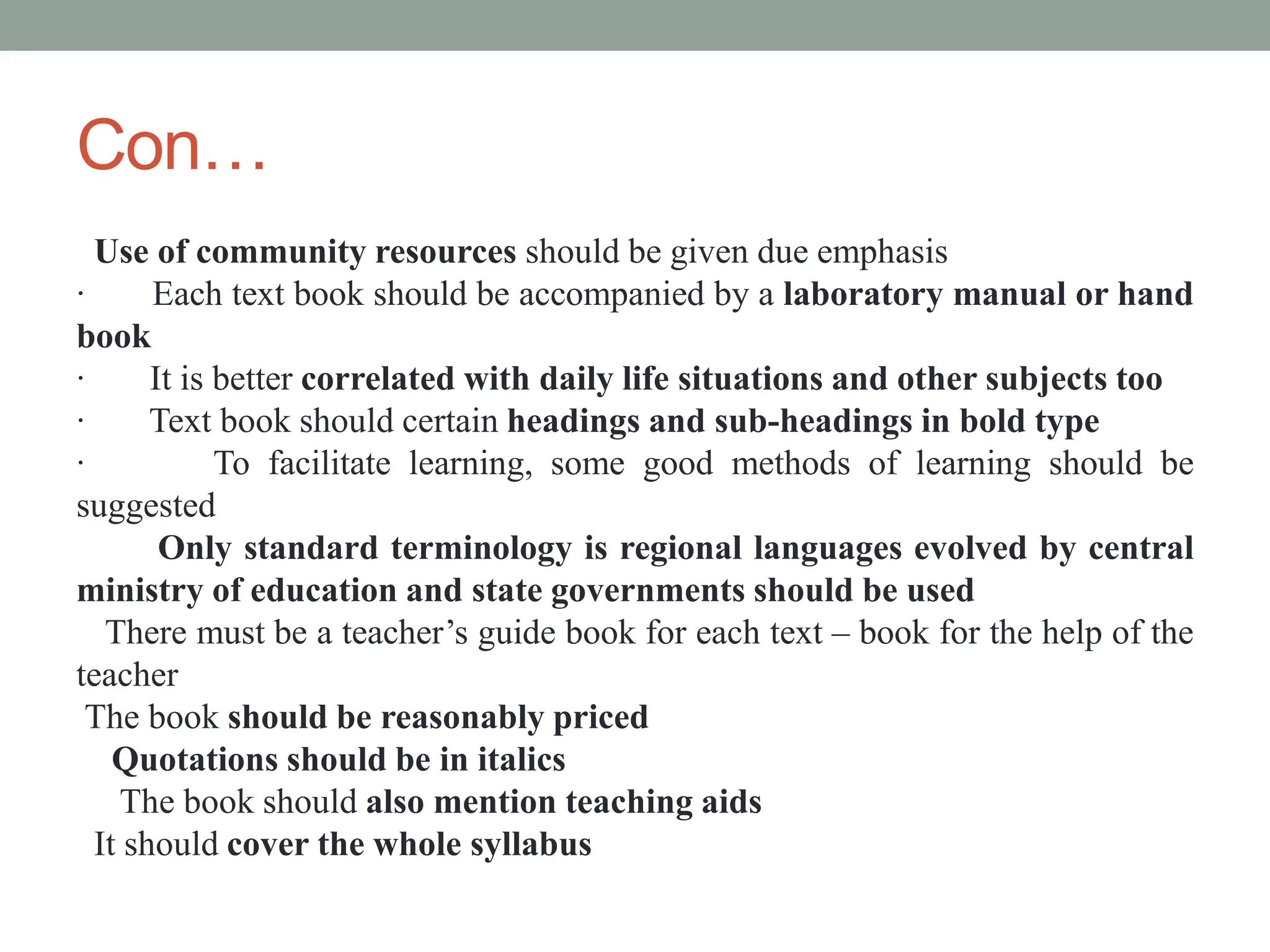
Use of community resources should be given due emphasis
· Each text book should be accompanied by a laboratory manual or hand
book
· It is better correlated with daily life situations and other subjects too
· Text book should certain headings and sub-headings in bold type
· To facilitate learning, some good methods of learning should be
suggested
Only standard terminology is regional languages evolved by central
ministry of education and state governments should be used
There must be a teacher’s guide book for each text – book for the help of the
teacher
The book should be reasonably priced
Quotations should be in italics
The book should also mention teaching aids
It should cover the whole syllabus
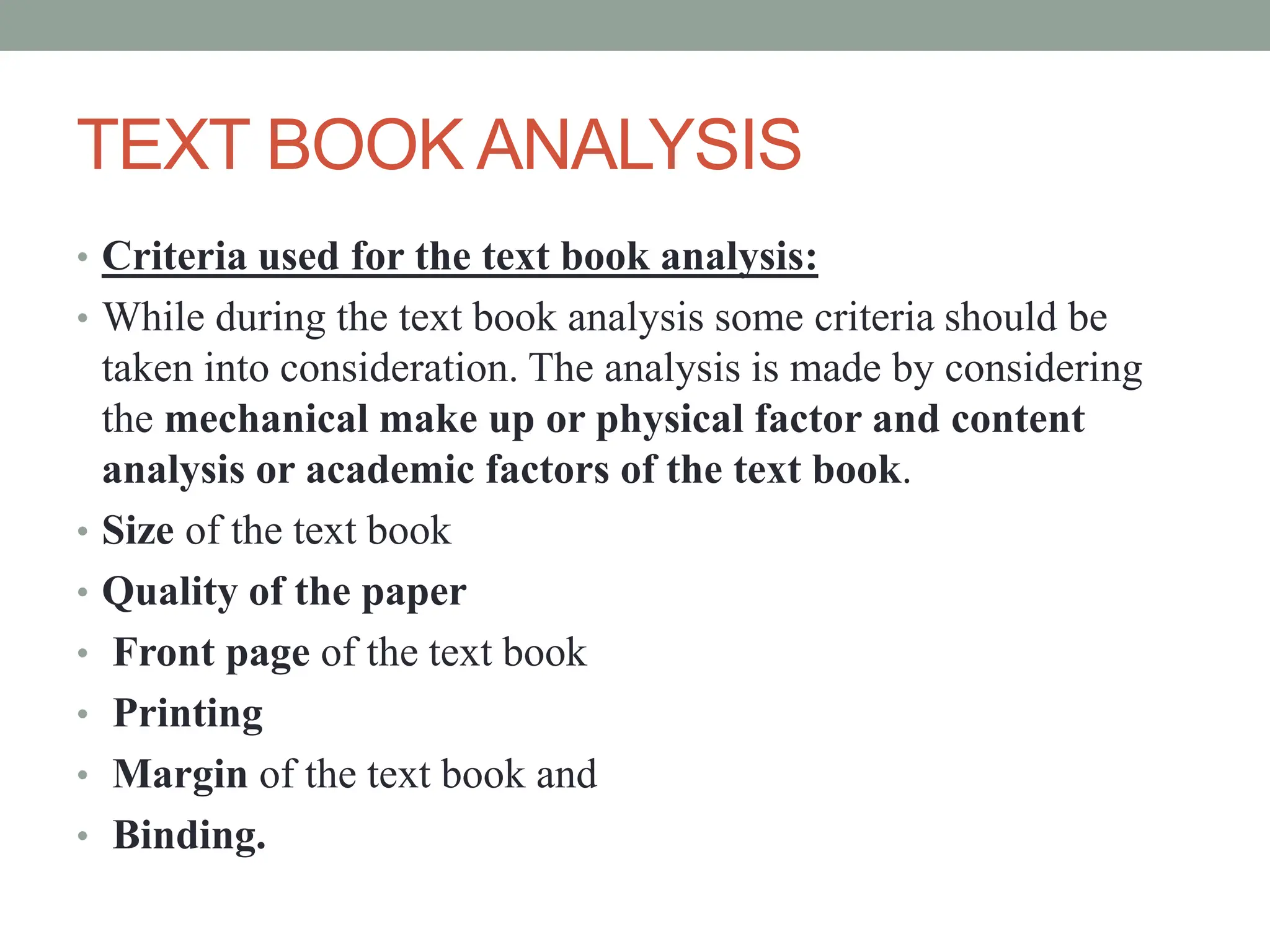
TEXT BOOK ANALYSIS
• Criteria used for the text book analysis:
• While during the text book analysis some criteria should be
taken into consideration. The analysis is made by considering
the mechanical make up or physical factor and content
analysis or academic factors of the text book.
• Size of the text book
• Quality of the paper
• Front page of the text book
• Printing
• Margin of the text book and
• Binding.
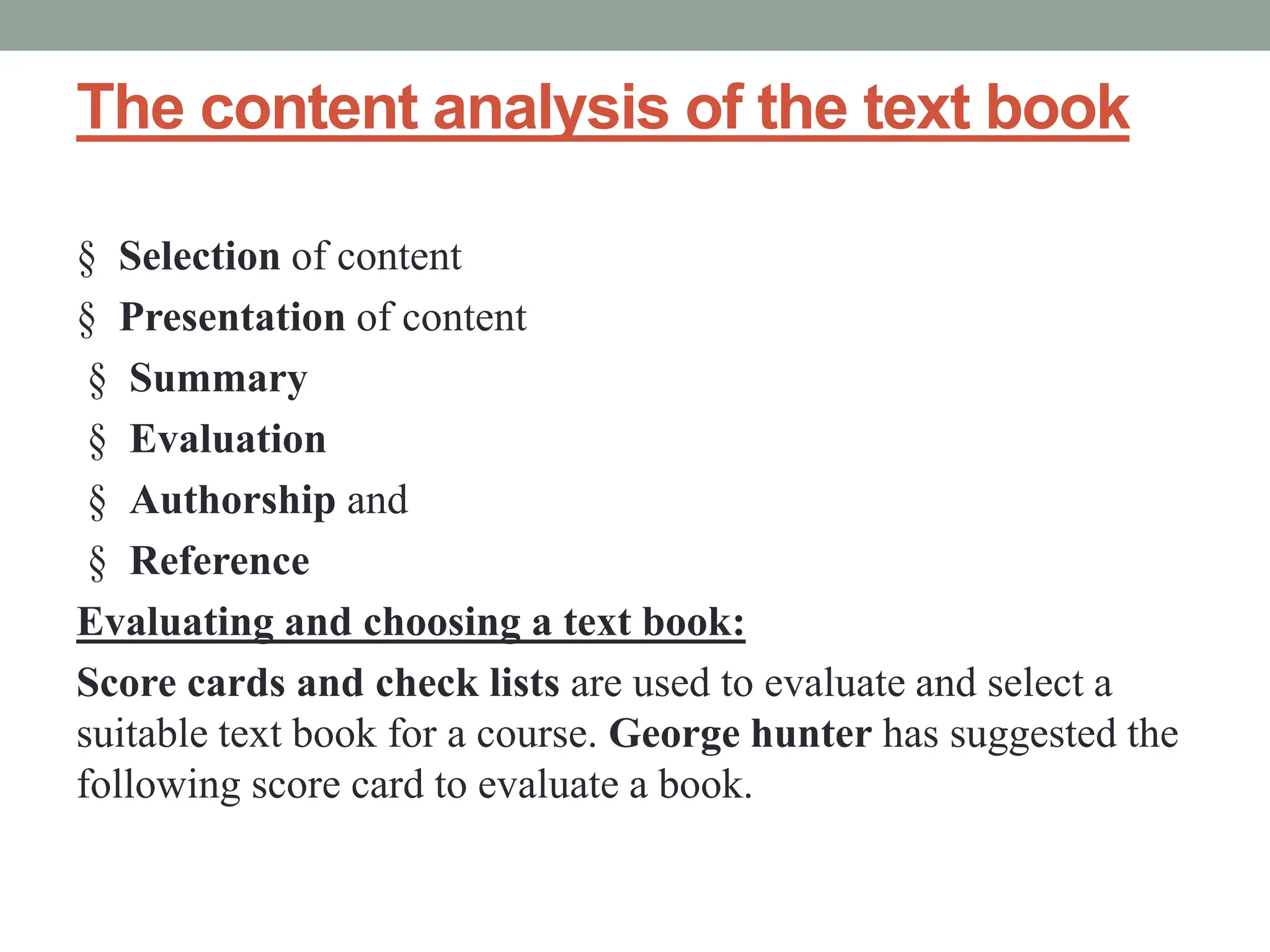
The content analysis of the text book
§ Selection of content
§ Presentation of content
§ Summary
§ Evaluation
§ Authorship and
§ Reference
Evaluating and choosing a text book:
Score cards and check lists are used to evaluate and select a
suitable text book for a course. George hunter has suggested the
following score card to evaluate a book.
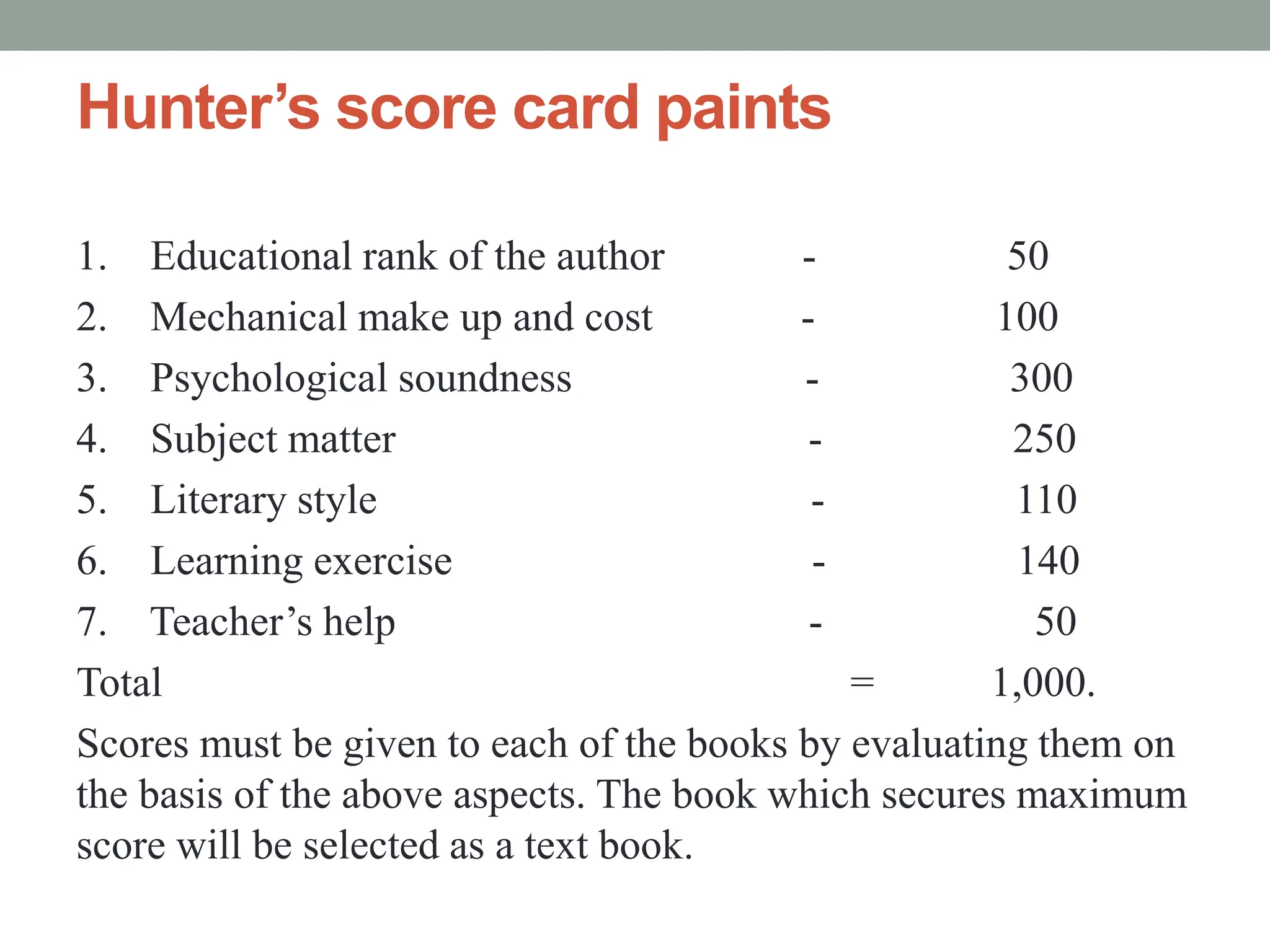
Hunter’s score card paints
1. Educational rank of the author - 50
2. Mechanical make up and cost - 100
3. Psychological soundness - 300
4. Subject matter - 250
5. Literary style - 110
6. Learning exercise - 140
7. Teacher’s help - 50
Total = 1,000.
Scores must be given to each of the books by evaluating them on
the basis of the above aspects. The book which secures maximum
score will be selected as a text book.
CHARACTERISTICS of SCIENCE TEXT
BOOK
• 1. Author-experience, efficient, expert in subject.
• 2. Style-psychological and logical style.
• 3.Subject Matter- curiosity. Subject matter-clear, well-
organized, written in interesting manner.
• A. Repetition of subject matter by experiments,
demonstrations and practical methods
• B. subject matter-according to age, level and growth
• C. related to life and national goals.
• D. Matter-interrelated, coordination bet. Diff. chapters.
Con…
• E. described in interesting & psychological manner
• F. mentally disciplined & moral values
• G. described aesthetically & inspirational.
• H. should be complete & chapters properly sequenced.
• 4. Illustrations
• 5.Printing
Con…
• 6. Cost
• 7. Contents
• 8. Questions
• 9. Coverage
• 10. Test papers
• 11. Objectives
• 12. Latest Knowledge
• 13. Proper Arrangement
Con…
• 14. Lesson Sequence
• 15. Methods
• 16. Revision
• 17. Practice
• 18. Objective Questions
• 19. Clues
• 20. Reference books
• 21. Revised
LIBRARY-MEANING
• Academic libraries include school, college, university and
research libraries. All these cater to the needs of academic
community for supplementing the study and research
programmes of the institution and help conserve and
disseminate knowledge. Although these academic libraries share
certain common features and characteristics, they differ
enormously in the value and content from one another.' (Sahai).
Academic libraries do not exist by themselves; they exist to
serve the objectives of the education system of which they form
a part.
OBJECTIVES
• The primary objectives of any academic institution are:
• • Conservation and preservation of knowledge;
• • Expansion of ideas and dissemination of knowledge with
the help of interpretation, research and publication; and
• • Dissemination of knowledge through teaching and
extension services. The libraries in academic institutions help
to achieve these objectives.
• file:///C:/Users/User/Downloads/Unit-1%20(2).pdf
UNIVERSITY LIBRARY
• The university library strives for the fulfillment of objectives of
its parent body the university. The university library's objectives
reflect that of their parent institution, as they have been
established to support fulfillment of parent body's goals. Hence,
the objectives of university library are to: ‘
• . set up policies, procedures, and standards for acquisition
and accessing information /knowledge that support teaching;
• • create collections both print and online, including expertise
from outside the library to support research
Con…
• • explore funding opportunities and collaborative projects
with other institutions;
• • provide services that meet the pertinent information needs
of members of university; and .
• • to conserve knowledge and ideas for future.
ADVANTAGE OF SCIENCE LIBRARY
• 1. Source of Knowledge to Teachers
• 2. Information of latest development.
• 3. New methods of teaching
• 4. Use in better learning by students
• 5. Development of Good habits
• 6. Providing inspiration
• 7. Developing Scientific Attitude
• 8. Good use of leisure
ORGANIZATION OF SCIENCE
LIBRARY
• 1. The Place and Accommodation
• 2. Library In charge
• 3. Classification of Science books and Reading Materials.
• 4. Management of Science Library
• 5. Promoting Student Interest in the science library
• chrome-
extension://efaidnbmnnnibpcajpcglclefindmkaj/https://ww
w.egyankosh.ac.in/bitstream/123456789/34888/1/Unit-
7.pdf
Library Resources
• Textbooks, e-books , Books in Braille ,Journals , e-
journals ,Dictionaries ,Handbooks,
• Manual, Newspapers , Newspapers index , Magazines ,
Reports ,Atlases/maps ,Encyclopedia, Government
• publications, Biographies , Assistive listening devices,
Audio-visual materials , Internet.
• https://digitalcommons.unl.edu/cgi/viewcontent.cgi?article
=13989&context=libphilprac
Utilization of Resources
• Library is one of those resources which are essential to support and
strengthen the educational quality.
• Over the centuries, libraries are the source of keeping and distributing the
information through books, journals, maps and other resources that are used
by students in their learning process.
• Unfortunately, library resources are the most ignored area in institutions of
teacher education.
Con…
• There is hardly any disagreement that libraries in our
institutions are deficient in trained professional staff and
material available for supporting student learning.
• By linking Schamber and Siddiqui, it is clear that library
resources i.e., human resources (strength of library officials,
their qualifications and experiences), physical resources (library
study space, chairs, tables, books and books selves, etc), printed
and e-resources are essentially important in preparing teaching
activities, lecture notes, students‟ assignment, conducting their
research work, accessing e-journals and web sites, subscription
to online journals by teachers and students

Science Text Book characteristics and library

  • 1.
  • 2.
    INTRODUCTION • Text booksare the most widely used of all instructional materials. Now a day’s text book has become a course of study. A set of unit plans and a learning guide as well. A text book should really design for the pupils rather than the teacher. Text book should stimulate reflective thinking and cultivate in students the scientific attitude. • In the teaching-learning process, the text-book occupies an important place. There is a saying “As is the text-book, so is the teaching and learning”. A good text-book can even replace class-room teaching. The science text-book should aim at aiding the pupils in the development of their personalities, in developing open mindedness, developing appreciation and understanding of nature and not merely stuffing their minds with facts.
  • 3.
    Qualities of agood science Text book • Thurber and Collette suggested six criteria for choosing a good textbook. They are • Content • Organization • Literary style vocabulary • Illustrations • Teaching aids • Mechanical make up and appearance • Authorship
  • 4.
    1. Content • Thecontent of text books for any one subject matter field is remarkable uniform about 85 percent of the content being common to all of them • The content should be appropriate for the age level and experience backgrounds of the pupils • The concept should not be too complex for the maturity of the pupils • The content should be consistent(always same) with the pupil’s needs and interests • The statements must be accurate
  • 5.
    2. Organization • Thesubject matter should cover the whole syllabus • Subject matter should be developed in psychological sequence • The text book has to be organized into units which are based on student interests and probability of use • Inductive approach is to be used whenever possible in introducing new topic • At the end of each units there should be assignments informing to the following • Application to life situations • Self assessment test • Suggestions for further reading
  • 6.
    Con… • Numerical questionsif necessary • Assessment for practicing skills • The text book should be written in simple unambiguous (un doubtful)scientific language. Prefer simple and compound sentence to complex sentences • It should contain a glossary(meaning of words) of technical terms used in the books. It should suggest some good methods of learning’s • Historical development of science should be attempted • Adequate provision should be made to correlate science with other subject and crafts. • It is better if the text book contains examples from the local environment
  • 7.
    Con… • There shouldbe a detailed table of contents and index text books • Controversial topics should be treated impartially • The social significance of science should be stressed • Headings and sub- headings should be in bold type • Important principles should be set in italics • Each text books should be accompanied by a laboratory manual and pupil’s work book • It must be supplemented by a teacher’s hand book
  • 8.
    3. Literary Style& Vocabulary • Literary style has much to do with the readability of the book. Although style is difficult to judge. • Length of sentences • Directness of sentences • Number of ideas per seconds • Use of lead sentence or paragraphs • Presence or absence of irrelevant thoughtscontinuity of thought • While evaluating a text book the teacher must decide whether or not the vocabulary is excessive or in appropriate text book should be easy to read
  • 9.
    4. Illustrations • Thequality and the quantity of the illustrations should be considered. • Photographs should be clearly reproduced • Diagrams should be carefully made attractive • Color in the illustrations add to eye appeal and when properly used has considerable teaching value • Photograph should have relation with content in the text
  • 10.
    5. Teaching aids •The table of content and index should be comprehensive • Glossary should be included • Activities should be given the end of a chapter • Activities should be closely related to content
  • 11.
    6. Mechanical make-up and appearance • Artistic cover • Durability(stability) for binding • Size of the book • Good quality of paper • Length of line and size- legible • Attractive over all experience • Cover design and colour should be appealing • Ample space to be left between lines to provide for ease(comfort) in reading
  • 12.
    7. Authorship • Onlysuch persons who have experience of teaching the subject should be allowed to become authors of school science text books. Such authors can understand the actual learning’s situations. Certain qualifications may also be prescribed for the authors. It will be better if some training is given to them
  • 13.
    Need for SCIENCEtext book • There are two different opinions about the need for the text books, adding that science is a subject to be learned by direct observation and experience and so it requires no text book. When the students learn science through the text book they get limited knowledge. • The argument of those who require text book for science is that the text book helps to organize and confirm the subject matter after observing the experiment. • The visual aids like diagrams and pictures and photographs in the text book to motivate the students to develop interest in the subject. The questions exercise and points to think given at the end of the lesson. Motivate the students to carry out additional work and some projects.
  • 14.
    Importance of ScienceText Books • A) A good science text book functions as a guide while framing the syllabus. • Such kind of book becomes part of the syllabus because of its important contents. • Generally it is seen that text books are followed in the situations where other educational aids are not accessible because of different reasons. • Thus, course of the science gets a kind of unity through the help of text books.
  • 15.
    Con… • b. Todesign the syllabus of various subjects, committees are being set up by authorities. Likewise, science syllabus is also designed by the committee set up in the school or educational institution. Textbooks play an important role in supplementing or enriching the science syllabus designed by various experts. • c. By making use of science text books, it becomes possible for the teacher to make students understand fundamental concepts and principles of science easily and quickly. Not only this, text books help in making this function in an effective manner.
  • 16.
    Con… • d. Throughgood science text book, students get acquainted (familiar)with the wide variety of application of the scientific knowledge as various kinds of exercises are being provided usually at the end of every chapter. • e. The information which is imparted through the teacher in practical form can be made understood by the students in written form through text books. Not only this, when students acquire information of different kinds from text books, then habit of self-study gets developed among them, as a result of which, their dependency on teacher gets lower to certain extent.
  • 17.
    Con… • f. Textbooks help the students in retaining the information provided by teachers for a long period of time as various kinds of exercises are provided in them, answers of which are to be provided by the students, through which teacher can also analyse their level of knowledge. Teacher can assign the task of accomplishing such exercise to the home, by which he can provide the students with meaningful and useful homework. • g. With the help of text books, classroom discussion can be directed towards accurate conclusions. • h. As all the information provided in the text book exist in the written form, as a result of which they can revive it at any time, with the help of which, students can make revision of any lesson speedily through such books. • https://www.preservearticles.com/education/what-is-the- importance-of-science-text-books/27948
  • 18.
    CRITERIA OF ASCIENCE TEXT BOOK • However there are certain other criteria for a good science text book. 1. The authors – this qualification and experience Only that person who has a certain amount of experience of teaching subject should be encourage to write a book because he can only be the better judge of teaching learning process. Certain minimum academic qualification should be prescribed for the author. 2. Mechanical features of the text book: The quality of the paper should be fine, the printing should be appealing and the binding of the text book should be attractive. The size of the print should be according to the students. The book should contain good illustrations with sketches, diagrams, picture etc… as the Chinese saying goes “one picture is worth a thousand words”.
  • 19.
    Con… 3. The subjectmatter – Its nature and organization: The subject matter should follow the psychological sequence .It should be according to the mental age and interests of the students. Each chapter should start with a brief introduction and end with a summary. The text book should be according to the aims and objectives of science teaching. There should be harmony of the subject matter. Each lesson should contain practice exercise at the end of the lesson conforming to the following.
  • 20.
    Con… a. Application tolife situations b. Suggested activities c. Suggested readings d. Experimental work of project e. Numerical examples where necessary. The text book should contain a detailed table of contents and an index The language of the matter should be simple and precise At the end of the book, glossary of scientific terms with their English equivalents should be there
  • 21.
    Con… Use of communityresources should be given due emphasis · Each text book should be accompanied by a laboratory manual or hand book · It is better correlated with daily life situations and other subjects too · Text book should certain headings and sub-headings in bold type · To facilitate learning, some good methods of learning should be suggested Only standard terminology is regional languages evolved by central ministry of education and state governments should be used There must be a teacher’s guide book for each text – book for the help of the teacher The book should be reasonably priced Quotations should be in italics The book should also mention teaching aids It should cover the whole syllabus
  • 22.
    TEXT BOOK ANALYSIS •Criteria used for the text book analysis: • While during the text book analysis some criteria should be taken into consideration. The analysis is made by considering the mechanical make up or physical factor and content analysis or academic factors of the text book. • Size of the text book • Quality of the paper • Front page of the text book • Printing • Margin of the text book and • Binding.
  • 23.
    The content analysisof the text book § Selection of content § Presentation of content § Summary § Evaluation § Authorship and § Reference Evaluating and choosing a text book: Score cards and check lists are used to evaluate and select a suitable text book for a course. George hunter has suggested the following score card to evaluate a book.
  • 24.
    Hunter’s score cardpaints 1. Educational rank of the author - 50 2. Mechanical make up and cost - 100 3. Psychological soundness - 300 4. Subject matter - 250 5. Literary style - 110 6. Learning exercise - 140 7. Teacher’s help - 50 Total = 1,000. Scores must be given to each of the books by evaluating them on the basis of the above aspects. The book which secures maximum score will be selected as a text book.
  • 25.
    CHARACTERISTICS of SCIENCETEXT BOOK • 1. Author-experience, efficient, expert in subject. • 2. Style-psychological and logical style. • 3.Subject Matter- curiosity. Subject matter-clear, well- organized, written in interesting manner. • A. Repetition of subject matter by experiments, demonstrations and practical methods • B. subject matter-according to age, level and growth • C. related to life and national goals. • D. Matter-interrelated, coordination bet. Diff. chapters.
  • 26.
    Con… • E. describedin interesting & psychological manner • F. mentally disciplined & moral values • G. described aesthetically & inspirational. • H. should be complete & chapters properly sequenced. • 4. Illustrations • 5.Printing
  • 27.
    Con… • 6. Cost •7. Contents • 8. Questions • 9. Coverage • 10. Test papers • 11. Objectives • 12. Latest Knowledge • 13. Proper Arrangement
  • 28.
    Con… • 14. LessonSequence • 15. Methods • 16. Revision • 17. Practice • 18. Objective Questions • 19. Clues • 20. Reference books • 21. Revised
  • 29.
    LIBRARY-MEANING • Academic librariesinclude school, college, university and research libraries. All these cater to the needs of academic community for supplementing the study and research programmes of the institution and help conserve and disseminate knowledge. Although these academic libraries share certain common features and characteristics, they differ enormously in the value and content from one another.' (Sahai). Academic libraries do not exist by themselves; they exist to serve the objectives of the education system of which they form a part.
  • 30.
    OBJECTIVES • The primaryobjectives of any academic institution are: • • Conservation and preservation of knowledge; • • Expansion of ideas and dissemination of knowledge with the help of interpretation, research and publication; and • • Dissemination of knowledge through teaching and extension services. The libraries in academic institutions help to achieve these objectives. • file:///C:/Users/User/Downloads/Unit-1%20(2).pdf
  • 31.
    UNIVERSITY LIBRARY • Theuniversity library strives for the fulfillment of objectives of its parent body the university. The university library's objectives reflect that of their parent institution, as they have been established to support fulfillment of parent body's goals. Hence, the objectives of university library are to: ‘ • . set up policies, procedures, and standards for acquisition and accessing information /knowledge that support teaching; • • create collections both print and online, including expertise from outside the library to support research
  • 32.
    Con… • • explorefunding opportunities and collaborative projects with other institutions; • • provide services that meet the pertinent information needs of members of university; and . • • to conserve knowledge and ideas for future.
  • 33.
    ADVANTAGE OF SCIENCELIBRARY • 1. Source of Knowledge to Teachers • 2. Information of latest development. • 3. New methods of teaching • 4. Use in better learning by students • 5. Development of Good habits • 6. Providing inspiration • 7. Developing Scientific Attitude • 8. Good use of leisure
  • 34.
    ORGANIZATION OF SCIENCE LIBRARY •1. The Place and Accommodation • 2. Library In charge • 3. Classification of Science books and Reading Materials. • 4. Management of Science Library • 5. Promoting Student Interest in the science library
  • 35.
  • 36.
    Library Resources • Textbooks,e-books , Books in Braille ,Journals , e- journals ,Dictionaries ,Handbooks, • Manual, Newspapers , Newspapers index , Magazines , Reports ,Atlases/maps ,Encyclopedia, Government • publications, Biographies , Assistive listening devices, Audio-visual materials , Internet. • https://digitalcommons.unl.edu/cgi/viewcontent.cgi?article =13989&context=libphilprac
  • 37.
    Utilization of Resources •Library is one of those resources which are essential to support and strengthen the educational quality. • Over the centuries, libraries are the source of keeping and distributing the information through books, journals, maps and other resources that are used by students in their learning process. • Unfortunately, library resources are the most ignored area in institutions of teacher education.
  • 38.
    Con… • There ishardly any disagreement that libraries in our institutions are deficient in trained professional staff and material available for supporting student learning. • By linking Schamber and Siddiqui, it is clear that library resources i.e., human resources (strength of library officials, their qualifications and experiences), physical resources (library study space, chairs, tables, books and books selves, etc), printed and e-resources are essentially important in preparing teaching activities, lecture notes, students‟ assignment, conducting their research work, accessing e-journals and web sites, subscription to online journals by teachers and students