Formation Damage
Target30Presentation
Mentor – Dr. Achinta Behra
Presenter – Mr. Mohit Patel
1) Plugging by
solid particles
foreign to the
formation
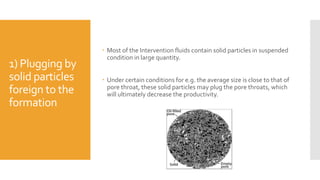
 Most of the Intervention fluids contain solid particles in suspended
condition in large quantity.
 Under certain conditions for e.g. the average size is close to that of
pore throat, these solid particles may plug the pore throats, which
will ultimately decrease the productivity.
2) Plugging by
formation
solids
 formation solids / fines are very small particles Located on the
interior surfaces of the porous matrix and are free to move or
migrate through the pores along with any fluid (which wets them),
that flow in the reservoir.
 As most of fines are water-wet, therefore small amount of water
production can induce the fines to migrate.
 The detachment and migration of fines depends on the fluid
velocity also, therefore flow rate also becomes an important
factor.
3)Clay swelling
(static clay
damage)
 Clays may change volume as the salinity of the fluid flowing
through the formation changes.
 The montmorillonite and illite are swelling in nature and are more
vulnerable in presence of lesser saline aqueous fluids than those of
formation water.
 Therefore, their presence in higher percentage and application of
lesser saline aqueous fluids can cause them to swell and the
increased volume may adversely affect the spaces useful to
production.
4) Dispersion
of clayey
platelets
 Kaolinite, which is also known as migration fines and mica needles
may migrate through the pores, if lesser saline aqueous fluid is
injected in the formation.
 Due to lesser concentration of divalent cations or potassium, the
mutual repulsion of clayey platelets increases.
 The repulsive force overcomes the attractive forces and the
released clayey particles can be carried to the vicinity of the well
bore and choke the formation pores.
5)Water block
 Due to increased interfacial tension, a water block may form,
which can block oil production. It is caused by a region of high Sw
around the wellbore.
 The high Sw may be caused by :
 – Loss of water based fluid from well.
 – Reservoir problems, like coning etc.
 The water blocks causes Kro or Krg to decrease in the near
wellbore region. It proves to be more troublesome in following
conditions:
 – Low permeability,
 – Low pressure gradients(gas wells),
 – High surface tensions (gas wells).
(Tight gas reservoir)
6) Emulsion
formation
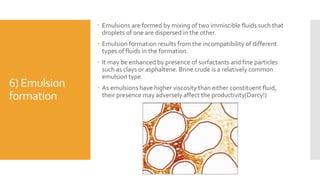
 Emulsions are formed by mixing of two immiscible fluids such that
droplets of one are dispersed in the other.
 Emulsion formation results from the incompatibility of different
types of fluids in the formation.
 It may be enhanced by presence of surfactants and fine particles
such as clays or asphaltene. Brine crude is a relatively common
emulsion type.
 As emulsions have higher viscosity than either constituent fluid,
their presence may adversely affect the productivity(Darcy!)
7) Precipitation
of inorganic
scales
 The incompatible invading fluid may generate precipitates of
inorganic substances in contact with native aqueous fluid which
can block pore spaces.
 Most of the invading waters (such as filtrates, completion fluids &
injection water) contain anions that are potential scale generators.
 Furthermore, if formation water contains significant percentages
of Ba, Sr or Ca ions, then under certain conditions of temperature,
pressure, pH and concentration, compounds such as BaSO4,
SrSO4 and CaCO3 may be precipitated.
8)Precipitation
related to
acidizing
 In stimulation jobs, such as acidizing, different precipitates may
form if the acid is not compatible to formation rock and fluid.
 --In sandstone formation, containing sufficient calciferous
minerals, may lead to precipitation of CaF2 if calcium is not
removed prior to injection of hydrofluoric acid (HF).
 --In formations rich in minerals like chlorite and ferric dolomite,
the acid solubilizes the iron, and may lead to precipitation of iron
hydroxide Fe(OH)3.
 Note- As acid dissolves matrix and matrix cementing materials,
mineral grains may be liberated and can migrate to plug pores.
9) Mechanical
damage
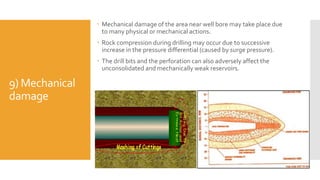
 Mechanical damage of the area near well bore may take place due
to many physical or mechanical actions.
 Rock compression during drilling may occur due to successive
increase in the pressure differential (caused by surge pressure).
 The drill bits and the perforation can also adversely affect the
unconsolidated and mechanically weak reservoirs.
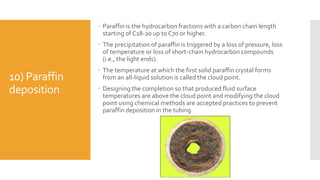
10) Paraffin
deposition
 Paraffin is the hydrocarbon fractions with a carbon chain length
starting of C18-20 up to C70 or higher.
 The precipitation of paraffin is triggered by a loss of pressure, loss
of temperature or loss of short-chain hydrocarbon compounds
(i.e., the light ends).
 The temperature at which the first solid paraffin crystal forms
from an all-liquid solution is called the cloud point.
 Designing the completion so that produced fluid surface
temperatures are above the cloud point and modifying the cloud
point using chemical methods are accepted practices to prevent
paraffin deposition in the tubing.
11)Precipitation
of asphaltene
 Asphaltene is black carbonaceous compound of petroleum and
are insoluble in high paraffinic hydrocarbon solvents.
 These compounds have relatively high molecular weights and are
considered as polar materials due to the presence of S, N, O and
complex metals.
 Asphaltenes occur in many crude oils in the form of colloidal
suspended solid particles.
 Asphaltene precipitation takes place when the crude oil loses its
ability to disperse the particle due to alteration of certain
equilibrium condition. It occurs mainly when pressure drops.
12)Wettability
alteration
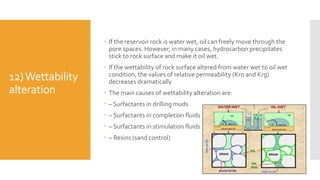
 If the reservoir rock is water wet, oil can freely move through the
pore spaces. However, in many cases, hydrocarbon precipitates
stick to rock surface and make it oil wet.
 If the wettability of rock surface altered from water wet to oil wet
condition, the values of relative permeability (Kro and Krg)
decreases dramatically
 The main causes of wettability alteration are:
 – Surfactants in drilling muds
 – Surfactants in completion fluids
 – Surfactants in stimulation fluids
 – Resins (sand control)
13) Reduced
relative
permeability
 In zones producing oil, if large volume of invading water enters
due to adverse nature of invading fluid, filter cake and pressure
differential, then oil saturation may decrease.
 In gas producing zones, the invading oil from oil-based mud can
increase oil saturation, thereby decreasing relative permeability of
gas.
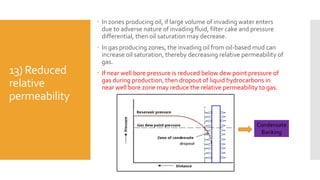
 If near well bore pressure is reduced below dew point pressure of
gas during production, then dropout of liquid hydrocarbons in
near well bore zone may reduce the relative permeability to gas.
Condensate
Banking
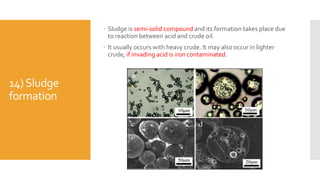
14)Sludge
formation
 Sludge is semi-solid compound and its formation takes place due
to reaction between acid and crude oil.
 It usually occurs with heavy crude. It may also occur in lighter
crude, if invading acid is iron contaminated.
15) Damage by
bacteria
 Bacteria can be a serious problem in production operations
because of what they consume and their byproducts.
 Bacteria can grow in many different environments and conditions:
 -temperatures ranging from 12°F to greater than 250°F [–11° to
>120°C],
 -pH values ranging from 1 to 11,
 -salinities to 30% and
 -pressures to 25,000 psi
 The most troublesome bacteria in the oilfield are sulfate-reducing
bacteria, slime formers, iron oxidizing bacteria and bacteria that
attack polymers in fracturing fluids.
16) Polymer
invasion
 Polymers are common invading fluid constituents.
 Mainly it is used for increasing viscosity or as lost circulation
materials.
 The degradation and breakup with time or on contact with
hydrocarbons are important factors while selecting the polymers.
 If proper care is not taken then polymer invasion can cause
formation damage.
17)Gas
breakout
 The gas breakout may be caused due to increased gas saturation
near wellbore or downward coning of preexisting gas cap.
 This leads to gas breakout and decrease in oil production.
ThankYou ! Queries?

Formation damage

  • 1.
    Formation Damage Target30Presentation Mentor –Dr. Achinta Behra Presenter – Mr. Mohit Patel
  • 2.
    1) Plugging by solidparticles foreign to the formation  Most of the Intervention fluids contain solid particles in suspended condition in large quantity.  Under certain conditions for e.g. the average size is close to that of pore throat, these solid particles may plug the pore throats, which will ultimately decrease the productivity.
  • 3.
    2) Plugging by formation solids formation solids / fines are very small particles Located on the interior surfaces of the porous matrix and are free to move or migrate through the pores along with any fluid (which wets them), that flow in the reservoir.  As most of fines are water-wet, therefore small amount of water production can induce the fines to migrate.  The detachment and migration of fines depends on the fluid velocity also, therefore flow rate also becomes an important factor.
  • 4.
    3)Clay swelling (static clay damage) Clays may change volume as the salinity of the fluid flowing through the formation changes.  The montmorillonite and illite are swelling in nature and are more vulnerable in presence of lesser saline aqueous fluids than those of formation water.  Therefore, their presence in higher percentage and application of lesser saline aqueous fluids can cause them to swell and the increased volume may adversely affect the spaces useful to production.
  • 5.
    4) Dispersion of clayey platelets Kaolinite, which is also known as migration fines and mica needles may migrate through the pores, if lesser saline aqueous fluid is injected in the formation.  Due to lesser concentration of divalent cations or potassium, the mutual repulsion of clayey platelets increases.  The repulsive force overcomes the attractive forces and the released clayey particles can be carried to the vicinity of the well bore and choke the formation pores.
  • 6.
    5)Water block  Dueto increased interfacial tension, a water block may form, which can block oil production. It is caused by a region of high Sw around the wellbore.  The high Sw may be caused by :  – Loss of water based fluid from well.  – Reservoir problems, like coning etc.  The water blocks causes Kro or Krg to decrease in the near wellbore region. It proves to be more troublesome in following conditions:  – Low permeability,  – Low pressure gradients(gas wells),  – High surface tensions (gas wells). (Tight gas reservoir)
  • 7.
    6) Emulsion formation  Emulsionsare formed by mixing of two immiscible fluids such that droplets of one are dispersed in the other.  Emulsion formation results from the incompatibility of different types of fluids in the formation.  It may be enhanced by presence of surfactants and fine particles such as clays or asphaltene. Brine crude is a relatively common emulsion type.  As emulsions have higher viscosity than either constituent fluid, their presence may adversely affect the productivity(Darcy!)
  • 8.
    7) Precipitation of inorganic scales The incompatible invading fluid may generate precipitates of inorganic substances in contact with native aqueous fluid which can block pore spaces.  Most of the invading waters (such as filtrates, completion fluids & injection water) contain anions that are potential scale generators.  Furthermore, if formation water contains significant percentages of Ba, Sr or Ca ions, then under certain conditions of temperature, pressure, pH and concentration, compounds such as BaSO4, SrSO4 and CaCO3 may be precipitated.
  • 9.
    8)Precipitation related to acidizing  Instimulation jobs, such as acidizing, different precipitates may form if the acid is not compatible to formation rock and fluid.  --In sandstone formation, containing sufficient calciferous minerals, may lead to precipitation of CaF2 if calcium is not removed prior to injection of hydrofluoric acid (HF).  --In formations rich in minerals like chlorite and ferric dolomite, the acid solubilizes the iron, and may lead to precipitation of iron hydroxide Fe(OH)3.  Note- As acid dissolves matrix and matrix cementing materials, mineral grains may be liberated and can migrate to plug pores.
  • 10.
    9) Mechanical damage  Mechanicaldamage of the area near well bore may take place due to many physical or mechanical actions.  Rock compression during drilling may occur due to successive increase in the pressure differential (caused by surge pressure).  The drill bits and the perforation can also adversely affect the unconsolidated and mechanically weak reservoirs.
  • 11.
    10) Paraffin deposition  Paraffinis the hydrocarbon fractions with a carbon chain length starting of C18-20 up to C70 or higher.  The precipitation of paraffin is triggered by a loss of pressure, loss of temperature or loss of short-chain hydrocarbon compounds (i.e., the light ends).  The temperature at which the first solid paraffin crystal forms from an all-liquid solution is called the cloud point.  Designing the completion so that produced fluid surface temperatures are above the cloud point and modifying the cloud point using chemical methods are accepted practices to prevent paraffin deposition in the tubing.
  • 12.
    11)Precipitation of asphaltene  Asphalteneis black carbonaceous compound of petroleum and are insoluble in high paraffinic hydrocarbon solvents.  These compounds have relatively high molecular weights and are considered as polar materials due to the presence of S, N, O and complex metals.  Asphaltenes occur in many crude oils in the form of colloidal suspended solid particles.  Asphaltene precipitation takes place when the crude oil loses its ability to disperse the particle due to alteration of certain equilibrium condition. It occurs mainly when pressure drops.
  • 13.
    12)Wettability alteration  If thereservoir rock is water wet, oil can freely move through the pore spaces. However, in many cases, hydrocarbon precipitates stick to rock surface and make it oil wet.  If the wettability of rock surface altered from water wet to oil wet condition, the values of relative permeability (Kro and Krg) decreases dramatically  The main causes of wettability alteration are:  – Surfactants in drilling muds  – Surfactants in completion fluids  – Surfactants in stimulation fluids  – Resins (sand control)
  • 14.
    13) Reduced relative permeability  Inzones producing oil, if large volume of invading water enters due to adverse nature of invading fluid, filter cake and pressure differential, then oil saturation may decrease.  In gas producing zones, the invading oil from oil-based mud can increase oil saturation, thereby decreasing relative permeability of gas.  If near well bore pressure is reduced below dew point pressure of gas during production, then dropout of liquid hydrocarbons in near well bore zone may reduce the relative permeability to gas. Condensate Banking
  • 15.
    14)Sludge formation  Sludge issemi-solid compound and its formation takes place due to reaction between acid and crude oil.  It usually occurs with heavy crude. It may also occur in lighter crude, if invading acid is iron contaminated.
  • 16.
    15) Damage by bacteria Bacteria can be a serious problem in production operations because of what they consume and their byproducts.  Bacteria can grow in many different environments and conditions:  -temperatures ranging from 12°F to greater than 250°F [–11° to >120°C],  -pH values ranging from 1 to 11,  -salinities to 30% and  -pressures to 25,000 psi  The most troublesome bacteria in the oilfield are sulfate-reducing bacteria, slime formers, iron oxidizing bacteria and bacteria that attack polymers in fracturing fluids.
  • 17.
    16) Polymer invasion  Polymersare common invading fluid constituents.  Mainly it is used for increasing viscosity or as lost circulation materials.  The degradation and breakup with time or on contact with hydrocarbons are important factors while selecting the polymers.  If proper care is not taken then polymer invasion can cause formation damage.
  • 18.
    17)Gas breakout  The gasbreakout may be caused due to increased gas saturation near wellbore or downward coning of preexisting gas cap.  This leads to gas breakout and decrease in oil production.
  • 19.