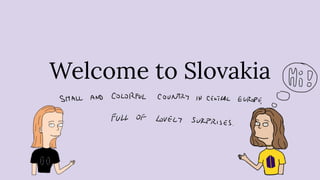
Welcome to Slovakia
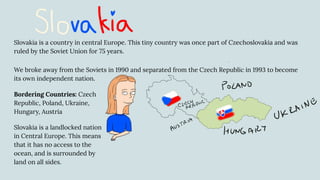
Slovakia is a country in central Europe. This tiny country was once part of Czechoslovakia and was
ruled by the Soviet Union for 75 years.
We broke away from the Soviets in 1990 and separated from the Czech Republic in 1993 to become
its own independent nation.
Bordering Countries: Czech
Republic, Poland, Ukraine,
Hungary, Austria
Slovakia is a landlocked nation
in Central Europe. This means
that it has no access to the
ocean, and is surrounded by
land on all sides.
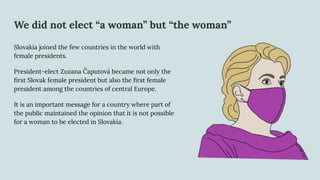
We did not elect “a woman” but “the woman”
Slovakia joined the few countries in the world with
female presidents.
President-elect Zuzana Čaputová became not only the
first Slovak female president but also the first female
president among the countries of central Europe.
It is an important message for a country where part of
the public maintained the opinion that it is not possible
for a woman to be elected in Slovakia.
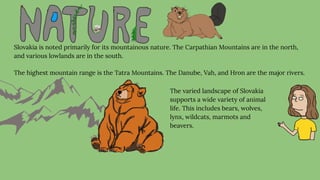
Slovakia is noted primarily for its mountainous nature. The Carpathian Mountains are in the north,
and various lowlands are in the south.
The highest mountain range is the Tatra Mountains. The Danube, Vah, and Hron are the major rivers.
The varied landscape of Slovakia
supports a wide variety of animal
life. This includes bears, wolves,
lynx, wildcats, marmots and
beavers.
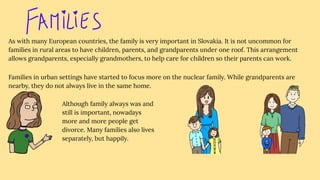
As with many European countries, the family is very important in Slovakia. It is not uncommon for
families in rural areas to have children, parents, and grandparents under one roof. This arrangement
allows grandparents, especially grandmothers, to help care for children so their parents can work.
Families in urban settings have started to focus more on the nuclear family. While grandparents are
nearby, they do not always live in the same home.
Although family always was and
still is important, nowadays
more and more people get
divorce. Many families also lives
separately, but happily.
Slovakian food is unique. True Slovak food and recipes,
unlike another type of cuisine, cannot be found outside
of Slovakia.
Slovakian dishes use items such as pork, poultry,
cabbage, wheat, cheese, potatoes, onions, and garlic.
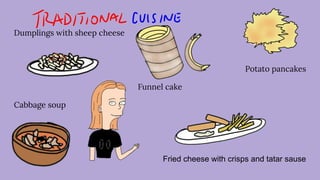
Dumplings with sheep cheese
Potato pancakes
Funnel cake
Cabbage soup
Fried cheese with crisps and tatar sause
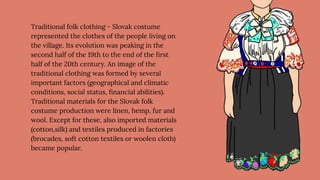
Traditional folk clothing - Slovak costume
represented the clothes of the people living on
the village. Its evolution was peaking in the
second half of the 19th to the end of the first
half of the 20th century. An image of the
traditional clothing was formed by several
important factors (geographical and climatic
conditions, social status, financial abilities).
Traditional materials for the Slovak folk
costume production were linen, hemp, fur and
wool. Except for these, also imported materials
(cotton,silk) and textiles produced in factories
(brocades, soft cotton textiles or woolen cloth)
became popular.
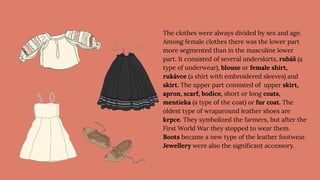
The clothes were always divided by sex and age.
Among female clothes there was the lower part
more segmented than in the masculine lower
part. It consisted of several underskirts, rubáš (a
type of underwear), blouse or female shirt,
rukávce (a shirt with embroidered sleeves) and
skirt. The upper part consisted of upper skirt,
apron, scarf, bodice, short or long coats,
mentieka (a type of the coat) or fur coat. The
oldest type of wraparound leather shoes are
krpce. They symbolized the farmers, but after the
First World War they stopped to wear them.
Boots became a new type of the leather footwear.
Jewellery were also the significant accessory.
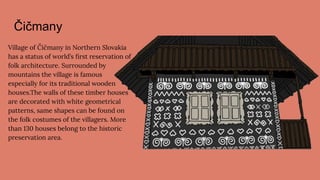
Čičmany
Village of Čičmany in Northern Slovakia
has a status of world’s first reservation of
folk architecture. Surrounded by
mountains the village is famous
especially for its traditional wooden
houses.The walls of these timber houses
are decorated with white geometrical
patterns, same shapes can be found on
the folk costumes of the villagers. More
than 130 houses belong to the historic
preservation area.
A little bit of traditions
Cold water and wicker whips for Easter
This holiday tradition dates back to the ninth century, when it was believed that dowsing women with
cold water would make them healthy for the upcoming spring season and ensure their fertility in the
year ahead. Men also hit the women with wicker sticks to ensure vitality. Today, it’s unlikely that young
men have this goal in mind when they receive permission to act like little demons for a day. Girls are
expected to give the boys a boiled egg, candy bar or money as a thanks for being soaked with cold
water.
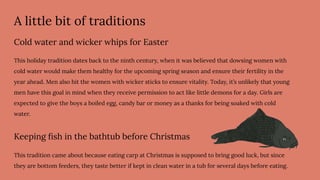
Keeping fish in the bathtub before Christmas
This tradition came about because eating carp at Christmas is supposed to bring good luck, but since
they are bottom feeders, they taste better if kept in clean water in a tub for several days before eating.
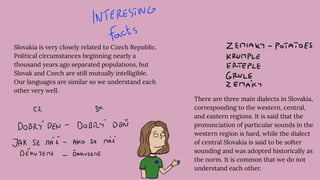
Slovakia is very closely related to Czech Republic.
Political circumstances beginning nearly a
thousand years ago separated populations, but
Slovak and Czech are still mutually intelligible.
Our languages are similar so we understand each
other very well.
There are three main dialects in Slovakia,
corresponding to the western, central,
and eastern regions. It is said that the
pronunciation of particular sounds in the
western region is hard, while the dialect
of central Slovakia is said to be softer
sounding and was adopted historically as
the norm. It is common that we do not
understand each other.
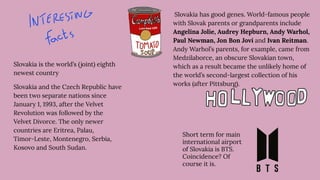
Slovakia has good genes. World-famous people
with Slovak parents or grandparents include
Angelina Jolie, Audrey Hepburn, Andy Warhol,
Paul Newman, Jon Bon Jovi and Ivan Reitman.
Andy Warhol’s parents, for example, came from
Medzilaborce, an obscure Slovakian town,
which as a result became the unlikely home of
the world’s second-largest collection of his
works (after Pittsburg).
Slovakia is the world’s (joint) eighth
newest country
Slovakia and the Czech Republic have
been two separate nations since
January 1, 1993, after the Velvet
Revolution was followed by the
Velvet Divorce. The only newer
countries are Eritrea, Palau,
Timor-Leste, Montenegro, Serbia,
Kosovo and South Sudan.
Short term for main
international airport
of Slovakia is BTS.
Coincidence? Of
course it is.
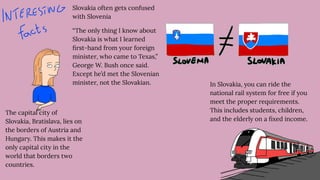
Slovakia often gets confused
with Slovenia
“The only thing I know about
Slovakia is what I learned
first-hand from your foreign
minister, who came to Texas,”
George W. Bush once said.
Except he’d met the Slovenian
minister, not the Slovakian. In Slovakia, you can ride the
national rail system for free if you
meet the proper requirements.
This includes students, children,
and the elderly on a fixed income.
The capital city of
Slovakia, Bratislava, lies on
the borders of Austria and
Hungary. This makes it the
only capital city in the
world that borders two
countries.
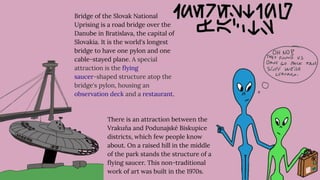
Bridge of the Slovak National
Uprising is a road bridge over the
Danube in Bratislava, the capital of
Slovakia. It is the world's longest
bridge to have one pylon and one
cable-stayed plane. A special
attraction is the flying
saucer-shaped structure atop the
bridge's pylon, housing an
observation deck and a restaurant.
There is an attraction between the
Vrakuňa and Podunajské Biskupice
districts, which few people know
about. On a raised hill in the middle
of the park stands the structure of a
flying saucer. This non-traditional
work of art was built in the 1970s.
Question time
1. Which one is not the
bordering country of
Slovakia?
- Hungary
- Poland
- Ukraine
- Slovenia
3. Which colour is not on
slovak flag?
- blue
- white
- yellow
- red
2. What is the short
term for our airport?
- EXO
- BTS
- NCT
Question time
4. How many main
dialects are in
slovakia?
- two
- three
- four
6. What animal is not on
the nature slide?
- bear
- wolf
- beaver
5. Which of these
dishes is not
traditional for
Slovakia?
-funnel cake
-cabbage soup
-sausages
Question time
7. What symbolizes the
old shoes called krpce?
- farmers
- dancers
- students
9. What was the name
of that green alien?
-Bob
-Dave
-Brian
8. What was the name
of the village which
has the world’s first
reservation of folk
architecture?
- Bardejov
- Čičmany
- Galanta
resources
https://bratislava.dnes24.sk/neverite-na-ufo-v-bratislave-mozete-vidiet-dokonca-dve-257829
https://www.slovakia.com/facts/interesting/
https://factcity.com/20-super-fun-facts-about-slovakia/
https://www.slovakia.com/facts/
http://blog.timeforslovakia.com/10-interesting-facts-about-slovakia-3/
https://www.everyculture.com/Sa-Th/Slovakia.html#ixzz6eXnDzeNK
https://theculturetrip.com/europe/slovakia/articles/8-traditions-only-slovaks-will-understand/
https://magnifique-brunette.blogspot.com/2015/12/traditional-folk-clothing-in-slovakia.html#:~:text=%20Traditional%20folk%
Zuzana Čaputová is the first Slovak female president - spectator.sme.sk
Slovenské nárečia a dialekty - nárečie.sk (narecie.sk)
Bratislava Airport - Wikipedia
Right answers
1. Slovenia
2. BTS
3. yellow
4. three
5. sausages
6. wolf
7. farmers
8. Čičmany
9. Dave
Thank you for your
attention
Eliška Mlynáriková Žofia Hüblerová

Welcome to Slovakia

  • 1.
  • 2.
    Slovakia is acountry in central Europe. This tiny country was once part of Czechoslovakia and was ruled by the Soviet Union for 75 years. We broke away from the Soviets in 1990 and separated from the Czech Republic in 1993 to become its own independent nation. Bordering Countries: Czech Republic, Poland, Ukraine, Hungary, Austria Slovakia is a landlocked nation in Central Europe. This means that it has no access to the ocean, and is surrounded by land on all sides.
  • 3.
    We did notelect “a woman” but “the woman” Slovakia joined the few countries in the world with female presidents. President-elect Zuzana Čaputová became not only the first Slovak female president but also the first female president among the countries of central Europe. It is an important message for a country where part of the public maintained the opinion that it is not possible for a woman to be elected in Slovakia.
  • 4.
    Slovakia is notedprimarily for its mountainous nature. The Carpathian Mountains are in the north, and various lowlands are in the south. The highest mountain range is the Tatra Mountains. The Danube, Vah, and Hron are the major rivers. The varied landscape of Slovakia supports a wide variety of animal life. This includes bears, wolves, lynx, wildcats, marmots and beavers.
  • 5.
    As with manyEuropean countries, the family is very important in Slovakia. It is not uncommon for families in rural areas to have children, parents, and grandparents under one roof. This arrangement allows grandparents, especially grandmothers, to help care for children so their parents can work. Families in urban settings have started to focus more on the nuclear family. While grandparents are nearby, they do not always live in the same home. Although family always was and still is important, nowadays more and more people get divorce. Many families also lives separately, but happily.
  • 6.
    Slovakian food isunique. True Slovak food and recipes, unlike another type of cuisine, cannot be found outside of Slovakia. Slovakian dishes use items such as pork, poultry, cabbage, wheat, cheese, potatoes, onions, and garlic.
  • 7.
    Dumplings with sheepcheese Potato pancakes Funnel cake Cabbage soup Fried cheese with crisps and tatar sause
  • 8.
    Traditional folk clothing- Slovak costume represented the clothes of the people living on the village. Its evolution was peaking in the second half of the 19th to the end of the first half of the 20th century. An image of the traditional clothing was formed by several important factors (geographical and climatic conditions, social status, financial abilities). Traditional materials for the Slovak folk costume production were linen, hemp, fur and wool. Except for these, also imported materials (cotton,silk) and textiles produced in factories (brocades, soft cotton textiles or woolen cloth) became popular.
  • 9.
    The clothes werealways divided by sex and age. Among female clothes there was the lower part more segmented than in the masculine lower part. It consisted of several underskirts, rubáš (a type of underwear), blouse or female shirt, rukávce (a shirt with embroidered sleeves) and skirt. The upper part consisted of upper skirt, apron, scarf, bodice, short or long coats, mentieka (a type of the coat) or fur coat. The oldest type of wraparound leather shoes are krpce. They symbolized the farmers, but after the First World War they stopped to wear them. Boots became a new type of the leather footwear. Jewellery were also the significant accessory.
  • 10.
    Čičmany Village of Čičmanyin Northern Slovakia has a status of world’s first reservation of folk architecture. Surrounded by mountains the village is famous especially for its traditional wooden houses.The walls of these timber houses are decorated with white geometrical patterns, same shapes can be found on the folk costumes of the villagers. More than 130 houses belong to the historic preservation area.
  • 11.
    A little bitof traditions Cold water and wicker whips for Easter This holiday tradition dates back to the ninth century, when it was believed that dowsing women with cold water would make them healthy for the upcoming spring season and ensure their fertility in the year ahead. Men also hit the women with wicker sticks to ensure vitality. Today, it’s unlikely that young men have this goal in mind when they receive permission to act like little demons for a day. Girls are expected to give the boys a boiled egg, candy bar or money as a thanks for being soaked with cold water. Keeping fish in the bathtub before Christmas This tradition came about because eating carp at Christmas is supposed to bring good luck, but since they are bottom feeders, they taste better if kept in clean water in a tub for several days before eating.
  • 12.
    Slovakia is veryclosely related to Czech Republic. Political circumstances beginning nearly a thousand years ago separated populations, but Slovak and Czech are still mutually intelligible. Our languages are similar so we understand each other very well. There are three main dialects in Slovakia, corresponding to the western, central, and eastern regions. It is said that the pronunciation of particular sounds in the western region is hard, while the dialect of central Slovakia is said to be softer sounding and was adopted historically as the norm. It is common that we do not understand each other.
  • 13.
    Slovakia has goodgenes. World-famous people with Slovak parents or grandparents include Angelina Jolie, Audrey Hepburn, Andy Warhol, Paul Newman, Jon Bon Jovi and Ivan Reitman. Andy Warhol’s parents, for example, came from Medzilaborce, an obscure Slovakian town, which as a result became the unlikely home of the world’s second-largest collection of his works (after Pittsburg). Slovakia is the world’s (joint) eighth newest country Slovakia and the Czech Republic have been two separate nations since January 1, 1993, after the Velvet Revolution was followed by the Velvet Divorce. The only newer countries are Eritrea, Palau, Timor-Leste, Montenegro, Serbia, Kosovo and South Sudan. Short term for main international airport of Slovakia is BTS. Coincidence? Of course it is.
  • 14.
    Slovakia often getsconfused with Slovenia “The only thing I know about Slovakia is what I learned first-hand from your foreign minister, who came to Texas,” George W. Bush once said. Except he’d met the Slovenian minister, not the Slovakian. In Slovakia, you can ride the national rail system for free if you meet the proper requirements. This includes students, children, and the elderly on a fixed income. The capital city of Slovakia, Bratislava, lies on the borders of Austria and Hungary. This makes it the only capital city in the world that borders two countries.
  • 15.
    Bridge of theSlovak National Uprising is a road bridge over the Danube in Bratislava, the capital of Slovakia. It is the world's longest bridge to have one pylon and one cable-stayed plane. A special attraction is the flying saucer-shaped structure atop the bridge's pylon, housing an observation deck and a restaurant. There is an attraction between the Vrakuňa and Podunajské Biskupice districts, which few people know about. On a raised hill in the middle of the park stands the structure of a flying saucer. This non-traditional work of art was built in the 1970s.
  • 16.
    Question time 1. Whichone is not the bordering country of Slovakia? - Hungary - Poland - Ukraine - Slovenia 3. Which colour is not on slovak flag? - blue - white - yellow - red 2. What is the short term for our airport? - EXO - BTS - NCT
  • 17.
    Question time 4. Howmany main dialects are in slovakia? - two - three - four 6. What animal is not on the nature slide? - bear - wolf - beaver 5. Which of these dishes is not traditional for Slovakia? -funnel cake -cabbage soup -sausages
  • 18.
    Question time 7. Whatsymbolizes the old shoes called krpce? - farmers - dancers - students 9. What was the name of that green alien? -Bob -Dave -Brian 8. What was the name of the village which has the world’s first reservation of folk architecture? - Bardejov - Čičmany - Galanta
  • 19.
  • 20.
    Right answers 1. Slovenia 2.BTS 3. yellow 4. three 5. sausages 6. wolf 7. farmers 8. Čičmany 9. Dave
  • 21.
    Thank you foryour attention Eliška Mlynáriková Žofia Hüblerová