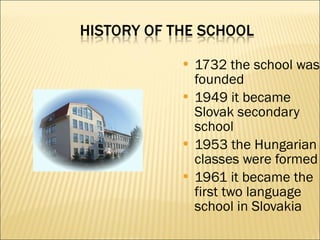
1732 the school was founded 1949 it became Slovak secondary school 1953 the Hungarian classes were formed 1961 it became the first two language school in Slovakia
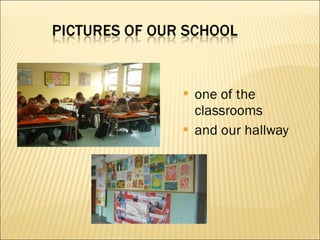
one of the classrooms and our hallway
 
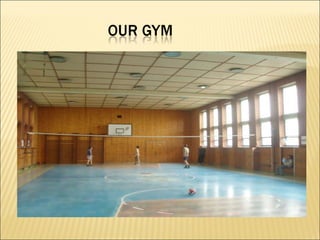
Every year a Christmas sale is organized in December  in our gym
 
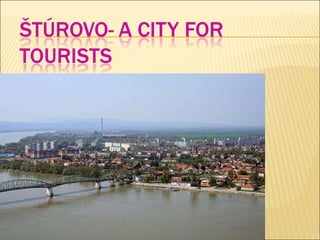
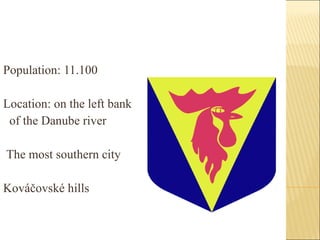
Population: 11.100 Location: on the left bank  of the Danube river The most southern city  Kováčovské hills
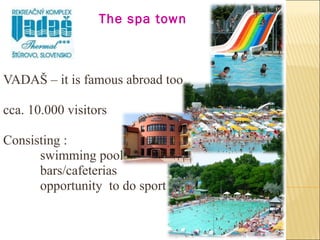
The spa town VADAŠ – it is famous abroad too cca. 10.000 visitors Consisting : swimming pools bars/cafeterias opportunity  to do sport
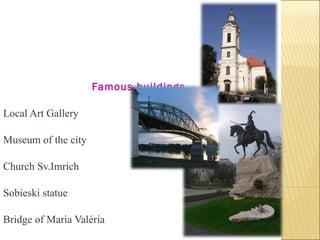
Famous buildings  Local Art Gallery Museum of the city Church Sv.Imrich Sobieski statue  Bridge of Maria Valéria
 
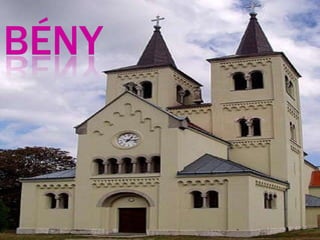
The history of Bény is very long. The most important things are that 6000 years ago there were Cornishes, Romans and Hungarians.  King St. Steven before his coronation  in Bény  collected his army for a battle. István Hunt son’s name was Bynn and the village was named  after him  whom Szent István gave this part of the country.
Castle of Béla It’s history Possibilities Free time
Its history: Its building  started in 1770 thanks for Török András. It had a baroque style. For a long time it was used as a prison. There was an agriculture school for some time. Till 1990  there were agricultural machines and warehouse. In 2000  Ilona von Krockow  countess and Matthias count started to renew the castle.  Today it is a very-very beautiful castle, Chateau Belá  but very expensive. It is a five-star hotel.
 
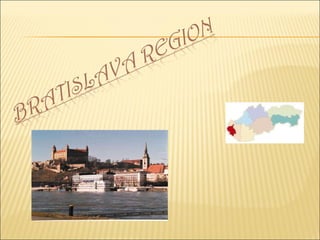
Capital city of Slovak Republik River Danube and mountain Low Karpat Bordering:  H ungary,  A ustria, Beautiful city in beautiful environment political, cultural, and economic centre of Slovakia Member of the Europian Union since 2004
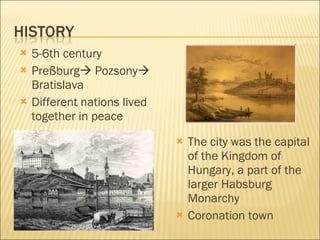
5-6th  century   Preßburg   Pozsony   Bratislava D ifferent nations  lived together in peace The city was the capital of the Kingdom of Hungary, a part of the larger Habsburg Monarchy Coronation town
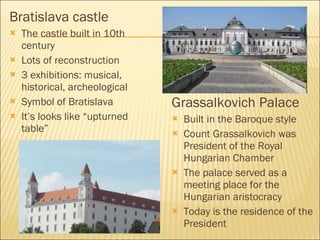
Bratislava castle The castle built in 10th century  Lots of reconstruction 3 exhibition s : musical, historical,  archeological Symbol of Bratislava It ’ s looks lik e “upturned table” Grassalkovich  Palace Built in  the Baroque style Count Grassalkovich was President of the Royal Hungarian Chamber The palace served as a meeting place for the Hungarian aristocracy Today is the residence of the President
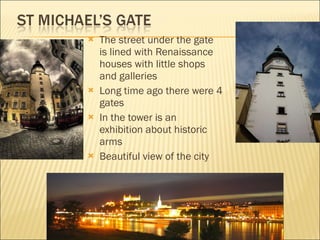
The street under the gate is lined with Renaissance houses with little shops and galleries Long time ago the re  were 4 gates In the tower is an exhibition about historic arms Beautiful view  of  the city
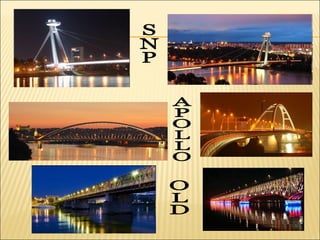
SNP APOLLO OLD
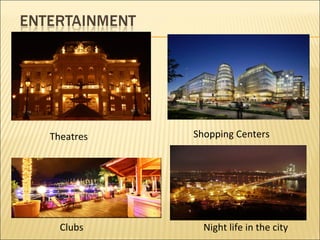
Theatres Shopping Centers Clubs Night life in the city
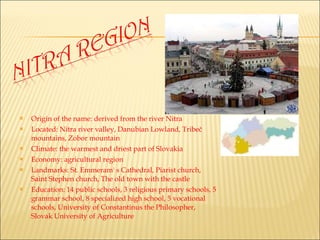
Origin of the name: derived from the river Nitra Located: Nitra river valley, Danubian Lowland, Tribeč mountains, Zobor mountain Climate: the warmest and driest part of Slovakia Economy: agricultural region Landmarks: St. Emmeram' s Cathedral, Piarist church, Saint Stephen church, The old town with the castle Education: 14 public schools, 3 religious primary schools, 5 grammar school, 8 specialized high school, 5 vocational schools, University of Constantinus the Philosopher, Slovak University of Agriculture
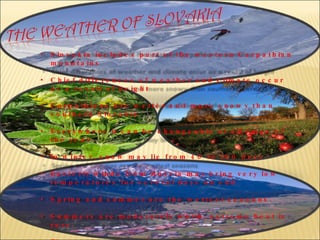
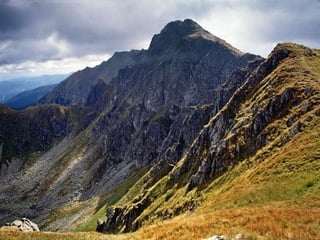
Slovakia includes part of the western Carpathian mountains Chief differences of weather and climate occur as a result of height Carpathians are wetter and more snowy than southern Slovakia Everywhere it can be changeable at all times of the year. In winter, snow may lie from 40 to 100 days Easterly winds from Russia may bring very low temperatures for several days on end. Spring and summer are the wettest seasons.  Summers are moderately warm, extreme heat is rare.  The number of wet days is rather less than in western Europe  Summer sunshine averages as much as eight hours per day.
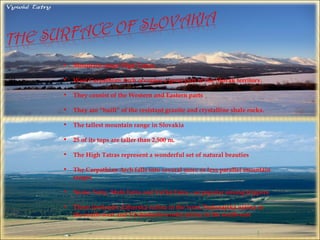
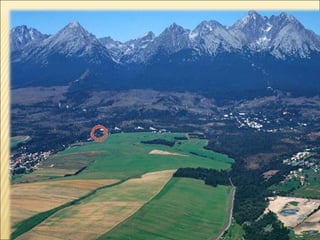
Mountain range High Tatras. West Carpathian Arch occupies a great part of the Slovak territory.  They consist of the Western and Eastern parts  They are “built” of the resistant granite and crystalline shale rocks.  The tallest mountain range in Slovakia  25 of its tops are taller than 2,500 m. The High Tatras represent a wonderful set of natural beauties The Carpathian Arch falls into several more or less parallel mountain ranges  Nízke Tatry, Malá Fatra and Veľká Fatra - so popular among trippers Three lowlands: Záhorská nížina in the west, Podunajská nížina in the south-west and Východoslovenská nížina in the south-east


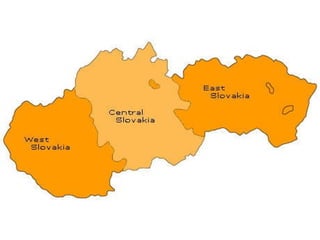
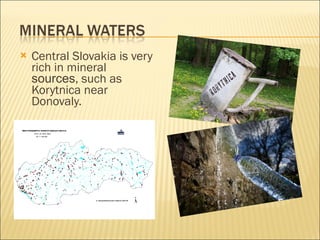
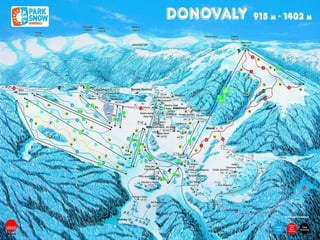
Central Slovakia is very rich in mineral  sources , such as Korytnica near Donovaly.


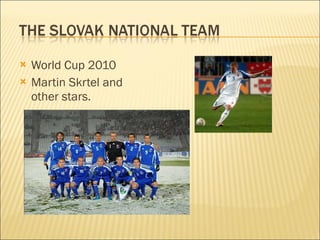
World Cup 2010 Martin Skrtel and other stars.
 
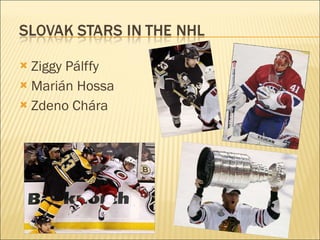
Ziggy Pálffy Marián Hossa Zdeno Chára


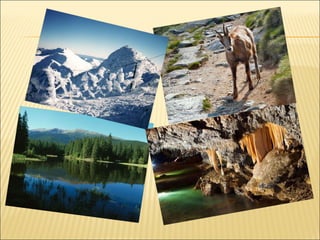
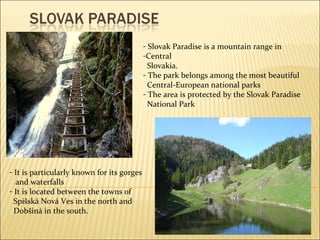
Slovak Paradise is a mountain range in  Central Slovakia. The park belongs among the most beautiful  Central- E uropean national parks The area is protected by the Slovak Paradise  National Park It is particularly known for its gorg e s and waterfalls It is located between the towns of Spišská Nová Ves in the north and  Dobšiná in the south.
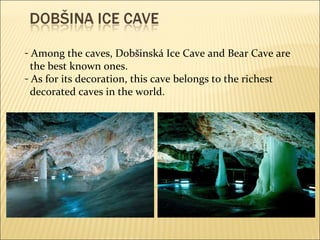
Among the caves, Dobšinská Ice Cave and Bear Cave are the best known ones. As for its decoration, this cave belongs to the richest decorated caves in the world.
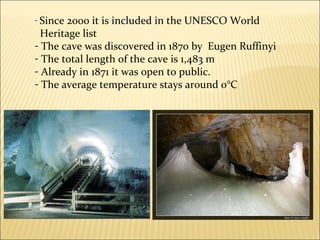
Since 2000 it is included in the UNESCO World Heritage list  The cave was discovered in 1870 by  Eugen Ruffinyi The total length of the cave is 1,483 m Already in 1871 it was open to public.  The average temperature stays around 0°C
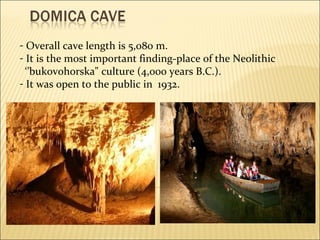
Overall cave length is 5,080 m.   It is the most important finding-place of the Neolithic ‘’ bukovohorska" culture (4,000 years B.C.). It was open to the public in  1932 .
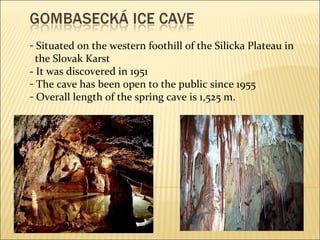
Situated on the western foothill of the Silicka Plateau in the Slovak Karst  -  It was discovered in 1951 The cave has been open to the public since 1955 Overall length of the spring cave is 1,525 m.
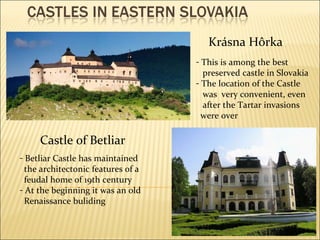
Krásna Hôrka T his is among the best preserved castle in Slovakia The location of the Castle was   very convenient, even after the Tartar invasions were over Castle of Betliar Betliar Castle has  m aintained the architectonic features of a feudal home of 19th century At the beginning it was an old Renaissance buliding
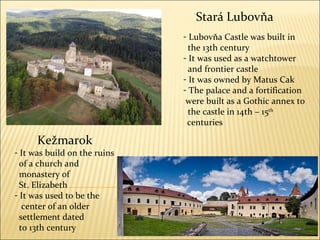
Stará Lubovňa Lubov ň a Castle was built in  the 13th century It was used as a   watchtower and frontier castle It was owned by Matus Cak The palace and a fortification  were built as a  G othic annex  t o the castle in 14th – 15 th   centuries Kežmarok It  was build on the ruins of a church and mo nastery of  St. Elizabeth It was used to be the center of an older settlement dated to 13th century

Gymnázium štúrovo

  • 1.
    1732 the schoolwas founded 1949 it became Slovak secondary school 1953 the Hungarian classes were formed 1961 it became the first two language school in Slovakia
  • 2.
    one of theclassrooms and our hallway
  • 3.
  • 4.
    Every year aChristmas sale is organized in December in our gym
  • 5.
  • 6.
    Population: 11.100 Location:on the left bank of the Danube river The most southern city Kováčovské hills
  • 7.
    The spa townVADAŠ – it is famous abroad too cca. 10.000 visitors Consisting : swimming pools bars/cafeterias opportunity to do sport
  • 8.
    Famous buildings Local Art Gallery Museum of the city Church Sv.Imrich Sobieski statue Bridge of Maria Valéria
  • 9.
  • 10.
    The history ofBény is very long. The most important things are that 6000 years ago there were Cornishes, Romans and Hungarians. King St. Steven before his coronation in Bény collected his army for a battle. István Hunt son’s name was Bynn and the village was named after him whom Szent István gave this part of the country.
  • 11.
    Castle of BélaIt’s history Possibilities Free time
  • 12.
    Its history: Itsbuilding started in 1770 thanks for Török András. It had a baroque style. For a long time it was used as a prison. There was an agriculture school for some time. Till 1990 there were agricultural machines and warehouse. In 2000 Ilona von Krockow countess and Matthias count started to renew the castle. Today it is a very-very beautiful castle, Chateau Belá but very expensive. It is a five-star hotel.
  • 13.
  • 14.
    Capital city ofSlovak Republik River Danube and mountain Low Karpat Bordering: H ungary, A ustria, Beautiful city in beautiful environment political, cultural, and economic centre of Slovakia Member of the Europian Union since 2004
  • 15.
    5-6th century Preßburg  Pozsony  Bratislava D ifferent nations lived together in peace The city was the capital of the Kingdom of Hungary, a part of the larger Habsburg Monarchy Coronation town
  • 16.
    Bratislava castle Thecastle built in 10th century Lots of reconstruction 3 exhibition s : musical, historical, archeological Symbol of Bratislava It ’ s looks lik e “upturned table” Grassalkovich Palace Built in the Baroque style Count Grassalkovich was President of the Royal Hungarian Chamber The palace served as a meeting place for the Hungarian aristocracy Today is the residence of the President
  • 17.
    The street underthe gate is lined with Renaissance houses with little shops and galleries Long time ago the re were 4 gates In the tower is an exhibition about historic arms Beautiful view of the city
  • 18.
  • 19.
    Theatres Shopping CentersClubs Night life in the city
  • 20.
    Origin of thename: derived from the river Nitra Located: Nitra river valley, Danubian Lowland, Tribeč mountains, Zobor mountain Climate: the warmest and driest part of Slovakia Economy: agricultural region Landmarks: St. Emmeram' s Cathedral, Piarist church, Saint Stephen church, The old town with the castle Education: 14 public schools, 3 religious primary schools, 5 grammar school, 8 specialized high school, 5 vocational schools, University of Constantinus the Philosopher, Slovak University of Agriculture
  • 21.
    Slovakia includes partof the western Carpathian mountains Chief differences of weather and climate occur as a result of height Carpathians are wetter and more snowy than southern Slovakia Everywhere it can be changeable at all times of the year. In winter, snow may lie from 40 to 100 days Easterly winds from Russia may bring very low temperatures for several days on end. Spring and summer are the wettest seasons. Summers are moderately warm, extreme heat is rare. The number of wet days is rather less than in western Europe Summer sunshine averages as much as eight hours per day.
  • 22.
    Mountain range HighTatras. West Carpathian Arch occupies a great part of the Slovak territory. They consist of the Western and Eastern parts They are “built” of the resistant granite and crystalline shale rocks. The tallest mountain range in Slovakia 25 of its tops are taller than 2,500 m. The High Tatras represent a wonderful set of natural beauties The Carpathian Arch falls into several more or less parallel mountain ranges Nízke Tatry, Malá Fatra and Veľká Fatra - so popular among trippers Three lowlands: Záhorská nížina in the west, Podunajská nížina in the south-west and Východoslovenská nížina in the south-east
  • 23.
  • 24.
  • 25.
  • 26.
  • 27.
    Central Slovakia isvery rich in mineral sources , such as Korytnica near Donovaly.
  • 28.
  • 29.
  • 30.
  • 31.
  • 32.
  • 33.
    World Cup 2010Martin Skrtel and other stars.
  • 34.
  • 35.
    Ziggy Pálffy MariánHossa Zdeno Chára
  • 36.
  • 37.
  • 38.
  • 39.
  • 40.
    Slovak Paradise isa mountain range in Central Slovakia. The park belongs among the most beautiful Central- E uropean national parks The area is protected by the Slovak Paradise National Park It is particularly known for its gorg e s and waterfalls It is located between the towns of Spišská Nová Ves in the north and Dobšiná in the south.
  • 41.
    Among the caves,Dobšinská Ice Cave and Bear Cave are the best known ones. As for its decoration, this cave belongs to the richest decorated caves in the world.
  • 42.
    Since 2000 itis included in the UNESCO World Heritage list The cave was discovered in 1870 by  Eugen Ruffinyi The total length of the cave is 1,483 m Already in 1871 it was open to public. The average temperature stays around 0°C
  • 43.
    Overall cave lengthis 5,080 m.   It is the most important finding-place of the Neolithic ‘’ bukovohorska" culture (4,000 years B.C.). It was open to the public in  1932 .
  • 44.
    Situated on thewestern foothill of the Silicka Plateau in the Slovak Karst - It was discovered in 1951 The cave has been open to the public since 1955 Overall length of the spring cave is 1,525 m.
  • 45.
    Krásna Hôrka This is among the best preserved castle in Slovakia The location of the Castle was very convenient, even after the Tartar invasions were over Castle of Betliar Betliar Castle has m aintained the architectonic features of a feudal home of 19th century At the beginning it was an old Renaissance buliding
  • 46.
    Stará Lubovňa Lubovň a Castle was built in the 13th century It was used as a watchtower and frontier castle It was owned by Matus Cak The palace and a fortification were built as a G othic annex t o the castle in 14th – 15 th centuries Kežmarok It was build on the ruins of a church and mo nastery of St. Elizabeth It was used to be the center of an older settlement dated to 13th century