Belarus
Belarus is a landlocked country in Eastern Europe bordered by Russia to
the north and east, Ukraine to the south, Poland to the west, and
Lithuania and Latvia to the north. Its capital is Minsk; other major
cities include Brest, Grodno (Hrodna), Gomel (Homiel), Mahilyow
(Mahiloŭ) and Vitebsk (Viciebsk). Forty percent of the country is
forested, and its strongest economic sectors are agriculture and
manufacturing.
The final unification of Belarusian lands within its modern borders took
place in 1939, when the ethnically Belarusian-Russian lands held by
the Second Polish Republic (interwar Poland) were annexed into the
USSR under the terms of the Nazi-Soviet pact,and attached to Soviet
Belarus. The territory and its nation were devastated in World War
II, during which Belarus lost about a third of its population and more
than half of its economic resources; the republic was redeveloped in
the post-war years. The parliament of the republic declared the
sovereignty of Belarus on 27 July 1990, and following the collapse of
the Soviet Union, Belarus declared independence on 25 August 1991.
Alexander Lukashenko has been the country's president since 1994.
During his presidency, Lukashenko has implemented Soviet-era
policies, such as state ownership of the economy, despite objections
from Western governments. Since 2000, Belarus and Russia signed a
treaty for greater cooperation, with some hints of forming a Union
State.
Most of Belarus' population of 9.85 million reside in the urban areas surrounding
Minsk and other oblast (regional) capitals. More than 80% of the population are native
Belarusians, with sizable minorities of Russians, Poles and Ukrainians. Since a
referendum in 1995, the country has had two official languages: Belarusian and Russian.
The Constitution of Belarus does not declare an official religion, although the primary
religion in the country is Russian Orthodox Christianity. The second most popular, Roman
Catholicism, has a much smaller following by comparison, but both Orthodox and Catholic
Christmas and Easter are officially respected as national holidays.
The region that is now modern-day Belarus was first settled by Slavic tribes in
the 6th century. They gradually came into contact with the Varangians, a
band of warriors consisting of Scandinavians and Slavs from the Baltics.
Though defeated and briefly exiled by the local population, the Varangians
were later asked to return and helped to form a polity—commonly referred
to as the Kievan Rus'—in exchange for tribute. The Kievan Rus' state began
in about 862 at the present-day city of Novgorod, or alternatively at Kiev.
Joseph Stalin implemented a policy of
Sovietization to isolate the Byelorussian
SSR from Western influences. This
policy involved sending Russians from
various parts of the Soviet Union and
placing them in key positions in the
Byelorussian SSR government. The
official use of the Belarusian language
and other cultural aspects were limited
by Moscow. After Stalin died in 1953,
successor Nikita Khrushchev continued
this program, stating, "The sooner we
all start speaking Russian, the faster
we shall build communism." The
Byelorussian SSR was significantly
exposed to nuclear fallout from the
explosion at the Chernobyl power plant
in neighboring Ukrainian SSR in 1986.
In June 1988 at the rural site of
Kurapaty near Minsk, archaeologist
Zianon Pazniak, the leader of Christian
Conservative Party of the BPF,
discovered mass graves which
contained about 250,000 bodies of
victims executed in 1937-1941.
Some nationalists contend that this discovery is proof that the Soviet government was trying to erase the
Belarusian people, causing Belarusian nationalists to seek independence.
Belarus is landlocked, relatively flat, and contains large tracts of marshy
land. According to a 2005 estimate by the United Nations, 40% of Belarus is
covered by forests. Many streams and 11,000 lakes are found in Belarus. Three
major rivers run through the country: the Neman, the Pripyat, and the Dnepr. The
Neman flows westward towards the Baltic sea and the Pripyat flows eastward to
the Dnepr; the Dnepr flows southward towards the Black Sea. Belarus's highest
point is Dzyarzhynskaya Hara (Dzyarzhynsk Hill) at 345 metres (1,132 ft), and its
lowest point is on the Neman River at 90 metres (295 ft).The average elevation of
Belarus is 525 feet (160 m) above sea level. The climate ranges from harsh
winters, with average January temperatures at −6 °C (21.2 °F), to cool and moist
summers with an average temperature of 18 °C (64.4 °F). Belarus has an average
annual rainfall of 550 to 700 mm (21.7 to 27.6 in). The country experiences a
yearly transition from a continental climate to a maritime climate.
Cuisine
Belarusian cuisine consists mainly of vegetables, meat (especially pork), and breads.
Foods are usually either slowly cooked or stewed. A typical Belarusian eats a very
light breakfast and two hearty meals, with dinner being the largest meal of the day.
Wheat and rye breads are consumed in Belarus, but rye is more plentiful because
conditions are too harsh for growing wheat. To show hospitality, a host traditionally
presents an offering of bread and salt when greeting a guest or visitor. Popular
drinks in Belarus include Russian wheat vodka and kvass, a soft drink made from
malted brown bread or rye flour. Kvass may also be combined with sliced
vegetables to create a cold soup called okroshka.
THE END

Belarus

  • 1.
  • 2.
    Belarus is alandlocked country in Eastern Europe bordered by Russia to the north and east, Ukraine to the south, Poland to the west, and Lithuania and Latvia to the north. Its capital is Minsk; other major cities include Brest, Grodno (Hrodna), Gomel (Homiel), Mahilyow (Mahiloŭ) and Vitebsk (Viciebsk). Forty percent of the country is forested, and its strongest economic sectors are agriculture and manufacturing. The final unification of Belarusian lands within its modern borders took place in 1939, when the ethnically Belarusian-Russian lands held by the Second Polish Republic (interwar Poland) were annexed into the USSR under the terms of the Nazi-Soviet pact,and attached to Soviet Belarus. The territory and its nation were devastated in World War II, during which Belarus lost about a third of its population and more than half of its economic resources; the republic was redeveloped in the post-war years. The parliament of the republic declared the sovereignty of Belarus on 27 July 1990, and following the collapse of the Soviet Union, Belarus declared independence on 25 August 1991. Alexander Lukashenko has been the country's president since 1994. During his presidency, Lukashenko has implemented Soviet-era policies, such as state ownership of the economy, despite objections from Western governments. Since 2000, Belarus and Russia signed a treaty for greater cooperation, with some hints of forming a Union State.
  • 3.
    Most of Belarus'population of 9.85 million reside in the urban areas surrounding Minsk and other oblast (regional) capitals. More than 80% of the population are native Belarusians, with sizable minorities of Russians, Poles and Ukrainians. Since a referendum in 1995, the country has had two official languages: Belarusian and Russian. The Constitution of Belarus does not declare an official religion, although the primary religion in the country is Russian Orthodox Christianity. The second most popular, Roman Catholicism, has a much smaller following by comparison, but both Orthodox and Catholic Christmas and Easter are officially respected as national holidays.
  • 4.
    The region thatis now modern-day Belarus was first settled by Slavic tribes in the 6th century. They gradually came into contact with the Varangians, a band of warriors consisting of Scandinavians and Slavs from the Baltics. Though defeated and briefly exiled by the local population, the Varangians were later asked to return and helped to form a polity—commonly referred to as the Kievan Rus'—in exchange for tribute. The Kievan Rus' state began in about 862 at the present-day city of Novgorod, or alternatively at Kiev.
  • 5.
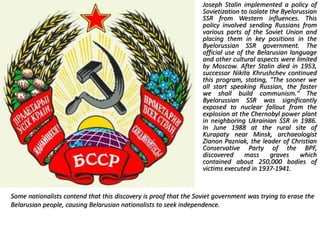
    Joseph Stalin implementeda policy of Sovietization to isolate the Byelorussian SSR from Western influences. This policy involved sending Russians from various parts of the Soviet Union and placing them in key positions in the Byelorussian SSR government. The official use of the Belarusian language and other cultural aspects were limited by Moscow. After Stalin died in 1953, successor Nikita Khrushchev continued this program, stating, "The sooner we all start speaking Russian, the faster we shall build communism." The Byelorussian SSR was significantly exposed to nuclear fallout from the explosion at the Chernobyl power plant in neighboring Ukrainian SSR in 1986. In June 1988 at the rural site of Kurapaty near Minsk, archaeologist Zianon Pazniak, the leader of Christian Conservative Party of the BPF, discovered mass graves which contained about 250,000 bodies of victims executed in 1937-1941. Some nationalists contend that this discovery is proof that the Soviet government was trying to erase the Belarusian people, causing Belarusian nationalists to seek independence.
  • 6.
    Belarus is landlocked,relatively flat, and contains large tracts of marshy land. According to a 2005 estimate by the United Nations, 40% of Belarus is covered by forests. Many streams and 11,000 lakes are found in Belarus. Three major rivers run through the country: the Neman, the Pripyat, and the Dnepr. The Neman flows westward towards the Baltic sea and the Pripyat flows eastward to the Dnepr; the Dnepr flows southward towards the Black Sea. Belarus's highest point is Dzyarzhynskaya Hara (Dzyarzhynsk Hill) at 345 metres (1,132 ft), and its lowest point is on the Neman River at 90 metres (295 ft).The average elevation of Belarus is 525 feet (160 m) above sea level. The climate ranges from harsh winters, with average January temperatures at −6 °C (21.2 °F), to cool and moist summers with an average temperature of 18 °C (64.4 °F). Belarus has an average annual rainfall of 550 to 700 mm (21.7 to 27.6 in). The country experiences a yearly transition from a continental climate to a maritime climate.
  • 7.
    Cuisine Belarusian cuisine consistsmainly of vegetables, meat (especially pork), and breads. Foods are usually either slowly cooked or stewed. A typical Belarusian eats a very light breakfast and two hearty meals, with dinner being the largest meal of the day. Wheat and rye breads are consumed in Belarus, but rye is more plentiful because conditions are too harsh for growing wheat. To show hospitality, a host traditionally presents an offering of bread and salt when greeting a guest or visitor. Popular drinks in Belarus include Russian wheat vodka and kvass, a soft drink made from malted brown bread or rye flour. Kvass may also be combined with sliced vegetables to create a cold soup called okroshka.
  • 8.