SLOVAKIA
SLOVAKIA
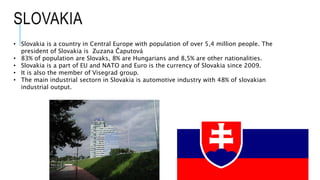
• Slovakia is a country in Central Europe with population of over 5,4 million people. The
president of Slovakia is Zuzana Čaputová
• 83% of population are Slovaks, 8% are Hungarians and 8,5% are other nationalities.
• Slovakia is a part of EU and NATO and Euro is the currency of Slovakia since 2009.
• It is also the member of Visegrad group.
• The main industrial sectorn in Slovakia is automotive industry with 48% of slovakian
industrial output.
NATURE
• Slovakia is a mountainous country, 41% of surface area is covered by forests. The largest
river is the Danube
• The two major lowlands are- Danubian Lowland (Podunajská Nížina) and Eastern Slovak
Lowland (Východoslovenská nížina).
• The largest mountains are The High Tatras in the north with the largest peak in Slovakia-
Gerlachovský Štít (2655 meters). Another symbolic peaks are Kriváň and Lomnický Štít.
• South of High Tatras lie Lower Tatras with a very iconic peak- Kráľova Hoľa. Ďumbier is
the highest peak in The Lower Tatras.
NATURE
• In Slovakia there are hundreds of caves under the mountains. 30 of them are opened to public. 5 of t
UNESCO world heritage status. There are 2 ice caves in Slovakia- Dobšiná Ice Cave and Demänovská Ice
• The longest river in Slovakia is Váh (403km).
Other famous rivers are- Orava, Hron, Ipeľ
etc.
HISTORY
• The oldest surviving human artefacts from Slovakia are found near Nové Mesto
nad Váhom and are dated at 270,000 BCE.
• In the Iron Age Celts settled in Slovakia. After Germanic invasions in the 1st
century AD they left.
• After the fall of Roman Empire, Slavs settled in Central and Eastern Europe. In
623 Samo´s empire was found and lasted until 804 AD.
• Mojmír I unified the Slavic tribes in 830 and turned the Municipality of Nitra
founded by Pribina (in 828 it had the first known christian church in Slovakia)
into the Great Moravia.
• Great Moravia was strongest during the reign of Svätopluk in 9th century.
Great Moravia fell after death of Svätopluk when his sons divided the empire.
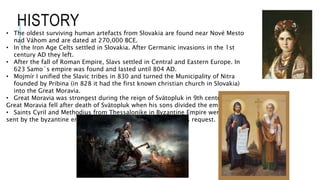
• Saints Cyril and Methodius from Thessalonike in Byzantine Empire were
sent by the byzantine emperor Michal III after Duke Rastislav´s request.
HISTORY
• Cyril invented Glagolitic script (the first slavic alphabet)
and translated gospel into the Old Slavonic language.
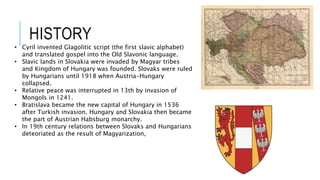
• Slavic lands in Slovakia were invaded by Magyar tribes
and Kingdom of Hungary was founded. Slovaks were ruled
by Hungarians until 1918 when Austria-Hungary
collapsed.
• Relative peace was interrupted in 13th by invasion of
Mongols in 1241.
• Bratislava became the new capital of Hungary in 1536
after Turkish invasion. Hungary and Slovakia then became
the part of Austrian Habsburg monarchy.
• In 19th century relations between Slovaks and Hungarians
deteoriated as the result of Magyarization,
HISTORY
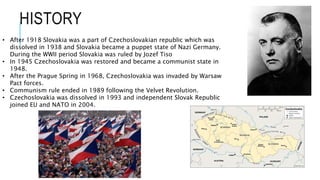
• After 1918 Slovakia was a part of Czechoslovakian republic which was
dissolved in 1938 and Slovakia became a puppet state of Nazi Germany.
During the WWII period Slovakia was ruled by Jozef Tiso
• In 1945 Czechoslovakia was restored and became a communist state in
1948.
• After the Prague Spring in 1968, Czechoslovakia was invaded by Warsaw
Pact forces.
• Communism rule ended in 1989 following the Velvet Revolution.
• Czechoslovakia was dissolved in 1993 and independent Slovak Republic
joined EU and NATO in 2004.
CULTURE
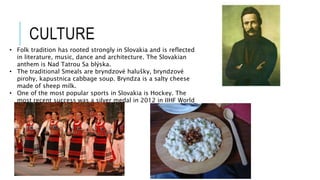
• Folk tradition has rooted strongly in Slovakia and is reflected
in literature, music, dance and architecture. The Slovakian
anthem is Nad Tatrou Sa blýska.
• The traditional Smeals are bryndzové halušky, bryndzové
pirohy, kapustnica cabbage soup. Bryndza is a salty cheese
made of sheep milk.
• One of the most popular sports in Slovakia is Hockey. The
most recent success was a silver medal in 2012 in IIHF World
Championship in Helsinki.
CITIES
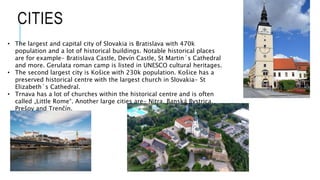
• The largest and capital city of Slovakia is Bratislava with 470k
population and a lot of historical buildings. Notable historical places
are for example- Bratislava Castle, Devín Castle, St Martin´s Cathedral
and more. Gerulata roman camp is listed in UNESCO cultural heritages.
• The second largest city is Košice with 230k population. Košice has a
preserved historical centre with the largest church in Slovakia- St
Elizabeth´s Cathedral.
• Trnava has a lot of churches within the historical centre and is often
called „Little Rome“. Another large cities are- Nitra, Banská Bystrica,
Prešov and Trenčín.
UNESCO CULTURAL HERITAGE
SITES
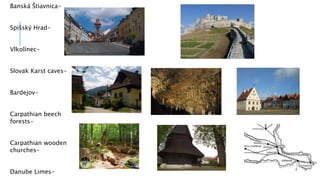
• Banská Štiavnica- the oldest mining town in Slovakia. There were rich deposits of gold
and silver but they were depleted in 19th century.
• Spišský Hrad- the largest castle in Central europe. The site includes well-preserved
buildings from 13th and 14th century in Romanesque and Gothic styles.
• Vlkolínec- is a traditional European settlement in a mounatinous area. The village has
43 traditional log houses.
• Caves of Slovak Karst- a system of 712 caves in Slovakia and Hungary.
• Bardejov town centre- the city plan dates back to 13th and 14th century. The town of
Bardejov was located close to an important trade route with Poland across the
Carpathians.
• Ancient Beech forests of the Carpathians- undisturbed area of beech forests in the far
east of Slovakia.
• Carpathian Wooden Churches- these churches were built between the 16th and 18th
centuries.
• The Danube Limes- a network of ancient fortifications which protected the border of
Roman Empire.
Banská Štiavnica-
Spišský Hrad-
Vlkolínec-
Slovak Karst caves-
Bardejov-
Carpathian beech
forests-
Carpathian wooden
churches-
Danube Limes-

Slovakia.pptx

  • 1.
  • 2.
    SLOVAKIA • Slovakia isa country in Central Europe with population of over 5,4 million people. The president of Slovakia is Zuzana Čaputová • 83% of population are Slovaks, 8% are Hungarians and 8,5% are other nationalities. • Slovakia is a part of EU and NATO and Euro is the currency of Slovakia since 2009. • It is also the member of Visegrad group. • The main industrial sectorn in Slovakia is automotive industry with 48% of slovakian industrial output.
  • 3.
    NATURE • Slovakia isa mountainous country, 41% of surface area is covered by forests. The largest river is the Danube • The two major lowlands are- Danubian Lowland (Podunajská Nížina) and Eastern Slovak Lowland (Východoslovenská nížina). • The largest mountains are The High Tatras in the north with the largest peak in Slovakia- Gerlachovský Štít (2655 meters). Another symbolic peaks are Kriváň and Lomnický Štít. • South of High Tatras lie Lower Tatras with a very iconic peak- Kráľova Hoľa. Ďumbier is the highest peak in The Lower Tatras.
  • 4.
    NATURE • In Slovakiathere are hundreds of caves under the mountains. 30 of them are opened to public. 5 of t UNESCO world heritage status. There are 2 ice caves in Slovakia- Dobšiná Ice Cave and Demänovská Ice • The longest river in Slovakia is Váh (403km). Other famous rivers are- Orava, Hron, Ipeľ etc.
  • 5.
    HISTORY • The oldestsurviving human artefacts from Slovakia are found near Nové Mesto nad Váhom and are dated at 270,000 BCE. • In the Iron Age Celts settled in Slovakia. After Germanic invasions in the 1st century AD they left. • After the fall of Roman Empire, Slavs settled in Central and Eastern Europe. In 623 Samo´s empire was found and lasted until 804 AD. • Mojmír I unified the Slavic tribes in 830 and turned the Municipality of Nitra founded by Pribina (in 828 it had the first known christian church in Slovakia) into the Great Moravia. • Great Moravia was strongest during the reign of Svätopluk in 9th century. Great Moravia fell after death of Svätopluk when his sons divided the empire. • Saints Cyril and Methodius from Thessalonike in Byzantine Empire were sent by the byzantine emperor Michal III after Duke Rastislav´s request.
  • 6.
    HISTORY • Cyril inventedGlagolitic script (the first slavic alphabet) and translated gospel into the Old Slavonic language. • Slavic lands in Slovakia were invaded by Magyar tribes and Kingdom of Hungary was founded. Slovaks were ruled by Hungarians until 1918 when Austria-Hungary collapsed. • Relative peace was interrupted in 13th by invasion of Mongols in 1241. • Bratislava became the new capital of Hungary in 1536 after Turkish invasion. Hungary and Slovakia then became the part of Austrian Habsburg monarchy. • In 19th century relations between Slovaks and Hungarians deteoriated as the result of Magyarization,
  • 7.
    HISTORY • After 1918Slovakia was a part of Czechoslovakian republic which was dissolved in 1938 and Slovakia became a puppet state of Nazi Germany. During the WWII period Slovakia was ruled by Jozef Tiso • In 1945 Czechoslovakia was restored and became a communist state in 1948. • After the Prague Spring in 1968, Czechoslovakia was invaded by Warsaw Pact forces. • Communism rule ended in 1989 following the Velvet Revolution. • Czechoslovakia was dissolved in 1993 and independent Slovak Republic joined EU and NATO in 2004.
  • 8.
    CULTURE • Folk traditionhas rooted strongly in Slovakia and is reflected in literature, music, dance and architecture. The Slovakian anthem is Nad Tatrou Sa blýska. • The traditional Smeals are bryndzové halušky, bryndzové pirohy, kapustnica cabbage soup. Bryndza is a salty cheese made of sheep milk. • One of the most popular sports in Slovakia is Hockey. The most recent success was a silver medal in 2012 in IIHF World Championship in Helsinki.
  • 9.
    CITIES • The largestand capital city of Slovakia is Bratislava with 470k population and a lot of historical buildings. Notable historical places are for example- Bratislava Castle, Devín Castle, St Martin´s Cathedral and more. Gerulata roman camp is listed in UNESCO cultural heritages. • The second largest city is Košice with 230k population. Košice has a preserved historical centre with the largest church in Slovakia- St Elizabeth´s Cathedral. • Trnava has a lot of churches within the historical centre and is often called „Little Rome“. Another large cities are- Nitra, Banská Bystrica, Prešov and Trenčín.
  • 10.
    UNESCO CULTURAL HERITAGE SITES •Banská Štiavnica- the oldest mining town in Slovakia. There were rich deposits of gold and silver but they were depleted in 19th century. • Spišský Hrad- the largest castle in Central europe. The site includes well-preserved buildings from 13th and 14th century in Romanesque and Gothic styles. • Vlkolínec- is a traditional European settlement in a mounatinous area. The village has 43 traditional log houses. • Caves of Slovak Karst- a system of 712 caves in Slovakia and Hungary. • Bardejov town centre- the city plan dates back to 13th and 14th century. The town of Bardejov was located close to an important trade route with Poland across the Carpathians. • Ancient Beech forests of the Carpathians- undisturbed area of beech forests in the far east of Slovakia. • Carpathian Wooden Churches- these churches were built between the 16th and 18th centuries. • The Danube Limes- a network of ancient fortifications which protected the border of Roman Empire.
  • 11.
    Banská Štiavnica- Spišský Hrad- Vlkolínec- SlovakKarst caves- Bardejov- Carpathian beech forests- Carpathian wooden churches- Danube Limes-