Materials Engineering
Department
1
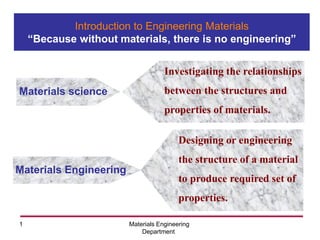
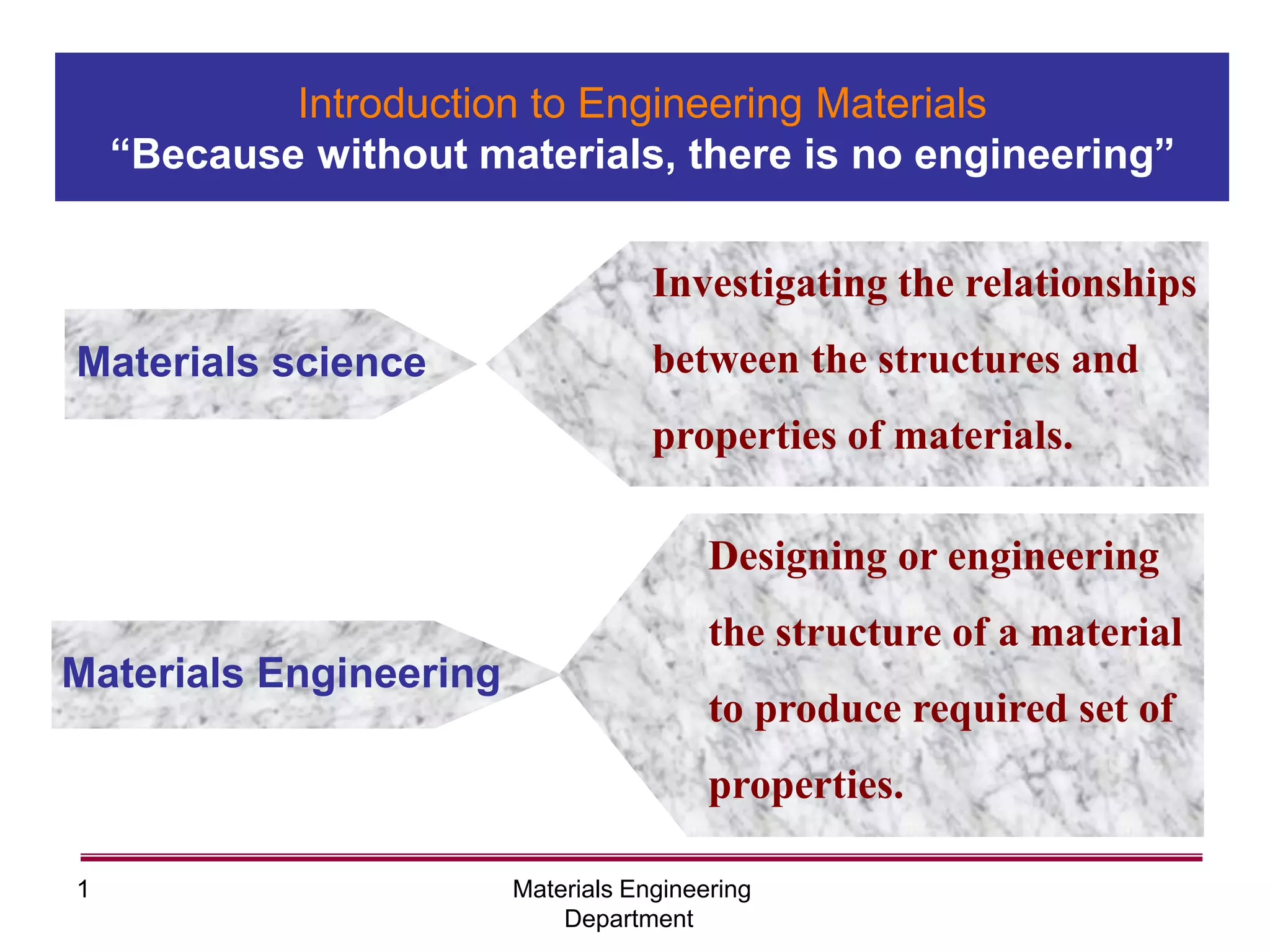
Introduction to Engineering Materials
“Because without materials, there is no engineering”
Investigating the relationships
between the structures and
properties of materials.
Materials science
Designing or engineering
the structure of a material
to produce required set of
properties.
Materials Engineering
Department
2
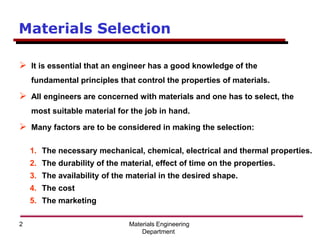
Materials Selection
➢ It is essential that an engineer has a good knowledge of the
fundamental principles that control the properties of materials.
➢ All engineers are concerned with materials and one has to select, the
most suitable material for the job in hand.
➢ Many factors are to be considered in making the selection:
1. The necessary mechanical, chemical, electrical and thermal properties.
2. The durability of the material, effect of time on the properties.
3. The availability of the material in the desired shape.
4. The cost
5. The marketing
Materials Engineering
Department
3
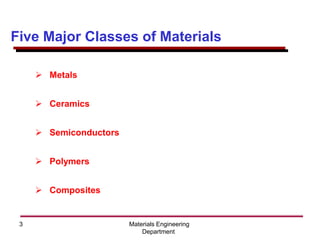
Five Major Classes of Materials
➢ Metals
➢ Ceramics
➢ Semiconductors
➢ Polymers
➢ Composites
Materials Engineering
Department
4
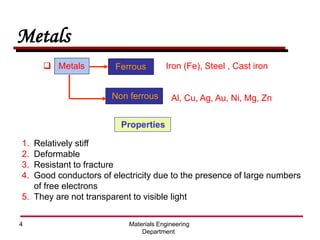
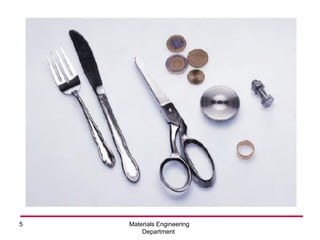
❑ Metals Ferrous
Non ferrous
Iron (Fe), Steel , Cast iron
Al, Cu, Ag, Au, Ni, Mg, Zn
Properties
1. Relatively stiff
2. Deformable
3. Resistant to fracture
4. Good conductors of electricity due to the presence of large numbers
of free electrons
5. They are not transparent to visible light
Metals
Materials Engineering
Department
5
Materials Engineering
Department
6
Ceramics
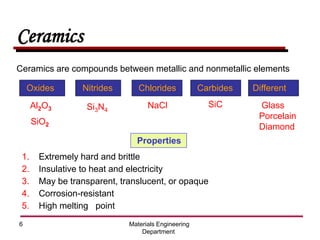
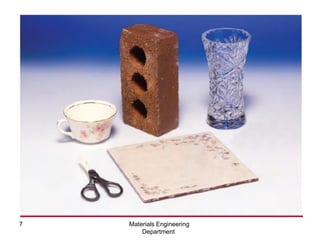
Ceramics are compounds between metallic and nonmetallic elements
Oxides Nitrides Chlorides Carbides Different
Al2O3
SiO2
Si3N4
NaCl SiC Glass
Porcelain
Diamond
Properties
1. Extremely hard and brittle
2. Insulative to heat and electricity
3. May be transparent, translucent, or opaque
4. Corrosion-resistant
5. High melting point
Materials Engineering
Department
7
Materials Engineering
Department
8
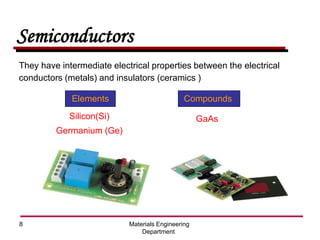
Semiconductors
They have intermediate electrical properties between the electrical
conductors (metals) and insulators (ceramics )
Elements Compounds
Silicon(Si)
Germanium (Ge)
GaAs
Materials Engineering
Department
9
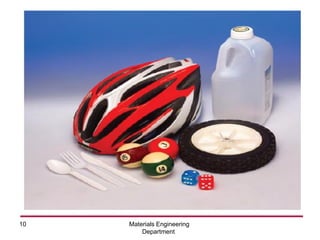
Polymers
Polyethylene Nylon Polystyrene Silicone rubber
Properties
1. Low density
2. High ductility (easily formed into complex shapes)
3. Relatively un-reactive in a large number of environments
4. Low electrical conductivities
5. Nonmagnetic
Materials Engineering
Department
10
Materials Engineering
Department
11
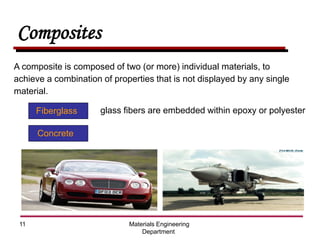
Composites
A composite is composed of two (or more) individual materials, to
achieve a combination of properties that is not displayed by any single
material.
Fiberglass glass fibers are embedded within epoxy or polyester
Concrete
Materials Engineering
Department
12
Atomic Structure
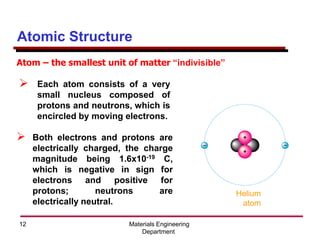
➢ Each atom consists of a very
small nucleus composed of
protons and neutrons, which is
encircled by moving electrons.
➢ Both electrons and protons are
electrically charged, the charge
magnitude being 1.6x10⁻¹⁹ C,
which is negative in sign for
electrons and positive for
protons; neutrons are
electrically neutral.
Atom – the smallest unit of matter “indivisible”
Helium
atom
Materials Engineering
Department
13
Electrons in Atoms
➢ The valence electrons are those that occupy the
outermost shell.
➢ These electrons are extremely important; as will be
seen, they participate in the bonding between atoms to
form atomic and molecular aggregates.
➢ Furthermore, many of the physical and chemical
properties of solids are based on these valence
electrons.
Valence electrons
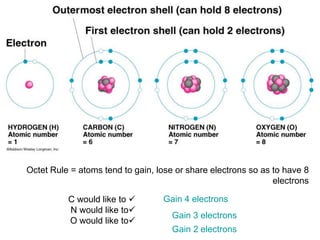
Octet Rule = atoms tend to gain, lose or share electrons so as to have 8
electrons
✓
C would like to
✓
N would like to
✓
O would like to
Gain 4 electrons
Gain 3 electrons
Gain 2 electrons
Chemical bonds
➢ PRIMARY BONDS
1. Ionic bonds –
2. Covalent bonds –
3. Metallic bonds
➢ Secondary bonding or van Der waals
bonding
Materials Engineering
Department
Formation of Ions from Metals &Nonmetal
⚫ Ionic compounds result when metals react with nonmetals
⚫ Metals lose electrons to match the number of valence electrons of
their nearest noble gas
⚫ Positive ions form when the number of electrons are less than the
number of protons
Group 1 metals ⎯→ ion 1+
Group 2 metals ⎯→ ion 2+
• Group 13 metals ⎯→ ion 3+
◼ In ionic compounds, nonmetals in 5, 6, and 7 gain electrons from
metals
◼ Nonmetal add electrons to achieve the octet arrangement
◼ Nonmetal ionic charge: 3-, 2-, or 1-
Materials Engineering
Department
Ionic Bond
Materials Engineering
Department
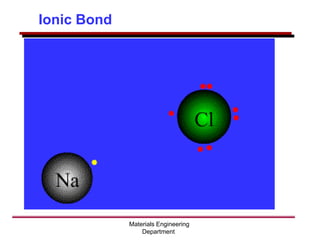
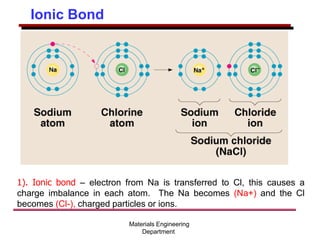
1). Ionic bond – electron from Na is transferred to Cl, this causes a
charge imbalance in each atom. The Na becomes (Na+) and the Cl
becomes (Cl-), charged particles or ions.
Ionic Bond
Materials Engineering
Department
Materials Engineering
Department
20
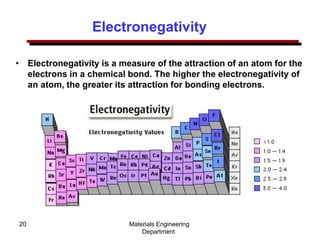
Electronegativity
• Electronegativity is a measure of the attraction of an atom for the
electrons in a chemical bond. The higher the electronegativity of
an atom, the greater its attraction for bonding electrons.
Properties of Ionic Compounds
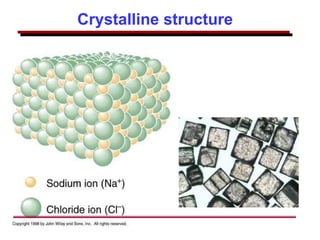
• Crystalline structure.
• A regular repeating arrangement of ions in the solid.
• Ions are strongly bonded.
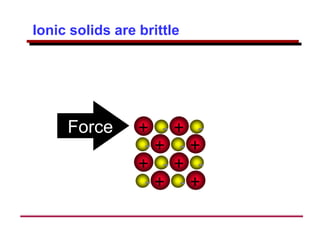
• Structure is rigid & Brittle.
• High melting points- because of strong forces
between ions.
• Insulators
Materials Engineering
Department
Crystalline structure
Ionic solids are brittle
+ - + -
+
- +
-
+ - + -
+
- +
-
Force
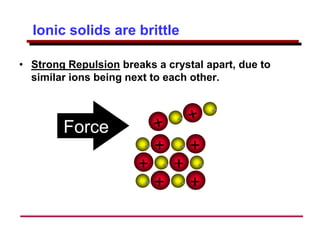
Ionic solids are brittle
+
- +
-
+ - + -
+
- +
-
• Strong Repulsion breaks a crystal apart, due to
similar ions being next to each other.
Force
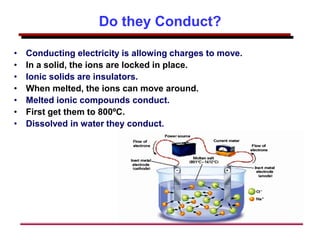
Do they Conduct?
• Conducting electricity is allowing charges to move.
• In a solid, the ions are locked in place.
• Ionic solids are insulators.
• When melted, the ions can move around.
• Melted ionic compounds conduct.
• First get them to 800ºC.
• Dissolved in water they conduct.
Materials Engineering
Department
26
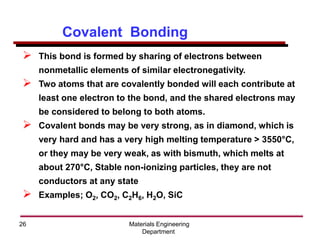
➢ This bond is formed by sharing of electrons between
nonmetallic elements of similar electronegativity.
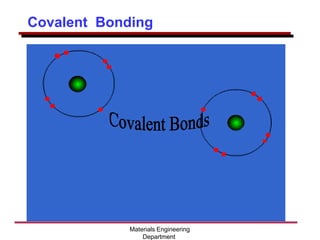
➢ Two atoms that are covalently bonded will each contribute at
least one electron to the bond, and the shared electrons may
be considered to belong to both atoms.
➢ Covalent bonds may be very strong, as in diamond, which is
very hard and has a very high melting temperature > 3550°C,
or they may be very weak, as with bismuth, which melts at
about 270°C, Stable non-ionizing particles, they are not
conductors at any state
➢ Examples; O2, CO2, C2H6, H2O, SiC
Covalent Bonding
Covalent Bonding
Materials Engineering
Department
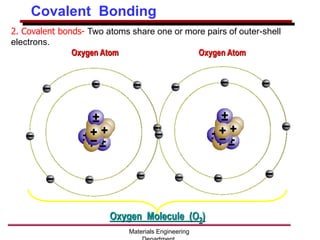
2. Covalent bonds- Two atoms share one or more pairs of outer-shell
electrons.
Oxygen Atom Oxygen Atom
Oxygen Molecule (O2)
Covalent Bonding
Materials Engineering
Polar Bonds
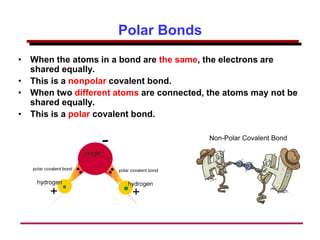
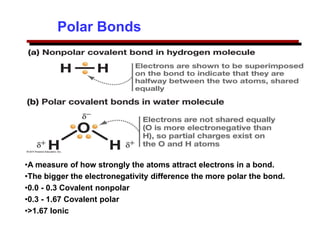
• When the atoms in a bond are the same, the electrons are
shared equally.
• This is a nonpolar covalent bond.
• When two different atoms are connected, the atoms may not be
shared equally.
• This is a polar covalent bond.
Polar Bonds
•A measure of how strongly the atoms attract electrons in a bond.
•The bigger the electronegativity difference the more polar the bond.
•0.0 - 0.3 Covalent nonpolar
•0.3 - 1.67 Covalent polar
•>1.67 Ionic
Materials Engineering
Department
31
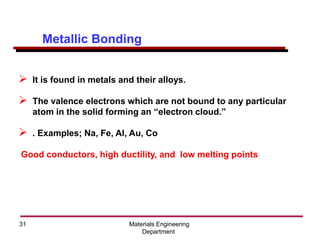
Metallic Bonding
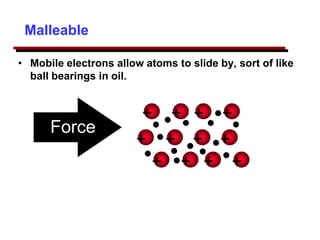
➢ It is found in metals and their alloys.
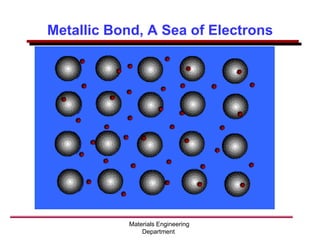
➢ The valence electrons which are not bound to any particular
atom in the solid forming an “electron cloud.”
➢ . Examples; Na, Fe, Al, Au, Co
Good conductors, high ductility, and low melting points
Metallic Bond, A Sea of Electrons
Materials Engineering
Department
Malleable
+ + + +
+ + + +
+ + + +
Force
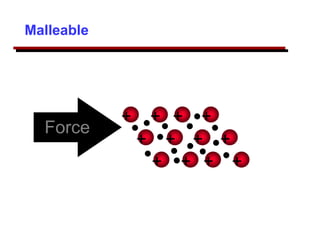
Malleable
+ + + +
+ + + +
+ + + +
• Mobile electrons allow atoms to slide by, sort of like
ball bearings in oil.
Force
Materials Engineering
Department
35
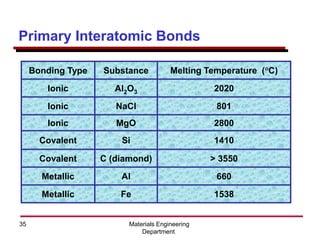
Melting Temperature (°C)
Substance
Bonding Type
2020
Al2O3
Ionic
801
NaCl
Ionic
2800
MgO
Ionic
1410
Si
Covalent
> 3550
C (diamond)
Covalent
660
Al
Metallic
1538
Fe
Metallic
Primary Interatomic Bonds
Materials Engineering
Department
36
Secondary bonding or Van Der Waals bonding
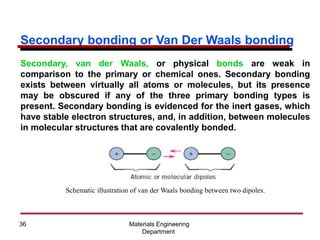
Secondary, van der Waals, or physical bonds are weak in
comparison to the primary or chemical ones. Secondary bonding
exists between virtually all atoms or molecules, but its presence
may be obscured if any of the three primary bonding types is
present. Secondary bonding is evidenced for the inert gases, which
have stable electron structures, and, in addition, between molecules
in molecular structures that are covalently bonded.
Schematic illustration of van der Waals bonding between two dipoles.

1-Introduction to Engineering Materials.pdf

  • 1.
    Materials Engineering Department 1 Introduction toEngineering Materials “Because without materials, there is no engineering” Investigating the relationships between the structures and properties of materials. Materials science Designing or engineering the structure of a material to produce required set of properties. Materials Engineering
  • 2.
    Materials Engineering Department 2 Materials Selection ➢It is essential that an engineer has a good knowledge of the fundamental principles that control the properties of materials. ➢ All engineers are concerned with materials and one has to select, the most suitable material for the job in hand. ➢ Many factors are to be considered in making the selection: 1. The necessary mechanical, chemical, electrical and thermal properties. 2. The durability of the material, effect of time on the properties. 3. The availability of the material in the desired shape. 4. The cost 5. The marketing
  • 3.
    Materials Engineering Department 3 Five MajorClasses of Materials ➢ Metals ➢ Ceramics ➢ Semiconductors ➢ Polymers ➢ Composites
  • 4.
    Materials Engineering Department 4 ❑ MetalsFerrous Non ferrous Iron (Fe), Steel , Cast iron Al, Cu, Ag, Au, Ni, Mg, Zn Properties 1. Relatively stiff 2. Deformable 3. Resistant to fracture 4. Good conductors of electricity due to the presence of large numbers of free electrons 5. They are not transparent to visible light Metals
  • 5.
  • 6.
    Materials Engineering Department 6 Ceramics Ceramics arecompounds between metallic and nonmetallic elements Oxides Nitrides Chlorides Carbides Different Al2O3 SiO2 Si3N4 NaCl SiC Glass Porcelain Diamond Properties 1. Extremely hard and brittle 2. Insulative to heat and electricity 3. May be transparent, translucent, or opaque 4. Corrosion-resistant 5. High melting point
  • 7.
  • 8.
    Materials Engineering Department 8 Semiconductors They haveintermediate electrical properties between the electrical conductors (metals) and insulators (ceramics ) Elements Compounds Silicon(Si) Germanium (Ge) GaAs
  • 9.
    Materials Engineering Department 9 Polymers Polyethylene NylonPolystyrene Silicone rubber Properties 1. Low density 2. High ductility (easily formed into complex shapes) 3. Relatively un-reactive in a large number of environments 4. Low electrical conductivities 5. Nonmagnetic
  • 10.
  • 11.
    Materials Engineering Department 11 Composites A compositeis composed of two (or more) individual materials, to achieve a combination of properties that is not displayed by any single material. Fiberglass glass fibers are embedded within epoxy or polyester Concrete
  • 12.
    Materials Engineering Department 12 Atomic Structure ➢Each atom consists of a very small nucleus composed of protons and neutrons, which is encircled by moving electrons. ➢ Both electrons and protons are electrically charged, the charge magnitude being 1.6x10⁻¹⁹ C, which is negative in sign for electrons and positive for protons; neutrons are electrically neutral. Atom – the smallest unit of matter “indivisible” Helium atom
  • 13.
    Materials Engineering Department 13 Electrons inAtoms ➢ The valence electrons are those that occupy the outermost shell. ➢ These electrons are extremely important; as will be seen, they participate in the bonding between atoms to form atomic and molecular aggregates. ➢ Furthermore, many of the physical and chemical properties of solids are based on these valence electrons. Valence electrons
  • 14.
    Octet Rule =atoms tend to gain, lose or share electrons so as to have 8 electrons ✓ C would like to ✓ N would like to ✓ O would like to Gain 4 electrons Gain 3 electrons Gain 2 electrons
  • 15.
    Chemical bonds ➢ PRIMARYBONDS 1. Ionic bonds – 2. Covalent bonds – 3. Metallic bonds ➢ Secondary bonding or van Der waals bonding Materials Engineering Department
  • 16.
    Formation of Ionsfrom Metals &Nonmetal ⚫ Ionic compounds result when metals react with nonmetals ⚫ Metals lose electrons to match the number of valence electrons of their nearest noble gas ⚫ Positive ions form when the number of electrons are less than the number of protons Group 1 metals ⎯→ ion 1+ Group 2 metals ⎯→ ion 2+ • Group 13 metals ⎯→ ion 3+ ◼ In ionic compounds, nonmetals in 5, 6, and 7 gain electrons from metals ◼ Nonmetal add electrons to achieve the octet arrangement ◼ Nonmetal ionic charge: 3-, 2-, or 1- Materials Engineering Department
  • 17.
  • 18.
    1). Ionic bond– electron from Na is transferred to Cl, this causes a charge imbalance in each atom. The Na becomes (Na+) and the Cl becomes (Cl-), charged particles or ions. Ionic Bond Materials Engineering Department
  • 19.
    Materials Engineering Department 20 Electronegativity • Electronegativityis a measure of the attraction of an atom for the electrons in a chemical bond. The higher the electronegativity of an atom, the greater its attraction for bonding electrons.
  • 20.
    Properties of IonicCompounds • Crystalline structure. • A regular repeating arrangement of ions in the solid. • Ions are strongly bonded. • Structure is rigid & Brittle. • High melting points- because of strong forces between ions. • Insulators Materials Engineering Department
  • 21.
  • 22.
    Ionic solids arebrittle + - + - + - + - + - + - + - + - Force
  • 23.
    Ionic solids arebrittle + - + - + - + - + - + - • Strong Repulsion breaks a crystal apart, due to similar ions being next to each other. Force
  • 24.
    Do they Conduct? •Conducting electricity is allowing charges to move. • In a solid, the ions are locked in place. • Ionic solids are insulators. • When melted, the ions can move around. • Melted ionic compounds conduct. • First get them to 800ºC. • Dissolved in water they conduct.
  • 25.
    Materials Engineering Department 26 ➢ Thisbond is formed by sharing of electrons between nonmetallic elements of similar electronegativity. ➢ Two atoms that are covalently bonded will each contribute at least one electron to the bond, and the shared electrons may be considered to belong to both atoms. ➢ Covalent bonds may be very strong, as in diamond, which is very hard and has a very high melting temperature > 3550°C, or they may be very weak, as with bismuth, which melts at about 270°C, Stable non-ionizing particles, they are not conductors at any state ➢ Examples; O2, CO2, C2H6, H2O, SiC Covalent Bonding
  • 26.
  • 27.
    2. Covalent bonds-Two atoms share one or more pairs of outer-shell electrons. Oxygen Atom Oxygen Atom Oxygen Molecule (O2) Covalent Bonding Materials Engineering
  • 28.
    Polar Bonds • Whenthe atoms in a bond are the same, the electrons are shared equally. • This is a nonpolar covalent bond. • When two different atoms are connected, the atoms may not be shared equally. • This is a polar covalent bond.
  • 29.
    Polar Bonds •A measureof how strongly the atoms attract electrons in a bond. •The bigger the electronegativity difference the more polar the bond. •0.0 - 0.3 Covalent nonpolar •0.3 - 1.67 Covalent polar •>1.67 Ionic
  • 30.
    Materials Engineering Department 31 Metallic Bonding ➢It is found in metals and their alloys. ➢ The valence electrons which are not bound to any particular atom in the solid forming an “electron cloud.” ➢ . Examples; Na, Fe, Al, Au, Co Good conductors, high ductility, and low melting points
  • 31.
    Metallic Bond, ASea of Electrons Materials Engineering Department
  • 32.
    Malleable + + ++ + + + + + + + + Force
  • 33.
    Malleable + + ++ + + + + + + + + • Mobile electrons allow atoms to slide by, sort of like ball bearings in oil. Force
  • 34.
    Materials Engineering Department 35 Melting Temperature(°C) Substance Bonding Type 2020 Al2O3 Ionic 801 NaCl Ionic 2800 MgO Ionic 1410 Si Covalent > 3550 C (diamond) Covalent 660 Al Metallic 1538 Fe Metallic Primary Interatomic Bonds
  • 35.
    Materials Engineering Department 36 Secondary bondingor Van Der Waals bonding Secondary, van der Waals, or physical bonds are weak in comparison to the primary or chemical ones. Secondary bonding exists between virtually all atoms or molecules, but its presence may be obscured if any of the three primary bonding types is present. Secondary bonding is evidenced for the inert gases, which have stable electron structures, and, in addition, between molecules in molecular structures that are covalently bonded. Schematic illustration of van der Waals bonding between two dipoles.