Danyuo Yiporo (PhD inview)
Materials Science
Dept. of EEE, NTNU
08161243421
yiporo@aol.com,
yiporodanyuo@gmail.com
Materials Science
 Home Work must be submitted within or
before the deadline given
 Class participation is highly recommended
 Participation in exercise or group projects
are recommended
 No make-up exams for any student
 Midterm and final exams are only for
students who attended classes
Rules and Regulations for the Course
Teaching Strategies
 The course will be taught via Lectures and
Tutorial Sessions
 The tutorial being designed to complement and
enhance both the lectures and the students
appreciation of the subject.
 Course work assignments will be reviewed with
the students.
Course Assessment
(i) Class Exercise: 5%
(ii) Quizzes: 5 %
(iii) Home Works/Group Project: 5 %
(iv) Attendance: 5 %
(v) One (1) mid-semester test, 1-hour duration counting
for 20% of the total course.
(vi) (ii) One (1) End-of-semester examination, 2 hours
duration counting for 60% of the total course marks.
Course Content
 (i) Atomic and molecular structure, crystals, Metallic states,
Defects in crystals, conductors, semi-conductors and
insulators.
 (ii) Alloy theory – Application to industrial alloys – steel in
particular. phases
 (iii) Engineering Properties – Their control, Hot and cold
working, heat treatment, etc. Creep, fatigue and fracture.
Corrosion and corrosion control.
 (iv) Non-metallic materials – glass, rubber, concrete,
plastics, wood and ceramics.
 (v) Elastic and plastic deformations: Defects in metals.
Books
 Materials Science Books
 Eg.
 Callister: Materials Science and Engineering by William D.
Callister, Jr. Chapter 1-9
 Askeland
 That’s easy! Look around.
 Our clothes are made of materials, our homes
are made of materials - mostly manufactured
 Glass windows, electronics items, electrical
appliances, metal silverware, ceramic dishes…
 Most things are made from many different
kinds of materials
What are Materials?
 Defined as the study of the properties of solid
materials and how those properties are determined by
a material’s composition and structure
 The ability to change the properties and/or behavior of
a material is what makes most materials useful and
this is at the heart of materials science!
Materials Science
Materials Science and Engineering
 Defined as the study of the properties of solid
materials and how those properties are determined
by a material’s composition and structure
 The ability to change the properties and/or behavior
of a material is what makes most materials useful
and this is at the heart of materials science!
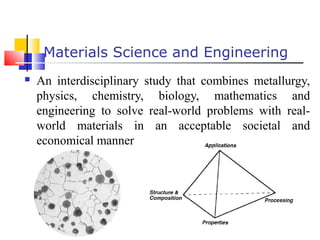
 An interdisciplinary study that combines metallurgy,
physics, chemistry, biology, mathematics and
engineering to solve real-world problems with real-
world materials in an acceptable societal and
economical manner
Materials Science and Engineering
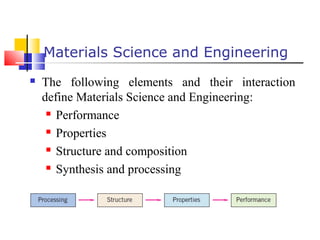
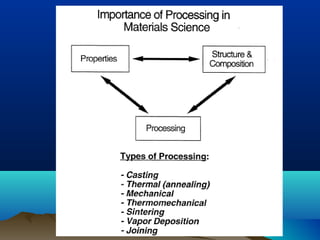
 The following elements and their interaction
define Materials Science and Engineering:
 Performance
 Properties
 Structure and composition
 Synthesis and processing
Materials Science and Engineering
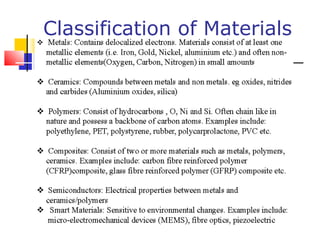
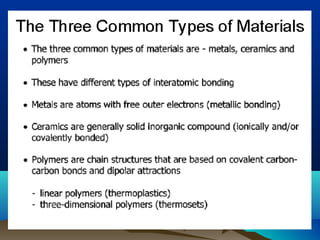
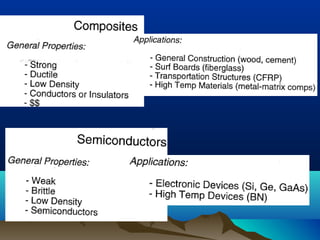
Classification of Materials
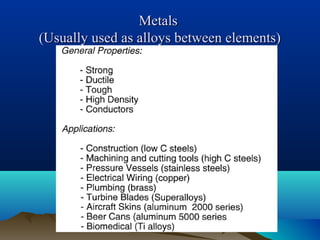
MetalsMetals
(Usually used as alloys between elements)(Usually used as alloys between elements)
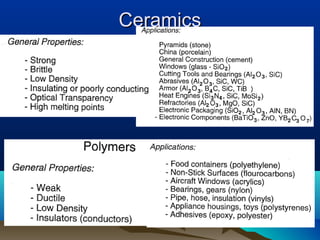
CeramicsCeramics
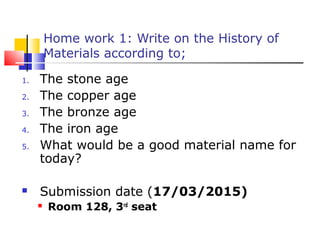
1. The stone age
2. The copper age
3. The bronze age
4. The iron age
5. What would be a good material name for
today?
 Submission date (17/03/2015)
 Room 128, 3rd
seat
Home work 1: Write on the History of
Materials according to;
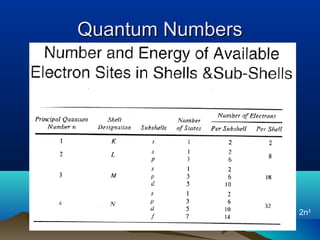
(a) Briefly describe the 4 types of quantum numbers and what
they represent.
(b)State the Pauli exclusion principle and what it means for the
periodic table of elements.
(c) Beryllium is a metallic element with atomic number 4.
Briefly describe the atomic structure of Be, and write out the
electronic configuration of beryllium in terms of its filled states.
(d) What properties should the head of a carpenter’s hammer
possess?
Submission date (20/03/2015)
 Room 128, 3rd
seat
Home Work 2
Atomic and Crystal Structure
A conductor is a material having a low resistance which allows electric
current to flow in it. All metals are conductors and some examples include
copper, aluminium, brass, platinum, silver, gold and carbon. Very little
energy is required to promote electrons into the low-lying empty states.
Generally, the energy provided by an electric field is sufficient to excite
large numbers of electrons into these conducting states.
An insulator is a material having a high resistance which does not allow
electric current to flow in it. Some examples of insulators include plastic,
rubber, glass, porcelain, air, paper, cork, mica, ceramics and certain oils.
The key difference in insulators, conductors and semiconductors lies in the
difference in bandgap energy. Metals have no or an overlap bandgap
whereas insulators has a wider bandgap that doesn’t promote the easy flow
of electrons into the conduction band.
Semiconductors on the other hand have their electrical properties mid-way
between insulators and conductors. They have a narrow bandgap such that
electrons could be excited from the valence band into the conduction band.
Increasing the temperature of either a semiconductor or an insulator results in
an increase in the thermal energy that is available for electron excitation.
Thus, more electrons are promoted into the conduction band, which gives
rise to an enhanced conductivity. Examples of semiconductors are Silicon,
Germanium, Indium Thin Oxide
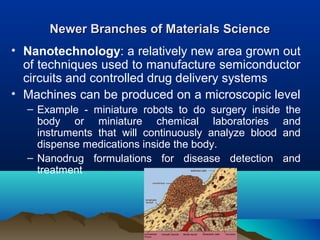
Newer Branches of Materials ScienceNewer Branches of Materials Science
• Nanotechnology: a relatively new area grown out
of techniques used to manufacture semiconductor
circuits and controlled drug delivery systems
• Machines can be produced on a microscopic level
– Example - miniature robots to do surgery inside the
body or miniature chemical laboratories and
instruments that will continuously analyze blood and
dispense medications inside the body.
– Nanodrug formulations for disease detection and
treatment
Materials TestingMaterials Testing
• Materials testing is a much narrower field
than materials science or engineering
• It is a way to determine the strength of
certain materials
• It is mostly used to determine safety. Ex.
concrete samples are tested
• It is not used to design new materials to
be used in new applications
History of MaterialsHistory of Materials
• Man has been studying materials since
before leaving the cave.
• Due to lack of communication, early man
spent hundreds of millennia experimenting
with stone tools.
• The first metal tools appeared perhaps
only six thousand years ago.
History of MaterialsHistory of Materials
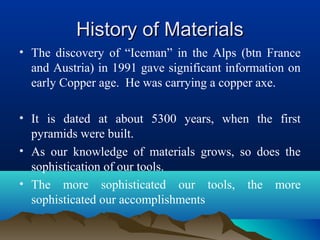
• The discovery of “Iceman” in the Alps (btn France
and Austria) in 1991 gave significant information on
early Copper age. He was carrying a copper axe.
• It is dated at about 5300 years, when the first
pyramids were built.
• As our knowledge of materials grows, so does the
sophistication of our tools.
• The more sophisticated our tools, the more
sophisticated our accomplishments
F.Nimmo EART162 Spring 10
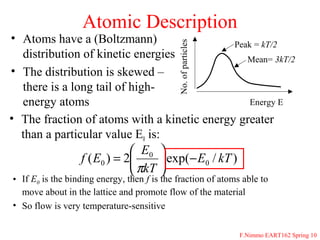
Atomic Description
• Atoms have a (Boltzmann)
distribution of kinetic energies
• The distribution is skewed –
there is a long tail of high-
energy atoms Energy E
No.ofparticles
Peak = kT/2
Mean= 3kT/2
• The fraction of atoms with a kinetic energy greater
than a particular value E0 is:
)/exp(2)( 0
0
0 kTE
kT
E
Ef −





=
π
• If E0 is the binding energy, then f is the fraction of atoms able to
move about in the lattice and promote flow of the material
• So flow is very temperature-sensitive
Quantum NumbersQuantum Numbers
2n3
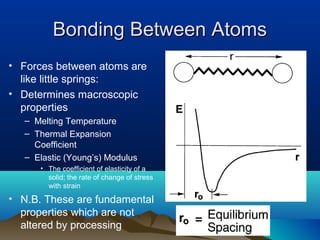
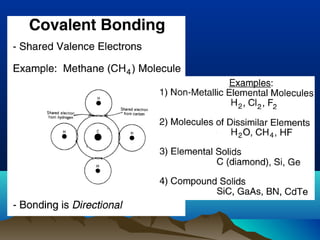
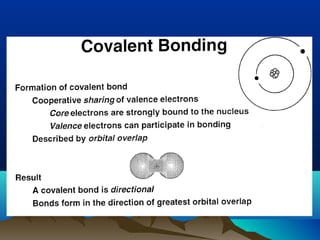
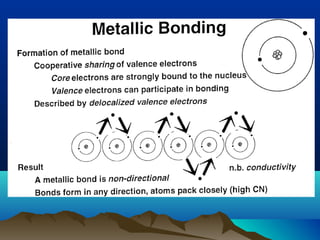
Bonding Between AtomsBonding Between Atoms
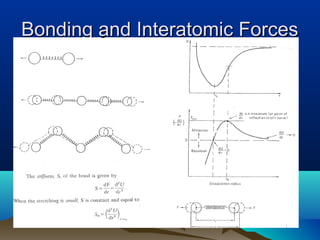
• Forces between atoms are
like little springs:
• Determines macroscopic
properties
– Melting Temperature
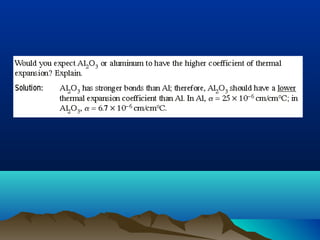
– Thermal Expansion
Coefficient
– Elastic (Young’s) Modulus
• The coefficient of elasticity of a
solid; the rate of change of stress
with strain
• N.B. These are fundamental
properties which are not
altered by processing
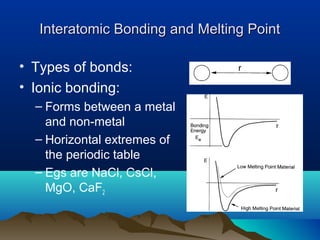
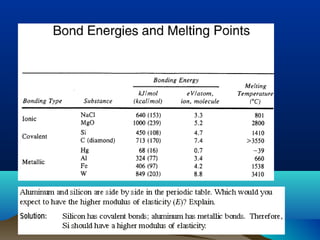
Interatomic Bonding and Melting PointInteratomic Bonding and Melting Point
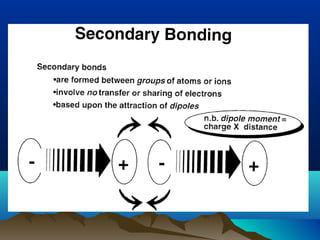
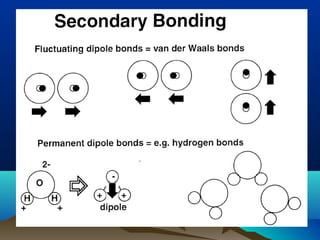
• Types of bonds:
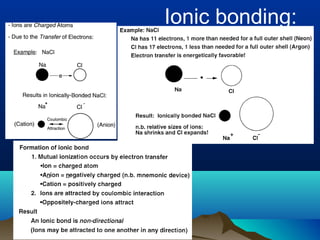
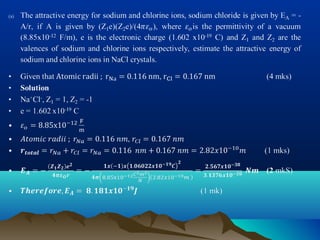
• Ionic bonding:
– Forms between a metal
and non-metal
– Horizontal extremes of
the periodic table
– Egs are NaCl, CsCl,
MgO, CaF2
Ionic bonding:
Bonding and Interatomic ForcesBonding and Interatomic Forces
Mat science_lect 1

Mat science_lect 1

  • 1.
    Danyuo Yiporo (PhDinview) Materials Science Dept. of EEE, NTNU 08161243421 yiporo@aol.com, yiporodanyuo@gmail.com Materials Science
  • 2.
     Home Workmust be submitted within or before the deadline given  Class participation is highly recommended  Participation in exercise or group projects are recommended  No make-up exams for any student  Midterm and final exams are only for students who attended classes Rules and Regulations for the Course
  • 3.
    Teaching Strategies  Thecourse will be taught via Lectures and Tutorial Sessions  The tutorial being designed to complement and enhance both the lectures and the students appreciation of the subject.  Course work assignments will be reviewed with the students.
  • 4.
    Course Assessment (i) ClassExercise: 5% (ii) Quizzes: 5 % (iii) Home Works/Group Project: 5 % (iv) Attendance: 5 % (v) One (1) mid-semester test, 1-hour duration counting for 20% of the total course. (vi) (ii) One (1) End-of-semester examination, 2 hours duration counting for 60% of the total course marks.
  • 5.
    Course Content  (i)Atomic and molecular structure, crystals, Metallic states, Defects in crystals, conductors, semi-conductors and insulators.  (ii) Alloy theory – Application to industrial alloys – steel in particular. phases  (iii) Engineering Properties – Their control, Hot and cold working, heat treatment, etc. Creep, fatigue and fracture. Corrosion and corrosion control.  (iv) Non-metallic materials – glass, rubber, concrete, plastics, wood and ceramics.  (v) Elastic and plastic deformations: Defects in metals.
  • 6.
    Books  Materials ScienceBooks  Eg.  Callister: Materials Science and Engineering by William D. Callister, Jr. Chapter 1-9  Askeland
  • 7.
     That’s easy!Look around.  Our clothes are made of materials, our homes are made of materials - mostly manufactured  Glass windows, electronics items, electrical appliances, metal silverware, ceramic dishes…  Most things are made from many different kinds of materials What are Materials?
  • 8.
     Defined asthe study of the properties of solid materials and how those properties are determined by a material’s composition and structure  The ability to change the properties and/or behavior of a material is what makes most materials useful and this is at the heart of materials science! Materials Science
  • 10.
    Materials Science andEngineering  Defined as the study of the properties of solid materials and how those properties are determined by a material’s composition and structure  The ability to change the properties and/or behavior of a material is what makes most materials useful and this is at the heart of materials science!
  • 11.
     An interdisciplinarystudy that combines metallurgy, physics, chemistry, biology, mathematics and engineering to solve real-world problems with real- world materials in an acceptable societal and economical manner Materials Science and Engineering
  • 12.
     The followingelements and their interaction define Materials Science and Engineering:  Performance  Properties  Structure and composition  Synthesis and processing Materials Science and Engineering
  • 13.
  • 16.
    MetalsMetals (Usually used asalloys between elements)(Usually used as alloys between elements)
  • 17.
  • 21.
    1. The stoneage 2. The copper age 3. The bronze age 4. The iron age 5. What would be a good material name for today?  Submission date (17/03/2015)  Room 128, 3rd seat Home work 1: Write on the History of Materials according to;
  • 22.
    (a) Briefly describethe 4 types of quantum numbers and what they represent. (b)State the Pauli exclusion principle and what it means for the periodic table of elements. (c) Beryllium is a metallic element with atomic number 4. Briefly describe the atomic structure of Be, and write out the electronic configuration of beryllium in terms of its filled states. (d) What properties should the head of a carpenter’s hammer possess? Submission date (20/03/2015)  Room 128, 3rd seat Home Work 2 Atomic and Crystal Structure
  • 23.
    A conductor isa material having a low resistance which allows electric current to flow in it. All metals are conductors and some examples include copper, aluminium, brass, platinum, silver, gold and carbon. Very little energy is required to promote electrons into the low-lying empty states. Generally, the energy provided by an electric field is sufficient to excite large numbers of electrons into these conducting states. An insulator is a material having a high resistance which does not allow electric current to flow in it. Some examples of insulators include plastic, rubber, glass, porcelain, air, paper, cork, mica, ceramics and certain oils. The key difference in insulators, conductors and semiconductors lies in the difference in bandgap energy. Metals have no or an overlap bandgap whereas insulators has a wider bandgap that doesn’t promote the easy flow of electrons into the conduction band. Semiconductors on the other hand have their electrical properties mid-way between insulators and conductors. They have a narrow bandgap such that electrons could be excited from the valence band into the conduction band. Increasing the temperature of either a semiconductor or an insulator results in an increase in the thermal energy that is available for electron excitation. Thus, more electrons are promoted into the conduction band, which gives rise to an enhanced conductivity. Examples of semiconductors are Silicon, Germanium, Indium Thin Oxide
  • 24.
    Newer Branches ofMaterials ScienceNewer Branches of Materials Science • Nanotechnology: a relatively new area grown out of techniques used to manufacture semiconductor circuits and controlled drug delivery systems • Machines can be produced on a microscopic level – Example - miniature robots to do surgery inside the body or miniature chemical laboratories and instruments that will continuously analyze blood and dispense medications inside the body. – Nanodrug formulations for disease detection and treatment
  • 25.
    Materials TestingMaterials Testing •Materials testing is a much narrower field than materials science or engineering • It is a way to determine the strength of certain materials • It is mostly used to determine safety. Ex. concrete samples are tested • It is not used to design new materials to be used in new applications
  • 27.
    History of MaterialsHistoryof Materials • Man has been studying materials since before leaving the cave. • Due to lack of communication, early man spent hundreds of millennia experimenting with stone tools. • The first metal tools appeared perhaps only six thousand years ago.
  • 28.
    History of MaterialsHistoryof Materials • The discovery of “Iceman” in the Alps (btn France and Austria) in 1991 gave significant information on early Copper age. He was carrying a copper axe. • It is dated at about 5300 years, when the first pyramids were built. • As our knowledge of materials grows, so does the sophistication of our tools. • The more sophisticated our tools, the more sophisticated our accomplishments
  • 29.
    F.Nimmo EART162 Spring10 Atomic Description • Atoms have a (Boltzmann) distribution of kinetic energies • The distribution is skewed – there is a long tail of high- energy atoms Energy E No.ofparticles Peak = kT/2 Mean= 3kT/2 • The fraction of atoms with a kinetic energy greater than a particular value E0 is: )/exp(2)( 0 0 0 kTE kT E Ef −      = π • If E0 is the binding energy, then f is the fraction of atoms able to move about in the lattice and promote flow of the material • So flow is very temperature-sensitive
  • 30.
  • 31.
    Bonding Between AtomsBondingBetween Atoms • Forces between atoms are like little springs: • Determines macroscopic properties – Melting Temperature – Thermal Expansion Coefficient – Elastic (Young’s) Modulus • The coefficient of elasticity of a solid; the rate of change of stress with strain • N.B. These are fundamental properties which are not altered by processing
  • 33.
    Interatomic Bonding andMelting PointInteratomic Bonding and Melting Point • Types of bonds: • Ionic bonding: – Forms between a metal and non-metal – Horizontal extremes of the periodic table – Egs are NaCl, CsCl, MgO, CaF2
  • 34.
  • 41.
    Bonding and InteratomicForcesBonding and Interatomic Forces