Research and Information Literacy
Lesson Outline
Describe strategy for academic research.
Recognize the difference between primary and secondary research.
Understand what is meant by a literature search.
Understand approaches to online search for information.
Understand concepts in evaluating evidence.
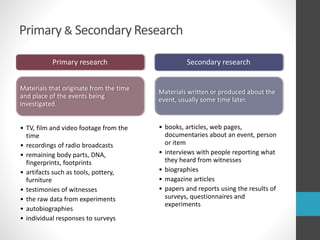
Primary & SecondaryResearch
Primary research
Materials that originate from the time
and place of the events being
investigated.
• TV, film and video footage from the
time
• recordings of radio broadcasts
• remaining body parts, DNA,
fingerprints, footprints
• artifacts such as tools, pottery,
furniture
• testimonies of witnesses
• the raw data from experiments
• autobiographies
• individual responses to surveys
Secondary research
Materials written or produced about the
event, usually some time later.
• books, articles, web pages,
documentaries about an event, person
or item
• interviews with people reporting what
they heard from witnesses
• biographies
• magazine articles
• papers and reports using the results of
surveys, questionnaires and
experiments
What is a reliable
source?
1. Authoritative
2. Accurate
3. Objective
4. Current
5. Comprehensive
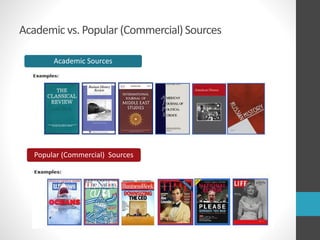
Academic vs. Popular (Commercial)Sources
Academic Sources
Popular (Commercial) Sources
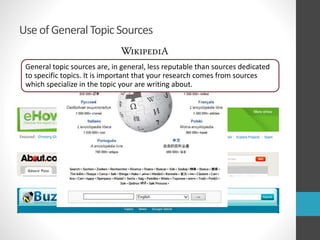
Use of GeneralTopic Sources
General topic sources are, in general, less reputable than sources dedicated
to specific topics. It is important that your research comes from sources
which specialize in the topic your are writing about.
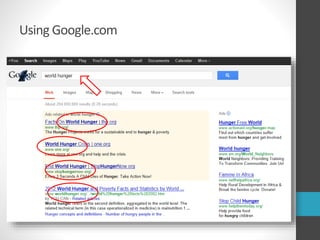
Using Google
Using google.com will provide more popular or commercial results.
Using Google.com
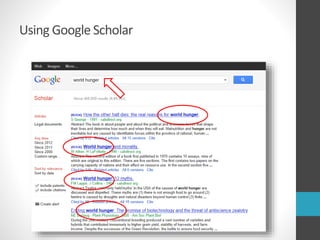
Using Google Scholar
Using scholar.google.com will provide more academic and scientific results.
Using Google Scholar
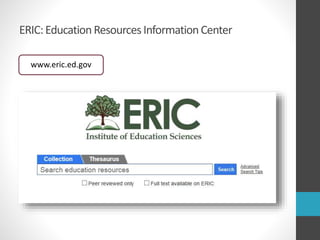
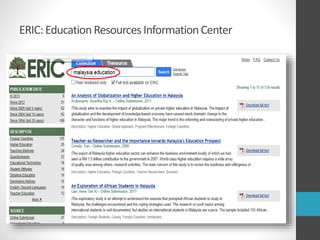
ERIC:EducationResourcesInformationCenter
www.eric.ed.gov
ERIC:EducationResourcesInformationCenter
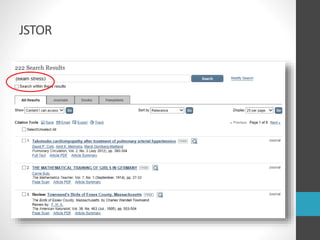
JSTOR
www.jstor.org
JSTOR
Journal abstract: example
An abstract of a journal article summarizes
• the main argument.
• research methods.
• findings and conclusions.
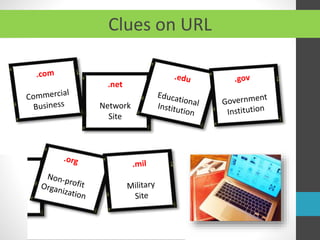
.net
Network
Site
Clues on URL
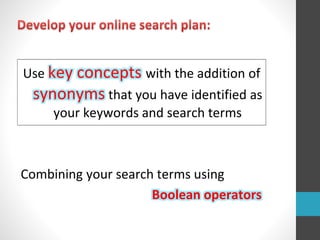
Use key concepts with the addition of
synonyms that you have identified as
your keywords and search terms
Combining your search terms using
Boolean operators
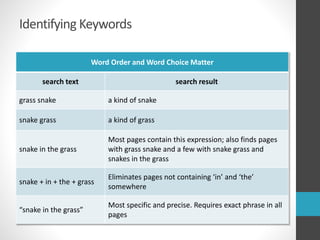
Identifying Keywords
Word Order and Word Choice Matter
search text search result
grass snake a kind of snake
snake grass a kind of grass
snake in the grass
Most pages contain this expression; also finds pages
with grass snake and a few with snake grass and
snakes in the grass
snake + in + the + grass
Eliminates pages not containing ‘in’ and ‘the’
somewhere
“snake in the grass”
Most specific and precise. Requires exact phrase in all
pages
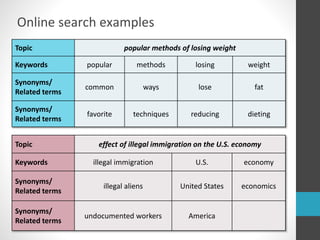
Online search examples
Topic popular methods of losing weight
Keywords popular methods losing weight
Synonyms/
Related terms
common ways lose fat
Synonyms/
Related terms
favorite techniques reducing dieting
Topic effect of illegal immigration on the U.S. economy
Keywords illegal immigration U.S. economy
Synonyms/
Related terms
illegal aliens United States economics
Synonyms/
Related terms
undocumented workers America
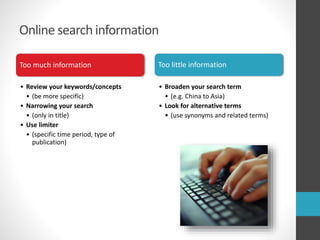
Online search information
Too much information
• Review your keywords/concepts
• (be more specific)
• Narrowing your search
• (only in title)
• Use limiter
• (specific time period, type of
publication)
Too little information
• Broaden your search term
• (e.g. China to Asia)
• Look for alternative terms
• (use synonyms and related terms)
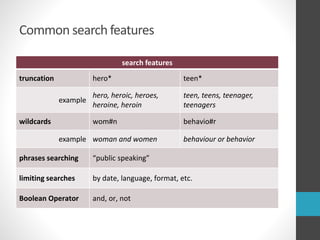
Common search features
search features
truncation hero* teen*
example
hero, heroic, heroes,
heroine, heroin
teen, teens, teenager,
teenagers
wildcards wom#n behavio#r
example woman and women behaviour or behavior
phrases searching “public speaking”
limiting searches by date, language, format, etc.
Boolean Operator and, or, not
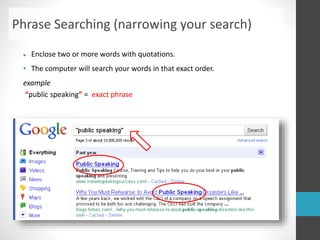
 Enclose two or more words with quotations.
• The computer will search your words in that exact order.
example
“public speaking” = exact phrase
Phrase Searching (narrowing your search)
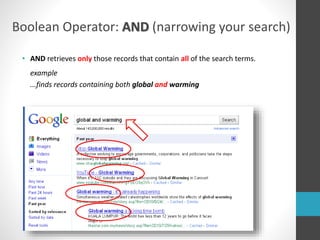
• AND retrieves only those records that contain all of the search terms.
example
...finds records containing both global and warming
Boolean Operator: AND (narrowing your search)
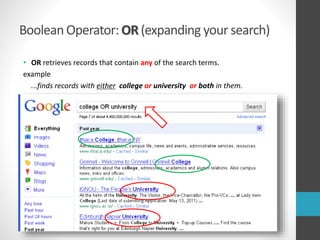
Boolean Operator: OR (expanding your search)
• OR retrieves records that contain any of the search terms.
example
...finds records with either college or university or both in them.
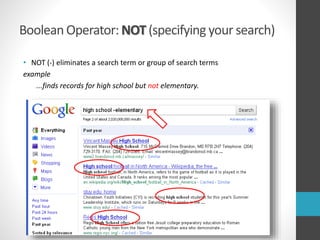
Boolean Operator: NOT (specifying your search)
• NOT (-) eliminates a search term or group of search terms
example
...finds records for high school but not elementary.
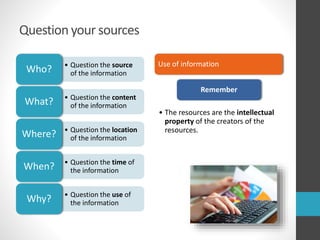
Question your sources
• Question the source
of the informationWho?
• Question the content
of the informationWhat?
• Question the location
of the informationWhere?
• Question the time of
the informationWhen?
• Question the use of
the informationWhy?
Use of information
Remember
• The resources are the intellectual
property of the creators of the
resources.
Practice
Evaluate if the following sources are reliable.
1. Dreambox.com article http://www.dreambox.com/blog/the-
effects-of-student-laptops-in-the-classroom
2. Just a game after all: Violent video game exposure and time
spent playing effects on hostile feelings, depression, and
visuospatial cognition. Computers in Human Behavior, 28, 608–
616. http://christopherjferguson.com/Just%20a%20Game.pdf
3. Yahoo Answers! Article
https://answers.yahoo.com/question/index?qid=200909131656
41AAjhe5V
4. Trump 'willing to work with Russia and China‘
http://www.bbc.com/news/world-us-canada-38621025
5. Why the Thai Education System is Running so Poorly. The
Main Problems & Possible Solutions 2016
http://jaiguytravels.com/2016/02/06/why-the-thai-education-
system-is-running-so-poorly-the-main-problems-and-possible-
solutions-2016/
6. Issues and trends in language testing and assessment in
Thailand
http://journals.sagepub.com/doi/pdf/10.1177/026553220708
3748

Week 9 research info literacy

  • 1.
  • 2.
    Lesson Outline Describe strategyfor academic research. Recognize the difference between primary and secondary research. Understand what is meant by a literature search. Understand approaches to online search for information. Understand concepts in evaluating evidence.
  • 3.
    Primary & SecondaryResearch Primaryresearch Materials that originate from the time and place of the events being investigated. • TV, film and video footage from the time • recordings of radio broadcasts • remaining body parts, DNA, fingerprints, footprints • artifacts such as tools, pottery, furniture • testimonies of witnesses • the raw data from experiments • autobiographies • individual responses to surveys Secondary research Materials written or produced about the event, usually some time later. • books, articles, web pages, documentaries about an event, person or item • interviews with people reporting what they heard from witnesses • biographies • magazine articles • papers and reports using the results of surveys, questionnaires and experiments
  • 4.
    What is areliable source? 1. Authoritative 2. Accurate 3. Objective 4. Current 5. Comprehensive
  • 5.
    Academic vs. Popular(Commercial)Sources Academic Sources Popular (Commercial) Sources
  • 6.
    Use of GeneralTopicSources General topic sources are, in general, less reputable than sources dedicated to specific topics. It is important that your research comes from sources which specialize in the topic your are writing about.
  • 7.
    Using Google Using google.comwill provide more popular or commercial results.
  • 8.
  • 9.
    Using Google Scholar Usingscholar.google.com will provide more academic and scientific results.
  • 10.
  • 11.
  • 12.
  • 13.
  • 14.
  • 15.
    Journal abstract: example Anabstract of a journal article summarizes • the main argument. • research methods. • findings and conclusions.
  • 16.
  • 17.
    Use key conceptswith the addition of synonyms that you have identified as your keywords and search terms Combining your search terms using Boolean operators
  • 18.
    Identifying Keywords Word Orderand Word Choice Matter search text search result grass snake a kind of snake snake grass a kind of grass snake in the grass Most pages contain this expression; also finds pages with grass snake and a few with snake grass and snakes in the grass snake + in + the + grass Eliminates pages not containing ‘in’ and ‘the’ somewhere “snake in the grass” Most specific and precise. Requires exact phrase in all pages
  • 19.
    Online search examples Topicpopular methods of losing weight Keywords popular methods losing weight Synonyms/ Related terms common ways lose fat Synonyms/ Related terms favorite techniques reducing dieting Topic effect of illegal immigration on the U.S. economy Keywords illegal immigration U.S. economy Synonyms/ Related terms illegal aliens United States economics Synonyms/ Related terms undocumented workers America
  • 20.
    Online search information Toomuch information • Review your keywords/concepts • (be more specific) • Narrowing your search • (only in title) • Use limiter • (specific time period, type of publication) Too little information • Broaden your search term • (e.g. China to Asia) • Look for alternative terms • (use synonyms and related terms)
  • 21.
    Common search features searchfeatures truncation hero* teen* example hero, heroic, heroes, heroine, heroin teen, teens, teenager, teenagers wildcards wom#n behavio#r example woman and women behaviour or behavior phrases searching “public speaking” limiting searches by date, language, format, etc. Boolean Operator and, or, not
  • 22.
     Enclose twoor more words with quotations. • The computer will search your words in that exact order. example “public speaking” = exact phrase Phrase Searching (narrowing your search)
  • 23.
    • AND retrievesonly those records that contain all of the search terms. example ...finds records containing both global and warming Boolean Operator: AND (narrowing your search)
  • 24.
    Boolean Operator: OR(expanding your search) • OR retrieves records that contain any of the search terms. example ...finds records with either college or university or both in them.
  • 25.
    Boolean Operator: NOT(specifying your search) • NOT (-) eliminates a search term or group of search terms example ...finds records for high school but not elementary.
  • 26.
    Question your sources •Question the source of the informationWho? • Question the content of the informationWhat? • Question the location of the informationWhere? • Question the time of the informationWhen? • Question the use of the informationWhy? Use of information Remember • The resources are the intellectual property of the creators of the resources.
  • 27.
    Practice Evaluate if thefollowing sources are reliable. 1. Dreambox.com article http://www.dreambox.com/blog/the- effects-of-student-laptops-in-the-classroom 2. Just a game after all: Violent video game exposure and time spent playing effects on hostile feelings, depression, and visuospatial cognition. Computers in Human Behavior, 28, 608– 616. http://christopherjferguson.com/Just%20a%20Game.pdf 3. Yahoo Answers! Article https://answers.yahoo.com/question/index?qid=200909131656 41AAjhe5V
  • 28.
    4. Trump 'willingto work with Russia and China‘ http://www.bbc.com/news/world-us-canada-38621025 5. Why the Thai Education System is Running so Poorly. The Main Problems & Possible Solutions 2016 http://jaiguytravels.com/2016/02/06/why-the-thai-education- system-is-running-so-poorly-the-main-problems-and-possible- solutions-2016/ 6. Issues and trends in language testing and assessment in Thailand http://journals.sagepub.com/doi/pdf/10.1177/026553220708 3748