Internet as a
Knowledge Repository
• A Knowledge repository is something which captures,
packs & stores relevant knowledge.
• In other words, it means a place to store knowledge and
retrieve knowledge. Hence internet is truly a knowledge
repository.
• Intranets & Internets offer new ways to manage &
communicate data, information & Knowledge.
• Knowledge repository formation involves
1. Identifing knowledge resources
2. Capturing identified knowledge
3. Organizing captured knowledge.
4. Transferring the captured knowledge.
Internet as a Knowledge Repository
• In this internet world, we can search any kind of
information.
• Typing of a keyword in the search engine provides a
lot of information about it.
• Internet is recognized as a rich source of information.
• Development of ICT has yielded an unlimited variety
of databases & multimedia platform.
• It supply multifarious needs including knowledge,
edutainment, entertainment, leisure activities,
consumer facilities, interpersonal interaction, etc.
Internet as a Knowledge Repository
• With development of ICT, there is an ever-increasing no.
of New users who yearly join & many millions who are
already familiar with on line www activity.
• Many of the online users are students who utilize the www
as a portal to the world of knowledge both formal &
informal.
• The educational system understands unlimited learning
possibilities presented by ICT and integrates the use of
ICT in learning in general & in online learning in particular.
Internet as a Knowledge Repository
Academic Search
Techniques
Search Engine
A search engine is a tool or a program
designed to search for information on the
www on the basis of specified keywords and
returns a list of the documents where the
keywords were found.
The search results are usually presented
in a list and are commonly called hits.
The information may consist of
WebPages, images, information and other
types of files.
Quotation Marks and Truncation
In library catalogs and article
databases, the two most helpful
advanced search techniques are:
1) Quotation Marks
2)Truncation or Wild Card
Quotation Marks
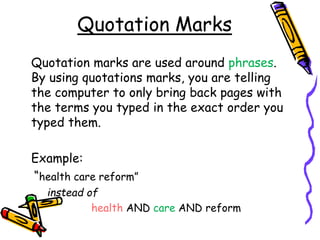
Quotation marks are used around phrases.
By using quotations marks, you are telling
the computer to only bring back pages with
the terms you typed in the exact order you
typed them.
Example:
“health care reform”
instead of
health AND care AND reform
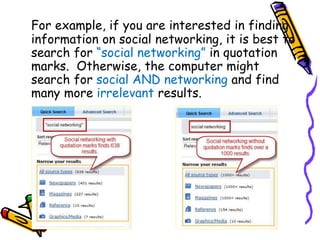
For example, if you are interested in finding
information on social networking, it is best to
search for “social networking” in quotation
marks. Otherwise, the computer might
search for social AND networking and find
many more irrelevant results.
Truncation
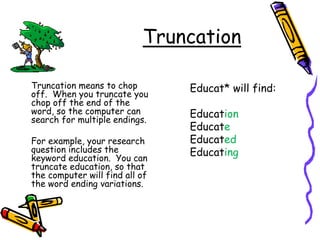
Truncation means to chop
off. When you truncate you
chop off the end of the
word, so the computer can
search for multiple endings.
For example, your research
question includes the
keyword education. You can
truncate education, so that
the computer will find all of
the word ending variations.
Educat* will find:
Education
Educate
Educated
Educating
Be careful where you place the truncation
symbol. Educate* will not find education or
educating, although it will find educate and
educated.
Truncation will not find synonyms (i.e. scien*
will not find the words botany, biology, or
astronomy), although it may bring up articles
on those topics IF they include the words
science, scientific, or scientist.
Tara Guthrie, 2010
BOOLEAN
SEARCHING
How it can help you do effective
database and Internet searching
What is Boolean searching?
• It is based on a method of logic
developed by George Boole, a 19th
century English mathematician.
• Most online databases and Internet
search engines support Boolean
searches.
• It allows you to do effective
searches by cutting out many
unrelated documents.
Basic Boolean Operators:
• AND
• OR
• NOT
AND
• Using AND narrows your search.
• It retrieves documents that contain
both of the search terms or
keywords that you specify.
• The more terms you connect with
AND, the fewer search results you
will find.
Example Using AND:
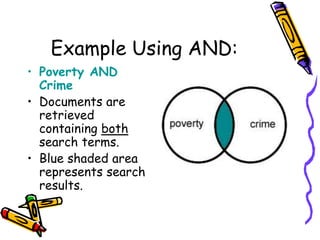
• Poverty AND
Crime
• Documents are
retrieved
containing both
search terms.
• Blue shaded area
represents search
results.
OR
• Using OR broadens your search.
• It retrieves documents that contain
either of the search terms or
keywords that you specify, but not
necessarily both.
• The more terms you connect with OR,
the more search results you will find.
(Remember: OR gives you more!)
• Use it to search for similar terms.
Tara Guthrie, 2010
Example Using OR:
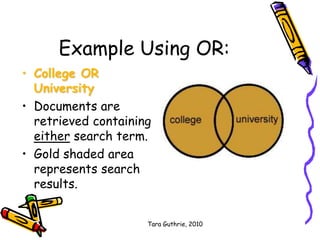
• College OR
University
• Documents are
retrieved containing
either search term.
• Gold shaded area
represents search
results.
NOT
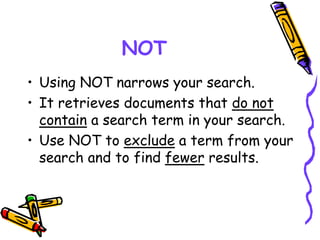
• Using NOT narrows your search.
• It retrieves documents that do not
contain a search term in your search.
• Use NOT to exclude a term from your
search and to find fewer results.
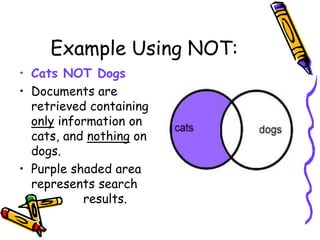
Example Using NOT:
• Cats NOT Dogs
• Documents are
retrieved containing
only information on
cats, and nothing on
dogs.
• Purple shaded area
represents search
results.
Tara Guthrie, 2010
Advanced Boolean
Search Techniques
• “Quotation
Marks”
• (Parentheses)
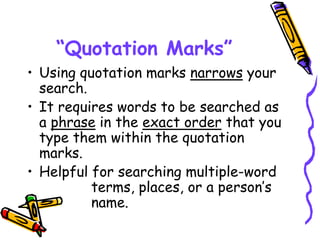
“Quotation Marks”
• Using quotation marks narrows your
search.
• It requires words to be searched as
a phrase in the exact order that you
type them within the quotation
marks.
• Helpful for searching multiple-word
terms, places, or a person’s
name.
Examples Using “ ”
• “global warming”
• “New York City”
• “Sachin Tendulkar”
• Note: Using “quotation marks” will
give you different search results
than if you use the AND operator
between each word without quotes.
(Parentheses)
• (Parentheses) allow you to combine
any of the Boolean operators
together in combination.
• Use NOT and OR together to limit
your search.
• Use AND and OR together to expand
your search.
• Using ( ) allows you to combine two
possible searches into one,
and it saves you time.
Example using ( )
• “alternative energy” NOT (wind OR
solar)
• Using this search string would allow
you to find documents about
alternative energy, but not wind or
solar methods – it would only give you
other methods.
• Your search is narrowed by using NOT,
and you exclude more by using OR.
• How could this be divided into 2 searches?
How do I know which
Boolean Operators to use?
• AND
• OR
• NOT
• “ ”
• ( )
Sample Question #1
• I want to find information about
cloning humans.
• You may want to try a couple of search
strings for more varied results.
• Possible searches:
– cloning AND human
– “human cloning”
Sample Question #2
• I want to find information about
either Abishek Bachan or his wife,
Aiswarya Rai.
• Suggested search:
– “Abishek Bachan” OR “Aiswarya Rai”
Tara Guthrie, 2010
Sample Question #3
• I want to find information about
mummies, but not mummies in
Egypt.
• Suggested search:
– mummies NOT Egypt
Sample Question #4
• I want to find information about
behavior in cats.
• Consider: is there more than one
term used for a cat?
• Possible search:
– behavior AND (cats OR felines)
Sample Question #5
• I want information on designing web
sites, but not on specific web design
software programs.
• Consider: which software programs help
you create web sites?
• Possible searches:
– “web site design” NOT (Dreamweaver OR
“Front Page”)
– “web site design” NOT software
Tara Guthrie, 2010
Boolean Search Tips
• If you find too many search results,
you may need to narrow your search.
Revise your search by adding
additional terms using AND, or
excluding a term using NOT.
• If you do not find enough search
results, you may need to expand your
search. Try using synonyms for your
search term using OR.
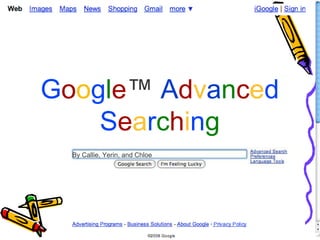
Google™ Advanced
Searching
By Callie, Yerin, and Chloe
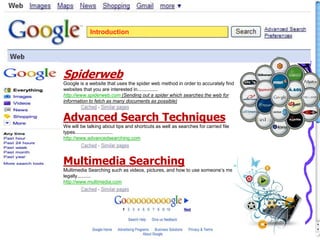
Introduction
Spiderweb
Google is a website that uses the spider web method in order to accurately find
websites that you are interested in...............
http://www.spiderweb.com (Sending out a spider which searches the web for
information to fetch as many documents as possible)
Advanced Search Techniques
We will be talking about tips and shortcuts as well as searches for carried file
types............................
http://www.advancedsearching.com
Multimedia Searching
Multimedia Searching such as videos, pictures, and how to use someone’s media
legally..........
http://www.multimedia.com
How Google Works
QuickTime™ and a
decompressor
are needed to see this picture.
Basic Searching
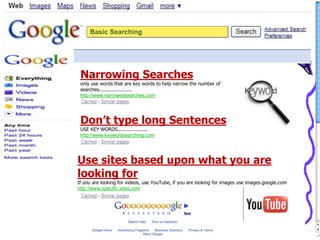
Narrowing Searches
only use words that are key words to help narrow the number of
searches......................
http://www.narrowedsearches.com
Don’t type long Sentences
USE KEY WORDS....................
http://www.keywordsearching.com
Use sites based upon what you are
looking for
If you are looking for videos, use YouTube, if you are looking for images use images.google.com
http://www.specific sites.com
Advanced Searching Techniques (tips and Shortcuts)
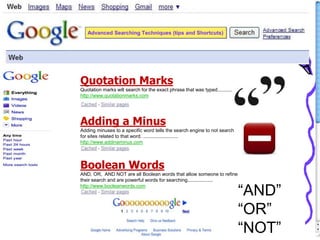
Quotation Marks
Quotation marks will search for the exact phrase that was typed..............
http://www.quotationmarks.com
Adding a Minus
Adding minuses to a specific word tells the search engine to not search
for sites related to that word. ..........................
http://www.addinaminus.com
Boolean Words
AND, OR, AND NOT are all Boolean words that allow someone to refine
their search and are powerful words for searching...................
http://www.booleanwords.com
“AND”
“OR”
“NOT”
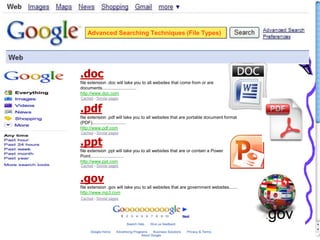
Advanced Searching Techniques (File Types)
.doc
file extension .doc will take you to all websites that come from or are
documents............................
http://www.doc.com
.pdf
file extension .pdf will take you to all websites that are portable document format
(PDF)...........................
http://www.pdf.com
.ppt
file extension .ppt will take you to all websites that are or contain a Power
Point...........................
http://www.ppt.com
.gov
file extension .gov will take you to all websites that are government websites.......
http://www.mp3.com
.gov
Advanced Searching File Types
QuickTime™ and a
decompressor
are needed to see this picture.
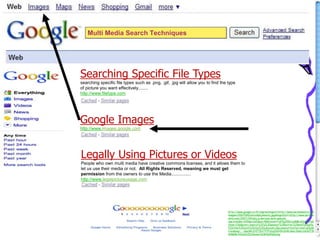
Multi Media Search Techniques
Searching Specific File Types
searching specific file types such as .png, .gif, .jpg will allow you to find the type
of picture you want effectively........
http://www.filetype.com
Google Images
http://www.images.google.com
Legally Using Pictures or Videos
People who own multi media have creative commons licenses, and it allows them to
let us use their media or not. All Rights Reserved, meaning we must get
permission from the owners to use the Media................
http://www.legalpictureusage.com
http://www.google.co.th/imgres?imgurl=http://www.seriouseats.com/
images/20070401istockpbjbeauty.jpg&imgrefurl=http://www.serious
eats.com/2007/04/pbj-a-serious-eats-special-
rep.html&h=345&w=620&sz=48&tbnid=PtdFEg55KUxd8M:&tbnh=76&
tbnw=136&prev=/search%3Fq%3Dpeanut%2Bbutter%2Band%2Bjelly
%26tbm%3Disch%26tbo%3Du&zoom=1&q=peanut+butter+and+jelly&h
l=en&usg=__SwsWL2YZTEHTf7Fs1uZG1h5xSH8=&sa=X&ei=HaS0T9r
nPMK8rAfwnICZDA&ved=0CB4Q9QEwAg
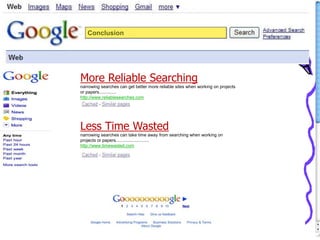
More Reliable Searching
narrowing searches can get better more reliable sites when working on projects
or papers..............
http://www.reliablesearches.com
Less Time Wasted
narrowing searches can take time away from searching when working on
projects or papers...........................
http://www.timewasted.com
Conclusion
Thanks For
Watching Presentation
about Searching
Techniques!
Happy Searching!

Knoweldge-Repository-Academic-Searching-Techniques.ppt

  • 1.
  • 2.
    • A Knowledgerepository is something which captures, packs & stores relevant knowledge. • In other words, it means a place to store knowledge and retrieve knowledge. Hence internet is truly a knowledge repository. • Intranets & Internets offer new ways to manage & communicate data, information & Knowledge. • Knowledge repository formation involves 1. Identifing knowledge resources 2. Capturing identified knowledge 3. Organizing captured knowledge. 4. Transferring the captured knowledge. Internet as a Knowledge Repository
  • 3.
    • In thisinternet world, we can search any kind of information. • Typing of a keyword in the search engine provides a lot of information about it. • Internet is recognized as a rich source of information. • Development of ICT has yielded an unlimited variety of databases & multimedia platform. • It supply multifarious needs including knowledge, edutainment, entertainment, leisure activities, consumer facilities, interpersonal interaction, etc. Internet as a Knowledge Repository
  • 4.
    • With developmentof ICT, there is an ever-increasing no. of New users who yearly join & many millions who are already familiar with on line www activity. • Many of the online users are students who utilize the www as a portal to the world of knowledge both formal & informal. • The educational system understands unlimited learning possibilities presented by ICT and integrates the use of ICT in learning in general & in online learning in particular. Internet as a Knowledge Repository
  • 5.
  • 6.
    Search Engine A searchengine is a tool or a program designed to search for information on the www on the basis of specified keywords and returns a list of the documents where the keywords were found. The search results are usually presented in a list and are commonly called hits. The information may consist of WebPages, images, information and other types of files.
  • 7.
    Quotation Marks andTruncation In library catalogs and article databases, the two most helpful advanced search techniques are: 1) Quotation Marks 2)Truncation or Wild Card
  • 8.
    Quotation Marks Quotation marksare used around phrases. By using quotations marks, you are telling the computer to only bring back pages with the terms you typed in the exact order you typed them. Example: “health care reform” instead of health AND care AND reform
  • 9.
    For example, ifyou are interested in finding information on social networking, it is best to search for “social networking” in quotation marks. Otherwise, the computer might search for social AND networking and find many more irrelevant results.
  • 10.
    Truncation Truncation means tochop off. When you truncate you chop off the end of the word, so the computer can search for multiple endings. For example, your research question includes the keyword education. You can truncate education, so that the computer will find all of the word ending variations. Educat* will find: Education Educate Educated Educating
  • 11.
    Be careful whereyou place the truncation symbol. Educate* will not find education or educating, although it will find educate and educated. Truncation will not find synonyms (i.e. scien* will not find the words botany, biology, or astronomy), although it may bring up articles on those topics IF they include the words science, scientific, or scientist.
  • 12.
    Tara Guthrie, 2010 BOOLEAN SEARCHING Howit can help you do effective database and Internet searching
  • 13.
    What is Booleansearching? • It is based on a method of logic developed by George Boole, a 19th century English mathematician. • Most online databases and Internet search engines support Boolean searches. • It allows you to do effective searches by cutting out many unrelated documents.
  • 14.
    Basic Boolean Operators: •AND • OR • NOT
  • 15.
    AND • Using ANDnarrows your search. • It retrieves documents that contain both of the search terms or keywords that you specify. • The more terms you connect with AND, the fewer search results you will find.
  • 16.
    Example Using AND: •Poverty AND Crime • Documents are retrieved containing both search terms. • Blue shaded area represents search results.
  • 17.
    OR • Using ORbroadens your search. • It retrieves documents that contain either of the search terms or keywords that you specify, but not necessarily both. • The more terms you connect with OR, the more search results you will find. (Remember: OR gives you more!) • Use it to search for similar terms.
  • 18.
    Tara Guthrie, 2010 ExampleUsing OR: • College OR University • Documents are retrieved containing either search term. • Gold shaded area represents search results.
  • 19.
    NOT • Using NOTnarrows your search. • It retrieves documents that do not contain a search term in your search. • Use NOT to exclude a term from your search and to find fewer results.
  • 20.
    Example Using NOT: •Cats NOT Dogs • Documents are retrieved containing only information on cats, and nothing on dogs. • Purple shaded area represents search results.
  • 21.
    Tara Guthrie, 2010 AdvancedBoolean Search Techniques • “Quotation Marks” • (Parentheses)
  • 22.
    “Quotation Marks” • Usingquotation marks narrows your search. • It requires words to be searched as a phrase in the exact order that you type them within the quotation marks. • Helpful for searching multiple-word terms, places, or a person’s name.
  • 23.
    Examples Using “” • “global warming” • “New York City” • “Sachin Tendulkar” • Note: Using “quotation marks” will give you different search results than if you use the AND operator between each word without quotes.
  • 24.
    (Parentheses) • (Parentheses) allowyou to combine any of the Boolean operators together in combination. • Use NOT and OR together to limit your search. • Use AND and OR together to expand your search. • Using ( ) allows you to combine two possible searches into one, and it saves you time.
  • 25.
    Example using () • “alternative energy” NOT (wind OR solar) • Using this search string would allow you to find documents about alternative energy, but not wind or solar methods – it would only give you other methods. • Your search is narrowed by using NOT, and you exclude more by using OR. • How could this be divided into 2 searches?
  • 26.
    How do Iknow which Boolean Operators to use? • AND • OR • NOT • “ ” • ( )
  • 27.
    Sample Question #1 •I want to find information about cloning humans. • You may want to try a couple of search strings for more varied results. • Possible searches: – cloning AND human – “human cloning”
  • 28.
    Sample Question #2 •I want to find information about either Abishek Bachan or his wife, Aiswarya Rai. • Suggested search: – “Abishek Bachan” OR “Aiswarya Rai”
  • 29.
    Tara Guthrie, 2010 SampleQuestion #3 • I want to find information about mummies, but not mummies in Egypt. • Suggested search: – mummies NOT Egypt
  • 30.
    Sample Question #4 •I want to find information about behavior in cats. • Consider: is there more than one term used for a cat? • Possible search: – behavior AND (cats OR felines)
  • 31.
    Sample Question #5 •I want information on designing web sites, but not on specific web design software programs. • Consider: which software programs help you create web sites? • Possible searches: – “web site design” NOT (Dreamweaver OR “Front Page”) – “web site design” NOT software
  • 32.
    Tara Guthrie, 2010 BooleanSearch Tips • If you find too many search results, you may need to narrow your search. Revise your search by adding additional terms using AND, or excluding a term using NOT. • If you do not find enough search results, you may need to expand your search. Try using synonyms for your search term using OR.
  • 33.
  • 34.
    Introduction Spiderweb Google is awebsite that uses the spider web method in order to accurately find websites that you are interested in............... http://www.spiderweb.com (Sending out a spider which searches the web for information to fetch as many documents as possible) Advanced Search Techniques We will be talking about tips and shortcuts as well as searches for carried file types............................ http://www.advancedsearching.com Multimedia Searching Multimedia Searching such as videos, pictures, and how to use someone’s media legally.......... http://www.multimedia.com
  • 35.
    How Google Works QuickTime™and a decompressor are needed to see this picture.
  • 36.
    Basic Searching Narrowing Searches onlyuse words that are key words to help narrow the number of searches...................... http://www.narrowedsearches.com Don’t type long Sentences USE KEY WORDS.................... http://www.keywordsearching.com Use sites based upon what you are looking for If you are looking for videos, use YouTube, if you are looking for images use images.google.com http://www.specific sites.com
  • 37.
    Advanced Searching Techniques(tips and Shortcuts) Quotation Marks Quotation marks will search for the exact phrase that was typed.............. http://www.quotationmarks.com Adding a Minus Adding minuses to a specific word tells the search engine to not search for sites related to that word. .......................... http://www.addinaminus.com Boolean Words AND, OR, AND NOT are all Boolean words that allow someone to refine their search and are powerful words for searching................... http://www.booleanwords.com “AND” “OR” “NOT”
  • 38.
    Advanced Searching Techniques(File Types) .doc file extension .doc will take you to all websites that come from or are documents............................ http://www.doc.com .pdf file extension .pdf will take you to all websites that are portable document format (PDF)........................... http://www.pdf.com .ppt file extension .ppt will take you to all websites that are or contain a Power Point........................... http://www.ppt.com .gov file extension .gov will take you to all websites that are government websites....... http://www.mp3.com .gov
  • 39.
    Advanced Searching FileTypes QuickTime™ and a decompressor are needed to see this picture.
  • 41.
    Multi Media SearchTechniques Searching Specific File Types searching specific file types such as .png, .gif, .jpg will allow you to find the type of picture you want effectively........ http://www.filetype.com Google Images http://www.images.google.com Legally Using Pictures or Videos People who own multi media have creative commons licenses, and it allows them to let us use their media or not. All Rights Reserved, meaning we must get permission from the owners to use the Media................ http://www.legalpictureusage.com http://www.google.co.th/imgres?imgurl=http://www.seriouseats.com/ images/20070401istockpbjbeauty.jpg&imgrefurl=http://www.serious eats.com/2007/04/pbj-a-serious-eats-special- rep.html&h=345&w=620&sz=48&tbnid=PtdFEg55KUxd8M:&tbnh=76& tbnw=136&prev=/search%3Fq%3Dpeanut%2Bbutter%2Band%2Bjelly %26tbm%3Disch%26tbo%3Du&zoom=1&q=peanut+butter+and+jelly&h l=en&usg=__SwsWL2YZTEHTf7Fs1uZG1h5xSH8=&sa=X&ei=HaS0T9r nPMK8rAfwnICZDA&ved=0CB4Q9QEwAg
  • 42.
    More Reliable Searching narrowingsearches can get better more reliable sites when working on projects or papers.............. http://www.reliablesearches.com Less Time Wasted narrowing searches can take time away from searching when working on projects or papers........................... http://www.timewasted.com Conclusion
  • 43.
  • 44.

Editor's Notes

  • #9 Put example in color and have “health care reform” come in and then health and care and reform appear later.
  • #11 Animated gif would be great here.