Evaluating the
Reliability of Sources
Reliable and
UNRELIABLEUNRELIABLE
Sources
CAN YOU TELL THE DIFFERENCE??
RELIABLE
 Some sources are considered to be “reliablereliable”
because they have been written by people who are
experts in the field.
 These are the sources you can
UNRELIABLE
 On the other hand, some sources, such as Wikipedia, are not
reliable because the authors may not have a thorough
knowledge or full understanding of a topic.
 Remember: anyone can post information on the internet, and
we need to be CRITICAL READERS in order to determine what to
believe!
POSSIBLE Reliable
Secondary Sources
 While you still need to read critically, here is a list of the types of
sources that are often reliable and would be good places to
start research:
 Books—authored, edited and published
 Newspapers and magazines
 Peer reviewed journals
 Peer reviewed articles
 PhD or MBA dissertations and research
 Public library
 Scholarly articles
 Isolated studies or academic research
 Educational institutions and their websites
Secondary Sources
 Evaluation of these sources is essential.
 Credibility of authorship, authenticity,
accuracy, and bias may be an issue.
Evaluating the source
Usefulness
Credibility
Bias
Usefulness
Your purpose:
What will this source add to your research
project? Will it help support a major point,
demonstrate you have researched thoroughly,
or help establish your own credibility as a
conscientious researcher?
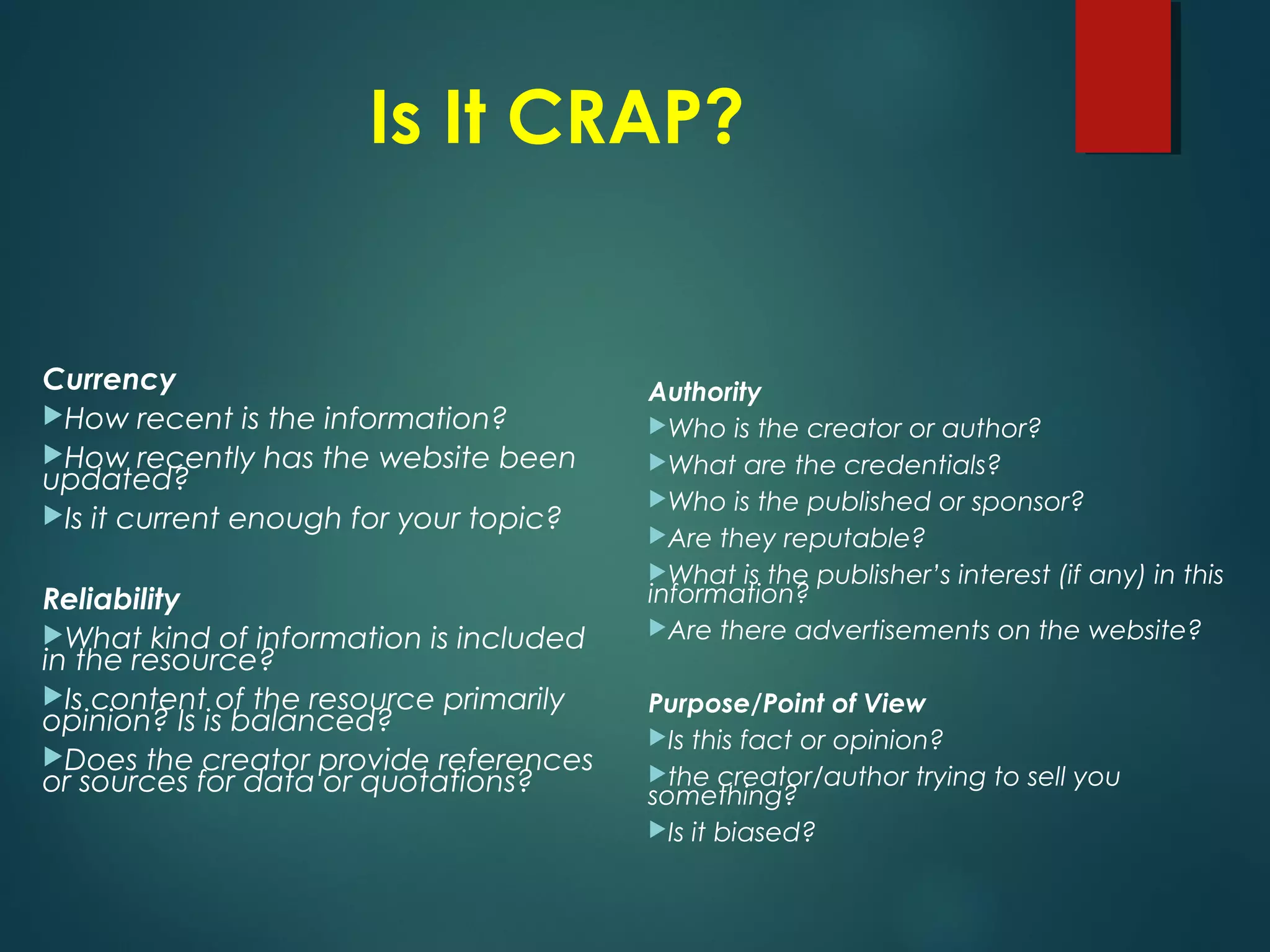
Is It CRAP?
Currency
How recent is the information?
How recently has the website been
updated?
Is it current enough for your topic?
Reliability
What kind of information is included
in the resource?
Is content of the resource primarily
opinion? Is is balanced?
Does the creator provide references
or sources for data or quotations?
Authority
Who is the creator or author?
What are the credentials?
Who is the published or sponsor?
Are they reputable?
What is the publisher’s interest (if any) in this
information?
Are there advertisements on the website?
Purpose/Point of View
Is this fact or opinion?
the creator/author trying to sell you
something?
Is it biased?
Usefulness
Relevance:
Is the source relevant to your project, or
are you simply listing sources to meet a
quota?
Usefulness
 Level of specialization:
General sources can be helpful when you are beginning your
research, but you may need more specialized or more
current resources.
Ask yourself,
 Who was this source written for?
 A general audience?
 A more specialized group?”
 How does this resource fit with your audience and
purpose.
Credibility
Credentials of the publisher or sponsor:
What can you learn about the newspaper or
sponsor of the source?
For example, is it a newspaper known for integrity
or is it a tabloid?
Is it a popular source, or is it sponsored by a
professional organization or academic institution?
Is the book published by a company you
recognize or can locate easily on the web?
Credibility
 Credentials of the author:
 An author’s credentials often are included on
the back cover or flap covers of the book.
When researching, does the author’s name
come up in other sources? He may be
influential in his field
Credibility
Date of the publication:
Recent publication dates may be
more useful in the sciences or other
fields where change is frequent and
current information is essential.
Credibility
Accuracy of the source:
Can you locate other sources that corroborate
this source?
 In other words, can you find other sources that
have similar information or support parts of what
you find in this source?
Credibility
 Cross-references to the source:
 Is the source cited in other works?
 If you see the source cited other places, notice
what another author says about the source.
 Another’s comments may give you insight into
the credibility.
Bias
 Stance of the source:
It’s important to identify the source’s point of view (bias).
 Would the author have a reason to slant the information?
 Leave out essential facts or details?
 Identifying the source is the first step toward evaluating
whether the source’s bias would be a concern.
 For instance, would the source be trying to convince you of an
idea? Sell something? Call you to action? Do any of those
purposes call the information in the source into question?
What is bias?
According to Webster's Dictionary online:
Bias is defined as:
 an inclination of temperament or outlook;
especially: a personal and sometimes
unreasoned judgment: PREJUDICE
Looking for bias
In Politics
Radio Talk Show Host
 Example: Proclaimed conservative radio
personality uses his talk show to promote his
political party's platform beliefs
Looking for bias
In SELF-PROMOTERS
Authors of books, websites, or various written
works promote their works for self-
gratification.
 Example: Toyota Today Magazine rating its
Toyota cars as the best in its class based on
some specifications outlined by them.
Looking for bias
In FINANCE:
A individual or company creates website
to advertise a product or service.
 Example: Receiving Saving Tips from a
website designed and maintained by
Siam Commercial Bank.
Looking for bias
From SPONSORS:
An individual or company supports a website with
the intention of gaining exposure.
 Example: Gaining interview and resume writing
tips from a website sponsored by Kelly  and
Manpower Temporary Services.com
Red Flags for
source credibility
 Anonymity – no author or sponsoring entity
 Negative reviews by other sources
 Misspelled words and poor grammar
 Vague or sweeping generalizations
 One-sided viewpoint that does not address
an opposing side
Red Flags
 Extreme tone or language ("stupid jerks," "shrill cries of my
extremist opponents") 
 Overstatement ("Thousands of children are murdered
every day in the United States.") 
 Sweeping statements of excessive significance ("This is the
most important idea ever conceived!") 
 Conflict of Interest ("Welcome to the Old Stogie Tobacco
Company Home Page. To read our report, 'Cigarettes
Make You Live Longer,' click here." or "The products our
competitors make are dangerous and bad for your
health.")
Red Flags
 Numbers or statistics presented without an
identified source for them 
 Absence of source documentation when the
discussion clearly needs such documentation 
 You cannot find any other sources that present
the same information or acknowledge that the
same information exists (lack of corroboration)
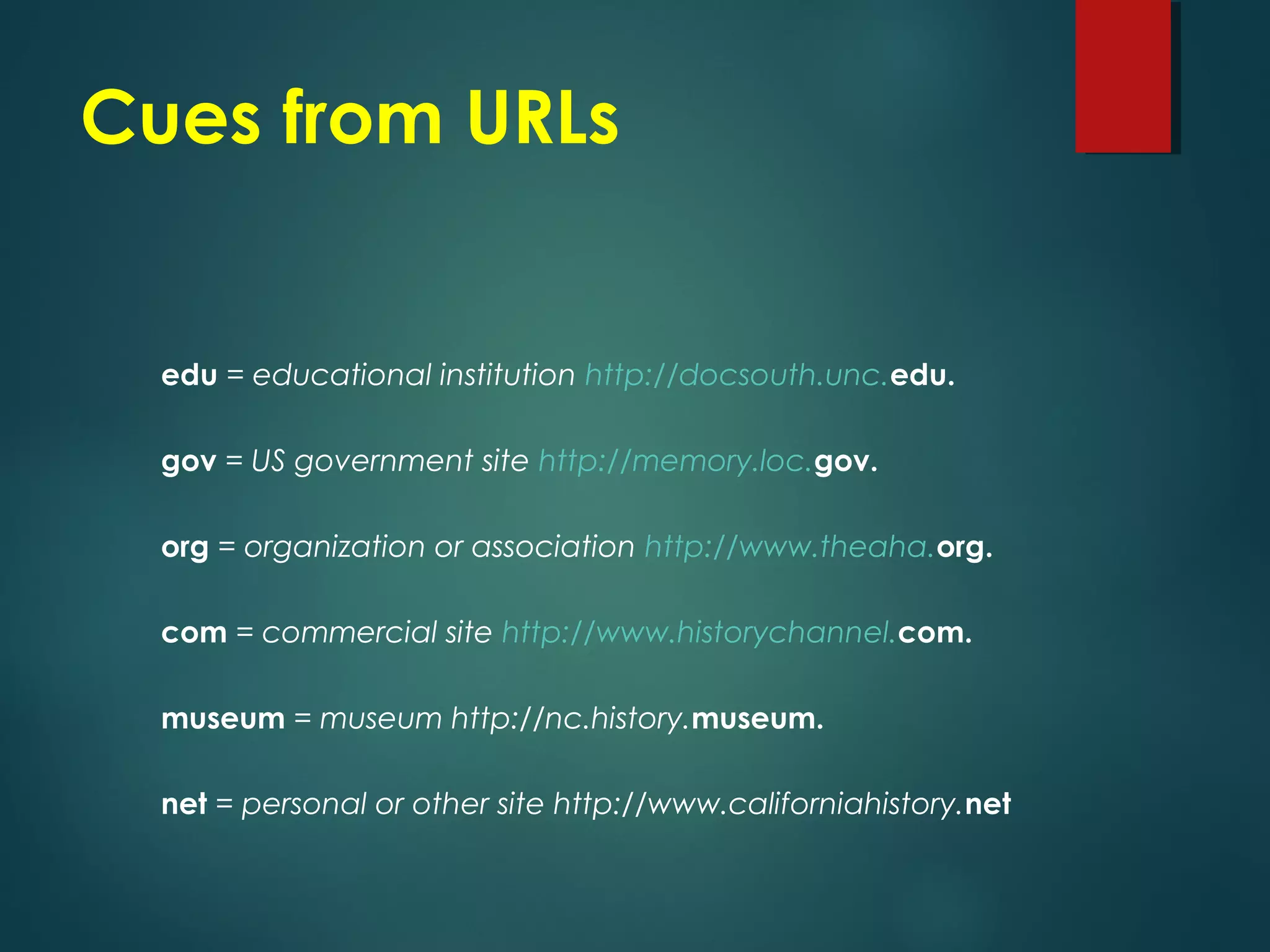
Cues from URLs
edu = educational institution http://docsouth.unc.edu.
gov = US government site http://memory.loc.gov.
org = organization or association http://www.theaha.org.
com = commercial site http://www.historychannel.com.
museum = museum http://nc.history.museum.
net = personal or other site http://www.californiahistory.net
Assess the source
Rank each of these websites from 1(low) to 4
(high) according to how reliable and accurate
you think they would be:
1. The most recent U.S. Department of Labor
statistics on unemployment
2. Twelfth-grader’s blog on the history of silent
films
3. Wikipedia article about a controversial
political issue
4. An editorial about Abraham Lincoln from the
New YorkTimes, January 1862
1. Watkins, S. (2015). Racism Is Poisoning Our Society. Retrieved
from http://time.com/3843203/racism-is-poisoning-our-society/
2. Assari, S., Moazen-Zadeh, E., Caldwell, C. H., & Zimmerman, M.
A. (2017). Racial Discrimination during Adolescence Predicts
Mental Health Deterioration in Adulthood: Gender Differences
among Blacks. Frontiers in Public Health, 5, 104.
http://doi.org/10.3389/fpubh.2017.00104. Retrieved from
https://www.ncbi.nlm.nih.gov/pmc/articles/PMC5316930/
3. Anderson, M. (2016). How the Stress of Racism Affects Learning.
Retrieved from
https://www.theatlantic.com/education/archive/2016/10/how
-the-stress-of-racism-affects-learning/503567/
4. WHAT IS THE IMPACT OF RACISM?
HTTPS://ITSTOPSWITHME.HUMANRIGHTS.GOV.AU/WHAT-IMPACT-
RACISM
Assess the source
Support your ranking
Explain your reasons for
ranking each website to a
partner.
Did you and your partner
agree on the rankings?
Sources
Harris, Robert. “Evaluating Internet Sources.” Virtual Salt.
June 15, 2007. January 12, 2010.
http://www.virtualsalt.com/evalu8it.htm. Web.
Lunsford, Andrea A. The Everyday Writer: Fourth Edition.
Boston:
Bedford- St. Martin’s Press, 2009. 170-171. Print

1 - Evaluating sources' credibility bb

  • 1.
  • 2.
  • 3.
    RELIABLE  Some sourcesare considered to be “reliablereliable” because they have been written by people who are experts in the field.  These are the sources you can
  • 4.
    UNRELIABLE  On theother hand, some sources, such as Wikipedia, are not reliable because the authors may not have a thorough knowledge or full understanding of a topic.  Remember: anyone can post information on the internet, and we need to be CRITICAL READERS in order to determine what to believe!
  • 5.
    POSSIBLE Reliable Secondary Sources While you still need to read critically, here is a list of the types of sources that are often reliable and would be good places to start research:  Books—authored, edited and published  Newspapers and magazines  Peer reviewed journals  Peer reviewed articles  PhD or MBA dissertations and research  Public library  Scholarly articles  Isolated studies or academic research  Educational institutions and their websites
  • 6.
    Secondary Sources  Evaluationof these sources is essential.  Credibility of authorship, authenticity, accuracy, and bias may be an issue.
  • 7.
  • 8.
    Usefulness Your purpose: What willthis source add to your research project? Will it help support a major point, demonstrate you have researched thoroughly, or help establish your own credibility as a conscientious researcher?
  • 9.
    Is It CRAP? Currency Howrecent is the information? How recently has the website been updated? Is it current enough for your topic? Reliability What kind of information is included in the resource? Is content of the resource primarily opinion? Is is balanced? Does the creator provide references or sources for data or quotations? Authority Who is the creator or author? What are the credentials? Who is the published or sponsor? Are they reputable? What is the publisher’s interest (if any) in this information? Are there advertisements on the website? Purpose/Point of View Is this fact or opinion? the creator/author trying to sell you something? Is it biased?
  • 10.
    Usefulness Relevance: Is the sourcerelevant to your project, or are you simply listing sources to meet a quota?
  • 11.
    Usefulness  Level ofspecialization: General sources can be helpful when you are beginning your research, but you may need more specialized or more current resources. Ask yourself,  Who was this source written for?  A general audience?  A more specialized group?”  How does this resource fit with your audience and purpose.
  • 12.
    Credibility Credentials of thepublisher or sponsor: What can you learn about the newspaper or sponsor of the source? For example, is it a newspaper known for integrity or is it a tabloid? Is it a popular source, or is it sponsored by a professional organization or academic institution? Is the book published by a company you recognize or can locate easily on the web?
  • 13.
    Credibility  Credentials ofthe author:  An author’s credentials often are included on the back cover or flap covers of the book. When researching, does the author’s name come up in other sources? He may be influential in his field
  • 14.
    Credibility Date of thepublication: Recent publication dates may be more useful in the sciences or other fields where change is frequent and current information is essential.
  • 15.
    Credibility Accuracy of thesource: Can you locate other sources that corroborate this source?  In other words, can you find other sources that have similar information or support parts of what you find in this source?
  • 16.
    Credibility  Cross-references tothe source:  Is the source cited in other works?  If you see the source cited other places, notice what another author says about the source.  Another’s comments may give you insight into the credibility.
  • 17.
    Bias  Stance ofthe source: It’s important to identify the source’s point of view (bias).  Would the author have a reason to slant the information?  Leave out essential facts or details?  Identifying the source is the first step toward evaluating whether the source’s bias would be a concern.  For instance, would the source be trying to convince you of an idea? Sell something? Call you to action? Do any of those purposes call the information in the source into question?
  • 18.
    What is bias? Accordingto Webster's Dictionary online: Bias is defined as:  an inclination of temperament or outlook; especially: a personal and sometimes unreasoned judgment: PREJUDICE
  • 19.
    Looking for bias InPolitics Radio Talk Show Host  Example: Proclaimed conservative radio personality uses his talk show to promote his political party's platform beliefs
  • 20.
    Looking for bias InSELF-PROMOTERS Authors of books, websites, or various written works promote their works for self- gratification.  Example: Toyota Today Magazine rating its Toyota cars as the best in its class based on some specifications outlined by them.
  • 21.
    Looking for bias InFINANCE: A individual or company creates website to advertise a product or service.  Example: Receiving Saving Tips from a website designed and maintained by Siam Commercial Bank.
  • 22.
    Looking for bias FromSPONSORS: An individual or company supports a website with the intention of gaining exposure.  Example: Gaining interview and resume writing tips from a website sponsored by Kelly  and Manpower Temporary Services.com
  • 23.
    Red Flags for sourcecredibility  Anonymity – no author or sponsoring entity  Negative reviews by other sources  Misspelled words and poor grammar  Vague or sweeping generalizations  One-sided viewpoint that does not address an opposing side
  • 24.
    Red Flags  Extremetone or language ("stupid jerks," "shrill cries of my extremist opponents")   Overstatement ("Thousands of children are murdered every day in the United States.")   Sweeping statements of excessive significance ("This is the most important idea ever conceived!")   Conflict of Interest ("Welcome to the Old Stogie Tobacco Company Home Page. To read our report, 'Cigarettes Make You Live Longer,' click here." or "The products our competitors make are dangerous and bad for your health.")
  • 25.
    Red Flags  Numbersor statistics presented without an identified source for them   Absence of source documentation when the discussion clearly needs such documentation   You cannot find any other sources that present the same information or acknowledge that the same information exists (lack of corroboration)
  • 26.
    Cues from URLs edu= educational institution http://docsouth.unc.edu. gov = US government site http://memory.loc.gov. org = organization or association http://www.theaha.org. com = commercial site http://www.historychannel.com. museum = museum http://nc.history.museum. net = personal or other site http://www.californiahistory.net
  • 27.
    Assess the source Rankeach of these websites from 1(low) to 4 (high) according to how reliable and accurate you think they would be: 1. The most recent U.S. Department of Labor statistics on unemployment 2. Twelfth-grader’s blog on the history of silent films 3. Wikipedia article about a controversial political issue 4. An editorial about Abraham Lincoln from the New YorkTimes, January 1862
  • 28.
    1. Watkins, S.(2015). Racism Is Poisoning Our Society. Retrieved from http://time.com/3843203/racism-is-poisoning-our-society/ 2. Assari, S., Moazen-Zadeh, E., Caldwell, C. H., & Zimmerman, M. A. (2017). Racial Discrimination during Adolescence Predicts Mental Health Deterioration in Adulthood: Gender Differences among Blacks. Frontiers in Public Health, 5, 104. http://doi.org/10.3389/fpubh.2017.00104. Retrieved from https://www.ncbi.nlm.nih.gov/pmc/articles/PMC5316930/ 3. Anderson, M. (2016). How the Stress of Racism Affects Learning. Retrieved from https://www.theatlantic.com/education/archive/2016/10/how -the-stress-of-racism-affects-learning/503567/ 4. WHAT IS THE IMPACT OF RACISM? HTTPS://ITSTOPSWITHME.HUMANRIGHTS.GOV.AU/WHAT-IMPACT- RACISM Assess the source
  • 29.
    Support your ranking Explainyour reasons for ranking each website to a partner. Did you and your partner agree on the rankings?
  • 30.
    Sources Harris, Robert. “EvaluatingInternet Sources.” Virtual Salt. June 15, 2007. January 12, 2010. http://www.virtualsalt.com/evalu8it.htm. Web. Lunsford, Andrea A. The Everyday Writer: Fourth Edition. Boston: Bedford- St. Martin’s Press, 2009. 170-171. Print