RENAISSANCE
Aikaterina Kiousi
INTRODUCTION
• Renaissance is a French word, coming from the Italian word rinascita, which means
“rebirth”. The Renaissance era was a period of rebirth in almost all the cultural and
societal faculties and institutions throughout Europe, including art, science, mathematics,
technology, philosophy, religion, and politics.
• The Renaissance time period had its starting point in Florence, Italy, during the 14th
Century, soon after the Medieval period in Europe. The Medieval period is characterized
as being a darker time in Europe’s history, and is often referred to as the Dark Ages
because of the various socio-economic and political upheavals.
• When we look at the contrast between the Medieval era and the Renaissance, it can seem
like a dark versus light period in history. The Renaissance evolved new ideas and concepts
and birthed many great human beings who contributed their talents and money to the
era’s fame and fortune throughout history.
MAIN IDEAS OF RENAISSANCE
• One of the new ideas and concepts that emerged during the Renaissance was Humanism. This
was a philosophical thought or intellectual movement during the 1300s that influenced the way
people perceived themselves and God in relation to the world. It also informed a new approach
towards visual arts and subject matter, providing a main framework towards the overall
Renaissance meaning.
• Another important concept in the Renaissance time period was the return to Classical
Antiquity, being the Greek and Roman ideals. The Greeks sought to emulate beauty, harmony,
and symmetry or perfect proportions in their art. This was also called Realism, which depicted
the human form with anatomical correctness. This was different from the more abstracted,
idealized forms of human figures from the preceding Byzantine art period.
THE MEDICI FAMILY
• The Renaissance would not have been the same without the Medici family. They
were wealthy Italian bankers who ruled Florence during the 1400s, starting under
Cosimo de’ Medici. The Medici Bank, established in 1397 to 1494, was the largest
bank in Europe, which gave the Medici significant respect and status in society.
• Furthermore, the Medicis were important patrons of the arts during the Renaissance
period in Florence, and commissioned various artists and provided financial support
to establishments like libraries in favor of developing arts and culture. Cosimo de’
Medici was also an avid art lover and collector.
RENAISSANCE ART
RENAISSANCE ART
• Renaissance art, painting, sculpture, architecture, music, and literature
produced during the 14th, 15th, and 16th centuries in Europe under the
combined influences of an increased awareness of nature, a revival of classical
learning, and a more individualistic view of man.
• One of the distinguishing features of Renaissance art was its development of
highly realistic linear perspective.
• The development of perspective was part of a wider trend towards realism in the
arts. Painters developed other techniques, studying light, shadow, and, famously
in the case of Leonardo da Vinci, human anatomy. Underlying these changes in
artistic method was a renewed desire to depict the beauty of nature and to
unravel the axioms of aesthetics.
THEMES AND SYMBOLISM
• Renaissance artists painted a wide variety of themes. Religious altarpieces, fresco cycles,
and small works for private devotion were very popular. For inspiration, painters in both
Italy and northern Europe frequently turned to Jacobus de Voragine's Golden Legend
(1260), a highly influential source book for the lives of saints that had already had a strong
influence on Medieval artists. The rebirth of classical antiquity and Renaissance
humanism also resulted in many mythological and history paintings. Ovidian stories, for
example, were very popular. Decorative ornament, often used in painted architectural
elements, was especially influenced by classical Roman motifs.
TECHNIQUES
• The use of proportion
• Foreshortening – The term foreshortening refers to the artistic effect of shortening lines
in a drawing so as to create an illusion of depth.
• Sfumato – The term sfumato was coined by Italian Renaissance artist Leonardo da Vinci
and refers to a fine art painting technique of blurring or softening of sharp outlines by
subtle and gradual blending of one tone into another through the use of thin glazes to
give the illusion of depth or three-dimensionality. This stems from the Italian word
sfumare meaning to evaporate or to fade out. The Latin origin is fumare, to smoke.
• Chiaroscuro – The term chiaroscuro refers to the fine art painting modeling effect of using
a strong contrast between light and dark to give the illusion of depth or three-
dimensionality. This comes from the Italian words meaning light (chiaro) and dark (scuro),
a technique which came into wide use in the Baroque period.
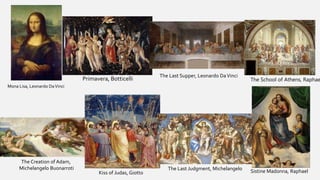
Mona Lisa, Leonardo DaVinci
Sistine Madonna, Raphael
The Last Judgment, Michelangelo
Kiss of Judas, Giotto
The Creation of Adam,
Michelangelo Buonarroti
Primavera, Botticelli The School of Athens, Raphae
The Last Supper, Leonardo DaVinci
RENAISSANCE MUSIC
RENAISSANCE MUSIC
• Music was increasingly freed from medieval constraints, and more variety was
permitted in range, rhythm, harmony, form, and notation. On the other hand,
rules of counterpoint became more constrained, particularly with regard to
treatment of dissonances. In the Renaissance, music became a vehicle for
personal expression. Composers found ways to make vocal music more
expressive of the texts they were setting. Music became more self-sufficient with
its availability in printed form, existing for its own sake.
MAIN CHARACTERISTICS
• Music based on modes.
• Richer texture, with four or more independent melodic parts being performed
simultaneously. These interweaving melodic lines, a style called polyphony, is
one of the defining features of Renaissance music.
• Blending, rather than contrasting, melodic lines in the musical texture.
• Harmony that placed a greater concern on the smooth flow of the music and its
progression of chords.
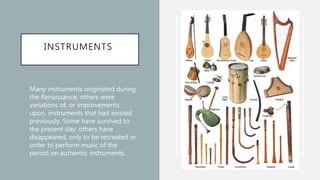
INSTRUMENTS
• Many instruments originated during
the Renaissance; others were
variations of, or improvements
upon, instruments that had existed
previously. Some have survived to
the present day; others have
disappeared, only to be recreated in
order to perform music of the
period on authentic instruments.
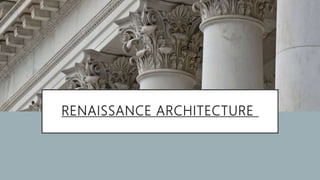
RENAISSANCE ARCHITECTURE
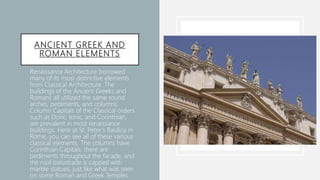
ANCIENT GREEK AND
ROMAN ELEMENTS
• Renaissance Architecture borrowed
many of its most distinctive elements
from Classical Architecture. The
buildings of the Ancient Greeks and
Romans all utilized the same round
arches, pediments, and columns.
Column Capitals of the Classical orders
such as Doric, Ionic, and Corinthian,
are prevalent in most renaissance
buildings. Here at St. Peter’s Basilica in
Rome, you can see all of these various
classical elements. The columns have
Corinthian Capitals, there are
pediments throughout the facade, and
the roof balustrade is capped with
marble statues, just like what was seen
on some Roman and Greek Temples.
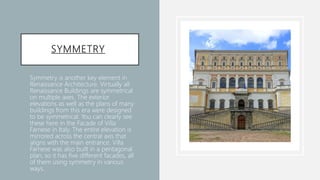
SYMMETRY
• Symmetry is another key element in
Renaissance Architecture. Virtually all
Renaissance Buildings are symmetrical
on multiple axes. The exterior
elevations as well as the plans of many
buildings from this era were designed
to be symmetrical. You can clearly see
these here in the Facade of Villa
Farnese in Italy. The entire elevation is
mirrored across the central axis that
aligns with the main entrance. Villa
Farnese was also built in a pentagonal
plan, so it has five different facades, all
of them using symmetry in various
ways.
PROPORTION & THE
GOLDEN RATIO
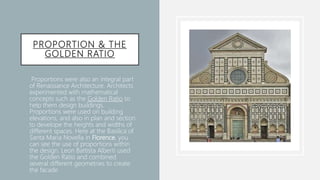
• Proportions were also an integral part
of Renaissance Architecture. Architects
experimented with mathematical
concepts such as the Golden Ratio to
help them design buildings.
Proportions were used on building
elevations, and also in plan and section
to develope the heights and widths of
different spaces. Here at the Basilica of
Santa Maria Novella in Florence, you
can see the use of proportions within
the design. Leon Battista Alberti used
the Golden Ratio and combined
several different geometries to create
the facade
RHYTHM
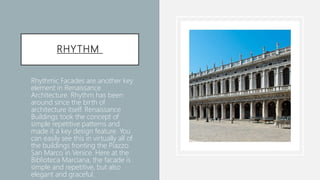
• Rhythmic Facades are another key
element in Renaissance
Architecture. Rhythm has been
around since the birth of
architecture itself. Renaissance
Buildings took the concept of
simple repetitive patterns and
made it a key design feature. You
can easily see this in virtually all of
the buildings fronting the Piazzo
San Marco in Venice. Here at the
Biblioteca Marciana, the facade is
simple and repetitive, but also
elegant and graceful.
SCULPTURE
RELIGIOUS THEMES
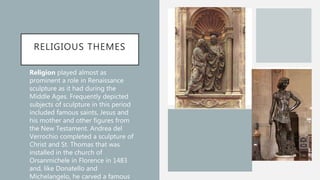
• Religion played almost as
prominent a role in Renaissance
sculpture as it had during the
Middle Ages. Frequently depicted
subjects of sculpture in this period
included famous saints, Jesus and
his mother and other figures from
the New Testament. Andrea del
Verrochio completed a sculpture of
Christ and St. Thomas that was
installed in the church of
Orsanmichele in Florence in 1483
and, like Donatello and
Michelangelo, he carved a famous
RENAISSANCE
REALISM
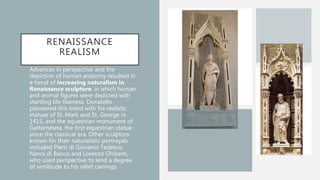
• Advances in perspective and the
depiction of human anatomy resulted in
a trend of increasing naturalism in
Renaissance sculpture, in which human
and animal figures were depicted with
startling life-likeness. Donatello
pioneered this trend with his realistic
statues of St. Mark and St. George in
1415, and the equestrian monument of
Gattamelata, the first equestrian statue
since the classical era. Other sculptors
known for their naturalistic portrayals
included Piero di Giovanni Tedesco,
Nanni di Banco and Lorenzo Ghiberti,
who used perspective to lend a degree
of similitude to his relief carvings.
SCULPTING MATERIALS
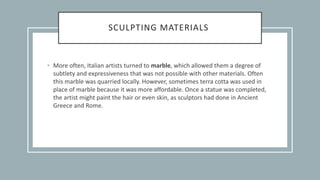
• More often, Italian artists turned to marble, which allowed them a degree of
subtlety and expressiveness that was not possible with other materials. Often
this marble was quarried locally. However, sometimes terra cotta was used in
place of marble because it was more affordable. Once a statue was completed,
the artist might paint the hair or even skin, as sculptors had done in Ancient
Greece and Rome.
SOURCES
• www.wikipedia.com
• www.oxfordartonline.com
• www.artincontext.org
• www.architectureofcities.com
• www.ehow.com
THANK YOU FOR
YOUR
ATTENTION!

Renaissance by aikaterina kiousi

  • 1.
  • 2.
    INTRODUCTION • Renaissance isa French word, coming from the Italian word rinascita, which means “rebirth”. The Renaissance era was a period of rebirth in almost all the cultural and societal faculties and institutions throughout Europe, including art, science, mathematics, technology, philosophy, religion, and politics. • The Renaissance time period had its starting point in Florence, Italy, during the 14th Century, soon after the Medieval period in Europe. The Medieval period is characterized as being a darker time in Europe’s history, and is often referred to as the Dark Ages because of the various socio-economic and political upheavals. • When we look at the contrast between the Medieval era and the Renaissance, it can seem like a dark versus light period in history. The Renaissance evolved new ideas and concepts and birthed many great human beings who contributed their talents and money to the era’s fame and fortune throughout history.
  • 3.
    MAIN IDEAS OFRENAISSANCE • One of the new ideas and concepts that emerged during the Renaissance was Humanism. This was a philosophical thought or intellectual movement during the 1300s that influenced the way people perceived themselves and God in relation to the world. It also informed a new approach towards visual arts and subject matter, providing a main framework towards the overall Renaissance meaning. • Another important concept in the Renaissance time period was the return to Classical Antiquity, being the Greek and Roman ideals. The Greeks sought to emulate beauty, harmony, and symmetry or perfect proportions in their art. This was also called Realism, which depicted the human form with anatomical correctness. This was different from the more abstracted, idealized forms of human figures from the preceding Byzantine art period.
  • 4.
    THE MEDICI FAMILY •The Renaissance would not have been the same without the Medici family. They were wealthy Italian bankers who ruled Florence during the 1400s, starting under Cosimo de’ Medici. The Medici Bank, established in 1397 to 1494, was the largest bank in Europe, which gave the Medici significant respect and status in society. • Furthermore, the Medicis were important patrons of the arts during the Renaissance period in Florence, and commissioned various artists and provided financial support to establishments like libraries in favor of developing arts and culture. Cosimo de’ Medici was also an avid art lover and collector.
  • 5.
  • 6.
    RENAISSANCE ART • Renaissanceart, painting, sculpture, architecture, music, and literature produced during the 14th, 15th, and 16th centuries in Europe under the combined influences of an increased awareness of nature, a revival of classical learning, and a more individualistic view of man. • One of the distinguishing features of Renaissance art was its development of highly realistic linear perspective. • The development of perspective was part of a wider trend towards realism in the arts. Painters developed other techniques, studying light, shadow, and, famously in the case of Leonardo da Vinci, human anatomy. Underlying these changes in artistic method was a renewed desire to depict the beauty of nature and to unravel the axioms of aesthetics.
  • 7.
    THEMES AND SYMBOLISM •Renaissance artists painted a wide variety of themes. Religious altarpieces, fresco cycles, and small works for private devotion were very popular. For inspiration, painters in both Italy and northern Europe frequently turned to Jacobus de Voragine's Golden Legend (1260), a highly influential source book for the lives of saints that had already had a strong influence on Medieval artists. The rebirth of classical antiquity and Renaissance humanism also resulted in many mythological and history paintings. Ovidian stories, for example, were very popular. Decorative ornament, often used in painted architectural elements, was especially influenced by classical Roman motifs.
  • 8.
    TECHNIQUES • The useof proportion • Foreshortening – The term foreshortening refers to the artistic effect of shortening lines in a drawing so as to create an illusion of depth. • Sfumato – The term sfumato was coined by Italian Renaissance artist Leonardo da Vinci and refers to a fine art painting technique of blurring or softening of sharp outlines by subtle and gradual blending of one tone into another through the use of thin glazes to give the illusion of depth or three-dimensionality. This stems from the Italian word sfumare meaning to evaporate or to fade out. The Latin origin is fumare, to smoke. • Chiaroscuro – The term chiaroscuro refers to the fine art painting modeling effect of using a strong contrast between light and dark to give the illusion of depth or three- dimensionality. This comes from the Italian words meaning light (chiaro) and dark (scuro), a technique which came into wide use in the Baroque period.
  • 9.
    Mona Lisa, LeonardoDaVinci Sistine Madonna, Raphael The Last Judgment, Michelangelo Kiss of Judas, Giotto The Creation of Adam, Michelangelo Buonarroti Primavera, Botticelli The School of Athens, Raphae The Last Supper, Leonardo DaVinci
  • 10.
  • 11.
    RENAISSANCE MUSIC • Musicwas increasingly freed from medieval constraints, and more variety was permitted in range, rhythm, harmony, form, and notation. On the other hand, rules of counterpoint became more constrained, particularly with regard to treatment of dissonances. In the Renaissance, music became a vehicle for personal expression. Composers found ways to make vocal music more expressive of the texts they were setting. Music became more self-sufficient with its availability in printed form, existing for its own sake.
  • 12.
    MAIN CHARACTERISTICS • Musicbased on modes. • Richer texture, with four or more independent melodic parts being performed simultaneously. These interweaving melodic lines, a style called polyphony, is one of the defining features of Renaissance music. • Blending, rather than contrasting, melodic lines in the musical texture. • Harmony that placed a greater concern on the smooth flow of the music and its progression of chords.
  • 13.
    INSTRUMENTS • Many instrumentsoriginated during the Renaissance; others were variations of, or improvements upon, instruments that had existed previously. Some have survived to the present day; others have disappeared, only to be recreated in order to perform music of the period on authentic instruments.
  • 14.
  • 15.
    ANCIENT GREEK AND ROMANELEMENTS • Renaissance Architecture borrowed many of its most distinctive elements from Classical Architecture. The buildings of the Ancient Greeks and Romans all utilized the same round arches, pediments, and columns. Column Capitals of the Classical orders such as Doric, Ionic, and Corinthian, are prevalent in most renaissance buildings. Here at St. Peter’s Basilica in Rome, you can see all of these various classical elements. The columns have Corinthian Capitals, there are pediments throughout the facade, and the roof balustrade is capped with marble statues, just like what was seen on some Roman and Greek Temples.
  • 16.
    SYMMETRY • Symmetry isanother key element in Renaissance Architecture. Virtually all Renaissance Buildings are symmetrical on multiple axes. The exterior elevations as well as the plans of many buildings from this era were designed to be symmetrical. You can clearly see these here in the Facade of Villa Farnese in Italy. The entire elevation is mirrored across the central axis that aligns with the main entrance. Villa Farnese was also built in a pentagonal plan, so it has five different facades, all of them using symmetry in various ways.
  • 17.
    PROPORTION & THE GOLDENRATIO • Proportions were also an integral part of Renaissance Architecture. Architects experimented with mathematical concepts such as the Golden Ratio to help them design buildings. Proportions were used on building elevations, and also in plan and section to develope the heights and widths of different spaces. Here at the Basilica of Santa Maria Novella in Florence, you can see the use of proportions within the design. Leon Battista Alberti used the Golden Ratio and combined several different geometries to create the facade
  • 18.
    RHYTHM • Rhythmic Facadesare another key element in Renaissance Architecture. Rhythm has been around since the birth of architecture itself. Renaissance Buildings took the concept of simple repetitive patterns and made it a key design feature. You can easily see this in virtually all of the buildings fronting the Piazzo San Marco in Venice. Here at the Biblioteca Marciana, the facade is simple and repetitive, but also elegant and graceful.
  • 19.
  • 20.
    RELIGIOUS THEMES • Religionplayed almost as prominent a role in Renaissance sculpture as it had during the Middle Ages. Frequently depicted subjects of sculpture in this period included famous saints, Jesus and his mother and other figures from the New Testament. Andrea del Verrochio completed a sculpture of Christ and St. Thomas that was installed in the church of Orsanmichele in Florence in 1483 and, like Donatello and Michelangelo, he carved a famous
  • 21.
    RENAISSANCE REALISM • Advances inperspective and the depiction of human anatomy resulted in a trend of increasing naturalism in Renaissance sculpture, in which human and animal figures were depicted with startling life-likeness. Donatello pioneered this trend with his realistic statues of St. Mark and St. George in 1415, and the equestrian monument of Gattamelata, the first equestrian statue since the classical era. Other sculptors known for their naturalistic portrayals included Piero di Giovanni Tedesco, Nanni di Banco and Lorenzo Ghiberti, who used perspective to lend a degree of similitude to his relief carvings.
  • 22.
    SCULPTING MATERIALS • Moreoften, Italian artists turned to marble, which allowed them a degree of subtlety and expressiveness that was not possible with other materials. Often this marble was quarried locally. However, sometimes terra cotta was used in place of marble because it was more affordable. Once a statue was completed, the artist might paint the hair or even skin, as sculptors had done in Ancient Greece and Rome.
  • 23.
    SOURCES • www.wikipedia.com • www.oxfordartonline.com •www.artincontext.org • www.architectureofcities.com • www.ehow.com
  • 24.