Download to read offline
![Exercises
1. Find the general solution of the following equations:
(a)
d2
x
dt2
− 2
dx
dt
− 3x = 6 (b)
d2
y
dx2
+ 5
dy
dx
+ 4y = 8 (c)
d2
y
dt2
+ 5
dy
dt
+ 6y = 2t
(d)
d2
x
dt2
+ 11
dx
dt
+ 30x = 8t (e)
d2
y
dx2
+ 2
dy
dx
+ 3y = 2 sin 2x (f)
d2
y
dt2
+
dy
dt
+ y = 4 cos 3t
(g)
d2
y
dx2
+ 9y = 4e8x
(h)
d2
x
dt2
− 16x = 9e6t
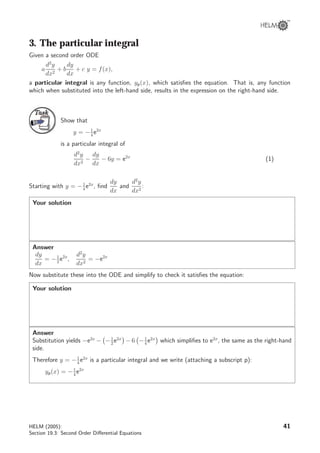
2. Find a particular integral for the equation
d2
x
dt2
− 3
dx
dt
+ 2x = 5e3t
3. Find a particular integral for the equation
d2
x
dt2
− x = 4e−2t
4. Obtain the general solution of y − y − 2y = 6
5. Obtain the general solution of the equation
d2
y
dx2
+ 3
dy
dx
+ 2y = 10 cos 2x
Find the particular solution satisfying y(0) = 1,
dy
dx
(0) = 0
6. Find a particular integral for the equation
d2
y
dx2
+
dy
dx
+ y = 1 + x
7. Find the general solution of
(a)
d2
x
dt2
− 6
dx
dt
+ 5x = 3 (b)
d2
x
dt2
− 2
dx
dt
+ x = et
Answers
1. (a) x = Ae−t
+ Be3t
− 2 (b) y = Ae−x
+ Be−4x
+ 2 (c) y = Ae−2t
+ Be−3t
+ 1
3
t − 5
18
(d) x = Ae−6t
+ Be−5t
+ 0.267t − 0.0978
(e) y = e−x
[A sin
√
2x + B cos
√
2x] − 8
17
cos 2x − 2
17
sin 2x
(f) y = e−0.5t
(A cos 0.866t + B sin 0.866t) − 0.438 cos 3t + 0.164 sin 3t
(g) y = A cos 3x + B sin 3x + 0.0548e8x
(h) x = Ae4t
+ Be−4t
+ 9
20
e6t
2. xp = 2.5e3t
3. xp = 4
3
e−2t
4. y = Ae2x
+ Be−x
− 3
5. y = Ae−2x
+ Be−x
+ 3
2
sin 2x − 1
2
cos 2x; y = 3
2
e−2x
+ 3
2
sin 2x − 1
2
cos 2x
6. yp = x
7. (a) x = Aet
+ Be5t
+ 3
5
(b) x = Aet
+ Btet
+ 1
2
t2
et
50 HELM (2005):
Workbook 19: Differential Equations](https://image.slidesharecdn.com/193-150929153425-lva1-app6891/85/19-3-21-320.jpg)

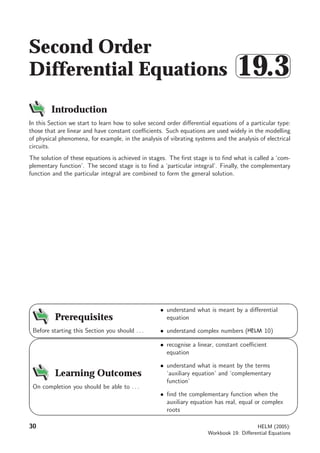
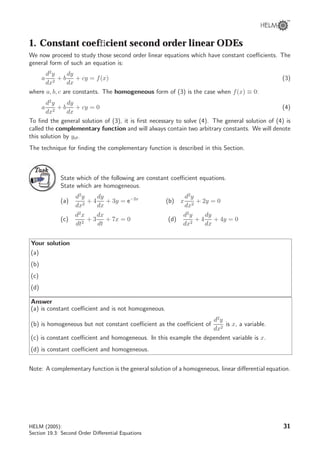
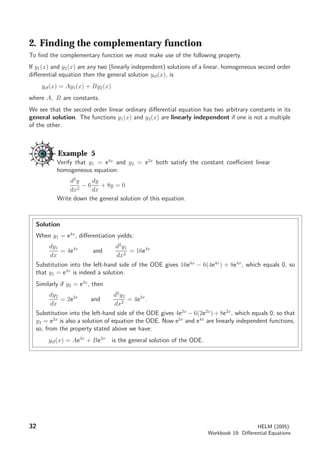
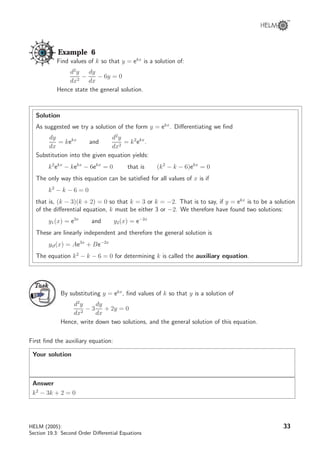
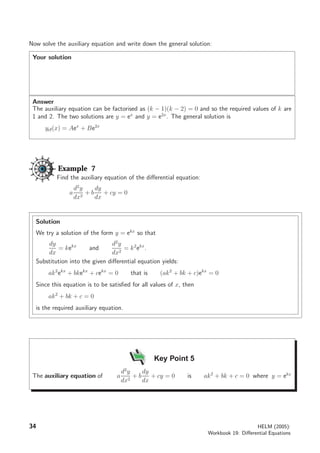
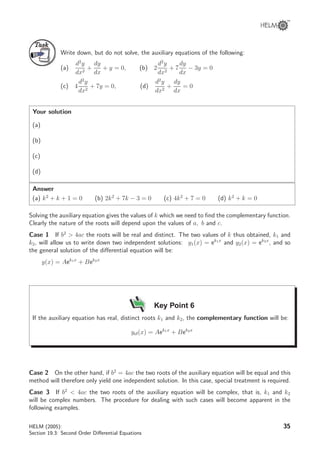
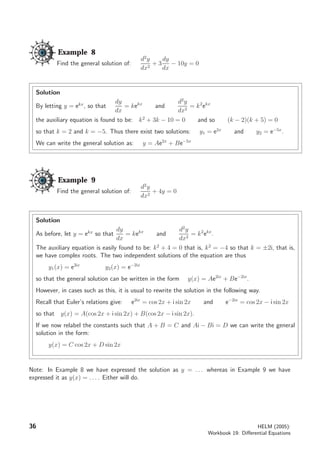
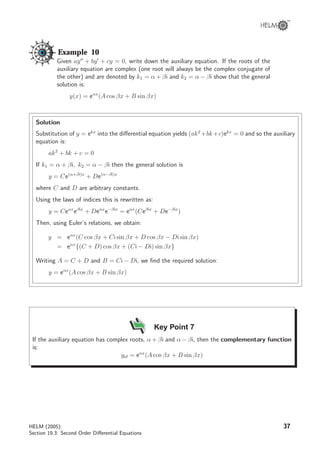
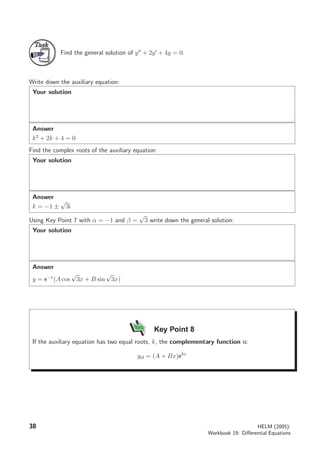
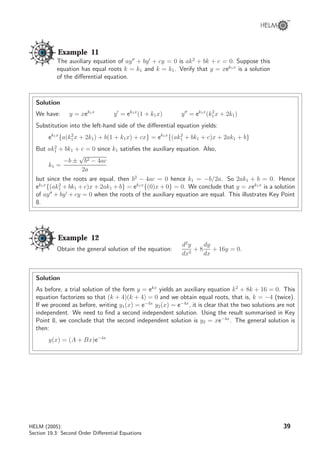
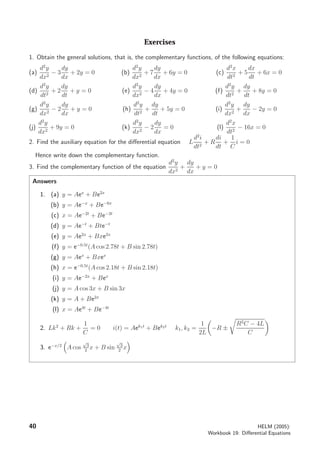
The document discusses solving second order linear differential equations with constant coefficients. It introduces the process of finding the complementary function, which is the general solution to the homogeneous equation. The complementary function contains two arbitrary constants. The document provides examples of finding the complementary function when the auxiliary equation has real roots, equal roots, and complex roots. When the auxiliary equation has complex roots k1 and k2, the complementary function is written as eαx(A cos βx + B sin βx), where α and β are the real and imaginary parts of k1 and k2.


![Week 7 [compatibility mode]](https://cdn.slidesharecdn.com/ss_thumbnails/week7compatibilitymode-130213163717-phpapp02-thumbnail.jpg?width=640&height=640&fit=bounds)


![Ch[1].2](https://cdn.slidesharecdn.com/ss_thumbnails/ch1-180205173321-thumbnail.jpg?width=640&height=640&fit=bounds)


![Week 6 [compatibility mode]](https://cdn.slidesharecdn.com/ss_thumbnails/week6compatibilitymode-130213163919-phpapp02-thumbnail.jpg?width=640&height=640&fit=bounds)


