3-1
Copyright © 2011 by The McGraw-Hill Companies, Inc. All rights reserved.
McGraw-
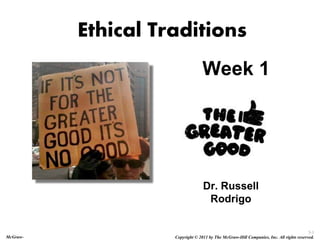
Ethical Traditions
Week 1
Dr. Russell
Rodrigo
3-2
• Introduction to Ethical Theories and
Traditions
• Religious Ethics VS Philosophical
Ethics
• Utilitarianism
OUTLINE
2
3-3
What Is Ethics?
• You probably already know what it means to be ethical: to know right from
wrong and to know when you’re practicing one instead of the other. At the risk
of oversimplifying, then, we can say that business ethics is the application of
ethical behavior in a business context.
• Acting ethically in business means more than simply obeying applicable laws
and regulations: It also means being honest, doing no harm to others, competing
fairly, and declining to put your own interests above those of your company, its
owners, and its workers.
• If you’re in business, you obviously need a strong sense of what’s right and
what’s wrong (not always an easy task). You need the personal conviction
to do what’s right, even if it means doing something that’s difficult or personally
disadvantageous.
3-4
What Contributes to Having a Good Character?
• Honesty
• Integrity
• Fairness
• Responsibility
• Respect for
others
• Hard work
• Positive
attitude
3-5
Think About It…
• Would an honest person cheat on a test?
• Would a responsible person skip classes?
• Does a bully show respect for others?
• Are athletes hard working?
• Do you know people who are known by some of
these traits? Are they known for having these
traits or, perhaps, for not having them?
3-6
• Religious ethics: Explains human well-being in
religious terms.
– What’s the practical problem with this
approach?
• Philosophical ethics: Provides justifications that
must be applicable to all people regardless, of their
religious starting points.
RELIGIOUS ETHICS VS. PHILOSOPHICAL
ETHICS
3-7
Ethical
relativist
DECISION POINT:
WHO IS TO SAY WHAT IS RIGHT OR WRONG?
Ethical values are relative to particular people,
cultures, or times.
Denies that there can be any rationally justified or
objective ethical judgments.
When in disagreements between people/cultures, no one is
right or more reasonable
Values depend on one’s own background, culture, and
personal opinions
In short, in RELATIVISM, a decision made is not justified.
Would just say that everybody is entitled of his or her
own opinion
3-8
DECISION POINT:
APPLICATION
8
3-9
• Imagine a teacher returns an assignment to you with a grade of “F.”
• When you ask for an explanation, you are told that, frankly, the teacher
does not believe that people “like you” (e.g., women, Christians, African
Americans) are capable of doing good work in this field (e.g., science,
engineering, math, finance).
• When you object that this is unfair and wrong, the teacher offers a relativist
explanation. “Fairness is a matter of personal opinion”.
• “Who determines what is fair or unfair?” you ask.
• Your teacher claims that his/her view of what is fair is as valid as any other.
Because everyone is entitled to their own personal opinion, he is entitled to
fail you since, in his personal opinion, you do not deserve to succeed.
DECISION POINT: APPLICATION
3-10
1. Would you accept this explanation and be content with your failing
grade? If not, how would you defend your own, opposing view?
2. Are there any relevant facts on which you would rely to support your
claim?
3. What values are involved in this dispute?
4. What alternatives are available to you?
5. Besides you and your teacher, are there any other people who are
or should be involved in this situation, any other stakeholders?
6. What reasons would you offer to the dean in an appeal to have the
grade changed?
7. What consequences would this professor’s practice have on
education?
8. If reasoning and logical persuasion do not work, how else could this
dispute be resolved?
DISCUSSION POINT:
10
3-11
1. Utilitarianism: Directs us to decide based on overall
consequences of our acts.
1. Deontological ethical traditions: Direct us to act on
the basis of moral principles such as respecting
human rights.
1. Virtue ethics: Directs us to consider the moral
character of individuals and how various character
traits can contribute to, or obstruct, a happy and
meaningful human life.
THE ETHICAL TRADITIONS
3-12
UTILITARIANISM
12
3-13
UTILITARIANISM: MAKING DECISIONS
BASED ON ETHICAL CONSEQUENCES
Utilitarianism
a consequentialist approach to ethics and social policy
which means we should act in ways that produce better
consequences.
What is meant by “better consequences”?
Promote human well-being: the happiness,
health, dignity, integrity, freedom, respect of all the
people affected
Utilitarianism is a decision that promotes the greatest amount of
these values for the greatest number of people is the
most reasonable decision from an ethical point of view.
3-14
“Maximize the overall good.”
OR
“The greatest good for the greatest
number.”
EXAMPLES:
• The ECONOMY and ECONOMIC INSTITUTIONS are
utilitarian:
They exist to provide the highest standard of living for the greatest number
of people.
They do not exist to create wealth for a privileged few.
UTILITARIANISM
3-15
Child labor
Problematic consequences to the child?
Consequences of alternative decisions
instead of child labor?
Consequences to the entire society?
UTILITARIANISM: EXAMPLE
Child Labour India · Sandstone Mine India
akemigardens.com
On UTILITARIAN grounds, child labor practices
are ethically permissible because they produce
better overall consequences than the
alternatives.
3-16
• Utilitarian reasoning supplies support for each competing
available alternative:
– Example: Banning child labor as harmful to the overall good or
allow child labor as contributing to the overall good.
• Deciding on the ethical legitimacy of alternative decisions
requires that we make judgments about the likely
CONSEQUENCES of our actions.
• How do we do this?
– With the help of social sciences: Social science studies the
causes and consequences of individual and social actions.
UTILITARIANISM: LESSONS FROM
EXAMPLES
3-17
• Policy experts can predict the outcome of various
policies and carry out policies that will attain utilitarian
ends.
• The administrative side (presidents, governors, mayors)
executes (administers) policies to fulfill public goals.
INFLUENTIAL VERSION OF
UTILITARIAN POLICY
3-18
• Utilitarians are very pragmatic thinkers:
– They decide on the basis of consequences.
– The consequences of our actions will depend on the
specific facts of each situation.
No act is ever absolutely right or wrong in all
cases in every situation; it will always depend
on the consequences.
– Is lying right?
– How about stealing?
UTILITARIANISM: LESSONS
FROM EXAMPLES
3-19
• Counting, measuring, comparing, and quantifying the
consequences of alternative actions is very difficult.
• The principle shift occurring from one of the earliest
ethical principles — “the end does not always justify
the means” to the utilitarian principle — “the end
justifies the means.”
Examples:
– Parents’ duties
– Contracts & Promises (business)
CHALLENGES TO
UTILITARIAN ETHICS
3-20
The idea that we ought to produce the greatest
happiness for the greatest number is called ‘
The principle of utility or the Greatest
Happiness principle’.
UTILITARIANISM
20
3-21
1.Consequentialism
1.Hedonism
1.Equity
21
3-22
Think about what you want
out of life –
• Money?
• Fame?
• A happy marriage?
These seem reasonable hopes
but could we ask what we want
things like these for?
22
WHY SHOULD WE AIM FOR
HAPPINESS?
Happiness is something, which is
worth having for its own sake.
3-23
CALCULATING HAPPINESS
For Utilitarianism to work – we have to be able to calculate and
measure pain and pleasure. (The aim of Utilitarianism)
23
HOWEVER, The experiences of pleasure and pain are
very complex. How do we calculate these?
We have to consider things like:
• How intense the experience is
• How long it lasts
• Whether it will lead to similar types of experiences
• How many people will be affected
3-24
24
3-25
CALCULATING HAPPINESS
Which pleasures are ‘higher’ and which ones are ‘lower’?
‘Higher’ - Intellectual pleasures such as reading, debating, learning
‘Lower’ – Physical pleasures such as eating, drinking and sex.
How does Mill justify this distinction?
1.Both animals and humans experience physical pleasures but the
pleasures of the intellect are what make us different to animals.
2.People who have experienced both sorts of pleasures prefer the
intellectual ones.
25
Mill’s higher and lower pleasures:
3-26
26
Look at the list below. Which do you think are ‘Higher’ pleasures?
Which do you think are ‘Lower’ pleasures?
List them under the headings ‘Higher’ and ‘Lower’
Compare your list with others in your group. Are they the same?
Try and list them according to what you think Mill would say.
These focus on individual acts called “Act Utilitarianism.”
3-27
• Instead of looking at every act to see whether it will bring about the
greatest happiness for the greatest number, Rule Utilitarians try to
find rules which will bring about the greatest happiness for the
greatest number and then just follow these rules.
RULE UTILITARIANISM
27
There are two forms of Rule Utilitarianism - Strong and Weak.
3-28
• Forces us to examine the
outcomes of our decisions.
• It is difficult to know everyone
who will be affected by our
decisions and how they are
impacted.
• It does not exhaust the range
of ethical concerns.
SHORTCOMINGS OF
UTILITARIAN ETHICS
3-29
Strengths
• Natural – Pleasure and pain are real. They play a huge part in our lives. Utilitarianism
gives them a central role.
• Everyone matters – How I feel and others feel. This seems right and only practical
when talking about morality.
• Balanced – The consequences of an action depend on the circumstances of each
case. e.g. What if you believe in the rules ‘don’t kill’ and ‘protect your family’ yet someone
is attacking your family? What do you do? Utilitarianism avoids such conflicts.
• Simple – Few ideas are actually involved – only the consequences of an action matter
and we only need to look at whether these bring about pleasure/pain.
STRENGTHS AND WEAKNESSES OF
UTILITARIANISM
29
So what do you think of Utilitarianism? Is it a good way to decide what is
right and wrong?
3-30
• Can we calculate pain/pleasure?
• Does everyone really matter?
• Problem of Justice
• Difficulties of Calculation
• Should we ignore rights/motives?
WEAKNESSES
30
3-31
PROFESSIONAL RESPONSI BILITIES
1.Do people have a right to do whatever they want? If not, in
what sense can people have a right to liberty or personal
freedom?
1.Do professional such as accountants, teachers, lawyers,
designers, bankers and others have duties and obligations that
other people don’t have? From where would such duties come
from? For example, can a teacher go out to a bar and get drunk,
or are teachers bound by a duty to set a good example for
students?
1.Distinguish the difference between professions and jobs and
explain by giving examples .
ASSIGNMENT 2
31
3-32
Copyright © 2011 by The McGraw-Hill Companies, Inc. All rights reserved.
McGraw-
EXERCISE
32
3-33
WHAT WOULD YOU DO? FOOD STAMPS
SINGLE MOTHER OF 4 CHILDREN CAN'T
AFFORD FOOD!
3-34
SOCIAL EXPERIMENT ON DOMESTIC VIOLENCE
34
3-35
35
3-36
36
3-37
37

Week 1 Ethical Traditions.pdf

  • 1.
    3-1 Copyright © 2011by The McGraw-Hill Companies, Inc. All rights reserved. McGraw- Ethical Traditions Week 1 Dr. Russell Rodrigo
  • 2.
    3-2 • Introduction toEthical Theories and Traditions • Religious Ethics VS Philosophical Ethics • Utilitarianism OUTLINE 2
  • 3.
    3-3 What Is Ethics? •You probably already know what it means to be ethical: to know right from wrong and to know when you’re practicing one instead of the other. At the risk of oversimplifying, then, we can say that business ethics is the application of ethical behavior in a business context. • Acting ethically in business means more than simply obeying applicable laws and regulations: It also means being honest, doing no harm to others, competing fairly, and declining to put your own interests above those of your company, its owners, and its workers. • If you’re in business, you obviously need a strong sense of what’s right and what’s wrong (not always an easy task). You need the personal conviction to do what’s right, even if it means doing something that’s difficult or personally disadvantageous.
  • 4.
    3-4 What Contributes toHaving a Good Character? • Honesty • Integrity • Fairness • Responsibility • Respect for others • Hard work • Positive attitude
  • 5.
    3-5 Think About It… •Would an honest person cheat on a test? • Would a responsible person skip classes? • Does a bully show respect for others? • Are athletes hard working? • Do you know people who are known by some of these traits? Are they known for having these traits or, perhaps, for not having them?
  • 6.
    3-6 • Religious ethics:Explains human well-being in religious terms. – What’s the practical problem with this approach? • Philosophical ethics: Provides justifications that must be applicable to all people regardless, of their religious starting points. RELIGIOUS ETHICS VS. PHILOSOPHICAL ETHICS
  • 7.
    3-7 Ethical relativist DECISION POINT: WHO ISTO SAY WHAT IS RIGHT OR WRONG? Ethical values are relative to particular people, cultures, or times. Denies that there can be any rationally justified or objective ethical judgments. When in disagreements between people/cultures, no one is right or more reasonable Values depend on one’s own background, culture, and personal opinions In short, in RELATIVISM, a decision made is not justified. Would just say that everybody is entitled of his or her own opinion
  • 8.
  • 9.
    3-9 • Imagine ateacher returns an assignment to you with a grade of “F.” • When you ask for an explanation, you are told that, frankly, the teacher does not believe that people “like you” (e.g., women, Christians, African Americans) are capable of doing good work in this field (e.g., science, engineering, math, finance). • When you object that this is unfair and wrong, the teacher offers a relativist explanation. “Fairness is a matter of personal opinion”. • “Who determines what is fair or unfair?” you ask. • Your teacher claims that his/her view of what is fair is as valid as any other. Because everyone is entitled to their own personal opinion, he is entitled to fail you since, in his personal opinion, you do not deserve to succeed. DECISION POINT: APPLICATION
  • 10.
    3-10 1. Would youaccept this explanation and be content with your failing grade? If not, how would you defend your own, opposing view? 2. Are there any relevant facts on which you would rely to support your claim? 3. What values are involved in this dispute? 4. What alternatives are available to you? 5. Besides you and your teacher, are there any other people who are or should be involved in this situation, any other stakeholders? 6. What reasons would you offer to the dean in an appeal to have the grade changed? 7. What consequences would this professor’s practice have on education? 8. If reasoning and logical persuasion do not work, how else could this dispute be resolved? DISCUSSION POINT: 10
  • 11.
    3-11 1. Utilitarianism: Directsus to decide based on overall consequences of our acts. 1. Deontological ethical traditions: Direct us to act on the basis of moral principles such as respecting human rights. 1. Virtue ethics: Directs us to consider the moral character of individuals and how various character traits can contribute to, or obstruct, a happy and meaningful human life. THE ETHICAL TRADITIONS
  • 12.
  • 13.
    3-13 UTILITARIANISM: MAKING DECISIONS BASEDON ETHICAL CONSEQUENCES Utilitarianism a consequentialist approach to ethics and social policy which means we should act in ways that produce better consequences. What is meant by “better consequences”? Promote human well-being: the happiness, health, dignity, integrity, freedom, respect of all the people affected Utilitarianism is a decision that promotes the greatest amount of these values for the greatest number of people is the most reasonable decision from an ethical point of view.
  • 14.
    3-14 “Maximize the overallgood.” OR “The greatest good for the greatest number.” EXAMPLES: • The ECONOMY and ECONOMIC INSTITUTIONS are utilitarian: They exist to provide the highest standard of living for the greatest number of people. They do not exist to create wealth for a privileged few. UTILITARIANISM
  • 15.
    3-15 Child labor Problematic consequencesto the child? Consequences of alternative decisions instead of child labor? Consequences to the entire society? UTILITARIANISM: EXAMPLE Child Labour India · Sandstone Mine India akemigardens.com On UTILITARIAN grounds, child labor practices are ethically permissible because they produce better overall consequences than the alternatives.
  • 16.
    3-16 • Utilitarian reasoningsupplies support for each competing available alternative: – Example: Banning child labor as harmful to the overall good or allow child labor as contributing to the overall good. • Deciding on the ethical legitimacy of alternative decisions requires that we make judgments about the likely CONSEQUENCES of our actions. • How do we do this? – With the help of social sciences: Social science studies the causes and consequences of individual and social actions. UTILITARIANISM: LESSONS FROM EXAMPLES
  • 17.
    3-17 • Policy expertscan predict the outcome of various policies and carry out policies that will attain utilitarian ends. • The administrative side (presidents, governors, mayors) executes (administers) policies to fulfill public goals. INFLUENTIAL VERSION OF UTILITARIAN POLICY
  • 18.
    3-18 • Utilitarians arevery pragmatic thinkers: – They decide on the basis of consequences. – The consequences of our actions will depend on the specific facts of each situation. No act is ever absolutely right or wrong in all cases in every situation; it will always depend on the consequences. – Is lying right? – How about stealing? UTILITARIANISM: LESSONS FROM EXAMPLES
  • 19.
    3-19 • Counting, measuring,comparing, and quantifying the consequences of alternative actions is very difficult. • The principle shift occurring from one of the earliest ethical principles — “the end does not always justify the means” to the utilitarian principle — “the end justifies the means.” Examples: – Parents’ duties – Contracts & Promises (business) CHALLENGES TO UTILITARIAN ETHICS
  • 20.
    3-20 The idea thatwe ought to produce the greatest happiness for the greatest number is called ‘ The principle of utility or the Greatest Happiness principle’. UTILITARIANISM 20
  • 21.
  • 22.
    3-22 Think about whatyou want out of life – • Money? • Fame? • A happy marriage? These seem reasonable hopes but could we ask what we want things like these for? 22 WHY SHOULD WE AIM FOR HAPPINESS? Happiness is something, which is worth having for its own sake.
  • 23.
    3-23 CALCULATING HAPPINESS For Utilitarianismto work – we have to be able to calculate and measure pain and pleasure. (The aim of Utilitarianism) 23 HOWEVER, The experiences of pleasure and pain are very complex. How do we calculate these? We have to consider things like: • How intense the experience is • How long it lasts • Whether it will lead to similar types of experiences • How many people will be affected
  • 24.
  • 25.
    3-25 CALCULATING HAPPINESS Which pleasuresare ‘higher’ and which ones are ‘lower’? ‘Higher’ - Intellectual pleasures such as reading, debating, learning ‘Lower’ – Physical pleasures such as eating, drinking and sex. How does Mill justify this distinction? 1.Both animals and humans experience physical pleasures but the pleasures of the intellect are what make us different to animals. 2.People who have experienced both sorts of pleasures prefer the intellectual ones. 25 Mill’s higher and lower pleasures:
  • 26.
    3-26 26 Look at thelist below. Which do you think are ‘Higher’ pleasures? Which do you think are ‘Lower’ pleasures? List them under the headings ‘Higher’ and ‘Lower’ Compare your list with others in your group. Are they the same? Try and list them according to what you think Mill would say. These focus on individual acts called “Act Utilitarianism.”
  • 27.
    3-27 • Instead oflooking at every act to see whether it will bring about the greatest happiness for the greatest number, Rule Utilitarians try to find rules which will bring about the greatest happiness for the greatest number and then just follow these rules. RULE UTILITARIANISM 27 There are two forms of Rule Utilitarianism - Strong and Weak.
  • 28.
    3-28 • Forces usto examine the outcomes of our decisions. • It is difficult to know everyone who will be affected by our decisions and how they are impacted. • It does not exhaust the range of ethical concerns. SHORTCOMINGS OF UTILITARIAN ETHICS
  • 29.
    3-29 Strengths • Natural –Pleasure and pain are real. They play a huge part in our lives. Utilitarianism gives them a central role. • Everyone matters – How I feel and others feel. This seems right and only practical when talking about morality. • Balanced – The consequences of an action depend on the circumstances of each case. e.g. What if you believe in the rules ‘don’t kill’ and ‘protect your family’ yet someone is attacking your family? What do you do? Utilitarianism avoids such conflicts. • Simple – Few ideas are actually involved – only the consequences of an action matter and we only need to look at whether these bring about pleasure/pain. STRENGTHS AND WEAKNESSES OF UTILITARIANISM 29 So what do you think of Utilitarianism? Is it a good way to decide what is right and wrong?
  • 30.
    3-30 • Can wecalculate pain/pleasure? • Does everyone really matter? • Problem of Justice • Difficulties of Calculation • Should we ignore rights/motives? WEAKNESSES 30
  • 31.
    3-31 PROFESSIONAL RESPONSI BILITIES 1.Dopeople have a right to do whatever they want? If not, in what sense can people have a right to liberty or personal freedom? 1.Do professional such as accountants, teachers, lawyers, designers, bankers and others have duties and obligations that other people don’t have? From where would such duties come from? For example, can a teacher go out to a bar and get drunk, or are teachers bound by a duty to set a good example for students? 1.Distinguish the difference between professions and jobs and explain by giving examples . ASSIGNMENT 2 31
  • 32.
    3-32 Copyright © 2011by The McGraw-Hill Companies, Inc. All rights reserved. McGraw- EXERCISE 32
  • 33.
    3-33 WHAT WOULD YOUDO? FOOD STAMPS SINGLE MOTHER OF 4 CHILDREN CAN'T AFFORD FOOD!
  • 34.
    3-34 SOCIAL EXPERIMENT ONDOMESTIC VIOLENCE 34
  • 35.
  • 36.
  • 37.