AGC450
Week 1
The Business
Foundation
Dr. Russell Rodrigo
Learning
Outcomes
1. Identify the main participants of
business, the functions that most
businesses perform, and the external
forces that influence business
activities.
2. Define economics and identify factors
of production.
3. Define the basics of supply and
demand
Tuesday, February 2, 20XX 2
Getting down
to business
3
What is
business?
• A business is any activity that provides
goods or services or both to consumers
to make a profit.
• Goods/Products: Apple iPhone, iPod,
iPad, Mac
• Services: hotels, airlines, law firms,
movie theaters, hospitals, etc.
4
Business
Participants
and
Activities
5
Participants: owners, money and
people, employees, customers.
The goal of any business is to satisfy
the needs of its customers in order to
generate a profit for the owners.
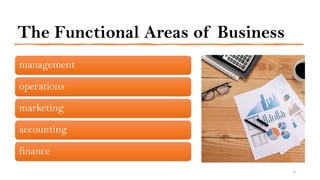
The Functional Areas of Business
6
management
operations
marketing
accounting
finance
7
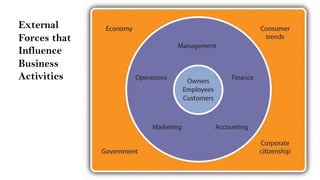
External
Forces that
Influence
Business
Activities
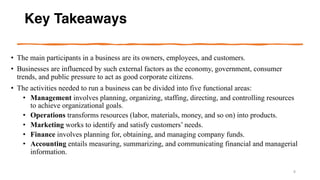
Key Takeaways
• The main participants in a business are its owners, employees, and customers.
• Businesses are influenced by such external factors as the economy, government, consumer
trends, and public pressure to act as good corporate citizens.
• The activities needed to run a business can be divided into five functional areas:
• Management involves planning, organizing, staffing, directing, and controlling resources
to achieve organizational goals.
• Operations transforms resources (labor, materials, money, and so on) into products.
• Marketing works to identify and satisfy customers’ needs.
• Finance involves planning for, obtaining, and managing company funds.
• Accounting entails measuring, summarizing, and communicating financial and managerial
information.
8
Analysis Exercises
1. The Martin family has been making guitars out of its
factory in Nazareth, Pennsylvania, factory for more than
150 years. In 2004, Martin Guitar was proud to produce its
millionth instrument. Go
to http://www.martinguitar.com to link to the Martin
Guitar Web site and read about the company’s long history.
You’ll discover that, even though it’s a family-run company
with a fairly unique product, it operates like any other
company. Identify the main activities or functions of
Martin Guitar’s business and explain how each activity
benefits the company.
2. Name four external factors that have an influence on
business. Give examples of the ways in which each factor
can affect the business performance of two companies:
Wal-Mart and Ford. 9
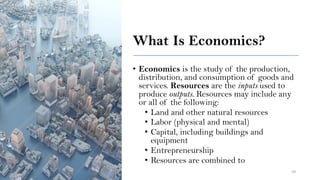
What Is Economics?
• Economics is the study of the production,
distribution, and consumption of goods and
services. Resources are the inputs used to
produce outputs. Resources may include any
or all of the following:
• Land and other natural resources
• Labor (physical and mental)
• Capital, including buildings and
equipment
• Entrepreneurship
• Resources are combined to
10
Because a business
uses resources
to produce things,
we also call these
resources factors of
production. The
factors of production
used to produce a
shirt would include
the following:
• The land that the shirt factory sits on, the
electricity used to run the plant, and the raw
cotton from which the shirts are made
• The laborers who make the shirts
• The factory and equipment used in the
manufacturing process, as well as the money
needed to operate the factory
• The entrepreneurship skill used to coordinate
the other resources to initiate the production
process and the distribution of the goods or
services to the marketplace
11
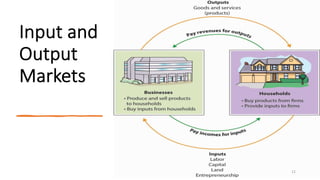
Input and
Output
Markets
12
The Questions Economists Ask
1.What goods and services should be produced to meet consumers’
needs? In what quantity? When should they be produced?
2.How should goods and services be produced? Who should produce
them, and what resources, including technology, should be combined
to produce them?
3.Who should receive the goods and services produced? How should
they be allocated among consumers?
13
Economic Systems
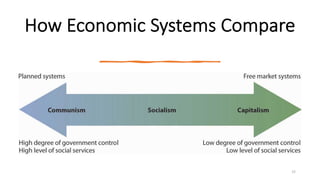
• Planned Systems
• Communism
• Socialism
• Free Market System
• The economic system in which most businesses are owned and operated by
individuals is the free market system, also known as capitalism.
14
How Economic Systems Compare
15
Mixed
Market
Economy
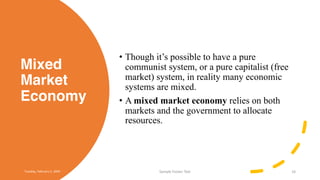
• Though it’s possible to have a pure
communist system, or a pure capitalist (free
market) system, in reality many economic
systems are mixed.
• A mixed market economy relies on both
markets and the government to allocate
resources.
Tuesday, February 2, 20XX Sample Footer Text 16
The U.S.
Economic
System
• Like most countries, the United States features a
mixed market system: though the U.S. economic
system is primarily a free market system, the
federal government controls some basic services,
such as the postal service and air traffic control.
• The U.S. economy also has some characteristics of
a socialist system, such as providing social security
retirement benefits to retired workers.
17
Key
Takeaways
• Economics is the study of the production, distribution, and
consumption of goods and services.
• Economists address these three questions: (1) What goods and
services should be produced to meet consumer needs? (2) How
should they be produced, and who should produce them? (3)
Who should receive goods and services?
• The answers to these questions depend on a
country’s economic system. The primary economic systems
that exist today are planned and free market systems.
• In a planned system, such as communism and socialism, the
government exerts control over the production and distribution
of all or some goods and services.
• In a free market system, also known as capitalism, business is
conducted with only limited government involvement.
Competition determines what goods and services are produced,
how they are produced, and for whom.
18
Exercises
1.If you started a business that made
surfboards, what factors of production would
you need to make your product? Where
would you get them? Where would you find
the money you’d need to pay for additional
resources?
2.Which three key questions do economists try
to answer? Will answers to these questions
differ, depending on whether they’re working
in the United States or in Cuba? Explain your
answer.
19
The Basics of Supply
and Demand
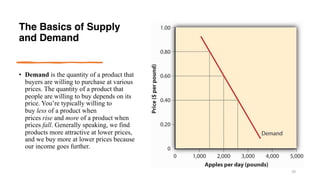
• Demand is the quantity of a product that
buyers are willing to purchase at various
prices. The quantity of a product that
people are willing to buy depends on its
price. You’re typically willing to
buy less of a product when
prices rise and more of a product when
prices fall. Generally speaking, we find
products more attractive at lower prices,
and we buy more at lower prices because
our income goes further.
20
Supply and the Supply
Curve
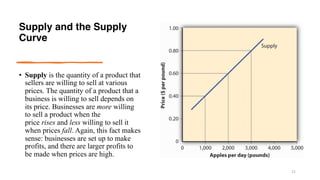
• Supply is the quantity of a product that
sellers are willing to sell at various
prices. The quantity of a product that a
business is willing to sell depends on
its price. Businesses are more willing
to sell a product when the
price rises and less willing to sell it
when prices fall. Again, this fact makes
sense: businesses are set up to make
profits, and there are larger profits to
be made when prices are high.
21
22
Equilibrium
Price
Key Takeaways
• In a free market system, buyers and sellers interact in a market to set prices.
• When the market is characterized by perfect competition, many small companies sell identical products.
Because no company is large enough to control price, each simply accepts the market price. The price is
determined by supply and demand.
• Supply is the quantity of a product that sellers are willing to sell at various prices.
• Demand is the quantity of a product that buyers are willing to purchase at various prices.
• The quantity of a product that people will buy depends on its price: they’ll buy more when the price is low
and less when it’s high.
• Price also influences the quantity of a product that producers are willing to supply: they’ll sell more of a
product when prices are high and less when they’re low.
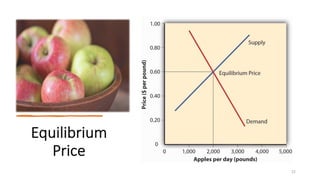
• In a competitive market, the decisions of buyers and sellers interact until the market reaches an equilibrium
price—the price at which buyers are willing to buy the same amount that sellers are willing to sell.
23
Key Terms
• There are four types of competition in a free market system: perfect
competition, monopolistic competition, oligopoly, and monopoly.
• Under monopolistic competition, many sellers offer differentiated
products—products that differ slightly but serve similar purposes. By
making consumers aware of product differences, sellers exert some
control over price.
• In an oligopoly, a few sellers supply a sizable portion of products in
the market. They exert some control over price, but because their
products are similar, when one company lowers prices, the others
follow.
• In a monopoly, there is only one seller in the market. The market
could be a geographical area, such as a city or a regional area, and
does not necessarily have to be an entire country. The single seller is
able to control prices.
• Most monopolies fall into one of two categories: natural and legal.
• Natural monopolies include public utilities, such as electricity and
gas suppliers. They inhibit competition, but they’re legal because
they’re important to society.
• A legal monopoly arises when a company receives a patent giving it
exclusive use of an invented product or process for a limited time,
generally twenty years.
24
Measuring the Health of the Economy
25
Economic Goals
• Growth
• High employment
• Price stability
All the world’s economies share three main goals:
Growth
• An economy provides people with
goods and services, and economists
measure its performance by
studying the gross domestic
product (GDP)—the market value
of all goods and services produced
by the economy in a given year.
• If GDP goes up, the economy is
growing; if it goes down, the
economy is contracting.
26
High
employment
27
• Because most people earn their money by
working, a goal of all economies is making
jobs available to everyone who wants one.
• The U.S. government reports
an unemployment rate—the percentage of
the labor force that’s unemployed and
actively seeking work.
• The unemployment rate goes up during
recessionary periods and down when the
economy is expanding.
Price stability
• When the average prices of products either don’t change or change very
little, price stability occurs.
• When overall prices go up, we have inflation; when they go down, we
have deflation.
• The consumer price index (CPI) measures inflation by determining the change in
prices of a hypothetical basket of goods bought by a typical household.
• To get a sense of where the economy is headed in the future, we use statistics
called economic indicators.
• Indicators that, like average length of unemployment, report the status of the
economy a few months in the past are lagging economic indicators.
• Those, like new claims for unemployment insurance, that predict the status of the
economy three to twelve months in the future are leading economic indicators.
28
Discussion
Tuesday, February 2, 20XX Sample Footer Text 29
If producers find additional oil reserves, what will happen to the price of oil?
If producers must extract oil from more-costly wells, what will happen to the price that you pay to
fill up your gas tank?
If China’s economy continues to expand rapidly, what will happen to the price of oil?
If drivers in the United States start favoring fuel-efficient cars over SUVs, will gas be cheaper or
more expensive?
In your opinion, will oil producers be able to supply enough oil to meet the increasing demand for
oil-related products, such as gasoline?

Week 1 The Business Foundation.pdf

  • 1.
  • 2.
    Learning Outcomes 1. Identify themain participants of business, the functions that most businesses perform, and the external forces that influence business activities. 2. Define economics and identify factors of production. 3. Define the basics of supply and demand Tuesday, February 2, 20XX 2
  • 3.
  • 4.
    What is business? • Abusiness is any activity that provides goods or services or both to consumers to make a profit. • Goods/Products: Apple iPhone, iPod, iPad, Mac • Services: hotels, airlines, law firms, movie theaters, hospitals, etc. 4
  • 5.
    Business Participants and Activities 5 Participants: owners, moneyand people, employees, customers. The goal of any business is to satisfy the needs of its customers in order to generate a profit for the owners.
  • 6.
    The Functional Areasof Business 6 management operations marketing accounting finance
  • 7.
  • 8.
    Key Takeaways • Themain participants in a business are its owners, employees, and customers. • Businesses are influenced by such external factors as the economy, government, consumer trends, and public pressure to act as good corporate citizens. • The activities needed to run a business can be divided into five functional areas: • Management involves planning, organizing, staffing, directing, and controlling resources to achieve organizational goals. • Operations transforms resources (labor, materials, money, and so on) into products. • Marketing works to identify and satisfy customers’ needs. • Finance involves planning for, obtaining, and managing company funds. • Accounting entails measuring, summarizing, and communicating financial and managerial information. 8
  • 9.
    Analysis Exercises 1. TheMartin family has been making guitars out of its factory in Nazareth, Pennsylvania, factory for more than 150 years. In 2004, Martin Guitar was proud to produce its millionth instrument. Go to http://www.martinguitar.com to link to the Martin Guitar Web site and read about the company’s long history. You’ll discover that, even though it’s a family-run company with a fairly unique product, it operates like any other company. Identify the main activities or functions of Martin Guitar’s business and explain how each activity benefits the company. 2. Name four external factors that have an influence on business. Give examples of the ways in which each factor can affect the business performance of two companies: Wal-Mart and Ford. 9
  • 10.
    What Is Economics? •Economics is the study of the production, distribution, and consumption of goods and services. Resources are the inputs used to produce outputs. Resources may include any or all of the following: • Land and other natural resources • Labor (physical and mental) • Capital, including buildings and equipment • Entrepreneurship • Resources are combined to 10
  • 11.
    Because a business usesresources to produce things, we also call these resources factors of production. The factors of production used to produce a shirt would include the following: • The land that the shirt factory sits on, the electricity used to run the plant, and the raw cotton from which the shirts are made • The laborers who make the shirts • The factory and equipment used in the manufacturing process, as well as the money needed to operate the factory • The entrepreneurship skill used to coordinate the other resources to initiate the production process and the distribution of the goods or services to the marketplace 11
  • 12.
  • 13.
    The Questions EconomistsAsk 1.What goods and services should be produced to meet consumers’ needs? In what quantity? When should they be produced? 2.How should goods and services be produced? Who should produce them, and what resources, including technology, should be combined to produce them? 3.Who should receive the goods and services produced? How should they be allocated among consumers? 13
  • 14.
    Economic Systems • PlannedSystems • Communism • Socialism • Free Market System • The economic system in which most businesses are owned and operated by individuals is the free market system, also known as capitalism. 14
  • 15.
  • 16.
    Mixed Market Economy • Though it’spossible to have a pure communist system, or a pure capitalist (free market) system, in reality many economic systems are mixed. • A mixed market economy relies on both markets and the government to allocate resources. Tuesday, February 2, 20XX Sample Footer Text 16
  • 17.
    The U.S. Economic System • Likemost countries, the United States features a mixed market system: though the U.S. economic system is primarily a free market system, the federal government controls some basic services, such as the postal service and air traffic control. • The U.S. economy also has some characteristics of a socialist system, such as providing social security retirement benefits to retired workers. 17
  • 18.
    Key Takeaways • Economics isthe study of the production, distribution, and consumption of goods and services. • Economists address these three questions: (1) What goods and services should be produced to meet consumer needs? (2) How should they be produced, and who should produce them? (3) Who should receive goods and services? • The answers to these questions depend on a country’s economic system. The primary economic systems that exist today are planned and free market systems. • In a planned system, such as communism and socialism, the government exerts control over the production and distribution of all or some goods and services. • In a free market system, also known as capitalism, business is conducted with only limited government involvement. Competition determines what goods and services are produced, how they are produced, and for whom. 18
  • 19.
    Exercises 1.If you starteda business that made surfboards, what factors of production would you need to make your product? Where would you get them? Where would you find the money you’d need to pay for additional resources? 2.Which three key questions do economists try to answer? Will answers to these questions differ, depending on whether they’re working in the United States or in Cuba? Explain your answer. 19
  • 20.
    The Basics ofSupply and Demand • Demand is the quantity of a product that buyers are willing to purchase at various prices. The quantity of a product that people are willing to buy depends on its price. You’re typically willing to buy less of a product when prices rise and more of a product when prices fall. Generally speaking, we find products more attractive at lower prices, and we buy more at lower prices because our income goes further. 20
  • 21.
    Supply and theSupply Curve • Supply is the quantity of a product that sellers are willing to sell at various prices. The quantity of a product that a business is willing to sell depends on its price. Businesses are more willing to sell a product when the price rises and less willing to sell it when prices fall. Again, this fact makes sense: businesses are set up to make profits, and there are larger profits to be made when prices are high. 21
  • 22.
  • 23.
    Key Takeaways • Ina free market system, buyers and sellers interact in a market to set prices. • When the market is characterized by perfect competition, many small companies sell identical products. Because no company is large enough to control price, each simply accepts the market price. The price is determined by supply and demand. • Supply is the quantity of a product that sellers are willing to sell at various prices. • Demand is the quantity of a product that buyers are willing to purchase at various prices. • The quantity of a product that people will buy depends on its price: they’ll buy more when the price is low and less when it’s high. • Price also influences the quantity of a product that producers are willing to supply: they’ll sell more of a product when prices are high and less when they’re low. • In a competitive market, the decisions of buyers and sellers interact until the market reaches an equilibrium price—the price at which buyers are willing to buy the same amount that sellers are willing to sell. 23
  • 24.
    Key Terms • Thereare four types of competition in a free market system: perfect competition, monopolistic competition, oligopoly, and monopoly. • Under monopolistic competition, many sellers offer differentiated products—products that differ slightly but serve similar purposes. By making consumers aware of product differences, sellers exert some control over price. • In an oligopoly, a few sellers supply a sizable portion of products in the market. They exert some control over price, but because their products are similar, when one company lowers prices, the others follow. • In a monopoly, there is only one seller in the market. The market could be a geographical area, such as a city or a regional area, and does not necessarily have to be an entire country. The single seller is able to control prices. • Most monopolies fall into one of two categories: natural and legal. • Natural monopolies include public utilities, such as electricity and gas suppliers. They inhibit competition, but they’re legal because they’re important to society. • A legal monopoly arises when a company receives a patent giving it exclusive use of an invented product or process for a limited time, generally twenty years. 24
  • 25.
    Measuring the Healthof the Economy 25 Economic Goals • Growth • High employment • Price stability All the world’s economies share three main goals:
  • 26.
    Growth • An economyprovides people with goods and services, and economists measure its performance by studying the gross domestic product (GDP)—the market value of all goods and services produced by the economy in a given year. • If GDP goes up, the economy is growing; if it goes down, the economy is contracting. 26
  • 27.
    High employment 27 • Because mostpeople earn their money by working, a goal of all economies is making jobs available to everyone who wants one. • The U.S. government reports an unemployment rate—the percentage of the labor force that’s unemployed and actively seeking work. • The unemployment rate goes up during recessionary periods and down when the economy is expanding.
  • 28.
    Price stability • Whenthe average prices of products either don’t change or change very little, price stability occurs. • When overall prices go up, we have inflation; when they go down, we have deflation. • The consumer price index (CPI) measures inflation by determining the change in prices of a hypothetical basket of goods bought by a typical household. • To get a sense of where the economy is headed in the future, we use statistics called economic indicators. • Indicators that, like average length of unemployment, report the status of the economy a few months in the past are lagging economic indicators. • Those, like new claims for unemployment insurance, that predict the status of the economy three to twelve months in the future are leading economic indicators. 28
  • 29.
    Discussion Tuesday, February 2,20XX Sample Footer Text 29 If producers find additional oil reserves, what will happen to the price of oil? If producers must extract oil from more-costly wells, what will happen to the price that you pay to fill up your gas tank? If China’s economy continues to expand rapidly, what will happen to the price of oil? If drivers in the United States start favoring fuel-efficient cars over SUVs, will gas be cheaper or more expensive? In your opinion, will oil producers be able to supply enough oil to meet the increasing demand for oil-related products, such as gasoline?