Week 5 Object Relative
Clause
Dr. Russell Rodrigo
Review on Subject
Relative Clause
The Longest Sentence Game
► How much do YOU know about world-famous people?
1. Make a simple statement about a famous person.
1. Albert Einstein was a scientist.
2. The next person must then add a piece of information to the sentence (using a
relative clause) without changing what the first person said.
1. Albert Einstein, who discovered the theory of relativity, was a scientist.
3. Play goes back to the first person who must add another piece of information to the
sentence, and so on.
4. When one player can no longer add a true piece of information to the sentence, the
other person scores a point.
Are you ready?
1. Kim Kardashian
2. Ana Delvey
3. Rob Pattinson
4. Putin
Week 4 Object Relative Clause
Object Relative Clauses
After the Main Clause
► We liked many works in the photo contest. Zeyna won the contest.
► We like many works in the photo contest that Zeyna won.
► The photo tells a story. Ricardo posted the photo on the internet.
► Ricardo posted the photo that tells a story on the internet.
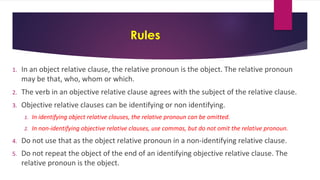
Rules
1. In an object relative clause, the relative pronoun is the object. The relative pronoun
may be that, who, whom or which.
2. The verb in an objective relative clause agrees with the subject of the relative clause.
3. Objective relative clauses can be identifying or non identifying.
1. In identifying object relative clauses, the relative pronoun can be omitted.
2. In non-identifying objective relative clauses, use commas, but do not omit the relative pronoun.
4. Do not use that as the object relative pronoun in a non-identifying relative clause.
5. Do not repeat the object of the end of an identifying objective relative clause. The
relative pronoun is the object.
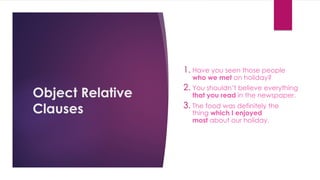
Object Relative
Clauses
1. Have you seen those people
who we met on holiday?
2. You shouldn’t believe everything
that you read in the newspaper.
3. The food was definitely the
thing which I enjoyed
most about our holiday.
1. Sometimes we use whom instead of who when the relative pronoun is
the object:
Have you seen those people whom we met on holiday?
2. When the relative pronoun is object of its clause we sometimes leave it
out:
Have you seen those people we met on holiday?
You shouldn’t believe everything you read in the newspaper.
The food was definitely the thing I enjoyed most about our holiday.
► WARNING:
The relative pronoun is the object of the clause.
We do not repeat the object:
► Have you seen those people who we met [them] on holiday?
► The house that we rented [it] in London was fully furnished.
► The food was definitely the thing I enjoyed [it] most about our holiday.
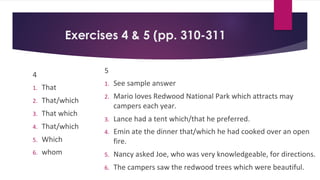
Exercises 4 & 5 (pp. 310-311
4
1. That
2. That/which
3. That which
4. That/which
5. Which
6. whom
5
1. See sample answer
2. Mario loves Redwood National Park which attracts may
campers each year.
3. Lance had a tent which/that he preferred.
4. Emin ate the dinner that/which he had cooked over an open
fire.
5. Nancy asked Joe, who was very knowledgeable, for directions.
6. The campers saw the redwood trees which were beautiful.
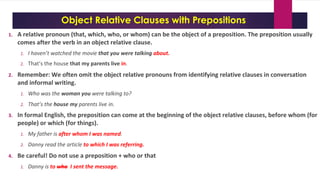
Object Relative Clauses with Prepositions
1. A relative pronoun (that, which, who, or whom) can be the object of a preposition. The preposition usually
comes after the verb in an object relative clause.
1. I haven’t watched the movie that you were talking about.
2. That’s the house that my parents live in.
2. Remember: We often omit the object relative pronouns from identifying relative clauses in conversation
and informal writing.
1. Who was the woman you were talking to?
2. That’s the house my parents live in.
3. In formal English, the preposition can come at the beginning of the object relative clauses, before whom (for
people) or which (for things).
1. My father is after whom I was named.
2. Danny read the article to which I was referring.
4. Be careful! Do not use a preposition + who or that
1. Danny is to who I sent the message.
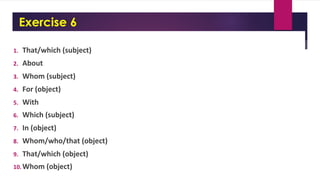
Exercise 6
1. That/which (subject)
2. About
3. Whom (subject)
4. For (object)
5. With
6. Which (subject)
7. In (object)
8. Whom/who/that (object)
9. That/which (object)
10.Whom (object)
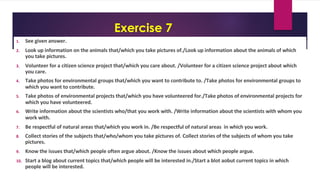
Exercise 7
1. See given answer.
2. Look up information on the animals that/which you take pictures of./Look up information about the animals of which
you take pictures.
3. Volunteer for a citizen science project that/which you care about. /Volunteer for a citizen science project about which
you care.
4. Take photos for environmental groups that/which you want to contribute to. /Take photos for environmental groups to
which you want to contribute.
5. Take photos of environmental projects that/which you have volunteered for./Take photos of environmental projects for
which you have volunteered.
6. Write information about the scientists who/that you work with. /Write information about the scientists with whom you
work with.
7. Be respectful of natural areas that/which you work in. /Be respectful of natural areas in which you work.
8. Collect stories of the subjects that/who/whom you take pictures of. Collect stories of the subjects of whom you take
pictures.
9. Know the issues that/which people often argue about. /Know the issues about which people argue.
10. Start a blog about current topics that/which people will be interested in./Start a blot aobut current topics in which
people will be interested.
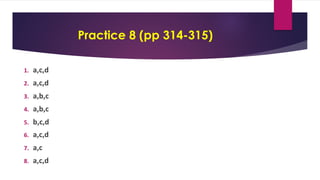
Practice 8 (pp 314-315)
1. a,c,d
2. a,c,d
3. a,b,c
4. a,b,c
5. b,c,d
6. a,c,d
7. a,c
8. a,c,d
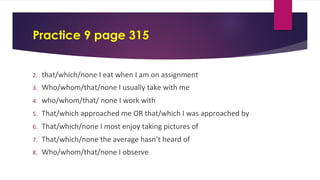
Practice 9 page 315
2. that/which/none I eat when I am on assignment
3. Who/whom/that/none I usually take with me
4. who/whom/that/ none I work with
5. That/which approached me OR that/which I was approached by
6. That/which/none I most enjoy taking pictures of
7. That/which/none the average hasn’t heard of
8. Who/whom/that/none I observe
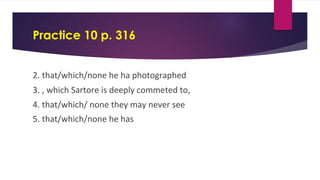
Practice 10 p. 316
2. that/which/none he ha photographed
3. , which Sartore is deeply commeted to,
4. that/which/ none they may never see
5. that/which/none he has
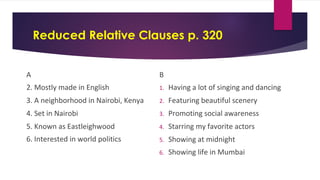
Reduced Relative Clauses p. 320
A
2. Mostly made in English
3. A neighborhood in Nairobi, Kenya
4. Set in Nairobi
5. Known as Eastleighwood
6. Interested in world politics
B
1. Having a lot of singing and dancing
2. Featuring beautiful scenery
3. Promoting social awareness
4. Starring my favorite actors
5. Showing at midnight
6. Showing life in Mumbai

Week 5 Object Relative Clauses.pdf

  • 1.
    Week 5 ObjectRelative Clause Dr. Russell Rodrigo
  • 2.
  • 3.
    The Longest SentenceGame ► How much do YOU know about world-famous people? 1. Make a simple statement about a famous person. 1. Albert Einstein was a scientist. 2. The next person must then add a piece of information to the sentence (using a relative clause) without changing what the first person said. 1. Albert Einstein, who discovered the theory of relativity, was a scientist. 3. Play goes back to the first person who must add another piece of information to the sentence, and so on. 4. When one player can no longer add a true piece of information to the sentence, the other person scores a point.
  • 4.
    Are you ready? 1.Kim Kardashian 2. Ana Delvey 3. Rob Pattinson 4. Putin
  • 5.
    Week 4 ObjectRelative Clause
  • 6.
    Object Relative Clauses Afterthe Main Clause ► We liked many works in the photo contest. Zeyna won the contest. ► We like many works in the photo contest that Zeyna won. ► The photo tells a story. Ricardo posted the photo on the internet. ► Ricardo posted the photo that tells a story on the internet.
  • 7.
    Rules 1. In anobject relative clause, the relative pronoun is the object. The relative pronoun may be that, who, whom or which. 2. The verb in an objective relative clause agrees with the subject of the relative clause. 3. Objective relative clauses can be identifying or non identifying. 1. In identifying object relative clauses, the relative pronoun can be omitted. 2. In non-identifying objective relative clauses, use commas, but do not omit the relative pronoun. 4. Do not use that as the object relative pronoun in a non-identifying relative clause. 5. Do not repeat the object of the end of an identifying objective relative clause. The relative pronoun is the object.
  • 8.
    Object Relative Clauses 1. Haveyou seen those people who we met on holiday? 2. You shouldn’t believe everything that you read in the newspaper. 3. The food was definitely the thing which I enjoyed most about our holiday.
  • 9.
    1. Sometimes weuse whom instead of who when the relative pronoun is the object: Have you seen those people whom we met on holiday? 2. When the relative pronoun is object of its clause we sometimes leave it out: Have you seen those people we met on holiday? You shouldn’t believe everything you read in the newspaper. The food was definitely the thing I enjoyed most about our holiday. ► WARNING: The relative pronoun is the object of the clause. We do not repeat the object: ► Have you seen those people who we met [them] on holiday? ► The house that we rented [it] in London was fully furnished. ► The food was definitely the thing I enjoyed [it] most about our holiday.
  • 10.
    Exercises 4 &5 (pp. 310-311 4 1. That 2. That/which 3. That which 4. That/which 5. Which 6. whom 5 1. See sample answer 2. Mario loves Redwood National Park which attracts may campers each year. 3. Lance had a tent which/that he preferred. 4. Emin ate the dinner that/which he had cooked over an open fire. 5. Nancy asked Joe, who was very knowledgeable, for directions. 6. The campers saw the redwood trees which were beautiful.
  • 11.
    Object Relative Clauseswith Prepositions 1. A relative pronoun (that, which, who, or whom) can be the object of a preposition. The preposition usually comes after the verb in an object relative clause. 1. I haven’t watched the movie that you were talking about. 2. That’s the house that my parents live in. 2. Remember: We often omit the object relative pronouns from identifying relative clauses in conversation and informal writing. 1. Who was the woman you were talking to? 2. That’s the house my parents live in. 3. In formal English, the preposition can come at the beginning of the object relative clauses, before whom (for people) or which (for things). 1. My father is after whom I was named. 2. Danny read the article to which I was referring. 4. Be careful! Do not use a preposition + who or that 1. Danny is to who I sent the message.
  • 12.
    Exercise 6 1. That/which(subject) 2. About 3. Whom (subject) 4. For (object) 5. With 6. Which (subject) 7. In (object) 8. Whom/who/that (object) 9. That/which (object) 10.Whom (object)
  • 13.
    Exercise 7 1. Seegiven answer. 2. Look up information on the animals that/which you take pictures of./Look up information about the animals of which you take pictures. 3. Volunteer for a citizen science project that/which you care about. /Volunteer for a citizen science project about which you care. 4. Take photos for environmental groups that/which you want to contribute to. /Take photos for environmental groups to which you want to contribute. 5. Take photos of environmental projects that/which you have volunteered for./Take photos of environmental projects for which you have volunteered. 6. Write information about the scientists who/that you work with. /Write information about the scientists with whom you work with. 7. Be respectful of natural areas that/which you work in. /Be respectful of natural areas in which you work. 8. Collect stories of the subjects that/who/whom you take pictures of. Collect stories of the subjects of whom you take pictures. 9. Know the issues that/which people often argue about. /Know the issues about which people argue. 10. Start a blog about current topics that/which people will be interested in./Start a blot aobut current topics in which people will be interested.
  • 14.
    Practice 8 (pp314-315) 1. a,c,d 2. a,c,d 3. a,b,c 4. a,b,c 5. b,c,d 6. a,c,d 7. a,c 8. a,c,d
  • 15.
    Practice 9 page315 2. that/which/none I eat when I am on assignment 3. Who/whom/that/none I usually take with me 4. who/whom/that/ none I work with 5. That/which approached me OR that/which I was approached by 6. That/which/none I most enjoy taking pictures of 7. That/which/none the average hasn’t heard of 8. Who/whom/that/none I observe
  • 16.
    Practice 10 p.316 2. that/which/none he ha photographed 3. , which Sartore is deeply commeted to, 4. that/which/ none they may never see 5. that/which/none he has
  • 17.
    Reduced Relative Clausesp. 320 A 2. Mostly made in English 3. A neighborhood in Nairobi, Kenya 4. Set in Nairobi 5. Known as Eastleighwood 6. Interested in world politics B 1. Having a lot of singing and dancing 2. Featuring beautiful scenery 3. Promoting social awareness 4. Starring my favorite actors 5. Showing at midnight 6. Showing life in Mumbai