Barriers and Facilitators of
Inclusive Education
08.08.2020 3.00 PM – 4.30 PM
Webinar Series
40
Department of Education
Manonmaniam Sundaranar University
Tirunelveli – 627 012
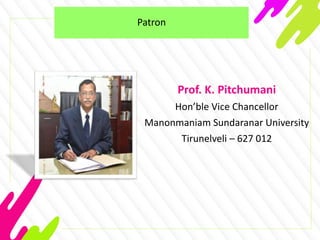
Patron
Prof. K. Pitchumani
Hon’ble Vice Chancellor
Manonmaniam Sundaranar University
Tirunelveli – 627 012
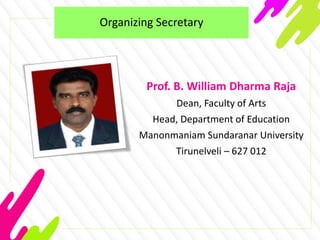
Organizing Secretary
Prof. B. William Dharma Raja
Dean, Faculty of Arts
Head, Department of Education
Manonmaniam Sundaranar University
Tirunelveli – 627 012
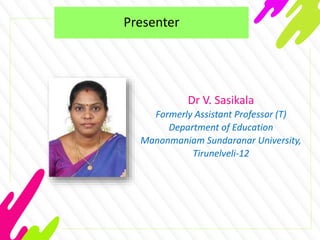
Presenter
Dr V. Sasikala
Formerly Assistant Professor (T)
Department of Education
Manonmaniam Sundaranar University,
Tirunelveli-12
Barriers of Inclusive Education
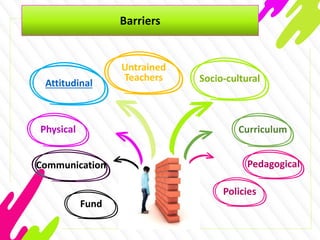
Barriers
Attitudinal
Physical
Communication
Curriculum
Pedagogical
Untrained
Teachers Socio-cultural
Policies
Fund
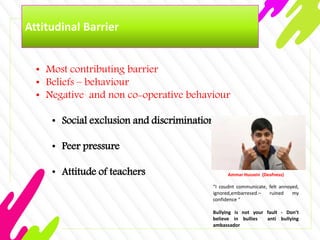
Attitudinal Barrier
• Most contributing barrier
• Beliefs – behaviour
• Negative and non co-operative behaviour
• Social exclusion and discrimination
• Peer pressure
• Attitude of teachers Ammar Hussein (Deafness)
“I coudnt communicate, felt annoyed,
ignored,embarresed.– ruined my
confidence “
Bullying is not your fault - Don’t
believe in bullies anti bullying
ambassador
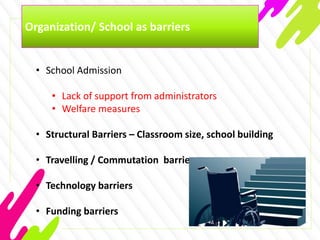
Organization/ School as barriers
• School Admission
• Lack of support from administrators
• Welfare measures
• Structural Barriers – Classroom size, school building
• Travelling / Commutation barrier
• Technology barriers
• Funding barriers
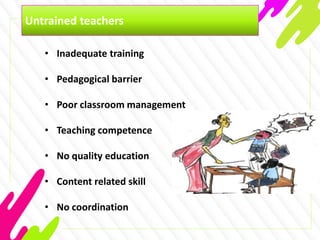
Untrained teachers
• Inadequate training
• Pedagogical barrier
• Poor classroom management
• Teaching competence
• No quality education
• Content related skill
• No coordination
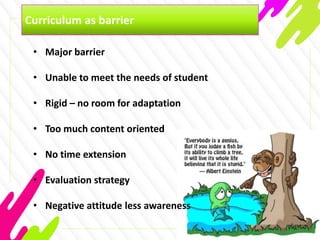
Curriculum as barrier
• Major barrier
• Unable to meet the needs of student
• Rigid – no room for adaptation
• Too much content oriented
• No time extension
• Evaluation strategy
• Negative attitude less awareness
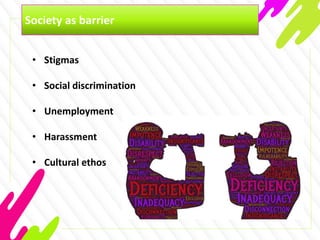
Society as barrier
• Stigmas
• Social discrimination
• Unemployment
• Harassment
• Cultural ethos
Facilitators of Inclusive Education
Facilitators
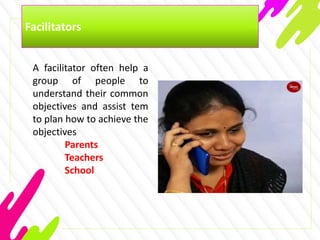
A facilitator often help a
group of people to
understand their common
objectives and assist tem
to plan how to achieve the
objectives
Parents
Teachers
School
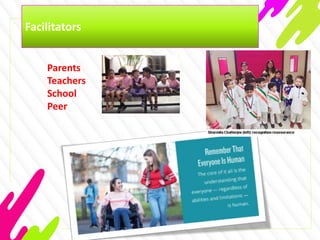
Facilitators
Parents
Teachers
School
Peer
Ethics in Inclusive Education
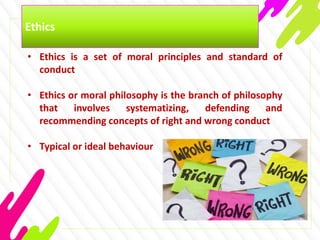
Ethics
• Ethics is a set of moral principles and standard of
conduct
• Ethics or moral philosophy is the branch of philosophy
that involves systematizing, defending and
recommending concepts of right and wrong conduct
• Typical or ideal behaviour
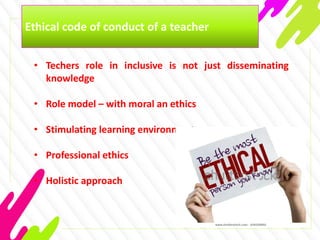
Ethical code of conduct of a teacher
• Techers role in inclusive is not just disseminating
knowledge
• Role model – with moral an ethics
• Stimulating learning environment
• Professional ethics
• Holistic approach
Trust in profession
• Exhibit mutual trust and respect
• Safety and wellbeing
• Respect the uniqueness and diversity of learning community
• Work in collaborative manner with colleague and other
professionals
• Develop and maintain cordial relationship with parents,
guardians of students
• Sensitive to confidentiality where appropriate
• Act with honesty, integrity and fairness
• Responsibility for maintaining quality in profession
• Create learning experiences which engage motivate and
challenge students for a life long learning
Professional Relationship with Students
• Maintain professional boundaries
• Evade inappropriate communication via any media
• Avoidance of improper physical contact
• Conduct personal interventions maintaining their
trust and status
• Abide to behaviour management, policies and
guidelines as per school administrators
• Acting appropriately towards students care in
language, gesture and attitude
• Professional attitude and behaviour
Respect uniqueness and diversity of students
• Promote equality – irrespective of gender, race, religion,
appearance , age, language or different needs or ability
• Equity – update knowledge and understanding to current
child centric practices
• Ensure Inclusive environment – bullying, stereotype
discrimination
• Identify and inform , consult with authorities for any issues at
early stage -Students welfare and interest
Collaboration with Colleague
• Being helpful and cooperative with colleague who work in
multi-disciplinary teams
• Respect support and collaborate other professionals in
educational matters
• Do not rebuke, or criticize others teaching in presence of a
student or public
• Refraining from public statements which turns profession
to disrepute
Collaboration with Parents
• Respect -parents caregivers, guardians
• Engage and work in collaboration with parents with
mutual trust
• Ensure the communication with parents, students and
colleagues comply with policies, procedures of the
institutions level and national level
• Demonstrate respect for diversity in all aspects while
partnering in educational process
• Take sincere effort to encourage and motivate parents
guardians to engage actively in education and welfare of
their child
Honesty and integrity
• Comply with policies and procedures
• Usage of property facility finance and ICT in educational
setting
• Conduction of assessment other task with integrity
• Represent the experience, professional and position
honestly
• Disclose confidential information within the parameters
allowed by legislation
• Be mindful of position, behaviour and attitude to role
model
Updating Professional Knowledge
• Maintain high standard of practice in classroom
management, planning monitoring, assessment reporting-
teaching learning
• Keep professional knowledge and skills updated
throughout the teaching career
• Keep updated in knowledge regarding relevant guidelines
and educational developments in relation to teaching
• Reflect upon your practice as continuing professional
development
• Be open and respond positive to constructive feedback
regarding teaching practice
• Seek support, advice and guidance when necessary
Current Status of Inclusive
Education in India
Policy and Legal Development
• Sarva Siksha Abhiyan
• Education for all (elementary education program)
• Girls and “children with special needs (CWSN)” under the
framework of “inclusive education” (IE)
• “zero rejection policy”
• identification, distribution of aids and appliances
• efforts - training teachers and the induction of
professionals, such as Inclusive Education Resource
Teachers etc to support mainstream teachers
• Need based skills – vocational, functional literacy
Rehabilitation Council of India Act (MSJE,
1992, 2000)
• Milestone in setting a legislative marker for the education
of children with disabilities
• provided mainly for people with locomotor, visual and
hearing disabilities and placed emphasis on registration of
professionals, leading to authentication of skills
• rehabilitation professionals and the maintenance of the
Central Rehabilitation Register and for matters connected
therewith
Right to Education Act (2009)
• significant landmark in the Indian educational landscape
• right to free and compulsory education for children in
the 6-14 age group, including those who have dropped
out or face issues in admission due to migration, caste,
disability and so on
• All disabilities within the Act have been included under
the blanket term of ‘disadvantaged group’
• provision of a range of educational services which
include access to infrastructural support, personnel
support, training of teachers, management of resources,
planning and monitoring and parental contribution
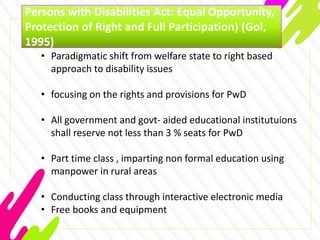
Persons with Disabilities Act: Equal Opportunity,
Protection of Right and Full Participation) (GoI,
1995)
• Paradigmatic shift from welfare state to right based
approach to disability issues
• focusing on the rights and provisions for PwD
• All government and govt- aided educational institutuions
shall reserve not less than 3 % seats for PwD
• Part time class , imparting non formal education using
manpower in rural areas
• Conducting class through interactive electronic media
• Free books and equipment
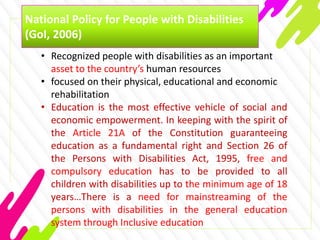
National Policy for People with Disabilities
(GoI, 2006)
• Recognized people with disabilities as an important
asset to the country’s human resources
• focused on their physical, educational and economic
rehabilitation
• Education is the most effective vehicle of social and
economic empowerment. In keeping with the spirit of
the Article 21A of the Constitution guaranteeing
education as a fundamental right and Section 26 of
the Persons with Disabilities Act, 1995, free and
compulsory education has to be provided to all
children with disabilities up to the minimum age of 18
years…There is a need for mainstreaming of the
persons with disabilities in the general education
system through Inclusive education
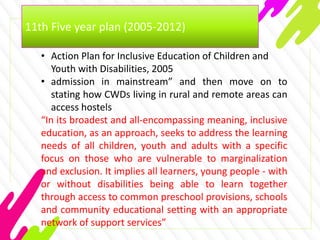
11th Five year plan (2005-2012)
• Action Plan for Inclusive Education of Children and
Youth with Disabilities, 2005
• admission in mainstream” and then move on to
stating how CWDs living in rural and remote areas can
access hostels
“In its broadest and all-encompassing meaning, inclusive
education, as an approach, seeks to address the learning
needs of all children, youth and adults with a specific
focus on those who are vulnerable to marginalization
and exclusion. It implies all learners, young people - with
or without disabilities being able to learn together
through access to common preschool provisions, schools
and community educational setting with an appropriate
network of support services”
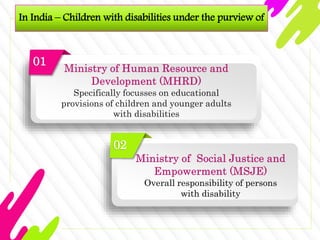
01
02
Overall responsibility of persons
with disability
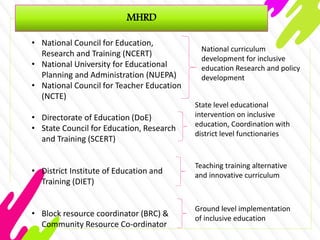
In India – Children with disabilities under the purview of
MHRD
• National Council for Education,
Research and Training (NCERT)
• National University for Educational
Planning and Administration (NUEPA)
• National Council for Teacher Education
(NCTE)
• Directorate of Education (DoE)
• State Council for Education, Research
and Training (SCERT)
• District Institute of Education and
Training (DIET)
• Block resource coordinator (BRC) &
Community Resource Co-ordinator
National curriculum
development for inclusive
education Research and policy
development
State level educational
intervention on inclusive
education, Coordination with
district level functionaries
Teaching training alternative
and innovative curriculum
Ground level implementation
of inclusive education
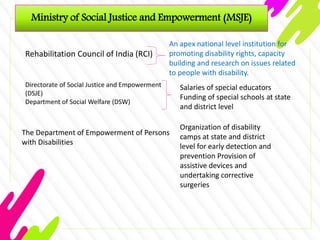
Ministry of Social Justice and Empowerment (MSJE)
Rehabilitation Council of India (RCI)
Directorate of Social Justice and Empowerment
(DSJE)
Department of Social Welfare (DSW)
An apex national level institution for
promoting disability rights, capacity
building and research on issues related
to people with disability.
Salaries of special educators
Funding of special schools at state
and district level
Organization of disability
camps at state and district
level for early detection and
prevention Provision of
assistive devices and
undertaking corrective
surgeries
The Department of Empowerment of Persons
with Disabilities
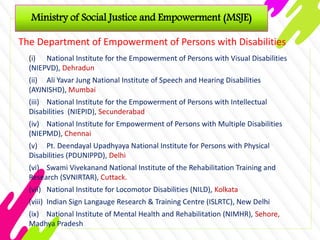
Ministry of Social Justice and Empowerment (MSJE)
The Department of Empowerment of Persons with Disabilities
(i) National Institute for the Empowerment of Persons with Visual Disabilities
(NIEPVD), Dehradun
(ii) Ali Yavar Jung National Institute of Speech and Hearing Disabilities
(AYJNISHD), Mumbai
(iii) National Institute for the Empowerment of Persons with Intellectual
Disabilities (NIEPID), Secunderabad
(iv) National Institute for Empowerment of Persons with Multiple Disabilities
(NIEPMD), Chennai
(v) Pt. Deendayal Upadhyaya National Institute for Persons with Physical
Disabilities (PDUNIPPD), Delhi
(vi) Swami Vivekanand National Institute of the Rehabilitation Training and
Research (SVNIRTAR), Cuttack.
(vii) National Institute for Locomotor Disabilities (NILD), Kolkata
(viii) Indian Sign Langauge Research & Training Centre (ISLRTC), New Delhi
(ix) National Institute of Mental Health and Rehabilitation (NIMHR), Sehore,
Madhya Pradesh
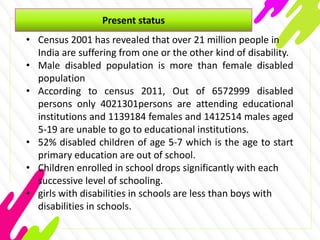
Present status
• Census 2001 has revealed that over 21 million people in
India are suffering from one or the other kind of disability.
• Male disabled population is more than female disabled
population
• According to census 2011, Out of 6572999 disabled
persons only 4021301persons are attending educational
institutions and 1139184 females and 1412514 males aged
5-19 are unable to go to educational institutions.
• 52% disabled children of age 5-7 which is the age to start
primary education are out of school.
• Children enrolled in school drops significantly with each
successive level of schooling.
• girls with disabilities in schools are less than boys with
disabilities in schools.
Cont..
• Around 12 percent of CWDs dropped out of school, which is
comparable with the overall percentage of dropouts among all
children.
• 27 percent of CWDs never attended any educational
institution, as opposed to the overall figure of 17 percent
when the entire child population is taken into account
• large number of children with disabilities do not go to regular
schools but are enrolled at the National Institute of Open
Schooling (NIOS).
• The percentage of children attending schools is the lowest
among those with multiple disabilities, mental illnesses and
mental retardation
Status of facilities provided
Eighth All India School Education Survey (2009)
• 12,99,902 schools in the country, only 2,74,445 (21.11%)
schools adhere to inclusive education for disabled children
• The number of teachers who have received training of at least
two weeks in inclusive education is 80,942 (1.32%) out of the
58,76,273 total teachers.
• The number of schools where special educator/resource
teachers never visited is 42.6 9%.
• As per U DISE report (2012- 13), none school of Pondicherry,
Andaman had separate toilet for CWSN and Tamil Nadu 0.7,
Odessa 0.3, Punjab 0.9, Himachal Pradesh 0.2, Jammu and
Kashmir had 0.6 percent schools with CWSN toilets.
Status of facilities provided
Eighth All India School Education Survey (2009)
• only 31.6% schools have ramp facilities in schools which are
very low
• No resource rooms in schools, According to UDISE (2015-16),
1% schools in almost every state except Daman & Diu,
Lakshadweep, and Uttar Pradesh have single classroom.
• In primary schools, reports indicated that 67.59% teachers had
not received any training in special education skills. 77.88%
teachers indicated that they did not have any experience
working with special needs children.
• In secondary schools, 32.28% indicated that they had received
some training to work with students with disabilities and
62.99% teachers indicated that they did not have any
experience teaching students with disabilities
Research Trends in Inclusion
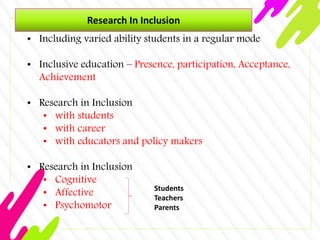
Research In Inclusion
• Including varied ability students in a regular mode
• Inclusive education – Presence, participation, Acceptance,
Achievement
• Research in Inclusion
• with students
• with career
• with educators and policy makers
• Research in Inclusion
• Cognitive
• Affective
• Psychomotor
Students
Teachers
Parents
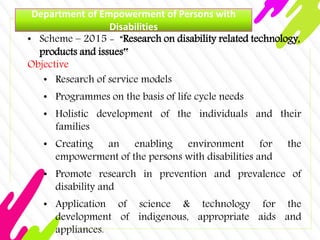
Department of Empowerment of Persons with
Disabilities
• Scheme – 2015 - “Research on disability related technology,
products and issues‟
Objective
• Research of service models
• Programmes on the basis of life cycle needs
• Holistic development of the individuals and their
families
• Creating an enabling environment for the
empowerment of the persons with disabilities and
• Promote research in prevention and prevalence of
disability and
• Application of science & technology for the
development of indigenous, appropriate aids and
appliances.
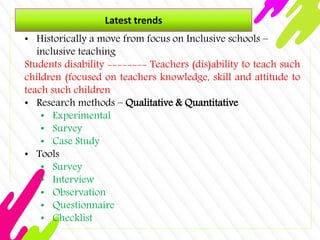
Latest trends
• Historically a move from focus on Inclusive schools –
inclusive teaching
Students disability -------- Teachers (dis)ability to teach such
children (focused on teachers knowledge, skill and attitude to
teach such children
• Research methods – Qualitative & Quantitative
• Experimental
• Survey
• Case Study
• Tools
• Survey
• Interview
• Observation
• Questionnaire
• Checklist
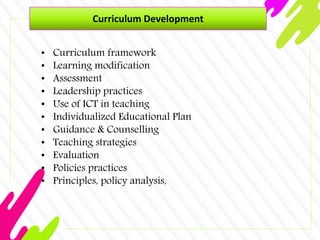
Curriculum Development
• Curriculum framework
• Learning modification
• Assessment
• Leadership practices
• Use of ICT in teaching
• Individualized Educational Plan
• Guidance & Counselling
• Teaching strategies
• Evaluation
• Policies practices
• Principles, policy analysis,
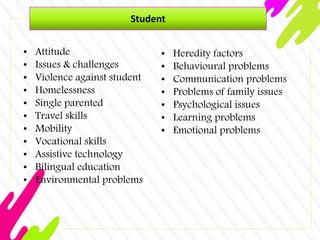
Student
• Attitude
• Issues & challenges
• Violence against student
• Homelessness
• Single parented
• Travel skills
• Mobility
• Vocational skills
• Assistive technology
• Bilingual education
• Environmental problems
• Heredity factors
• Behavioural problems
• Communication problems
• Problems of family issues
• Psychological issues
• Learning problems
• Emotional problems
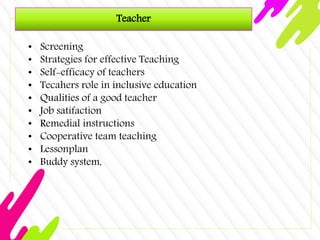
Teacher
• Screening
• Strategies for effective Teaching
• Self-efficacy of teachers
• Tecahers role in inclusive education
• Qualities of a good teacher
• Job satifaction
• Remedial instructions
• Cooperative team teaching
• Lessonplan
• Buddy system,
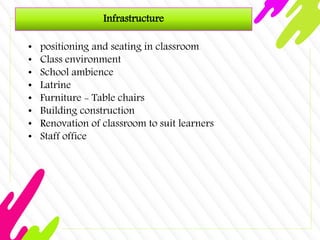
Infrastructure
• positioning and seating in classroom
• Class environment
• School ambience
• Latrine
• Furniture - Table chairs
• Building construction
• Renovation of classroom to suit learners
• Staff office
Societal aspects
• Socialization
• Accommodation
• Societal discrimination
• Social rights
• Human rights
• Social acceptance
• Social awareness
• Census
• Social interaction
Parents
• Financial issues
• Parental involvement
• Parental support
• Siblings cooperation
• Single parent
• Attitude
• Genetic factors
• Emotional imbalance
Who can do research?
• Teachers
• collaborative with other teachers
• Student
• policy makers
• Funding agencies - grant , project work
• Research scholars
• Special educators
Why to research
• Impact of research not for development of
studenst
• Professional development
• University or college ranking
• H index factor or I factor
• Research project
Conclusions
Research gaps should be identified
Longitudinal research, Action Research – Monitor,
evaluate, assessment towards the improvement of children.
Planning and implementing of IE programmes local
government at school management level
Qualitive and quantitative researches, continual research
must be encouraged to voice the unheard problems.

Webinar ppt

  • 1.
    Barriers and Facilitatorsof Inclusive Education 08.08.2020 3.00 PM – 4.30 PM Webinar Series 40 Department of Education Manonmaniam Sundaranar University Tirunelveli – 627 012
  • 2.
    Patron Prof. K. Pitchumani Hon’bleVice Chancellor Manonmaniam Sundaranar University Tirunelveli – 627 012
  • 3.
    Organizing Secretary Prof. B.William Dharma Raja Dean, Faculty of Arts Head, Department of Education Manonmaniam Sundaranar University Tirunelveli – 627 012
  • 4.
    Presenter Dr V. Sasikala FormerlyAssistant Professor (T) Department of Education Manonmaniam Sundaranar University, Tirunelveli-12
  • 5.
  • 6.
  • 7.
    Attitudinal Barrier • Mostcontributing barrier • Beliefs – behaviour • Negative and non co-operative behaviour • Social exclusion and discrimination • Peer pressure • Attitude of teachers Ammar Hussein (Deafness) “I coudnt communicate, felt annoyed, ignored,embarresed.– ruined my confidence “ Bullying is not your fault - Don’t believe in bullies anti bullying ambassador
  • 8.
    Organization/ School asbarriers • School Admission • Lack of support from administrators • Welfare measures • Structural Barriers – Classroom size, school building • Travelling / Commutation barrier • Technology barriers • Funding barriers
  • 9.
    Untrained teachers • Inadequatetraining • Pedagogical barrier • Poor classroom management • Teaching competence • No quality education • Content related skill • No coordination
  • 10.
    Curriculum as barrier •Major barrier • Unable to meet the needs of student • Rigid – no room for adaptation • Too much content oriented • No time extension • Evaluation strategy • Negative attitude less awareness
  • 11.
    Society as barrier •Stigmas • Social discrimination • Unemployment • Harassment • Cultural ethos
  • 12.
  • 13.
    Facilitators A facilitator oftenhelp a group of people to understand their common objectives and assist tem to plan how to achieve the objectives Parents Teachers School
  • 14.
  • 15.
  • 16.
    Ethics • Ethics isa set of moral principles and standard of conduct • Ethics or moral philosophy is the branch of philosophy that involves systematizing, defending and recommending concepts of right and wrong conduct • Typical or ideal behaviour
  • 17.
    Ethical code ofconduct of a teacher • Techers role in inclusive is not just disseminating knowledge • Role model – with moral an ethics • Stimulating learning environment • Professional ethics • Holistic approach
  • 18.
    Trust in profession •Exhibit mutual trust and respect • Safety and wellbeing • Respect the uniqueness and diversity of learning community • Work in collaborative manner with colleague and other professionals • Develop and maintain cordial relationship with parents, guardians of students • Sensitive to confidentiality where appropriate • Act with honesty, integrity and fairness • Responsibility for maintaining quality in profession • Create learning experiences which engage motivate and challenge students for a life long learning
  • 19.
    Professional Relationship withStudents • Maintain professional boundaries • Evade inappropriate communication via any media • Avoidance of improper physical contact • Conduct personal interventions maintaining their trust and status • Abide to behaviour management, policies and guidelines as per school administrators • Acting appropriately towards students care in language, gesture and attitude • Professional attitude and behaviour
  • 20.
    Respect uniqueness anddiversity of students • Promote equality – irrespective of gender, race, religion, appearance , age, language or different needs or ability • Equity – update knowledge and understanding to current child centric practices • Ensure Inclusive environment – bullying, stereotype discrimination • Identify and inform , consult with authorities for any issues at early stage -Students welfare and interest
  • 21.
    Collaboration with Colleague •Being helpful and cooperative with colleague who work in multi-disciplinary teams • Respect support and collaborate other professionals in educational matters • Do not rebuke, or criticize others teaching in presence of a student or public • Refraining from public statements which turns profession to disrepute
  • 22.
    Collaboration with Parents •Respect -parents caregivers, guardians • Engage and work in collaboration with parents with mutual trust • Ensure the communication with parents, students and colleagues comply with policies, procedures of the institutions level and national level • Demonstrate respect for diversity in all aspects while partnering in educational process • Take sincere effort to encourage and motivate parents guardians to engage actively in education and welfare of their child
  • 23.
    Honesty and integrity •Comply with policies and procedures • Usage of property facility finance and ICT in educational setting • Conduction of assessment other task with integrity • Represent the experience, professional and position honestly • Disclose confidential information within the parameters allowed by legislation • Be mindful of position, behaviour and attitude to role model
  • 24.
    Updating Professional Knowledge •Maintain high standard of practice in classroom management, planning monitoring, assessment reporting- teaching learning • Keep professional knowledge and skills updated throughout the teaching career • Keep updated in knowledge regarding relevant guidelines and educational developments in relation to teaching • Reflect upon your practice as continuing professional development • Be open and respond positive to constructive feedback regarding teaching practice • Seek support, advice and guidance when necessary
  • 25.
    Current Status ofInclusive Education in India
  • 26.
    Policy and LegalDevelopment • Sarva Siksha Abhiyan • Education for all (elementary education program) • Girls and “children with special needs (CWSN)” under the framework of “inclusive education” (IE) • “zero rejection policy” • identification, distribution of aids and appliances • efforts - training teachers and the induction of professionals, such as Inclusive Education Resource Teachers etc to support mainstream teachers • Need based skills – vocational, functional literacy
  • 27.
    Rehabilitation Council ofIndia Act (MSJE, 1992, 2000) • Milestone in setting a legislative marker for the education of children with disabilities • provided mainly for people with locomotor, visual and hearing disabilities and placed emphasis on registration of professionals, leading to authentication of skills • rehabilitation professionals and the maintenance of the Central Rehabilitation Register and for matters connected therewith
  • 28.
    Right to EducationAct (2009) • significant landmark in the Indian educational landscape • right to free and compulsory education for children in the 6-14 age group, including those who have dropped out or face issues in admission due to migration, caste, disability and so on • All disabilities within the Act have been included under the blanket term of ‘disadvantaged group’ • provision of a range of educational services which include access to infrastructural support, personnel support, training of teachers, management of resources, planning and monitoring and parental contribution
  • 29.
    Persons with DisabilitiesAct: Equal Opportunity, Protection of Right and Full Participation) (GoI, 1995) • Paradigmatic shift from welfare state to right based approach to disability issues • focusing on the rights and provisions for PwD • All government and govt- aided educational institutuions shall reserve not less than 3 % seats for PwD • Part time class , imparting non formal education using manpower in rural areas • Conducting class through interactive electronic media • Free books and equipment
  • 30.
    National Policy forPeople with Disabilities (GoI, 2006) • Recognized people with disabilities as an important asset to the country’s human resources • focused on their physical, educational and economic rehabilitation • Education is the most effective vehicle of social and economic empowerment. In keeping with the spirit of the Article 21A of the Constitution guaranteeing education as a fundamental right and Section 26 of the Persons with Disabilities Act, 1995, free and compulsory education has to be provided to all children with disabilities up to the minimum age of 18 years…There is a need for mainstreaming of the persons with disabilities in the general education system through Inclusive education
  • 31.
    11th Five yearplan (2005-2012) • Action Plan for Inclusive Education of Children and Youth with Disabilities, 2005 • admission in mainstream” and then move on to stating how CWDs living in rural and remote areas can access hostels “In its broadest and all-encompassing meaning, inclusive education, as an approach, seeks to address the learning needs of all children, youth and adults with a specific focus on those who are vulnerable to marginalization and exclusion. It implies all learners, young people - with or without disabilities being able to learn together through access to common preschool provisions, schools and community educational setting with an appropriate network of support services”
  • 32.
    01 02 Overall responsibility ofpersons with disability In India – Children with disabilities under the purview of
  • 33.
    MHRD • National Councilfor Education, Research and Training (NCERT) • National University for Educational Planning and Administration (NUEPA) • National Council for Teacher Education (NCTE) • Directorate of Education (DoE) • State Council for Education, Research and Training (SCERT) • District Institute of Education and Training (DIET) • Block resource coordinator (BRC) & Community Resource Co-ordinator National curriculum development for inclusive education Research and policy development State level educational intervention on inclusive education, Coordination with district level functionaries Teaching training alternative and innovative curriculum Ground level implementation of inclusive education
  • 34.
    Ministry of SocialJustice and Empowerment (MSJE) Rehabilitation Council of India (RCI) Directorate of Social Justice and Empowerment (DSJE) Department of Social Welfare (DSW) An apex national level institution for promoting disability rights, capacity building and research on issues related to people with disability. Salaries of special educators Funding of special schools at state and district level Organization of disability camps at state and district level for early detection and prevention Provision of assistive devices and undertaking corrective surgeries The Department of Empowerment of Persons with Disabilities
  • 35.
    Ministry of SocialJustice and Empowerment (MSJE) The Department of Empowerment of Persons with Disabilities (i) National Institute for the Empowerment of Persons with Visual Disabilities (NIEPVD), Dehradun (ii) Ali Yavar Jung National Institute of Speech and Hearing Disabilities (AYJNISHD), Mumbai (iii) National Institute for the Empowerment of Persons with Intellectual Disabilities (NIEPID), Secunderabad (iv) National Institute for Empowerment of Persons with Multiple Disabilities (NIEPMD), Chennai (v) Pt. Deendayal Upadhyaya National Institute for Persons with Physical Disabilities (PDUNIPPD), Delhi (vi) Swami Vivekanand National Institute of the Rehabilitation Training and Research (SVNIRTAR), Cuttack. (vii) National Institute for Locomotor Disabilities (NILD), Kolkata (viii) Indian Sign Langauge Research & Training Centre (ISLRTC), New Delhi (ix) National Institute of Mental Health and Rehabilitation (NIMHR), Sehore, Madhya Pradesh
  • 36.
    Present status • Census2001 has revealed that over 21 million people in India are suffering from one or the other kind of disability. • Male disabled population is more than female disabled population • According to census 2011, Out of 6572999 disabled persons only 4021301persons are attending educational institutions and 1139184 females and 1412514 males aged 5-19 are unable to go to educational institutions. • 52% disabled children of age 5-7 which is the age to start primary education are out of school. • Children enrolled in school drops significantly with each successive level of schooling. • girls with disabilities in schools are less than boys with disabilities in schools.
  • 37.
    Cont.. • Around 12percent of CWDs dropped out of school, which is comparable with the overall percentage of dropouts among all children. • 27 percent of CWDs never attended any educational institution, as opposed to the overall figure of 17 percent when the entire child population is taken into account • large number of children with disabilities do not go to regular schools but are enrolled at the National Institute of Open Schooling (NIOS). • The percentage of children attending schools is the lowest among those with multiple disabilities, mental illnesses and mental retardation
  • 38.
    Status of facilitiesprovided Eighth All India School Education Survey (2009) • 12,99,902 schools in the country, only 2,74,445 (21.11%) schools adhere to inclusive education for disabled children • The number of teachers who have received training of at least two weeks in inclusive education is 80,942 (1.32%) out of the 58,76,273 total teachers. • The number of schools where special educator/resource teachers never visited is 42.6 9%. • As per U DISE report (2012- 13), none school of Pondicherry, Andaman had separate toilet for CWSN and Tamil Nadu 0.7, Odessa 0.3, Punjab 0.9, Himachal Pradesh 0.2, Jammu and Kashmir had 0.6 percent schools with CWSN toilets.
  • 39.
    Status of facilitiesprovided Eighth All India School Education Survey (2009) • only 31.6% schools have ramp facilities in schools which are very low • No resource rooms in schools, According to UDISE (2015-16), 1% schools in almost every state except Daman & Diu, Lakshadweep, and Uttar Pradesh have single classroom. • In primary schools, reports indicated that 67.59% teachers had not received any training in special education skills. 77.88% teachers indicated that they did not have any experience working with special needs children. • In secondary schools, 32.28% indicated that they had received some training to work with students with disabilities and 62.99% teachers indicated that they did not have any experience teaching students with disabilities
  • 40.
  • 41.
    Research In Inclusion •Including varied ability students in a regular mode • Inclusive education – Presence, participation, Acceptance, Achievement • Research in Inclusion • with students • with career • with educators and policy makers • Research in Inclusion • Cognitive • Affective • Psychomotor Students Teachers Parents
  • 42.
    Department of Empowermentof Persons with Disabilities • Scheme – 2015 - “Research on disability related technology, products and issues‟ Objective • Research of service models • Programmes on the basis of life cycle needs • Holistic development of the individuals and their families • Creating an enabling environment for the empowerment of the persons with disabilities and • Promote research in prevention and prevalence of disability and • Application of science & technology for the development of indigenous, appropriate aids and appliances.
  • 43.
    Latest trends • Historicallya move from focus on Inclusive schools – inclusive teaching Students disability -------- Teachers (dis)ability to teach such children (focused on teachers knowledge, skill and attitude to teach such children • Research methods – Qualitative & Quantitative • Experimental • Survey • Case Study • Tools • Survey • Interview • Observation • Questionnaire • Checklist
  • 44.
    Curriculum Development • Curriculumframework • Learning modification • Assessment • Leadership practices • Use of ICT in teaching • Individualized Educational Plan • Guidance & Counselling • Teaching strategies • Evaluation • Policies practices • Principles, policy analysis,
  • 45.
    Student • Attitude • Issues& challenges • Violence against student • Homelessness • Single parented • Travel skills • Mobility • Vocational skills • Assistive technology • Bilingual education • Environmental problems • Heredity factors • Behavioural problems • Communication problems • Problems of family issues • Psychological issues • Learning problems • Emotional problems
  • 46.
    Teacher • Screening • Strategiesfor effective Teaching • Self-efficacy of teachers • Tecahers role in inclusive education • Qualities of a good teacher • Job satifaction • Remedial instructions • Cooperative team teaching • Lessonplan • Buddy system,
  • 47.
    Infrastructure • positioning andseating in classroom • Class environment • School ambience • Latrine • Furniture - Table chairs • Building construction • Renovation of classroom to suit learners • Staff office
  • 48.
    Societal aspects • Socialization •Accommodation • Societal discrimination • Social rights • Human rights • Social acceptance • Social awareness • Census • Social interaction
  • 49.
    Parents • Financial issues •Parental involvement • Parental support • Siblings cooperation • Single parent • Attitude • Genetic factors • Emotional imbalance
  • 50.
    Who can doresearch? • Teachers • collaborative with other teachers • Student • policy makers • Funding agencies - grant , project work • Research scholars • Special educators Why to research • Impact of research not for development of studenst • Professional development • University or college ranking • H index factor or I factor • Research project
  • 51.
    Conclusions Research gaps shouldbe identified Longitudinal research, Action Research – Monitor, evaluate, assessment towards the improvement of children. Planning and implementing of IE programmes local government at school management level Qualitive and quantitative researches, continual research must be encouraged to voice the unheard problems.

Editor's Notes

  • #2 barrUnESCO attitude and sociggest barririal barriers are b
  • #3 barrUnESCO attitude and sociggest barririal barriers are b
  • #4 barrUnESCO attitude and sociggest barririal barriers are b
  • #5 barrUnESCO attitude and sociggest barririal barriers are b
  • #7 Barrier any factor that obstruct the capacity fothird sector organization to implementevidence based interventionstor
  • #8 barrUnESCO attitude and sociggest barririal barriers are b
  • #9 barrUnESCO attitude and sociggest barririal barriers are b
  • #10 barrUnESCO attitude and sociggest barririal barriers are b
  • #11 barrUnESCO attitude and sociggest barririal barriers are b
  • #12 barrUnESCO attitude and sociggest barririal barriers are b
  • #14 barrUnESCO attitude and sociggest barririal barriers are b
  • #15 barrUnESCO attitude and sociggest barririal barriers are b
  • #17 barrUnESCO attitude and sociggest barririal barriers are b
  • #18 barrUnESCO attitude and sociggest barririal barriers are b
  • #19 barrUnESCO attitude and sociggest barririal barriers are b
  • #20 barrUnESCO attitude and sociggest barririal barriers are b
  • #21 barrUnESCO attitude and sociggest barririal barriers are b
  • #22 barrUnESCO attitude and sociggest barririal barriers are b
  • #23 barrUnESCO attitude and sociggest barririal barriers are b
  • #24 barrUnESCO attitude and sociggest barririal barriers are b
  • #25 barrUnESCO attitude and sociggest barririal barriers are b