The Quality of Education:
(A Draft Guideline for Training)
Eyob Milkias
Department of Curriculum and
Instruction
The Quality of Education
Session objectives: after the end of this session, the candidates will be
able to
 Describe the term “quality” in the context of education and
 Elaborate both internal and external factors influencing the quality of
higher education in Ethiopia.
Activities for candidates
1) How do you understand the term “quality” in the context of
education?
2) What are the internal factors which influence the quality of higher
education in Ethiopia?
3) What are the external factors which influence the quality of higher
education in Ethiopia?
2
Origin of quality concept in Education
• The concept of quality was emerged during the age of
Industrialization (19th century).
 Focused on a massive production of products rather than its quality
 Detecting products with low value/defects
 Avoiding/removing products with low value/high defects
 Identifying, selling/buying and consuming products with high
value/low defects
• 1940s … Quality Control
 Introduction of the concept Quality Control in industry.
 Quality Control is a system of maintaining standards in
manufactured products by testing a sample of the output against the
specification.
 Quality Control is the process of checking to determine whether
proper progress is being made towards the objectives and goals
or not.
 Shifted the responsibility of checking quality from workers to process
or systems in organizations
 Focused on detecting defective products in factories/industries
 Focused on stopping defective products from reaching the customers
3
• 1960s …
 There was shift from statistical process control to
assuring the quality of products.
Quality Assurance: is a process of measuring and
assuring the effectiveness of overall activities done
and products produced.
 Its main or first focus was reducing or avoiding the
production of defective products.
• 1980s…
 Lead to the emergence of Total Quality Management
(TQM).
 TQM is a continuous effort taken by the management as
well as employees of a particular organization to ensure
long term customer loyalty and customer satisfaction.
4
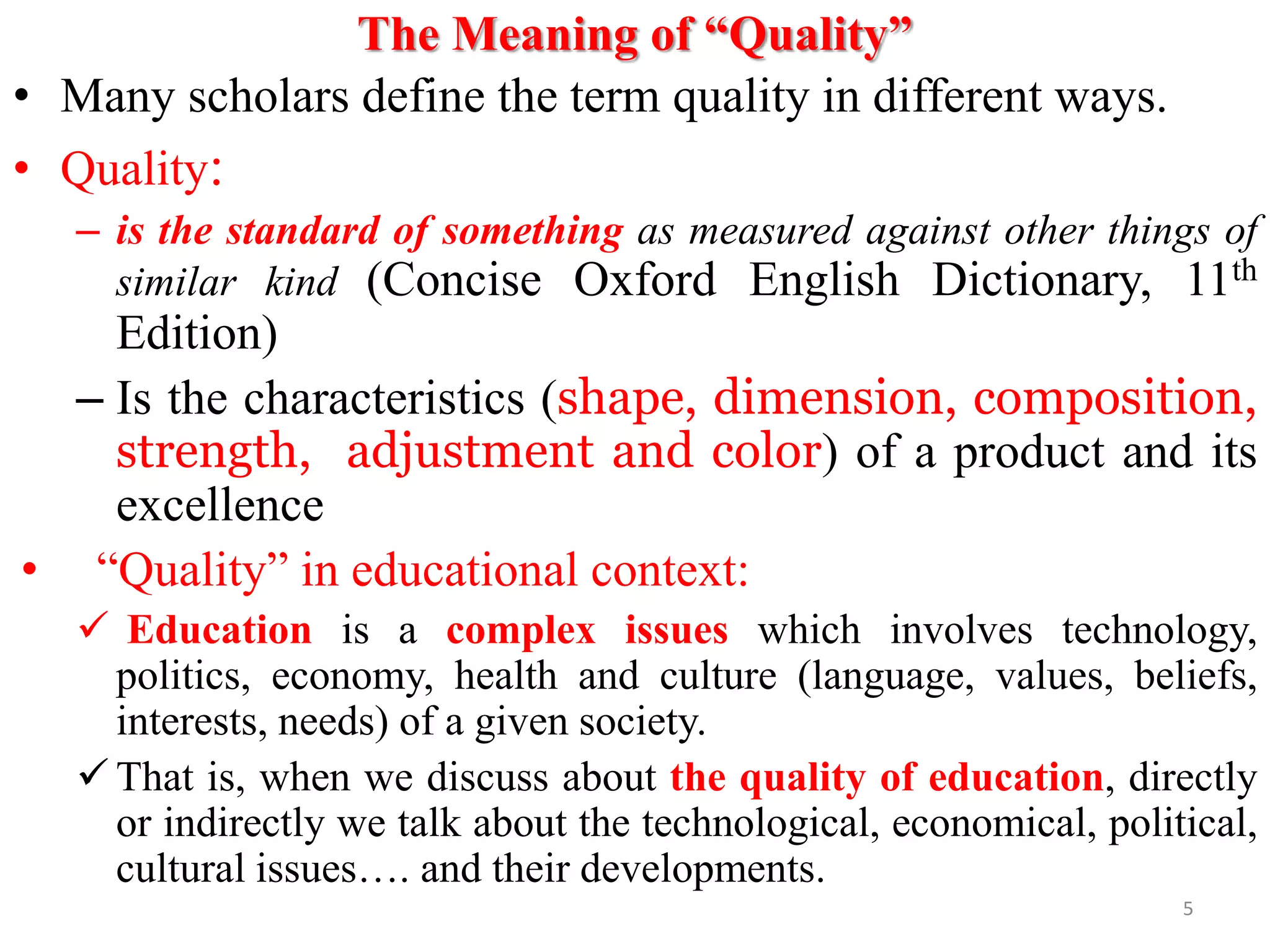
The Meaning of “Quality”
• Many scholars define the term quality in different ways.
• Quality:
– is the standard of something as measured against other things of
similar kind (Concise Oxford English Dictionary, 11th
Edition)
– Is the characteristics (shape, dimension, composition,
strength, adjustment and color) of a product and its
excellence
• “Quality” in educational context:
 Education is a complex issues which involves technology,
politics, economy, health and culture (language, values, beliefs,
interests, needs) of a given society.
 That is, when we discuss about the quality of education, directly
or indirectly we talk about the technological, economical, political,
cultural issues…. and their developments.
5
“Quality” in the context of education
 It has similar meaning with the following terms
 Efficiency: Performing or functioning in the best possible manner
with the least waste of time and effort. It occurs when outputs from
education (such as test results or value added) are produced at the
lowest level of resource.
 Effectiveness: Accomplishing a purpose of education and achieving
its expected result adequately.
 Relevance: Learning experiences that are either directly applicable
to the personal aspirations, interests, or cultural experiences of
students (personal relevance) or that are connected in some way to
real-world issues, problems, and contexts
 Equity: Relatively same or equal distribution or access to
educational opportunities.
 the concept quality is open to change based on the changing
contexts, needs and challenges in both local and global
society. Quality is a relative term and is never absolute
depending upon circumstances under which it is used.
6
Major Factors Influencing the Quality of Education in
General and Higher Education in Particular
Quality of
Education
Teachers
Parents
Learners
LeadershipEnvironments
Teaching/
assessment
methods
Curriculum
7
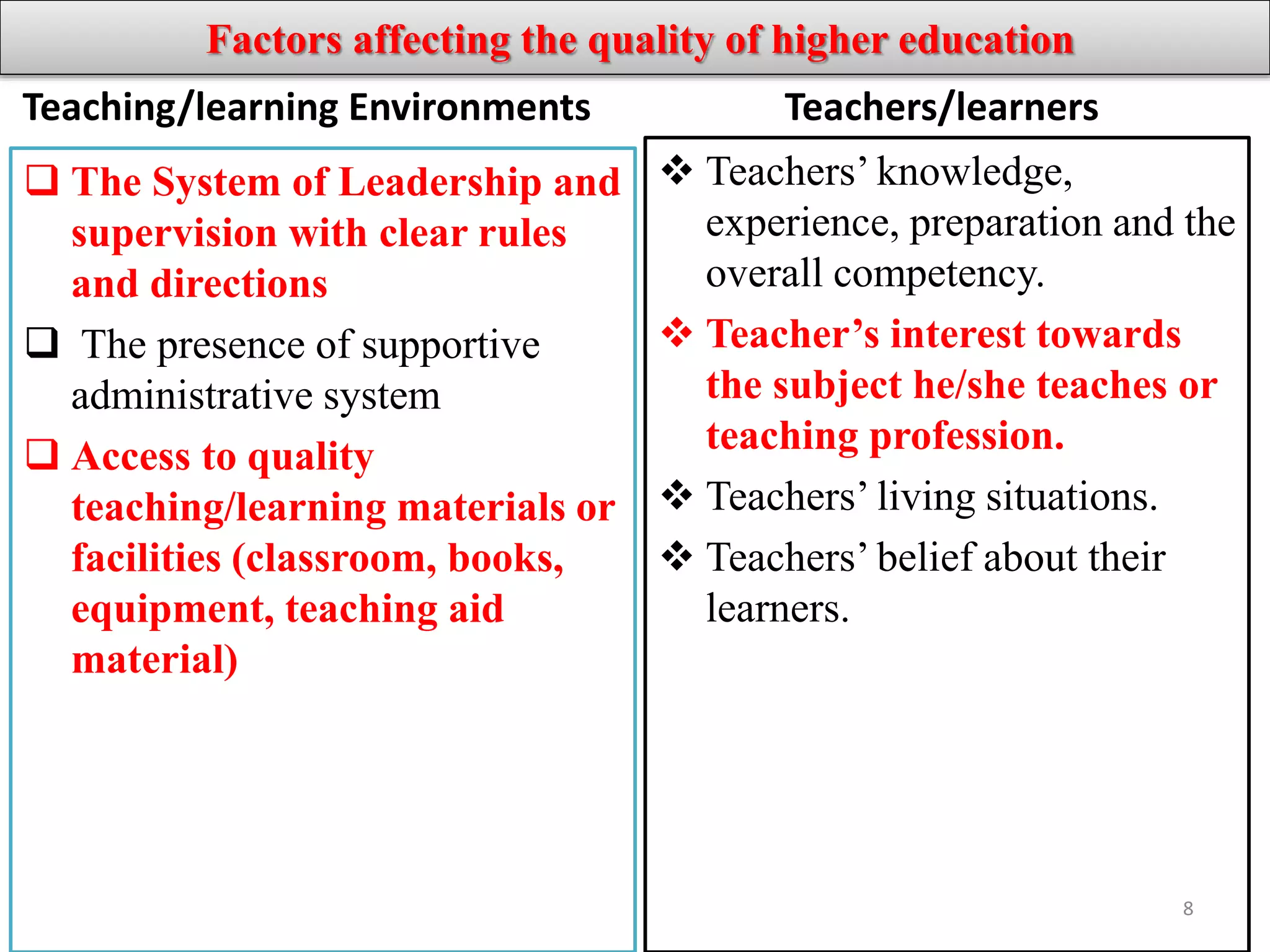
Factors affecting the quality of higher education
Teaching/learning Environments
 The System of Leadership and
supervision with clear rules
and directions
 The presence of supportive
administrative system
 Access to quality
teaching/learning materials or
facilities (classroom, books,
equipment, teaching aid
material)
Teachers/learners
 Teachers’ knowledge,
experience, preparation and the
overall competency.
 Teacher’s interest towards
the subject he/she teaches or
teaching profession.
 Teachers’ living situations.
 Teachers’ belief about their
learners.
8
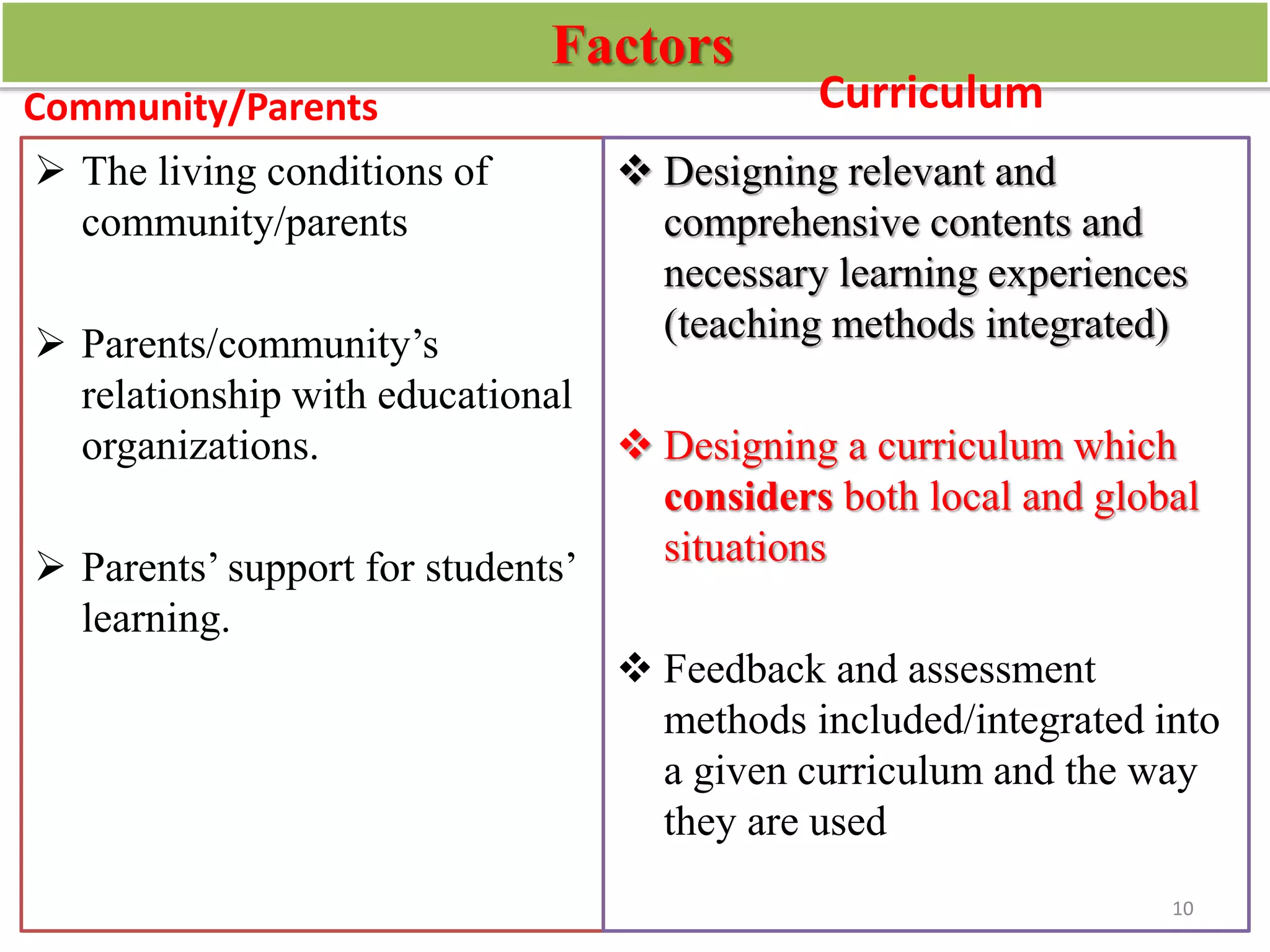
Factors
Environments
 The existence of peaceful or
safe environments for all
teachers, learners and others
individuals
 The existence of inclusive
environments at classrooms
 Teachers-learners-leadership
relationship
Teachers/learners
 Teachers-learners relationship.
 Teachers-teachers relationship.
 Learners’ interest towards
education (specific subject).
 Learners’ regular attendance in
the classroom.
 The amount of time which
students and teachers use for
doing a given task.
 Instructional language used in
CR.
9
Factors
Community/Parents
 The living conditions of
community/parents
 Parents/community’s
relationship with educational
organizations.
 Parents’ support for students’
learning.
Curriculum
 Designing relevant and
comprehensive contents and
necessary learning experiences
(teaching methods integrated)
 Designing a curriculum which
considers both local and global
situations
 Feedback and assessment
methods included/integrated into
a given curriculum and the way
they are used
10
Conclusion
Activity:
Identify four key factors which are highly affecting the
quality of higher education currently in Ethiopian context?
Rank and put them in order. (Refer back to your previous
discussion and presentation made)
The first key
factor
Third key factor
Second key factor
Forth key factor
11

Quality of education: Overview

  • 1.
    The Quality ofEducation: (A Draft Guideline for Training) Eyob Milkias Department of Curriculum and Instruction
  • 2.
    The Quality ofEducation Session objectives: after the end of this session, the candidates will be able to  Describe the term “quality” in the context of education and  Elaborate both internal and external factors influencing the quality of higher education in Ethiopia. Activities for candidates 1) How do you understand the term “quality” in the context of education? 2) What are the internal factors which influence the quality of higher education in Ethiopia? 3) What are the external factors which influence the quality of higher education in Ethiopia? 2
  • 3.
    Origin of qualityconcept in Education • The concept of quality was emerged during the age of Industrialization (19th century).  Focused on a massive production of products rather than its quality  Detecting products with low value/defects  Avoiding/removing products with low value/high defects  Identifying, selling/buying and consuming products with high value/low defects • 1940s … Quality Control  Introduction of the concept Quality Control in industry.  Quality Control is a system of maintaining standards in manufactured products by testing a sample of the output against the specification.  Quality Control is the process of checking to determine whether proper progress is being made towards the objectives and goals or not.  Shifted the responsibility of checking quality from workers to process or systems in organizations  Focused on detecting defective products in factories/industries  Focused on stopping defective products from reaching the customers 3
  • 4.
    • 1960s … There was shift from statistical process control to assuring the quality of products. Quality Assurance: is a process of measuring and assuring the effectiveness of overall activities done and products produced.  Its main or first focus was reducing or avoiding the production of defective products. • 1980s…  Lead to the emergence of Total Quality Management (TQM).  TQM is a continuous effort taken by the management as well as employees of a particular organization to ensure long term customer loyalty and customer satisfaction. 4
  • 5.
    The Meaning of“Quality” • Many scholars define the term quality in different ways. • Quality: – is the standard of something as measured against other things of similar kind (Concise Oxford English Dictionary, 11th Edition) – Is the characteristics (shape, dimension, composition, strength, adjustment and color) of a product and its excellence • “Quality” in educational context:  Education is a complex issues which involves technology, politics, economy, health and culture (language, values, beliefs, interests, needs) of a given society.  That is, when we discuss about the quality of education, directly or indirectly we talk about the technological, economical, political, cultural issues…. and their developments. 5
  • 6.
    “Quality” in thecontext of education  It has similar meaning with the following terms  Efficiency: Performing or functioning in the best possible manner with the least waste of time and effort. It occurs when outputs from education (such as test results or value added) are produced at the lowest level of resource.  Effectiveness: Accomplishing a purpose of education and achieving its expected result adequately.  Relevance: Learning experiences that are either directly applicable to the personal aspirations, interests, or cultural experiences of students (personal relevance) or that are connected in some way to real-world issues, problems, and contexts  Equity: Relatively same or equal distribution or access to educational opportunities.  the concept quality is open to change based on the changing contexts, needs and challenges in both local and global society. Quality is a relative term and is never absolute depending upon circumstances under which it is used. 6
  • 7.
    Major Factors Influencingthe Quality of Education in General and Higher Education in Particular Quality of Education Teachers Parents Learners LeadershipEnvironments Teaching/ assessment methods Curriculum 7
  • 8.
    Factors affecting thequality of higher education Teaching/learning Environments  The System of Leadership and supervision with clear rules and directions  The presence of supportive administrative system  Access to quality teaching/learning materials or facilities (classroom, books, equipment, teaching aid material) Teachers/learners  Teachers’ knowledge, experience, preparation and the overall competency.  Teacher’s interest towards the subject he/she teaches or teaching profession.  Teachers’ living situations.  Teachers’ belief about their learners. 8
  • 9.
    Factors Environments  The existenceof peaceful or safe environments for all teachers, learners and others individuals  The existence of inclusive environments at classrooms  Teachers-learners-leadership relationship Teachers/learners  Teachers-learners relationship.  Teachers-teachers relationship.  Learners’ interest towards education (specific subject).  Learners’ regular attendance in the classroom.  The amount of time which students and teachers use for doing a given task.  Instructional language used in CR. 9
  • 10.
    Factors Community/Parents  The livingconditions of community/parents  Parents/community’s relationship with educational organizations.  Parents’ support for students’ learning. Curriculum  Designing relevant and comprehensive contents and necessary learning experiences (teaching methods integrated)  Designing a curriculum which considers both local and global situations  Feedback and assessment methods included/integrated into a given curriculum and the way they are used 10
  • 11.
    Conclusion Activity: Identify four keyfactors which are highly affecting the quality of higher education currently in Ethiopian context? Rank and put them in order. (Refer back to your previous discussion and presentation made) The first key factor Third key factor Second key factor Forth key factor 11