Faculty of Education
Integral University
Lucknow, India
Value Added Course
On
“Inclusive Education in India:
Principles and Practices”
(EDV-24-02)
21st February 2025 to 11th March
2025
MODULE I: Understanding
Inclusive Education
Resource Person: Dr. Bushra Sumaiya Assistant
Professor
Faculty of Education
Integral University
The objective of this module is to develop a
comprehensive understanding of inclusive education by
exploring its concepts, principles, historical and
international perspectives, models of disability, diversity
dimensions, and the legal and policy framework in the
Indian context.
OBJECTIVE
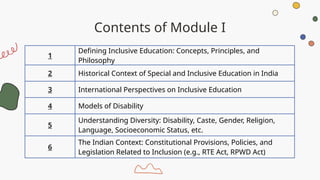
Contents of Module I
1
Defining Inclusive Education: Concepts, Principles, and
Philosophy
2 Historical Context of Special and Inclusive Education in India
3 International Perspectives on Inclusive Education
4 Models of Disability
5
Understanding Diversity: Disability, Caste, Gender, Religion,
Language, Socioeconomic Status, etc.
6
The Indian Context: Constitutional Provisions, Policies, and
Legislation Related to Inclusion (e.g., RTE Act, RPWD Act)
DAY 1
All About Today’s Lecture
International
Perspectives on
Inclusive Education
Defining Inclusive
Education: Concepts,
Principles, and
Philosophy
Historical Context of
Special and Inclusive
Education in India
Discussion
01
03
02
04
Introduction
Inclusive education ensures that all learners,
regardless of their abilities or backgrounds,
receive equitable access to quality education
within a common learning environment.
Standard Definition of Inclusive Education
Salamanca Statement
(1994): “Schools should
accommodate all children,
regardless of their
physical, intellectual,
social, emotional,
linguistic, or other
conditions, ensuring equal
access and participation in
education.”
UNESCO (2009): “Inclusive
education is a process that
involves transforming schools
and other centers of learning
to cater to all learners,
regardless of their physical,
intellectual, social, emotional,
linguistic, or other conditions.”
Concept of Inclusive Education
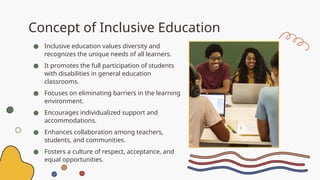
● Inclusive education values diversity and
recognizes the unique needs of all learners.
● It promotes the full participation of students
with disabilities in general education
classrooms.
● Focuses on eliminating barriers in the learning
environment.
● Encourages individualized support and
accommodations.
● Enhances collaboration among teachers,
students, and communities.
● Fosters a culture of respect, acceptance, and
equal opportunities.
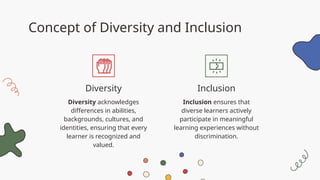
Concept of Diversity and Inclusion
Inclusion ensures that
diverse learners actively
participate in meaningful
learning experiences without
discrimination.
Diversity acknowledges
differences in abilities,
backgrounds, cultures, and
identities, ensuring that every
learner is recognized and
valued.
Diversity Inclusion
Principles of Inclusive Education
● Equal access to education for all.
● Acceptance and respect for diversity.
● Zero discrimination and removal of
barriers.
● Flexible and adaptive teaching methods.
● Collaboration among teachers, parents,
and community members.
● Holistic development of every student.
● Provision of necessary resources and
accommodations.
Philosophical Underpinnings of Inclusive Education
● Human Rights Perspective – Education as a
fundamental right.
● Social Justice Approach – Equal opportunities
for all.
● Constructivist Learning Theory – Learning is
active and personalized.
● Democratic Values – Equity, participation,
and mutual respect.
● Empowerment Theory – Fostering
independence and self-advocacy.
● Universal Design for Learning (UDL) –
Flexible learning strategies for diverse needs.
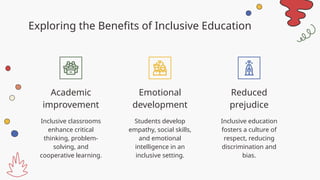
Exploring the Benefits of Inclusive Education
Inclusive classrooms
enhance critical
thinking, problem-
solving, and
cooperative learning.
Students develop
empathy, social skills,
and emotional
intelligence in an
inclusive setting.
Inclusive education
fosters a culture of
respect, reducing
discrimination and
bias.
Academic
improvement
Emotional
development
Reduced
prejudice
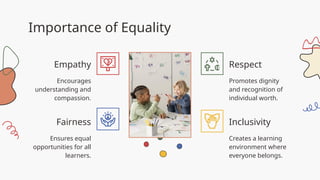
Importance of Equality
Encourages
understanding and
compassion.
Promotes dignity
and recognition of
individual worth.
Ensures equal
opportunities for all
learners.
Creates a learning
environment where
everyone belongs.
Empathy
Fairness
Respect
Inclusivity
Addressing inequalities
in the education
system.
Enabling students to
reach their full
potential.
Educating with Equality
Ensuring every child
receives an education.
Fostering holistic
development and
lifelong learning.
Cultivating ethics,
tolerance, and
responsibility.
Promoting well-being
and self-confidence.
Human rights Social justice Empowerment
Growth Values Happiness
Awesome words
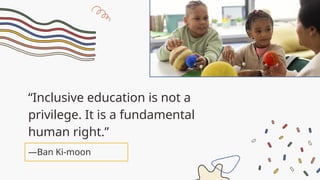
“Inclusive education is not a
privilege. It is a fundamental
human right.”
—Ban Ki-moon
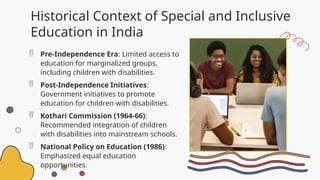
Historical Context of Special and Inclusive
Education in India
 Pre-Independence Era: Limited access to
education for marginalized groups,
including children with disabilities.
 Post-Independence Initiatives:
Government initiatives to promote
education for children with disabilities.
 Kothari Commission (1964-66):
Recommended integration of children
with disabilities into mainstream schools.
 National Policy on Education (1986):
Emphasized equal education
opportunities.
Historical Context of Special and Inclusive
Education in India
 Rehabilitation Council of India Act
(1992): Established standards for special
education training.
 Sarva Shiksha Abhiyan (2001):
Integrated disabled children into
mainstream schools.
 Right to Education Act (2009): Mandated
inclusive education for all children.
 RPWD Act (2016): Strengthened legal
support for inclusive education.
International Perspectives on Inclusive
Education
 Salamanca Statement (1994) –
Framework for inclusive education
worldwide.
 UNESCO’s Education for All (2000) –
Ensured equitable learning opportunities.
 Convention on the Rights of Persons
with Disabilities (2006) – Emphasized
inclusion as a right.
 Sustainable Development Goal 4 (2015)
– Promotes inclusive and equitable
quality education.
International Perspectives on Inclusive
Education
 Finland's Education System –
Emphasizes individual learning plans for
students.
 Canada’s Approach – Strong policy
framework for inclusive learning.
 Australia’s Disability Standards for
Education (2005) – Enforces accessibility
and support.
Open-Ended Discussion Question
What are the biggest challenges in implementing
inclusive education in India, and how can we
overcome them?
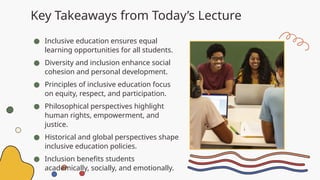
Key Takeaways from Today’s Lecture
● Inclusive education ensures equal
learning opportunities for all students.
● Diversity and inclusion enhance social
cohesion and personal development.
● Principles of inclusive education focus
on equity, respect, and participation.
● Philosophical perspectives highlight
human rights, empowerment, and
justice.
● Historical and global perspectives shape
inclusive education policies.
● Inclusion benefits students
academically, socially, and emotionally.
THANK YOU

1. Understanding Inclusive Education.pptx

  • 1.
    Faculty of Education IntegralUniversity Lucknow, India Value Added Course On “Inclusive Education in India: Principles and Practices” (EDV-24-02) 21st February 2025 to 11th March 2025
  • 2.
    MODULE I: Understanding InclusiveEducation Resource Person: Dr. Bushra Sumaiya Assistant Professor Faculty of Education Integral University
  • 3.
    The objective ofthis module is to develop a comprehensive understanding of inclusive education by exploring its concepts, principles, historical and international perspectives, models of disability, diversity dimensions, and the legal and policy framework in the Indian context. OBJECTIVE
  • 4.
    Contents of ModuleI 1 Defining Inclusive Education: Concepts, Principles, and Philosophy 2 Historical Context of Special and Inclusive Education in India 3 International Perspectives on Inclusive Education 4 Models of Disability 5 Understanding Diversity: Disability, Caste, Gender, Religion, Language, Socioeconomic Status, etc. 6 The Indian Context: Constitutional Provisions, Policies, and Legislation Related to Inclusion (e.g., RTE Act, RPWD Act)
  • 5.
  • 6.
    All About Today’sLecture International Perspectives on Inclusive Education Defining Inclusive Education: Concepts, Principles, and Philosophy Historical Context of Special and Inclusive Education in India Discussion 01 03 02 04
  • 7.
    Introduction Inclusive education ensuresthat all learners, regardless of their abilities or backgrounds, receive equitable access to quality education within a common learning environment.
  • 8.
    Standard Definition ofInclusive Education Salamanca Statement (1994): “Schools should accommodate all children, regardless of their physical, intellectual, social, emotional, linguistic, or other conditions, ensuring equal access and participation in education.” UNESCO (2009): “Inclusive education is a process that involves transforming schools and other centers of learning to cater to all learners, regardless of their physical, intellectual, social, emotional, linguistic, or other conditions.”
  • 9.
    Concept of InclusiveEducation ● Inclusive education values diversity and recognizes the unique needs of all learners. ● It promotes the full participation of students with disabilities in general education classrooms. ● Focuses on eliminating barriers in the learning environment. ● Encourages individualized support and accommodations. ● Enhances collaboration among teachers, students, and communities. ● Fosters a culture of respect, acceptance, and equal opportunities.
  • 10.
    Concept of Diversityand Inclusion Inclusion ensures that diverse learners actively participate in meaningful learning experiences without discrimination. Diversity acknowledges differences in abilities, backgrounds, cultures, and identities, ensuring that every learner is recognized and valued. Diversity Inclusion
  • 11.
    Principles of InclusiveEducation ● Equal access to education for all. ● Acceptance and respect for diversity. ● Zero discrimination and removal of barriers. ● Flexible and adaptive teaching methods. ● Collaboration among teachers, parents, and community members. ● Holistic development of every student. ● Provision of necessary resources and accommodations.
  • 12.
    Philosophical Underpinnings ofInclusive Education ● Human Rights Perspective – Education as a fundamental right. ● Social Justice Approach – Equal opportunities for all. ● Constructivist Learning Theory – Learning is active and personalized. ● Democratic Values – Equity, participation, and mutual respect. ● Empowerment Theory – Fostering independence and self-advocacy. ● Universal Design for Learning (UDL) – Flexible learning strategies for diverse needs.
  • 13.
    Exploring the Benefitsof Inclusive Education Inclusive classrooms enhance critical thinking, problem- solving, and cooperative learning. Students develop empathy, social skills, and emotional intelligence in an inclusive setting. Inclusive education fosters a culture of respect, reducing discrimination and bias. Academic improvement Emotional development Reduced prejudice
  • 14.
    Importance of Equality Encourages understandingand compassion. Promotes dignity and recognition of individual worth. Ensures equal opportunities for all learners. Creates a learning environment where everyone belongs. Empathy Fairness Respect Inclusivity
  • 15.
    Addressing inequalities in theeducation system. Enabling students to reach their full potential. Educating with Equality Ensuring every child receives an education. Fostering holistic development and lifelong learning. Cultivating ethics, tolerance, and responsibility. Promoting well-being and self-confidence. Human rights Social justice Empowerment Growth Values Happiness
  • 16.
  • 17.
    “Inclusive education isnot a privilege. It is a fundamental human right.” —Ban Ki-moon
  • 18.
    Historical Context ofSpecial and Inclusive Education in India  Pre-Independence Era: Limited access to education for marginalized groups, including children with disabilities.  Post-Independence Initiatives: Government initiatives to promote education for children with disabilities.  Kothari Commission (1964-66): Recommended integration of children with disabilities into mainstream schools.  National Policy on Education (1986): Emphasized equal education opportunities.
  • 19.
    Historical Context ofSpecial and Inclusive Education in India  Rehabilitation Council of India Act (1992): Established standards for special education training.  Sarva Shiksha Abhiyan (2001): Integrated disabled children into mainstream schools.  Right to Education Act (2009): Mandated inclusive education for all children.  RPWD Act (2016): Strengthened legal support for inclusive education.
  • 20.
    International Perspectives onInclusive Education  Salamanca Statement (1994) – Framework for inclusive education worldwide.  UNESCO’s Education for All (2000) – Ensured equitable learning opportunities.  Convention on the Rights of Persons with Disabilities (2006) – Emphasized inclusion as a right.  Sustainable Development Goal 4 (2015) – Promotes inclusive and equitable quality education.
  • 21.
    International Perspectives onInclusive Education  Finland's Education System – Emphasizes individual learning plans for students.  Canada’s Approach – Strong policy framework for inclusive learning.  Australia’s Disability Standards for Education (2005) – Enforces accessibility and support.
  • 22.
    Open-Ended Discussion Question Whatare the biggest challenges in implementing inclusive education in India, and how can we overcome them?
  • 23.
    Key Takeaways fromToday’s Lecture ● Inclusive education ensures equal learning opportunities for all students. ● Diversity and inclusion enhance social cohesion and personal development. ● Principles of inclusive education focus on equity, respect, and participation. ● Philosophical perspectives highlight human rights, empowerment, and justice. ● Historical and global perspectives shape inclusive education policies. ● Inclusion benefits students academically, socially, and emotionally.
  • 24.