 MEANING OF INCLUSIVE EDUCATION
 DEFINITION OF INCLUSIVE EDUCATION
 OBJECTIVE OF INCLUSIVE EDUCATION
 TARGET GROUP
 CHALLENGES & STRATEGIES OF INCLUSIVE
EDUCATION
 ROLE OF TEACHER
 BENEFITS OF INCLUSION (SUBJECT WISE)
 BENEFITS OF INCLUSION (YEAR WISE)
 CONCLUSION
 BIBLIOGRAPHY
 It is term inclusion is an International buzz word in education
and Indian education has no exception.
 The Universal Declaration of human rights, the United Nations
General Assembly charter, and United Nations Convention on
the rights of the child all acknowledged education as a human
right.
 It may also be seen as a continuing process of breaking down
barriers to learning and participation for all children and young
people.
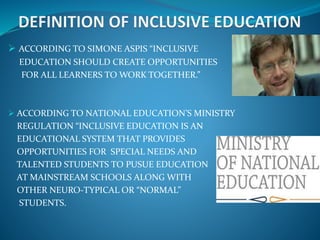
 ACCORDING TO SIMONE ASPIS “INCLUSIVE
EDUCATION SHOULD CREATE OPPORTUNITIES
FOR ALL LEARNERS TO WORK TOGETHER.”
 ACCORDING TO NATIONAL EDUCATION’S MINISTRY
REGULATION “INCLUSIVE EDUCATION IS AN
EDUCATIONAL SYSTEM THAT PROVIDES
OPPORTUNITIES FOR SPECIAL NEEDS AND
TALENTED STUDENTS TO PUSUE EDUCATION
AT MAINSTREAM SCHOOLS ALONG WITH
OTHER NEURO-TYPICAL OR “NORMAL”
STUDENTS.
 To ensure that no child is denied admission in mainstream
education.
 To ensure that every child would have the right to access an
Aanganwadi and school.
 To ensure that mainstream and specialist training institutions
serving persons with disabilities in govt. and non-govt. sector.
 To provide home based learning.
 To promote distance education.
 To facilitate access of disabled student from rural and remote
area.
 To emphasize job-teaching and job-oriented vocational
training.
 To promote an understanding of the paradigm shift from
charity to development.
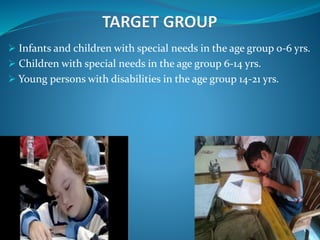
 Infants and children with special needs in the age group 0-6 yrs.
 Children with special needs in the age group 6-14 yrs.
 Young persons with disabilities in the age group 14-21 yrs.
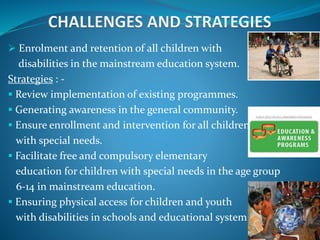
 Enrolment and retention of all children with
disabilities in the mainstream education system.
Strategies : -
 Review implementation of existing programmes.
 Generating awareness in the general community.
 Ensure enrollment and intervention for all children
with special needs.
 Facilitate free and compulsory elementary
education for children with special needs in the age group
6-14 in mainstream education.
 Ensuring physical access for children and youth
with disabilities in schools and educational system.
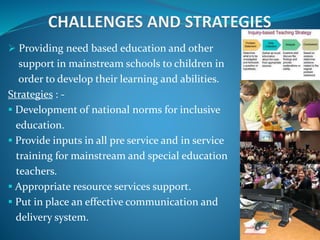
 Providing need based education and other
support in mainstream schools to children in
order to develop their learning and abilities.
Strategies : -
 Development of national norms for inclusive
education.
 Provide inputs in all pre service and in service
training for mainstream and special education
teachers.
 Appropriate resource services support.
 Put in place an effective communication and
delivery system.
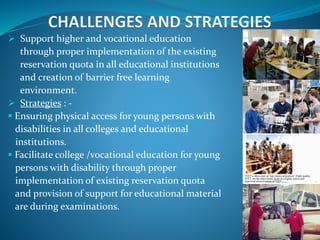
 Support higher and vocational education
through proper implementation of the existing
reservation quota in all educational institutions
and creation of barrier free learning
environment.
 Strategies : -
 Ensuring physical access for young persons with
disabilities in all colleges and educational
institutions.
 Facilitate college /vocational education for young
persons with disability through proper
implementation of existing reservation quota
and provision of support for educational material
are during examinations.
 Disability focused research and interventions in universities
and educational institutions.
 Strategies : -
 Setting up of centers for disability studies and
chair disability studies in universities.
 Supporting research in areas related to inclusive practices.
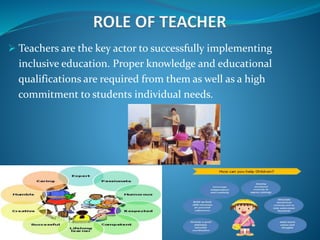
 Teachers are the key actor to successfully implementing
inclusive education. Proper knowledge and educational
qualifications are required from them as well as a high
commitment to students individual needs.
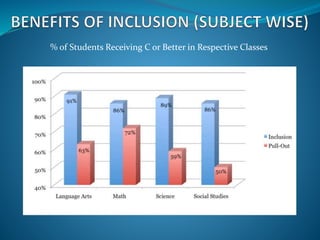
% of Students Receiving C or Better in Respective Classes
% of Students’ Grades Improving Over 1-year Period
 Enrolment and retention of all children with disabilities.
 Providing need based education and other support in
mainstream schools to children.
 Support higher and vocational education through proper
implementation.
 Disability focused research and interventions in universities
and educational institutions.
 http://www.education.nic.in/INCLUSIVE.asp
 ThakurA.S.and Berwal S “Development of learner and teaching
learning process” Agarwal publications, Agra.
 Singh.V “Technology based social inclusion for children with special
needs” Learning CommunityVol.1 no.1 June 2010
 Oza D.and Madhvi R.L. “Developmental challenges of special groups
and technological determinism. University News Vol48oct.2010
 EENET (1998) Inclusive education: Making a difference A report of an
International Disability and Development Consortium seminar, Agra.
 Finkelstein, V (1992) Issues in the Terminology of Disability: A
synposis. An edited version of a paper submitted to the Open University
Advisory Committee on Students with Disabilities Milton Keynes:Open
University
 Finkelstein, V & Stuart, O (1996) 'Developing New Services' in Hales, G
(ed), Beyond Disability: Towards an Enabling Society London: Sage