WEB 2.0
A Bubble?    ...A bubble? Bubble?
                        ...A
...A Bubble?
“Web 2.0 is a group of economically, socially, and
technologically driven changes in attitudes, tools, and
applications that are allowing the Web to become the
next platform for communication, collaboration,
community, and cumulative learning.”
Web 2.0 characteristics

• Web is the platform
• The read-write web (as distinct from the read-only web)
• Data comes from users, often many users
• Data stored somewhere outside of your direct control
• Sometimes data combined from multiple sources – XML
  data assists this
• Authentication taken care of by site (and often transferable
  eg Google, Gmail, etc)
• Often AJAX-based (Asynchronous Javascript and
  XML..ability to process in browser without perceptible lag).
5
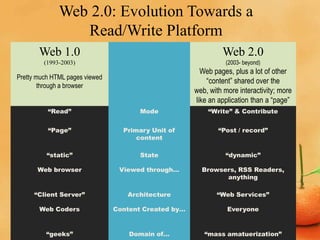
Web 2.0: Evolution Towards a
                 Read/Write Platform
       Web 1.0                                                 Web 2.0
         (1993-2003)                                            (2003- beyond)
                                                        Web pages, plus a lot of other
Pretty much HTML pages viewed
                                                          “content” shared over the
        through a browser
                                                      web, with more interactivity; more
                                                      like an application than a “page”
          “Read”                       Mode               “Write” & Contribute


          “Page”                  Primary Unit of             “Post / record”
                                      content

          “static”                     State                    “dynamic”

       Web browser               Viewed through…        Browsers, RSS Readers,
                                                              anything

     “Client Server”               Architecture              “Web Services”

       Web Coders               Content Created by…              Everyone


         “geeks”
             Cuene.com/mima         Domain of…           “mass amatuerization”
Metaphors
• Web 1.0 – web as digital library, largely a
  source of information for students. Strive for
  content to be authoritative.

• Web 2.0 – web as place for students to build
  knowledge, interact, share ideas/ Resulting
  content treated accordingly.


8
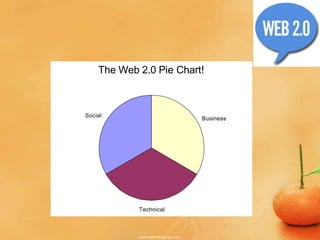
The Web 2.0 Pie Chart!


Social
                         Business


            Technical
Social Trends
• Spread of Broadband

    – Increasingly ubiquitous connections

• A generation of “web natives”

    – Living on the web
    – Social networking; blogging; instant messenger

• Create, not just consume

• Some hard lessons about data ownership

    – Don’t steal my data; don’t lock me in
Business Trends
• Exploit the Long Tail
   – At internet scale even niche communities are very large

    – “We sold more books today that we didn't sell at all yesterday, than we sold
      today of all the books that did sell yesterday.”
            – Amazon employee quoted on Wikipedia

• Success of web services

    – No need to own the user interface. It's your data that they want

• Users can enrich your data

    – “Harnessing collective intelligence of users”
    – Review and Recommend; Social Bookmarking; Folksonomies
Technology Trends
• The Power of XML
   – Easier to exchange and process application independent data

• Agile Engineering

    – Incrementally developer your product; short release cycles
    – Continually adapt to user needs

    – “The Perpetual Beta”

• Maturation of the browser

    – XHTML, DOM, CSS, Javascript

    – Browser as platform, not just document viewer
Students are using Web 2.0
                  now
•    Blogs,e.g. Blogspot, Blogger, Mo’time,
•    Social network software, e.g. Myspace, Facebook,
•    Tagged photo stores, e.g. Flickr
•    Del.icio.us
•    Wikis,e.g. Wikipedia
•    Communication networks, e.g. Skype
•    News and audio services, e.g. podcasts and hosted
     video


13
Flickr
                     http://www.flickr.com/

• Simple photo-storing and sharing site
• Tagging by users
• As always educators find unexpected ways to use it


•   16 ways to use
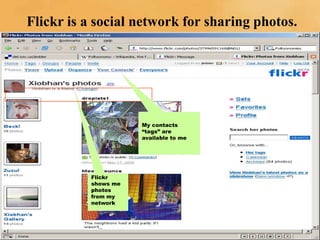
Flickr is a social network for sharing photos.


                            My contacts
                            “tags” are
                            available to me


                 Flickr
                 shows me
                 photos
                 from my
                 network


Cuene.com/mima
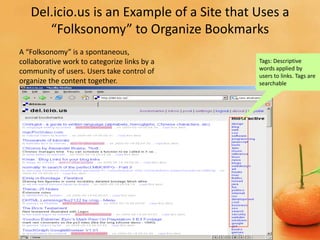
Del.icio.us is an Example of a Site that Uses a
       “Folksonomy” to Organize Bookmarks
A “Folksonomy” is a spontaneous,
collaborative work to categorize links by a   Tags: Descriptive
                                              words applied by
community of users. Users take control of
                                              users to links. Tags are
organize the content together.                searchable


Cuene.com/mima
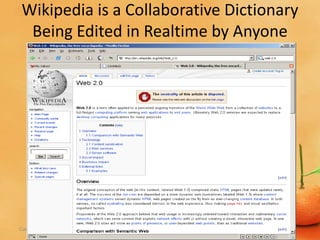
Wikipedia is a Collaborative Dictionary
 Being Edited in Realtime by Anyone


Cuene.com/mima
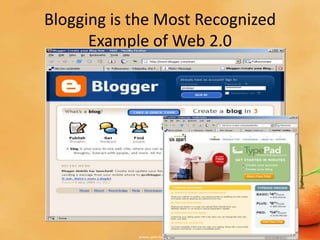
Blogging is the Most Recognized
      Example of Web 2.0
Summing Up
• Web 2.0 hard to define, but very far from just hype

    – Culmination of a number of web trends

• Importance of Open Data

    – Allows communities to assemble unique tailored applications

• Importance of Users

    – Seek and create network effects

• Browser as Application Platform

    – Huge potential for new kinds of web applications
Lokesh Kumar

web 2.0

  • 1.
  • 3.
    A Bubble? ...A bubble? Bubble? ...A ...A Bubble?
  • 4.
    “Web 2.0 isa group of economically, socially, and technologically driven changes in attitudes, tools, and applications that are allowing the Web to become the next platform for communication, collaboration, community, and cumulative learning.”
  • 5.
    Web 2.0 characteristics •Web is the platform • The read-write web (as distinct from the read-only web) • Data comes from users, often many users • Data stored somewhere outside of your direct control • Sometimes data combined from multiple sources – XML data assists this • Authentication taken care of by site (and often transferable eg Google, Gmail, etc) • Often AJAX-based (Asynchronous Javascript and XML..ability to process in browser without perceptible lag). 5
  • 7.
    Web 2.0: EvolutionTowards a Read/Write Platform Web 1.0 Web 2.0 (1993-2003) (2003- beyond) Web pages, plus a lot of other Pretty much HTML pages viewed “content” shared over the through a browser web, with more interactivity; more like an application than a “page” “Read” Mode “Write” & Contribute “Page” Primary Unit of “Post / record” content “static” State “dynamic” Web browser Viewed through… Browsers, RSS Readers, anything “Client Server” Architecture “Web Services” Web Coders Content Created by… Everyone “geeks” Cuene.com/mima Domain of… “mass amatuerization”
  • 8.
    Metaphors • Web 1.0– web as digital library, largely a source of information for students. Strive for content to be authoritative. • Web 2.0 – web as place for students to build knowledge, interact, share ideas/ Resulting content treated accordingly. 8
  • 9.
    The Web 2.0Pie Chart! Social Business Technical
  • 10.
    Social Trends • Spreadof Broadband – Increasingly ubiquitous connections • A generation of “web natives” – Living on the web – Social networking; blogging; instant messenger • Create, not just consume • Some hard lessons about data ownership – Don’t steal my data; don’t lock me in
  • 11.
    Business Trends • Exploitthe Long Tail – At internet scale even niche communities are very large – “We sold more books today that we didn't sell at all yesterday, than we sold today of all the books that did sell yesterday.” – Amazon employee quoted on Wikipedia • Success of web services – No need to own the user interface. It's your data that they want • Users can enrich your data – “Harnessing collective intelligence of users” – Review and Recommend; Social Bookmarking; Folksonomies
  • 12.
    Technology Trends • ThePower of XML – Easier to exchange and process application independent data • Agile Engineering – Incrementally developer your product; short release cycles – Continually adapt to user needs – “The Perpetual Beta” • Maturation of the browser – XHTML, DOM, CSS, Javascript – Browser as platform, not just document viewer
  • 13.
    Students are usingWeb 2.0 now • Blogs,e.g. Blogspot, Blogger, Mo’time, • Social network software, e.g. Myspace, Facebook, • Tagged photo stores, e.g. Flickr • Del.icio.us • Wikis,e.g. Wikipedia • Communication networks, e.g. Skype • News and audio services, e.g. podcasts and hosted video 13
  • 15.
    Flickr http://www.flickr.com/ • Simple photo-storing and sharing site • Tagging by users • As always educators find unexpected ways to use it • 16 ways to use
  • 16.
    Flickr is asocial network for sharing photos. My contacts “tags” are available to me Flickr shows me photos from my network Cuene.com/mima
  • 17.
    Del.icio.us is anExample of a Site that Uses a “Folksonomy” to Organize Bookmarks A “Folksonomy” is a spontaneous, collaborative work to categorize links by a Tags: Descriptive words applied by community of users. Users take control of users to links. Tags are organize the content together. searchable Cuene.com/mima
  • 18.
    Wikipedia is aCollaborative Dictionary Being Edited in Realtime by Anyone Cuene.com/mima
  • 19.
    Blogging is theMost Recognized Example of Web 2.0
  • 20.
    Summing Up • Web2.0 hard to define, but very far from just hype – Culmination of a number of web trends • Importance of Open Data – Allows communities to assemble unique tailored applications • Importance of Users – Seek and create network effects • Browser as Application Platform – Huge potential for new kinds of web applications
  • 21.