Human-centered AI: how can we support lay
users to understand AI?
NEC labs Europe - 24 Oct 2022
Katrien Verbert
Augment/HCI - KU Leuven
@katrien_v
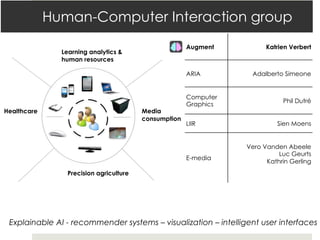
Human-Computer Interaction group
Explainable AI - recommender systems – visualization – intelligent user interfaces
Learning analytics &
human resources
Media
consumption
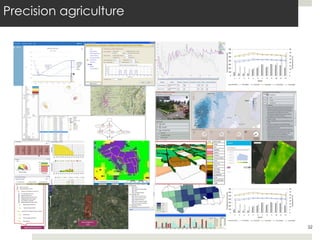
Precision agriculture
Healthcare
Augment Katrien Verbert
ARIA Adalberto Simeone
Computer
Graphics
Phil Dutré
LIIR Sien Moens
E-media
Vero Vanden Abeele
Luc Geurts
Kathrin Gerling
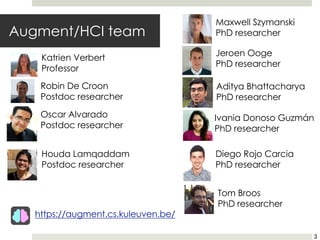
Augment/HCI team
Robin De Croon
Postdoc researcher
Katrien Verbert
Professor
Tom Broos
PhD researcher
Houda Lamqaddam
Postdoc researcher
Oscar Alvarado
Postdoc researcher
https://augment.cs.kuleuven.be/
Diego Rojo Carcia
PhD researcher
Maxwell Szymanski
PhD researcher
Jeroen Ooge
PhD researcher
Aditya Bhattacharya
PhD researcher
Ivania Donoso Guzmán
PhD researcher
3
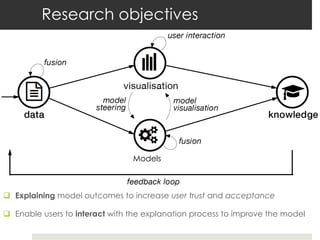
q Explaining model outcomes to increase user trust and acceptance
q Enable users to interact with the explanation process to improve the model
Research objectives
Models
5
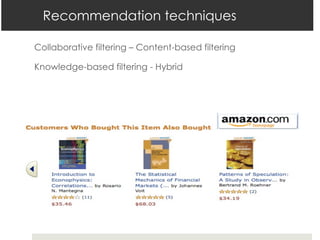
Collaborative filtering – Content-based filtering
Knowledge-based filtering - Hybrid
Recommendation techniques
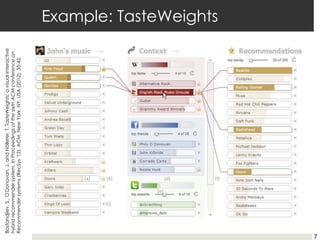
Example: TasteWeights
7
Bostandjiev,
S.,
O'Donovan,
J.
and
Höllerer,
T.
TasteWeights:
a
visual
interactive
hybrid
recommender
system.
In
Proceedings
of
the
sixth
ACM
conference
on
Recommender
systems
(RecSys
'12).
ACM,
New
York,
NY,
USA
(2012),
35-42.
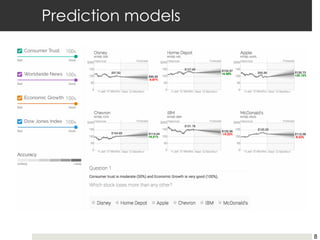
Prediction models
8
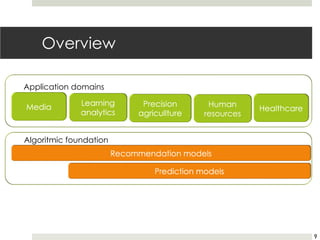
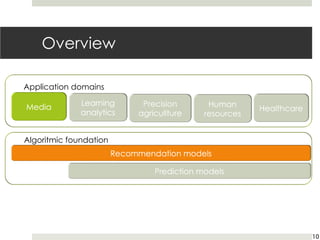
Overview
9
Application domains
Algoritmic foundation
Overview
10
Application domains
Algoritmic foundation
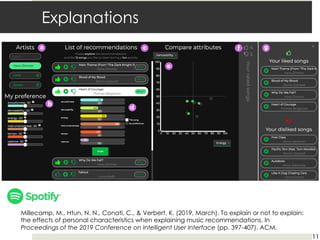
Explanations
11
Millecamp, M., Htun, N. N., Conati, C., & Verbert, K. (2019, March). To explain or not to explain:
the effects of personal characteristics when explaining music recommendations. In
Proceedings of the 2019 Conference on Intelligent User Interface (pp. 397-407). ACM.
Personal characteristics
Need for cognition
•Measurement of the tendency for an individual to engage in, and enjoy, effortful cognitive
activities
•Measured by test of Cacioppo et al. [1984]
Visualisation literacy
•Measurement of the ability to interpret and make meaning from information presented in the form
of images and graphs
•Measured by test of Boy et al. [2014]
Locus of control (LOC)
•Measurement of the extent to which people believe they have power over events in their lives
•Measured by test of Rotter et al. [1966]
Visual working memory
•Measurement of the ability to recall visual patterns [Tintarev and Mastoff, 2016]
•Measured by Corsi block-tapping test
Musical experience
•Measurement of the ability to engage with music in a flexible, effective and nuanced way
[Müllensiefen et al., 2014]
•Measured using the Goldsmiths Musical Sophistication Index (Gold-MSI)
Tech savviness
•Measured by confidence in trying out new technology 12
User study
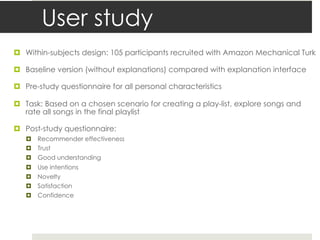
¤ Within-subjects design: 105 participants recruited with Amazon Mechanical Turk
¤ Baseline version (without explanations) compared with explanation interface
¤ Pre-study questionnaire for all personal characteristics
¤ Task: Based on a chosen scenario for creating a play-list, explore songs and
rate all songs in the final playlist
¤ Post-study questionnaire:
¤ Recommender effectiveness
¤ Trust
¤ Good understanding
¤ Use intentions
¤ Novelty
¤ Satisfaction
¤ Confidence
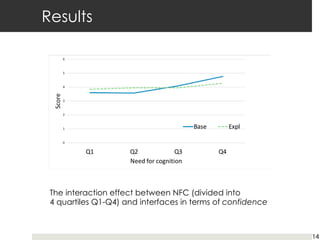
Results
14
The interaction effect between NFC (divided into
4 quartiles Q1-Q4) and interfaces in terms of confidence
Design implications
¤ Explanations should be personalised for different groups of
end-users.
¤ Users should be able to choose whether or not they want to
see explanations.
¤ Explanation components should be flexible enough to present
varying levels of details depending on a user’s preference.
15
User control
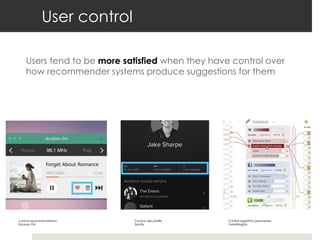
Users tend to be more satisfied when they have control over
how recommender systems produce suggestions for them
Control recommendations
Douban FM
Control user profile
Spotify
Control algorithm parameters
TasteWeights
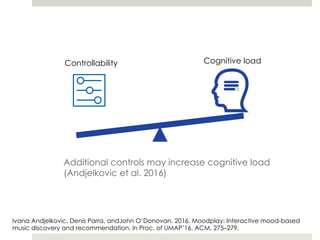
Controllability Cognitive load
Additional controls may increase cognitive load
(Andjelkovic et al. 2016)
Ivana Andjelkovic, Denis Parra, andJohn O’Donovan. 2016. Moodplay: Interactive mood-based
music discovery and recommendation. In Proc. of UMAP’16. ACM, 275–279.
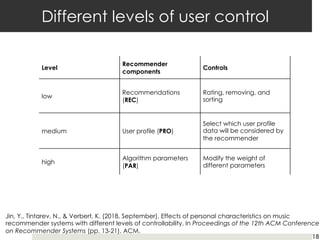
Different levels of user control
18
Level
Recommender
components
Controls
low
Recommendations
(REC)
Rating, removing, and
sorting
medium User profile (PRO)
Select which user profile
data will be considered by
the recommender
high
Algorithm parameters
(PAR)
Modify the weight of
different parameters
Jin, Y., Tintarev, N., & Verbert, K. (2018, September). Effects of personal characteristics on music
recommender systems with different levels of controllability. In Proceedings of the 12th ACM Conference
on Recommender Systems (pp. 13-21). ACM.
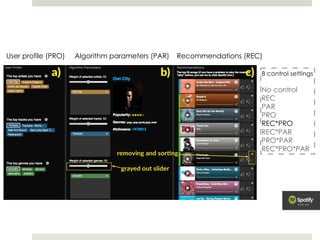
User profile (PRO) Algorithm parameters (PAR) Recommendations (REC)
8 control settings
No control
REC
PAR
PRO
REC*PRO
REC*PAR
PRO*PAR
REC*PRO*PAR
Evaluation method
¤ Between-subjects – 240 participants recruited with AMT
¤ Independent variable: settings of user control
¤ 2x2x2 factorial design
¤ Dependent variables:
¤ Acceptance (ratings)
¤ Cognitive load (NASA-TLX), Musical Sophistication, Visual Memory
¤ Framework Knijnenburg et al. [2012]
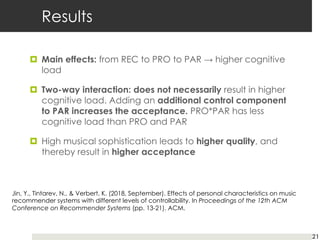
Results
¤ Main effects: from REC to PRO to PAR → higher cognitive
load
¤ Two-way interaction: does not necessarily result in higher
cognitive load. Adding an additional control component
to PAR increases the acceptance. PRO*PAR has less
cognitive load than PRO and PAR
¤ High musical sophistication leads to higher quality, and
thereby result in higher acceptance
21
Jin, Y., Tintarev, N., & Verbert, K. (2018, September). Effects of personal characteristics on music
recommender systems with different levels of controllability. In Proceedings of the 12th ACM
Conference on Recommender Systems (pp. 13-21). ACM.
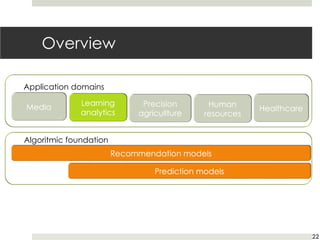
Overview
22
Application domains
Algoritmic foundation
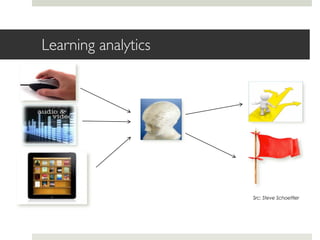
Learning analytics
Src: Steve Schoettler
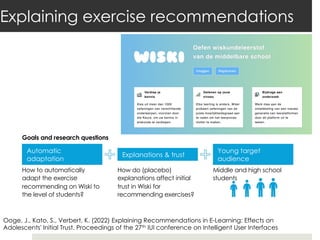
Explaining exercise recommendations
How to automatically
adapt the exercise
recommending on Wiski to
the level of students?
How do (placebo)
explanations affect initial
trust in Wiski for
recommending exercises?
Goals and research questions
Automatic
adaptation
Explanations & trust
Young target
audience
Middle and high school
students
Ooge, J., Kato, S., Verbert, K. (2022) Explaining Recommendations in E-Learning: Effects on
Adolescents' Initial Trust. Proceedings of the 27th IUI conference on Intelligent User Interfaces
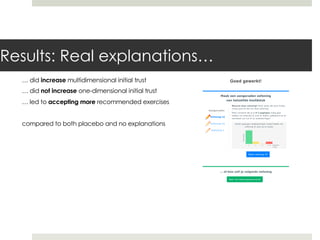
Results: Real explanations…
… did increase multidimensional initial trust
… did not increase one-dimensional initial trust
… led to accepting more recommended exercises
compared to both placebo and no explanations
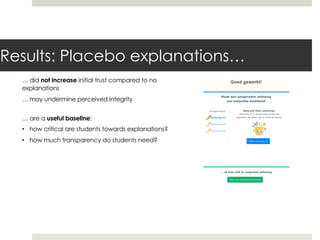
Results: Placebo explanations…
… did not increase initial trust compared to no
explanations
… may undermine perceived integrity
… are a useful baseline:
• how critical are students towards explanations?
• how much transparency do students need?
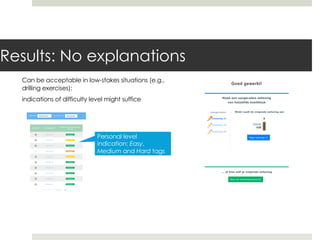
Results: No explanations
Can be acceptable in low-stakes situations (e.g.,
drilling exercises):
indications of difficulty level might suffice
Personal level
indication: Easy,
Medium and Hard tags
Learning analytics
Src: Steve Schoettler
30
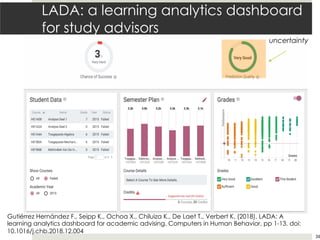
uncertainty
Gutiérrez Hernández F., Seipp K., Ochoa X., Chiluiza K., De Laet T., Verbert K. (2018). LADA: A
learning analytics dashboard for academic advising. Computers in Human Behavior, pp 1-13. doi:
10.1016/j.chb.2018.12.004
LADA: a learning analytics dashboard
for study advisors
Overview
31
Application domains
Algoritmic foundation
Precision agriculture
32
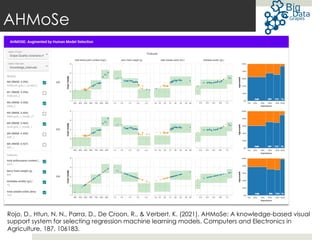
AHMoSe
Rojo, D., Htun, N. N., Parra, D., De Croon, R., & Verbert, K. (2021). AHMoSe: A knowledge-based visual
support system for selecting regression machine learning models. Computers and Electronics in
Agriculture, 187, 106183.
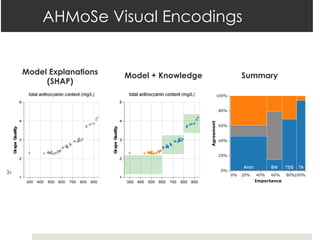
AHMoSe Visual Encodings
34
Model Explanations
(SHAP)
Model + Knowledge Summary
Case Study – Grape Quality Prediction
35
¤ Grape Quality Prediction Scenario
[Tag14]
¤ Data
¤ Years 2010, 2011 (train) 2012 (test)
¤ 48 cells (Central Greece)
¤ Knowledge-based rules
[Tag14] Tagarakis, A., et al. "A fuzzy inference system to model grape
quality in vineyards." Precision Agriculture 15.5 (2014): 555-578. Source: [Tag14]
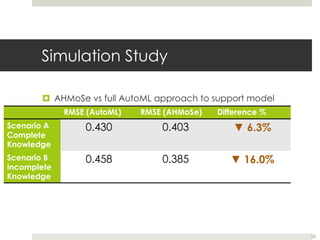
Simulation Study
¤ AHMoSe vs full AutoML approach to support model
selection.
36
RMSE (AutoML) RMSE (AHMoSe) Difference %
Scenario A
Complete
Knowledge
0.430 0.403 ▼ 6.3%
Scenario B
Incomplete
Knowledge
0.458 0.385 ▼ 16.0%
Qualitative Evaluation
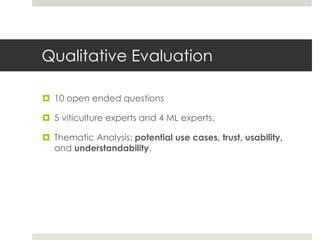
¤ 10 open ended questions
¤ 5 viticulture experts and 4 ML experts.
¤ Thematic Analysis: potential use cases, trust, usability,
and understandability.
Qualitative Evaluation - Trust
38
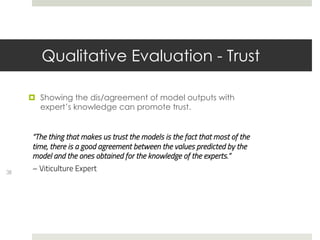
¤ Showing the dis/agreement of model outputs with
expert’s knowledge can promote trust.
“The thing that makes us trust the models is the fact that most of the
time, there is a good agreement between the values predicted by the
model and the ones obtained for the knowledge of the experts.”
– Viticulture Expert
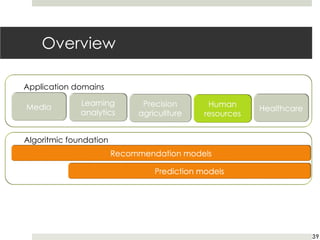
Overview
39
Application domains
Algoritmic foundation
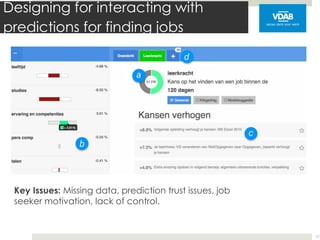
Designing for interacting with
predictions for finding jobs
40
Key Issues: Missing data, prediction trust issues, job
seeker motivation, lack of control.
Methods
¤ A Customer Journey approach. (5 mediators).
¤ Hands-on time with the original dashboard (22 mediators).
¤ Observations of mediation sessions. (3 mediators, 6 job seekers).
¤ Questionnaire regarding perception of the dashboard and
prediction model (15 Mediators).
41
Charleer S., Gutiérrez Hernández F., Verbert K. (2018). Supporting job mediator and job seeker
through an actionable dashboard. In: Proceedings of the 24th IUI conference on Intelligent User
Interfaces Presented at the ACM IUI 2019, Los Angeles, USA.
42
Take away messages
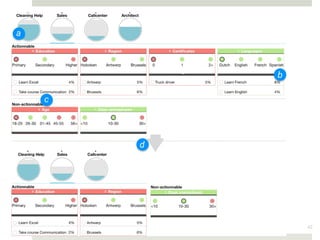
¤ Key difference between actionable and non-actionable
parameters
¤ Need for customization and contextualization.
¤ The human expert plays a crucial role when interpreting
and relaying in the predicted or recommended output.
43
Charleer S., Gutiérrez Hernández F., Verbert K. (2019). Supporting job mediator and job
seeker through an actionable dashboard. In: Proceedings of the 24th IUI conference on
Intelligent User Interfaces Presented at the ACM IUI 2019, Los Angeles, USA. (Core: A)
Overview
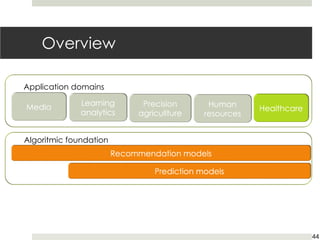
44
Application domains
Algoritmic foundation
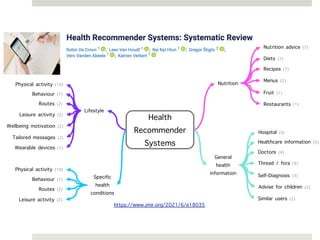
https://www.jmir.org/2021/6/e18035
Nutrition
Nutrition advice (7)
Diets (7)
Recipes (7)
Menus (2)
Fruit (1)
Restaurants (1)
Doctors (4)
Hospital (5)
Thread / fora (3)
Self-Diagnosis (3)
Healthcare information (5)
Similar users (2)
Advise for children (2)
General
health
information
Routes (2)
Physical activity (10)
Leisure activity (2)
Wellbeing motivation (2)
Behaviour (7)
Wearable devices (1)
Tailored messages (2)
Routes (2)
Physical activity (10)
Leisure activity (2)
Behaviour (7)
Lifestyle
Specific
health
conditions
Health
Recommender
Systems
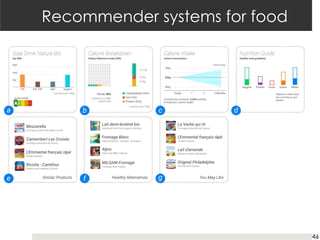
Recommender systems for food
46
47
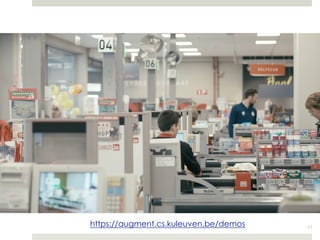
https://augment.cs.kuleuven.be/demos
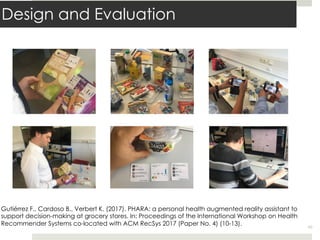
Design and Evaluation
48
Gutiérrez F., Cardoso B., Verbert K. (2017). PHARA: a personal health augmented reality assistant to
support decision-making at grocery stores. In: Proceedings of the International Workshop on Health
Recommender Systems co-located with ACM RecSys 2017 (Paper No. 4) (10-13).
49
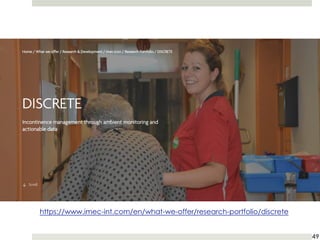
https://www.imec-int.com/en/what-we-offer/research-portfolio/discrete
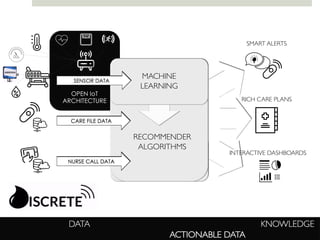
RECOMMENDER
ALGORITHMS
MACHINE
LEARNING
INTERACTIVE DASHBOARDS
SMART ALERTS
RICH CARE PLANS
OPEN IoT
ARCHITECTURE
51
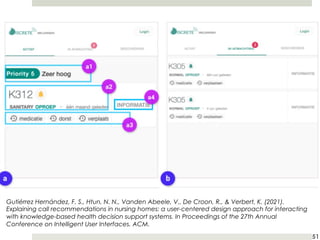
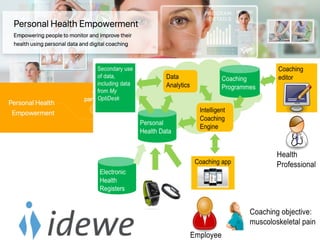
Gutiérrez Hernández, F. S., Htun, N. N., Vanden Abeele, V., De Croon, R., & Verbert, K. (2021).
Explaining call recommendations in nursing homes: a user-centered design approach for interacting
with knowledge-based health decision support systems. In Proceedings of the 27th Annual
Conference on Intelligent User Interfaces. ACM.
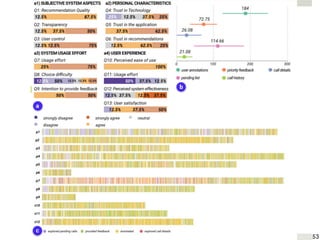
Evaluation
¤ 12 nurses used the app for three months
¤ Data collection
¤ Interaction logs
¤ Resque questions
¤ Semi-structured interviews
52
¤ 12 nurses during 3 months
53
Results
¤ Iterative design process identified several important features, such as the pending
list, overview and the feedback shortcut to encourage feedback.
¤ Explanations seem to contribute well to better support the healthcare
professionals.
¤ Results indicate a better understanding of the call notifications by being able to
see the reasons of the calls.
¤ More trust in the recommendations and increased perceptions of transparency
and control
¤ Interaction patterns indicate that users engaged well with the interface, although
some users did not use all features to interact with the system.
¤ Need for further simplification and personalization.
54
55
56
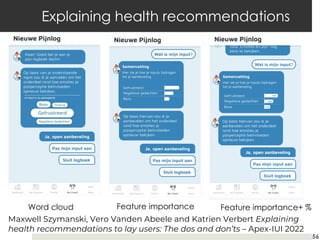
Explaining health recommendations
Word cloud Feature importance Feature importance+ %
Maxwell Szymanski, Vero Vanden Abeele and Katrien Verbert Explaining
health recommendations to lay users: The dos and don’ts – Apex-IUI 2022
57
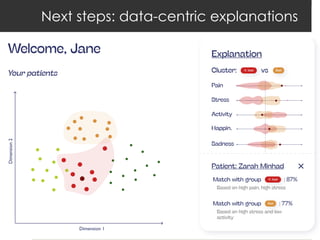
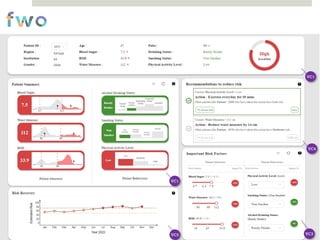
Next steps: data-centric explanations
58
Next steps
¤ Mixed-initiative explanation methods
¤ Conversational explanation methods
59
Take-away messages
¤ Involvement of end-users has been key to come up with
interfaces tailored to the needs of non-expert users
¤ Actionable vs non-actionable parameters
¤ Domain expertise of users and need for cognition
important personal characteristics
¤ Need for personalisation and simplification
60
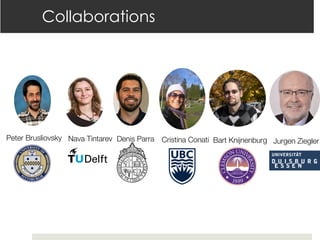
Peter Brusliovsky Nava Tintarev Cristina Conati
Denis Parra
Collaborations
Bart Knijnenburg Jurgen Ziegler
Questions?
katrien.verbert@cs.kuleuven.be
@katrien_v
Thank you!
http://augment.cs.kuleuven.be/

Human-centered AI: how can we support lay users to understand AI?

  • 1.
    Human-centered AI: howcan we support lay users to understand AI? NEC labs Europe - 24 Oct 2022 Katrien Verbert Augment/HCI - KU Leuven @katrien_v
  • 2.
    Human-Computer Interaction group ExplainableAI - recommender systems – visualization – intelligent user interfaces Learning analytics & human resources Media consumption Precision agriculture Healthcare Augment Katrien Verbert ARIA Adalberto Simeone Computer Graphics Phil Dutré LIIR Sien Moens E-media Vero Vanden Abeele Luc Geurts Kathrin Gerling
  • 3.
    Augment/HCI team Robin DeCroon Postdoc researcher Katrien Verbert Professor Tom Broos PhD researcher Houda Lamqaddam Postdoc researcher Oscar Alvarado Postdoc researcher https://augment.cs.kuleuven.be/ Diego Rojo Carcia PhD researcher Maxwell Szymanski PhD researcher Jeroen Ooge PhD researcher Aditya Bhattacharya PhD researcher Ivania Donoso Guzmán PhD researcher 3
  • 4.
    q Explaining modeloutcomes to increase user trust and acceptance q Enable users to interact with the explanation process to improve the model Research objectives Models
  • 5.
  • 6.
    Collaborative filtering –Content-based filtering Knowledge-based filtering - Hybrid Recommendation techniques
  • 7.
  • 8.
  • 9.
  • 10.
  • 11.
    Explanations 11 Millecamp, M., Htun,N. N., Conati, C., & Verbert, K. (2019, March). To explain or not to explain: the effects of personal characteristics when explaining music recommendations. In Proceedings of the 2019 Conference on Intelligent User Interface (pp. 397-407). ACM.
  • 12.
    Personal characteristics Need forcognition •Measurement of the tendency for an individual to engage in, and enjoy, effortful cognitive activities •Measured by test of Cacioppo et al. [1984] Visualisation literacy •Measurement of the ability to interpret and make meaning from information presented in the form of images and graphs •Measured by test of Boy et al. [2014] Locus of control (LOC) •Measurement of the extent to which people believe they have power over events in their lives •Measured by test of Rotter et al. [1966] Visual working memory •Measurement of the ability to recall visual patterns [Tintarev and Mastoff, 2016] •Measured by Corsi block-tapping test Musical experience •Measurement of the ability to engage with music in a flexible, effective and nuanced way [Müllensiefen et al., 2014] •Measured using the Goldsmiths Musical Sophistication Index (Gold-MSI) Tech savviness •Measured by confidence in trying out new technology 12
  • 13.
    User study ¤ Within-subjectsdesign: 105 participants recruited with Amazon Mechanical Turk ¤ Baseline version (without explanations) compared with explanation interface ¤ Pre-study questionnaire for all personal characteristics ¤ Task: Based on a chosen scenario for creating a play-list, explore songs and rate all songs in the final playlist ¤ Post-study questionnaire: ¤ Recommender effectiveness ¤ Trust ¤ Good understanding ¤ Use intentions ¤ Novelty ¤ Satisfaction ¤ Confidence
  • 14.
    Results 14 The interaction effectbetween NFC (divided into 4 quartiles Q1-Q4) and interfaces in terms of confidence
  • 15.
    Design implications ¤ Explanationsshould be personalised for different groups of end-users. ¤ Users should be able to choose whether or not they want to see explanations. ¤ Explanation components should be flexible enough to present varying levels of details depending on a user’s preference. 15
  • 16.
    User control Users tendto be more satisfied when they have control over how recommender systems produce suggestions for them Control recommendations Douban FM Control user profile Spotify Control algorithm parameters TasteWeights
  • 17.
    Controllability Cognitive load Additionalcontrols may increase cognitive load (Andjelkovic et al. 2016) Ivana Andjelkovic, Denis Parra, andJohn O’Donovan. 2016. Moodplay: Interactive mood-based music discovery and recommendation. In Proc. of UMAP’16. ACM, 275–279.
  • 18.
    Different levels ofuser control 18 Level Recommender components Controls low Recommendations (REC) Rating, removing, and sorting medium User profile (PRO) Select which user profile data will be considered by the recommender high Algorithm parameters (PAR) Modify the weight of different parameters Jin, Y., Tintarev, N., & Verbert, K. (2018, September). Effects of personal characteristics on music recommender systems with different levels of controllability. In Proceedings of the 12th ACM Conference on Recommender Systems (pp. 13-21). ACM.
  • 19.
    User profile (PRO)Algorithm parameters (PAR) Recommendations (REC) 8 control settings No control REC PAR PRO REC*PRO REC*PAR PRO*PAR REC*PRO*PAR
  • 20.
    Evaluation method ¤ Between-subjects– 240 participants recruited with AMT ¤ Independent variable: settings of user control ¤ 2x2x2 factorial design ¤ Dependent variables: ¤ Acceptance (ratings) ¤ Cognitive load (NASA-TLX), Musical Sophistication, Visual Memory ¤ Framework Knijnenburg et al. [2012]
  • 21.
    Results ¤ Main effects:from REC to PRO to PAR → higher cognitive load ¤ Two-way interaction: does not necessarily result in higher cognitive load. Adding an additional control component to PAR increases the acceptance. PRO*PAR has less cognitive load than PRO and PAR ¤ High musical sophistication leads to higher quality, and thereby result in higher acceptance 21 Jin, Y., Tintarev, N., & Verbert, K. (2018, September). Effects of personal characteristics on music recommender systems with different levels of controllability. In Proceedings of the 12th ACM Conference on Recommender Systems (pp. 13-21). ACM.
  • 22.
  • 23.
  • 25.
    Explaining exercise recommendations Howto automatically adapt the exercise recommending on Wiski to the level of students? How do (placebo) explanations affect initial trust in Wiski for recommending exercises? Goals and research questions Automatic adaptation Explanations & trust Young target audience Middle and high school students Ooge, J., Kato, S., Verbert, K. (2022) Explaining Recommendations in E-Learning: Effects on Adolescents' Initial Trust. Proceedings of the 27th IUI conference on Intelligent User Interfaces
  • 26.
    Results: Real explanations… …did increase multidimensional initial trust … did not increase one-dimensional initial trust … led to accepting more recommended exercises compared to both placebo and no explanations
  • 27.
    Results: Placebo explanations… …did not increase initial trust compared to no explanations … may undermine perceived integrity … are a useful baseline: • how critical are students towards explanations? • how much transparency do students need?
  • 28.
    Results: No explanations Canbe acceptable in low-stakes situations (e.g., drilling exercises): indications of difficulty level might suffice Personal level indication: Easy, Medium and Hard tags
  • 29.
  • 30.
    30 uncertainty Gutiérrez Hernández F.,Seipp K., Ochoa X., Chiluiza K., De Laet T., Verbert K. (2018). LADA: A learning analytics dashboard for academic advising. Computers in Human Behavior, pp 1-13. doi: 10.1016/j.chb.2018.12.004 LADA: a learning analytics dashboard for study advisors
  • 31.
  • 32.
  • 33.
    AHMoSe Rojo, D., Htun,N. N., Parra, D., De Croon, R., & Verbert, K. (2021). AHMoSe: A knowledge-based visual support system for selecting regression machine learning models. Computers and Electronics in Agriculture, 187, 106183.
  • 34.
    AHMoSe Visual Encodings 34 ModelExplanations (SHAP) Model + Knowledge Summary
  • 35.
    Case Study –Grape Quality Prediction 35 ¤ Grape Quality Prediction Scenario [Tag14] ¤ Data ¤ Years 2010, 2011 (train) 2012 (test) ¤ 48 cells (Central Greece) ¤ Knowledge-based rules [Tag14] Tagarakis, A., et al. "A fuzzy inference system to model grape quality in vineyards." Precision Agriculture 15.5 (2014): 555-578. Source: [Tag14]
  • 36.
    Simulation Study ¤ AHMoSevs full AutoML approach to support model selection. 36 RMSE (AutoML) RMSE (AHMoSe) Difference % Scenario A Complete Knowledge 0.430 0.403 ▼ 6.3% Scenario B Incomplete Knowledge 0.458 0.385 ▼ 16.0%
  • 37.
    Qualitative Evaluation ¤ 10open ended questions ¤ 5 viticulture experts and 4 ML experts. ¤ Thematic Analysis: potential use cases, trust, usability, and understandability.
  • 38.
    Qualitative Evaluation -Trust 38 ¤ Showing the dis/agreement of model outputs with expert’s knowledge can promote trust. “The thing that makes us trust the models is the fact that most of the time, there is a good agreement between the values predicted by the model and the ones obtained for the knowledge of the experts.” – Viticulture Expert
  • 39.
  • 40.
    Designing for interactingwith predictions for finding jobs 40 Key Issues: Missing data, prediction trust issues, job seeker motivation, lack of control.
  • 41.
    Methods ¤ A CustomerJourney approach. (5 mediators). ¤ Hands-on time with the original dashboard (22 mediators). ¤ Observations of mediation sessions. (3 mediators, 6 job seekers). ¤ Questionnaire regarding perception of the dashboard and prediction model (15 Mediators). 41 Charleer S., Gutiérrez Hernández F., Verbert K. (2018). Supporting job mediator and job seeker through an actionable dashboard. In: Proceedings of the 24th IUI conference on Intelligent User Interfaces Presented at the ACM IUI 2019, Los Angeles, USA.
  • 42.
  • 43.
    Take away messages ¤Key difference between actionable and non-actionable parameters ¤ Need for customization and contextualization. ¤ The human expert plays a crucial role when interpreting and relaying in the predicted or recommended output. 43 Charleer S., Gutiérrez Hernández F., Verbert K. (2019). Supporting job mediator and job seeker through an actionable dashboard. In: Proceedings of the 24th IUI conference on Intelligent User Interfaces Presented at the ACM IUI 2019, Los Angeles, USA. (Core: A)
  • 44.
  • 45.
    https://www.jmir.org/2021/6/e18035 Nutrition Nutrition advice (7) Diets(7) Recipes (7) Menus (2) Fruit (1) Restaurants (1) Doctors (4) Hospital (5) Thread / fora (3) Self-Diagnosis (3) Healthcare information (5) Similar users (2) Advise for children (2) General health information Routes (2) Physical activity (10) Leisure activity (2) Wellbeing motivation (2) Behaviour (7) Wearable devices (1) Tailored messages (2) Routes (2) Physical activity (10) Leisure activity (2) Behaviour (7) Lifestyle Specific health conditions Health Recommender Systems
  • 46.
  • 47.
  • 48.
    Design and Evaluation 48 GutiérrezF., Cardoso B., Verbert K. (2017). PHARA: a personal health augmented reality assistant to support decision-making at grocery stores. In: Proceedings of the International Workshop on Health Recommender Systems co-located with ACM RecSys 2017 (Paper No. 4) (10-13).
  • 49.
  • 50.
  • 51.
    51 Gutiérrez Hernández, F.S., Htun, N. N., Vanden Abeele, V., De Croon, R., & Verbert, K. (2021). Explaining call recommendations in nursing homes: a user-centered design approach for interacting with knowledge-based health decision support systems. In Proceedings of the 27th Annual Conference on Intelligent User Interfaces. ACM.
  • 52.
    Evaluation ¤ 12 nursesused the app for three months ¤ Data collection ¤ Interaction logs ¤ Resque questions ¤ Semi-structured interviews 52
  • 53.
    ¤ 12 nursesduring 3 months 53
  • 54.
    Results ¤ Iterative designprocess identified several important features, such as the pending list, overview and the feedback shortcut to encourage feedback. ¤ Explanations seem to contribute well to better support the healthcare professionals. ¤ Results indicate a better understanding of the call notifications by being able to see the reasons of the calls. ¤ More trust in the recommendations and increased perceptions of transparency and control ¤ Interaction patterns indicate that users engaged well with the interface, although some users did not use all features to interact with the system. ¤ Need for further simplification and personalization. 54
  • 55.
  • 56.
    56 Explaining health recommendations Wordcloud Feature importance Feature importance+ % Maxwell Szymanski, Vero Vanden Abeele and Katrien Verbert Explaining health recommendations to lay users: The dos and don’ts – Apex-IUI 2022
  • 57.
  • 58.
  • 59.
    Next steps ¤ Mixed-initiativeexplanation methods ¤ Conversational explanation methods 59
  • 60.
    Take-away messages ¤ Involvementof end-users has been key to come up with interfaces tailored to the needs of non-expert users ¤ Actionable vs non-actionable parameters ¤ Domain expertise of users and need for cognition important personal characteristics ¤ Need for personalisation and simplification 60
  • 61.
    Peter Brusliovsky NavaTintarev Cristina Conati Denis Parra Collaborations Bart Knijnenburg Jurgen Ziegler
  • 62.