Web Security for E-Commerce
Protection for online business
2
Web Concepts for E-Commerce
• Client/Server Applications
• Communication Channels
• TCP/IP
3
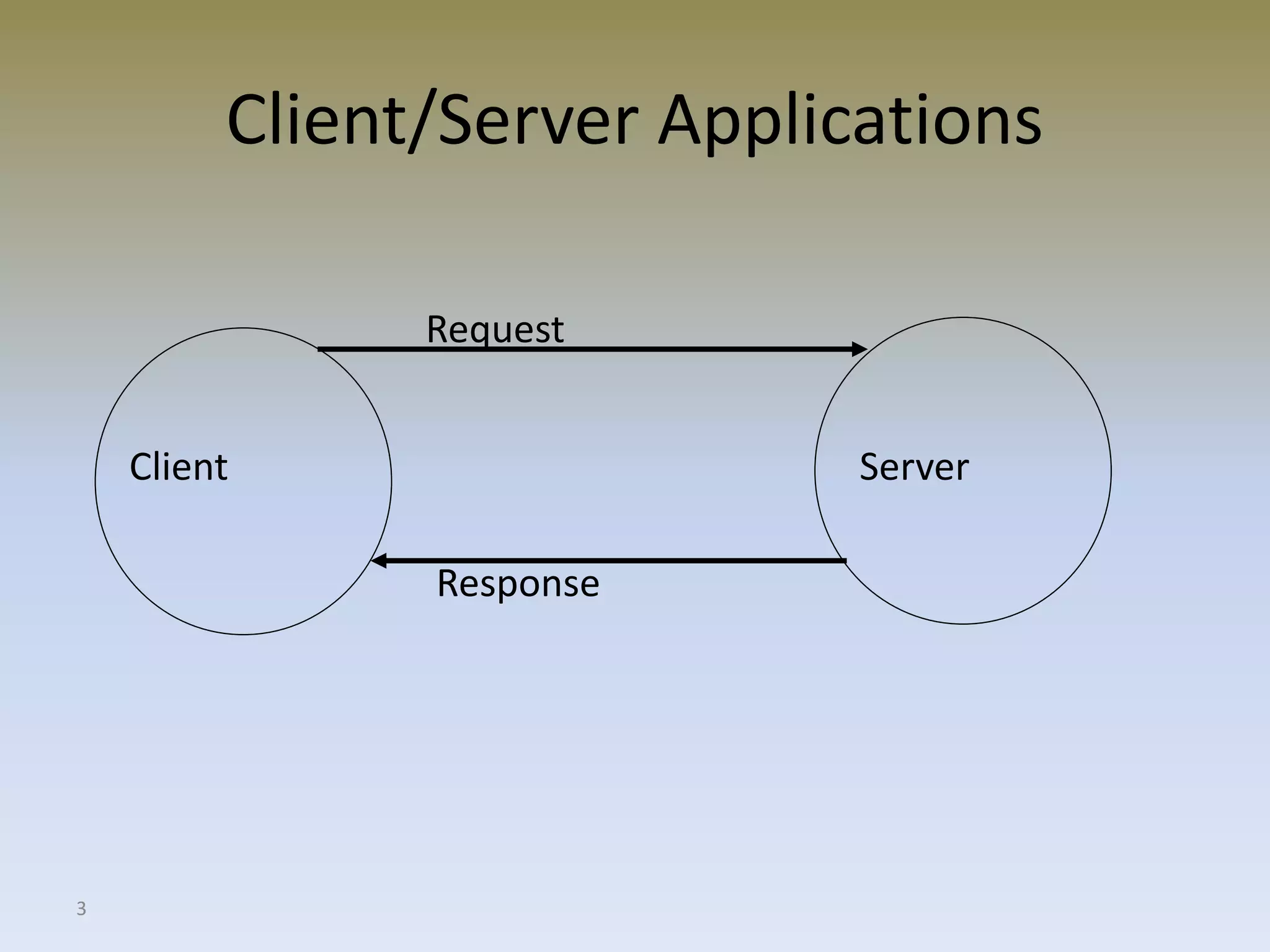
Client/Server Applications
Client Server
Request
Response
4
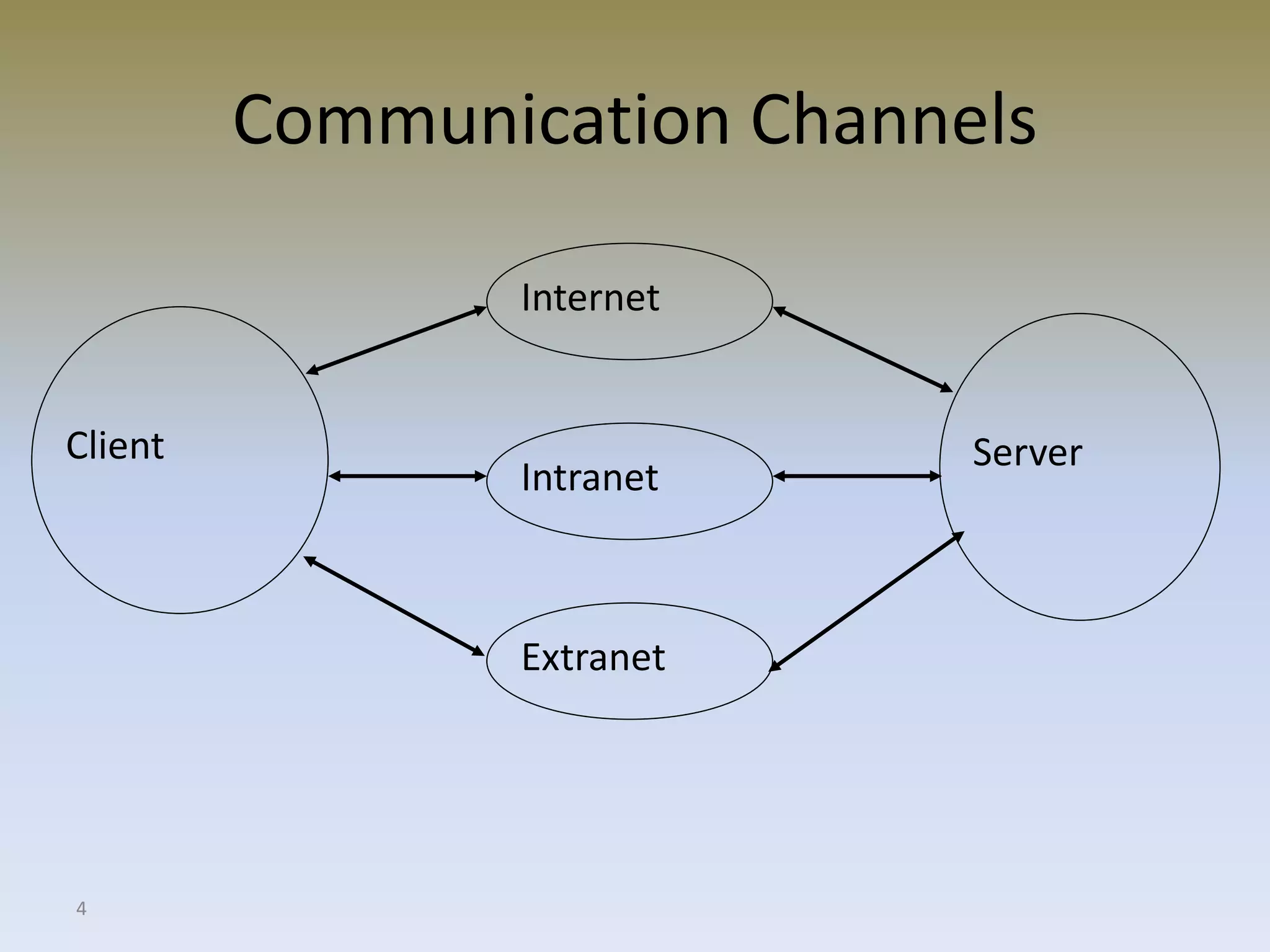
Communication Channels
ServerClient
Intranet
Internet
Extranet
5
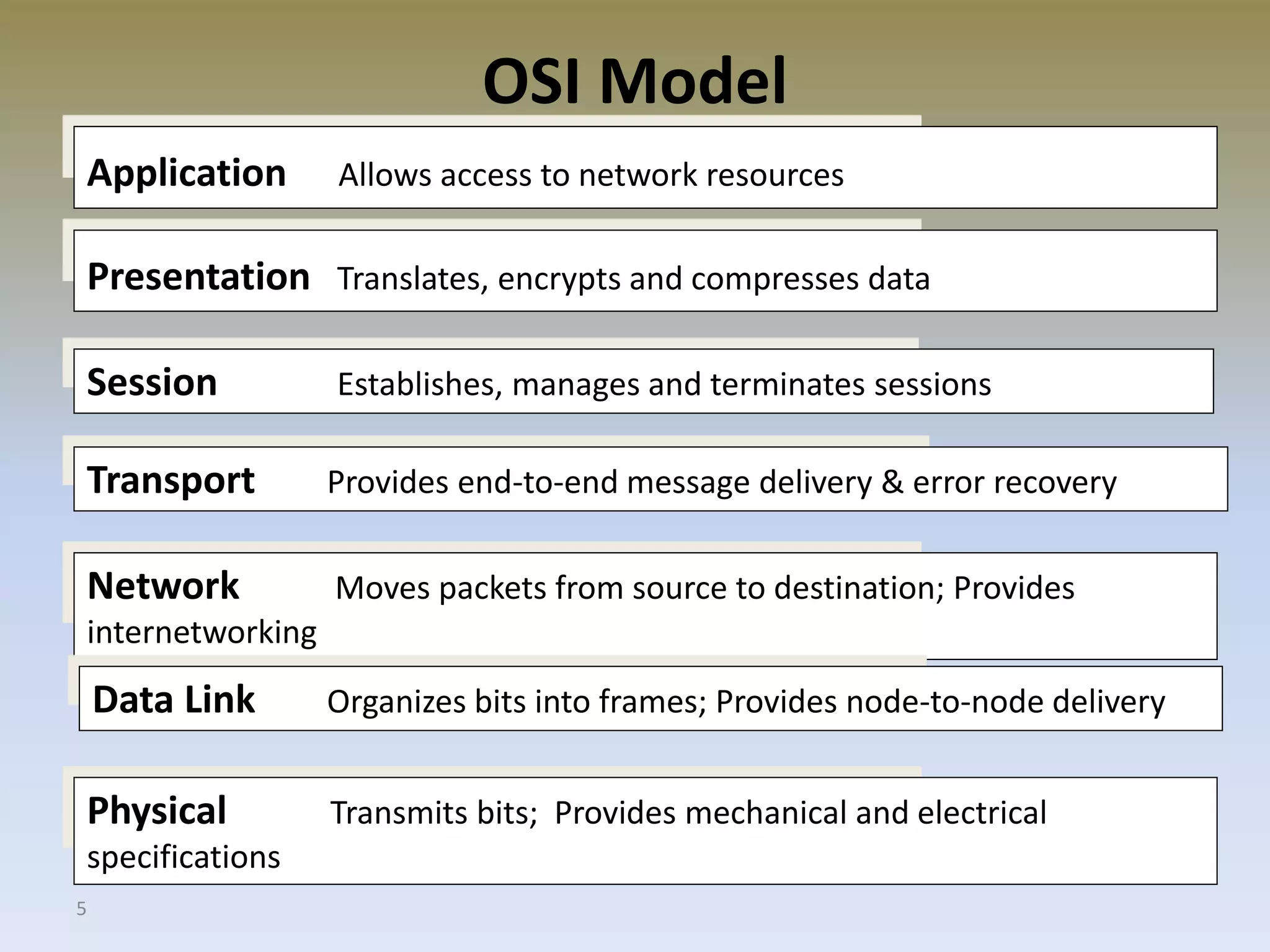
Application Allows access to network resources
OSI Model
Presentation Translates, encrypts and compresses data
Session Establishes, manages and terminates sessions
Transport Provides end-to-end message delivery & error recovery
Network Moves packets from source to destination; Provides
internetworking
Data Link Organizes bits into frames; Provides node-to-node delivery
Physical Transmits bits; Provides mechanical and electrical
specifications
6
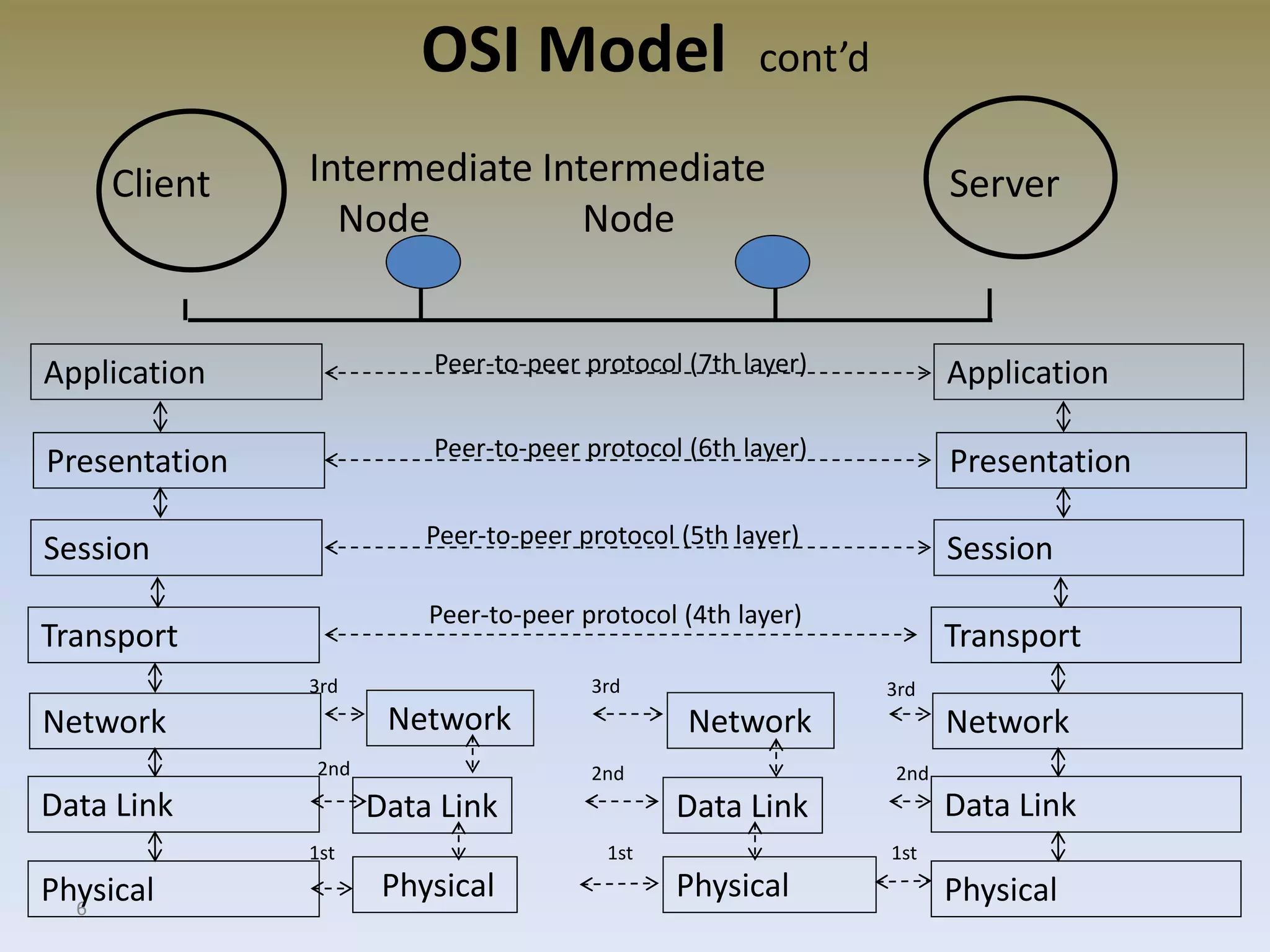
OSI Model cont’d
Client ServerIntermediate Intermediate
Node Node
Application
Presentation
Session
Transport
Network
Data Link
Physical
Application
Presentation
Session
Transport
Network
Data Link
Physical
Peer-to-peer protocol (7th layer)
Peer-to-peer protocol (6th layer)
Peer-to-peer protocol (5th layer)
Peer-to-peer protocol (4th layer)
Data Link Data Link
NetworkNetwork
Physical Physical
3rd 3rd 3rd
2nd2nd2nd
1st 1st 1st
7
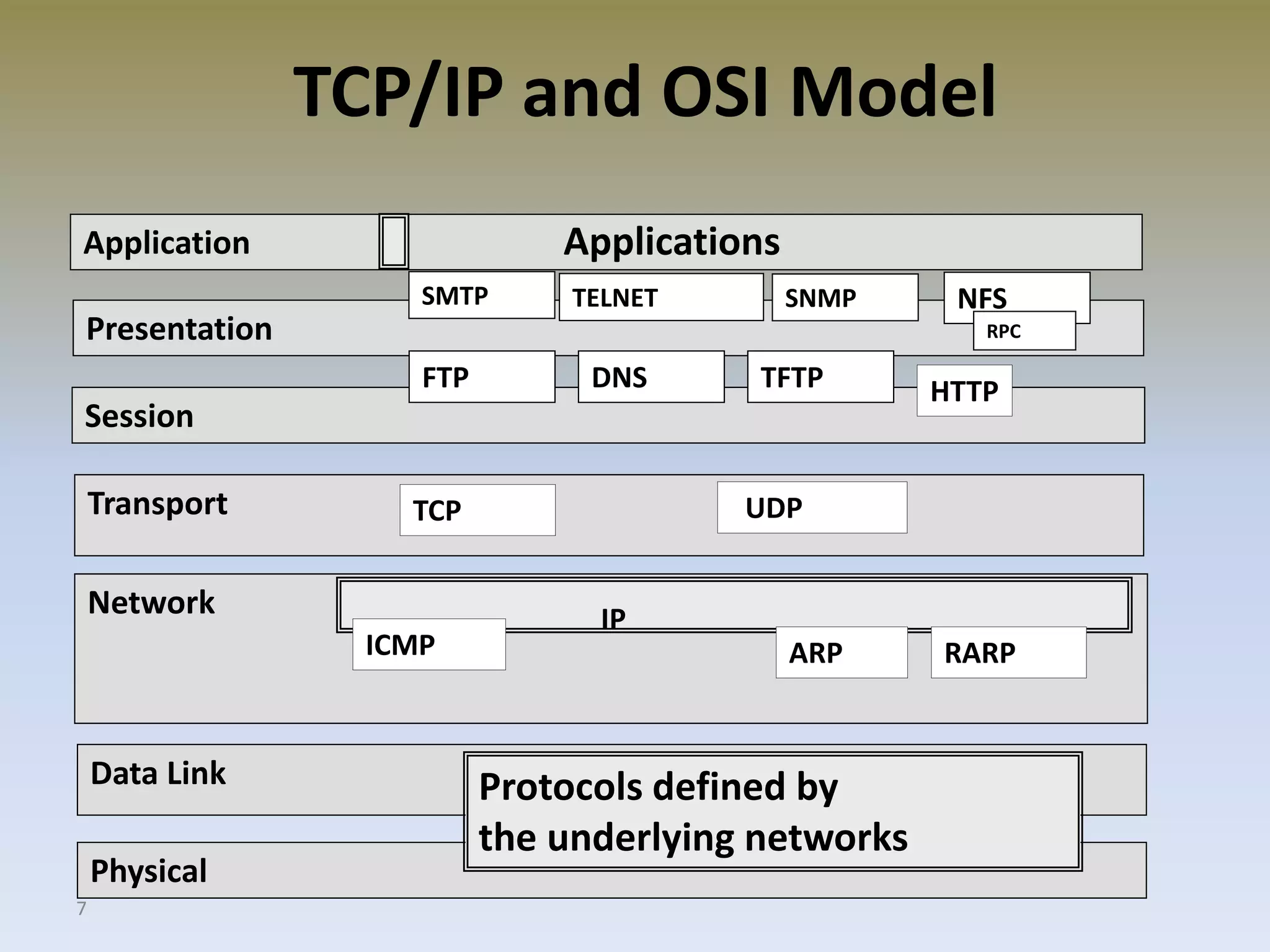
TCP/IP and OSI Model
Network
Application
Presentation
Session
Transport
Data Link
Physical
SMTP
Applications
FTP
TELNET
DNS
SNMP NFS
TFTP
RPC
TCP UDP
ICMP ARP RARP
IP
Protocols defined by
the underlying networks
HTTP
8
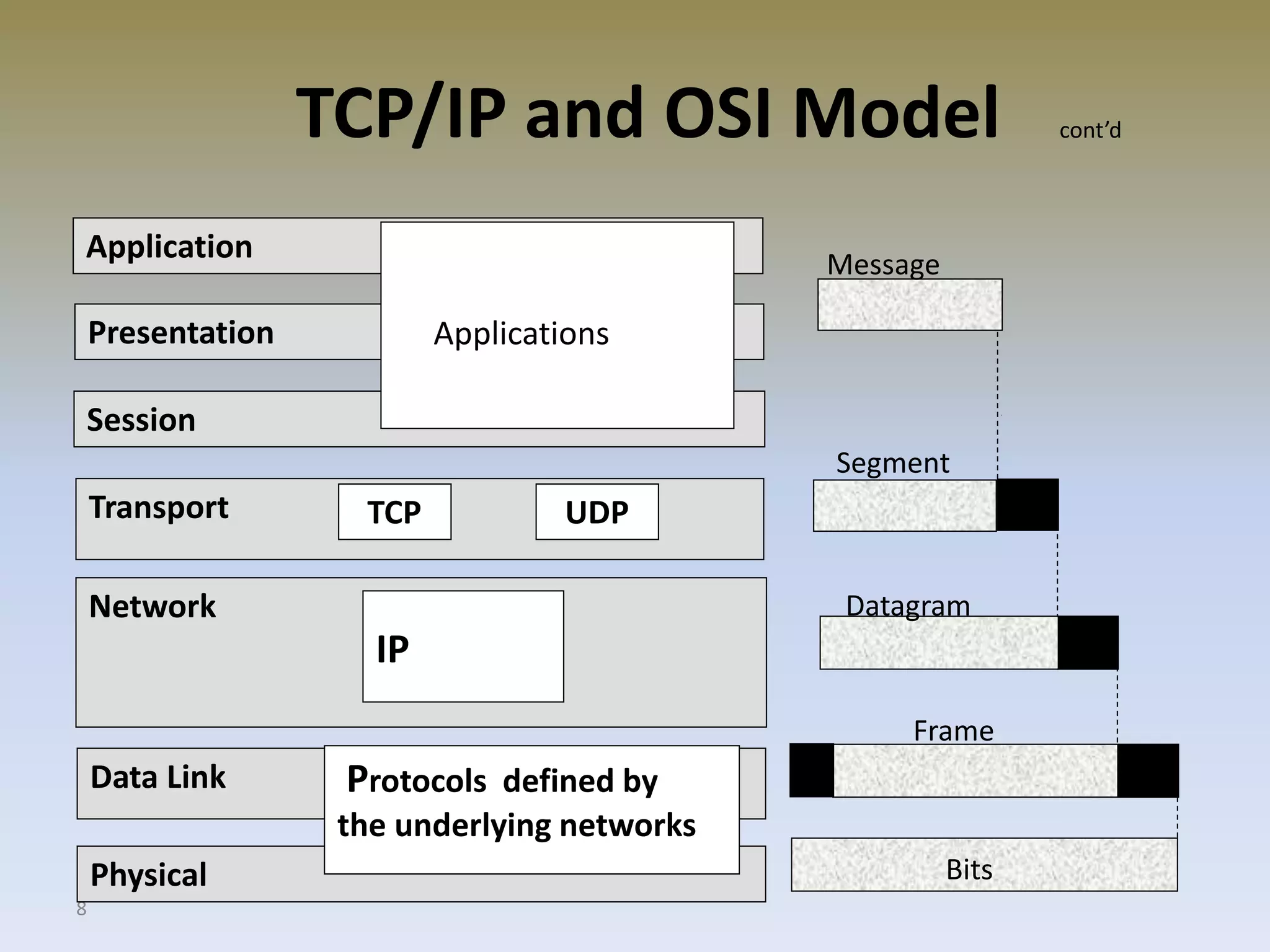
TCP/IP and OSI Model cont’d
Network
Application
Presentation
Session
Transport
Data Link
Physical
TCP UDP
IP
Protocols defined by
the underlying networks
Applications
Message
Segment
Datagram
Bits
Frame
11
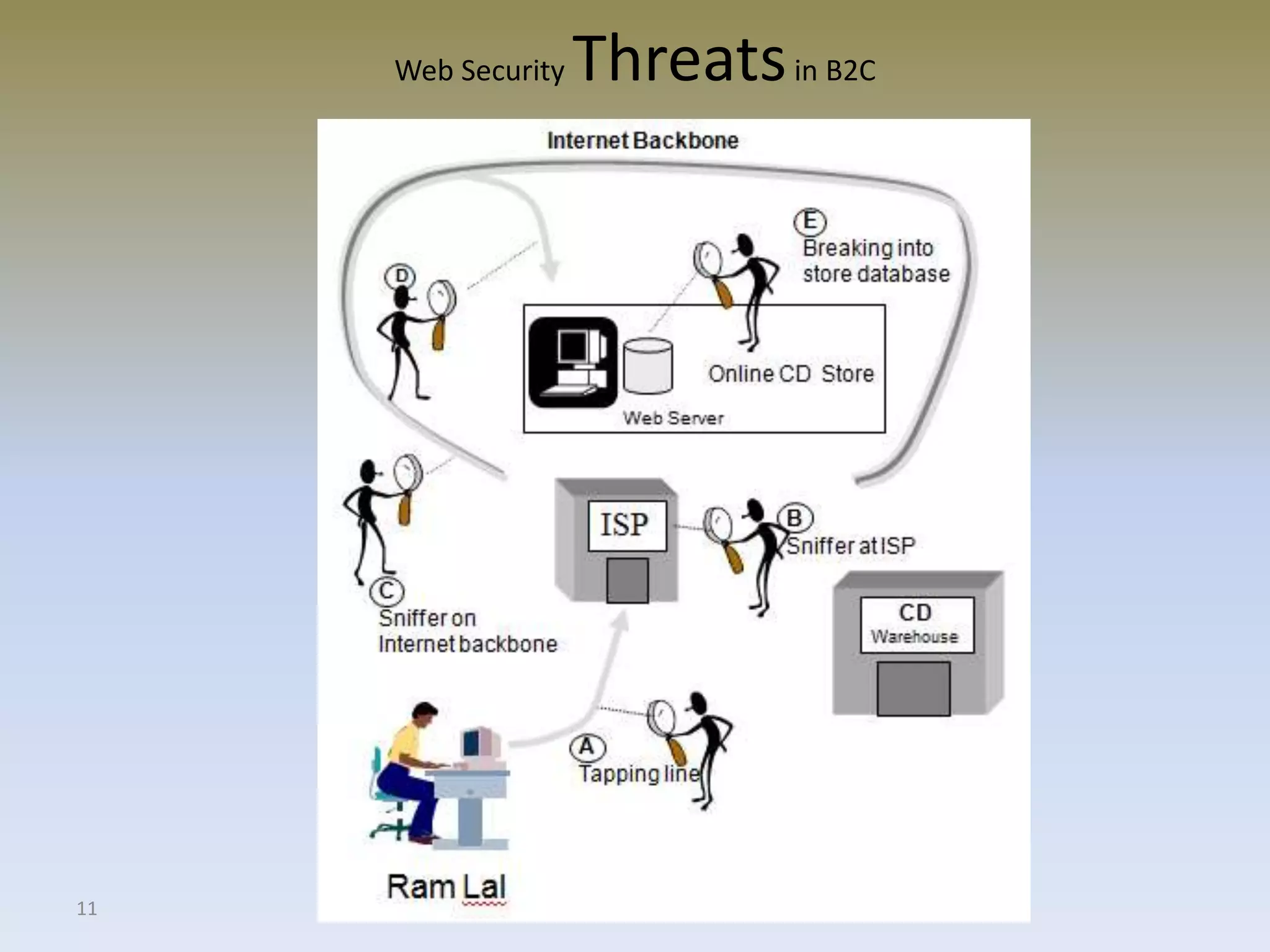
Web Security Threatsin B2C
12
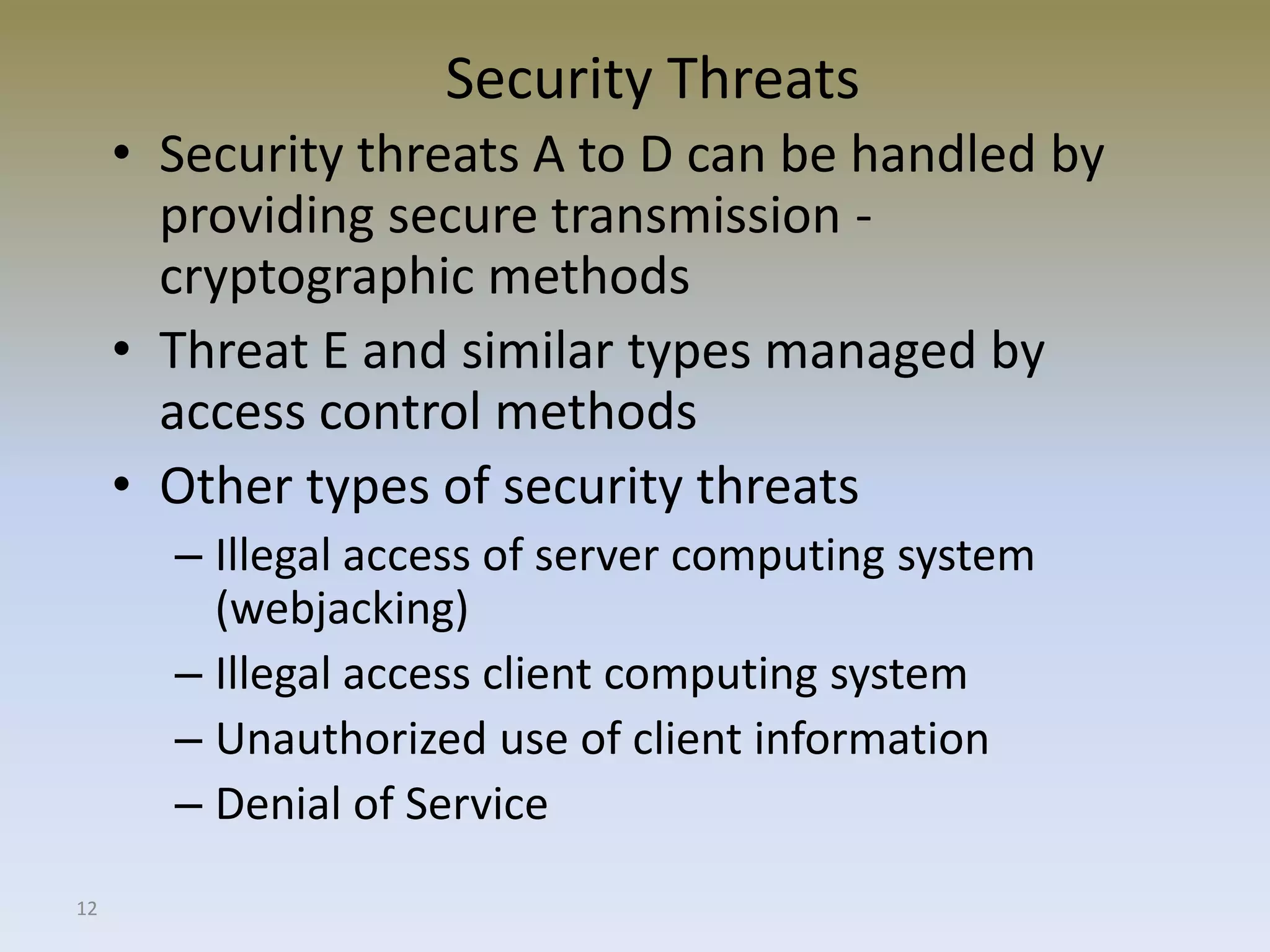
Security Threats
• Security threats A to D can be handled by
providing secure transmission -
cryptographic methods
• Threat E and similar types managed by
access control methods
• Other types of security threats
– Illegal access of server computing system
(webjacking)
– Illegal access client computing system
– Unauthorized use of client information
– Denial of Service
13
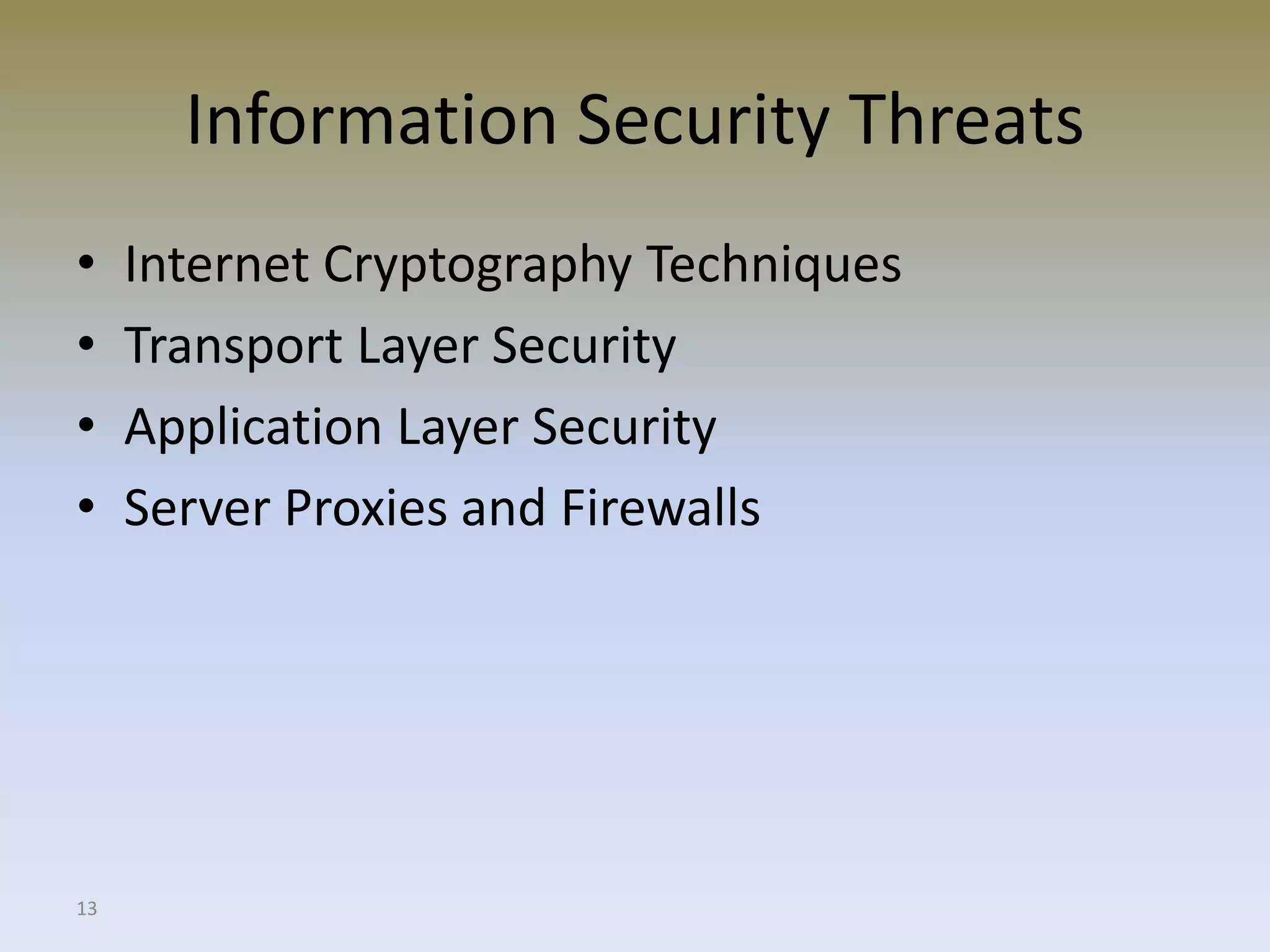
Information Security Threats
• Internet Cryptography Techniques
• Transport Layer Security
• Application Layer Security
• Server Proxies and Firewalls
14
Purpose of Cryptography
• Secure stored information - regardless if
access obtained
• Secure transmitted information - regardless if
transmission has been monitored
15
Services Provided by Cryptography
• Confidentiality
– provides privacy for messages and stored data by
hiding
• Message Integrity
– provides assurance to all parties that a message
remains unchanged
• Non-repudiation
– Can prove a document came from X even if X’
denies it
• Authentication
– identifies the origin of a message
– verifies the identity of person using a computer
system
16
Cryptographic Services Allow
• Digital Signatures
– sign messages to validate source and integrity of the
contents
• Digital Envelopes
– secure delivery of secret keys
• Message Digests
– short bit string hash of message
• Certificates (Digital Ids)
– used to authenticate: users, web sites, public keys of
public/private pair, and information in general
• Secure Channels
– Encryption can be used to create secure channels over
private or public networks
17
Digital Signatures
• Digital Signature
– Encrypt sender’s identity string with sender’s private key
– Concatenate the encrypted text and the identity string
together
– Encrypt this message with receiver’s public key to create
message
– Receiver decrypts the encrypted text with their private key
– the cypher text portion of the message is decrypted with
sender’s public key
– The decrypted text can be compared with the normal text to
checks its integrity
18
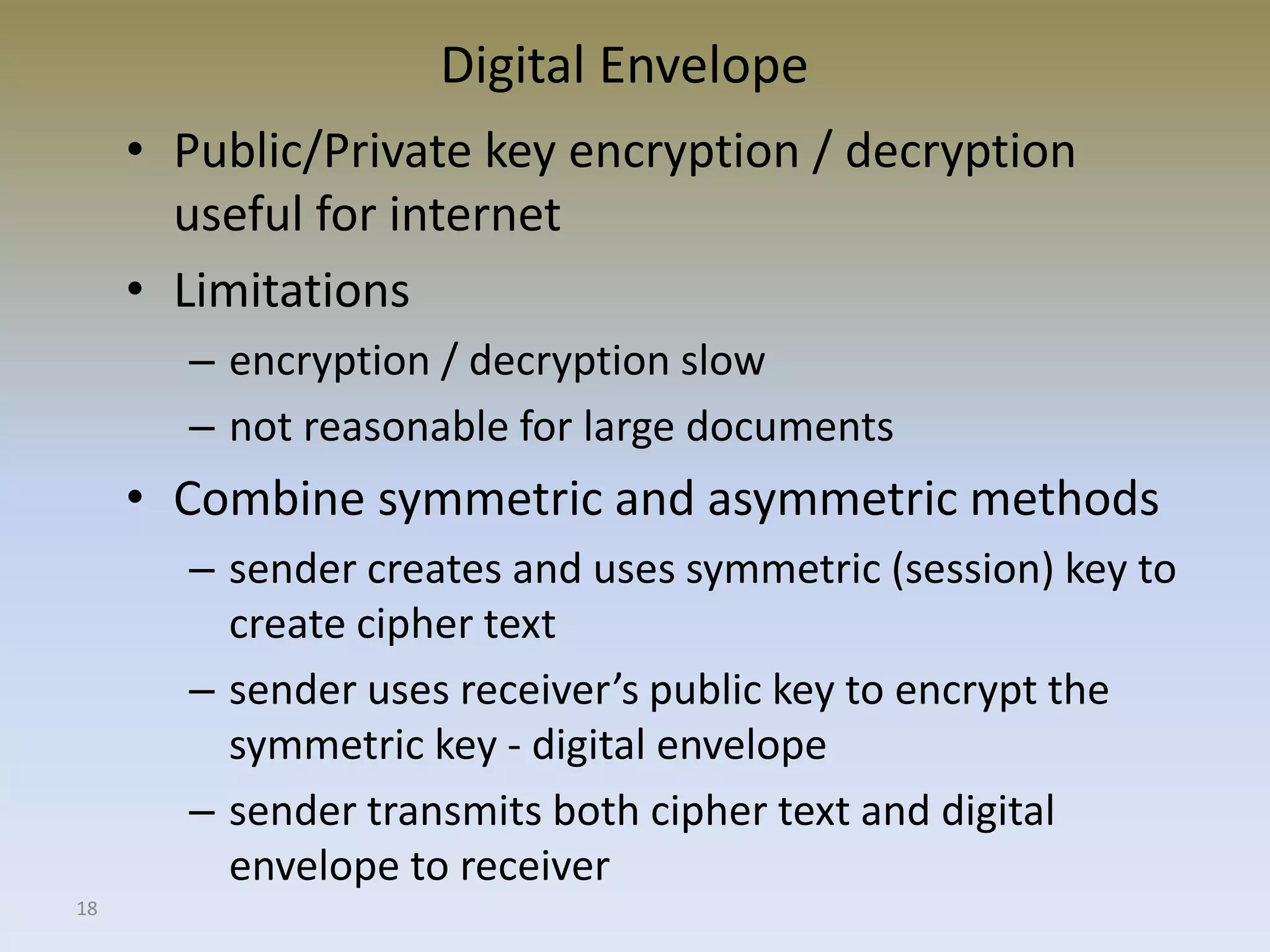
Digital Envelope
• Public/Private key encryption / decryption
useful for internet
• Limitations
– encryption / decryption slow
– not reasonable for large documents
• Combine symmetric and asymmetric methods
– sender creates and uses symmetric (session) key to
create cipher text
– sender uses receiver’s public key to encrypt the
symmetric key - digital envelope
– sender transmits both cipher text and digital
envelope to receiver
19
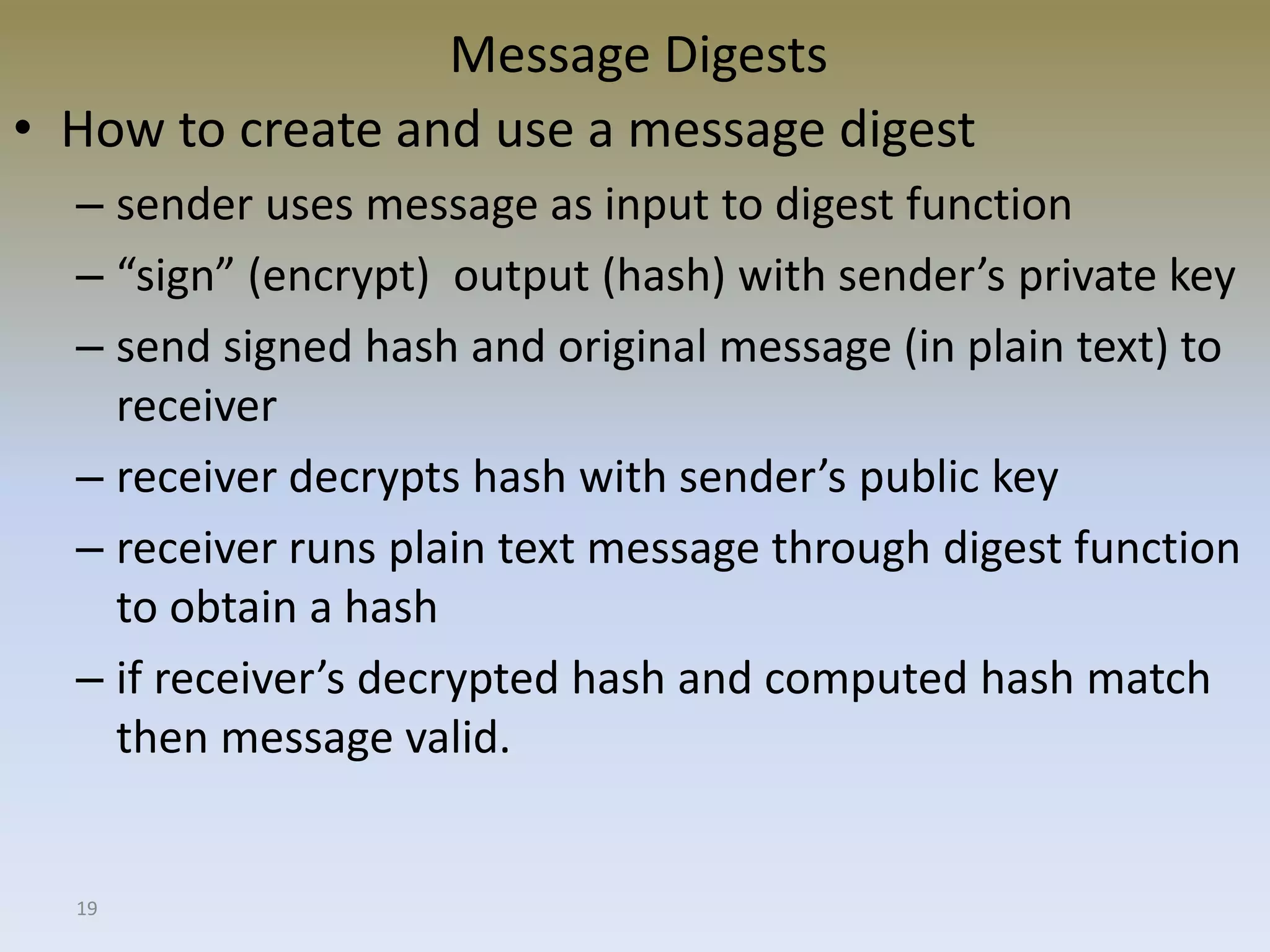
Message Digests
• How to create and use a message digest
– sender uses message as input to digest function
– “sign” (encrypt) output (hash) with sender’s private key
– send signed hash and original message (in plain text) to
receiver
– receiver decrypts hash with sender’s public key
– receiver runs plain text message through digest function
to obtain a hash
– if receiver’s decrypted hash and computed hash match
then message valid.
20
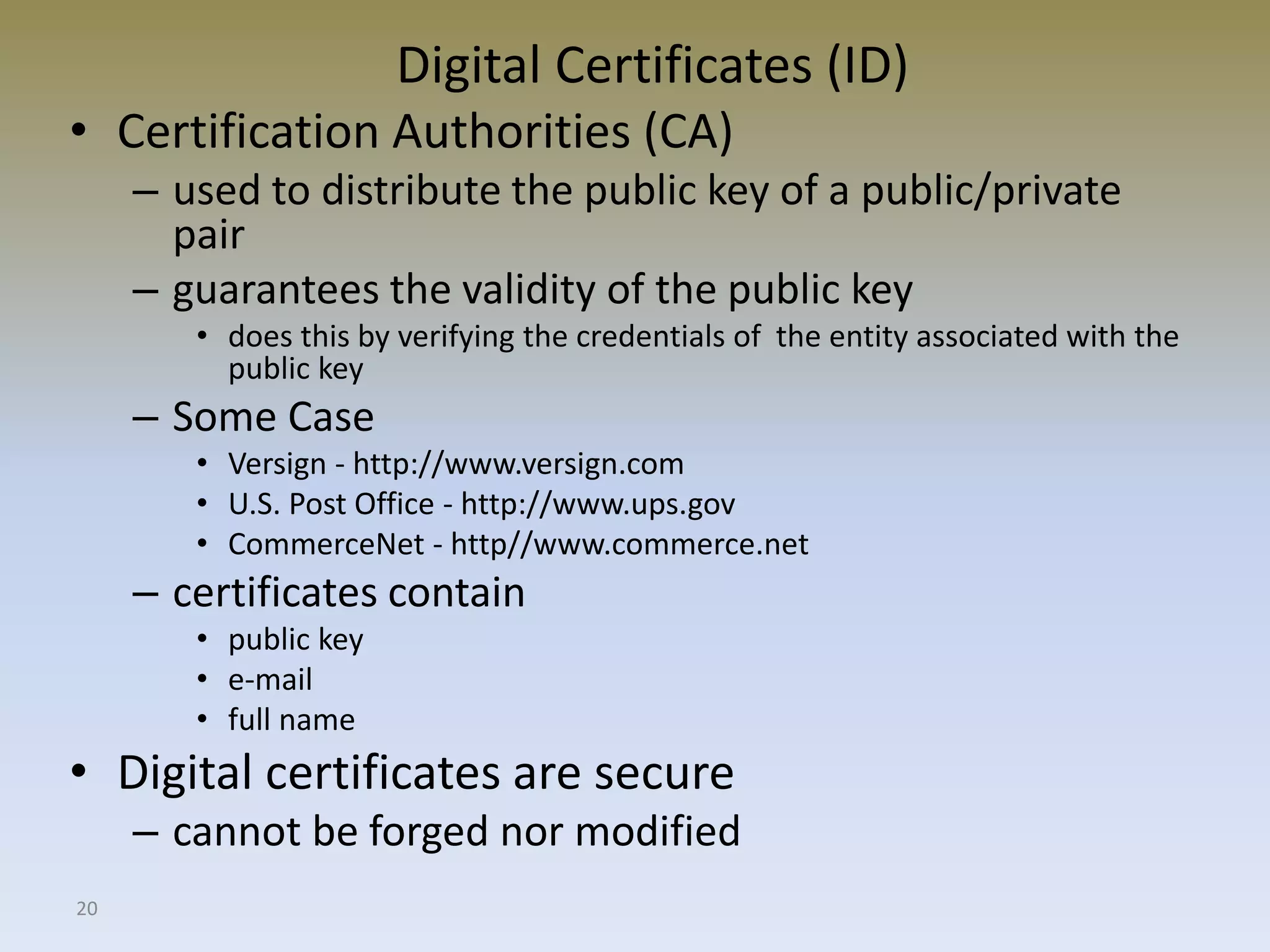
Digital Certificates (ID)
• Certification Authorities (CA)
– used to distribute the public key of a public/private
pair
– guarantees the validity of the public key
• does this by verifying the credentials of the entity associated with the
public key
– Some Case
• Versign - http://www.versign.com
• U.S. Post Office - http://www.ups.gov
• CommerceNet - http//www.commerce.net
– certificates contain
• public key
• e-mail
• full name
• Digital certificates are secure
– cannot be forged nor modified
21
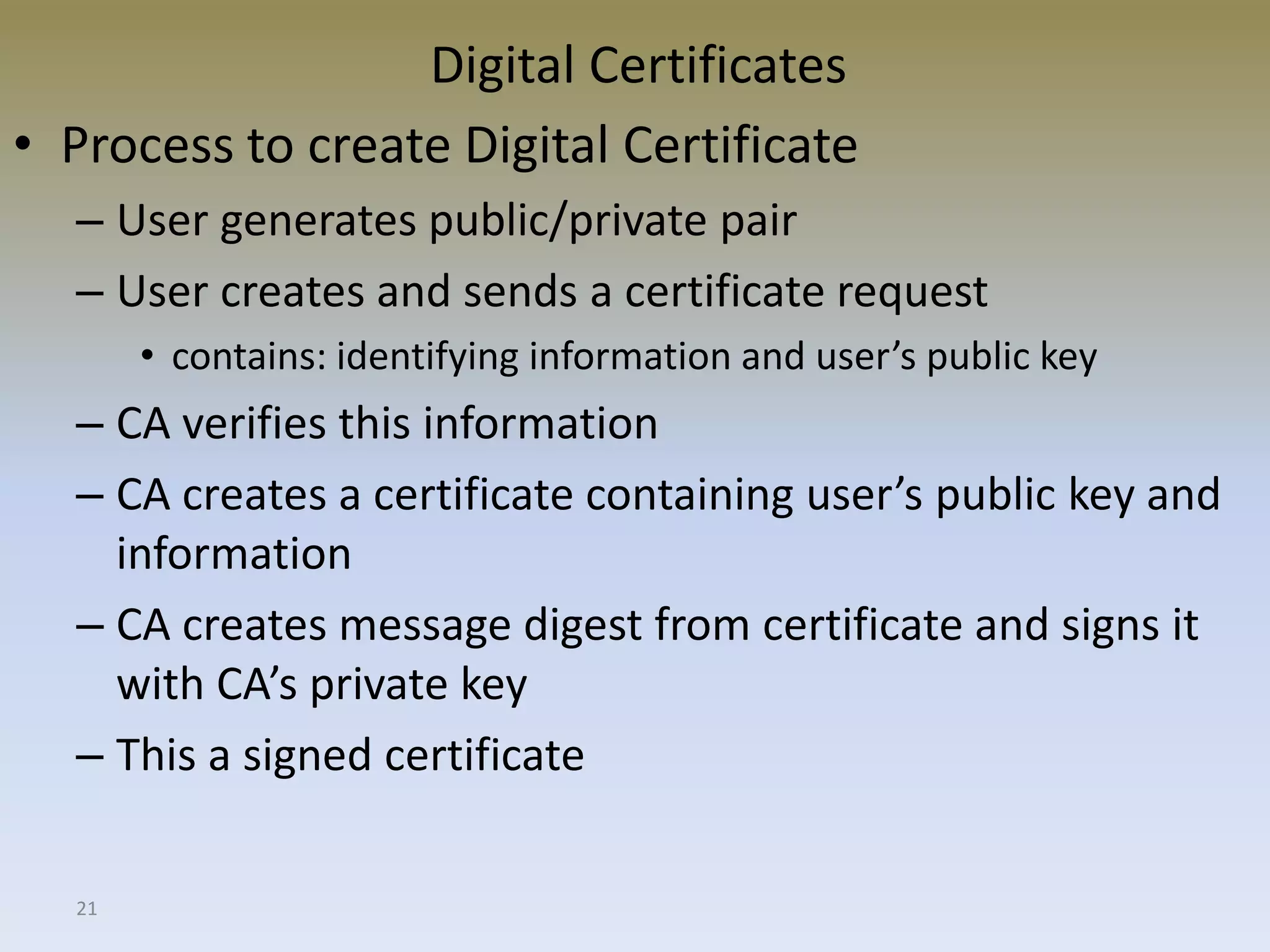
Digital Certificates
• Process to create Digital Certificate
– User generates public/private pair
– User creates and sends a certificate request
• contains: identifying information and user’s public key
– CA verifies this information
– CA creates a certificate containing user’s public key and
information
– CA creates message digest from certificate and signs it
with CA’s private key
– This a signed certificate
22
Digital Certificates
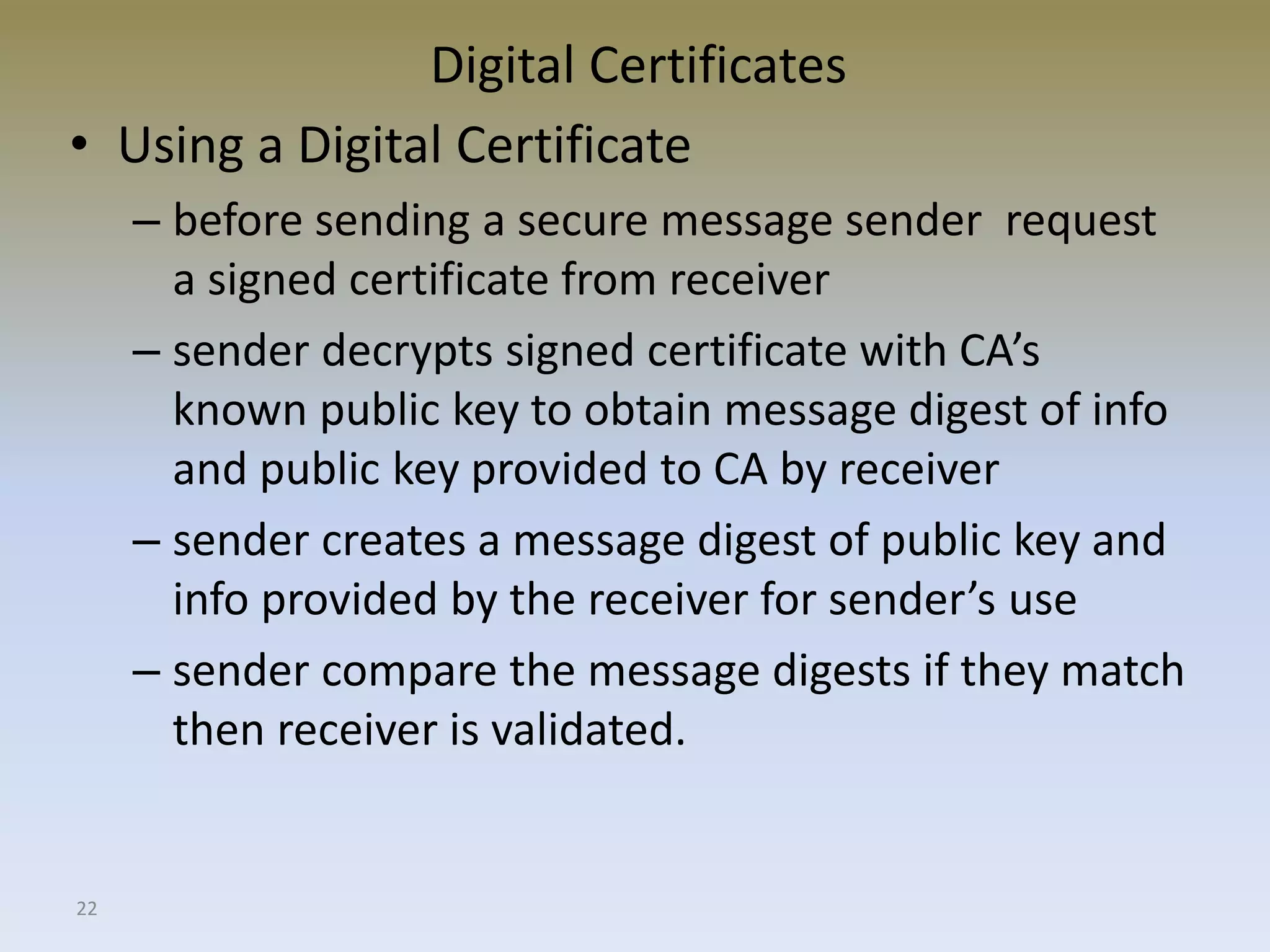
• Using a Digital Certificate
– before sending a secure message sender request
a signed certificate from receiver
– sender decrypts signed certificate with CA’s
known public key to obtain message digest of info
and public key provided to CA by receiver
– sender creates a message digest of public key and
info provided by the receiver for sender’s use
– sender compare the message digests if they match
then receiver is validated.
23
Digital Certificates
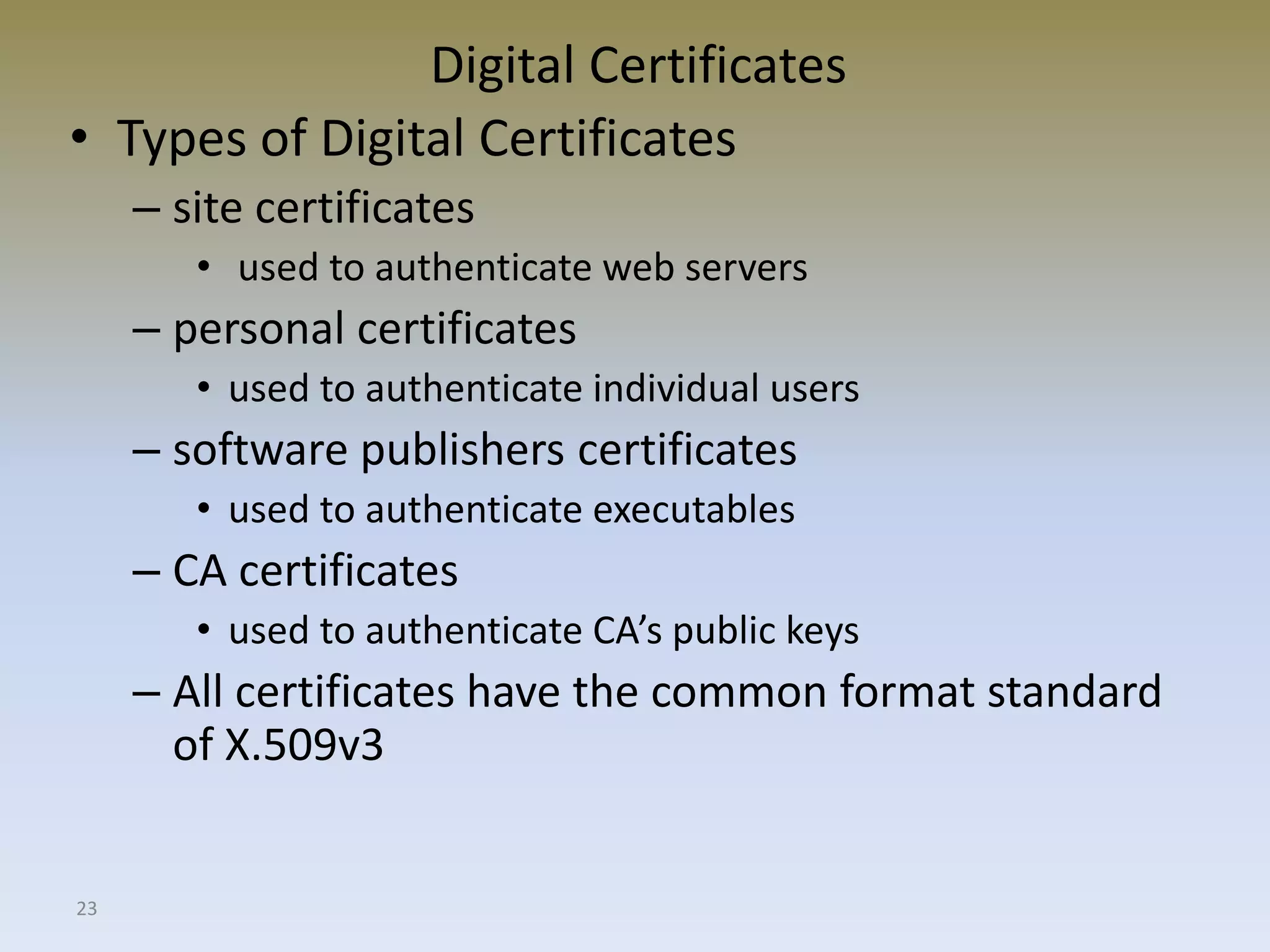
• Types of Digital Certificates
– site certificates
• used to authenticate web servers
– personal certificates
• used to authenticate individual users
– software publishers certificates
• used to authenticate executables
– CA certificates
• used to authenticate CA’s public keys
– All certificates have the common format standard
of X.509v3
24
Secure Channels
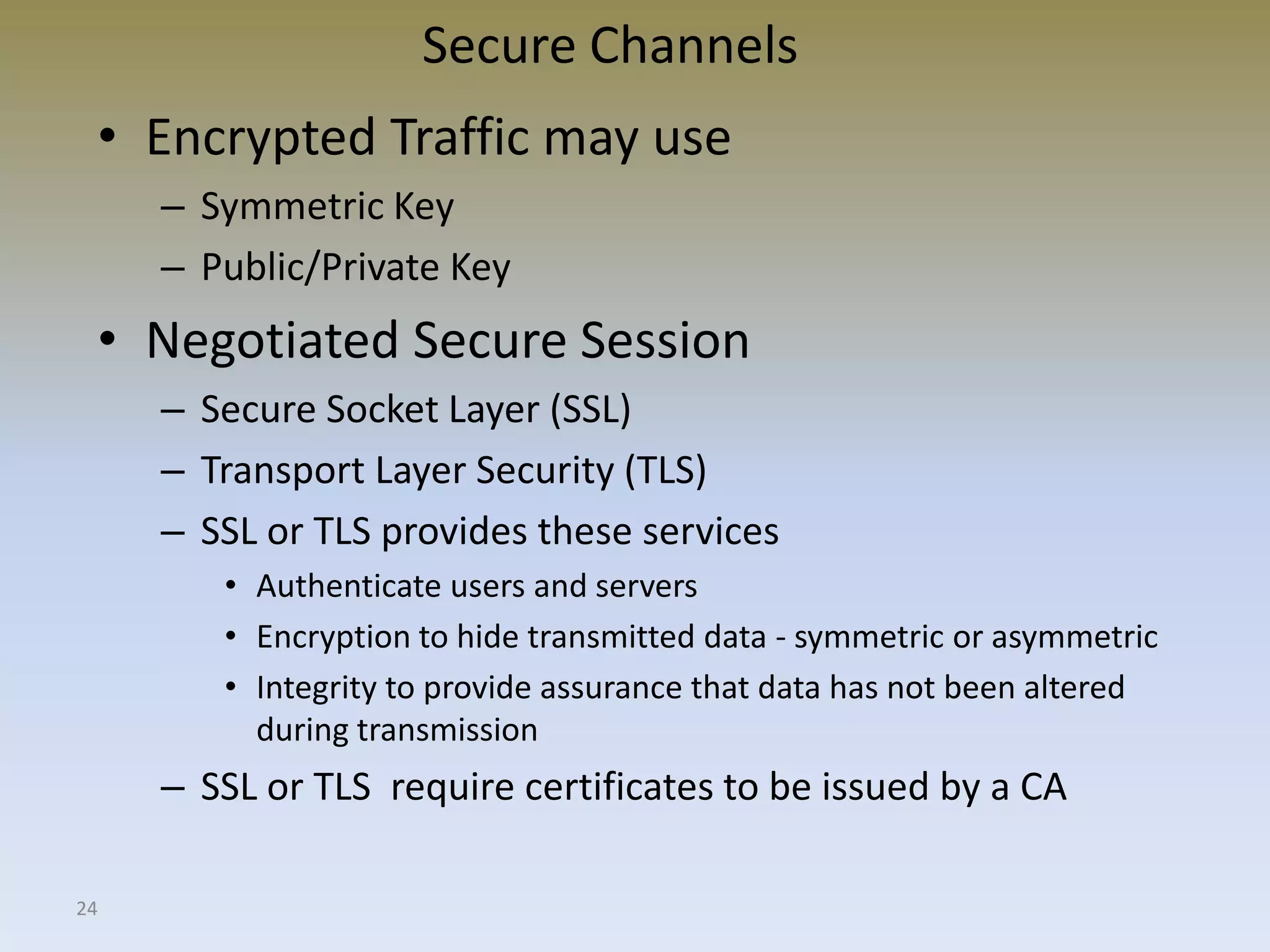
• Encrypted Traffic may use
– Symmetric Key
– Public/Private Key
• Negotiated Secure Session
– Secure Socket Layer (SSL)
– Transport Layer Security (TLS)
– SSL or TLS provides these services
• Authenticate users and servers
• Encryption to hide transmitted data - symmetric or asymmetric
• Integrity to provide assurance that data has not been altered
during transmission
– SSL or TLS require certificates to be issued by a CA
25
Secure Channels (con’t)
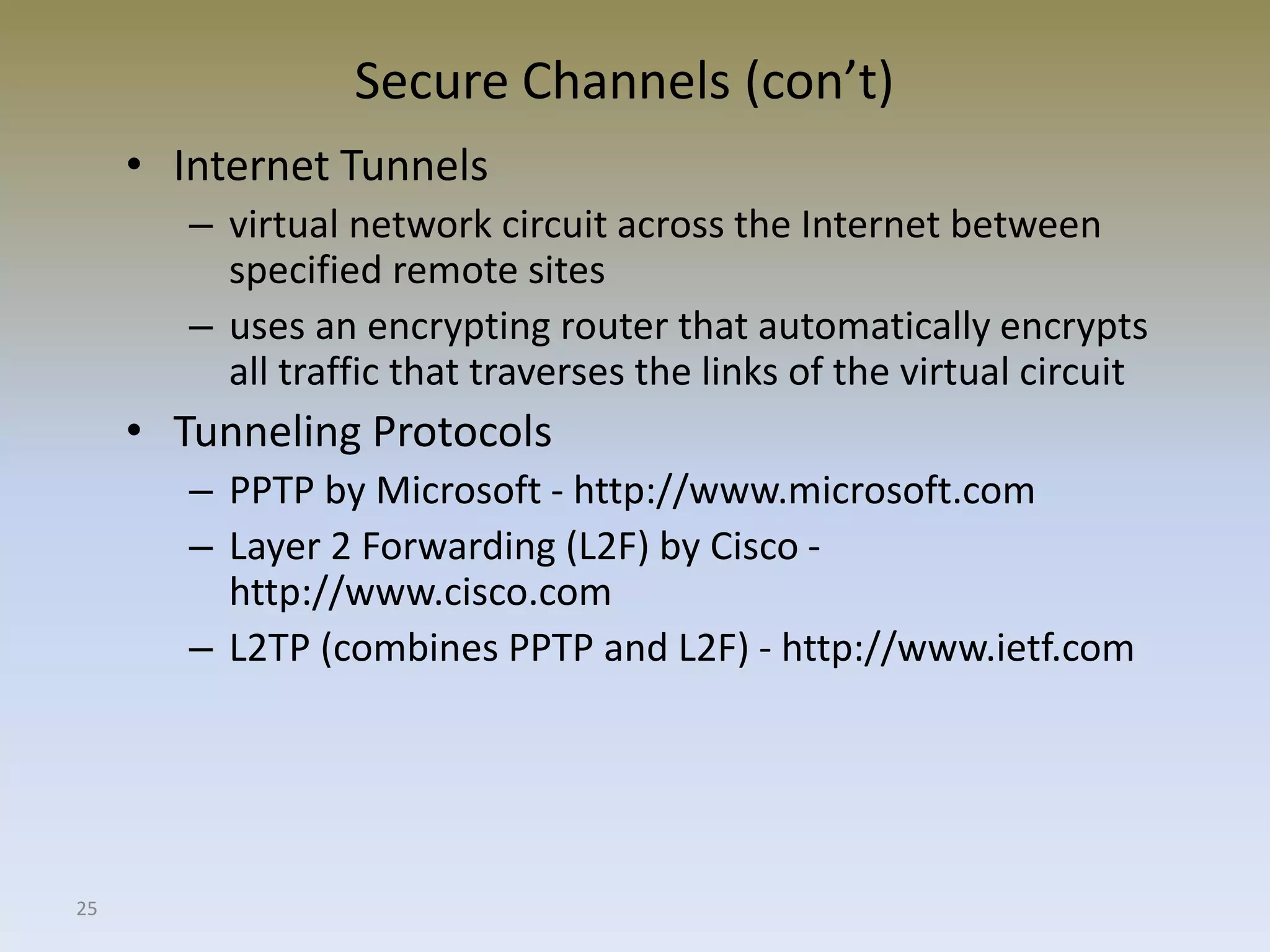
• Internet Tunnels
– virtual network circuit across the Internet between
specified remote sites
– uses an encrypting router that automatically encrypts
all traffic that traverses the links of the virtual circuit
• Tunneling Protocols
– PPTP by Microsoft - http://www.microsoft.com
– Layer 2 Forwarding (L2F) by Cisco -
http://www.cisco.com
– L2TP (combines PPTP and L2F) - http://www.ietf.com
Query Session
Confusion comes with lack of
understanding … Improve
understanding by asking questions

Web security for e-commerce

  • 1.
    Web Security forE-Commerce Protection for online business
  • 2.
    2 Web Concepts forE-Commerce • Client/Server Applications • Communication Channels • TCP/IP
  • 3.
  • 4.
  • 5.
    5 Application Allows accessto network resources OSI Model Presentation Translates, encrypts and compresses data Session Establishes, manages and terminates sessions Transport Provides end-to-end message delivery & error recovery Network Moves packets from source to destination; Provides internetworking Data Link Organizes bits into frames; Provides node-to-node delivery Physical Transmits bits; Provides mechanical and electrical specifications
  • 6.
    6 OSI Model cont’d ClientServerIntermediate Intermediate Node Node Application Presentation Session Transport Network Data Link Physical Application Presentation Session Transport Network Data Link Physical Peer-to-peer protocol (7th layer) Peer-to-peer protocol (6th layer) Peer-to-peer protocol (5th layer) Peer-to-peer protocol (4th layer) Data Link Data Link NetworkNetwork Physical Physical 3rd 3rd 3rd 2nd2nd2nd 1st 1st 1st
  • 7.
    7 TCP/IP and OSIModel Network Application Presentation Session Transport Data Link Physical SMTP Applications FTP TELNET DNS SNMP NFS TFTP RPC TCP UDP ICMP ARP RARP IP Protocols defined by the underlying networks HTTP
  • 8.
    8 TCP/IP and OSIModel cont’d Network Application Presentation Session Transport Data Link Physical TCP UDP IP Protocols defined by the underlying networks Applications Message Segment Datagram Bits Frame
  • 11.
  • 12.
    12 Security Threats • Securitythreats A to D can be handled by providing secure transmission - cryptographic methods • Threat E and similar types managed by access control methods • Other types of security threats – Illegal access of server computing system (webjacking) – Illegal access client computing system – Unauthorized use of client information – Denial of Service
  • 13.
    13 Information Security Threats •Internet Cryptography Techniques • Transport Layer Security • Application Layer Security • Server Proxies and Firewalls
  • 14.
    14 Purpose of Cryptography •Secure stored information - regardless if access obtained • Secure transmitted information - regardless if transmission has been monitored
  • 15.
    15 Services Provided byCryptography • Confidentiality – provides privacy for messages and stored data by hiding • Message Integrity – provides assurance to all parties that a message remains unchanged • Non-repudiation – Can prove a document came from X even if X’ denies it • Authentication – identifies the origin of a message – verifies the identity of person using a computer system
  • 16.
    16 Cryptographic Services Allow •Digital Signatures – sign messages to validate source and integrity of the contents • Digital Envelopes – secure delivery of secret keys • Message Digests – short bit string hash of message • Certificates (Digital Ids) – used to authenticate: users, web sites, public keys of public/private pair, and information in general • Secure Channels – Encryption can be used to create secure channels over private or public networks
  • 17.
    17 Digital Signatures • DigitalSignature – Encrypt sender’s identity string with sender’s private key – Concatenate the encrypted text and the identity string together – Encrypt this message with receiver’s public key to create message – Receiver decrypts the encrypted text with their private key – the cypher text portion of the message is decrypted with sender’s public key – The decrypted text can be compared with the normal text to checks its integrity
  • 18.
    18 Digital Envelope • Public/Privatekey encryption / decryption useful for internet • Limitations – encryption / decryption slow – not reasonable for large documents • Combine symmetric and asymmetric methods – sender creates and uses symmetric (session) key to create cipher text – sender uses receiver’s public key to encrypt the symmetric key - digital envelope – sender transmits both cipher text and digital envelope to receiver
  • 19.
    19 Message Digests • Howto create and use a message digest – sender uses message as input to digest function – “sign” (encrypt) output (hash) with sender’s private key – send signed hash and original message (in plain text) to receiver – receiver decrypts hash with sender’s public key – receiver runs plain text message through digest function to obtain a hash – if receiver’s decrypted hash and computed hash match then message valid.
  • 20.
    20 Digital Certificates (ID) •Certification Authorities (CA) – used to distribute the public key of a public/private pair – guarantees the validity of the public key • does this by verifying the credentials of the entity associated with the public key – Some Case • Versign - http://www.versign.com • U.S. Post Office - http://www.ups.gov • CommerceNet - http//www.commerce.net – certificates contain • public key • e-mail • full name • Digital certificates are secure – cannot be forged nor modified
  • 21.
    21 Digital Certificates • Processto create Digital Certificate – User generates public/private pair – User creates and sends a certificate request • contains: identifying information and user’s public key – CA verifies this information – CA creates a certificate containing user’s public key and information – CA creates message digest from certificate and signs it with CA’s private key – This a signed certificate
  • 22.
    22 Digital Certificates • Usinga Digital Certificate – before sending a secure message sender request a signed certificate from receiver – sender decrypts signed certificate with CA’s known public key to obtain message digest of info and public key provided to CA by receiver – sender creates a message digest of public key and info provided by the receiver for sender’s use – sender compare the message digests if they match then receiver is validated.
  • 23.
    23 Digital Certificates • Typesof Digital Certificates – site certificates • used to authenticate web servers – personal certificates • used to authenticate individual users – software publishers certificates • used to authenticate executables – CA certificates • used to authenticate CA’s public keys – All certificates have the common format standard of X.509v3
  • 24.
    24 Secure Channels • EncryptedTraffic may use – Symmetric Key – Public/Private Key • Negotiated Secure Session – Secure Socket Layer (SSL) – Transport Layer Security (TLS) – SSL or TLS provides these services • Authenticate users and servers • Encryption to hide transmitted data - symmetric or asymmetric • Integrity to provide assurance that data has not been altered during transmission – SSL or TLS require certificates to be issued by a CA
  • 25.
    25 Secure Channels (con’t) •Internet Tunnels – virtual network circuit across the Internet between specified remote sites – uses an encrypting router that automatically encrypts all traffic that traverses the links of the virtual circuit • Tunneling Protocols – PPTP by Microsoft - http://www.microsoft.com – Layer 2 Forwarding (L2F) by Cisco - http://www.cisco.com – L2TP (combines PPTP and L2F) - http://www.ietf.com
  • 26.
    Query Session Confusion comeswith lack of understanding … Improve understanding by asking questions