An exploration, with share and tell   Presented by  Denise R. Jacobs Web 2.0 for Foundations, High-Ed, and  Non-profits
Who am I? Denise R. Jacobs Been working on the web since 1996. Formerly an instructor of Web Design and Development at Seattle Central Community College, currently a Project Manager at Dotmarketing, Inc. in Miami, FL who produces dotCMS, an open-source java-based CMS.  How to contact me:  [email_address] Yes, I will post this presentation afterwards. Send me an email and I will send you the link.
What is web 2.0? Web 2.0 is a term describing the trend in the use of World Wide Web technology and web design that aims to enhance creativity, information sharing, and, most notably, collaboration among users. - Wikipedia
But really, Web 2.0 is… …  mostly buzzword that helps define a complicated and nebulous set of concepts Eases communication Good for non-technical people Good way to promote a group of technologies
What do web 2.0 sites do? Provide a service, not a product (infoware not software) Encourage user contribution (reviews, comments) Leverage collective intelligence (ranking/rating, folksonomies, popularity, peer reviews) facilitate to re-use and re-mix of content from other sites (feeds, mashups) Encourage a sense of community and ownership
Why use web 2.0 tools? Humans are inherently social Social activity is happening around your content or service whether you want it to or not. People are sharing their stories, commenting about what’s good, what’s bad, and trying to find out information By adding social features to a web site, you’re enabling them to do it in a way that is trackable and can guide/instruct the organization
Web 2.0, Technically Speaking Web 2.0 websites typically include some of the following features/techniques: Semantically valid XHTML and HTML markup Cascading Style Sheets to support the separation of presentation and content Ajax-based rich Internet application techniques Microformats extending pages with additional semantics
Web  2.0 Tools/Techniques Folksonomies/Tagging (collaborative tagging, social classification, social indexing, and social tagging) Taxonomy-driven navigation, Data-driven (strategies) Syndication, aggregation and notification of data with feeds Mashups, merging content from different sources, client- and server-side Blogs Wiki or forum software, etc., to support user-generated content Social bookmarking/promotion
Change is Afoot! The new face of the web: Users needs are established, but set of wants and expectations are evolving
Why? Because… brochure sites are no longer effective these bodies want to engage their audiences by encouraging participation and action provide rich content storytelling provide a face and personality to the entity provide a venue for distant people/groups to connect with each other and continue the goals/mission of the entity Adapt or die
Share and Tell Here are some examples of techniques that some Foundations, Higher Education institutions and Non-profits are using.
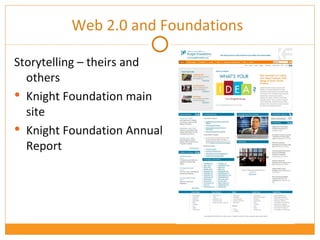
Web 2.0 and Foundations Storytelling – theirs and others Knight Foundation main site Knight Foundation Annual Report
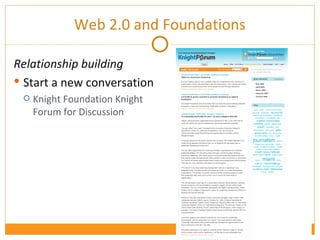
Web 2.0 and Foundations Relationship building Start a new conversation Knight Foundation Knight Forum for Discussion
Web 2.0 and Foundations Relationship building Aggregating conversations already happening around their activities into a central location and drive others to become engaged in those conversations as well
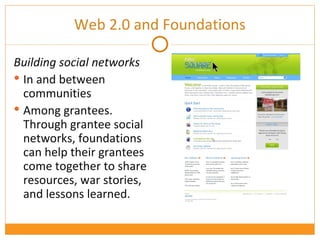
Building social networks  In and between communities Among grantees. Through grantee social networks, foundations can help their grantees come together to share resources, war stories, and lessons learned.  Web 2.0 and Foundations
More build relationships use social networks to communicate what the foundation is funding and why grant giving building social networks amongst grantees building social networks in and between communities provide richer content through aggregation provide richers content with mash-ups Web 2.0 and Foundations
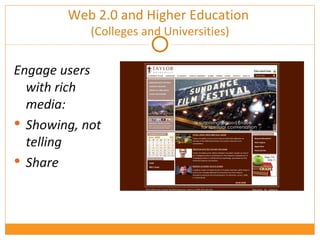
Web 2.0 and Higher Education  (Colleges and Universities) Engage users with rich media: Showing, not telling Share
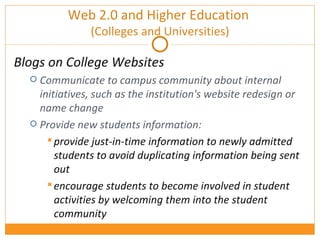
Web 2.0 and Higher Education  (Colleges and Universities) Blogs on College Websites Communicate to campus community about internal initiatives, such as the institution's website redesign or name change Provide new students information: provide just-in-time information to newly admitted students to avoid duplicating information being sent out  encourage students to become involved in student activities by welcoming them into the student community
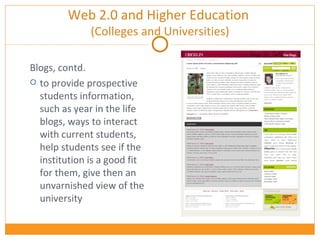
Web 2.0 and Higher Education  (Colleges and Universities) Blogs, contd. to provide prospective students information, such as year in the life blogs, ways to interact with current students, help students see if the institution is a good fit for them, give then an unvarnished view of the university
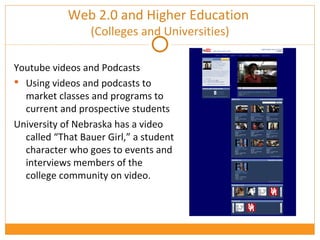
Web 2.0 and Higher Education  (Colleges and Universities) Youtube videos and Podcasts Using videos and podcasts to market classes and programs to current and prospective students University of Nebraska has a video called “That Bauer Girl,” a student character who goes to events and interviews members of the college community on video.
Using Tools in a fresh way ENS’s: some schools have invested a lot of money into a cell phone notification systems University of Michigan implemented Twitter as a FREE Emergency Notification System to send text messages to students Twitter as a live chat channel for admission Twitter to aggregate their school news feeds Web 2.0 and Higher Education  (Colleges and Universities)
More Using social networking tools to connect groups and create community Facebook Use web 2.0 in the classroom (in a multitudes of ways!) Commenting Social bookmarking and sharing/promotion Web 2.0 and Higher Education  (Colleges and Universities)
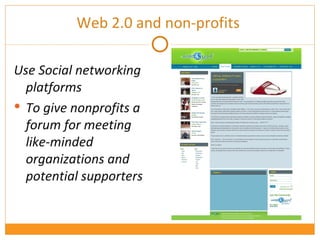
Web 2.0 and non-profits  Use Social networking platforms  To give nonprofits a forum for meeting like-minded organizations and potential supporters
Blogs for Non-profits  to keep constituents and volunteers up-to-date on projects and goals new technologies, new science, new communication tools, social change, fundraising trends, and volunteerism current issues, organization's own latest public policy reports, action alerts, and commentary. Using blogs to locate employees, volunteers, etc Web 2.0 and non-profits
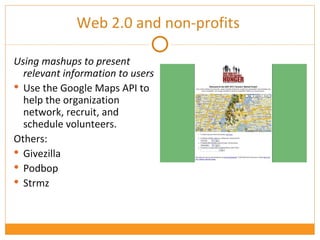
Using mashups to present relevant information to users Use the Google Maps API to help the organization network, recruit, and schedule volunteers. Others: Givezilla Podbop Strmz  Web 2.0 and non-profits
More Tagging/social bookmarking Using RSS feeds and aggregators to serve content to users Use podcasts to promote their organization and reach their constituency Web 2.0 and non-profits
Getting the word out: if you build it, will they come? Storytelling: Developing a conversation strategy to support it and help it grow Some Final Thoughts
The End… Thoughts? Questions? Comments?  Share a story? Hit me up, if ya wanna: [email_address]

Web 2.0 for Foundations, Higher Ed, and Non-profits - TODCon 2008

  • 1.
    An exploration, withshare and tell Presented by Denise R. Jacobs Web 2.0 for Foundations, High-Ed, and Non-profits
  • 2.
    Who am I?Denise R. Jacobs Been working on the web since 1996. Formerly an instructor of Web Design and Development at Seattle Central Community College, currently a Project Manager at Dotmarketing, Inc. in Miami, FL who produces dotCMS, an open-source java-based CMS. How to contact me: [email_address] Yes, I will post this presentation afterwards. Send me an email and I will send you the link.
  • 3.
    What is web2.0? Web 2.0 is a term describing the trend in the use of World Wide Web technology and web design that aims to enhance creativity, information sharing, and, most notably, collaboration among users. - Wikipedia
  • 4.
    But really, Web2.0 is… … mostly buzzword that helps define a complicated and nebulous set of concepts Eases communication Good for non-technical people Good way to promote a group of technologies
  • 5.
    What do web2.0 sites do? Provide a service, not a product (infoware not software) Encourage user contribution (reviews, comments) Leverage collective intelligence (ranking/rating, folksonomies, popularity, peer reviews) facilitate to re-use and re-mix of content from other sites (feeds, mashups) Encourage a sense of community and ownership
  • 6.
    Why use web2.0 tools? Humans are inherently social Social activity is happening around your content or service whether you want it to or not. People are sharing their stories, commenting about what’s good, what’s bad, and trying to find out information By adding social features to a web site, you’re enabling them to do it in a way that is trackable and can guide/instruct the organization
  • 7.
    Web 2.0, TechnicallySpeaking Web 2.0 websites typically include some of the following features/techniques: Semantically valid XHTML and HTML markup Cascading Style Sheets to support the separation of presentation and content Ajax-based rich Internet application techniques Microformats extending pages with additional semantics
  • 8.
    Web 2.0Tools/Techniques Folksonomies/Tagging (collaborative tagging, social classification, social indexing, and social tagging) Taxonomy-driven navigation, Data-driven (strategies) Syndication, aggregation and notification of data with feeds Mashups, merging content from different sources, client- and server-side Blogs Wiki or forum software, etc., to support user-generated content Social bookmarking/promotion
  • 9.
    Change is Afoot!The new face of the web: Users needs are established, but set of wants and expectations are evolving
  • 10.
    Why? Because… brochuresites are no longer effective these bodies want to engage their audiences by encouraging participation and action provide rich content storytelling provide a face and personality to the entity provide a venue for distant people/groups to connect with each other and continue the goals/mission of the entity Adapt or die
  • 11.
    Share and TellHere are some examples of techniques that some Foundations, Higher Education institutions and Non-profits are using.
  • 12.
    Web 2.0 andFoundations Storytelling – theirs and others Knight Foundation main site Knight Foundation Annual Report
  • 13.
    Web 2.0 andFoundations Relationship building Start a new conversation Knight Foundation Knight Forum for Discussion
  • 14.
    Web 2.0 andFoundations Relationship building Aggregating conversations already happening around their activities into a central location and drive others to become engaged in those conversations as well
  • 15.
    Building social networks In and between communities Among grantees. Through grantee social networks, foundations can help their grantees come together to share resources, war stories, and lessons learned. Web 2.0 and Foundations
  • 16.
    More build relationshipsuse social networks to communicate what the foundation is funding and why grant giving building social networks amongst grantees building social networks in and between communities provide richer content through aggregation provide richers content with mash-ups Web 2.0 and Foundations
  • 17.
    Web 2.0 andHigher Education (Colleges and Universities) Engage users with rich media: Showing, not telling Share
  • 18.
    Web 2.0 andHigher Education (Colleges and Universities) Blogs on College Websites Communicate to campus community about internal initiatives, such as the institution's website redesign or name change Provide new students information: provide just-in-time information to newly admitted students to avoid duplicating information being sent out encourage students to become involved in student activities by welcoming them into the student community
  • 19.
    Web 2.0 andHigher Education (Colleges and Universities) Blogs, contd. to provide prospective students information, such as year in the life blogs, ways to interact with current students, help students see if the institution is a good fit for them, give then an unvarnished view of the university
  • 20.
    Web 2.0 andHigher Education (Colleges and Universities) Youtube videos and Podcasts Using videos and podcasts to market classes and programs to current and prospective students University of Nebraska has a video called “That Bauer Girl,” a student character who goes to events and interviews members of the college community on video.
  • 21.
    Using Tools ina fresh way ENS’s: some schools have invested a lot of money into a cell phone notification systems University of Michigan implemented Twitter as a FREE Emergency Notification System to send text messages to students Twitter as a live chat channel for admission Twitter to aggregate their school news feeds Web 2.0 and Higher Education (Colleges and Universities)
  • 22.
    More Using socialnetworking tools to connect groups and create community Facebook Use web 2.0 in the classroom (in a multitudes of ways!) Commenting Social bookmarking and sharing/promotion Web 2.0 and Higher Education (Colleges and Universities)
  • 23.
    Web 2.0 andnon-profits Use Social networking platforms To give nonprofits a forum for meeting like-minded organizations and potential supporters
  • 24.
    Blogs for Non-profits to keep constituents and volunteers up-to-date on projects and goals new technologies, new science, new communication tools, social change, fundraising trends, and volunteerism current issues, organization's own latest public policy reports, action alerts, and commentary. Using blogs to locate employees, volunteers, etc Web 2.0 and non-profits
  • 25.
    Using mashups topresent relevant information to users Use the Google Maps API to help the organization network, recruit, and schedule volunteers. Others: Givezilla Podbop Strmz Web 2.0 and non-profits
  • 26.
    More Tagging/social bookmarkingUsing RSS feeds and aggregators to serve content to users Use podcasts to promote their organization and reach their constituency Web 2.0 and non-profits
  • 27.
    Getting the wordout: if you build it, will they come? Storytelling: Developing a conversation strategy to support it and help it grow Some Final Thoughts
  • 28.
    The End… Thoughts?Questions? Comments? Share a story? Hit me up, if ya wanna: [email_address]