MINI PROJECT PRESENTATION
Prepared By:
Hasna Heng Kamal Koh
0911796
Hasna Heng
DENSE WAVELENGTHDIVISION MULTIPLEXING
(DWDM)
An Evolution of Optical Fiber Transmission
System

Hasna Heng
Objectives
To have a basic understanding on optical fiber
transmission system
 To understand the basic principle of the DWDM
technology


Hasna Heng
INTRODUCTION OF

OPTICAL FIBER

Hasna Heng
OPTICAL FIBER

Fine threads of glass in layers
 Diameter ≈ human hair
 Core & Cladding + protection layers (polymers)
 2 types of fiber profiles


Hasna Heng
STEPPED-INDEX FIBER


Multimode Fiber
Larger core (50-200µm)
 Simultaneously transmit
numerous mode of light
 1st generation system
(1975-1980)




Single-mode Fiber
Small core (<10µm)
 Carries single mode of
light
 Eliminate intermodal
dispersion


Hasna Heng
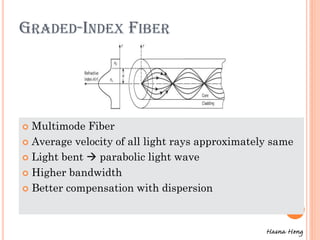
GRADED-INDEX FIBER

Multimode Fiber
 Average velocity of all light rays approximately same
 Light bent  parabolic light wave
 Higher bandwidth
 Better compensation with dispersion


Hasna Heng
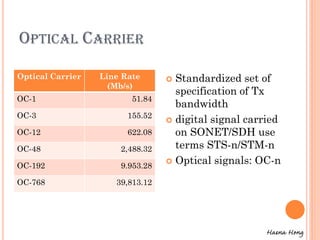
OPTICAL CARRIER
Optical Carrier

Line Rate
(Mb/s)

OC-1

51.84

OC-3

155.52

OC-12

622.08

OC-48

2,488.32

OC-192

9.953.28

OC-768

Standardized set of
specification of Tx
bandwidth
 digital signal carried
on SONET/SDH use
terms STS-n/STM-n
 Optical signals: OC-n


39,813.12

Hasna Heng
WHY MOVE TO OPTICAL FIBER?
Copper Wiring

Optical Fiber

Expensive material
 High power
consumption
 Large and heavy
 Weak signal due to
power degradation
 Low signal capacity
 Stealing cases
 Low cost on
installation













Low cost material
Lower power
consumption
Smaller size & lighter
Minimize degradation of
signal
Large data capacity
Expensive for
construction and
installation
Less flexible  easily
damaged
Hasna Heng
RESOLVING THE
BANDWIDTH DEMAND
INTORDUCING TDM & WDM

Hasna Heng
Statistical studies: Annual growth of the internet
= 40% !!
 Upsurge of emerging services: 3G, broadband,
integrated multimedia services etc.
 Network traffic became sophisticated
 Increasing bandwidth demands
Internet growth
 2 solutions:





Time-Division Multiplexing (TDM)
Wavelength-Division Multiplexing (WDM)

40%/year

Hasna Heng
TDM


Increase the bit rate
data

Input data

Arrange in
sequence

Output

WDM


Increase the wavelength

Input
wavelength

Combine &
Split
Wavelength

Output

Hasna Heng
TDM
Input Signals
Output Signals

WDM
Input Signals

Output Signals

Hasna Heng
WDM


Coarse WDM (CWDM)
Wide channel spacing (20nm)
 Up to 16 wavelengths
 Low cost




Dense WDM (DWDM)
Dense channel spacing (0.2nm)
 Allows numerous wavelength transmission
simultaneously – high capacity


Hasna Heng
DENSE WAVELENGTHDIVISION MULTIPLEXING
DWDM

Hasna Heng
DWDM TECHNOLOGY
Multiplex multiple signals on single optical fiber
using different wavelength
 Channel signals carried by its wavelength
 Using C-band (1550nm) or L-band (1625nm)
(Early development)


Hasna Heng
Hasna Heng
MAIN COMPONENTS IN DWDM
Terminal Multiplexer (MUX)
Intermediate Line Repeater

1.
2.



3.
4.

Optical Amplifier
Erbium-Doped Fiber Amplifier (EDFA)

Optical Add/Drop Multiplexer (OADM)
Terminal De-multiplexer (DEMUX)

Hasna Heng
1. TERMINAL MULTIPLEXER (MUX)


Transponder
O-E-O conversion
 Each can convert one wavelength signal
 Covert input signals into C-band laser




MUX


Combined multiple data streams into a single data
channel to be transmitted

Hasna Heng
2. INTERMEDIATE LINE REPEATER
Booster for transmission signals
 To overcome the issue of attenuation on a longhaul network
 Installed every 80-100km
 Traditional amplifier need O-E conversion






Costly
Signal noise
Format restriction

Hasna Heng
TYPICAL OPTICAL AMPLIFIER
Don’t need electrical regeneration
 Independence of data format
 Speed increment
 Eg: Raman effect amplifier, semiconductor
optical/laser amplifier (SOA/SLA)


Hasna Heng
16 fiber pairs + 128 generators
 1 fiber pair + 16 Optical Amplifier


Hasna Heng
ERBIUMDOPED
FIBER
AMPLIFIER
(EDFA)


Significant breakthrough for DWDM
system (1995)
Larger power output
 Minimize noise factor
 Operates on wide bandwidth network
 No data format restriction


Hasna Heng
ENERGY-LEVEL DIAGRAM

Hasna Heng
3. OPTICAL ADD/DROP MULTIPLEXER
(OADM)
aka Intermediate optical terminal
 Allows wavelength to be added/dropped from the
signal as other wavelength passes through
 Can substitute optical amplifier


Hasna Heng
ROADM


Disadvantages of OADM:


Inserting/replacing Wavelength-selective card manually
Costly
 Optical signal interrupted


Hence  Reconfigurable OADM (ROADM)
 Switching wavelength configuration by remote
 Efficient & cost-effective
 More advanced OADM: the enhanced ROADM
(eROADM)


Hasna Heng
4. DEMUX



Inverse function of
MUX
Multiple-wavelengths
signals  individual
signals

Hasna Heng
WHY MOVE TO DWDM?
Capacity upgrade w/o adding fibers
 Transparency – can carry any transmission
format
 Scalability – Install additional equipment as
needed
 Wavelength routing and switching – wavelength
is used as another dimension to time and space


Hasna Heng
ISSUES IN DWDM
Attenuation
 Nonlinear inelastic scattering processes


Stimulated Raman Scattering (SRS)
 Stimulated Brillion Scattering (SBS)




Nonlinear variations in the refractive index due to
varying light intensity
Self Phase Modulation (SPM)
 Cross Phase Modulation (XPM)
 Four Wave Mixing (FWM)


Hasna Heng
LATEST ACHIEVEMENTS
HuaWei  Global leading ICT solution provider
 Pioneer in 100G DWDM





16 commercials + 50 trials of 100G networks

Recently: World’s first 400G long-haul DWDM system
(super channels)



Capacity up to 20Tbps over C-band
Transmission distance spanning 1000km w/o electrical
regeneration

Hasna Heng
CONCLUSION
DWDM plays an essential role in high capacity
optical networks
 Theoretically, enormous capacity is possible


No communication system is as terrific as our
communication with our Creator, Allah the
Almighty.
 No cost
 No limitation
 100% guaranteed !!
Hasna Heng
BIBLIOGRAPHY




















(n.d.). Retrieved from http://technologyinside.com/2007/03/30/making-sdh-dwdm-and-packetfriendy/
Ciena Corporation. (1997). Dense Wavelength Division Multiplexing. Natick: The Applied
Technologies Group.
Cisco Systems Inc. (2001, June 4). Introduction to DWDM Technology. Retrieved from
http://www.cisco.com/application/pdf/en/us/guest/products/ps2011/c2001/ccmigration_09186a00802
342cf.pdf
EXFO Inc. (n.d.). EXFOTube. Retrieved from www.youtube.com:
http://www.youtube.com/user/EXFOTube/
Fiber Optics For Sale Co. (n.d.). Retrieved from fiberoptics4sale:
http://www.fiberoptics4sale.com/wordpress/
Kartalopoulos, S. V. (2003). Optical Components and Optics. Retrieved from Global Spec:
http://beta.globalspec.com/reference/21551/160210/chapter-4-2-dwdm-network-topologies-review
Radmer, H. (2007). Basic DWDM Components. Retrieved from
http://www.nordu.net/development/fiber-workshop2007/Basic-DWDM-Components.pdf
Rahman, A. (n.d.). A Review of DWDM - The Heart of Optical Networks. Retrieved from
http://home.comcast.net/~dwdm2/DWDM_Review.PDF
Senior, J. M. (2009). Optical Fiber Communications - Principles and Practice (3rd ed.). Harlow:
Pearson Education Limited.
Song, S. (2001). An Overview of DWDM Networks. IEEE Canadian Review.

Hasna Heng
Hasna Heng

Optical Fibre & Introduction to TDM & DWDM

  • 1.
    MINI PROJECT PRESENTATION PreparedBy: Hasna Heng Kamal Koh 0911796 Hasna Heng
  • 2.
    DENSE WAVELENGTHDIVISION MULTIPLEXING (DWDM) AnEvolution of Optical Fiber Transmission System Hasna Heng
  • 3.
    Objectives To have abasic understanding on optical fiber transmission system  To understand the basic principle of the DWDM technology  Hasna Heng
  • 4.
  • 5.
    OPTICAL FIBER Fine threadsof glass in layers  Diameter ≈ human hair  Core & Cladding + protection layers (polymers)  2 types of fiber profiles  Hasna Heng
  • 6.
    STEPPED-INDEX FIBER  Multimode Fiber Largercore (50-200µm)  Simultaneously transmit numerous mode of light  1st generation system (1975-1980)   Single-mode Fiber Small core (<10µm)  Carries single mode of light  Eliminate intermodal dispersion  Hasna Heng
  • 7.
    GRADED-INDEX FIBER Multimode Fiber Average velocity of all light rays approximately same  Light bent  parabolic light wave  Higher bandwidth  Better compensation with dispersion  Hasna Heng
  • 8.
    OPTICAL CARRIER Optical Carrier LineRate (Mb/s) OC-1 51.84 OC-3 155.52 OC-12 622.08 OC-48 2,488.32 OC-192 9.953.28 OC-768 Standardized set of specification of Tx bandwidth  digital signal carried on SONET/SDH use terms STS-n/STM-n  Optical signals: OC-n  39,813.12 Hasna Heng
  • 9.
    WHY MOVE TOOPTICAL FIBER? Copper Wiring Optical Fiber Expensive material  High power consumption  Large and heavy  Weak signal due to power degradation  Low signal capacity  Stealing cases  Low cost on installation         Low cost material Lower power consumption Smaller size & lighter Minimize degradation of signal Large data capacity Expensive for construction and installation Less flexible  easily damaged Hasna Heng
  • 10.
  • 11.
    Statistical studies: Annualgrowth of the internet = 40% !!  Upsurge of emerging services: 3G, broadband, integrated multimedia services etc.  Network traffic became sophisticated  Increasing bandwidth demands Internet growth  2 solutions:    Time-Division Multiplexing (TDM) Wavelength-Division Multiplexing (WDM) 40%/year Hasna Heng
  • 12.
    TDM  Increase the bitrate data Input data Arrange in sequence Output WDM  Increase the wavelength Input wavelength Combine & Split Wavelength Output Hasna Heng
  • 13.
    TDM Input Signals Output Signals WDM InputSignals Output Signals Hasna Heng
  • 14.
    WDM  Coarse WDM (CWDM) Widechannel spacing (20nm)  Up to 16 wavelengths  Low cost   Dense WDM (DWDM) Dense channel spacing (0.2nm)  Allows numerous wavelength transmission simultaneously – high capacity  Hasna Heng
  • 15.
  • 16.
    DWDM TECHNOLOGY Multiplex multiplesignals on single optical fiber using different wavelength  Channel signals carried by its wavelength  Using C-band (1550nm) or L-band (1625nm) (Early development)  Hasna Heng
  • 17.
  • 18.
    MAIN COMPONENTS INDWDM Terminal Multiplexer (MUX) Intermediate Line Repeater 1. 2.   3. 4. Optical Amplifier Erbium-Doped Fiber Amplifier (EDFA) Optical Add/Drop Multiplexer (OADM) Terminal De-multiplexer (DEMUX) Hasna Heng
  • 19.
    1. TERMINAL MULTIPLEXER(MUX)  Transponder O-E-O conversion  Each can convert one wavelength signal  Covert input signals into C-band laser   MUX  Combined multiple data streams into a single data channel to be transmitted Hasna Heng
  • 20.
    2. INTERMEDIATE LINEREPEATER Booster for transmission signals  To overcome the issue of attenuation on a longhaul network  Installed every 80-100km  Traditional amplifier need O-E conversion     Costly Signal noise Format restriction Hasna Heng
  • 21.
    TYPICAL OPTICAL AMPLIFIER Don’tneed electrical regeneration  Independence of data format  Speed increment  Eg: Raman effect amplifier, semiconductor optical/laser amplifier (SOA/SLA)  Hasna Heng
  • 22.
    16 fiber pairs+ 128 generators  1 fiber pair + 16 Optical Amplifier  Hasna Heng
  • 23.
    ERBIUMDOPED FIBER AMPLIFIER (EDFA)  Significant breakthrough forDWDM system (1995) Larger power output  Minimize noise factor  Operates on wide bandwidth network  No data format restriction  Hasna Heng
  • 24.
  • 25.
    3. OPTICAL ADD/DROPMULTIPLEXER (OADM) aka Intermediate optical terminal  Allows wavelength to be added/dropped from the signal as other wavelength passes through  Can substitute optical amplifier  Hasna Heng
  • 26.
    ROADM  Disadvantages of OADM:  Inserting/replacingWavelength-selective card manually Costly  Optical signal interrupted  Hence  Reconfigurable OADM (ROADM)  Switching wavelength configuration by remote  Efficient & cost-effective  More advanced OADM: the enhanced ROADM (eROADM)  Hasna Heng
  • 27.
    4. DEMUX   Inverse functionof MUX Multiple-wavelengths signals  individual signals Hasna Heng
  • 28.
    WHY MOVE TODWDM? Capacity upgrade w/o adding fibers  Transparency – can carry any transmission format  Scalability – Install additional equipment as needed  Wavelength routing and switching – wavelength is used as another dimension to time and space  Hasna Heng
  • 29.
    ISSUES IN DWDM Attenuation Nonlinear inelastic scattering processes  Stimulated Raman Scattering (SRS)  Stimulated Brillion Scattering (SBS)   Nonlinear variations in the refractive index due to varying light intensity Self Phase Modulation (SPM)  Cross Phase Modulation (XPM)  Four Wave Mixing (FWM)  Hasna Heng
  • 30.
    LATEST ACHIEVEMENTS HuaWei Global leading ICT solution provider  Pioneer in 100G DWDM    16 commercials + 50 trials of 100G networks Recently: World’s first 400G long-haul DWDM system (super channels)   Capacity up to 20Tbps over C-band Transmission distance spanning 1000km w/o electrical regeneration Hasna Heng
  • 31.
    CONCLUSION DWDM plays anessential role in high capacity optical networks  Theoretically, enormous capacity is possible  No communication system is as terrific as our communication with our Creator, Allah the Almighty.  No cost  No limitation  100% guaranteed !! Hasna Heng
  • 32.
    BIBLIOGRAPHY           (n.d.). Retrieved fromhttp://technologyinside.com/2007/03/30/making-sdh-dwdm-and-packetfriendy/ Ciena Corporation. (1997). Dense Wavelength Division Multiplexing. Natick: The Applied Technologies Group. Cisco Systems Inc. (2001, June 4). Introduction to DWDM Technology. Retrieved from http://www.cisco.com/application/pdf/en/us/guest/products/ps2011/c2001/ccmigration_09186a00802 342cf.pdf EXFO Inc. (n.d.). EXFOTube. Retrieved from www.youtube.com: http://www.youtube.com/user/EXFOTube/ Fiber Optics For Sale Co. (n.d.). Retrieved from fiberoptics4sale: http://www.fiberoptics4sale.com/wordpress/ Kartalopoulos, S. V. (2003). Optical Components and Optics. Retrieved from Global Spec: http://beta.globalspec.com/reference/21551/160210/chapter-4-2-dwdm-network-topologies-review Radmer, H. (2007). Basic DWDM Components. Retrieved from http://www.nordu.net/development/fiber-workshop2007/Basic-DWDM-Components.pdf Rahman, A. (n.d.). A Review of DWDM - The Heart of Optical Networks. Retrieved from http://home.comcast.net/~dwdm2/DWDM_Review.PDF Senior, J. M. (2009). Optical Fiber Communications - Principles and Practice (3rd ed.). Harlow: Pearson Education Limited. Song, S. (2001). An Overview of DWDM Networks. IEEE Canadian Review. Hasna Heng
  • 33.