Code Division Multiple Access
                      S-72.4210 Postgraduate Course in Radio Communications

                                                Er Liu
                                           liuer@cc.hut.fi
                                             2006-01-17


         Content Outline
           CDMA History
           Spread Spectrum Technology
                Direct-Sequence
                Frequency Hopping
                Time Hopping
           CDMA Challenges
                Receiver design
                Near-Far Problem
                Power Control
                Soft and softer Handover
           CDMA Applications in Mobile Network
                IS-95
                CDMA2000
                WCDMA
           Conclusion
           Homework
2006-01-17 Code Division Multiple Access
2006- 01-                                                                     2


                                                                                  1
CDMA History
            Code Division Multiple Access (CDMA) is both a modulation
            and multiple access scheme
            Researches started even from 1950’  s
            Claude Shannon and Robert Pierce had provided CDMA
            framework in 1949
            De-Rosa-Rogoff defined the direct sequence spread spectrum
            method in 1950
            Rake receiver was first patented by Price and Green in 1956
            Cellular spread-spectrum application was suggested by Cooper
            and Nettleton in 1978
            IS-95, the narrow band CDMA mobile network, has been
            standardized in 1993 and commercial networks were introduced
            in 1995
            3G wideband CDMA systems, such as CDMA2000 in U.S. and
            European WCDMA developed from 1990s and still ongoing
2006-01-17 Code Division Multiple Access
2006- 01-                                                                  3


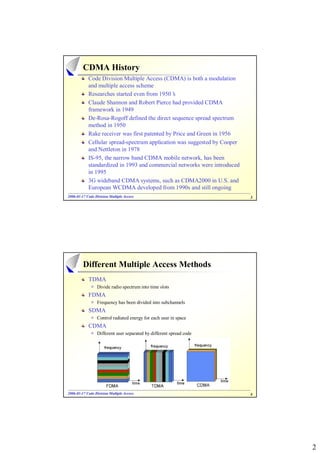
         Different Multiple Access Methods
            TDMA
                 Divide radio spectrum into time slots
            FDMA
                 Frequency has been divided into subchannels
            SDMA
                 Control radiated energy for each user in space
            CDMA
                 Different user separated by different spread code


2006-01-17 Code Division Multiple Access
2006- 01-                                                                  4


                                                                               2
Spread Spectrum Technology
            Originally developed for military and navigation purposes
                 Hard to be intercepted
                 Anti-jamming
            Nowadays feasible for commercial applications especially for
            mobile communication systems
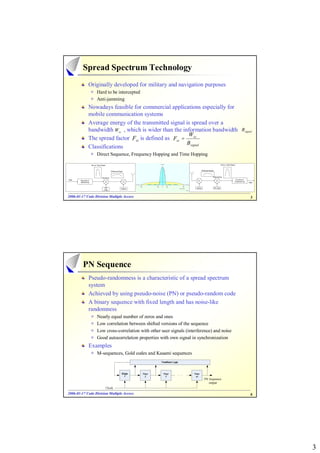
            Average energy of the transmitted signal is spread over a
            bandwidth Wss , which is wider than the information bandwidth Bsignal
                                                       W
            The spread factor Fss is defined as Fss = ss
                                                      Bsignal
            Classifications
                 Direct Sequence, Frequency Hopping and Time Hopping


2006-01-17 Code Division Multiple Access
2006- 01-                                                                                 5


         PN Sequence
            Pseudo-randomness is a characteristic of a spread spectrum
            system
            Achieved by using pseudo-noise (PN) or pseudo-random code
            A binary sequence with fixed length and has noise-like
            randomness
                 Nearly equal number of zeros and ones
                 Low correlation between shifted versions of the sequence
                 Low cross-correlation with other user signals (interference) and noise
                 Good autocorrelation properties with own signal in synchronization
            Examples
                 M-sequences, Gold codes and Kasami sequences


2006-01-17 Code Division Multiple Access
2006- 01-                                                                                 6


                                                                                              3
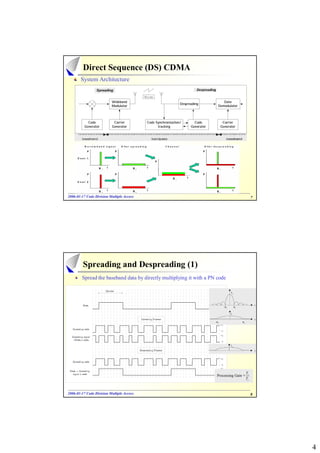
Direct Sequence (DS) CDMA
       System Architecture

                                           Noise
                          Wideband                                                   Data
                                                                Despreading
                          Modulator                                               Demodulator


            Code           Carrier          Code Synchronization/       Code         Carrier
          Generator       Generator               tracking            Generator     Generator


2006-01-17 Code Division Multiple Access
2006- 01-                                                                                                  7


         Spreading and Despreading (1)
        Spread the baseband data by directly multiplying it with a PN code


                                                                                                      Ts
                                                                                  Processing Gain =
                                                                                                      Tc


2006-01-17 Code Division Multiple Access
2006- 01-                                                                                                  8


                                                                                                               4
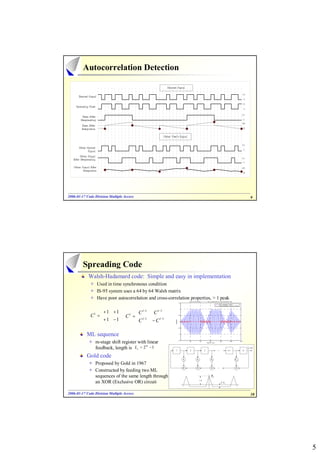
Autocorrelation Detection


2006-01-17 Code Division Multiple Access
2006- 01-                                                                                                                                                                                     9


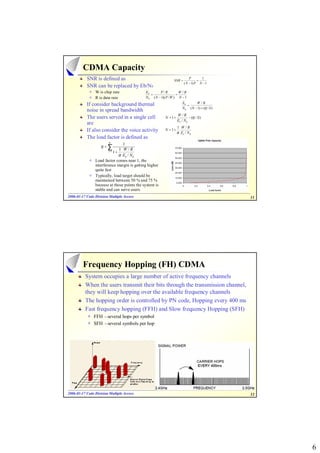
         Spreading Code
            Walsh-Hadamard code: Simple and easy in implementation
                 Used in time synchronous condition
                 IS-95 system uses a 64 by 64 Walsh matrix
                 Have poor autocorrelation and cross-correlation properties, > 1 peak
                                                                                          W hen transmitt ing 1 1 -1 -1 1, the correlationship of user spreading c ode
                                                                              1.5
                                                                                                                                              Auto-correlation: User3
                                                                                                                                              Cross-correlation: User3 vs User5


                  + 1 + 1     C         l −1       l −1
                                                              
                                                                                1


                                                  C
             C1 =         C =  l −1
                             l
                                                              
                                                                              0.5


                  + 1 − 1     C                −C   l −1
                                                              
                                                                  co lation


                                                                                0
                                                                    rre


                                                                              -0.5


           ML sequence                                                          -1


                m-stage shift register with linear
                                                                              -1.5
                                                                                          32                64               96                128               160              192
                                                                                                                        Delay in chip


                feedback, length is Lc = 2 − 1
                                           m
                                                                                                                                                                                        {c (i)}
                                                                                                                                                                                          j


           Gold code                                                                 h1                h2                       h3                                       hm−1

                Proposed by Gold in 1967
                Constructed by feeding two ML
                sequences of the same length through                                                                            RC

                an XOR (Exclusive OR) circuit                                                                                                    1 / Lc


2006-01-17 Code Division Multiple Access
2006- 01-                                                                                                                                                                                     10


                                                                                                                                                                                                   5
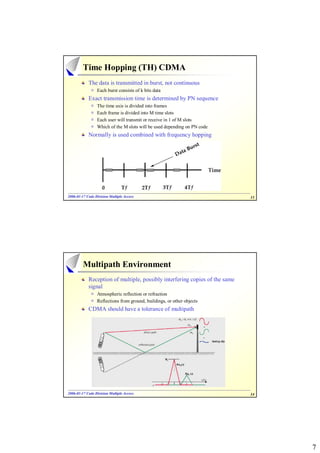
CDMA Capacity
           SNR is defined as                                   SNR =
                                                                           P
                                                                                 =
                                                                                   1
                                                                       ( N − 1) P N − 1
           SNR can be replaced by Eb/N0
                W is chip rate               Eb       P/R           W /R
                                                =                 =
                R is data rate               N 0 ( N − 1)( P / W ) N − 1

           If consider background thermal                             Eb       W /R
                                                                         =
                                                                      N 0 ( N − 1) + (η / S )
           noise in spread bandwidth
                                                                  W /R
           The users served in a single cell             N = 1+            − (η / S )
                                                                  Eb / N 0
           are
                                                                  1 W/R
           If also consider the voice activity           N = 1+
                                                                  α Eb / N 0
           The load factor is defined as
                         K
                                1
                   η=∑
                              1 W/R
                           1+
                        j =1
                              α Eb / N 0
                Load factor comes near 1, the
                interference margin is getting higher
                quite fast
                Typically, load target should be
                maintained between 50 % and 75 %
                because at those points the system is
                stable and can serve users.
2006-01-17 Code Division Multiple Access
2006- 01-                                                                                       11


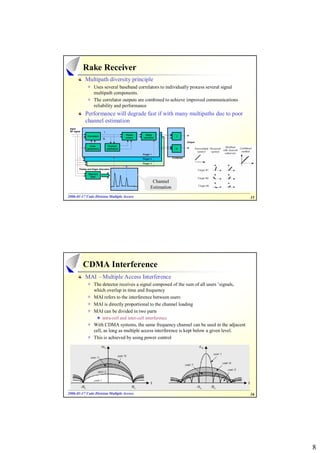
         Frequency Hopping (FH) CDMA
          System occupies a large number of active frequency channels
          When the users transmit their bits through the transmission channel,
          they will keep hopping over the available frequency channels
          The hopping order is controlled by PN code, Hopping every 400 ms
          Fast frequency hopping (FFH) and Slow frequency Hopping (SFH)
               FFH –several hops per symbol
               SFH –several symbols per hop


2006-01-17 Code Division Multiple Access
2006- 01-                                                                                       12


                                                                                                     6
Time Hopping (TH) CDMA
            The data is transmitted in burst, not continuous
                 Each burst consists of k bits data
            Exact transmission time is determined by PN sequence
                 The time axis is divided into frames
                 Each frame is divided into M time slots
                 Each user will transmit or receive in 1 of M slots
                 Which of the M slots will be used depending on PN code
            Normally is used combined with frequency hopping


2006-01-17 Code Division Multiple Access
2006- 01-                                                                    13


         Multipath Environment
            Reception of multiple, possibly interfering copies of the same
            signal
                 Atmospheric reflection or refraction
                 Reflections from ground, buildings, or other objects
            CDMA should have a tolerance of multipath


2006-01-17 Code Division Multiple Access
2006- 01-                                                                    14


                                                                                  7
Rake Receiver
          Multipath diversity principle
               Uses several baseband correlators to individually process several signal
               multipath components.
               The correlator outputs are combined to achieve improved communications
               reliability and performance
          Performance will degrade fast if with many multipaths due to poor
          channel estimation


                                                 Channel
                                                Estimation
2006-01-17 Code Division Multiple Access
2006- 01-                                                                                   15


         CDMA Interference
          MAI –Multiple Access Interference
               The detector receives a signal composed of the sum of all users’signals,
               which overlap in time and frequency
               MAI refers to the interference between users
               MAI is directly proportional to the channel loading
               MAI can be divided in two parts
                    intra-cell and inter-cell interference
               With CDMA systems, the same frequency channel can be used in the adjacent
               cell, as long as multiple access interference is kept below a given level.
               This is achieved by using power control


2006-01-17 Code Division Multiple Access
2006- 01-                                                                                   16


                                                                                                 8
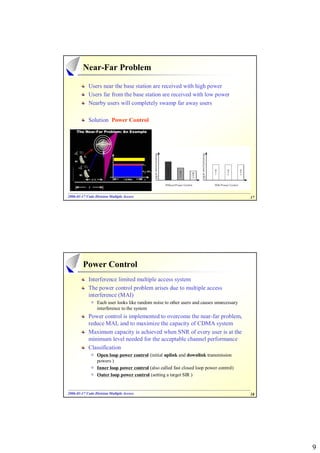
Near-Far Problem

            Users near the base station are received with high power
            Users far from the base station are received with low power
            Nearby users will completely swamp far away users

            Solution Power Control


2006-01-17 Code Division Multiple Access
2006- 01-                                                                                  17


         Power Control
            Interference limited multiple access system
            The power control problem arises due to multiple access
            interference (MAI)
                 Each user looks like random noise to other users and causes unnecessary
                 interference to the system
            Power control is implemented to overcome the near-far problem,
            reduce MAI, and to maximize the capacity of CDMA system
            Maximum capacity is achieved when SNR of every user is at the
            minimum level needed for the acceptable channel performance
            Classification
                 Open loop power control (initial uplink and downlink transmission
                 powers )
                 Inner loop power control (also called fast closed loop power control)
                 Outer loop power control (setting a target SIR )


2006-01-17 Code Division Multiple Access
2006- 01-                                                                                  18


                                                                                                9
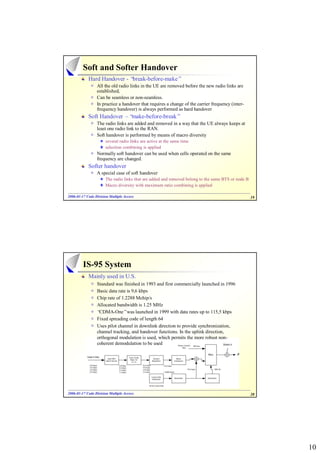
Soft and Softer Handover
            Hard Handover - “break-before-make”
                 All the old radio links in the UE are removed before the new radio links are
                 established,
                 Can be seamless or non-seamless.
                 In practice a handover that requires a change of the carrier frequency (inter-
                 frequency handover) is always performed as hard handover
            Soft Handover –“make-before-break”
                 The radio links are added and removed in a way that the UE always keeps at
                 least one radio link to the RAN.
                 Soft handover is performed by means of macro diversity
                      several radio links are active at the same time
                      selection combining is applied
                 Normally soft handover can be used when cells operated on the same
                 frequency are changed.
            Softer handover
                 A special case of soft handover
                      The radio links that are added and removed belong to the same BTS or node B
                      Macro diversity with maximum ratio combining is applied

2006-01-17 Code Division Multiple Access
2006- 01-                                                                                           19


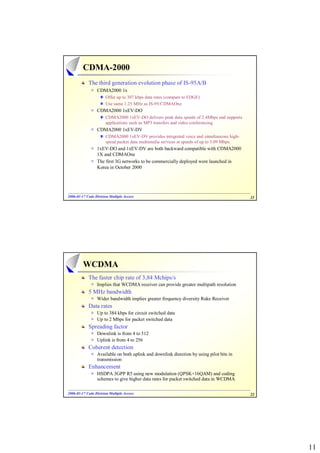
         IS-95 System
            Mainly used in U.S.
                 Standard was finished in 1993 and first commercially launched in 1996
                 Basic data rate is 9,6 kbps
                 Chip rate of 1.2288 Mchip/s
                 Allocated bandwidth is 1.25 MHz
                 “CDMA-One”was launched in 1999 with data rates up to 115,5 kbps
                 Fixed spreading code of length 64
                 Uses pilot channel in downlink direction to provide synchronization,
                 channel tracking, and handover functions. In the uplink direction,
                 orthogonal modulation is used, which permits the more robust non-
                 coherent demodulation to be used


2006-01-17 Code Division Multiple Access
2006- 01-                                                                                           20


                                                                                                         10
CDMA-2000
            The third generation evolution phase of IS-95A/B
                 CDMA2000 1x
                      Offer up to 307 kbps data rates (compare to EDGE)
                      Use same 1.25 MHz as IS-95/CDMAOne
                 CDMA2000 1xEV-DO
                      CDMA2000 1xEV-DO delivers peak data speeds of 2.4Mbps and supports
                      applications such as MP3 transfers and video conferencing
                 CDMA2000 1xEV-DV
                      CDMA2000 1xEV-DV provides integrated voice and simultaneous high-
                      speed packet data multimedia services at speeds of up to 3.09 Mbps.
                 1xEV-DO and 1xEV-DV are both backward compatible with CDMA2000
                 1X and CDMAOne
                 The first 3G networks to be commercially deployed were launched in
                 Korea in October 2000


2006-01-17 Code Division Multiple Access
2006- 01-                                                                                   21


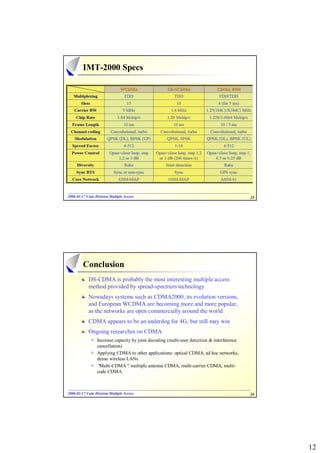
         WCDMA
            The faster chip rate of 3,84 Mchips/s
                 Implies that WCDMA receiver can provide greater multipath resolution
            5 MHz bandwidth
                 Wider bandwidth implies greater frequency diversity Rake Receiver
            Data rates
                 Up to 384 kbps for circuit switched data
                 Up to 2 Mbps for packet switched data
            Spreading factor
                 Downlink is from 4 to 512
                 Uplink is from 4 to 256
            Coherent detection
                 Available on both uplink and downlink direction by using pilot bits in
                 transmission
            Enhancement
                 HSDPA 3GPP R5 using new modulation (QPSK+16QAM) and coding
                 schemes to give higher data rates for packet switched data in WCDMA

2006-01-17 Code Division Multiple Access
2006- 01-                                                                                   22


                                                                                                 11
IMT-2000 Specs


2006-01-17 Code Division Multiple Access
2006- 01-                                                                                   23


         Conclusion
            DS-CDMA is probably the most interesting multiple access
            method provided by spread-spectrum technology
            Nowadays systems such as CDMA2000, its evolution versions,
            and European WCDMA are becoming more and more popular,
            as the networks are open commercially around the world
            CDMA appears to be an underdog for 4G, but still may win
            Ongoing researches on CDMA
                 Increase capacity by joint decoding (multi-user detection & interference
                 cancellation)
                 Applying CDMA to other applications: optical CDMA, ad hoc networks,
                 dense wireless LANs
                 “Multi-CDMA” multiple antenna CDMA, multi-carrier CDMA, multi-
                                 :
                 code CDMA


2006-01-17 Code Division Multiple Access
2006- 01-                                                                                   24


                                                                                                 12
Homework
             CDMA Capacity
                  If chip rate is 1.25 MHz, data rate is 9600 bps. The minimum acceptable
                  SNR is 10 dB
                  (1) determine the maximum number of users that can be supported in a
                  single cell CDMA system?
                  (2) if voice activity factor is 3/8, how about the result?


             Spreading Code
                  Construct a Gold code with length of 31.
                  Construct a Walsh code with length of 32 by using initial matrix

                          + 1 + 1
                     C1 =        
                          + 1 − 1
                  Plot the auto-correlation figures of Gold code and Walsh code, and
                  analysis their auto-correlation properties respectively, based on the
                  figures you plot..

2006-01-17 Code Division Multiple Access
2006- 01-                                                                                   25


                                      Any Questions ?

                                           Thank you !


                                                                                                 13

11 cdma

  • 1.
    Code Division MultipleAccess S-72.4210 Postgraduate Course in Radio Communications Er Liu liuer@cc.hut.fi 2006-01-17 Content Outline CDMA History Spread Spectrum Technology Direct-Sequence Frequency Hopping Time Hopping CDMA Challenges Receiver design Near-Far Problem Power Control Soft and softer Handover CDMA Applications in Mobile Network IS-95 CDMA2000 WCDMA Conclusion Homework 2006-01-17 Code Division Multiple Access 2006- 01- 2 1
  • 2.
    CDMA History Code Division Multiple Access (CDMA) is both a modulation and multiple access scheme Researches started even from 1950’ s Claude Shannon and Robert Pierce had provided CDMA framework in 1949 De-Rosa-Rogoff defined the direct sequence spread spectrum method in 1950 Rake receiver was first patented by Price and Green in 1956 Cellular spread-spectrum application was suggested by Cooper and Nettleton in 1978 IS-95, the narrow band CDMA mobile network, has been standardized in 1993 and commercial networks were introduced in 1995 3G wideband CDMA systems, such as CDMA2000 in U.S. and European WCDMA developed from 1990s and still ongoing 2006-01-17 Code Division Multiple Access 2006- 01- 3 Different Multiple Access Methods TDMA Divide radio spectrum into time slots FDMA Frequency has been divided into subchannels SDMA Control radiated energy for each user in space CDMA Different user separated by different spread code 2006-01-17 Code Division Multiple Access 2006- 01- 4 2
  • 3.
    Spread Spectrum Technology Originally developed for military and navigation purposes Hard to be intercepted Anti-jamming Nowadays feasible for commercial applications especially for mobile communication systems Average energy of the transmitted signal is spread over a bandwidth Wss , which is wider than the information bandwidth Bsignal W The spread factor Fss is defined as Fss = ss Bsignal Classifications Direct Sequence, Frequency Hopping and Time Hopping 2006-01-17 Code Division Multiple Access 2006- 01- 5 PN Sequence Pseudo-randomness is a characteristic of a spread spectrum system Achieved by using pseudo-noise (PN) or pseudo-random code A binary sequence with fixed length and has noise-like randomness Nearly equal number of zeros and ones Low correlation between shifted versions of the sequence Low cross-correlation with other user signals (interference) and noise Good autocorrelation properties with own signal in synchronization Examples M-sequences, Gold codes and Kasami sequences 2006-01-17 Code Division Multiple Access 2006- 01- 6 3
  • 4.
    Direct Sequence (DS)CDMA System Architecture Noise Wideband Data Despreading Modulator Demodulator Code Carrier Code Synchronization/ Code Carrier Generator Generator tracking Generator Generator 2006-01-17 Code Division Multiple Access 2006- 01- 7 Spreading and Despreading (1) Spread the baseband data by directly multiplying it with a PN code Ts Processing Gain = Tc 2006-01-17 Code Division Multiple Access 2006- 01- 8 4
  • 5.
    Autocorrelation Detection 2006-01-17 CodeDivision Multiple Access 2006- 01- 9 Spreading Code Walsh-Hadamard code: Simple and easy in implementation Used in time synchronous condition IS-95 system uses a 64 by 64 Walsh matrix Have poor autocorrelation and cross-correlation properties, > 1 peak W hen transmitt ing 1 1 -1 -1 1, the correlationship of user spreading c ode 1.5 Auto-correlation: User3 Cross-correlation: User3 vs User5 + 1 + 1 C l −1 l −1  1 C C1 =   C =  l −1 l  0.5 + 1 − 1 C −C l −1  co lation 0 rre -0.5 ML sequence -1 m-stage shift register with linear -1.5 32 64 96 128 160 192 Delay in chip feedback, length is Lc = 2 − 1 m {c (i)} j Gold code h1 h2 h3 hm−1 Proposed by Gold in 1967 Constructed by feeding two ML sequences of the same length through RC an XOR (Exclusive OR) circuit 1 / Lc 2006-01-17 Code Division Multiple Access 2006- 01- 10 5
  • 6.
    CDMA Capacity SNR is defined as SNR = P = 1 ( N − 1) P N − 1 SNR can be replaced by Eb/N0 W is chip rate Eb P/R W /R = = R is data rate N 0 ( N − 1)( P / W ) N − 1 If consider background thermal Eb W /R = N 0 ( N − 1) + (η / S ) noise in spread bandwidth W /R The users served in a single cell N = 1+ − (η / S ) Eb / N 0 are 1 W/R If also consider the voice activity N = 1+ α Eb / N 0 The load factor is defined as K 1 η=∑ 1 W/R 1+ j =1 α Eb / N 0 Load factor comes near 1, the interference margin is getting higher quite fast Typically, load target should be maintained between 50 % and 75 % because at those points the system is stable and can serve users. 2006-01-17 Code Division Multiple Access 2006- 01- 11 Frequency Hopping (FH) CDMA System occupies a large number of active frequency channels When the users transmit their bits through the transmission channel, they will keep hopping over the available frequency channels The hopping order is controlled by PN code, Hopping every 400 ms Fast frequency hopping (FFH) and Slow frequency Hopping (SFH) FFH –several hops per symbol SFH –several symbols per hop 2006-01-17 Code Division Multiple Access 2006- 01- 12 6
  • 7.
    Time Hopping (TH)CDMA The data is transmitted in burst, not continuous Each burst consists of k bits data Exact transmission time is determined by PN sequence The time axis is divided into frames Each frame is divided into M time slots Each user will transmit or receive in 1 of M slots Which of the M slots will be used depending on PN code Normally is used combined with frequency hopping 2006-01-17 Code Division Multiple Access 2006- 01- 13 Multipath Environment Reception of multiple, possibly interfering copies of the same signal Atmospheric reflection or refraction Reflections from ground, buildings, or other objects CDMA should have a tolerance of multipath 2006-01-17 Code Division Multiple Access 2006- 01- 14 7
  • 8.
    Rake Receiver Multipath diversity principle Uses several baseband correlators to individually process several signal multipath components. The correlator outputs are combined to achieve improved communications reliability and performance Performance will degrade fast if with many multipaths due to poor channel estimation Channel Estimation 2006-01-17 Code Division Multiple Access 2006- 01- 15 CDMA Interference MAI –Multiple Access Interference The detector receives a signal composed of the sum of all users’signals, which overlap in time and frequency MAI refers to the interference between users MAI is directly proportional to the channel loading MAI can be divided in two parts intra-cell and inter-cell interference With CDMA systems, the same frequency channel can be used in the adjacent cell, as long as multiple access interference is kept below a given level. This is achieved by using power control 2006-01-17 Code Division Multiple Access 2006- 01- 16 8
  • 9.
    Near-Far Problem Users near the base station are received with high power Users far from the base station are received with low power Nearby users will completely swamp far away users Solution Power Control 2006-01-17 Code Division Multiple Access 2006- 01- 17 Power Control Interference limited multiple access system The power control problem arises due to multiple access interference (MAI) Each user looks like random noise to other users and causes unnecessary interference to the system Power control is implemented to overcome the near-far problem, reduce MAI, and to maximize the capacity of CDMA system Maximum capacity is achieved when SNR of every user is at the minimum level needed for the acceptable channel performance Classification Open loop power control (initial uplink and downlink transmission powers ) Inner loop power control (also called fast closed loop power control) Outer loop power control (setting a target SIR ) 2006-01-17 Code Division Multiple Access 2006- 01- 18 9
  • 10.
    Soft and SofterHandover Hard Handover - “break-before-make” All the old radio links in the UE are removed before the new radio links are established, Can be seamless or non-seamless. In practice a handover that requires a change of the carrier frequency (inter- frequency handover) is always performed as hard handover Soft Handover –“make-before-break” The radio links are added and removed in a way that the UE always keeps at least one radio link to the RAN. Soft handover is performed by means of macro diversity several radio links are active at the same time selection combining is applied Normally soft handover can be used when cells operated on the same frequency are changed. Softer handover A special case of soft handover The radio links that are added and removed belong to the same BTS or node B Macro diversity with maximum ratio combining is applied 2006-01-17 Code Division Multiple Access 2006- 01- 19 IS-95 System Mainly used in U.S. Standard was finished in 1993 and first commercially launched in 1996 Basic data rate is 9,6 kbps Chip rate of 1.2288 Mchip/s Allocated bandwidth is 1.25 MHz “CDMA-One”was launched in 1999 with data rates up to 115,5 kbps Fixed spreading code of length 64 Uses pilot channel in downlink direction to provide synchronization, channel tracking, and handover functions. In the uplink direction, orthogonal modulation is used, which permits the more robust non- coherent demodulation to be used 2006-01-17 Code Division Multiple Access 2006- 01- 20 10
  • 11.
    CDMA-2000 The third generation evolution phase of IS-95A/B CDMA2000 1x Offer up to 307 kbps data rates (compare to EDGE) Use same 1.25 MHz as IS-95/CDMAOne CDMA2000 1xEV-DO CDMA2000 1xEV-DO delivers peak data speeds of 2.4Mbps and supports applications such as MP3 transfers and video conferencing CDMA2000 1xEV-DV CDMA2000 1xEV-DV provides integrated voice and simultaneous high- speed packet data multimedia services at speeds of up to 3.09 Mbps. 1xEV-DO and 1xEV-DV are both backward compatible with CDMA2000 1X and CDMAOne The first 3G networks to be commercially deployed were launched in Korea in October 2000 2006-01-17 Code Division Multiple Access 2006- 01- 21 WCDMA The faster chip rate of 3,84 Mchips/s Implies that WCDMA receiver can provide greater multipath resolution 5 MHz bandwidth Wider bandwidth implies greater frequency diversity Rake Receiver Data rates Up to 384 kbps for circuit switched data Up to 2 Mbps for packet switched data Spreading factor Downlink is from 4 to 512 Uplink is from 4 to 256 Coherent detection Available on both uplink and downlink direction by using pilot bits in transmission Enhancement HSDPA 3GPP R5 using new modulation (QPSK+16QAM) and coding schemes to give higher data rates for packet switched data in WCDMA 2006-01-17 Code Division Multiple Access 2006- 01- 22 11
  • 12.
    IMT-2000 Specs 2006-01-17 CodeDivision Multiple Access 2006- 01- 23 Conclusion DS-CDMA is probably the most interesting multiple access method provided by spread-spectrum technology Nowadays systems such as CDMA2000, its evolution versions, and European WCDMA are becoming more and more popular, as the networks are open commercially around the world CDMA appears to be an underdog for 4G, but still may win Ongoing researches on CDMA Increase capacity by joint decoding (multi-user detection & interference cancellation) Applying CDMA to other applications: optical CDMA, ad hoc networks, dense wireless LANs “Multi-CDMA” multiple antenna CDMA, multi-carrier CDMA, multi- : code CDMA 2006-01-17 Code Division Multiple Access 2006- 01- 24 12
  • 13.
    Homework CDMA Capacity If chip rate is 1.25 MHz, data rate is 9600 bps. The minimum acceptable SNR is 10 dB (1) determine the maximum number of users that can be supported in a single cell CDMA system? (2) if voice activity factor is 3/8, how about the result? Spreading Code Construct a Gold code with length of 31. Construct a Walsh code with length of 32 by using initial matrix + 1 + 1 C1 =   + 1 − 1 Plot the auto-correlation figures of Gold code and Walsh code, and analysis their auto-correlation properties respectively, based on the figures you plot.. 2006-01-17 Code Division Multiple Access 2006- 01- 25 Any Questions ? Thank you ! 13