Etiology and pathogenesis of
white blood cell pathology.
Leukemia: classification,
pathogenesis, main types.
Ivano-Frankivsk National Medical University
Department of Pathophysiology
Assistant Professor
Fedorchenko Yu.V.
Lecture plan
Leukopoiesis.
Leukocytosis. Definition. Classification.
Pathogenesis of leukocytosis.
Leukopenias. Definition. Classification.
Pathogenesis of leukopenias.
Agranulocytosis.
Leukemias. Definition. Classification.
Pathogenesis. Clinical signs.
Leukemoid reactions.
The stem cell
can
differentiate
into many
different
cell types.
Eosino
Eosino
phils
phils
Baso
Baso
phils
phils
Neutrophils
Neutrophils
Lymp
hocyt
es
Lymp
hocyt
es
Mono
Mono
cytes
cytes
myelo
myelo
cyte
cyte
metamy
elocyte
metamy
elocyte
band
band
segm
ented
segm
ented
1-4
1-4 0-1
0-1 0
0 0
0 2-5
2-5 50-70
50-70
20
-40
20
-40
3-10
3-10
Leukocytic formula
% correlation between different forms
of WBC
Absolute value =
Degenerative forms of leukocytes
•
•
•
Leukocytes with
Döhle bodies
infections
poisoning
burns
•
•
Leukocytes with
toxic granulation
severe
inflammation
tumor necrosis
•
Gumprecht’s cells
(shadows)
smudge cells
cell’s partial
breakdown during
preparation of a
smear (CLL)
•
•
Neutrophils with
hypersegmented
nucleus
 level of
glucocorticoids
B12 deficiency.
Leukocytosis
This is an increase in the total content
of leukocytes in the peripheral blood
more than 9 *109/L
Classification
By the causal agent:
physiological and pathological.
By pathogenesis:
Reactive, redistributive and tumorous.
By wbc form:
neutrophilic, eosinophilic, basophilic,
lymphocytic, monocytic.
Absolute and relative.
Absolute Relative
Leukocytosis
1. Stimulation of
leukopoiesis
2 . I n c r e a s e o f
l e u k o c y t e s
transport from bone
marrow
3 . I n c r e a s e o f
tumorous type of
leukopoiesis during
leukosis
1.Hemoconcentrationa
l
2.Redistributional
Physiological
leukocytosis
alimentary – develops in 2-3 hours after
food intake;
myogenic - caused by physical work ;
emotional – caused by strong emotions;
acclimatization – caused by changing of
climatic zone;
static – caused by changing recumbent
position to plantigrade position;
leukocytosis in pregnant
Pathological leukocytosis
is related to the presence of the
pathological process in the organism:
infectious diseases, inflammation or
allergic process.
Reactive leukocytosis
Is a reaction of red bone marrow to
pathogenic influences. It is
characterized by enhanced leukocyte
proliferation in red bone marrow
(increased production of colony
stimulating factors) and mobilization of
reserve pool of leukocytes from red
bone marrow into the circulation under
the action of IL-1, TNF.
Redistributive leukocytosis
Is a transition of leukocytes from
marginal pool into circulating pool.
Characterized by short duration
Leukogram is not changed,
No degenerative changes of leukocytes.
Neutrophilic Leukocytosis
acute bacterial infections (caused by pyogenic
organisms); tissue necrosis (myocardial infarction,
burns).
Eosinophilic Leukocytosis (Eosinophilia)
allergic disorders (asthma, hay fever, allergic skin
diseases); parasitic infestations; drug reactions; some
malignancies
Basophilic Leukocytosis (Basophilia)
chronic myelogenous leukemia
Monocytosis
Chronic infections (tuberculosis, brucellosis),
rickettsiosis, malaria;
Lymphocytosis
chronic disorders (tuberculosis, brucellosis);
some viral infections (hepatitis A, Epstein-Barr virus).
Analysis of Leukoformula
Left-side nuclear shift of neutrophils:
elevated content of immature forms neutrophils in the blood
(myelocytes, metamyelocytes, bands).
Right-side nuclear shift of neutrophils:
prevalence of the mature neutrophils
(with many segments, 5-6 and more) with absence of young
cells.
Regenerative
Hyperregenerative
Regenerative-
Degenerative
Degenerative
There are four types of nuclear shift
to the left
Regenerative NNS to the left – of band neutrophils , appearance
of metamyelocytes (moderate infection/inflammation);
Eosino
Eosino
phils
phils
Baso
Baso
phils
phils
Neutrophils
Neutrophils
Lympho
cytes
Lympho
cytes
Mon
o
Mon
o
cytes
cytes
myelo
myelo
cyte
cyte
metamyelocyt
e
metamyelocyt
e
band
band
segme
nted
segme
nted
4
4 0
0 0
0 2
2 8
8 57
57 20
20 9
9
Hyperregenerative NNS to the left - it is an excessive
hyperplasia of the hemopoietic tissue with disorder of
maturation of the cells
(can be tumorous origin or so-called leukemoid reaction),
increased amount of immature neutrophils up to
myelocytes,
promyelocytes and myeloblasts.
Eosino
Eosino
phils
phils
Baso
Baso
phils
phils
Neutrophils
Neutrophils
Lymp
hocy
tes
Lymp
hocy
tes
Mono
Mono
cytes
cytes
promyel
ocytes
promyel
ocytes
myelo
myelo
cyte
cyte
metamy
elocyte
metamy
elocyte
band
band
segm
ented
segm
ented
2
2 0
0 3
3 4
4 5
5 12
12 51
51 18
18 4
4
Regenerative-Degenerative-hyperpro duc tio n o f
pathologically changed wbc (degenerative) and impairment
of their maturation in the bone marrow.
Eosino
Eosino
phils
phils
Baso
Baso
phils
phils
Neutrophils
Neutrophils
Lymph
ocytes
Lymph
ocytes
Mono
Mono
cytes
cytes
myelo
myelo
cyte
cyte
metamyeloc
yte
metamyeloc
yte
band
band segmented
segmented
4
4 0
0 2
2 7
7 16
16 42
42 20
20 9
9
Leukopenia is a decrease of a total
content of leukocytes in the peripheral
blood below 
 4*109 /L

•
•
By origin:
acquired and inherited leukopenia.
Depending on the alteration in total leukocyte
number:
absolute and relative.
By wbc form:
neutropenia, eosinopenia, lymphopenia and
monocytopenia.
Leukopenias
Hereditary Acquired
-
-
1. Deficit of maturity factors
constant hereditary
neutropenia
periodic hereditary
neutropenia
2. Deficit of myeloperoxidase,
G-6-PhDG
- hereditary monocytopenia
with phagocytic insufficiency
deficit (disease of Chediak-
Higashi)
1. Inhibition of
leukopoiesis
2. Increase of
leukodieresis
3. Increase of
leukocyte loss
4. Decrease of
leukocyte
emigration from
bone morrow
1. Redistributional
shock, muscular
work etc.
2. Hemodilutional
transfusion of blood
substitutes,
hydremia etc.
Absolute Relative
By pathogenesis :
D e c r e a s e d l e u k o c y t e
prod uc tion i n the bone
marrow;
Slow release of leukocytes
from the bone marrow into the
circulation;
Time reduction of leukocyte
staying in the peripheral blood;
Redistribution of leukocytes
in the vessels.
1.
2.
3.
4.
Decreased production of leukocytes is linked with
disturbance of leukopoiesis under effect of poisons
and ionizing radiation, genetic and immune factors, in
deficit of leukopoetins.
Inherited: chronic benign neutropenia, Kostmann’s
syndrome
Acquired :
cytolytic (damaging effect of ionizing radiation, heavy
metals)
antimetabolic ( substances effecting stem cell
division – antibiotics, antitumor drugs)
def i
ciency of substances required for leukopoiesis
(vitamin B12, folic acid)
idiosyncrasy to certain medicines .
•
•
•
•
Slow release of leukocytes from the bone
marrow into the circulation :
can be associated with genetic defects of
leukocyte mobility
( syndrome of lazy leukocytes’’ ).
Time reduction of leukocyte staying in the
peripheral blood due to :
shortening of granulocytes’ life span
leukocytic destruction by antibodies
increased leukocytic loss (chronic
suppurative processes, cough with
sputum)
hypersplenism
Redistribution of leukocytes in the vessels :
may be a reason of relative leukopenia.
I t i s o b s e r v e d , f o r e x a m p l e , i n
h e m o t r a n s f u s i o n s h o c k , a n d i s
characterized by altered ratio between the
circulating and marginal pools of
leukocytes.
Leukopenia is a decrease of a total
content of leukocytes in the peripheral
blood below 
 4*109 /L

•
•
By origin:
acquired and inherited leukopenia.
Depending on the alteration in total leukocyte
number:
absolute and relative.
By wbc form:
neutropenia, eosinopenia, lymphopenia and
monocytopenia.
Agranulocytosis – total WBC 1-3*109/L
granulocytes  than 750/μL
Clinically - resistance to infection
fever
inflammation of the mouth, nose and
eyes
furunculosis
pneumonia
septicemia
Myelotoxic Immune
AGRANULOCYTOSIS
Damage of red bone marrow Destruction by antibodies
Leukaemoid reaction is defined as a reactive
excessive leucocytosis in the peripheral blood
resembling that of leukaemia in a subject who does
not have leukaemia.
It differs from it by etiology, pathogenesis and
signif i
cance.
The cause is often known (it is always infection) on
the contrary to leukemia.
Pathogenesis is different as well – it is a hyperreactive
but not neoplastic hyperplasia of the leukopoietic
tissue.
Leukemoid reaction is temporary, reversible and does
not turn into leukemia.
There are two types of leukemoid reaction - myeloid
and lymphoid in dependence with type of cells, which
underwent proliferation.
CAUSES of Leukaemoid Reaction:
Infections e.g. infectious mononucleosis, cytomegalovirus infection,
chickenpox, measles, infectious lymphocytosis, staphylococcal
pneumonia, tuberculosis,
Intoxication;
Severe haemorrhage and severe haemolysis;
Laboratory findings
Leucocytosis
Proportion of immature cells mild to moderate, comprised by
metamyelocytes, myelocytes (5-15%), and blasts fewer than 5%
Toxic granulation and Döhle bodies in the cytoplasm of neutrophils.
Neutrophil alkaline phosphatase score in the cytoplasm of mature
neutrophils is high (difference from from chronic myeloid leukaemia )
Negative Philadelphia chromosome in myeloid leukaemoid reaction but
positive in cases of CML.
Leukemia are malignancies of hematopoietic cells or
tissues in which there is abnormal proliferation of
hemopoietic cells with infiltration of bone marrow and
lymphatic tissues
Features of leukemia:
Boundless and unregulated growth ;
Arises up from one transformed initially changed cell ;
apoptosis of leukemic cells;
Suppression of normal hemopoiesis;
Characterized by systemic damage.
HAEMATOLOGIC NEOPLASMS
Lymphoblastic (ALL)
Acute
Myeloid (AML)
Lymphatic (CLL)
Chronic
Myeloid (CML)
Etiology of leukemia
ionizing radiation,
certain kinds of chemicals (benzene and other
aromatic hydrocarbons),
some viruses (human T-lymphotrophic virus,
Epstein-Barr virus),
genetic predisposition.
Pathogenesis of leukemia
1) mutation of hemopoetic cells under
the action of oncogenic viruses,
ionizing radiation,chemicals
(initiation stage),
2) monoclonal proliferation (promotion)
- development of primary leukemia of
some hemopoetic stem.
3) polyclonal proliferation (tumor
progression stage) - tumor obtains
malignant character.
Myeloid maturation
myeloblast promyelocyte myelocytemetamyelocyte band neutrophil
MATURATION
MATURATION
Leukemia types
Acute leukemia
Cells lose ability to differentiation
cells of the bone marrow of I-IV classes being able to
unlimited growth and uncontrolled proliferation
hiatus leukemicus” (leukemic gap) - a lack of cell
stages of maturation between blasts and mature cells
in leukocytic formula
occur in children and young adults
rapid progression and spread to the organs of the body
Chronic leukemia
cells of the bone marrow of I-IV classes being able to
unlimited growth and uncontrolled proliferation
more slowly rate of tumor progression
mostly occurs in older people, but can theoretically
occur in any age group
Leukemia classification
leukopenic form - WBC count lower than
4*109/L
aleukemic form – WBC count doesn’t
change.
subleukemic form – to 20 *109/L, a few
blasts in peripheral blood.
leukemic form – leukocytosis 20-100
*109/L, blasts prevalence in peripheral
blood.
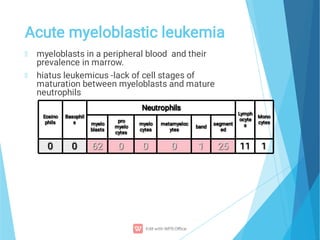
Acute Myeloblastic leukemia
The special feature of leukoformula is that only the
youngest forms (myeloblasts) and the mature neutrophiles
(segmentonuclear) are present. The intermediate forms
promyelocytes, myelocytes, metamyelocytes, stab-nuclear
are absent. This phenomenon is called leukemic gap
(hiatus leukemicus).
Leukemic (nuclear) gap— loss of an ability of neoplastic
cells to differentiate. Maturation of neutrophils in bone
marrow does not occur. Only myeloblasts are multiplied, and
they fall into the peripheral blood. The mature neutrophils,
which are determined in peripheral blood, are those, which
were formed earlier, before the beginning of a disease. The
lifetime of mature neutrophils is short.
Acute myeloblastic leukemia
Myeloblasts
Peripheral blood Bone marrow
Acute myeloblastic leukemia
myeloblasts in a peripheral blood and their
prevalence in marrow.
hiatus leukemicus -lack of cell stages of
maturation between myeloblasts and mature
neutrophils
Eosino
Eosino
phils
phils
Basophil
s
Basophil
s
Neutrophils
Neutrophils
Lymph
ocyte
s
Lymph
ocyte
s
Mono
Mono
cytes
cytes
myelo
myelo
blasts
blasts
pro
pro
myelo
myelo
cytes
cytes
myelo
myelo
cytes
cytes
metamyeloc
ytes
metamyeloc
ytes
band
band
segment
ed
segment
ed
0
0 0
0 62
62 0
0 0
0 0
0 1
1 25
25 11
11 1
1
39
•
•
•
Predominant proliferation of granulocytic cells.
Consistently associated with the BCR-ABL1 fusion gene
located in the Philadelphia (Ph) chromosome which results
from t(9;22)
Absence of hiatus leukemicus
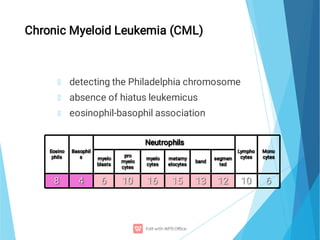
Chronic Myeloid Leukemia (CML)
myeloblast promyelocyte myelocyte metamyelocyte band neutrophil
MATURATION
MATURATION
Chronic Myeloid Leukemia (CML)
In chronic myeloleukemia, neoplastic clone appears in
stem cells but the larger part of them maturate in the bone
marrow.
In the peripheral blood it is possible to see the
granulocytes of any degree of maturity. The
hyperregenerative nuclear shift to the left is noted, but the
leukemic nuclear gap is absent.
Increased number of neutrophilic metamyelocytes,
myelocytes, promyelocytes and single myeloblasts is
typical for chronic leukemia.
The number of eosinophilic and basophilic granulocytes is
increased (eosinophilic and basopholic leukocytosis).
Chronic Myeloid Leukemia (CML)
detecting the Philadelphia chromosome
absence of hiatus leukemicus
eosinophil-basophil association
Eosino
Eosino
phils
phils
Basophil
s
Basophil
s
Neutrophils
Neutrophils
Lympho
cytes
Lympho
cytes
Mono
Mono
cytes
cytes
myelo
myelo
blasts
blasts
pro
pro
myelo
myelo
cytes
cytes
myelo
myelo
cytes
cytes
metamy
elocytes
metamy
elocytes
band
band
segmen
ted
segmen
ted
8
8 4
4 6
6 10
10 16
16 15
15 13
13 12
12 10
10 6
6
Chronic myeloleukemia
peripheral blood
bone marrow
Philadelphia chromosome
Due to reciprocal translocation
between the long arm of
chromosomes 9(9q) and 22(22q)
(9:22 translocation)
It is found in all haematopoietic
precursors of CML patients.
This result in the transfer of the
Abelson's (abl) oncogene to an area
of chromosome 22 termed the
break-point cluster region (bcr)
This results in a fused bcr-abl gene
and production of an abnormal
tyrosine kinase protein.
This protein causes disordered
myelopoiesis in CML
Acute 
lymphoblastic leukemia
Lymphoblasts
in peripheral
blood smear
Eosino
Eosino
phils
phils
Baso
phils
Baso
phils
Neutrophils
Neutrophils Lymphocytes
Lymphocytes
Mono
Mono
cytes
cytes
mye
locy
tes
mye
locy
tes
juve
nile
juve
nile band
band segm.
segm. lympho
blasts
lympho
blasts
prolymp
hocytes
prolymp
hocytes
lympho
cytes
lympho
cytes
0
0 0
0 0
0 0
0 1
1 16
16 61
61 0
0 19
19 3
3
LYMPHOBLASTS
(ALL)
Chronic lymphogenous leukemia

Lymphoid leukemia is the neoplastic transformation of lymphoid
tissue.
Lymphocytes are mostly mature. The majority of the
lymphoblasts is matured up to the end and reaches 80-90%
(relative and absolute lymphocytosis with relative neutropenia).
There are single prolymphocytes and lymphoblasts in the
leukoformula .
Absolute number of neutrophils may remain normal taking into
consideration a significant increase of total quantity of
leukocytes (above 120 G/l).
The course of a disease is chronic and flows for years.
Chronic lymphogenous leukemia
Eosino
Eosino
phils
phils
Baso
phils
Baso
phils
Neutrophils
Neutrophils Lymphocytes
Lymphocytes
Mono
Mono
cytes
cytes
myel
ocyt
es
myel
ocyt
es
metamyelo
cute
metamyelo
cute band
band segm.
segm. lymphob
lasts
lymphob
lasts
proly
mpho
cytes
proly
mpho
cytes
lymph
ocytes
lymph
ocytes
0
0 0
0 0
0 0
0 2
2 36
36 5
5 9
9 21
21 3
3
lymphocytes
Clinical syndromes of leukemias:
1.
2.
3.
1.
2.
3.
4.
1.
2.
3.
4.
Hematological syndrome (substitution the normal
hemopoietic tissue by tumor ) :
Pancytopenia-diminishing of amount of all blood cells ;
Anemia
Hemorrhagic syndrome – thrombocytopenia
Syndromes, related to the features of functioning of cells
of leukemia:
Fever
Intoxication
Increased amount of uric acid in the blood ( breakdown
of purines releasing from neoplastic cells )
Autoimmune processes
Syndromes, related to metastasis:
Enlargement of lymph nodes, liver, spleen
Skin infiltrates of tumor cells
Pain in bones
Cardiac insufficiency
Literature
Kumar V, Abbas A., Aster J. (eds.) Robbins  Cotran Pathologic Basis of Disease 10th
edition. Elsevier; 2020. p.586-587, 592-594,597-599, 616-622
Kumar V, Abbas Abul K, Aster JC, editors. Robbins Basic Pathology. 10th ed.
Philadelphia: Elsevier; 2017. p.459-484.
Kubyshkin AV. General and Clinical Pathophysiology. 3rd ed. Vinnytsya: Nova Knyha;
2017. p.588-612.
Robert J Hubert, Karin C. VanMeter, editors. Gould's Pathophysiology for the Health
Professions. 6th ed. St. Louis: Saunders Elsevier; 2018. p.263-271
McCance KL, Huether SE, editors. Pathophysiology: The Biologic Basis for Disease in
Adults and Children. 8th ed. St. Louis: Mosby; 2018. 1720 p.
Huether SE, McCance KL, editors. Understanding Pathophysiology. 6th ed. St. Louis:
Elsevier; 2017. p.105-111.
Grossman SC, Porth CM, editors. Porth’s Pathophysiology.Concepts of Altered Health
States. 10th ed. Philadelphia: Lippincott Williams  Wilkins; 2018.1688 p.
Simeonova NK, Mikhnev VA editors. Pathophysiology: textbook. 3rd ed. Кyiv: AUS
Medicine Publishing; 2017. 544p. + 4 p. colour insert.
Thanks for attention

WBC pathology.pdf

  • 1.
    Etiology and pathogenesisof white blood cell pathology. Leukemia: classification, pathogenesis, main types. Ivano-Frankivsk National Medical University Department of Pathophysiology Assistant Professor Fedorchenko Yu.V.
  • 2.
    Lecture plan Leukopoiesis. Leukocytosis. Definition.Classification. Pathogenesis of leukocytosis. Leukopenias. Definition. Classification. Pathogenesis of leukopenias. Agranulocytosis. Leukemias. Definition. Classification. Pathogenesis. Clinical signs. Leukemoid reactions.
  • 3.
    The stem cell can differentiate intomany different cell types.
  • 4.
  • 5.
    Degenerative forms ofleukocytes • • • Leukocytes with Döhle bodies infections poisoning burns • • Leukocytes with toxic granulation severe inflammation tumor necrosis • Gumprecht’s cells (shadows) smudge cells cell’s partial breakdown during preparation of a smear (CLL) • • Neutrophils with hypersegmented nucleus  level of glucocorticoids B12 deficiency.
  • 6.
    Leukocytosis This is anincrease in the total content of leukocytes in the peripheral blood more than 9 *109/L
  • 7.
    Classification By the causalagent: physiological and pathological. By pathogenesis: Reactive, redistributive and tumorous. By wbc form: neutrophilic, eosinophilic, basophilic, lymphocytic, monocytic. Absolute and relative.
  • 8.
    Absolute Relative Leukocytosis 1. Stimulationof leukopoiesis 2 . I n c r e a s e o f l e u k o c y t e s transport from bone marrow 3 . I n c r e a s e o f tumorous type of leukopoiesis during leukosis 1.Hemoconcentrationa l 2.Redistributional
  • 9.
    Physiological leukocytosis alimentary – developsin 2-3 hours after food intake; myogenic - caused by physical work ; emotional – caused by strong emotions; acclimatization – caused by changing of climatic zone; static – caused by changing recumbent position to plantigrade position; leukocytosis in pregnant
  • 10.
    Pathological leukocytosis is relatedto the presence of the pathological process in the organism: infectious diseases, inflammation or allergic process.
  • 11.
    Reactive leukocytosis Is areaction of red bone marrow to pathogenic influences. It is characterized by enhanced leukocyte proliferation in red bone marrow (increased production of colony stimulating factors) and mobilization of reserve pool of leukocytes from red bone marrow into the circulation under the action of IL-1, TNF.
  • 12.
    Redistributive leukocytosis Is atransition of leukocytes from marginal pool into circulating pool. Characterized by short duration Leukogram is not changed, No degenerative changes of leukocytes.
  • 13.
    Neutrophilic Leukocytosis acute bacterialinfections (caused by pyogenic organisms); tissue necrosis (myocardial infarction, burns). Eosinophilic Leukocytosis (Eosinophilia) allergic disorders (asthma, hay fever, allergic skin diseases); parasitic infestations; drug reactions; some malignancies Basophilic Leukocytosis (Basophilia) chronic myelogenous leukemia Monocytosis Chronic infections (tuberculosis, brucellosis), rickettsiosis, malaria; Lymphocytosis chronic disorders (tuberculosis, brucellosis); some viral infections (hepatitis A, Epstein-Barr virus).
  • 14.
    Analysis of Leukoformula Left-sidenuclear shift of neutrophils: elevated content of immature forms neutrophils in the blood (myelocytes, metamyelocytes, bands). Right-side nuclear shift of neutrophils: prevalence of the mature neutrophils (with many segments, 5-6 and more) with absence of young cells.
  • 15.
  • 16.
    Regenerative NNS tothe left – of band neutrophils , appearance of metamyelocytes (moderate infection/inflammation); Eosino Eosino phils phils Baso Baso phils phils Neutrophils Neutrophils Lympho cytes Lympho cytes Mon o Mon o cytes cytes myelo myelo cyte cyte metamyelocyt e metamyelocyt e band band segme nted segme nted 4 4 0 0 0 0 2 2 8 8 57 57 20 20 9 9
  • 17.
    Hyperregenerative NNS tothe left - it is an excessive hyperplasia of the hemopoietic tissue with disorder of maturation of the cells (can be tumorous origin or so-called leukemoid reaction), increased amount of immature neutrophils up to myelocytes, promyelocytes and myeloblasts. Eosino Eosino phils phils Baso Baso phils phils Neutrophils Neutrophils Lymp hocy tes Lymp hocy tes Mono Mono cytes cytes promyel ocytes promyel ocytes myelo myelo cyte cyte metamy elocyte metamy elocyte band band segm ented segm ented 2 2 0 0 3 3 4 4 5 5 12 12 51 51 18 18 4 4
  • 18.
    Regenerative-Degenerative-hyperpro duc tion o f pathologically changed wbc (degenerative) and impairment of their maturation in the bone marrow. Eosino Eosino phils phils Baso Baso phils phils Neutrophils Neutrophils Lymph ocytes Lymph ocytes Mono Mono cytes cytes myelo myelo cyte cyte metamyeloc yte metamyeloc yte band band segmented segmented 4 4 0 0 2 2 7 7 16 16 42 42 20 20 9 9
  • 19.
    Leukopenia is adecrease of a total content of leukocytes in the peripheral blood below 4*109 /L • • By origin: acquired and inherited leukopenia. Depending on the alteration in total leukocyte number: absolute and relative. By wbc form: neutropenia, eosinopenia, lymphopenia and monocytopenia.
  • 20.
    Leukopenias Hereditary Acquired - - 1. Deficitof maturity factors constant hereditary neutropenia periodic hereditary neutropenia 2. Deficit of myeloperoxidase, G-6-PhDG - hereditary monocytopenia with phagocytic insufficiency deficit (disease of Chediak- Higashi) 1. Inhibition of leukopoiesis 2. Increase of leukodieresis 3. Increase of leukocyte loss 4. Decrease of leukocyte emigration from bone morrow 1. Redistributional shock, muscular work etc. 2. Hemodilutional transfusion of blood substitutes, hydremia etc. Absolute Relative
  • 21.
    By pathogenesis : De c r e a s e d l e u k o c y t e prod uc tion i n the bone marrow; Slow release of leukocytes from the bone marrow into the circulation; Time reduction of leukocyte staying in the peripheral blood; Redistribution of leukocytes in the vessels.
  • 22.
    1. 2. 3. 4. Decreased production ofleukocytes is linked with disturbance of leukopoiesis under effect of poisons and ionizing radiation, genetic and immune factors, in deficit of leukopoetins. Inherited: chronic benign neutropenia, Kostmann’s syndrome Acquired : cytolytic (damaging effect of ionizing radiation, heavy metals) antimetabolic ( substances effecting stem cell division – antibiotics, antitumor drugs) def i ciency of substances required for leukopoiesis (vitamin B12, folic acid) idiosyncrasy to certain medicines .
  • 23.
    • • • • Slow release ofleukocytes from the bone marrow into the circulation : can be associated with genetic defects of leukocyte mobility ( syndrome of lazy leukocytes’’ ). Time reduction of leukocyte staying in the peripheral blood due to : shortening of granulocytes’ life span leukocytic destruction by antibodies increased leukocytic loss (chronic suppurative processes, cough with sputum) hypersplenism Redistribution of leukocytes in the vessels : may be a reason of relative leukopenia. I t i s o b s e r v e d , f o r e x a m p l e , i n h e m o t r a n s f u s i o n s h o c k , a n d i s characterized by altered ratio between the circulating and marginal pools of leukocytes.
  • 24.
    Leukopenia is adecrease of a total content of leukocytes in the peripheral blood below 4*109 /L • • By origin: acquired and inherited leukopenia. Depending on the alteration in total leukocyte number: absolute and relative. By wbc form: neutropenia, eosinopenia, lymphopenia and monocytopenia.
  • 25.
    Agranulocytosis – totalWBC 1-3*109/L granulocytes than 750/μL Clinically - resistance to infection fever inflammation of the mouth, nose and eyes furunculosis pneumonia septicemia
  • 26.
    Myelotoxic Immune AGRANULOCYTOSIS Damage ofred bone marrow Destruction by antibodies
  • 27.
    Leukaemoid reaction isdefined as a reactive excessive leucocytosis in the peripheral blood resembling that of leukaemia in a subject who does not have leukaemia. It differs from it by etiology, pathogenesis and signif i cance. The cause is often known (it is always infection) on the contrary to leukemia. Pathogenesis is different as well – it is a hyperreactive but not neoplastic hyperplasia of the leukopoietic tissue. Leukemoid reaction is temporary, reversible and does not turn into leukemia. There are two types of leukemoid reaction - myeloid and lymphoid in dependence with type of cells, which underwent proliferation.
  • 28.
    CAUSES of LeukaemoidReaction: Infections e.g. infectious mononucleosis, cytomegalovirus infection, chickenpox, measles, infectious lymphocytosis, staphylococcal pneumonia, tuberculosis, Intoxication; Severe haemorrhage and severe haemolysis; Laboratory findings Leucocytosis Proportion of immature cells mild to moderate, comprised by metamyelocytes, myelocytes (5-15%), and blasts fewer than 5% Toxic granulation and Döhle bodies in the cytoplasm of neutrophils. Neutrophil alkaline phosphatase score in the cytoplasm of mature neutrophils is high (difference from from chronic myeloid leukaemia ) Negative Philadelphia chromosome in myeloid leukaemoid reaction but positive in cases of CML.
  • 29.
    Leukemia are malignanciesof hematopoietic cells or tissues in which there is abnormal proliferation of hemopoietic cells with infiltration of bone marrow and lymphatic tissues Features of leukemia: Boundless and unregulated growth ; Arises up from one transformed initially changed cell ; apoptosis of leukemic cells; Suppression of normal hemopoiesis; Characterized by systemic damage.
  • 30.
    HAEMATOLOGIC NEOPLASMS Lymphoblastic (ALL) Acute Myeloid(AML) Lymphatic (CLL) Chronic Myeloid (CML)
  • 31.
    Etiology of leukemia ionizingradiation, certain kinds of chemicals (benzene and other aromatic hydrocarbons), some viruses (human T-lymphotrophic virus, Epstein-Barr virus), genetic predisposition.
  • 32.
    Pathogenesis of leukemia 1)mutation of hemopoetic cells under the action of oncogenic viruses, ionizing radiation,chemicals (initiation stage), 2) monoclonal proliferation (promotion) - development of primary leukemia of some hemopoetic stem. 3) polyclonal proliferation (tumor progression stage) - tumor obtains malignant character.
  • 33.
    Myeloid maturation myeloblast promyelocytemyelocytemetamyelocyte band neutrophil MATURATION MATURATION
  • 34.
    Leukemia types Acute leukemia Cellslose ability to differentiation cells of the bone marrow of I-IV classes being able to unlimited growth and uncontrolled proliferation hiatus leukemicus” (leukemic gap) - a lack of cell stages of maturation between blasts and mature cells in leukocytic formula occur in children and young adults rapid progression and spread to the organs of the body Chronic leukemia cells of the bone marrow of I-IV classes being able to unlimited growth and uncontrolled proliferation more slowly rate of tumor progression mostly occurs in older people, but can theoretically occur in any age group
  • 35.
    Leukemia classification leukopenic form- WBC count lower than 4*109/L aleukemic form – WBC count doesn’t change. subleukemic form – to 20 *109/L, a few blasts in peripheral blood. leukemic form – leukocytosis 20-100 *109/L, blasts prevalence in peripheral blood.
  • 36.
    Acute Myeloblastic leukemia Thespecial feature of leukoformula is that only the youngest forms (myeloblasts) and the mature neutrophiles (segmentonuclear) are present. The intermediate forms promyelocytes, myelocytes, metamyelocytes, stab-nuclear are absent. This phenomenon is called leukemic gap (hiatus leukemicus). Leukemic (nuclear) gap— loss of an ability of neoplastic cells to differentiate. Maturation of neutrophils in bone marrow does not occur. Only myeloblasts are multiplied, and they fall into the peripheral blood. The mature neutrophils, which are determined in peripheral blood, are those, which were formed earlier, before the beginning of a disease. The lifetime of mature neutrophils is short.
  • 37.
  • 38.
    Acute myeloblastic leukemia myeloblastsin a peripheral blood and their prevalence in marrow. hiatus leukemicus -lack of cell stages of maturation between myeloblasts and mature neutrophils Eosino Eosino phils phils Basophil s Basophil s Neutrophils Neutrophils Lymph ocyte s Lymph ocyte s Mono Mono cytes cytes myelo myelo blasts blasts pro pro myelo myelo cytes cytes myelo myelo cytes cytes metamyeloc ytes metamyeloc ytes band band segment ed segment ed 0 0 0 0 62 62 0 0 0 0 0 0 1 1 25 25 11 11 1 1
  • 39.
    39 • • • Predominant proliferation ofgranulocytic cells. Consistently associated with the BCR-ABL1 fusion gene located in the Philadelphia (Ph) chromosome which results from t(9;22) Absence of hiatus leukemicus Chronic Myeloid Leukemia (CML) myeloblast promyelocyte myelocyte metamyelocyte band neutrophil MATURATION MATURATION
  • 40.
    Chronic Myeloid Leukemia(CML) In chronic myeloleukemia, neoplastic clone appears in stem cells but the larger part of them maturate in the bone marrow. In the peripheral blood it is possible to see the granulocytes of any degree of maturity. The hyperregenerative nuclear shift to the left is noted, but the leukemic nuclear gap is absent. Increased number of neutrophilic metamyelocytes, myelocytes, promyelocytes and single myeloblasts is typical for chronic leukemia. The number of eosinophilic and basophilic granulocytes is increased (eosinophilic and basopholic leukocytosis).
  • 41.
    Chronic Myeloid Leukemia(CML) detecting the Philadelphia chromosome absence of hiatus leukemicus eosinophil-basophil association Eosino Eosino phils phils Basophil s Basophil s Neutrophils Neutrophils Lympho cytes Lympho cytes Mono Mono cytes cytes myelo myelo blasts blasts pro pro myelo myelo cytes cytes myelo myelo cytes cytes metamy elocytes metamy elocytes band band segmen ted segmen ted 8 8 4 4 6 6 10 10 16 16 15 15 13 13 12 12 10 10 6 6
  • 42.
  • 43.
    Philadelphia chromosome Due toreciprocal translocation between the long arm of chromosomes 9(9q) and 22(22q) (9:22 translocation) It is found in all haematopoietic precursors of CML patients. This result in the transfer of the Abelson's (abl) oncogene to an area of chromosome 22 termed the break-point cluster region (bcr) This results in a fused bcr-abl gene and production of an abnormal tyrosine kinase protein. This protein causes disordered myelopoiesis in CML
  • 44.
    Acute lymphoblastic leukemia Lymphoblasts inperipheral blood smear Eosino Eosino phils phils Baso phils Baso phils Neutrophils Neutrophils Lymphocytes Lymphocytes Mono Mono cytes cytes mye locy tes mye locy tes juve nile juve nile band band segm. segm. lympho blasts lympho blasts prolymp hocytes prolymp hocytes lympho cytes lympho cytes 0 0 0 0 0 0 0 0 1 1 16 16 61 61 0 0 19 19 3 3
  • 45.
  • 46.
    Chronic lymphogenous leukemia Lymphoidleukemia is the neoplastic transformation of lymphoid tissue. Lymphocytes are mostly mature. The majority of the lymphoblasts is matured up to the end and reaches 80-90% (relative and absolute lymphocytosis with relative neutropenia). There are single prolymphocytes and lymphoblasts in the leukoformula . Absolute number of neutrophils may remain normal taking into consideration a significant increase of total quantity of leukocytes (above 120 G/l). The course of a disease is chronic and flows for years.
  • 47.
    Chronic lymphogenous leukemia Eosino Eosino phils phils Baso phils Baso phils Neutrophils NeutrophilsLymphocytes Lymphocytes Mono Mono cytes cytes myel ocyt es myel ocyt es metamyelo cute metamyelo cute band band segm. segm. lymphob lasts lymphob lasts proly mpho cytes proly mpho cytes lymph ocytes lymph ocytes 0 0 0 0 0 0 0 0 2 2 36 36 5 5 9 9 21 21 3 3 lymphocytes
  • 48.
    Clinical syndromes ofleukemias: 1. 2. 3. 1. 2. 3. 4. 1. 2. 3. 4. Hematological syndrome (substitution the normal hemopoietic tissue by tumor ) : Pancytopenia-diminishing of amount of all blood cells ; Anemia Hemorrhagic syndrome – thrombocytopenia Syndromes, related to the features of functioning of cells of leukemia: Fever Intoxication Increased amount of uric acid in the blood ( breakdown of purines releasing from neoplastic cells ) Autoimmune processes Syndromes, related to metastasis: Enlargement of lymph nodes, liver, spleen Skin infiltrates of tumor cells Pain in bones Cardiac insufficiency
  • 49.
    Literature Kumar V, AbbasA., Aster J. (eds.) Robbins Cotran Pathologic Basis of Disease 10th edition. Elsevier; 2020. p.586-587, 592-594,597-599, 616-622 Kumar V, Abbas Abul K, Aster JC, editors. Robbins Basic Pathology. 10th ed. Philadelphia: Elsevier; 2017. p.459-484. Kubyshkin AV. General and Clinical Pathophysiology. 3rd ed. Vinnytsya: Nova Knyha; 2017. p.588-612. Robert J Hubert, Karin C. VanMeter, editors. Gould's Pathophysiology for the Health Professions. 6th ed. St. Louis: Saunders Elsevier; 2018. p.263-271 McCance KL, Huether SE, editors. Pathophysiology: The Biologic Basis for Disease in Adults and Children. 8th ed. St. Louis: Mosby; 2018. 1720 p. Huether SE, McCance KL, editors. Understanding Pathophysiology. 6th ed. St. Louis: Elsevier; 2017. p.105-111. Grossman SC, Porth CM, editors. Porth’s Pathophysiology.Concepts of Altered Health States. 10th ed. Philadelphia: Lippincott Williams Wilkins; 2018.1688 p. Simeonova NK, Mikhnev VA editors. Pathophysiology: textbook. 3rd ed. Кyiv: AUS Medicine Publishing; 2017. 544p. + 4 p. colour insert.
  • 50.