Translanguaging in Diverse
Learning Contexts
Kate Seltzer
The CUNY Graduate Center
October 8, 2015
Today’s Plan:
 This presentation will:
 Extend existing understandings of translanguaging as
pedagogy
 Clarify the purposes and benefits of translanguaging
in the classroom
 Provide examples of translanguaging in action in
language learning classrooms
 Use a case study of a super diverse
school/classroom to illustrate the power &
possibilities of translanguaging
 Leave you with practical strategies and resources for
using translanguaging in your schools and
classrooms
Context for today’s
presentation
 A U.S. perspective on a theoretical
approach/pedagogy being taken up internationally
 Forthcoming book:
 Translanguaging Classrooms: Reimagining the Education of
Bilingual Students (García, Ibarra-Johnson, & Seltzer)
 Research project:
 CUNY-NYSIEB (New York State Initiative on Emergent Bilinguals)
 Translanguaging: A CUNY-NYSIEB Guide for Educators (Celic &
Seltzer, 2012)
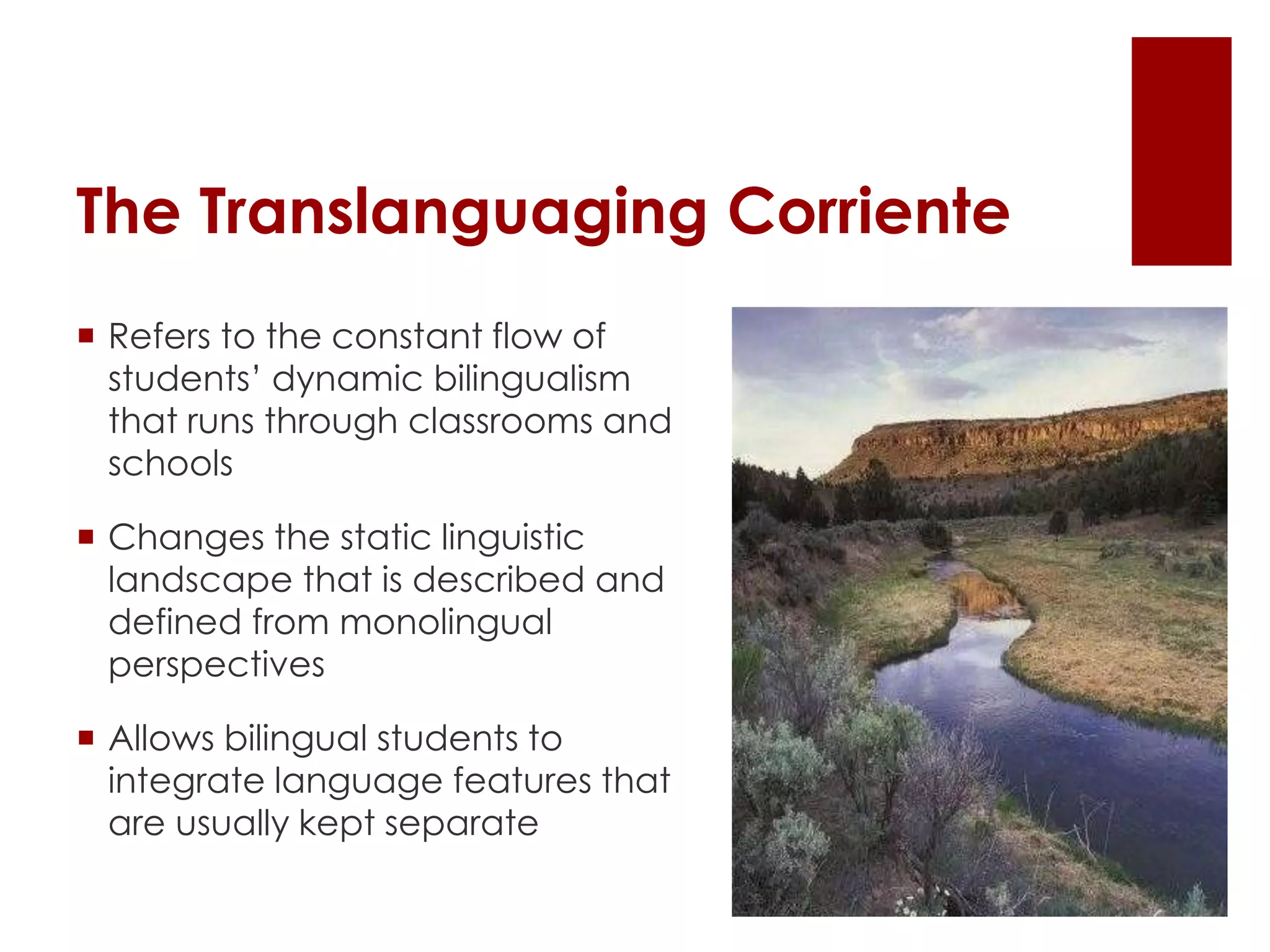
The Translanguaging Corriente
 Refers to the constant flow of
students’ dynamic bilingualism
that runs through classrooms and
schools
 Changes the static linguistic
landscape that is described and
defined from monolingual
perspectives
 Allows bilingual students to
integrate language features that
are usually kept separate
Translanguaging
Classrooms
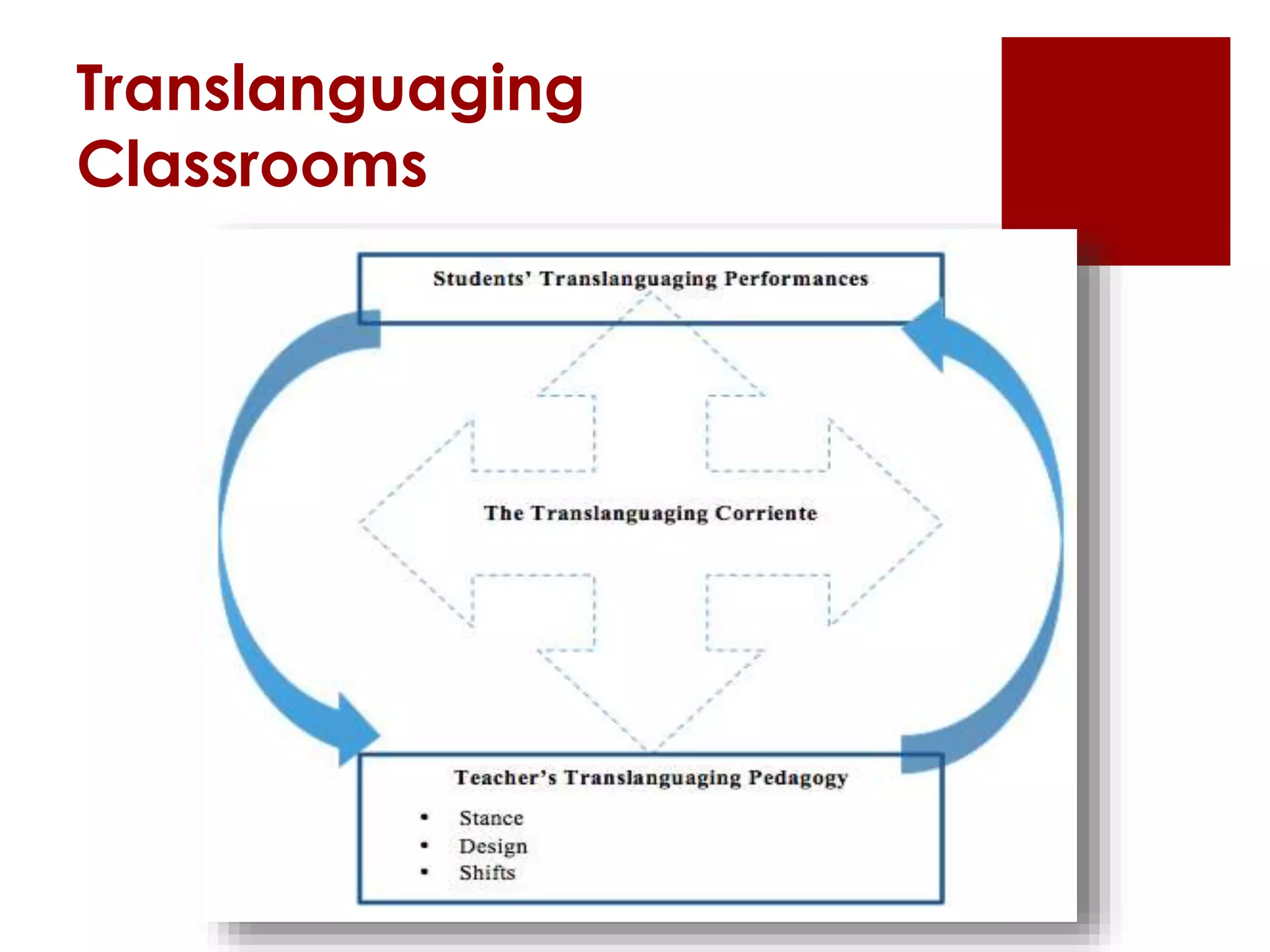
Students’ Translanguaging
Performances
 Enable us to understand students’ ability to use
features of their entire linguistic repertoire, as well as
their ability to conform to different sociolinguistic
situations
 Do not separate “proficiency” into countable “languages”
 Move away from deficit views of students’ languaging
 Look at students’ bilingual performances holistically
 Recognize that bilinguals’ “proficiency” shifts depending on
the social situation/social context (not linear)
Teacher’s Translanguaging
Pedagogy
 Translanguaging Stance
 A philosophy that informs all instruction and assessment
of bilingual students
 Students’ language practices and cultural understandings
include those they bring from home/communities, as well as
those they take-up in schools
 Students’ families/communities are sources of knowledge
and must be involved in the education process.
 The classroom is a democratic space where teachers &
students co-create knowledge, challenge traditional
hierarchies, and work towards social justice
Teacher’s Translanguaging
Pedagogy
 Translanguaging Design
 Includes the design of the classroom space, units,
lessons, learning activities, assessments, etc.
 A science teacher organizes students into groups with
different levels of home/new language proficiency
 An English teacher organizes a unit around writers who utilize
multiple languages in their writing
 A bilingual teacher gives out a text in Spanish and English
and asks students to compare/contrast the lexicon, syntax,
morphology, and discourse structure
 A TESOL teacher plans assessments that differentiate
students’ general linguistic performances from their
language specific performances
Teacher’s Translanguaging
Pedagogy
 Translanguaging Shifts
 Moment-by-moment decisions that change with the flow
of the translanguaging corriente and allow for flexibility
in language practices, conversations, activities, and
plans
 In moments of difficulty/misunderstanding, encouraging
students to talk to one another about a new concept,
vocabulary word, etc., using their own language practices
 Looking up words and phrases using online translation tools
or having students do so on their own
 Using culturally meaningful metaphors and/or stories that
students relate to in order to make sense of new content
Why use translanguaging in
instruction?
 To enable students to engage with and comprehend
complex content and texts
 To develop students’ linguistic practices for
academic contexts
 To make space for students to draw on their
bilingualism and bilingual ways of knowing
 To support students’ social emotional development
and bilingual identities, and advance social justice
Classroom Examples –
 As a part of an unit on voting, students created
one election campaign advertisement for their
community in their home language, and a
different one in the second language. Students
presented both, in the second language, to the
class.
Classroom Examples –
 After a poetry study, students chose a poem
written in their home language and created a
PowerPoint presentation to teach their
classmates about that poem. Students read the
poem in their home language, but spoke about
and explained it to the class in the second
language.
Classroom Examples –
 Students were paired by shared home language
to complete a chemistry experiment. They were
able to discuss the experiment, read the
directions, and record their findings in that home
language. When it was time to discuss their
findings with the class and write up their formal
lab report, students did so in the second
language.
Translanguaging in
diverse contexts
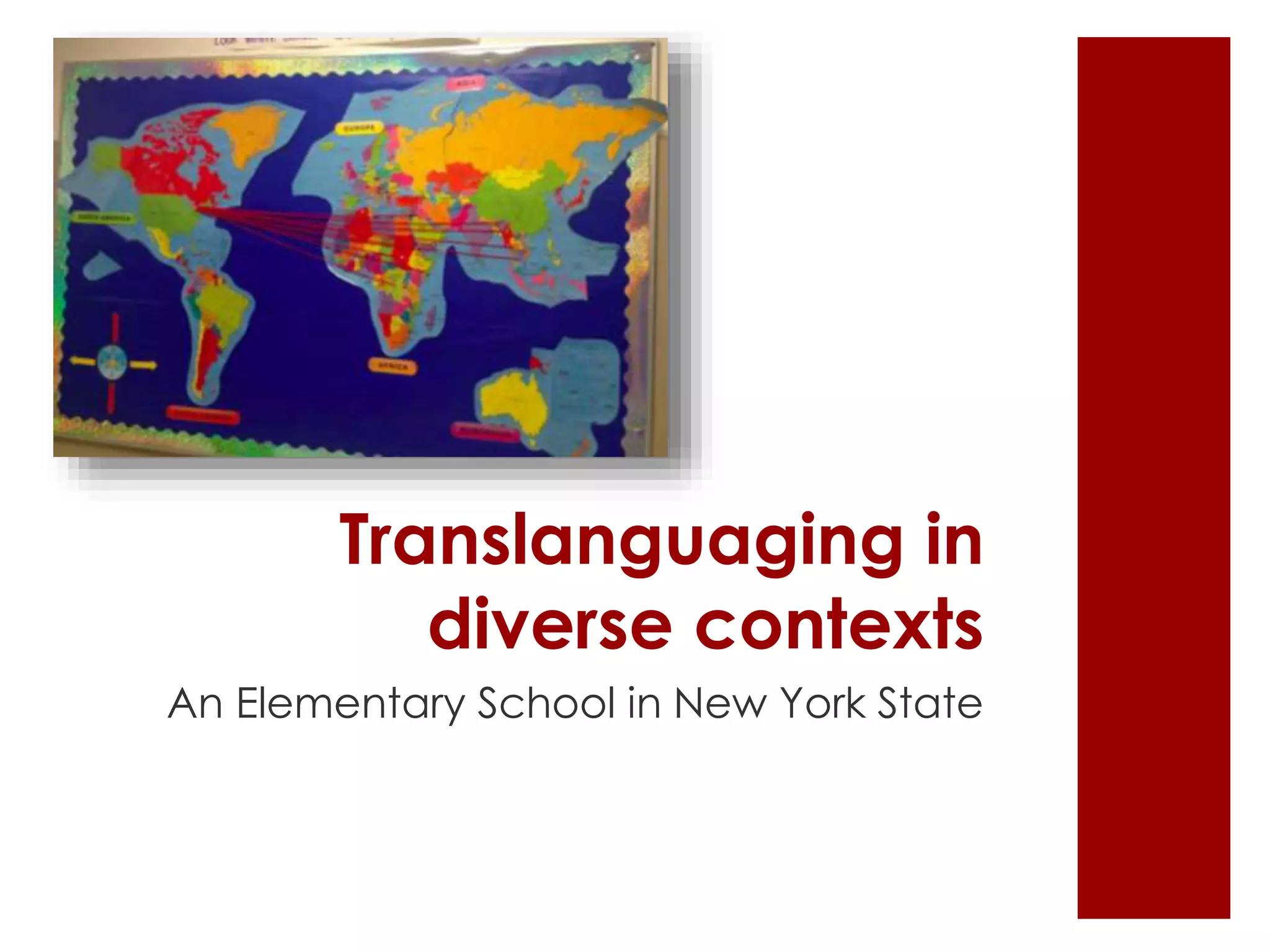
An Elementary School in New York State
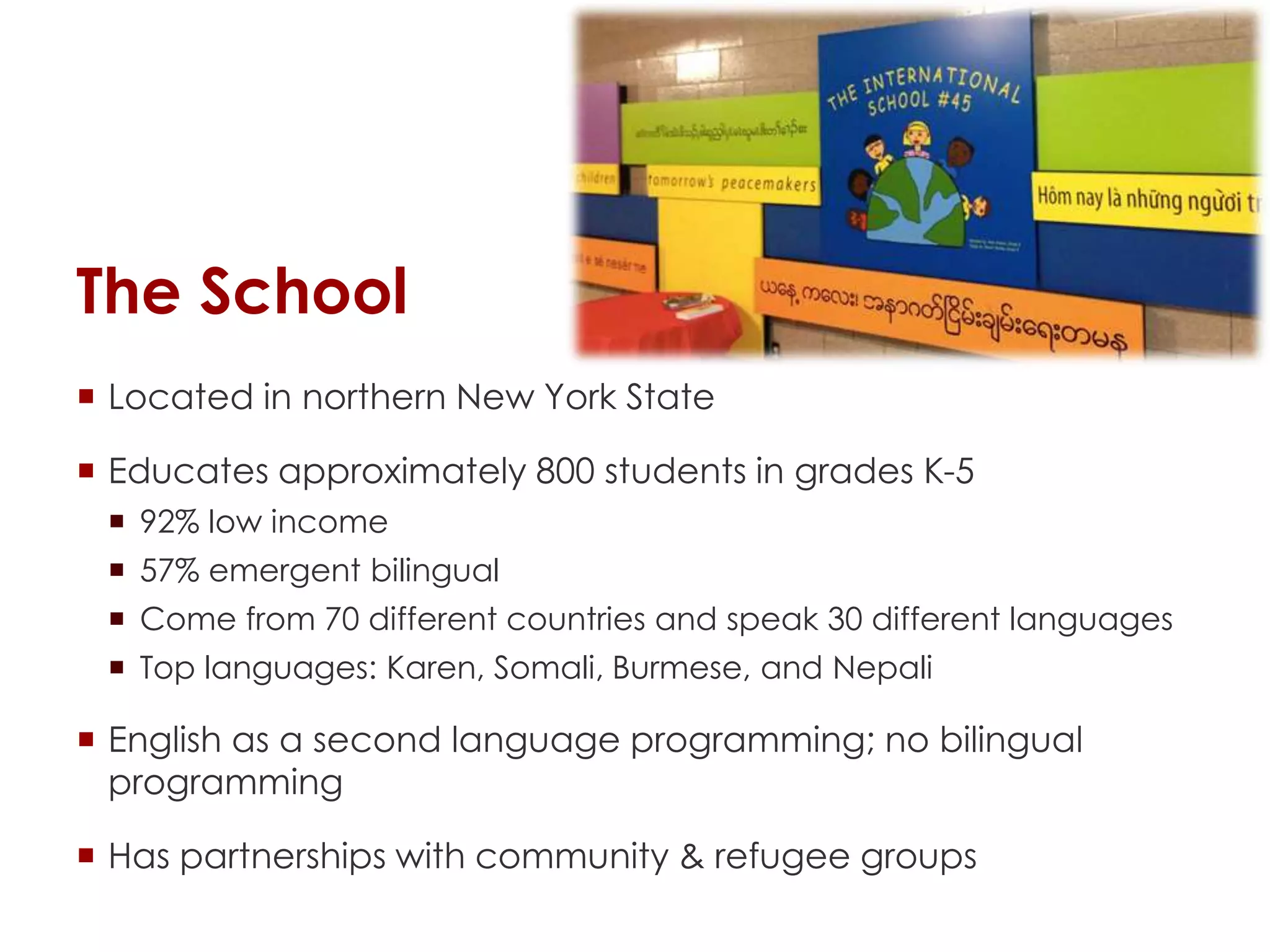
The School
 Located in northern New York State
 Educates approximately 800 students in grades K-5
 92% low income
 57% emergent bilingual
 Come from 70 different countries and speak 30 different languages
 Top languages: Karen, Somali, Burmese, and Nepali
 English as a second language programming; no bilingual
programming
 Has partnerships with community & refugee groups
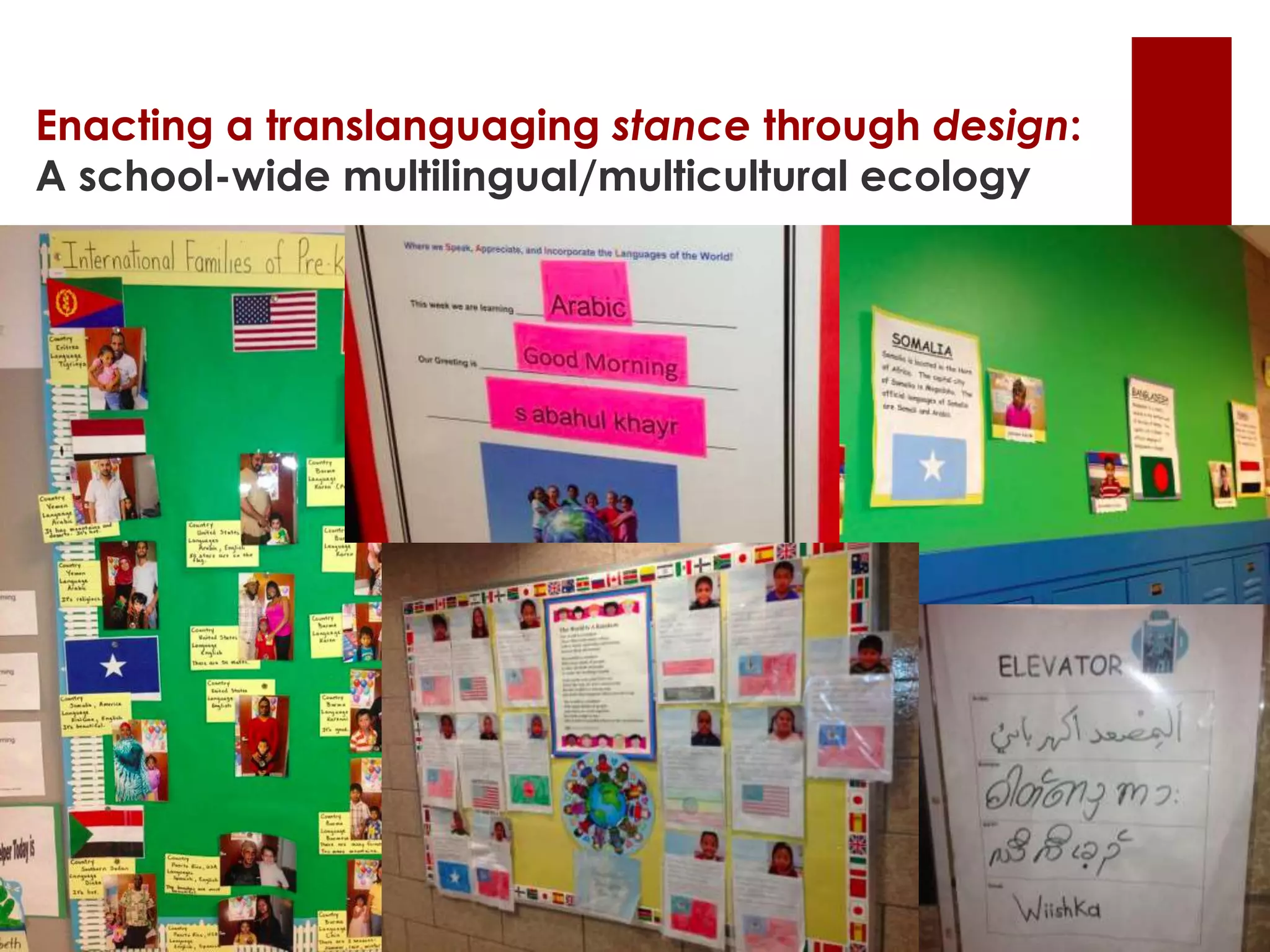
Enacting a translanguaging stance through design:
A school-wide multilingual/multicultural ecology
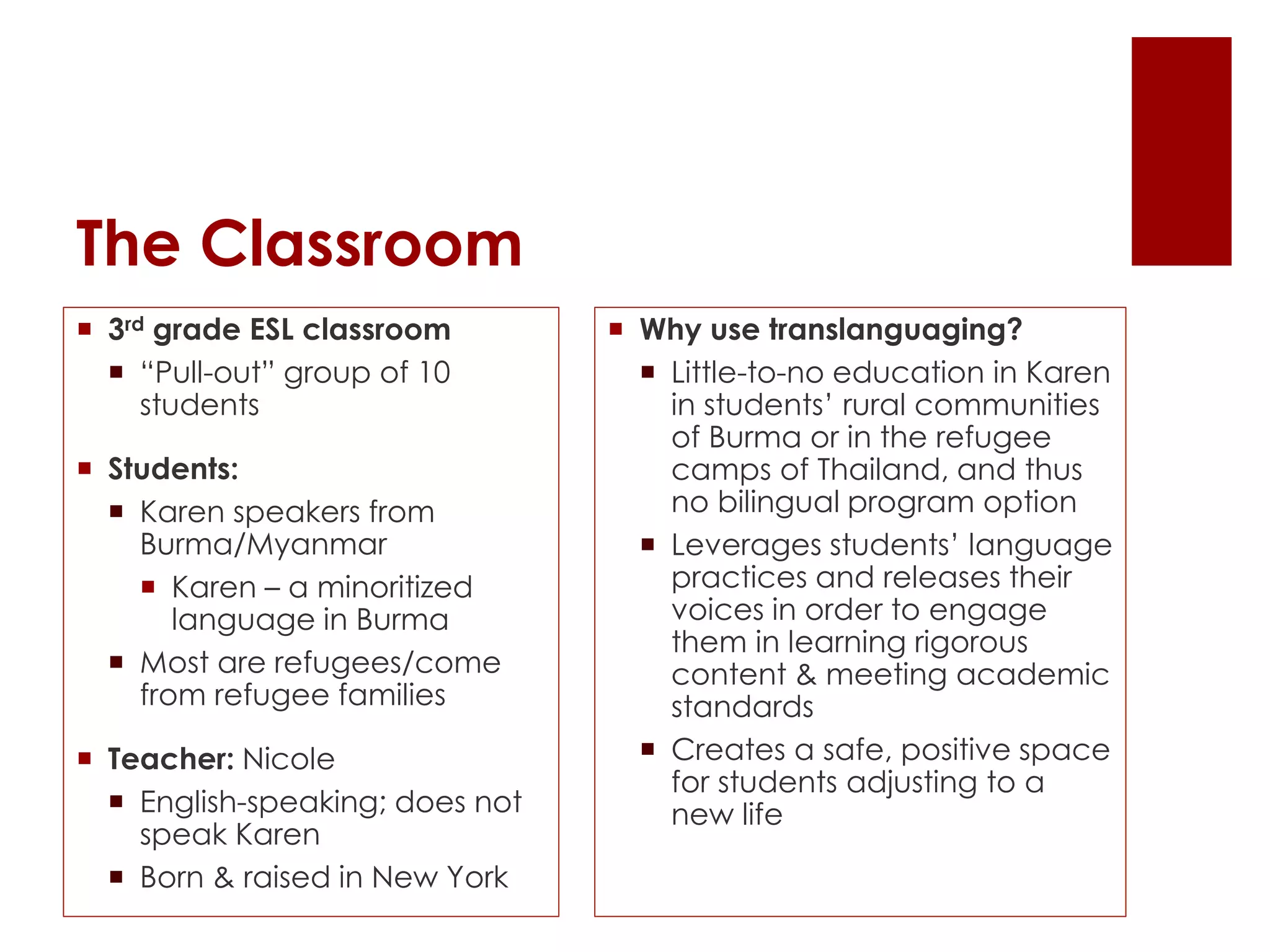
The Classroom
 3rd grade ESL classroom
 “Pull-out” group of 10
students
 Students:
 Karen speakers from
Burma/Myanmar
 Karen – a minoritized
language in Burma
 Most are refugees/come
from refugee families
 Teacher: Nicole
 English-speaking; does not
speak Karen
 Born & raised in New York
 Why use translanguaging?
 Little-to-no education in Karen
in students’ rural communities
of Burma or in the refugee
camps of Thailand, and thus
no bilingual program option
 Leverages students’ language
practices and releases their
voices in order to engage
them in learning rigorous
content & meeting academic
standards
 Creates a safe, positive space
for students adjusting to a
new life
Nicole’s Translanguaging
Stance
 Became a teacher after volunteering with a
refugee organization in her city
 Attends Karen cultural and social events around
the city
 Advocated for an ESL pull-out classroom for small
number of Karen speakers
“Translanguaging is a way to showcase how special
[my students] are and what I feel as a person, not just
as a teacher. It has given me the support that I need
to do what I want to do with these kids. Before it was
like, ‘shh, hush it under the rug, use English
only”…[Translanguaging] is a way for me to
showcase who they are, make them feel special,
and give me a chance to learn about them.”
Nicole’s Translanguaging
Design
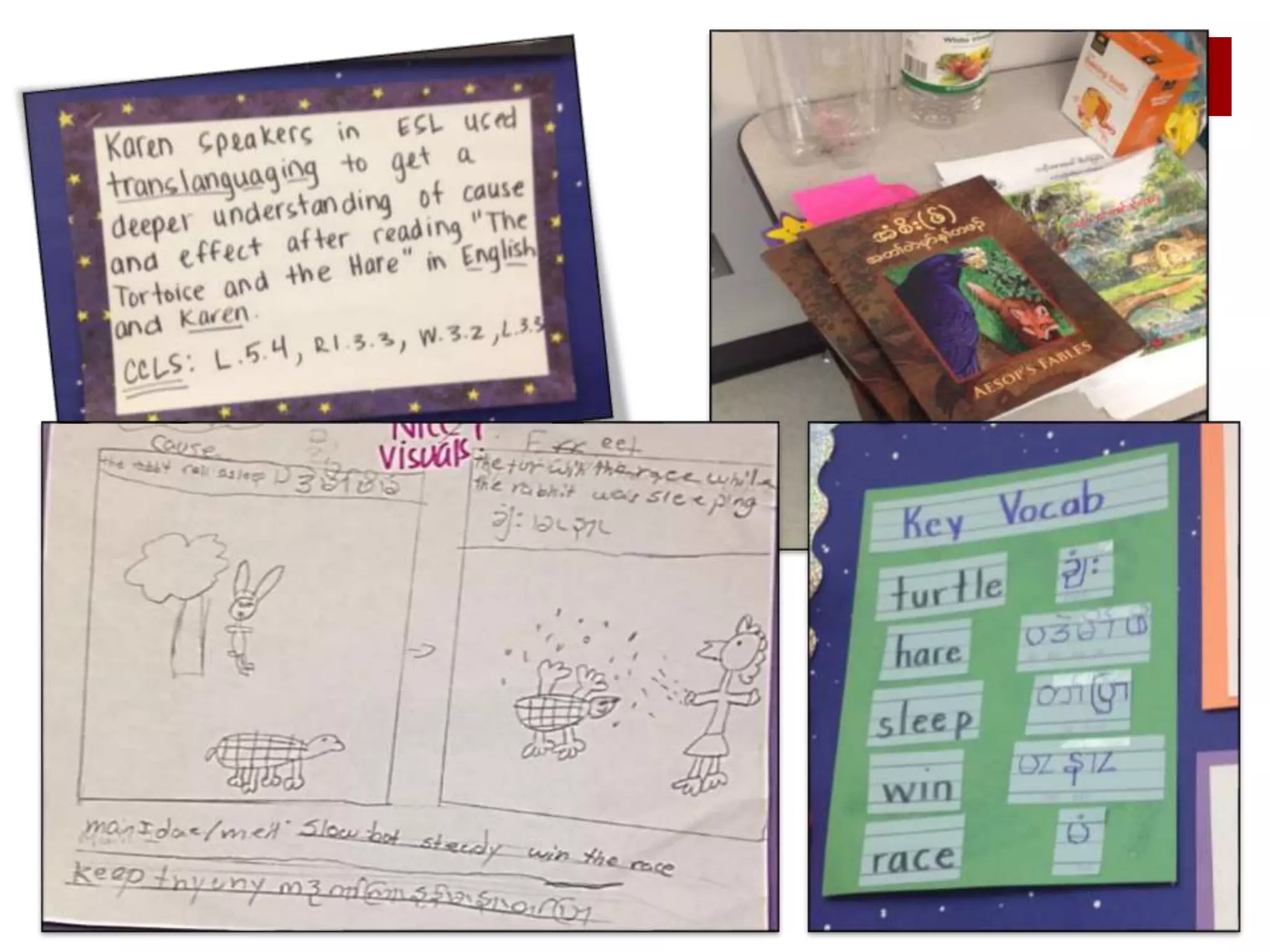
 Unit: Aesop’s Fables in English & Karen
①Nicole recorded members of the Karen-speaking community
& video recorded them reading the fables (6 total) in Karen
①Nicole planned literacy lessons around the use of the 2
versions of the fables
• Students read the fable in English with translations of key words in
Karen while practicing literacy skills (i.e.: compare/contrast,
sequencing, cause & effect)
• Students listened to the fable in Karen & followed along with the
Karen text, picking out the key words already introduced
• Students engaged in literacy activities that extended their
understandings of the fables in both English & Karen
Impact of translanguaging
in Nicole’s classroom
 “The most noticeable [differences] were motivation and
engagement…total, 100% attention.”
 “When I incorporate translanguaging in this way, I notice how
happy students are…they want to understand [the text]
because they’re proud [of their language”].
 Students’ role: from passive listeners to active teachers and
experts
 When students were held responsible for teaching Nicole new words
in their own language, they rose to the challenge!
Translanguaging Strategies for the
Second Language Classroom
 Students read in the SL and
discuss/analyze what they read in
the HL
 Assign reading partners that
share a HL for mutual assistance
 Students do independent reading
in multiple languages
 Encourage students to read &
research for research projects in
both languages
 Supplement SL readings with HL
language readings on the same
topic/theme
 Allow students to audio record
ideas first using both languages,
then transfer to writing
 Students pre-write in both
languages, then publish in the SL
 Assign writing partners that share
a HL for mutual assistance
 Students write first in the HL and
then translate that text into the
SL
READING WRITING
Translanguaging Strategies for the
Second Language Classroom
 Assign partners: beginner
speakers with intermediate
speakers, intermediate speakers
with any level, advanced
speakers with intermediate
 Assign newcomers a buddy to
show them around school,
answer questions, etc.
 Group students so they can use
both languages in small group
work, then present in the SL
 Allow students to discuss
lesson/ideas with partner in the
HL and SL
 Allow students to explain/share
ideas using the HL and the SL
(another student can translate if
you don’t speak language)
 Have students interview one
another using both the HL and
the SL and then share what they
learned in the SL
 Create a multilingual listening
center comprised of fiction and
non-fiction texts in the
classroom, narratives of
community members, and
books recorded by students (a
favorite book or their own
writing)
SPEAKING LISTENING
Translanguaging Strategies for the
Second Language Classroom
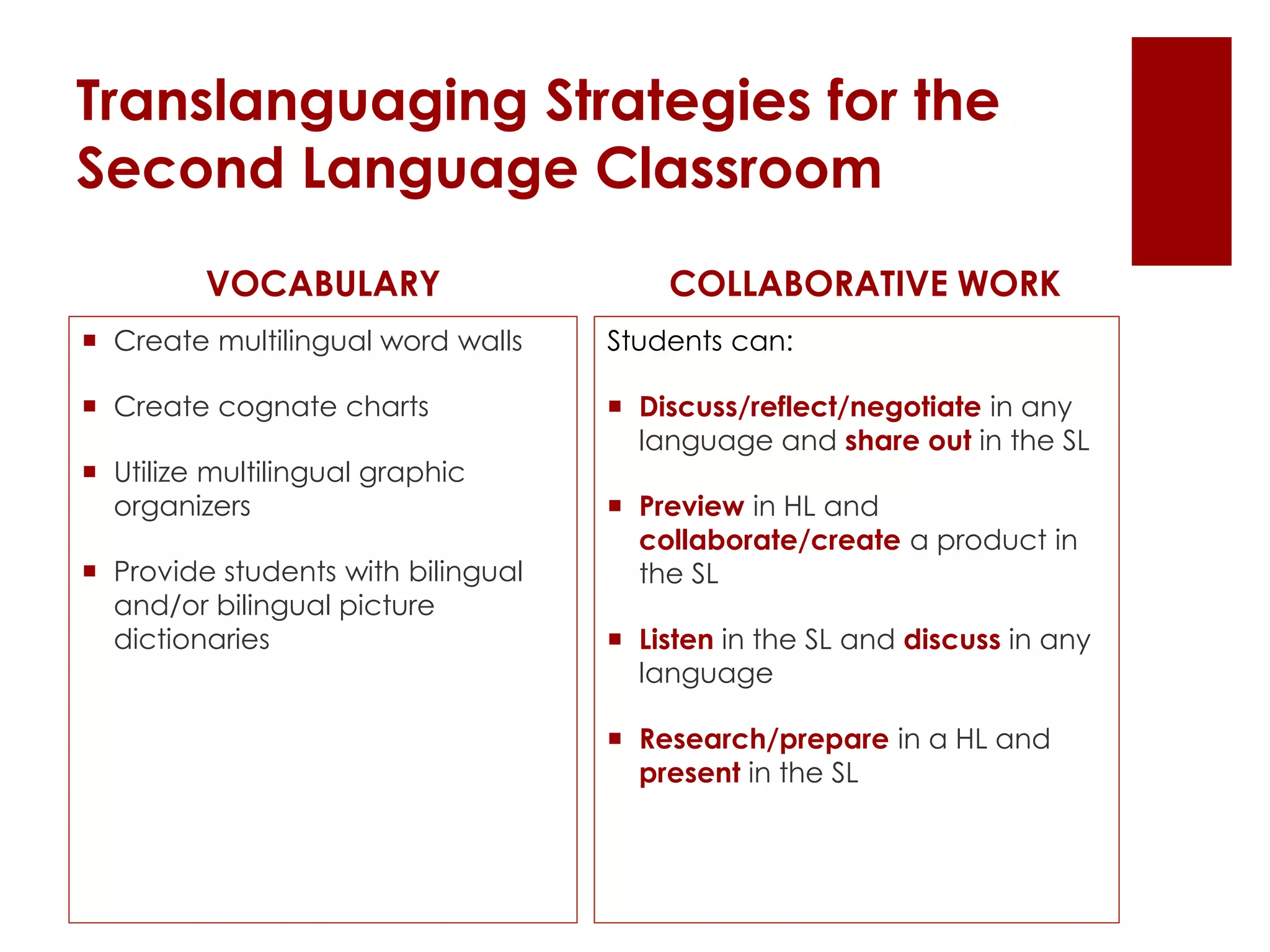
 Create multilingual word walls
 Create cognate charts
 Utilize multilingual graphic
organizers
 Provide students with bilingual
and/or bilingual picture
dictionaries
VOCABULARY COLLABORATIVE WORK
Students can:
 Discuss/reflect/negotiate in any
language and share out in the SL
 Preview in HL and
collaborate/create a product in
the SL
 Listen in the SL and discuss in any
language
 Research/prepare in a HL and
present in the SL
Ideas for moving forward with
translanguaging:
Read more about it:
Available for free online:
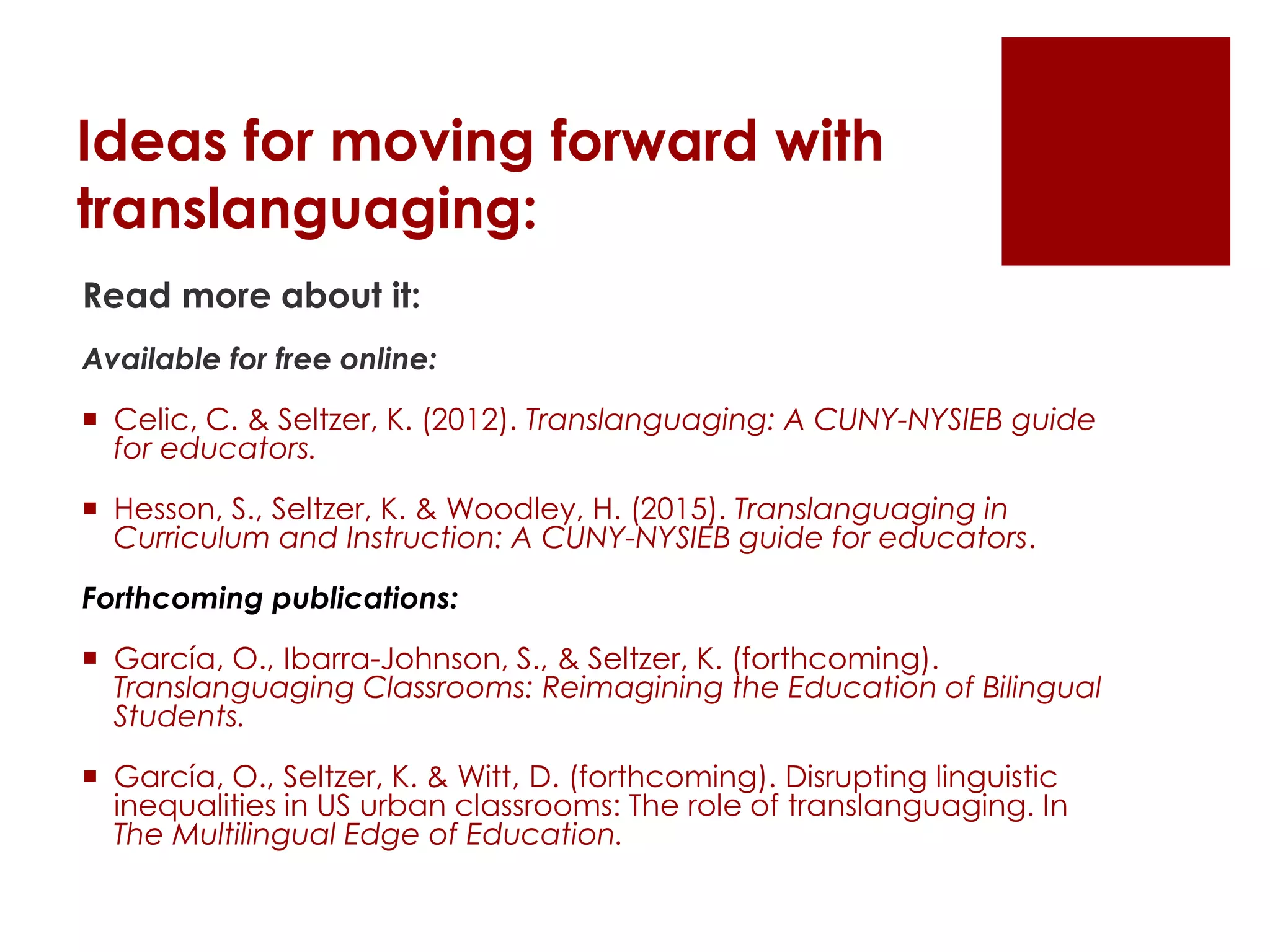
 Celic, C. & Seltzer, K. (2012). Translanguaging: A CUNY-NYSIEB guide
for educators.
 Hesson, S., Seltzer, K. & Woodley, H. (2015). Translanguaging in
Curriculum and Instruction: A CUNY-NYSIEB guide for educators.
Forthcoming publications:
 García, O., Ibarra-Johnson, S., & Seltzer, K. (forthcoming).
Translanguaging Classrooms: Reimagining the Education of Bilingual
Students.
 García, O., Seltzer, K. & Witt, D. (forthcoming). Disrupting linguistic
inequalities in US urban classrooms: The role of translanguaging. In
The Multilingual Edge of Education.
Ideas for moving forward with
translanguaging:
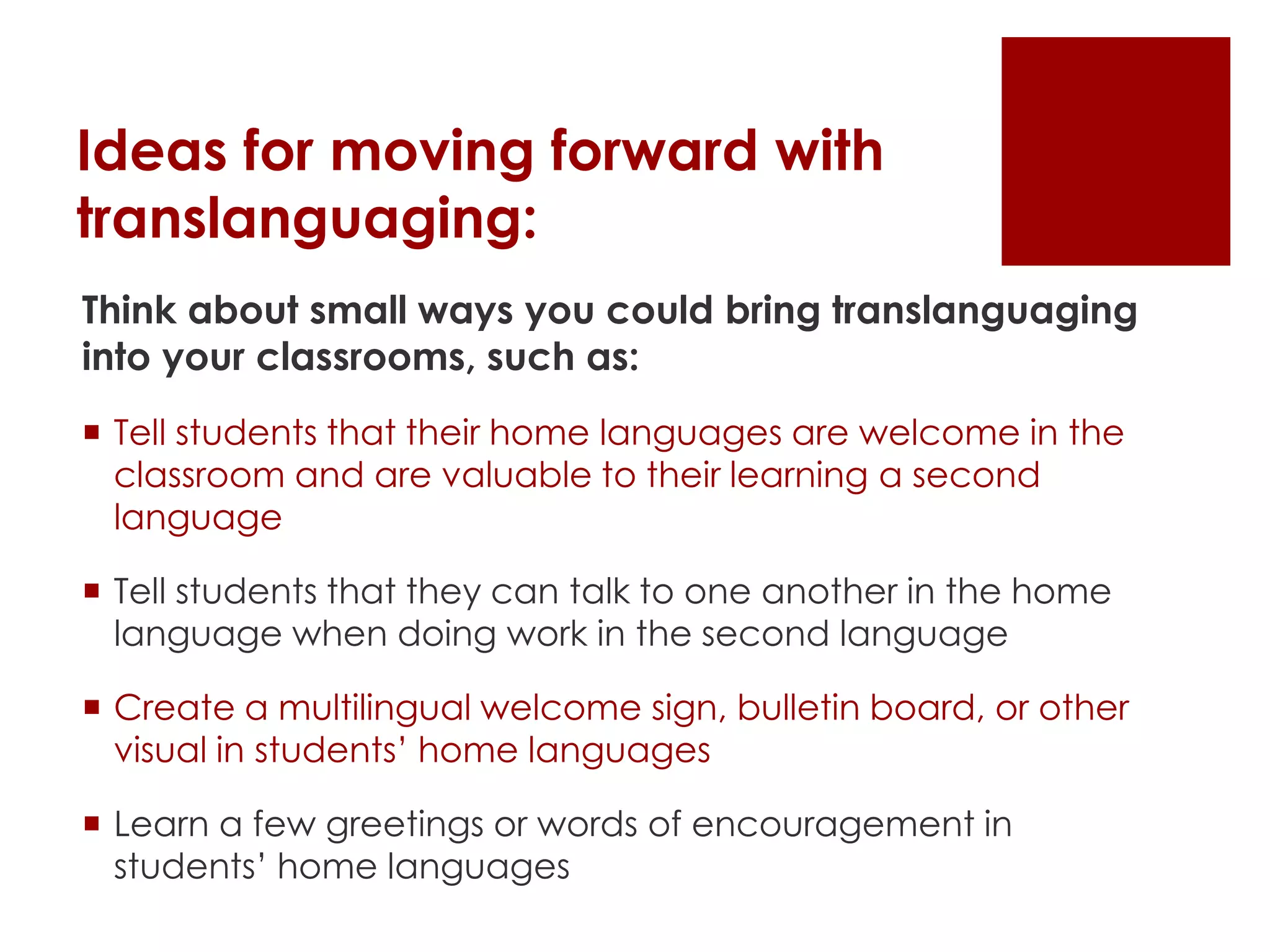
Think about small ways you could bring translanguaging
into your classrooms, such as:
 Tell students that their home languages are welcome in the
classroom and are valuable to their learning a second
language
 Tell students that they can talk to one another in the home
language when doing work in the second language
 Create a multilingual welcome sign, bulletin board, or other
visual in students’ home languages
 Learn a few greetings or words of encouragement in
students’ home languages
Questions & Answers
+
Kate Seltzer
kseltzer@gc.cuny.edu
Thank
you!

Ways to teach and collaborate in superdiverse schools

  • 1.
    Translanguaging in Diverse LearningContexts Kate Seltzer The CUNY Graduate Center October 8, 2015
  • 2.
    Today’s Plan:  Thispresentation will:  Extend existing understandings of translanguaging as pedagogy  Clarify the purposes and benefits of translanguaging in the classroom  Provide examples of translanguaging in action in language learning classrooms  Use a case study of a super diverse school/classroom to illustrate the power & possibilities of translanguaging  Leave you with practical strategies and resources for using translanguaging in your schools and classrooms
  • 3.
    Context for today’s presentation A U.S. perspective on a theoretical approach/pedagogy being taken up internationally  Forthcoming book:  Translanguaging Classrooms: Reimagining the Education of Bilingual Students (García, Ibarra-Johnson, & Seltzer)  Research project:  CUNY-NYSIEB (New York State Initiative on Emergent Bilinguals)  Translanguaging: A CUNY-NYSIEB Guide for Educators (Celic & Seltzer, 2012)
  • 4.
    The Translanguaging Corriente Refers to the constant flow of students’ dynamic bilingualism that runs through classrooms and schools  Changes the static linguistic landscape that is described and defined from monolingual perspectives  Allows bilingual students to integrate language features that are usually kept separate
  • 5.
  • 6.
    Students’ Translanguaging Performances  Enableus to understand students’ ability to use features of their entire linguistic repertoire, as well as their ability to conform to different sociolinguistic situations  Do not separate “proficiency” into countable “languages”  Move away from deficit views of students’ languaging  Look at students’ bilingual performances holistically  Recognize that bilinguals’ “proficiency” shifts depending on the social situation/social context (not linear)
  • 7.
    Teacher’s Translanguaging Pedagogy  TranslanguagingStance  A philosophy that informs all instruction and assessment of bilingual students  Students’ language practices and cultural understandings include those they bring from home/communities, as well as those they take-up in schools  Students’ families/communities are sources of knowledge and must be involved in the education process.  The classroom is a democratic space where teachers & students co-create knowledge, challenge traditional hierarchies, and work towards social justice
  • 8.
    Teacher’s Translanguaging Pedagogy  TranslanguagingDesign  Includes the design of the classroom space, units, lessons, learning activities, assessments, etc.  A science teacher organizes students into groups with different levels of home/new language proficiency  An English teacher organizes a unit around writers who utilize multiple languages in their writing  A bilingual teacher gives out a text in Spanish and English and asks students to compare/contrast the lexicon, syntax, morphology, and discourse structure  A TESOL teacher plans assessments that differentiate students’ general linguistic performances from their language specific performances
  • 9.
    Teacher’s Translanguaging Pedagogy  TranslanguagingShifts  Moment-by-moment decisions that change with the flow of the translanguaging corriente and allow for flexibility in language practices, conversations, activities, and plans  In moments of difficulty/misunderstanding, encouraging students to talk to one another about a new concept, vocabulary word, etc., using their own language practices  Looking up words and phrases using online translation tools or having students do so on their own  Using culturally meaningful metaphors and/or stories that students relate to in order to make sense of new content
  • 10.
    Why use translanguagingin instruction?  To enable students to engage with and comprehend complex content and texts  To develop students’ linguistic practices for academic contexts  To make space for students to draw on their bilingualism and bilingual ways of knowing  To support students’ social emotional development and bilingual identities, and advance social justice
  • 11.
    Classroom Examples – As a part of an unit on voting, students created one election campaign advertisement for their community in their home language, and a different one in the second language. Students presented both, in the second language, to the class.
  • 12.
    Classroom Examples – After a poetry study, students chose a poem written in their home language and created a PowerPoint presentation to teach their classmates about that poem. Students read the poem in their home language, but spoke about and explained it to the class in the second language.
  • 13.
    Classroom Examples – Students were paired by shared home language to complete a chemistry experiment. They were able to discuss the experiment, read the directions, and record their findings in that home language. When it was time to discuss their findings with the class and write up their formal lab report, students did so in the second language.
  • 14.
    Translanguaging in diverse contexts AnElementary School in New York State
  • 15.
    The School  Locatedin northern New York State  Educates approximately 800 students in grades K-5  92% low income  57% emergent bilingual  Come from 70 different countries and speak 30 different languages  Top languages: Karen, Somali, Burmese, and Nepali  English as a second language programming; no bilingual programming  Has partnerships with community & refugee groups
  • 16.
    Enacting a translanguagingstance through design: A school-wide multilingual/multicultural ecology
  • 17.
    The Classroom  3rdgrade ESL classroom  “Pull-out” group of 10 students  Students:  Karen speakers from Burma/Myanmar  Karen – a minoritized language in Burma  Most are refugees/come from refugee families  Teacher: Nicole  English-speaking; does not speak Karen  Born & raised in New York  Why use translanguaging?  Little-to-no education in Karen in students’ rural communities of Burma or in the refugee camps of Thailand, and thus no bilingual program option  Leverages students’ language practices and releases their voices in order to engage them in learning rigorous content & meeting academic standards  Creates a safe, positive space for students adjusting to a new life
  • 18.
    Nicole’s Translanguaging Stance  Becamea teacher after volunteering with a refugee organization in her city  Attends Karen cultural and social events around the city  Advocated for an ESL pull-out classroom for small number of Karen speakers “Translanguaging is a way to showcase how special [my students] are and what I feel as a person, not just as a teacher. It has given me the support that I need to do what I want to do with these kids. Before it was like, ‘shh, hush it under the rug, use English only”…[Translanguaging] is a way for me to showcase who they are, make them feel special, and give me a chance to learn about them.”
  • 19.
    Nicole’s Translanguaging Design  Unit:Aesop’s Fables in English & Karen ①Nicole recorded members of the Karen-speaking community & video recorded them reading the fables (6 total) in Karen ①Nicole planned literacy lessons around the use of the 2 versions of the fables • Students read the fable in English with translations of key words in Karen while practicing literacy skills (i.e.: compare/contrast, sequencing, cause & effect) • Students listened to the fable in Karen & followed along with the Karen text, picking out the key words already introduced • Students engaged in literacy activities that extended their understandings of the fables in both English & Karen
  • 21.
    Impact of translanguaging inNicole’s classroom  “The most noticeable [differences] were motivation and engagement…total, 100% attention.”  “When I incorporate translanguaging in this way, I notice how happy students are…they want to understand [the text] because they’re proud [of their language”].  Students’ role: from passive listeners to active teachers and experts  When students were held responsible for teaching Nicole new words in their own language, they rose to the challenge!
  • 22.
    Translanguaging Strategies forthe Second Language Classroom  Students read in the SL and discuss/analyze what they read in the HL  Assign reading partners that share a HL for mutual assistance  Students do independent reading in multiple languages  Encourage students to read & research for research projects in both languages  Supplement SL readings with HL language readings on the same topic/theme  Allow students to audio record ideas first using both languages, then transfer to writing  Students pre-write in both languages, then publish in the SL  Assign writing partners that share a HL for mutual assistance  Students write first in the HL and then translate that text into the SL READING WRITING
  • 23.
    Translanguaging Strategies forthe Second Language Classroom  Assign partners: beginner speakers with intermediate speakers, intermediate speakers with any level, advanced speakers with intermediate  Assign newcomers a buddy to show them around school, answer questions, etc.  Group students so they can use both languages in small group work, then present in the SL  Allow students to discuss lesson/ideas with partner in the HL and SL  Allow students to explain/share ideas using the HL and the SL (another student can translate if you don’t speak language)  Have students interview one another using both the HL and the SL and then share what they learned in the SL  Create a multilingual listening center comprised of fiction and non-fiction texts in the classroom, narratives of community members, and books recorded by students (a favorite book or their own writing) SPEAKING LISTENING
  • 24.
    Translanguaging Strategies forthe Second Language Classroom  Create multilingual word walls  Create cognate charts  Utilize multilingual graphic organizers  Provide students with bilingual and/or bilingual picture dictionaries VOCABULARY COLLABORATIVE WORK Students can:  Discuss/reflect/negotiate in any language and share out in the SL  Preview in HL and collaborate/create a product in the SL  Listen in the SL and discuss in any language  Research/prepare in a HL and present in the SL
  • 25.
    Ideas for movingforward with translanguaging: Read more about it: Available for free online:  Celic, C. & Seltzer, K. (2012). Translanguaging: A CUNY-NYSIEB guide for educators.  Hesson, S., Seltzer, K. & Woodley, H. (2015). Translanguaging in Curriculum and Instruction: A CUNY-NYSIEB guide for educators. Forthcoming publications:  García, O., Ibarra-Johnson, S., & Seltzer, K. (forthcoming). Translanguaging Classrooms: Reimagining the Education of Bilingual Students.  García, O., Seltzer, K. & Witt, D. (forthcoming). Disrupting linguistic inequalities in US urban classrooms: The role of translanguaging. In The Multilingual Edge of Education.
  • 26.
    Ideas for movingforward with translanguaging: Think about small ways you could bring translanguaging into your classrooms, such as:  Tell students that their home languages are welcome in the classroom and are valuable to their learning a second language  Tell students that they can talk to one another in the home language when doing work in the second language  Create a multilingual welcome sign, bulletin board, or other visual in students’ home languages  Learn a few greetings or words of encouragement in students’ home languages
  • 27.
  • 28.

Editor's Notes

  • #5 Currents can be on the surface or deep beneath the water, but they’re always present Not always linear – runs a course that adapts to its surroundings The corriente, even when not seen/heard, is always present and helps EBLs make meaning bilingually at all times
  • #6 The corriente runs through all elements of classroom life and shapes the way we teach bilingual students Dynamic translanguaging progressions are where we start, and translanguaging instruction and assessment respond to where students’ are – their language practices, existing knowledge, and needs
  • #7 Not about how “proficient” they are but how competent they are at enacting/suppressing different features of their linguistic repertoire (a focus on flexibility, fluidity, and agency) E.g.: Students may be considered “beginners” in school, but they are “advanced” translators for their parents at home
  • #8 Translanguaging pedagogy extends to instruction and assessment and is informed by 3 strands: the stance, the design, and the shifts The stance can be different depending on the individual educator and individual students, but we see there being 3 central tenets of a translanguaging stance that can be enacted in different ways
  • #9 Includes planning the physical space, the unit plans, the lesson plans, and the assessments (basically all pedagogical activity in the classrooms) General linguistic proficiency = the ability to express complex thoughts effectively, the ability to explain, persuade, argue, compare and contrast, give directions, recount events Language-specific proficiency = ability to use oSLy selected features of the bilinguals’ language repertoire to perform certain tasks
  • #10 A monolingual teacher uses an app on her phone that has a microphone feature; when a student doesn’t know a word, she has him/her say the word into her phone and she translates it into English (if the student knows how to spell the word in his/her home language, she also allows him/her to type it into the phone)
  • #11 Talking more specifically about literacy, there are many reasons to tap into the translanguaging corriente The rationale for using translanguaging is both academic and social emotional; it is also an act of social justice as we give ALL students voice and access to the tools that will help them grow as critical thinkers
  • #12 Separate slides
  • #19 Karen speakers as most marginalized > need for an all-Karen group
  • #21 11:25-11:45 - Find a text that has multilingual versions or translate 1 text into the languages of your classroom and place them side by side with the English text Multilingual word walls Create a piece of writing in both English and the home language
  • #23 Though the case study classroom had all Karen speakers, most ESL classes at the school are highly diverse
  • #25 11:15-11:40
  • #28 12:10pm