1
LIGHT
Hanisah/EO301/JKE/PTSS/Dis'13
2
Waves?
What is Light?
Particles?
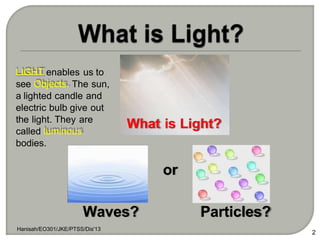
LIGHT enables us to
see Objects. The sun,
a lighted candle and
electric bulb give out
the light. They are
called luminous
bodies.
or
Hanisah/EO301/JKE/PTSS/Dis'13
3
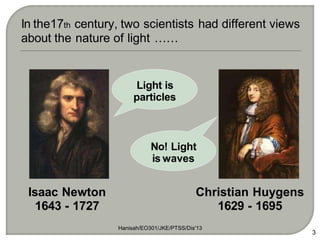
Isaac Newton
1643 - 1727
Christian Huygens
1629 - 1695
In the17th century, two scientists had different views
about the nature of light ……
Light is
particles
No! Light
is waves
In Late 1600, Sir Isaac Newton believed that light travels in
the form of particles which named as “corpuscles”.
Then, in 1678 Christian Huygens argued that light might be
some sort of a wave motion. Huygens came up with
Huygens's Principle that explain the light is a wave
traveling through a medium called “aether”.
Huygens deduced the Laws of Reflection and Refraction
and could explain Double Refraction to prove the Theory of
Wave.
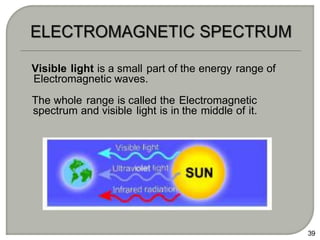
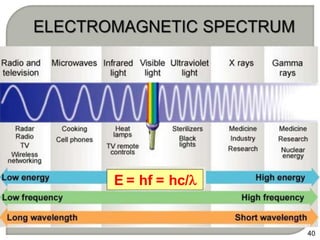
However, if light behaves as waves, diffraction and
interference should be seen using light.
4
WAVE or PARTICLES?
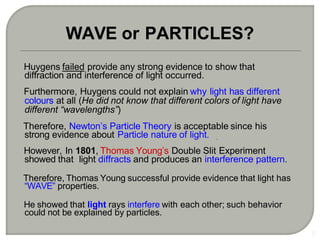
Huygens failed provide any strong evidence to show that
diffraction and interference of light occurred.
Furthermore, Huygens could not explain why light has different
colours at all (He did not know that different colors of light have
different “wavelengths”)
Therefore, Newton’s Particle Theory is acceptable since his
strong evidence about Particle nature of light.
However, In 1801, Thomas Young’s Double Slit Experiment
showed that light diffracts and produces an interference pattern.
Therefore, Thomas Young successful provide evidence that light has
“WAVE” properties.
He showed that light rays interfere with each other; such behavior
could not be explained by particles.
5
WAVE or PARTICLES?
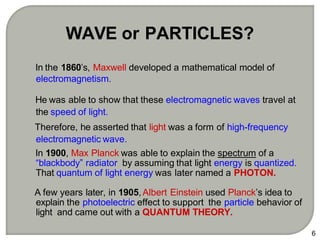
In the 1860’s, Maxwell developed a mathematical model of
electromagnetism.
He was able to show that these electromagnetic waves travel at
the speed of light.
Therefore, he asserted that light was a form of high-frequency
electromagnetic wave.
In 1900, Max Planck was able to explain the spectrum of a
“blackbody” radiator by assuming that light energy is quantized.
That quantum of light energy was later named a PHOTON.
A few years later, in 1905, Albert Einstein used Planck’s idea to
explain the photoelectric effect to support the particle behavior of
light and came out with a QUANTUM THEORY.
6
WAVE or PARTICLES?
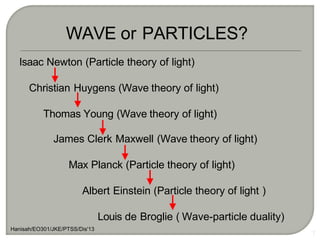
Isaac Newton (Particle theory of light)
Christian Huygens (Wave theory of light)
Thomas Young (Wave theory of light)
James Clerk Maxwell (Wave theory of light)
Max Planck (Particle theory of light)
Albert Einstein (Particle theory of light )
Louis de Broglie ( Wave-particle duality)
Hanisah/EO301/JKE/PTSS/Dis'13
7
WAVE or PARTICLES?
Experiment to proof
the Dual Nature of
light
• Double slit exp. for
particles
• Double slit exp. for
waves
• Double slit exp. for
electrons
• Double slit exp. for
particle-wave
duality
8
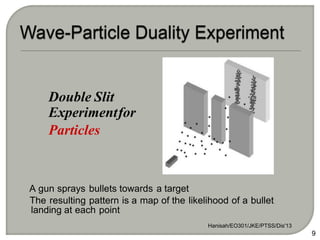
A gun sprays bullets towards a target
The resulting pattern is a map of the likelihood of a bullet
landing at each point
Hanisah/EO301/JKE/PTSS/Dis'13
9
Double Slit
Experimentfor
Particles
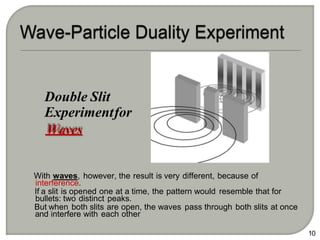
With waves, however, the result is very different, because of
interference.
If a slit is opened one at a time, the pattern would resemble that for
bullets: two distinct peaks.
But when both slits are open, the waves pass through both slits at once
and interfere with each other
10
Double Slit
Experimentfor
Waves
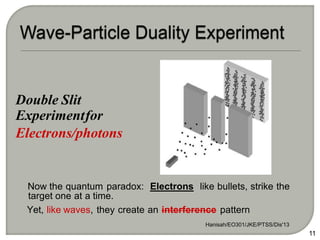
Now the quantum paradox: Electrons like bullets, strike the
target one at a time.
Yet, like waves, they create an interference pattern
Hanisah/EO301/JKE/PTSS/Dis'13
11
Double Slit
Experimentfor
Electrons/photons
Double Slit
Experimentfor Light
Wave-Particle Duality
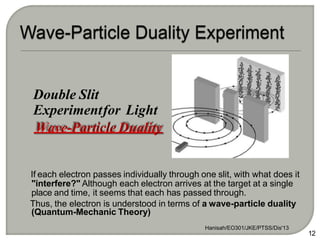
If each electron passes individually through one slit, with what does it
"interfere?" Although each electron arrives at the target at a single
place and time, it seems that each has passed through.
Thus, the electron is understood in terms of a wave-particle duality
(Quantum-Mechanic Theory)
Hanisah/EO301/JKE/PTSS/Dis'13
12
13
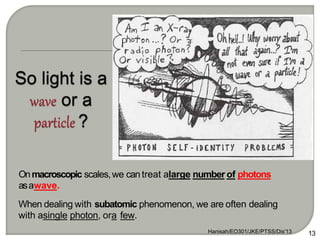
Onmacroscopic scales,we can treat alarge number of photons
asawave.
When dealing with subatomic phenomenon, we are often dealing
with asingle photon, ora few.
Hanisah/EO301/JKE/PTSS/Dis'13
As a conclusion, the scientists have observed that light
energy can behave;
• Either like a wave as it moves through space, OR
• It can behave like a discrete particles with a discrete
amount of energy(quantum) that can be absorbed and
emitted.
When light traveling through space, they act like waves.
When light interacts with atoms and molecules, they act
like a stream of energy called photons or quanta.
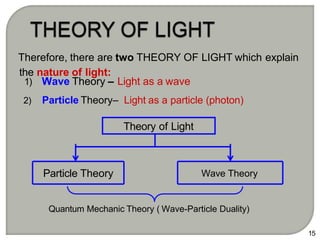
Theory of Light
Particle Theory Wave Theory
Therefore, there are two THEORY OF LIGHT which explain
the nature of light:
1) Wave Theory – Light as a wave
2) Particle Theory– Light as a particle (photon)
15
Quantum Mechanic Theory ( Wave-Particle Duality)
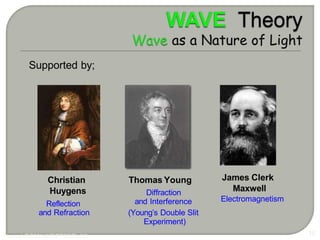
Supported by;
Hanisah/EO301/JKE/PTSS/Dis'13 16
Christian
Huygens
Reflection
and Refraction
James Clerk
Maxwell
Electromagnetism
Thomas Young
Diffraction
and Interference
(Young’s Double Slit
Experiment)
W
a
v
eTheoryexplain that the WAVE as a nature of
light.
In WaveTheory, light is considered as an
Electromagnetic (EM) Wave.
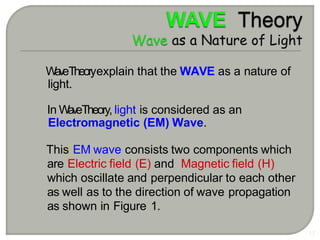
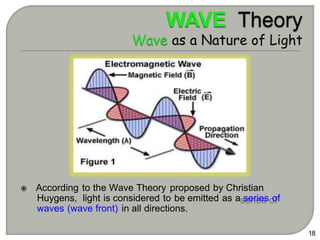
This EM wave consists two components which
are Electric field (E) and Magnetic field (H)
which oscillate and perpendicular to each other
as well as to the direction of wave propagation
as shown in Figure 1.
17
According to the Wave Theory proposed by Christian
Huygens, light is considered to be emitted as a series of
waves (wave front) in all directions.
18
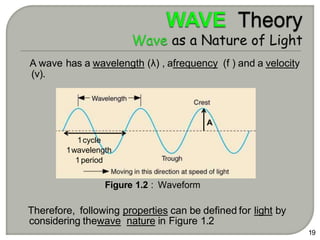
A wave has a wavelength (λ) , afrequency (f ) and a velocity
(ν).
1cycle
1wavelength
1period
A
Figure 1.2 : Waveform
Therefore, following properties can be defined for light by
considering thewave nature in Figure 1.2
19
PROPERTIES OF LIGHT W
A
V
E
S
1.
2.
3.
Wavelength (λ) - is the length that one cycle OR
Distance between 2 crests. (Unit: meter, m)
Frequency (f) - How often cycle of wave repeats in one
second OR number of cycles per sec. (Unit: Hertz, Hz)
Velocity (v) – the distance covered by the wave in one
second. (Unit: m/s)
20
According to Figure 1.2…
PROPERTIES OF LIGHT W
A
V
E
S
4.
5.
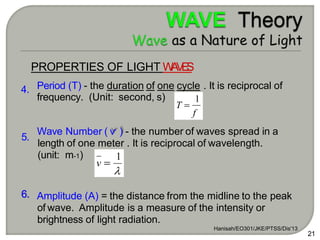
Period (T) - the duration of one cycle . It is reciprocal of
frequency. (Unit: second, s)
6. Amplitude (A) = the distance from the midline to the peak
of wave. Amplitude is a measure of the intensity or
brightness of light radiation.
Hanisah/EO301/JKE/PTSS/Dis'13
21
f
T
1
1
Wave Number ( ⱱ ) - the number of waves spread in a
length of one meter . It is reciprocal of wavelength.
(unit: m-1)
v
CHARACTERISTICS OF LIGHT W
A
V
E
S
The velocity of light wave is not constant. It depends on
type of medium the wave travels through.
Velocity/speed of light wave (v) in vacuum is denoted by
c. c = 3 x 10⁸ m/s
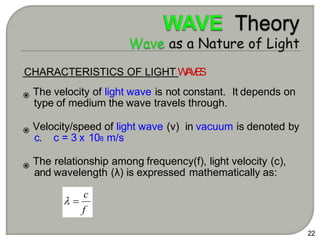
The relationship among frequency(f), light velocity (c),
and wavelength (λ) is expressed mathematically as:
22
f
c
CHARACTERISTICS OF LIGHT W
A
V
E
S
From equation 1.1, it can be seen that wavelength (λ) is
inversely proportional to the frequency (f).
high frequency = short wavelength
low frequency = long wavelength
Light wave have different colors of dispersion depends
on the frequency (f) or wavelength (λ).
Different frequency, or wavelength of wave will give
different color of light
23
CHARACTERISTICS OF LIGHT W
A
V
E
S
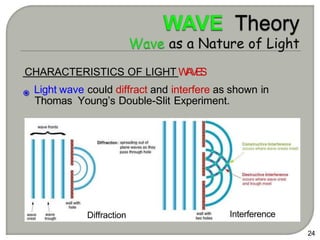
Light wave could diffract and interfere as shown in
Thomas Young’s Double-Slit Experiment.
24
Diffraction Interference
CHARACTERISTICS OF LIGHT W
A
V
E
S
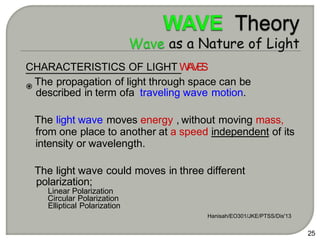
The propagation of light through space can be
described in term ofa traveling wave motion.
The light wave moves energy , without moving mass,
from one place to another at a speed independent of its
intensity or wavelength.
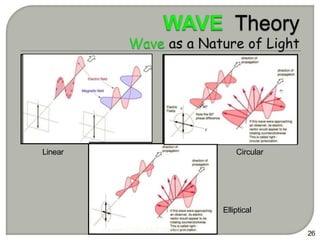
The light wave could moves in three different
polarization;
Linear Polarization
Circular Polarization
Elliptical Polarization
Hanisah/EO301/JKE/PTSS/Dis'13
25
26
Linear
Hanisah/EO301/JKE/PTSS/Dis'13
Circular
Elliptical
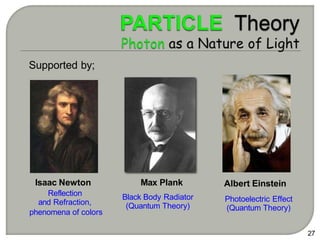
Supported by;
27
Isaac Newton Max Plank Albert Einstein
Reflection
and Refraction,
phenomena of colors
Black Body Radiator
(Quantum Theory)
Photoelectric Effect
(Quantum Theory)
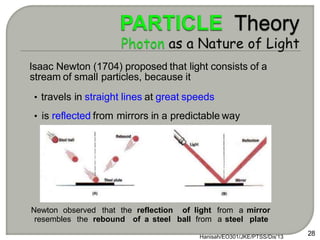
Isaac Newton (1704) proposed that light consists of a
stream of small particles, because it
• travels in straight lines at great speeds
• is reflected from mirrors in a predictable way
28
Newton observed that the reflection of light from a mirror
resembles the rebound of a steel ball from a steel plate
Hanisah/EO301/JKE/PTSS/Dis'13
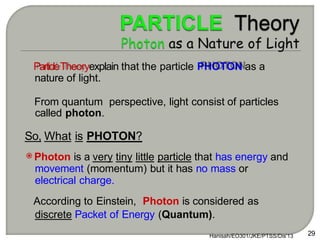
ParticleTheoryexplain that the particle PHOTON as a
nature of light.
From quantum perspective, light consist of particles
called photon.
So, What is PHOTON?
Photon is a very tiny little particle that has energy and
movement (momentum) but it has no mass or
electrical charge.
According to Einstein, Photon is considered as
discrete Packet of Energy (Quantum).
Hanisah/EO301/JKE/PTSS/Dis'13 29
Hanisah/EO301/JKE/PTSS/Dis'13
30
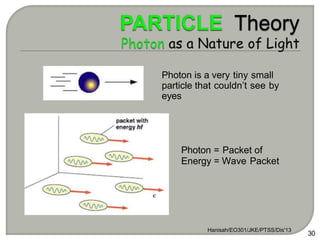
Photon is a very tiny small
particle that couldn’t see by
eyes
Photon = Packet of
Energy = Wave Packet
31
CHARACTERISTICS OF LIGHT P
H
O
T
O
N
Photon has no mass and electrical charge.
Photon carries electromagnetic energy, E and
momentum, p as well as intrinsic angular momentum (or
spin) associated with its polarization properties.
Photon travels at the speed of light in vacuum;
c = 3 x 10⁸ m/s
CHARACTERISTICS OF LIGHT P
H
O
T
O
N
Photon has a wavelike character that determines its
localization properties in space and time, and the rules
by which it interferes and diffracts.
Photon are always in motion.
Photons can produces :-
Infrared Light
Visible Light (e.g: sunlight)
Ultraviolet (UV) Light - UVa & UVb rays that give you
sunburns
X – rays
Hanisah/EO301/JKE/PTSS/Dis'13
35
CHARACTERISTICS OF LIGHT P
H
O
T
O
N
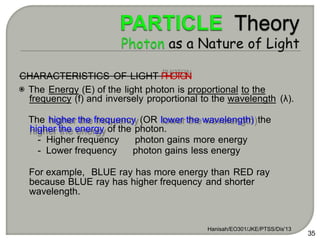
The Energy (E) of the light photon is proportional to the
frequency (f) and inversely proportional to the wavelength (λ).
The higher the frequency (OR lower the wavelength) the
higher the energy of the photon.
- Higher frequency photon gains more energy
- Lower frequency photon gains less energy
For example, BLUE ray has more energy than RED ray
because BLUE ray has higher frequency and shorter
wavelength.
36
CHARACTERISTICS OF LIGHT P
H
O
T
O
N
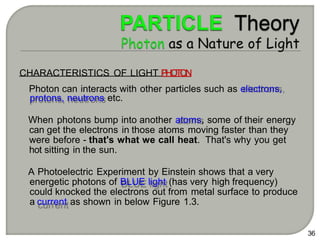
Photon can interacts with other particles such as electrons,
protons, neutrons etc.
When photons bump into another atoms, some of their energy
can get the electrons in those atoms moving faster than they
were before - that's what we call heat. That's why you get
hot sitting in the sun.
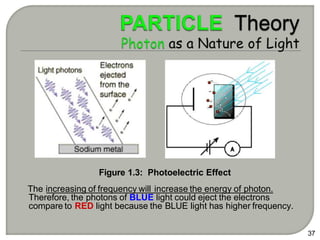
A Photoelectric Experiment by Einstein shows that a very
energetic photons of BLUE light (has very high frequency)
could knocked the electrons out from metal surface to produce
a current as shown in below Figure 1.3.
37
The increasing of frequency will increase the energy of photon.
Therefore, the photons of BLUE light could eject the electrons
compare to RED light because the BLUE light has higher frequency.
Figure 1.3: Photoelectric Effect
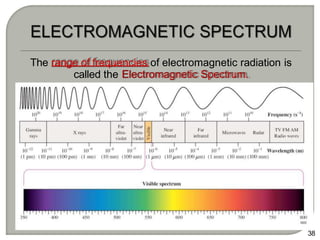
The range of frequencies of electromagnetic radiation is
called the Electromagnetic Spectrum.
38
Visible light is a small part of the energy range of
Electromagnetic waves.
The whole range is called the Electromagnetic
spectrum and visible light is in the middle of it.
39
E = hf = hc/
40
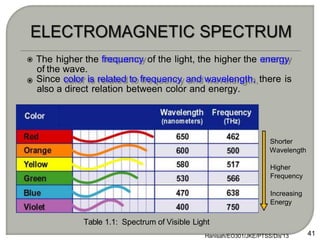
The higher the frequency of the light, the higher the energy
of the wave.
Since color is related to frequency and wavelength, there is
also a direct relation between color and energy.
41
Table 1.1: Spectrum of Visible Light
Hanisah/EO301/JKE/PTSS/Dis'13
Shorter
Wavelength
Higher
Frequency
Increasing
Energy
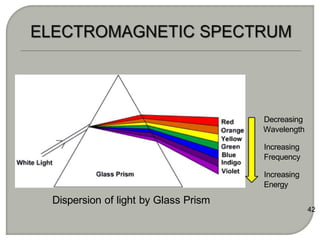
Dispersion of light by Glass Prism
42
Decreasing
Wavelength
Increasing
Frequency
Increasing
Energy
Definition: LIGHT is a special kind of
electromagnetic energy with a wavelength
range from 380nm to 740nm (visible light).
This electromagnetic energy consists two
components which are electric field, E and the
magnetic field, H which oscillate and
perpendicular each other.
This electromagnetic radiation are produced by
the vibrations of a charged particles called
photons.
43
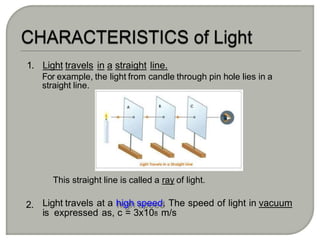
1. Light travels in a straight line.
For example, the light from candle through pin hole lies in a
straight line.
2.
This straight line is called a ray of light.
Light travels at a high speed. The speed of light in vacuum
is expressed as, c = 3x10⁸ m/s
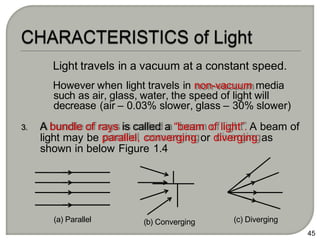
3. A bundle of rays is called a “beam of light”. A beam of
light may be parallel, converging or diverging as
shown in below Figure 1.4
45
(c) Diverging
(a) Parallel (b) Converging
Light travels in a vacuum at a constant speed.
However when light travels in non-vacuum media
such as air, glass, water, the speed of light will
decrease (air – 0.03% slower, glass – 30% slower)
4.
5.
6.
Light consist of different types of colours.
These colours are differentiated on the basis of their
wavelengths in the visible light spectrum (see Table 1.1)
Light has no mass but carries energy and momentum, p
where the energy of light is proportional to the frequency but
reciprocal to the wavelength.
When the frequency of light increase, the energy of light
also increase and vice versa.
Different colors of light has different energy because it
has different frequencies.
Light is emitted and absorbed in the form of
Quanta(Photons) but propagated in the form of waves
46
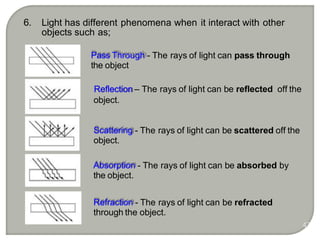
Pass Through - The rays of light can pass through
the object
Absorption - The rays of light can be absorbed by
the object.
Reflection – The rays of light can be reflected off the
object.
Scattering - The rays of light can be scattered off the
object.
Refraction - The rays of light can be refracted
through the object.
6. Light has different phenomena when it interact with other
objects such as;
47
The sources of light are many and varied.
Usually there are 2 categories of source;
• Natural Source – (Sun, Star, radio star, lightning, or any
“Body” that exists at a temperature over absolute zero).
• Man-made Source – (Incandescent light, Fluorescent light,
heater, lasers, antennas, radars, and X-ray tubes).
All materials with temperature above absolute zero emit
electromagnetic radiation (light).
For example, atoms and molecules which has their own
characteristics set of spectral lines.
48
Hanisah/EO301/JKE/PTSS/Dis'13
62

02.Light-Lec2.pptx

  • 1.
  • 2.
    Hanisah/EO301/JKE/PTSS/Dis'13 2 Waves? What is Light? Particles? LIGHTenables us to see Objects. The sun, a lighted candle and electric bulb give out the light. They are called luminous bodies. or
  • 3.
    Hanisah/EO301/JKE/PTSS/Dis'13 3 Isaac Newton 1643 -1727 Christian Huygens 1629 - 1695 In the17th century, two scientists had different views about the nature of light …… Light is particles No! Light is waves
  • 4.
    In Late 1600,Sir Isaac Newton believed that light travels in the form of particles which named as “corpuscles”. Then, in 1678 Christian Huygens argued that light might be some sort of a wave motion. Huygens came up with Huygens's Principle that explain the light is a wave traveling through a medium called “aether”. Huygens deduced the Laws of Reflection and Refraction and could explain Double Refraction to prove the Theory of Wave. However, if light behaves as waves, diffraction and interference should be seen using light. 4 WAVE or PARTICLES?
  • 5.
    Huygens failed provideany strong evidence to show that diffraction and interference of light occurred. Furthermore, Huygens could not explain why light has different colours at all (He did not know that different colors of light have different “wavelengths”) Therefore, Newton’s Particle Theory is acceptable since his strong evidence about Particle nature of light. However, In 1801, Thomas Young’s Double Slit Experiment showed that light diffracts and produces an interference pattern. Therefore, Thomas Young successful provide evidence that light has “WAVE” properties. He showed that light rays interfere with each other; such behavior could not be explained by particles. 5 WAVE or PARTICLES?
  • 6.
    In the 1860’s,Maxwell developed a mathematical model of electromagnetism. He was able to show that these electromagnetic waves travel at the speed of light. Therefore, he asserted that light was a form of high-frequency electromagnetic wave. In 1900, Max Planck was able to explain the spectrum of a “blackbody” radiator by assuming that light energy is quantized. That quantum of light energy was later named a PHOTON. A few years later, in 1905, Albert Einstein used Planck’s idea to explain the photoelectric effect to support the particle behavior of light and came out with a QUANTUM THEORY. 6 WAVE or PARTICLES?
  • 7.
    Isaac Newton (Particletheory of light) Christian Huygens (Wave theory of light) Thomas Young (Wave theory of light) James Clerk Maxwell (Wave theory of light) Max Planck (Particle theory of light) Albert Einstein (Particle theory of light ) Louis de Broglie ( Wave-particle duality) Hanisah/EO301/JKE/PTSS/Dis'13 7 WAVE or PARTICLES?
  • 8.
    Experiment to proof theDual Nature of light • Double slit exp. for particles • Double slit exp. for waves • Double slit exp. for electrons • Double slit exp. for particle-wave duality 8
  • 9.
    A gun spraysbullets towards a target The resulting pattern is a map of the likelihood of a bullet landing at each point Hanisah/EO301/JKE/PTSS/Dis'13 9 Double Slit Experimentfor Particles
  • 10.
    With waves, however,the result is very different, because of interference. If a slit is opened one at a time, the pattern would resemble that for bullets: two distinct peaks. But when both slits are open, the waves pass through both slits at once and interfere with each other 10 Double Slit Experimentfor Waves
  • 11.
    Now the quantumparadox: Electrons like bullets, strike the target one at a time. Yet, like waves, they create an interference pattern Hanisah/EO301/JKE/PTSS/Dis'13 11 Double Slit Experimentfor Electrons/photons
  • 12.
    Double Slit Experimentfor Light Wave-ParticleDuality If each electron passes individually through one slit, with what does it "interfere?" Although each electron arrives at the target at a single place and time, it seems that each has passed through. Thus, the electron is understood in terms of a wave-particle duality (Quantum-Mechanic Theory) Hanisah/EO301/JKE/PTSS/Dis'13 12
  • 13.
    13 Onmacroscopic scales,we cantreat alarge number of photons asawave. When dealing with subatomic phenomenon, we are often dealing with asingle photon, ora few. Hanisah/EO301/JKE/PTSS/Dis'13
  • 14.
    As a conclusion,the scientists have observed that light energy can behave; • Either like a wave as it moves through space, OR • It can behave like a discrete particles with a discrete amount of energy(quantum) that can be absorbed and emitted. When light traveling through space, they act like waves. When light interacts with atoms and molecules, they act like a stream of energy called photons or quanta.
  • 15.
    Theory of Light ParticleTheory Wave Theory Therefore, there are two THEORY OF LIGHT which explain the nature of light: 1) Wave Theory – Light as a wave 2) Particle Theory– Light as a particle (photon) 15 Quantum Mechanic Theory ( Wave-Particle Duality)
  • 16.
    Supported by; Hanisah/EO301/JKE/PTSS/Dis'13 16 Christian Huygens Reflection andRefraction James Clerk Maxwell Electromagnetism Thomas Young Diffraction and Interference (Young’s Double Slit Experiment)
  • 17.
    W a v eTheoryexplain that theWAVE as a nature of light. In WaveTheory, light is considered as an Electromagnetic (EM) Wave. This EM wave consists two components which are Electric field (E) and Magnetic field (H) which oscillate and perpendicular to each other as well as to the direction of wave propagation as shown in Figure 1. 17
  • 18.
    According to theWave Theory proposed by Christian Huygens, light is considered to be emitted as a series of waves (wave front) in all directions. 18
  • 19.
    A wave hasa wavelength (λ) , afrequency (f ) and a velocity (ν). 1cycle 1wavelength 1period A Figure 1.2 : Waveform Therefore, following properties can be defined for light by considering thewave nature in Figure 1.2 19
  • 20.
    PROPERTIES OF LIGHTW A V E S 1. 2. 3. Wavelength (λ) - is the length that one cycle OR Distance between 2 crests. (Unit: meter, m) Frequency (f) - How often cycle of wave repeats in one second OR number of cycles per sec. (Unit: Hertz, Hz) Velocity (v) – the distance covered by the wave in one second. (Unit: m/s) 20 According to Figure 1.2…
  • 21.
    PROPERTIES OF LIGHTW A V E S 4. 5. Period (T) - the duration of one cycle . It is reciprocal of frequency. (Unit: second, s) 6. Amplitude (A) = the distance from the midline to the peak of wave. Amplitude is a measure of the intensity or brightness of light radiation. Hanisah/EO301/JKE/PTSS/Dis'13 21 f T 1 1 Wave Number ( ⱱ ) - the number of waves spread in a length of one meter . It is reciprocal of wavelength. (unit: m-1) v
  • 22.
    CHARACTERISTICS OF LIGHTW A V E S The velocity of light wave is not constant. It depends on type of medium the wave travels through. Velocity/speed of light wave (v) in vacuum is denoted by c. c = 3 x 10⁸ m/s The relationship among frequency(f), light velocity (c), and wavelength (λ) is expressed mathematically as: 22 f c
  • 23.
    CHARACTERISTICS OF LIGHTW A V E S From equation 1.1, it can be seen that wavelength (λ) is inversely proportional to the frequency (f). high frequency = short wavelength low frequency = long wavelength Light wave have different colors of dispersion depends on the frequency (f) or wavelength (λ). Different frequency, or wavelength of wave will give different color of light 23
  • 24.
    CHARACTERISTICS OF LIGHTW A V E S Light wave could diffract and interfere as shown in Thomas Young’s Double-Slit Experiment. 24 Diffraction Interference
  • 25.
    CHARACTERISTICS OF LIGHTW A V E S The propagation of light through space can be described in term ofa traveling wave motion. The light wave moves energy , without moving mass, from one place to another at a speed independent of its intensity or wavelength. The light wave could moves in three different polarization; Linear Polarization Circular Polarization Elliptical Polarization Hanisah/EO301/JKE/PTSS/Dis'13 25
  • 26.
  • 27.
    Supported by; 27 Isaac NewtonMax Plank Albert Einstein Reflection and Refraction, phenomena of colors Black Body Radiator (Quantum Theory) Photoelectric Effect (Quantum Theory)
  • 28.
    Isaac Newton (1704)proposed that light consists of a stream of small particles, because it • travels in straight lines at great speeds • is reflected from mirrors in a predictable way 28 Newton observed that the reflection of light from a mirror resembles the rebound of a steel ball from a steel plate Hanisah/EO301/JKE/PTSS/Dis'13
  • 29.
    ParticleTheoryexplain that theparticle PHOTON as a nature of light. From quantum perspective, light consist of particles called photon. So, What is PHOTON? Photon is a very tiny little particle that has energy and movement (momentum) but it has no mass or electrical charge. According to Einstein, Photon is considered as discrete Packet of Energy (Quantum). Hanisah/EO301/JKE/PTSS/Dis'13 29
  • 30.
    Hanisah/EO301/JKE/PTSS/Dis'13 30 Photon is avery tiny small particle that couldn’t see by eyes Photon = Packet of Energy = Wave Packet
  • 31.
    31 CHARACTERISTICS OF LIGHTP H O T O N Photon has no mass and electrical charge. Photon carries electromagnetic energy, E and momentum, p as well as intrinsic angular momentum (or spin) associated with its polarization properties. Photon travels at the speed of light in vacuum; c = 3 x 10⁸ m/s
  • 32.
    CHARACTERISTICS OF LIGHTP H O T O N Photon has a wavelike character that determines its localization properties in space and time, and the rules by which it interferes and diffracts. Photon are always in motion. Photons can produces :- Infrared Light Visible Light (e.g: sunlight) Ultraviolet (UV) Light - UVa & UVb rays that give you sunburns X – rays
  • 33.
    Hanisah/EO301/JKE/PTSS/Dis'13 35 CHARACTERISTICS OF LIGHTP H O T O N The Energy (E) of the light photon is proportional to the frequency (f) and inversely proportional to the wavelength (λ). The higher the frequency (OR lower the wavelength) the higher the energy of the photon. - Higher frequency photon gains more energy - Lower frequency photon gains less energy For example, BLUE ray has more energy than RED ray because BLUE ray has higher frequency and shorter wavelength.
  • 34.
    36 CHARACTERISTICS OF LIGHTP H O T O N Photon can interacts with other particles such as electrons, protons, neutrons etc. When photons bump into another atoms, some of their energy can get the electrons in those atoms moving faster than they were before - that's what we call heat. That's why you get hot sitting in the sun. A Photoelectric Experiment by Einstein shows that a very energetic photons of BLUE light (has very high frequency) could knocked the electrons out from metal surface to produce a current as shown in below Figure 1.3.
  • 35.
    37 The increasing offrequency will increase the energy of photon. Therefore, the photons of BLUE light could eject the electrons compare to RED light because the BLUE light has higher frequency. Figure 1.3: Photoelectric Effect
  • 36.
    The range offrequencies of electromagnetic radiation is called the Electromagnetic Spectrum. 38
  • 37.
    Visible light isa small part of the energy range of Electromagnetic waves. The whole range is called the Electromagnetic spectrum and visible light is in the middle of it. 39
  • 38.
    E = hf= hc/ 40
  • 39.
    The higher thefrequency of the light, the higher the energy of the wave. Since color is related to frequency and wavelength, there is also a direct relation between color and energy. 41 Table 1.1: Spectrum of Visible Light Hanisah/EO301/JKE/PTSS/Dis'13 Shorter Wavelength Higher Frequency Increasing Energy
  • 40.
    Dispersion of lightby Glass Prism 42 Decreasing Wavelength Increasing Frequency Increasing Energy
  • 41.
    Definition: LIGHT isa special kind of electromagnetic energy with a wavelength range from 380nm to 740nm (visible light). This electromagnetic energy consists two components which are electric field, E and the magnetic field, H which oscillate and perpendicular each other. This electromagnetic radiation are produced by the vibrations of a charged particles called photons. 43
  • 42.
    1. Light travelsin a straight line. For example, the light from candle through pin hole lies in a straight line. 2. This straight line is called a ray of light. Light travels at a high speed. The speed of light in vacuum is expressed as, c = 3x10⁸ m/s
  • 43.
    3. A bundleof rays is called a “beam of light”. A beam of light may be parallel, converging or diverging as shown in below Figure 1.4 45 (c) Diverging (a) Parallel (b) Converging Light travels in a vacuum at a constant speed. However when light travels in non-vacuum media such as air, glass, water, the speed of light will decrease (air – 0.03% slower, glass – 30% slower)
  • 44.
    4. 5. 6. Light consist ofdifferent types of colours. These colours are differentiated on the basis of their wavelengths in the visible light spectrum (see Table 1.1) Light has no mass but carries energy and momentum, p where the energy of light is proportional to the frequency but reciprocal to the wavelength. When the frequency of light increase, the energy of light also increase and vice versa. Different colors of light has different energy because it has different frequencies. Light is emitted and absorbed in the form of Quanta(Photons) but propagated in the form of waves 46
  • 45.
    Pass Through -The rays of light can pass through the object Absorption - The rays of light can be absorbed by the object. Reflection – The rays of light can be reflected off the object. Scattering - The rays of light can be scattered off the object. Refraction - The rays of light can be refracted through the object. 6. Light has different phenomena when it interact with other objects such as; 47
  • 46.
    The sources oflight are many and varied. Usually there are 2 categories of source; • Natural Source – (Sun, Star, radio star, lightning, or any “Body” that exists at a temperature over absolute zero). • Man-made Source – (Incandescent light, Fluorescent light, heater, lasers, antennas, radars, and X-ray tubes). All materials with temperature above absolute zero emit electromagnetic radiation (light). For example, atoms and molecules which has their own characteristics set of spectral lines. 48
  • 47.