Topic 4.1 Waves, Interference and Optics
1
UEEP1033 Oscillations and Waves
Topic 7:
Interference and Diffraction
Topic 4.1 Waves, Interference and Optics
2
UEEP1033 Oscillations and Waves
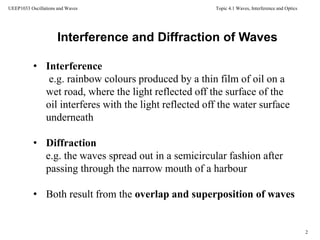
• Interference
e.g. rainbow colours produced by a thin film of oil on a
wet road, where the light reflected off the surface of the
oil interferes with the light reflected off the water surface
underneath
• Diffraction
e.g. the waves spread out in a semicircular fashion after
passing through the narrow mouth of a harbour
• Both result from the overlap and superposition of waves
Interference and Diffraction of Waves
Topic 4.1 Waves, Interference and Optics
3
UEEP1033 Oscillations and Waves
Interference
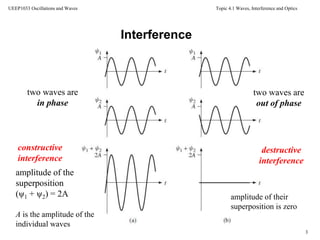
two waves are
out of phase
destructive
interference
two waves are
in phase
constructive
interference
amplitude of their
superposition is zero
amplitude of the
superposition
(ψ1 + ψ2) = 2A
A is the amplitude of the
individual waves
Topic 4.1 Waves, Interference and Optics
4
UEEP1033 Oscillations and Waves
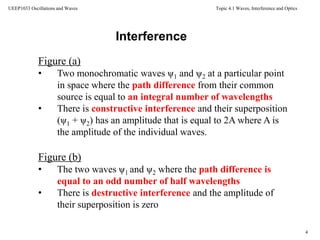
Figure (a)
• Two monochromatic waves ψ1 and ψ2 at a particular point
in space where the path difference from their common
source is equal to an integral number of wavelengths
• There is constructive interference and their superposition
(ψ1 + ψ2) has an amplitude that is equal to 2A where A is
the amplitude of the individual waves.
Figure (b)
• The two waves ψ1 and ψ2 where the path difference is
equal to an odd number of half wavelengths
• There is destructive interference and the amplitude of
their superposition is zero
Interference
Topic 4.1 Waves, Interference and Optics
5
UEEP1033 Oscillations and Waves
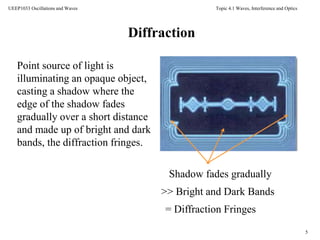
Point source of light is
illuminating an opaque object,
casting a shadow where the
edge of the shadow fades
gradually over a short distance
and made up of bright and dark
bands, the diffraction fringes.
Shadow fades gradually
>> Bright and Dark Bands
= Diffraction Fringes
Diffraction
Topic 4.1 Waves, Interference and Optics
6
UEEP1033 Oscillations and Waves
Francesco Grimaldi
in 1665 first accurate report
description of deviation of light from
rectilinear propagation (diffraction)
The effect is a general characteristics of wave phenomena
occurring whenever a portion of a wavefront is
obstructed in some way
Diffraction
Topic 4.1 Waves, Interference and Optics
7
UEEP1033 Oscillations and Waves
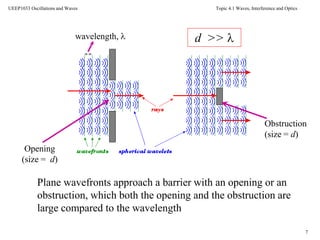
Plane wavefronts approach a barrier with an opening or an
obstruction, which both the opening and the obstruction are
large compared to the wavelength
Opening
(size = d)
Obstruction
(size = d)
wavelength,  d >> 
Topic 4.1 Waves, Interference and Optics
8
UEEP1033 Oscillations and Waves
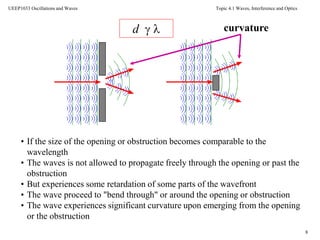
• If the size of the opening or obstruction becomes comparable to the
wavelength
• The waves is not allowed to propagate freely through the opening or past the
obstruction
• But experiences some retardation of some parts of the wavefront
• The wave proceed to "bend through" or around the opening or obstruction
• The wave experiences significant curvature upon emerging from the opening
or the obstruction
curvatured  
Topic 4.1 Waves, Interference and Optics
9
UEEP1033 Oscillations and Waves
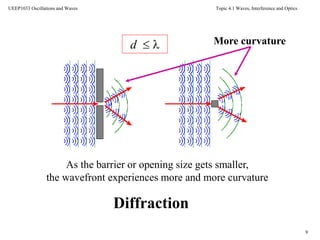
As the barrier or opening size gets smaller,
the wavefront experiences more and more curvature
More curvature
Diffraction
d  
Topic 4.1 Waves, Interference and Optics
10
UEEP1033 Oscillations and Waves
Topic 4.1 Waves, Interference and Optics
11
UEEP1033 Oscillations and Waves
Historical Background
Topic 4.1 Waves, Interference and Optics
12
UEEP1033 Oscillations and Waves
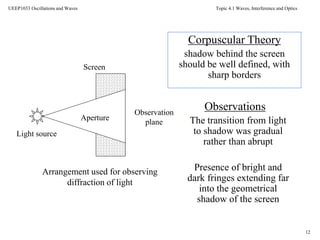
Light source
Aperture
Observation
plane
Screen
Arrangement used for observing
diffraction of light
Corpuscular Theory
shadow behind the screen
should be well defined, with
sharp borders
Observations
• The transition from light
to shadow was gradual
rather than abrupt
• Presence of bright and
dark fringes extending far
into the geometrical
shadow of the screen
Topic 4.1 Waves, Interference and Optics
13
UEEP1033 Oscillations and Waves
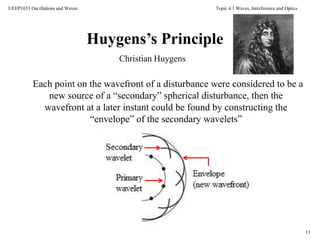
Christian Huygens
Huygens’s Principle
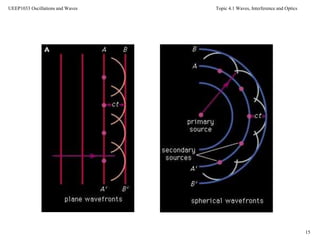
Each point on the wavefront of a disturbance were considered to be a
new source of a “secondary” spherical disturbance, then the
wavefront at a later instant could be found by constructing the
“envelope” of the secondary wavelets”
Topic 4.1 Waves, Interference and Optics
14
UEEP1033 Oscillations and Waves
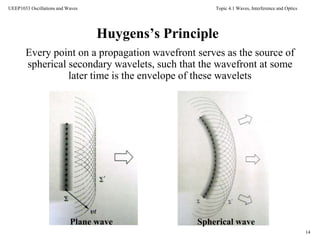
Huygens’s Principle
Every point on a propagation wavefront serves as the source of
spherical secondary wavelets, such that the wavefront at some
later time is the envelope of these wavelets
Plane wave Spherical wave
Topic 4.1 Waves, Interference and Optics
15
UEEP1033 Oscillations and Waves
Topic 4.1 Waves, Interference and Optics
16
UEEP1033 Oscillations and Waves
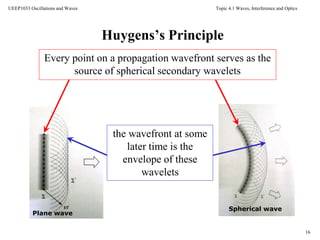
Huygens’s Principle
Plane wave
Spherical wave
Every point on a propagation wavefront serves as the
source of spherical secondary wavelets
the wavefront at some
later time is the
envelope of these
wavelets
Topic 4.1 Waves, Interference and Optics
17
UEEP1033 Oscillations and Waves
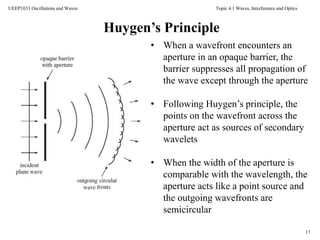
• When a wavefront encounters an
aperture in an opaque barrier, the
barrier suppresses all propagation of
the wave except through the aperture
• Following Huygen’s principle, the
points on the wavefront across the
aperture act as sources of secondary
wavelets
• When the width of the aperture is
comparable with the wavelength, the
aperture acts like a point source and
the outgoing wavefronts are
semicircular
Huygen’s Principle
Topic 4.1 Waves, Interference and Optics
18
UEEP1033 Oscillations and Waves
18
• Ignores most of each secondary wavelet and only retaining the
portions common to the envelope
• As a result, Huygens’s principle by itself is unable to account
for the details of the diffraction process
• The difficulty was resolved by Fresnel with his addition of the
concept of interference
Huygens’s Principle
Topic 4.1 Waves, Interference and Optics
19
UEEP1033 Oscillations and Waves
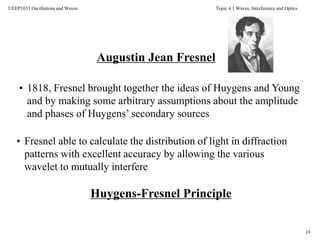
Augustin Jean Fresnel
• 1818, Fresnel brought together the ideas of Huygens and Young
and by making some arbitrary assumptions about the amplitude
and phases of Huygens’ secondary sources
• Fresnel able to calculate the distribution of light in diffraction
patterns with excellent accuracy by allowing the various
wavelet to mutually interfere
Huygens-Fresnel Principle
Topic 4.1 Waves, Interference and Optics
20
UEEP1033 Oscillations and Waves
Huygens-Fresnel Principle
Every unobstructed point of a wavefront, at given instant, serves
as a source of spherical secondary wavelets
(with the same frequency as that of the primary wave)
The amplitude of the optical field at any point beyond is the
superposition of all these wavelets
(considering their amplitudes and relative phases)
Topic 4.1 Waves, Interference and Optics
21
UEEP1033 Oscillations and Waves
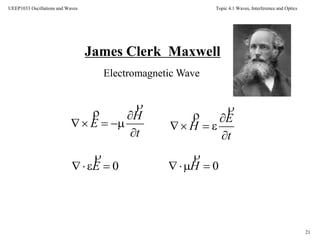
James Clerk Maxwell
Electromagnetic Wave
t
H
E





t
E
H





0 E

0 H

Topic 4.1 Waves, Interference and Optics
22
UEEP1033 Oscillations and Waves
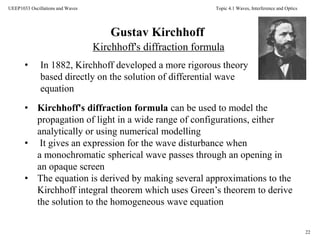
Gustav Kirchhoff
• Kirchhoff's diffraction formula can be used to model the
propagation of light in a wide range of configurations, either
analytically or using numerical modelling
• It gives an expression for the wave disturbance when
a monochromatic spherical wave passes through an opening in
an opaque screen
• The equation is derived by making several approximations to the
Kirchhoff integral theorem which uses Green’s theorem to derive
the solution to the homogeneous wave equation
• In 1882, Kirchhoff developed a more rigorous theory
based directly on the solution of differential wave
equation
Kirchhoff's diffraction formula
Topic 4.1 Waves, Interference and Optics
23
UEEP1033 Oscillations and Waves
Although the problem was physically somewhat unrealistic , i.e. it
involved an infinitely thin yet opaque, perfectly conducting plane
screen, the result was nonetheless extremely valuable, providing a good
deal of insight into the fundamental processes involved
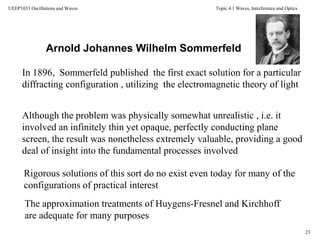
Arnold Johannes Wilhelm Sommerfeld
In 1896, Sommerfeld published the first exact solution for a particular
diffracting configuration , utilizing the electromagnetic theory of light
Rigorous solutions of this sort do no exist even today for many of the
configurations of practical interest
The approximation treatments of Huygens-Fresnel and Kirchhoff
are adequate for many purposes
Topic 4.1 Waves, Interference and Optics
24
UEEP1033 Oscillations and Waves
Interference
Young’s Double-Slit Experiment
Topic 4.1 Waves, Interference and Optics
25
UEEP1033 Oscillations and Waves
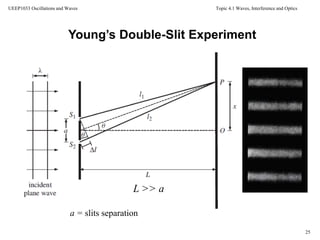
Young’s Double-Slit Experiment
L >> a
a = slits separation
Topic 4.1 Waves, Interference and Optics
26
UEEP1033 Oscillations and Waves
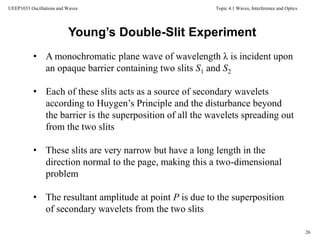
• A monochromatic plane wave of wavelength λ is incident upon
an opaque barrier containing two slits S1 and S2
• Each of these slits acts as a source of secondary wavelets
according to Huygen’s Principle and the disturbance beyond
the barrier is the superposition of all the wavelets spreading out
from the two slits
• These slits are very narrow but have a long length in the
direction normal to the page, making this a two-dimensional
problem
• The resultant amplitude at point P is due to the superposition
of secondary wavelets from the two slits
Young’s Double-Slit Experiment
Topic 4.1 Waves, Interference and Optics
27
UEEP1033 Oscillations and Waves
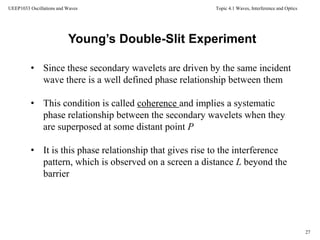
• Since these secondary wavelets are driven by the same incident
wave there is a well defined phase relationship between them
• This condition is called coherence and implies a systematic
phase relationship between the secondary wavelets when they
are superposed at some distant point P
• It is this phase relationship that gives rise to the interference
pattern, which is observed on a screen a distance L beyond the
barrier
Young’s Double-Slit Experiment
Topic 4.1 Waves, Interference and Optics
28
UEEP1033 Oscillations and Waves
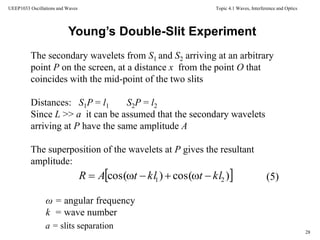
The secondary wavelets from S1 and S2 arriving at an arbitrary
point P on the screen, at a distance x from the point O that
coincides with the mid-point of the two slits
Distances: S1P = l1 S2P = l2
Since L >> a it can be assumed that the secondary wavelets
arriving at P have the same amplitude A
The superposition of the wavelets at P gives the resultant
amplitude:
Young’s Double-Slit Experiment
 )cos()cos( 21 kltkltAR 
ω = angular frequency
k = wave number
(5)
a = slits separation
Topic 4.1 Waves, Interference and Optics
29
UEEP1033 Oscillations and Waves
This result can be rewritten as:
Since L >> a, the lines from S1 and S2 to P can be assumed to be
parallel and also to make the same angle θ with respect to the
horizontal axis
Young’s Double-Slit Experiment
 2/)(cos[]2/)(cos2 1212 llkllktAR 
The line joining P to the mid-point of the slits makes an angle θ
with respect to the horizontal axis
21 cos/ lLl 
 cos/212 Lll
(6)
a = slits separation
Topic 4.1 Waves, Interference and Optics
30
UEEP1033 Oscillations and Waves
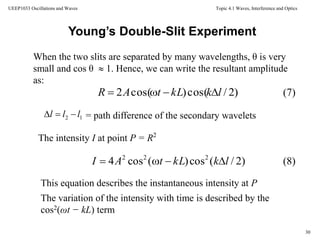
When the two slits are separated by many wavelengths, θ is very
small and cos θ  1. Hence, we can write the resultant amplitude
as:
Young’s Double-Slit Experiment
)2/cos()cos(2 lkkLtAR 
= path difference of the secondary wavelets
The intensity I at point P = R2
12 lll 
)2/(cos)(cos4 222
lkkLtAI 
This equation describes the instantaneous intensity at P
The variation of the intensity with time is described by the
cos2(ωt − kL) term
(7)
(8)
Topic 4.1 Waves, Interference and Optics
31
UEEP1033 Oscillations and Waves
• The frequency of oscillation of visible light is of the order of
1015 Hz, which is far too high for the human eye and any
laboratory apparatus to follow.
• What we observe is a time average of the intensity
• Since the time average of cos2(ωt − kL) over many cycles = 1/2
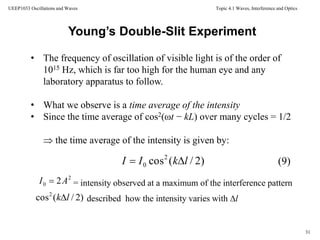
 the time average of the intensity is given by:
Young’s Double-Slit Experiment
)2/(cos2
0 lkII 
2
0 2AI  = intensity observed at a maximum of the interference pattern
described how the intensity varies with l)2/(cos2
lk
(9)
Topic 4.1 Waves, Interference and Optics
32
UEEP1033 Oscillations and Waves
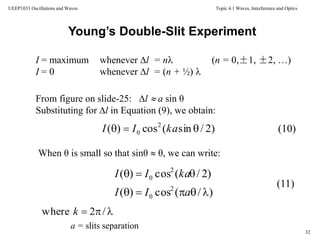
I = maximum whenever l = n (n = 0,±1, ±2, …)
I = 0 whenever l = (n + ½) 
Young’s Double-Slit Experiment
From figure on slide-25: l  a sin θ
Substituting for l in Equation (9), we obtain:
(10))2/sin(cos)( 2
0  kaII
When θ is small so that sinθ  θ, we can write:
)/(cos)(
)2/(cos)(
2
0
2
0


aII
kaII
(11)
 /2where k
a = slits separation
Topic 4.1 Waves, Interference and Optics
33
UEEP1033 Oscillations and Waves
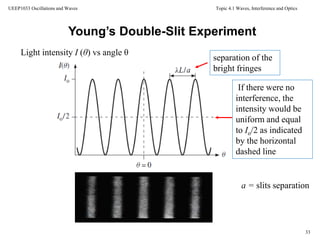
separation of the
bright fringes
If there were no
interference, the
intensity would be
uniform and equal
to Io/2 as indicated
by the horizontal
dashed line
Young’s Double-Slit Experiment
Light intensity I (θ) vs angle θ
a = slits separation
Topic 4.1 Waves, Interference and Optics
34
UEEP1033 Oscillations and Waves
Young’s Double-Slit Experiment
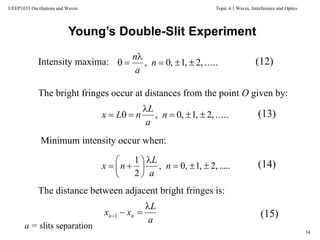
Intensity maxima: .....,2,1,0, 

 n
a
n
.....,2,1,0, 

 n
a
L
nLx
(12)
(13)
(14)
(15)
The bright fringes occur at distances from the point O given by:
Minimum intensity occur when:
The distance between adjacent bright fringes is:
.....,2,1,0,
2
1








 n
a
L
nx
a
L
xx nn

1
a = slits separation
Topic 4.1 Waves, Interference and Optics
35
UEEP1033 Oscillations and Waves
Fraunhofer and Fresnel
Diffraction
Topic 4.1 Waves, Interference and Optics
36
UEEP1033 Oscillations and Waves
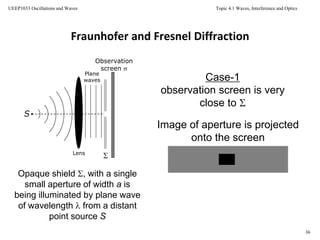
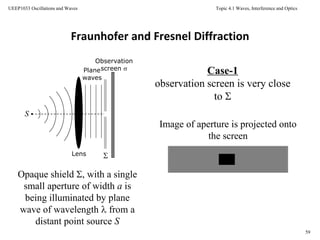
Observation
screen 
Fraunhofer and Fresnel Diffraction
S
Lens
Plane
waves
Opaque shield , with a single
small aperture of width a is
being illuminated by plane wave
of wavelength  from a distant
point source S
Case-1
observation screen is very
close to 
Image of aperture is projected
onto the screen
Topic 4.1 Waves, Interference and Optics
37
UEEP1033 Oscillations and Waves
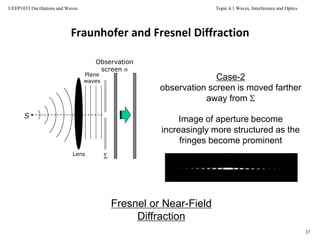
Observation
screen 
Fraunhofer and Fresnel Diffraction
S
Lens
Plane
waves
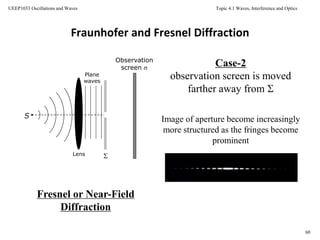
Case-2
observation screen is moved farther
away from 
Image of aperture become
increasingly more structured as the
fringes become prominent
Fresnel or Near-Field
Diffraction
Topic 4.1 Waves, Interference and Optics
38
UEEP1033 Oscillations and Waves
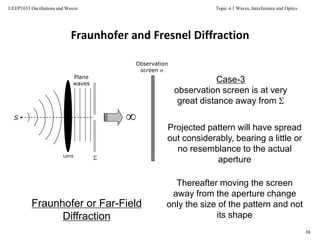
Fraunhofer and Fresnel Diffraction
S
Lens
Plane
waves
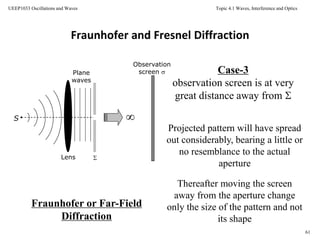
Case-3
observation screen is at very
great distance away from 
Projected pattern will have spread
out considerably, bearing a little or
no resemblance to the actual
aperture
Observation
screen 

Thereafter moving the screen
away from the aperture change
only the size of the pattern and not
its shape
Fraunhofer or Far-Field
Diffraction
Topic 4.1 Waves, Interference and Optics
39
UEEP1033 Oscillations and Waves
Fraunhofer and Fresnel Diffraction
S
Lens
Plane
waves
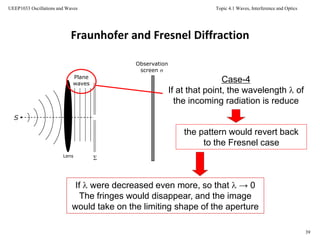
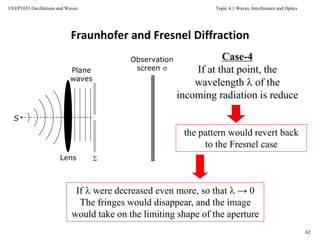
Case-4
If at that point, the wavelength  of
the incoming radiation is reduce
Observation
screen 
the pattern would revert back
to the Fresnel case
If  were decreased even more, so that  → 0
The fringes would disappear, and the image
would take on the limiting shape of the aperture
Topic 4.1 Waves, Interference and Optics
40
UEEP1033 Oscillations and Waves
Fraunhofer and Fresnel Diffraction
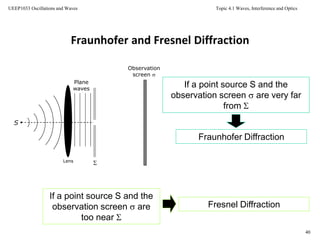
If a point source S and the
observation screen  are very far
from 
S
Lens
Plane
waves
Observation
screen 
Fraunhofer Diffraction
If a point source S and the
observation screen  are
too near 
Fresnel Diffraction
Topic 4.1 Waves, Interference and Optics
41
UEEP1033 Oscillations and Waves
Fraunhofer and Fresnel Diffraction
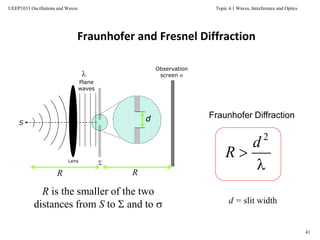
S
Lens
Plane
waves
Observation
screen 
Fraunhofer Diffractiond

R R
R is the smaller of the two
distances from S to  and to 


2
d
R
d = slit width
Topic 4.1 Waves, Interference and Optics
42
UEEP1033 Oscillations and Waves
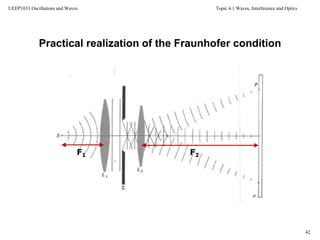
Practical realization of the Fraunhofer condition
F1 F2
Topic 4.1 Waves, Interference and Optics
43
UEEP1033 Oscillations and Waves
Diffraction
• Any obstacle in the path of the wave affects the way it spreads out; the
wave appears to ‘bend’ around the obstacle
• Similarly, the wave spreads out beyond any aperture that it meets. such
bending or spreading of the wave is called diffraction
• The effects of diffraction are evident in the shadow of an object that is
illuminated by a point source. The edges of the shadow are not sharp but
are blurred due to the bending of the light at the edges of the object
• The degree of spreading of a wave after passing through an aperture
depends on the ratio of the wavelength λ of the wave to the size d of the
aperture
• The angular width of the spreading is approximately equal to λ/d; the
bigger this ratio, the greater is the spreading
Topic 4.1 Waves, Interference and Optics
44
UEEP1033 Oscillations and Waves
The Mechanism of Diffraction
• Diffraction arises because of the way in which waves propagate as
described by the Huygens-Fresnel Principle
• The propagation of a wave can be visualized by considering every point
on a wavefront as a point source for a secondary radial wave
• The subsequent propagation and addition of all these radial waves form
the new wavefront
• When waves are added together, their sum is determined by the relative
phases as well as the amplitudes of the individual waves, an effect
which is often known as wave interference
• The summed amplitude of the waves can have any value between zero
and the sum of the individual amplitudes
• Hence, diffraction patterns usually have a series of maxima and minima
Topic 4.1 Waves, Interference and Optics
45
UEEP1033 Oscillations and Waves
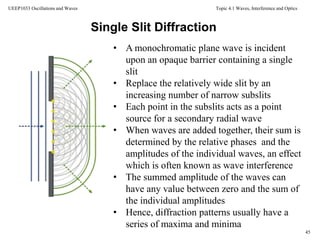
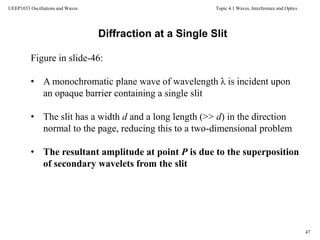
• A monochromatic plane wave is incident
upon an opaque barrier containing a single
slit
• Replace the relatively wide slit by an
increasing number of narrow subslits
• Each point in the subslits acts as a point
source for a secondary radial wave
• When waves are added together, their sum is
determined by the relative phases and the
amplitudes of the individual waves, an effect
which is often known as wave interference
• The summed amplitude of the waves can
have any value between zero and the sum of
the individual amplitudes
• Hence, diffraction patterns usually have a
series of maxima and minima
Single Slit Diffraction
Topic 4.1 Waves, Interference and Optics
46
UEEP1033 Oscillations and Waves
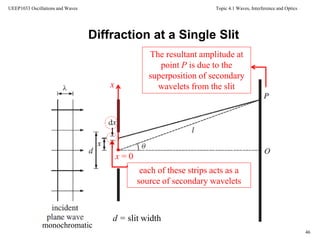
Diffraction at a Single Slit
The resultant amplitude at
point P is due to the
superposition of secondary
wavelets from the slit
monochromatic
x = 0
x
each of these strips acts as a
source of secondary wavelets
d = slit width
Topic 4.1 Waves, Interference and Optics
47
UEEP1033 Oscillations and Waves
Diffraction at a Single Slit
Figure in slide-46:
• A monochromatic plane wave of wavelength λ is incident upon
an opaque barrier containing a single slit
• The slit has a width d and a long length (>> d) in the direction
normal to the page, reducing this to a two-dimensional problem
• The resultant amplitude at point P is due to the superposition
of secondary wavelets from the slit
Topic 4.1 Waves, Interference and Optics
48
UEEP1033 Oscillations and Waves
Diffraction at a Single Slit
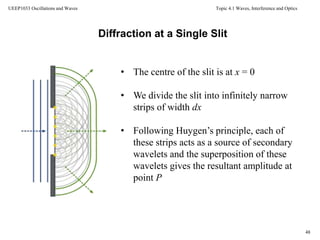
• The centre of the slit is at x = 0
• We divide the slit into infinitely narrow
strips of width dx
• Following Huygen’s principle, each of
these strips acts as a source of secondary
wavelets and the superposition of these
wavelets gives the resultant amplitude at
point P
Topic 4.1 Waves, Interference and Optics
49
UEEP1033 Oscillations and Waves
• We consider the case in which P is very distant from the slit
• Consequently, all the wavelets arriving at P can be assumed to
be plane waves and to have the same amplitude
• In addition, we can assume that the lines joining P to all points
on the slit make the same angle θ to the horizontal axis
• The amplitude dR of the wavelet arriving at P from the strip dx
at x is proportional to the width dx of the strip
• its phase depends on the distance of P from the strip
i.e. on (l − x sin θ), where l is the distance of P from the
midpoint of the slit
Diffraction at a Single Slit
Topic 4.1 Waves, Interference and Optics
50
UEEP1033 Oscillations and Waves
Hence dR is given by:
Diffraction at a Single Slit
ω = angular frequency k = wave number α = constant
)]sin(cos[  xlktdxdR
The resultant amplitude at P due to the contributions of the
secondary wavelets from all the strips is


2/
2/
)]sin(cos[
d
d
xlktdxR
)cos(]sin)2/sin[(
sin)2/(
kltkd
kd
d
R 



d = slit width
Topic 4.1 Waves, Interference and Optics
51
UEEP1033 Oscillations and Waves
Instantaneous intensity I at P:
2
2
2222
]sin)2/[(
]sin)2/[(sin
)(cos



kd
kd
kltdRI
Diffraction at a Single Slit
Since the time average over many cycles of cos2(ωt − kl) = 1/2
the time average of the intensity is given by:
2
2
02
2
0
sin
]sin)2/[(
]sin)2/[(sin
)(





 I
kd
kd
II
2/22
0 dI  = maximum intensity of the diffraction pattern
This equation describes how an incident plane wave of wavelength λ
spreads out from a single slit of width d in terms of the angle θ
2/sin kd
Topic 4.1 Waves, Interference and Optics
52
UEEP1033 Oscillations and Waves
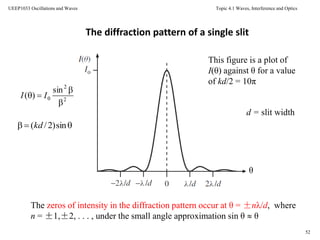
The diffraction pattern of a single slit
The zeros of intensity in the diffraction pattern occur at θ = ±nλ/d, where
n = ±1,±2, . . . , under the small angle approximation sin θ  θ
This figure is a plot of
I(θ) against θ for a value
of kd/2 = 10π
2
2
0
sin
)(


 II
 sin)2/(kd
θ
d = slit width
Topic 4.1 Waves, Interference and Optics
53
UEEP1033 Oscillations and Waves
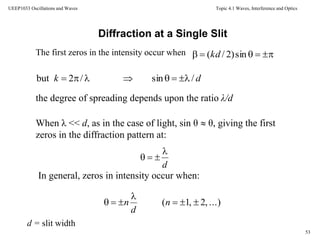
The first zeros in the intensity occur when  sin)2/(kd
Diffraction at a Single Slit
dk /sin/2but 
the degree of spreading depends upon the ratio λ/d
When λ << d, as in the case of light, sin θ  θ, giving the first
zeros in the diffraction pattern at:
...),2,1( 

 n
d
n
d


In general, zeros in intensity occur when:
d = slit width
Topic 4.1 Waves, Interference and Optics
54
UEEP1033 Oscillations and Waves
Double slits of finite width
• Consider each of the two slits to be composed of infinitely
narrow strips that act as sources of secondary wavelets
• Then the resultant amplitude R at a point P is the
superposition of the secondary wavelets from both slits








2/2/
2/2/
2/2/
2/2/
)]sin(cos[
)]sin(cos[
da
da
da
da
xlktdx
xlktdxR
d = the width of each slit
a = separation of the slits
Topic 4.1 Waves, Interference and Optics
55
UEEP1033 Oscillations and Waves
]sin)2/cos[(
sin)2/(
]sin)2/sin[(
)cos(2 


 ka
kd
kd
kltdR
Double slits of finite width
]sin)2/[(cos
]sin)2/[(
]sin)2/[(sin
)( 2
2
2
0 


 ka
kd
kd
II
Resultant Intensity:
• This result is the product of two functions.
• The first is the square of a sinc function corresponding to
diffraction at a single slit
• The second is the cosine-squared term of the double-slit
interference pattern
Topic 4.1 Waves, Interference and Optics
56
UEEP1033 Oscillations and Waves
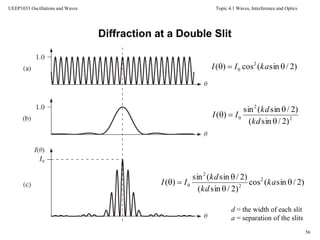
Diffraction at a Double Slit
)2/sin(cos)( 2
0  kaII
2
2
0
)2/sin(
)2/sin(sin
)(



kd
kd
II
)2/sin(cos
)2/sin(
)2/sin(sin
)( 2
2
2
0 


 ka
kd
kd
II
d = the width of each slit
a = separation of the slits
Topic 4.1 Waves, Interference and Optics
57
UEEP1033 Oscillations and Waves
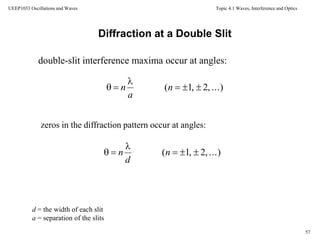
Diffraction at a Double Slit
double-slit interference maxima occur at angles:
...),2,1( 

 n
a
n
zeros in the diffraction pattern occur at angles:
...),2,1( 

 n
d
n
d = the width of each slit
a = separation of the slits
Topic 4.1 Waves, Interference and Optics
58
UEEP1033 Oscillations and Waves
Fraunhofer Diffraction
Topic 4.1 Waves, Interference and Optics
59
UEEP1033 Oscillations and Waves
Observation
screen 
Fraunhofer and Fresnel Diffraction
S
Lens
Plane
waves
Opaque shield , with a single
small aperture of width a is
being illuminated by plane
wave of wavelength  from a
distant point source S
Case-1
observation screen is very close
to 
Image of aperture is projected onto
the screen
Topic 4.1 Waves, Interference and Optics
60
UEEP1033 Oscillations and Waves
Observation
screen 
Fraunhofer and Fresnel Diffraction
S
Lens
Plane
waves
Case-2
observation screen is moved
farther away from 
Image of aperture become increasingly
more structured as the fringes become
prominent
Fresnel or Near-Field
Diffraction
Topic 4.1 Waves, Interference and Optics
61
UEEP1033 Oscillations and Waves
Fraunhofer and Fresnel Diffraction
S
Lens
Plane
waves
Case-3
observation screen is at very
great distance away from 
Projected pattern will have spread
out considerably, bearing a little or
no resemblance to the actual
aperture
Observation
screen 

Thereafter moving the screen
away from the aperture change
only the size of the pattern and not
its shape
Fraunhofer or Far-Field
Diffraction
Topic 4.1 Waves, Interference and Optics
62
UEEP1033 Oscillations and Waves
Fraunhofer and Fresnel Diffraction
S
Lens
Plane
waves
Case-4
If at that point, the
wavelength  of the
incoming radiation is reduce
Observation
screen 
the pattern would revert back
to the Fresnel case
If  were decreased even more, so that  → 0
The fringes would disappear, and the image
would take on the limiting shape of the aperture
Topic 4.1 Waves, Interference and Optics
63
UEEP1033 Oscillations and Waves
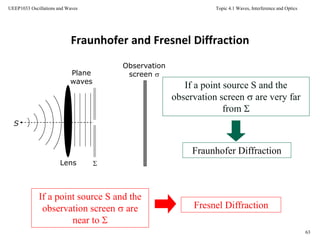
Fraunhofer and Fresnel Diffraction
S
Lens
Plane
waves
If a point source S and the
observation screen  are very far
from 
Observation
screen 
Fraunhofer Diffraction
If a point source S and the
observation screen  are
near to 
Fresnel Diffraction
Topic 4.1 Waves, Interference and Optics
64
UEEP1033 Oscillations and Waves
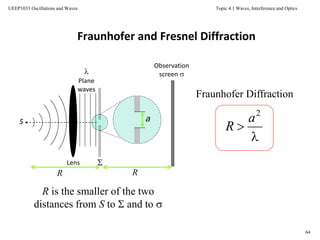
Fraunhofer and Fresnel Diffraction
S
Lens
Plane
waves
Observation
screen 
Fraunhofer Diffraction
a

R R
R is the smaller of the two
distances from S to  and to 


2
a
R
Topic 4.1 Waves, Interference and Optics
65
UEEP1033 Oscillations and Waves
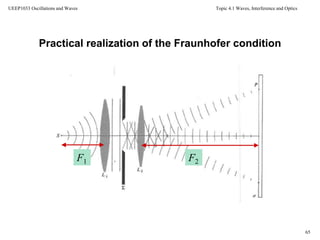
Practical realization of the Fraunhofer condition
F1 F2
Topic 4.1 Waves, Interference and Optics
66
UEEP1033 Oscillations and Waves
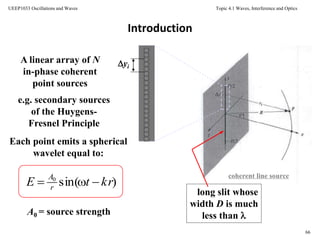
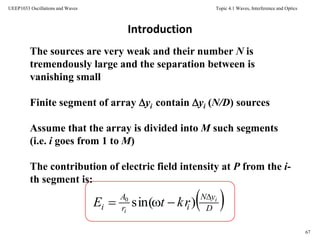
coherent line source
Introduction
yi
A linear array of N
in-phase coherent
point sources
e.g. secondary sources
of the Huygens-
Fresnel Principle
a long slit whose
width D is much
less than 
Each point emits a spherical
wavelet equal to:
A0 = source strength
)sin(0
krtE r
A

Topic 4.1 Waves, Interference and Optics
67
UEEP1033 Oscillations and Waves
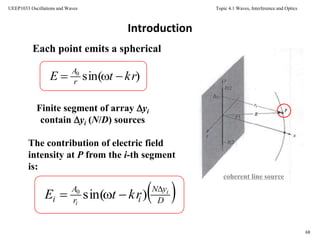
Introduction
The sources are very weak and their number N is
tremendously large and the separation between is
vanishing small
Finite segment of array yi contain yi (N/D) sources
Assume that the array is divided into M such segments
(i.e. i goes from 1 to M)
The contribution of electric field intensity at P from the i-
th segment is:
 D
yN
ir
A
i
i
i
krtE

 )sin(0
Topic 4.1 Waves, Interference and Optics
68
UEEP1033 Oscillations and Waves
Introduction
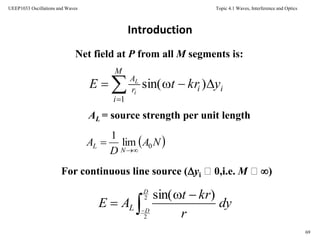
The contribution of electric field
intensity at P from the i-th segment
is:
coherent line source
Finite segment of array yi
contain yi (N/D) sources
)sin(0
krtE r
A

 D
yN
ir
A
i
i
i
krtE

 )sin(0
Each point emits a spherical wavelets:
Topic 4.1 Waves, Interference and Optics
69
UEEP1033 Oscillations and Waves
Introduction
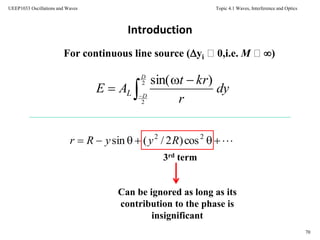
Net field at P from all M segments is:
AL = source strength per unit length
For continuous line source (yi 0,i.e. M )


M
i
iir
A
ykrtE i
L
1
)sin(
 NA
D
A
N
L 0lim
1


dy
r
krt
AE
D
DL 


2
2
)sin(
Topic 4.1 Waves, Interference and Optics
70
UEEP1033 Oscillations and Waves
Introduction
3rd term
Can be ignored as long as its
contribution to the phase is
insignificant
 22
cos)2/(sin RyyRr
For continuous line source (yi 0,i.e. M )
dy
r
krt
AE
D
DL 


2
2
)sin(
Topic 4.1 Waves, Interference and Optics
71
UEEP1033 Oscillations and Waves
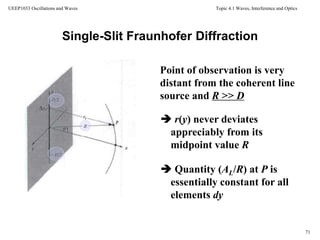
Single-Slit Fraunhofer Diffraction
coherent line source
Point of observation is very
distant from the coherent line
source and R >> D
 r(y) never deviates
appreciably from its
midpoint value R
 Quantity (AL/R) at P is
essentially constant for all
elements dy
Topic 4.1 Waves, Interference and Optics
72
UEEP1033 Oscillations and Waves
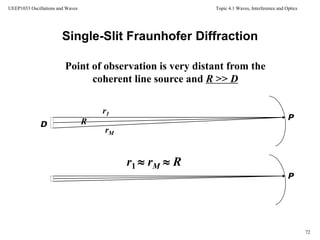
Point of observation is very distant from the
coherent line source and R >> D
P
D
r1
rM
R
P
r1  rM  R
Single-Slit Fraunhofer Diffraction
Topic 4.1 Waves, Interference and Optics
73
UEEP1033 Oscillations and Waves
Single-Slit Fraunhofer Diffraction
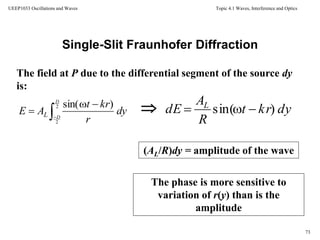
(AL/R)dy = amplitude of the wave
The field at P due to the differential segment of the source dy
is:

The phase is more sensitive to
variation of r(y) than is the
amplitude
dy
r
krt
AE
D
DL 


2
2
)sin(
dykrt
R
A
dE L
)sin( 
Topic 4.1 Waves, Interference and Optics
74
UEEP1033 Oscillations and Waves
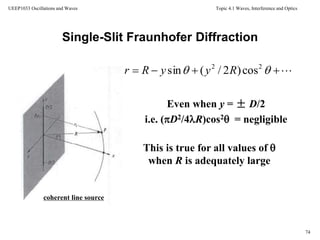
coherent line source
Even when y = ± D/2
i.e. (D2/4R)cos2 = negligible
This is true for all values of 
when R is adequately large
Single-Slit Fraunhofer Diffraction
  22
cos)2/(sin RyyRr
Topic 4.1 Waves, Interference and Optics
75
UEEP1033 Oscillations and Waves
Fraunhofer conditions: The distance r is linear in y
Single-Slit Fraunhofer Diffraction
Therefore the phase can be written as a
function of the aperture variable

 sinyRr
dyyRkt
R
A
E
D
D
L


2
2
)]sin(sin[
)sin(  yRkkr
Topic 4.1 Waves, Interference and Optics
76
UEEP1033 Oscillations and Waves
Single-Slit Fraunhofer Diffraction
Simplify:

where:
dyyRkt
R
A
E
D
D
L


2
2
)]sin(sin[
)sin(
sin)2/(
]sin)2/sin[(
kRt
kD
kD
R
DA
E L




)sin(
sin
kRt
R
DA
E L









 sin)2/(kD
Topic 4.1 Waves, Interference and Optics
77
UEEP1033 Oscillations and Waves
22
sin
2
1
)( 














R
DA
I L
Single-Slit Fraunhofer Diffraction
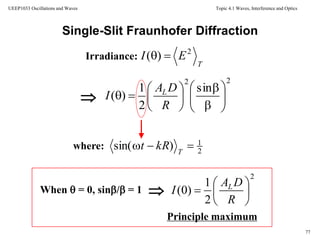
Irradiance:
where:
When  = 0, sin/ = 1 
Principle maximum

T
EI 2
)( 
2
1
)sin(  T
kRt
2
2
1
)0( 






R
DA
I L
Topic 4.1 Waves, Interference and Optics
78
UEEP1033 Oscillations and Waves
Single-Slit Fraunhofer Diffraction
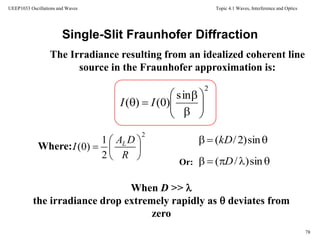
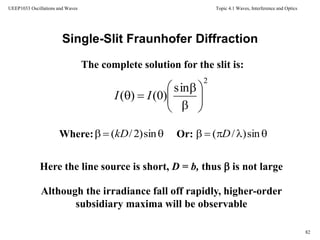
The Irradiance resulting from an idealized coherent line
source in the Fraunhofer approximation is:
When D >> 
the irradiance drop extremely rapidly as  deviates from
zero
Or:
Where:
2
sin
)0()( 







 II
2
2
1
)0( 






R
DA
I L  sin)2/(kD
 sin)/( D
Topic 4.1 Waves, Interference and Optics
79
UEEP1033 Oscillations and Waves
Single-Slit Fraunhofer Diffraction
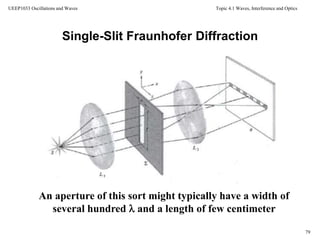
An aperture of this sort might typically have a width of
several hundred  and a length of few centimeter
Topic 4.1 Waves, Interference and Optics
80
UEEP1033 Oscillations and Waves
Single-Slit Fraunhofer Diffraction
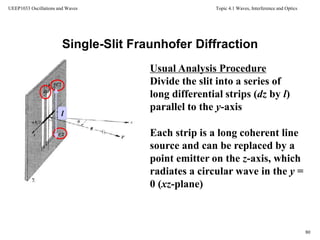
l
Each strip is a long coherent line
source and can be replaced by a
point emitter on the z-axis, which
radiates a circular wave in the y =
0 (xz-plane)
Usual Analysis Procedure
Divide the slit into a series of
long differential strips (dz by l)
parallel to the y-axis
Topic 4.1 Waves, Interference and Optics
81
UEEP1033 Oscillations and Waves
Single-Slit Fraunhofer Diffraction
Our Problem is:
To find the field in the xz-plane due to the infinite
number of point sources extending across the
width of the slit along the z-axis
Only evaluate the integral of the contribution of
dE from each element dz in the Fraunhofer
approximation
Topic 4.1 Waves, Interference and Optics
82
UEEP1033 Oscillations and Waves
Single-Slit Fraunhofer Diffraction
The complete solution for the slit is:
Here the line source is short, D = b, thus  is not large
Or:Where:
Although the irradiance fall off rapidly, higher-order
subsidiary maxima will be observable
2
sin
)0()( 







 II
 sin)2/(kD  sin)/( D
Topic 4.1 Waves, Interference and Optics
83
UEEP1033 Oscillations and Waves
Single-Slit Fraunhofer Diffraction
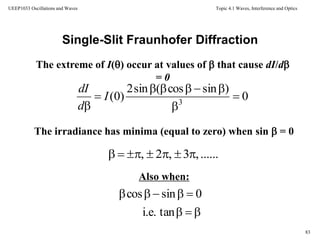
The extreme of I() occur at values of  that cause dI/d
= 0
The irradiance has minima (equal to zero) when sin  = 0
Also when:
0
)sincos(sin2
)0( 3





I
d
dI
......,3,2, 


tani.e.
0sincos
Topic 4.1 Waves, Interference and Optics
84
UEEP1033 Oscillations and Waves
Single-Slit Fraunhofer Diffraction
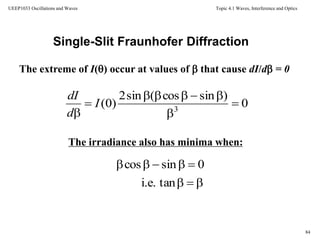
The extreme of I() occur at values of  that cause dI/d = 0
The irradiance also has minima when:
0
)sincos(sin2
)0( 3





I
d
dI


tani.e.
0sincos
Topic 4.1 Waves, Interference and Optics
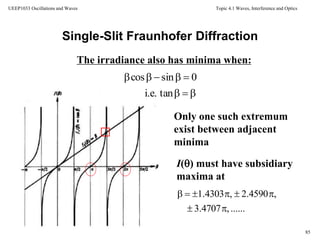
85
UEEP1033 Oscillations and Waves
Single-Slit Fraunhofer Diffraction
The irradiance also has minima when:
Only one such extremum
exist between adjacent
minima
I() must have subsidiary
maxima at
......,4707.3
,4590.2,4303.1




tani.e.
0sincos
Topic 4.1 Waves, Interference and Optics
86
UEEP1033 Oscillations and Waves
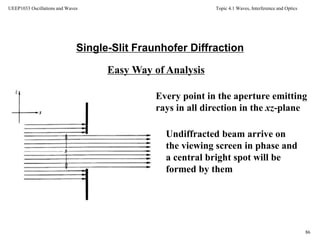
Single-Slit Fraunhofer Diffraction
Easy Way of Analysis
Every point in the aperture emitting
rays in all direction in the xz-plane
Undiffracted beam arrive on
the viewing screen in phase and
a central bright spot will be
formed by them
Topic 4.1 Waves, Interference and Optics
87
UEEP1033 Oscillations and Waves
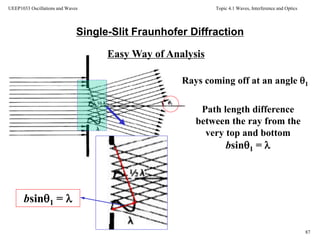
Single-Slit Fraunhofer Diffraction
Rays coming off at an angle 1
Path length difference
between the ray from the
very top and bottom
bsin1 = 
Easy Way of Analysis
bsin1 = 
Topic 4.1 Waves, Interference and Optics
88
UEEP1033 Oscillations and Waves
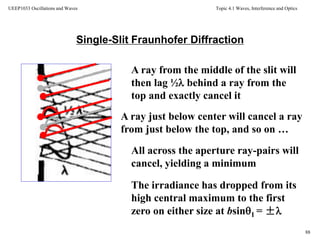
Single-Slit Fraunhofer Diffraction
A ray from the middle of the slit will
then lag ½ behind a ray from the
top and exactly cancel it
A ray just below center will cancel a ray
from just below the top, and so on …
All across the aperture ray-pairs will
cancel, yielding a minimum
The irradiance has dropped from its
high central maximum to the first
zero on either size at bsin1 = ±
Topic 4.1 Waves, Interference and Optics
89
UEEP1033 Oscillations and Waves
Single-Slit Fraunhofer Diffraction
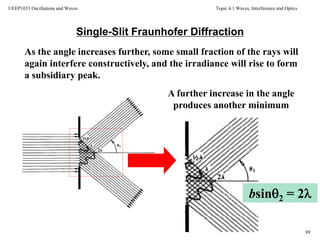
As the angle increases further, some small fraction of the rays will
again interfere constructively, and the irradiance will rise to form
a subsidiary peak.
A further increase in the angle
produces another minimum
bsin2 = 2
Topic 4.1 Waves, Interference and Optics
90
UEEP1033 Oscillations and Waves
Single-Slit Fraunhofer Diffraction
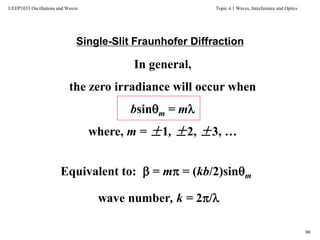
In general,
the zero irradiance will occur when
bsinm = m
where, m = ±1, ±2, ±3, …
Equivalent to:  = m = (kb/2)sinm
wave number, k = 2/
Topic 4.1 Waves, Interference and Optics
91
UEEP1033 Oscillations and Waves
Single-Slit Fraunhofer Diffraction
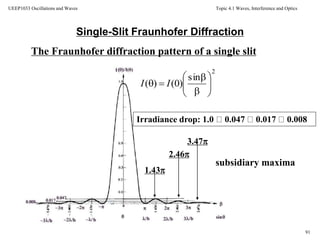
The Fraunhofer diffraction pattern of a single slit
Irradiance drop: 1.0 0.047 0.017 0.008
2.46
3.47
1.43
subsidiary maxima
2
sin
)0()( 







 II
Topic 4.1 Waves, Interference and Optics
92
UEEP1033 Oscillations and Waves
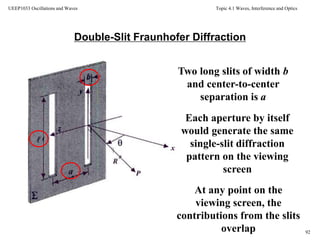
Double-Slit Fraunhofer Diffraction
Two long slits of width b
and center-to-center
separation is a
Each aperture by itself
would generate the same
single-slit diffraction
pattern on the viewing
screen
At any point on the
viewing screen, the
contributions from the slits
overlap
Topic 4.1 Waves, Interference and Optics
93
UEEP1033 Oscillations and Waves
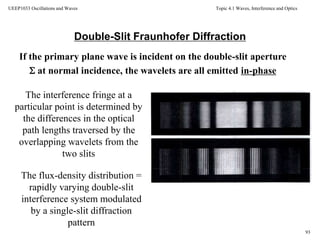
Double-Slit Fraunhofer Diffraction
If the primary plane wave is incident on the double-slit aperture
 at normal incidence, the wavelets are all emitted in-phase
The interference fringe at a
particular point is determined by
the differences in the optical
path lengths traversed by the
overlapping wavelets from the
two slits
The flux-density distribution =
rapidly varying double-slit
interference system modulated
by a single-slit diffraction
pattern
Topic 4.1 Waves, Interference and Optics
94
UEEP1033 Oscillations and Waves
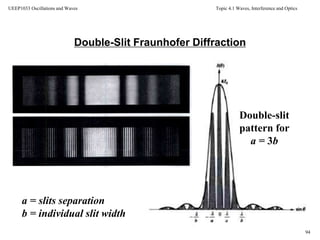
Double-Slit Fraunhofer Diffraction
Double-slit
pattern for
a = 3b
a = slits separation
b = individual slit width
Topic 4.1 Waves, Interference and Optics
95
UEEP1033 Oscillations and Waves
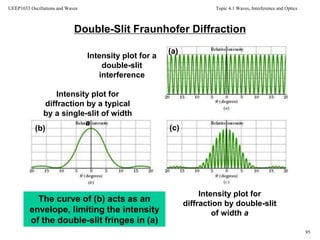
Double-Slit Fraunhofer Diffraction
(a)
(b) (c)
Intensity plot for a
double-slit
interference
Intensity plot for
diffraction by a typical
by a single-slit of width
a
Intensity plot for
diffraction by double-slit
of width a
The curve of (b) acts as an
envelope, limiting the intensity
of the double-slit fringes in (a)
Topic 4.1 Waves, Interference and Optics
96
UEEP1033 Oscillations and Waves
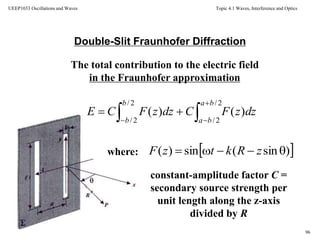
Double-Slit Fraunhofer Diffraction
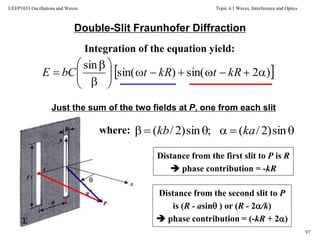
The total contribution to the electric field
in the Fraunhofer approximation
where:
constant-amplitude factor C =
secondary source strength per
unit length along the z-axis
divided by R




2/
2/
2/
2/
)()(
ba
ba
b
b
dzzFCdzzFCE
 )sin(sin)(  zRktzF
Topic 4.1 Waves, Interference and Optics
97
UEEP1033 Oscillations and Waves
 )2sin()sin(
sin








 kRtkRtbCE
Double-Slit Fraunhofer Diffraction
Integration of the equation yield:
where:
Just the sum of the two fields at P, one from each slit
Distance from the first slit to P is R
 phase contribution = -kR
Distance from the second slit to P
is (R - asin ) or (R - 2/k)
 phase contribution = (-kR + 2)
 sin)2/(;sin)2/( kakb
Topic 4.1 Waves, Interference and Optics
98
UEEP1033 Oscillations and Waves
Double-Slit Fraunhofer Diffraction
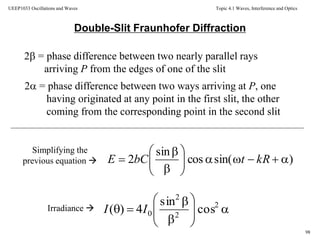
2 = phase difference between two nearly parallel rays
arriving P from the edges of one of the slit
2 = phase difference between two ways arriving at P, one
having originated at any point in the first slit, the other
coming from the corresponding point in the second slit
Simplifying the
previous equation 
Irradiance 
)sin(cos
sin
2 







 kRtbCE










 2
2
2
0 cos
sin
4)( II
Topic 4.1 Waves, Interference and Optics
99
UEEP1033 Oscillations and Waves
Double-Slit Fraunhofer Diffraction
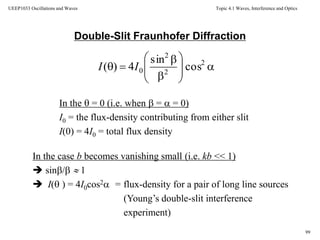
In the  = 0 (i.e. when  =  = 0)
I0 = the flux-density contributing from either slit
I(0) = 4I0 = total flux density
In the case b becomes vanishing small (i.e. kb << 1)
 sin/  1
 I( ) = 4I0cos2 = flux-density for a pair of long line sources
(Young’s double-slit interference
experiment)










 2
2
2
0 cos
sin
4)( II
Topic 4.1 Waves, Interference and Optics
100
UEEP1033 Oscillations and Waves
Double-Slit Fraunhofer Diffraction
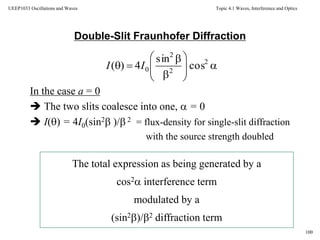
In the case a = 0
 The two slits coalesce into one,  = 0
 I() = 4I0(sin2 )/ 2 = flux-density for single-slit diffraction
with the source strength doubled
The total expression as being generated by a
cos2 interference term
modulated by a
(sin2)/2 diffraction term










 2
2
2
0 cos
sin
4)( II
Topic 4.1 Waves, Interference and Optics
101
UEEP1033 Oscillations and Waves
Double-Slit Fraunhofer Diffraction
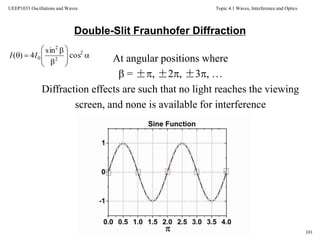
At angular positions where
 = ±, ±2, ±3, …
Diffraction effects are such that no light reaches the viewing
screen, and none is available for interference










 2
2
2
0 cos
sin
4)( II
Topic 4.1 Waves, Interference and Optics
102
UEEP1033 Oscillations and Waves
Double-Slit Fraunhofer Diffraction
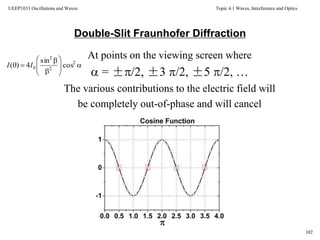
At points on the viewing screen where
 = ±/2, ±3 /2, ±5 /2, …
The various contributions to the electric field will
be completely out-of-phase and will cancel










 2
2
2
0 cos
sin
4)( II
Topic 4.1 Waves, Interference and Optics
103
UEEP1033 Oscillations and Waves
Double-Slit Fraunhofer Diffraction
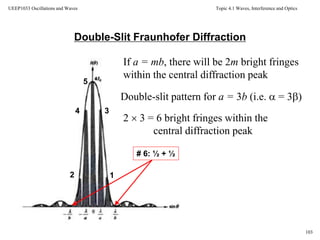
Double-slit pattern for a = 3b (i.e.  = 3)
If a = mb, there will be 2m bright fringes
within the central diffraction peak
2  3 = 6 bright fringes within the
central diffraction peak
1
3
5
4
2
# 6: ½ + ½
Topic 4.1 Waves, Interference and Optics
104
UEEP1033 Oscillations and Waves
Double-Slit Fraunhofer Diffraction
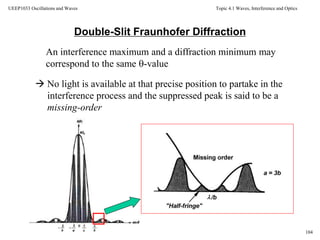
 No light is available at that precise position to partake in the
interference process and the suppressed peak is said to be a
missing-order
An interference maximum and a diffraction minimum may
correspond to the same -value
Topic 4.1 Waves, Interference and Optics
105
UEEP1033 Oscillations and Waves
Diffraction by Many Slits
Procedure for obtaining the irradiance
function for diffraction by many slits
is the same as that used when
considering two slits
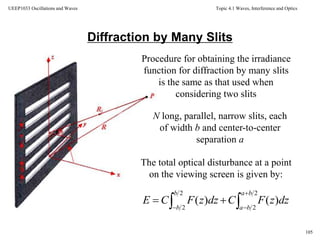
N long, parallel, narrow slits, each
of width b and center-to-center
separation a
The total optical disturbance at a point
on the viewing screen is given by:




2
2
2
2
)()(
ba
ba
b
b
dzzFCdzzFCE
Topic 4.1 Waves, Interference and Optics
106
UEEP1033 Oscillations and Waves
Diffraction by Many Slits
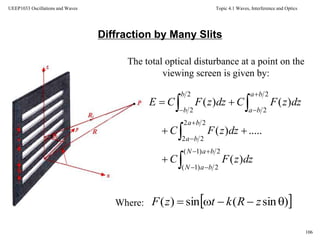
The total optical disturbance at a point on the
viewing screen is given by:
Where:












2)1(
2)1(
22
22
2
2
2
2
)(
.....)(
)()(
baN
baN
ba
ba
ba
ba
b
b
dzzFC
dzzFC
dzzFCdzzFCE
 )sin(sin)(  zRktzF
Topic 4.1 Waves, Interference and Optics
107
UEEP1033 Oscillations and Waves
Diffraction by Many Slits
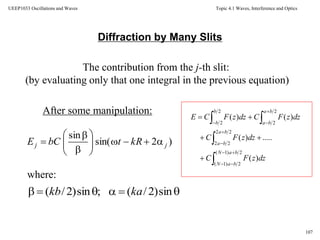
The contribution from the j-th slit:
(by evaluating only that one integral in the previous equation)
After some manipulation:
where:












2)1(
2)1(
22
22
2
2
2
2
)(
.....)(
)()(
baN
baN
ba
ba
ba
ba
b
b
dzzFC
dzzFC
dzzFCdzzFCE
)2sin(
sin
jj kRtbCE 








 sin)2/(;sin)2/( kakb
Topic 4.1 Waves, Interference and Optics
108
UEEP1033 Oscillations and Waves
Diffraction by Many Slits
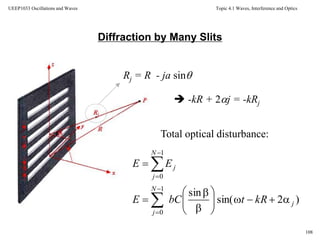
Rj = R - ja sin
 -kR + 2j = -kRj
Total optical disturbance:
)2sin(
sin1
0
1
0
j
N
j
N
j
j
kRtbCE
EE
















Topic 4.1 Waves, Interference and Optics
109
UEEP1033 Oscillations and Waves
Diffraction by Many Slits
Total optical disturbance written as the
imaginary part of a complex exponential:
Geometric series
 
















 



1
0
2)(sin
Im
N
j
jikRti
eebCE
  ][
][
1
1
2
21
0
2











 iii
iNiNiN
i
NiN
j
ji
eee
eee
e
e
e
  







 



 sin
sin)1(
1
0
2 N
ee Ni
N
j
ji
Topic 4.1 Waves, Interference and Optics
110
UEEP1033 Oscillations and Waves
Diffraction by Many Slits
Total optical disturbance written as the
imaginary part of a complex exponential:

 
















 



1
0
2)(sin
Im
N
j
jikRti
eebCE
])1(sin[
sin
sinsin
















 NkRt
N
bCE
Topic 4.1 Waves, Interference and Optics
111
UEEP1033 Oscillations and Waves
Diffraction by Many Slits
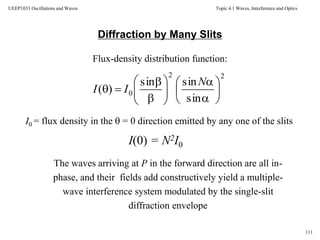
Flux-density distribution function:
I0 = flux density in the  = 0 direction emitted by any one of the slits
I(0) = N2I0
The waves arriving at P in the forward direction are all in-
phase, and their fields add constructively yield a multiple-
wave interference system modulated by the single-slit
diffraction envelope
22
0
sin
sinsin
)( 
















N
II
Topic 4.1 Waves, Interference and Optics
112
UEEP1033 Oscillations and Waves
Diffraction by Many Slits
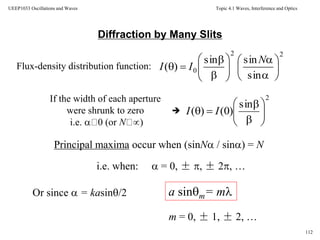
Flux-density distribution function:
If the width of each aperture
were shrunk to zero
i.e.  0 (or N )

Principal maxima occur when (sinN / sin) = N
i.e. when:  = 0, ± , ± 2, …
Or since  = kasin/2 a sinm= m
m = 0, ± 1, ± 2, …
22
0
sin
sinsin
)( 
















N
II
2
sin
)0()( 







 II
Topic 4.1 Waves, Interference and Optics
113
UEEP1033 Oscillations and Waves
Diffraction by Many Slits
Flux-density distribution function:
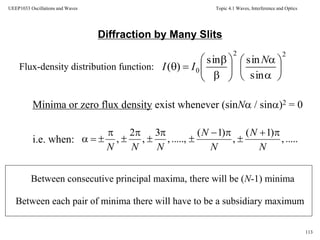
Minima or zero flux density exist whenever (sinN / sin)2 = 0
i.e. when:
Between consecutive principal maxima, there will be (N-1) minima
Between each pair of minima there will have to be a subsidiary maximum
22
0
sin
sinsin
)( 
















N
II
.....,
)1(
,
)1(
.....,,
3
,
2
,
N
N
N
N
NNN










Topic 4.1 Waves, Interference and Optics
114
UEEP1033 Oscillations and Waves
Diffraction by Many Slits
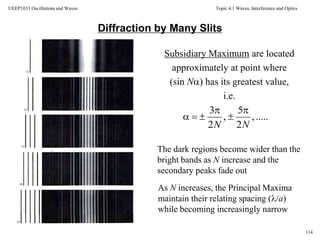
Subsidiary Maximum are located
approximately at point where
(sin N) has its greatest value,
i.e.
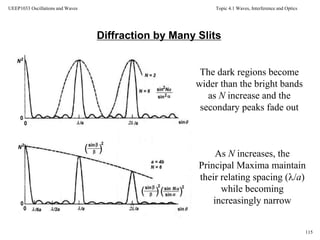
The dark regions become wider than the
bright bands as N increase and the
secondary peaks fade out
As N increases, the Principal Maxima
maintain their relating spacing (/a)
while becoming increasingly narrow
.....,
2
5
,
2
3
NN




Topic 4.1 Waves, Interference and Optics
115
UEEP1033 Oscillations and Waves
Diffraction by Many Slits
The dark regions become
wider than the bright bands
as N increase and the
secondary peaks fade out
As N increases, the
Principal Maxima maintain
their relating spacing (/a)
while becoming
increasingly narrow
Topic 4.1 Waves, Interference and Optics
116
UEEP1033 Oscillations and Waves
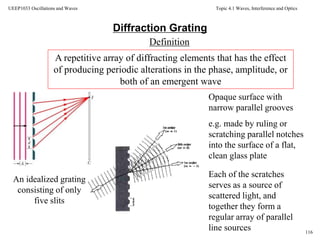
Diffraction Grating
Definition
A repetitive array of diffracting elements that has the effect
of producing periodic alterations in the phase, amplitude, or
both of an emergent wave
An idealized grating
consisting of only
five slits
Opaque surface with
narrow parallel grooves
e.g. made by ruling or
scratching parallel notches
into the surface of a flat,
clean glass plate
Each of the scratches
serves as a source of
scattered light, and
together they form a
regular array of parallel
line sources
Topic 4.1 Waves, Interference and Optics
117
UEEP1033 Oscillations and Waves
Diffraction Grating
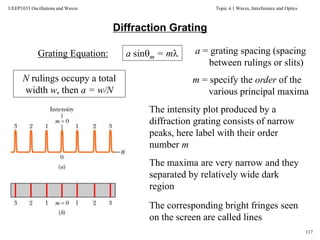
Grating Equation: a sinm = m
m = specify the order of the
various principal maxima
The intensity plot produced by a
diffraction grating consists of narrow
peaks, here label with their order
number m
The corresponding bright fringes seen
on the screen are called lines
The maxima are very narrow and they
separated by relatively wide dark
region
a = grating spacing (spacing
between rulings or slits)
N rulings occupy a total
width w, then a = w/N
Topic 4.1 Waves, Interference and Optics
118
UEEP1033 Oscillations and Waves
Diffraction Grating
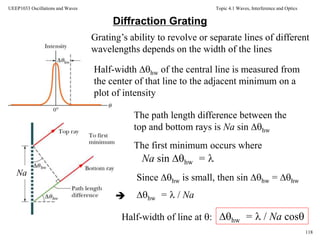
Grating’s ability to revolve or separate lines of different
wavelengths depends on the width of the lines
Half-width hw of the central line is measured from
the center of that line to the adjacent minimum on a
plot of intensity
The path length difference between the
top and bottom rays is Na sin hw
Na sin hw = 
Na
The first minimum occurs where
Since hw is small, then sin hw = hw
hw =  / Na (Half-width of central line)
Half-width of line at : hw =  / Na cos
Topic 4.1 Waves, Interference and Optics
119
UEEP1033 Oscillations and Waves
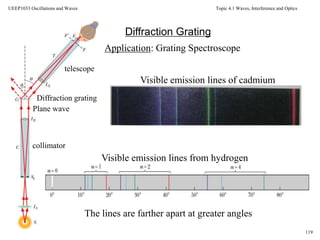
Diffraction Grating
Application: Grating Spectroscope
collimator
Plane wave
Diffraction grating
telescope
Visible emission lines of cadmium
Visible emission lines from hydrogen
The lines are farther apart at greater angles
Topic 4.1 Waves, Interference and Optics
120
UEEP1033 Oscillations and Waves
Reflection and Refraction
Topic 4.1 Waves, Interference and Optics
121
UEEP1033 Oscillations and Waves
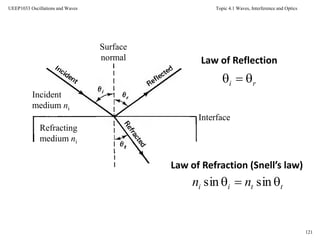
ri 
Law of Reflection
Law of Refraction (Snell’s law)
ttii nn  sinsin
Interface
Incident
medium ni
Refracting
medium ni
Surface
normal
Topic 4.1 Waves, Interference and Optics
122
UEEP1033 Oscillations and Waves
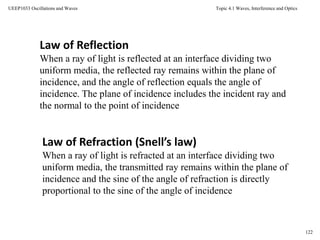
Law of Reflection
When a ray of light is reflected at an interface dividing two
uniform media, the reflected ray remains within the plane of
incidence, and the angle of reflection equals the angle of
incidence. The plane of incidence includes the incident ray and
the normal to the point of incidence
Law of Refraction (Snell’s law)
When a ray of light is refracted at an interface dividing two
uniform media, the transmitted ray remains within the plane of
incidence and the sine of the angle of refraction is directly
proportional to the sine of the angle of incidence
Topic 4.1 Waves, Interference and Optics
123
UEEP1033 Oscillations and Waves
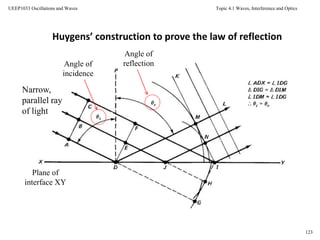
Huygens’ construction to prove the law of reflection
Narrow,
parallel ray
of light
Plane of
interface XY
Angle of
incidence
Angle of
reflection
Topic 4.1 Waves, Interference and Optics
124
UEEP1033 Oscillations and Waves
Huygens’ construction to prove the law of reflection
• Since points along the plane wavefront do not arrive at the
interface simultaneously, allowance is made for these
differences in constructing the wavelets that determine the
reflected wavefront
• If the interface XY were not present, the Huygens
construction would produce the wavefront GI at the instant
ray CF reached the interface at I
• The intrusion of the reflecting surface, means that during the
same time interval required for ray CF to progress from F to
I, ray BE has progressed from E to J and then a distance
equivalent to JH after reflection
Topic 4.1 Waves, Interference and Optics
125
UEEP1033 Oscillations and Waves
Huygens’ construction to prove the law of reflection
• Wavelet of radius JN = JH centered at J is drawn above the
reflecting surface
• Wavelet of radius DG is drawn centered at D to represent the
propagation after reflection of the lower part of the light
• The new wavefront, which must now be tangent to these
wavelets at points M and N, and include the point I, is shown
as KI in the figure
• A representative reflected ray is DL, shown perpendicular to
the reflected wavefront
• The normal PD drawn for this ray is used to define angles of
incidence and reflection for the light
Topic 4.1 Waves, Interference and Optics
126
UEEP1033 Oscillations and Waves
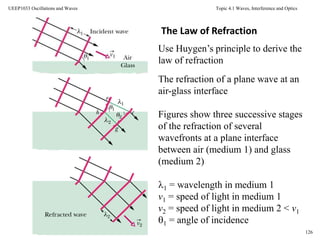
The Law of Refraction
Use Huygen’s principle to derive the
law of refraction
The refraction of a plane wave at an
air-glass interface
Figures show three successive stages
of the refraction of several
wavefronts at a plane interface
between air (medium 1) and glass
(medium 2)
1 = wavelength in medium 1
v1 = speed of light in medium 1
v2 = speed of light in medium 2 < v1
1 = angle of incidence
Topic 4.1 Waves, Interference and Optics
127
UEEP1033 Oscillations and Waves
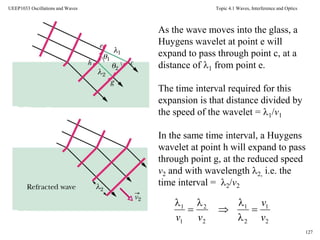
As the wave moves into the glass, a
Huygens wavelet at point e will
expand to pass through point c, at a
distance of 1 from point e.
The time interval required for this
expansion is that distance divided by
the speed of the wavelet = 1/v1
In the same time interval, a Huygens
wavelet at point h will expand to pass
through point g, at the reduced speed
v2 and with wavelength 2, i.e. the
time interval = 2/v2
2
2
1
1
vv



2
1
2
1
v
v




Topic 4.1 Waves, Interference and Optics
128
UEEP1033 Oscillations and Waves
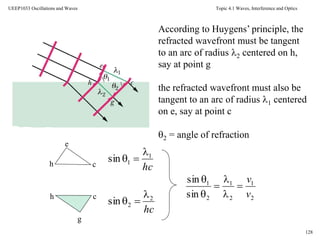
According to Huygens’ principle, the
refracted wavefront must be tangent
to an arc of radius 2 centered on h,
say at point g
the refracted wavefront must also be
tangent to an arc of radius 1 centered
on e, say at point c
2 = angle of refraction
h c
e
h c
g
hc
1
1sin


hc
2
2sin

 2
1
2
1
2
1
sin
sin
v
v






Topic 4.1 Waves, Interference and Optics
129
UEEP1033 Oscillations and Waves
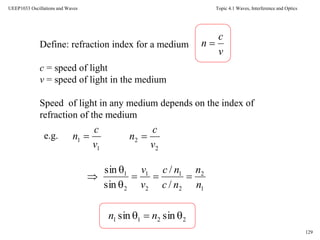
Define: refraction index for a medium
c = speed of light
v = speed of light in the medium
Speed of light in any medium depends on the index of
refraction of the medium
1
1
v
c
n e.g.
2
2
v
c
n 
v
c
n 
1
2
2
1
2
1
2
1
/
/
sin
sin
n
n
nc
nc
v
v




2211 sinsin  nn
Topic 4.1 Waves, Interference and Optics
130
UEEP1033 Oscillations and Waves
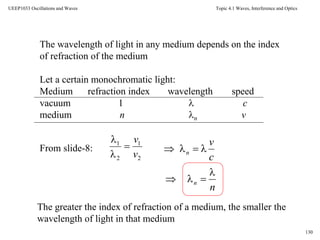
The wavelength of light in any medium depends on the index
of refraction of the medium
Let a certain monochromatic light:
Medium refraction index wavelength speed
vacuum 1  c
medium n n v
2
1
2
1
v
v



From slide-8:
c
v
n 
The greater the index of refraction of a medium, the smaller the
wavelength of light in that medium
n
n


Topic 4.1 Waves, Interference and Optics
131
UEEP1033 Oscillations and Waves
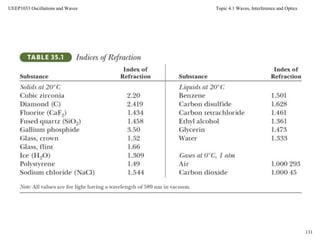
Topic 4.1 Waves, Interference and Optics
132
UEEP1033 Oscillations and Waves
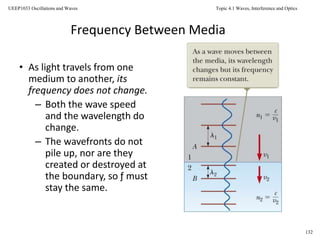
Frequency Between Media
• As light travels from one
medium to another, its
frequency does not change.
– Both the wave speed
and the wavelength do
change.
– The wavefronts do not
pile up, nor are they
created or destroyed at
the boundary, so ƒ must
stay the same.
Topic 4.1 Waves, Interference and Optics
133
UEEP1033 Oscillations and Waves
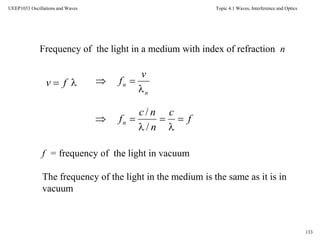
n
n
v
f


Frequency of the light in a medium with index of refraction n
 fv
f
c
n
nc
fn 




/
/
f = frequency of the light in vacuum
The frequency of the light in the medium is the same as it is in
vacuum
Topic 4.1 Waves, Interference and Optics
134
UEEP1033 Oscillations and Waves
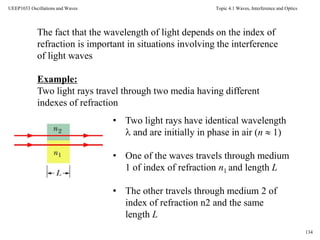
The fact that the wavelength of light depends on the index of
refraction is important in situations involving the interference
of light waves
Example:
Two light rays travel through two media having different
indexes of refraction
• Two light rays have identical wavelength
 and are initially in phase in air (n  1)
• One of the waves travels through medium
1 of index of refraction n1 and length L
• The other travels through medium 2 of
index of refraction n2 and the same
length L
Topic 4.1 Waves, Interference and Optics
135
UEEP1033 Oscillations and Waves
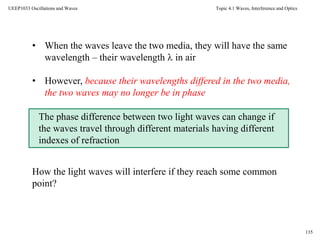
• When the waves leave the two media, they will have the same
wavelength – their wavelength  in air
• However, because their wavelengths differed in the two media,
the two waves may no longer be in phase
The phase difference between two light waves can change if
the waves travel through different materials having different
indexes of refraction
How the light waves will interfere if they reach some common
point?
Topic 4.1 Waves, Interference and Optics
136
UEEP1033 Oscillations and Waves
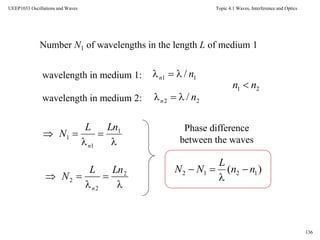
Number N1 of wavelengths in the length L of medium 1
11 / nn wavelength in medium 1:



 1
1
1
LnL
N
n
wavelength in medium 2: 22 / nn 



 2
2
2
LnL
N
n
)( 1212 nn
L
NN 


Phase difference
between the waves
21 nn 
Topic 4.1 Waves, Interference and Optics
137
UEEP1033 Oscillations and Waves
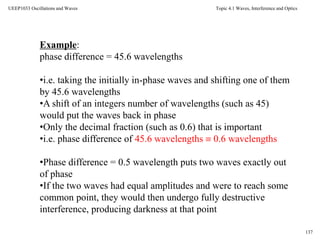
Example:
phase difference = 45.6 wavelengths
•i.e. taking the initially in-phase waves and shifting one of them
by 45.6 wavelengths
•A shift of an integers number of wavelengths (such as 45)
would put the waves back in phase
•Only the decimal fraction (such as 0.6) that is important
•i.e. phase difference of 45.6 wavelengths  0.6 wavelengths
•Phase difference = 0.5 wavelength puts two waves exactly out
of phase
•If the two waves had equal amplitudes and were to reach some
common point, they would then undergo fully destructive
interference, producing darkness at that point
Topic 4.1 Waves, Interference and Optics
138
UEEP1033 Oscillations and Waves
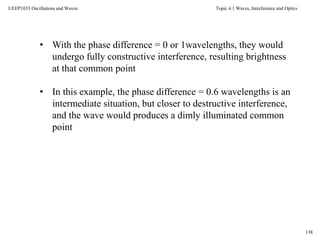
• With the phase difference = 0 or 1wavelengths, they would
undergo fully constructive interference, resulting brightness
at that common point
• In this example, the phase difference = 0.6 wavelengths is an
intermediate situation, but closer to destructive interference,
and the wave would produces a dimly illuminated common
point
Topic 4.1 Waves, Interference and Optics
139
UEEP1033 Oscillations and Waves
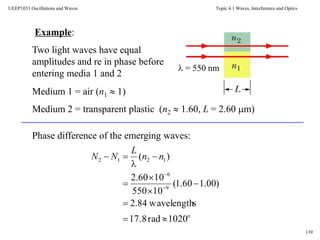
Example:
 = 550 nm
Two light waves have equal
amplitudes and re in phase before
entering media 1 and 2
Medium 1 = air (n1  1)
Medium 2 = transparent plastic (n2  1.60, L = 2.60 m)
Phase difference of the emerging waves:
o
9
6
1212
1020rad17.8
swavelength84.2
)00.160.1(
10550
1060.2
)(











nn
L
NN
Topic 4.1 Waves, Interference and Optics
140
UEEP1033 Oscillations and Waves
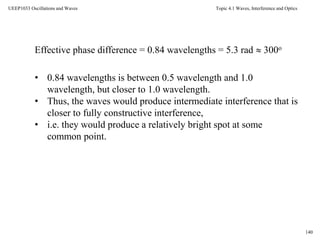
Effective phase difference = 0.84 wavelengths = 5.3 rad  300o
• 0.84 wavelengths is between 0.5 wavelength and 1.0
wavelength, but closer to 1.0 wavelength.
• Thus, the waves would produce intermediate interference that is
closer to fully constructive interference,
• i.e. they would produce a relatively bright spot at some
common point.
Topic 4.1 Waves, Interference and Optics
141
UEEP1033 Oscillations and Waves
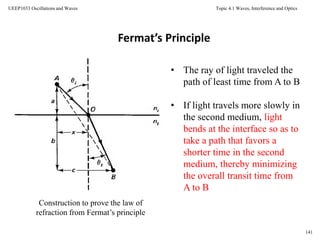
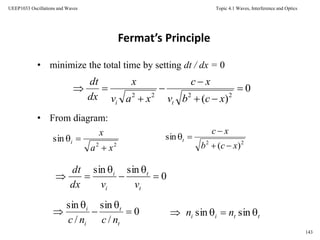
Fermat’s Principle
• The ray of light traveled the
path of least time from A to B
• If light travels more slowly in
the second medium, light
bends at the interface so as to
take a path that favors a
shorter time in the second
medium, thereby minimizing
the overall transit time from
A to B
Construction to prove the law of
refraction from Fermat’s principle
Topic 4.1 Waves, Interference and Optics
142
UEEP1033 Oscillations and Waves
Fermat’s Principle
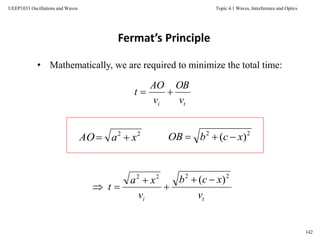
• Mathematically, we are required to minimize the total time:
ti v
OB
v
AO
t 
22
xaAO  22
)( xcbOB 
ti v
xcb
v
xa
t
2222
)( 



Topic 4.1 Waves, Interference and Optics
143
UEEP1033 Oscillations and Waves
Fermat’s Principle
0
)( 2222






xcbv
xc
xav
x
dx
dt
ti
• minimize the total time by setting dt / dx = 0
22
sin
xa
x
i


• From diagram:
22
)(
sin
xcb
xc
t



0
sinsin





t
t
i
i
vvdx
dt
0
/
sin
/
sin





t
t
i
i
ncnc ttii nn  sinsin

Topic 7 wave interference

  • 1.
    Topic 4.1 Waves,Interference and Optics 1 UEEP1033 Oscillations and Waves Topic 7: Interference and Diffraction
  • 2.
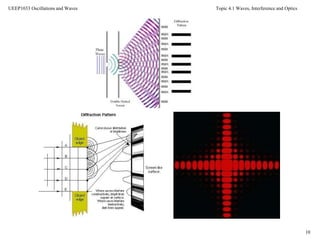
    Topic 4.1 Waves,Interference and Optics 2 UEEP1033 Oscillations and Waves • Interference e.g. rainbow colours produced by a thin film of oil on a wet road, where the light reflected off the surface of the oil interferes with the light reflected off the water surface underneath • Diffraction e.g. the waves spread out in a semicircular fashion after passing through the narrow mouth of a harbour • Both result from the overlap and superposition of waves Interference and Diffraction of Waves
  • 3.
    Topic 4.1 Waves,Interference and Optics 3 UEEP1033 Oscillations and Waves Interference two waves are out of phase destructive interference two waves are in phase constructive interference amplitude of their superposition is zero amplitude of the superposition (ψ1 + ψ2) = 2A A is the amplitude of the individual waves
  • 4.
    Topic 4.1 Waves,Interference and Optics 4 UEEP1033 Oscillations and Waves Figure (a) • Two monochromatic waves ψ1 and ψ2 at a particular point in space where the path difference from their common source is equal to an integral number of wavelengths • There is constructive interference and their superposition (ψ1 + ψ2) has an amplitude that is equal to 2A where A is the amplitude of the individual waves. Figure (b) • The two waves ψ1 and ψ2 where the path difference is equal to an odd number of half wavelengths • There is destructive interference and the amplitude of their superposition is zero Interference
  • 5.
    Topic 4.1 Waves,Interference and Optics 5 UEEP1033 Oscillations and Waves Point source of light is illuminating an opaque object, casting a shadow where the edge of the shadow fades gradually over a short distance and made up of bright and dark bands, the diffraction fringes. Shadow fades gradually >> Bright and Dark Bands = Diffraction Fringes Diffraction
  • 6.
    Topic 4.1 Waves,Interference and Optics 6 UEEP1033 Oscillations and Waves Francesco Grimaldi in 1665 first accurate report description of deviation of light from rectilinear propagation (diffraction) The effect is a general characteristics of wave phenomena occurring whenever a portion of a wavefront is obstructed in some way Diffraction
  • 7.
    Topic 4.1 Waves,Interference and Optics 7 UEEP1033 Oscillations and Waves Plane wavefronts approach a barrier with an opening or an obstruction, which both the opening and the obstruction are large compared to the wavelength Opening (size = d) Obstruction (size = d) wavelength,  d >> 
  • 8.
    Topic 4.1 Waves,Interference and Optics 8 UEEP1033 Oscillations and Waves • If the size of the opening or obstruction becomes comparable to the wavelength • The waves is not allowed to propagate freely through the opening or past the obstruction • But experiences some retardation of some parts of the wavefront • The wave proceed to "bend through" or around the opening or obstruction • The wave experiences significant curvature upon emerging from the opening or the obstruction curvatured  
  • 9.
    Topic 4.1 Waves,Interference and Optics 9 UEEP1033 Oscillations and Waves As the barrier or opening size gets smaller, the wavefront experiences more and more curvature More curvature Diffraction d  
  • 10.
    Topic 4.1 Waves,Interference and Optics 10 UEEP1033 Oscillations and Waves
  • 11.
    Topic 4.1 Waves,Interference and Optics 11 UEEP1033 Oscillations and Waves Historical Background
  • 12.
    Topic 4.1 Waves,Interference and Optics 12 UEEP1033 Oscillations and Waves Light source Aperture Observation plane Screen Arrangement used for observing diffraction of light Corpuscular Theory shadow behind the screen should be well defined, with sharp borders Observations • The transition from light to shadow was gradual rather than abrupt • Presence of bright and dark fringes extending far into the geometrical shadow of the screen
  • 13.
    Topic 4.1 Waves,Interference and Optics 13 UEEP1033 Oscillations and Waves Christian Huygens Huygens’s Principle Each point on the wavefront of a disturbance were considered to be a new source of a “secondary” spherical disturbance, then the wavefront at a later instant could be found by constructing the “envelope” of the secondary wavelets”
  • 14.
    Topic 4.1 Waves,Interference and Optics 14 UEEP1033 Oscillations and Waves Huygens’s Principle Every point on a propagation wavefront serves as the source of spherical secondary wavelets, such that the wavefront at some later time is the envelope of these wavelets Plane wave Spherical wave
  • 15.
    Topic 4.1 Waves,Interference and Optics 15 UEEP1033 Oscillations and Waves
  • 16.
    Topic 4.1 Waves,Interference and Optics 16 UEEP1033 Oscillations and Waves Huygens’s Principle Plane wave Spherical wave Every point on a propagation wavefront serves as the source of spherical secondary wavelets the wavefront at some later time is the envelope of these wavelets
  • 17.
    Topic 4.1 Waves,Interference and Optics 17 UEEP1033 Oscillations and Waves • When a wavefront encounters an aperture in an opaque barrier, the barrier suppresses all propagation of the wave except through the aperture • Following Huygen’s principle, the points on the wavefront across the aperture act as sources of secondary wavelets • When the width of the aperture is comparable with the wavelength, the aperture acts like a point source and the outgoing wavefronts are semicircular Huygen’s Principle
  • 18.
    Topic 4.1 Waves,Interference and Optics 18 UEEP1033 Oscillations and Waves 18 • Ignores most of each secondary wavelet and only retaining the portions common to the envelope • As a result, Huygens’s principle by itself is unable to account for the details of the diffraction process • The difficulty was resolved by Fresnel with his addition of the concept of interference Huygens’s Principle
  • 19.
    Topic 4.1 Waves,Interference and Optics 19 UEEP1033 Oscillations and Waves Augustin Jean Fresnel • 1818, Fresnel brought together the ideas of Huygens and Young and by making some arbitrary assumptions about the amplitude and phases of Huygens’ secondary sources • Fresnel able to calculate the distribution of light in diffraction patterns with excellent accuracy by allowing the various wavelet to mutually interfere Huygens-Fresnel Principle
  • 20.
    Topic 4.1 Waves,Interference and Optics 20 UEEP1033 Oscillations and Waves Huygens-Fresnel Principle Every unobstructed point of a wavefront, at given instant, serves as a source of spherical secondary wavelets (with the same frequency as that of the primary wave) The amplitude of the optical field at any point beyond is the superposition of all these wavelets (considering their amplitudes and relative phases)
  • 21.
    Topic 4.1 Waves,Interference and Optics 21 UEEP1033 Oscillations and Waves James Clerk Maxwell Electromagnetic Wave t H E      t E H      0 E  0 H 
  • 22.
    Topic 4.1 Waves,Interference and Optics 22 UEEP1033 Oscillations and Waves Gustav Kirchhoff • Kirchhoff's diffraction formula can be used to model the propagation of light in a wide range of configurations, either analytically or using numerical modelling • It gives an expression for the wave disturbance when a monochromatic spherical wave passes through an opening in an opaque screen • The equation is derived by making several approximations to the Kirchhoff integral theorem which uses Green’s theorem to derive the solution to the homogeneous wave equation • In 1882, Kirchhoff developed a more rigorous theory based directly on the solution of differential wave equation Kirchhoff's diffraction formula
  • 23.
    Topic 4.1 Waves,Interference and Optics 23 UEEP1033 Oscillations and Waves Although the problem was physically somewhat unrealistic , i.e. it involved an infinitely thin yet opaque, perfectly conducting plane screen, the result was nonetheless extremely valuable, providing a good deal of insight into the fundamental processes involved Arnold Johannes Wilhelm Sommerfeld In 1896, Sommerfeld published the first exact solution for a particular diffracting configuration , utilizing the electromagnetic theory of light Rigorous solutions of this sort do no exist even today for many of the configurations of practical interest The approximation treatments of Huygens-Fresnel and Kirchhoff are adequate for many purposes
  • 24.
    Topic 4.1 Waves,Interference and Optics 24 UEEP1033 Oscillations and Waves Interference Young’s Double-Slit Experiment
  • 25.
    Topic 4.1 Waves,Interference and Optics 25 UEEP1033 Oscillations and Waves Young’s Double-Slit Experiment L >> a a = slits separation
  • 26.
    Topic 4.1 Waves,Interference and Optics 26 UEEP1033 Oscillations and Waves • A monochromatic plane wave of wavelength λ is incident upon an opaque barrier containing two slits S1 and S2 • Each of these slits acts as a source of secondary wavelets according to Huygen’s Principle and the disturbance beyond the barrier is the superposition of all the wavelets spreading out from the two slits • These slits are very narrow but have a long length in the direction normal to the page, making this a two-dimensional problem • The resultant amplitude at point P is due to the superposition of secondary wavelets from the two slits Young’s Double-Slit Experiment
  • 27.
    Topic 4.1 Waves,Interference and Optics 27 UEEP1033 Oscillations and Waves • Since these secondary wavelets are driven by the same incident wave there is a well defined phase relationship between them • This condition is called coherence and implies a systematic phase relationship between the secondary wavelets when they are superposed at some distant point P • It is this phase relationship that gives rise to the interference pattern, which is observed on a screen a distance L beyond the barrier Young’s Double-Slit Experiment
  • 28.
    Topic 4.1 Waves,Interference and Optics 28 UEEP1033 Oscillations and Waves The secondary wavelets from S1 and S2 arriving at an arbitrary point P on the screen, at a distance x from the point O that coincides with the mid-point of the two slits Distances: S1P = l1 S2P = l2 Since L >> a it can be assumed that the secondary wavelets arriving at P have the same amplitude A The superposition of the wavelets at P gives the resultant amplitude: Young’s Double-Slit Experiment  )cos()cos( 21 kltkltAR  ω = angular frequency k = wave number (5) a = slits separation
  • 29.
    Topic 4.1 Waves,Interference and Optics 29 UEEP1033 Oscillations and Waves This result can be rewritten as: Since L >> a, the lines from S1 and S2 to P can be assumed to be parallel and also to make the same angle θ with respect to the horizontal axis Young’s Double-Slit Experiment  2/)(cos[]2/)(cos2 1212 llkllktAR  The line joining P to the mid-point of the slits makes an angle θ with respect to the horizontal axis 21 cos/ lLl   cos/212 Lll (6) a = slits separation
  • 30.
    Topic 4.1 Waves,Interference and Optics 30 UEEP1033 Oscillations and Waves When the two slits are separated by many wavelengths, θ is very small and cos θ  1. Hence, we can write the resultant amplitude as: Young’s Double-Slit Experiment )2/cos()cos(2 lkkLtAR  = path difference of the secondary wavelets The intensity I at point P = R2 12 lll  )2/(cos)(cos4 222 lkkLtAI  This equation describes the instantaneous intensity at P The variation of the intensity with time is described by the cos2(ωt − kL) term (7) (8)
  • 31.
    Topic 4.1 Waves,Interference and Optics 31 UEEP1033 Oscillations and Waves • The frequency of oscillation of visible light is of the order of 1015 Hz, which is far too high for the human eye and any laboratory apparatus to follow. • What we observe is a time average of the intensity • Since the time average of cos2(ωt − kL) over many cycles = 1/2  the time average of the intensity is given by: Young’s Double-Slit Experiment )2/(cos2 0 lkII  2 0 2AI  = intensity observed at a maximum of the interference pattern described how the intensity varies with l)2/(cos2 lk (9)
  • 32.
    Topic 4.1 Waves,Interference and Optics 32 UEEP1033 Oscillations and Waves I = maximum whenever l = n (n = 0,±1, ±2, …) I = 0 whenever l = (n + ½)  Young’s Double-Slit Experiment From figure on slide-25: l  a sin θ Substituting for l in Equation (9), we obtain: (10))2/sin(cos)( 2 0  kaII When θ is small so that sinθ  θ, we can write: )/(cos)( )2/(cos)( 2 0 2 0   aII kaII (11)  /2where k a = slits separation
  • 33.
    Topic 4.1 Waves,Interference and Optics 33 UEEP1033 Oscillations and Waves separation of the bright fringes If there were no interference, the intensity would be uniform and equal to Io/2 as indicated by the horizontal dashed line Young’s Double-Slit Experiment Light intensity I (θ) vs angle θ a = slits separation
  • 34.
    Topic 4.1 Waves,Interference and Optics 34 UEEP1033 Oscillations and Waves Young’s Double-Slit Experiment Intensity maxima: .....,2,1,0,    n a n .....,2,1,0,    n a L nLx (12) (13) (14) (15) The bright fringes occur at distances from the point O given by: Minimum intensity occur when: The distance between adjacent bright fringes is: .....,2,1,0, 2 1          n a L nx a L xx nn  1 a = slits separation
  • 35.
    Topic 4.1 Waves,Interference and Optics 35 UEEP1033 Oscillations and Waves Fraunhofer and Fresnel Diffraction
  • 36.
    Topic 4.1 Waves,Interference and Optics 36 UEEP1033 Oscillations and Waves Observation screen  Fraunhofer and Fresnel Diffraction S Lens Plane waves Opaque shield , with a single small aperture of width a is being illuminated by plane wave of wavelength  from a distant point source S Case-1 observation screen is very close to  Image of aperture is projected onto the screen
  • 37.
    Topic 4.1 Waves,Interference and Optics 37 UEEP1033 Oscillations and Waves Observation screen  Fraunhofer and Fresnel Diffraction S Lens Plane waves Case-2 observation screen is moved farther away from  Image of aperture become increasingly more structured as the fringes become prominent Fresnel or Near-Field Diffraction
  • 38.
    Topic 4.1 Waves,Interference and Optics 38 UEEP1033 Oscillations and Waves Fraunhofer and Fresnel Diffraction S Lens Plane waves Case-3 observation screen is at very great distance away from  Projected pattern will have spread out considerably, bearing a little or no resemblance to the actual aperture Observation screen   Thereafter moving the screen away from the aperture change only the size of the pattern and not its shape Fraunhofer or Far-Field Diffraction
  • 39.
    Topic 4.1 Waves,Interference and Optics 39 UEEP1033 Oscillations and Waves Fraunhofer and Fresnel Diffraction S Lens Plane waves Case-4 If at that point, the wavelength  of the incoming radiation is reduce Observation screen  the pattern would revert back to the Fresnel case If  were decreased even more, so that  → 0 The fringes would disappear, and the image would take on the limiting shape of the aperture
  • 40.
    Topic 4.1 Waves,Interference and Optics 40 UEEP1033 Oscillations and Waves Fraunhofer and Fresnel Diffraction If a point source S and the observation screen  are very far from  S Lens Plane waves Observation screen  Fraunhofer Diffraction If a point source S and the observation screen  are too near  Fresnel Diffraction
  • 41.
    Topic 4.1 Waves,Interference and Optics 41 UEEP1033 Oscillations and Waves Fraunhofer and Fresnel Diffraction S Lens Plane waves Observation screen  Fraunhofer Diffractiond  R R R is the smaller of the two distances from S to  and to    2 d R d = slit width
  • 42.
    Topic 4.1 Waves,Interference and Optics 42 UEEP1033 Oscillations and Waves Practical realization of the Fraunhofer condition F1 F2
  • 43.
    Topic 4.1 Waves,Interference and Optics 43 UEEP1033 Oscillations and Waves Diffraction • Any obstacle in the path of the wave affects the way it spreads out; the wave appears to ‘bend’ around the obstacle • Similarly, the wave spreads out beyond any aperture that it meets. such bending or spreading of the wave is called diffraction • The effects of diffraction are evident in the shadow of an object that is illuminated by a point source. The edges of the shadow are not sharp but are blurred due to the bending of the light at the edges of the object • The degree of spreading of a wave after passing through an aperture depends on the ratio of the wavelength λ of the wave to the size d of the aperture • The angular width of the spreading is approximately equal to λ/d; the bigger this ratio, the greater is the spreading
  • 44.
    Topic 4.1 Waves,Interference and Optics 44 UEEP1033 Oscillations and Waves The Mechanism of Diffraction • Diffraction arises because of the way in which waves propagate as described by the Huygens-Fresnel Principle • The propagation of a wave can be visualized by considering every point on a wavefront as a point source for a secondary radial wave • The subsequent propagation and addition of all these radial waves form the new wavefront • When waves are added together, their sum is determined by the relative phases as well as the amplitudes of the individual waves, an effect which is often known as wave interference • The summed amplitude of the waves can have any value between zero and the sum of the individual amplitudes • Hence, diffraction patterns usually have a series of maxima and minima
  • 45.
    Topic 4.1 Waves,Interference and Optics 45 UEEP1033 Oscillations and Waves • A monochromatic plane wave is incident upon an opaque barrier containing a single slit • Replace the relatively wide slit by an increasing number of narrow subslits • Each point in the subslits acts as a point source for a secondary radial wave • When waves are added together, their sum is determined by the relative phases and the amplitudes of the individual waves, an effect which is often known as wave interference • The summed amplitude of the waves can have any value between zero and the sum of the individual amplitudes • Hence, diffraction patterns usually have a series of maxima and minima Single Slit Diffraction
  • 46.
    Topic 4.1 Waves,Interference and Optics 46 UEEP1033 Oscillations and Waves Diffraction at a Single Slit The resultant amplitude at point P is due to the superposition of secondary wavelets from the slit monochromatic x = 0 x each of these strips acts as a source of secondary wavelets d = slit width
  • 47.
    Topic 4.1 Waves,Interference and Optics 47 UEEP1033 Oscillations and Waves Diffraction at a Single Slit Figure in slide-46: • A monochromatic plane wave of wavelength λ is incident upon an opaque barrier containing a single slit • The slit has a width d and a long length (>> d) in the direction normal to the page, reducing this to a two-dimensional problem • The resultant amplitude at point P is due to the superposition of secondary wavelets from the slit
  • 48.
    Topic 4.1 Waves,Interference and Optics 48 UEEP1033 Oscillations and Waves Diffraction at a Single Slit • The centre of the slit is at x = 0 • We divide the slit into infinitely narrow strips of width dx • Following Huygen’s principle, each of these strips acts as a source of secondary wavelets and the superposition of these wavelets gives the resultant amplitude at point P
  • 49.
    Topic 4.1 Waves,Interference and Optics 49 UEEP1033 Oscillations and Waves • We consider the case in which P is very distant from the slit • Consequently, all the wavelets arriving at P can be assumed to be plane waves and to have the same amplitude • In addition, we can assume that the lines joining P to all points on the slit make the same angle θ to the horizontal axis • The amplitude dR of the wavelet arriving at P from the strip dx at x is proportional to the width dx of the strip • its phase depends on the distance of P from the strip i.e. on (l − x sin θ), where l is the distance of P from the midpoint of the slit Diffraction at a Single Slit
  • 50.
    Topic 4.1 Waves,Interference and Optics 50 UEEP1033 Oscillations and Waves Hence dR is given by: Diffraction at a Single Slit ω = angular frequency k = wave number α = constant )]sin(cos[  xlktdxdR The resultant amplitude at P due to the contributions of the secondary wavelets from all the strips is   2/ 2/ )]sin(cos[ d d xlktdxR )cos(]sin)2/sin[( sin)2/( kltkd kd d R     d = slit width
  • 51.
    Topic 4.1 Waves,Interference and Optics 51 UEEP1033 Oscillations and Waves Instantaneous intensity I at P: 2 2 2222 ]sin)2/[( ]sin)2/[(sin )(cos    kd kd kltdRI Diffraction at a Single Slit Since the time average over many cycles of cos2(ωt − kl) = 1/2 the time average of the intensity is given by: 2 2 02 2 0 sin ]sin)2/[( ]sin)2/[(sin )(       I kd kd II 2/22 0 dI  = maximum intensity of the diffraction pattern This equation describes how an incident plane wave of wavelength λ spreads out from a single slit of width d in terms of the angle θ 2/sin kd
  • 52.
    Topic 4.1 Waves,Interference and Optics 52 UEEP1033 Oscillations and Waves The diffraction pattern of a single slit The zeros of intensity in the diffraction pattern occur at θ = ±nλ/d, where n = ±1,±2, . . . , under the small angle approximation sin θ  θ This figure is a plot of I(θ) against θ for a value of kd/2 = 10π 2 2 0 sin )(    II  sin)2/(kd θ d = slit width
  • 53.
    Topic 4.1 Waves,Interference and Optics 53 UEEP1033 Oscillations and Waves The first zeros in the intensity occur when  sin)2/(kd Diffraction at a Single Slit dk /sin/2but  the degree of spreading depends upon the ratio λ/d When λ << d, as in the case of light, sin θ  θ, giving the first zeros in the diffraction pattern at: ...),2,1(    n d n d   In general, zeros in intensity occur when: d = slit width
  • 54.
    Topic 4.1 Waves,Interference and Optics 54 UEEP1033 Oscillations and Waves Double slits of finite width • Consider each of the two slits to be composed of infinitely narrow strips that act as sources of secondary wavelets • Then the resultant amplitude R at a point P is the superposition of the secondary wavelets from both slits         2/2/ 2/2/ 2/2/ 2/2/ )]sin(cos[ )]sin(cos[ da da da da xlktdx xlktdxR d = the width of each slit a = separation of the slits
  • 55.
    Topic 4.1 Waves,Interference and Optics 55 UEEP1033 Oscillations and Waves ]sin)2/cos[( sin)2/( ]sin)2/sin[( )cos(2     ka kd kd kltdR Double slits of finite width ]sin)2/[(cos ]sin)2/[( ]sin)2/[(sin )( 2 2 2 0     ka kd kd II Resultant Intensity: • This result is the product of two functions. • The first is the square of a sinc function corresponding to diffraction at a single slit • The second is the cosine-squared term of the double-slit interference pattern
  • 56.
    Topic 4.1 Waves,Interference and Optics 56 UEEP1033 Oscillations and Waves Diffraction at a Double Slit )2/sin(cos)( 2 0  kaII 2 2 0 )2/sin( )2/sin(sin )(    kd kd II )2/sin(cos )2/sin( )2/sin(sin )( 2 2 2 0     ka kd kd II d = the width of each slit a = separation of the slits
  • 57.
    Topic 4.1 Waves,Interference and Optics 57 UEEP1033 Oscillations and Waves Diffraction at a Double Slit double-slit interference maxima occur at angles: ...),2,1(    n a n zeros in the diffraction pattern occur at angles: ...),2,1(    n d n d = the width of each slit a = separation of the slits
  • 58.
    Topic 4.1 Waves,Interference and Optics 58 UEEP1033 Oscillations and Waves Fraunhofer Diffraction
  • 59.
    Topic 4.1 Waves,Interference and Optics 59 UEEP1033 Oscillations and Waves Observation screen  Fraunhofer and Fresnel Diffraction S Lens Plane waves Opaque shield , with a single small aperture of width a is being illuminated by plane wave of wavelength  from a distant point source S Case-1 observation screen is very close to  Image of aperture is projected onto the screen
  • 60.
    Topic 4.1 Waves,Interference and Optics 60 UEEP1033 Oscillations and Waves Observation screen  Fraunhofer and Fresnel Diffraction S Lens Plane waves Case-2 observation screen is moved farther away from  Image of aperture become increasingly more structured as the fringes become prominent Fresnel or Near-Field Diffraction
  • 61.
    Topic 4.1 Waves,Interference and Optics 61 UEEP1033 Oscillations and Waves Fraunhofer and Fresnel Diffraction S Lens Plane waves Case-3 observation screen is at very great distance away from  Projected pattern will have spread out considerably, bearing a little or no resemblance to the actual aperture Observation screen   Thereafter moving the screen away from the aperture change only the size of the pattern and not its shape Fraunhofer or Far-Field Diffraction
  • 62.
    Topic 4.1 Waves,Interference and Optics 62 UEEP1033 Oscillations and Waves Fraunhofer and Fresnel Diffraction S Lens Plane waves Case-4 If at that point, the wavelength  of the incoming radiation is reduce Observation screen  the pattern would revert back to the Fresnel case If  were decreased even more, so that  → 0 The fringes would disappear, and the image would take on the limiting shape of the aperture
  • 63.
    Topic 4.1 Waves,Interference and Optics 63 UEEP1033 Oscillations and Waves Fraunhofer and Fresnel Diffraction S Lens Plane waves If a point source S and the observation screen  are very far from  Observation screen  Fraunhofer Diffraction If a point source S and the observation screen  are near to  Fresnel Diffraction
  • 64.
    Topic 4.1 Waves,Interference and Optics 64 UEEP1033 Oscillations and Waves Fraunhofer and Fresnel Diffraction S Lens Plane waves Observation screen  Fraunhofer Diffraction a  R R R is the smaller of the two distances from S to  and to    2 a R
  • 65.
    Topic 4.1 Waves,Interference and Optics 65 UEEP1033 Oscillations and Waves Practical realization of the Fraunhofer condition F1 F2
  • 66.
    Topic 4.1 Waves,Interference and Optics 66 UEEP1033 Oscillations and Waves coherent line source Introduction yi A linear array of N in-phase coherent point sources e.g. secondary sources of the Huygens- Fresnel Principle a long slit whose width D is much less than  Each point emits a spherical wavelet equal to: A0 = source strength )sin(0 krtE r A 
  • 67.
    Topic 4.1 Waves,Interference and Optics 67 UEEP1033 Oscillations and Waves Introduction The sources are very weak and their number N is tremendously large and the separation between is vanishing small Finite segment of array yi contain yi (N/D) sources Assume that the array is divided into M such segments (i.e. i goes from 1 to M) The contribution of electric field intensity at P from the i- th segment is:  D yN ir A i i i krtE   )sin(0
  • 68.
    Topic 4.1 Waves,Interference and Optics 68 UEEP1033 Oscillations and Waves Introduction The contribution of electric field intensity at P from the i-th segment is: coherent line source Finite segment of array yi contain yi (N/D) sources )sin(0 krtE r A   D yN ir A i i i krtE   )sin(0 Each point emits a spherical wavelets:
  • 69.
    Topic 4.1 Waves,Interference and Optics 69 UEEP1033 Oscillations and Waves Introduction Net field at P from all M segments is: AL = source strength per unit length For continuous line source (yi 0,i.e. M )   M i iir A ykrtE i L 1 )sin(  NA D A N L 0lim 1   dy r krt AE D DL    2 2 )sin(
  • 70.
    Topic 4.1 Waves,Interference and Optics 70 UEEP1033 Oscillations and Waves Introduction 3rd term Can be ignored as long as its contribution to the phase is insignificant  22 cos)2/(sin RyyRr For continuous line source (yi 0,i.e. M ) dy r krt AE D DL    2 2 )sin(
  • 71.
    Topic 4.1 Waves,Interference and Optics 71 UEEP1033 Oscillations and Waves Single-Slit Fraunhofer Diffraction coherent line source Point of observation is very distant from the coherent line source and R >> D  r(y) never deviates appreciably from its midpoint value R  Quantity (AL/R) at P is essentially constant for all elements dy
  • 72.
    Topic 4.1 Waves,Interference and Optics 72 UEEP1033 Oscillations and Waves Point of observation is very distant from the coherent line source and R >> D P D r1 rM R P r1  rM  R Single-Slit Fraunhofer Diffraction
  • 73.
    Topic 4.1 Waves,Interference and Optics 73 UEEP1033 Oscillations and Waves Single-Slit Fraunhofer Diffraction (AL/R)dy = amplitude of the wave The field at P due to the differential segment of the source dy is:  The phase is more sensitive to variation of r(y) than is the amplitude dy r krt AE D DL    2 2 )sin( dykrt R A dE L )sin( 
  • 74.
    Topic 4.1 Waves,Interference and Optics 74 UEEP1033 Oscillations and Waves coherent line source Even when y = ± D/2 i.e. (D2/4R)cos2 = negligible This is true for all values of  when R is adequately large Single-Slit Fraunhofer Diffraction   22 cos)2/(sin RyyRr
  • 75.
    Topic 4.1 Waves,Interference and Optics 75 UEEP1033 Oscillations and Waves Fraunhofer conditions: The distance r is linear in y Single-Slit Fraunhofer Diffraction Therefore the phase can be written as a function of the aperture variable   sinyRr dyyRkt R A E D D L   2 2 )]sin(sin[ )sin(  yRkkr
  • 76.
    Topic 4.1 Waves,Interference and Optics 76 UEEP1033 Oscillations and Waves Single-Slit Fraunhofer Diffraction Simplify:  where: dyyRkt R A E D D L   2 2 )]sin(sin[ )sin( sin)2/( ]sin)2/sin[( kRt kD kD R DA E L     )sin( sin kRt R DA E L           sin)2/(kD
  • 77.
    Topic 4.1 Waves,Interference and Optics 77 UEEP1033 Oscillations and Waves 22 sin 2 1 )(                R DA I L Single-Slit Fraunhofer Diffraction Irradiance: where: When  = 0, sin/ = 1  Principle maximum  T EI 2 )(  2 1 )sin(  T kRt 2 2 1 )0(        R DA I L
  • 78.
    Topic 4.1 Waves,Interference and Optics 78 UEEP1033 Oscillations and Waves Single-Slit Fraunhofer Diffraction The Irradiance resulting from an idealized coherent line source in the Fraunhofer approximation is: When D >>  the irradiance drop extremely rapidly as  deviates from zero Or: Where: 2 sin )0()(          II 2 2 1 )0(        R DA I L  sin)2/(kD  sin)/( D
  • 79.
    Topic 4.1 Waves,Interference and Optics 79 UEEP1033 Oscillations and Waves Single-Slit Fraunhofer Diffraction An aperture of this sort might typically have a width of several hundred  and a length of few centimeter
  • 80.
    Topic 4.1 Waves,Interference and Optics 80 UEEP1033 Oscillations and Waves Single-Slit Fraunhofer Diffraction l Each strip is a long coherent line source and can be replaced by a point emitter on the z-axis, which radiates a circular wave in the y = 0 (xz-plane) Usual Analysis Procedure Divide the slit into a series of long differential strips (dz by l) parallel to the y-axis
  • 81.
    Topic 4.1 Waves,Interference and Optics 81 UEEP1033 Oscillations and Waves Single-Slit Fraunhofer Diffraction Our Problem is: To find the field in the xz-plane due to the infinite number of point sources extending across the width of the slit along the z-axis Only evaluate the integral of the contribution of dE from each element dz in the Fraunhofer approximation
  • 82.
    Topic 4.1 Waves,Interference and Optics 82 UEEP1033 Oscillations and Waves Single-Slit Fraunhofer Diffraction The complete solution for the slit is: Here the line source is short, D = b, thus  is not large Or:Where: Although the irradiance fall off rapidly, higher-order subsidiary maxima will be observable 2 sin )0()(          II  sin)2/(kD  sin)/( D
  • 83.
    Topic 4.1 Waves,Interference and Optics 83 UEEP1033 Oscillations and Waves Single-Slit Fraunhofer Diffraction The extreme of I() occur at values of  that cause dI/d = 0 The irradiance has minima (equal to zero) when sin  = 0 Also when: 0 )sincos(sin2 )0( 3      I d dI ......,3,2,    tani.e. 0sincos
  • 84.
    Topic 4.1 Waves,Interference and Optics 84 UEEP1033 Oscillations and Waves Single-Slit Fraunhofer Diffraction The extreme of I() occur at values of  that cause dI/d = 0 The irradiance also has minima when: 0 )sincos(sin2 )0( 3      I d dI   tani.e. 0sincos
  • 85.
    Topic 4.1 Waves,Interference and Optics 85 UEEP1033 Oscillations and Waves Single-Slit Fraunhofer Diffraction The irradiance also has minima when: Only one such extremum exist between adjacent minima I() must have subsidiary maxima at ......,4707.3 ,4590.2,4303.1     tani.e. 0sincos
  • 86.
    Topic 4.1 Waves,Interference and Optics 86 UEEP1033 Oscillations and Waves Single-Slit Fraunhofer Diffraction Easy Way of Analysis Every point in the aperture emitting rays in all direction in the xz-plane Undiffracted beam arrive on the viewing screen in phase and a central bright spot will be formed by them
  • 87.
    Topic 4.1 Waves,Interference and Optics 87 UEEP1033 Oscillations and Waves Single-Slit Fraunhofer Diffraction Rays coming off at an angle 1 Path length difference between the ray from the very top and bottom bsin1 =  Easy Way of Analysis bsin1 = 
  • 88.
    Topic 4.1 Waves,Interference and Optics 88 UEEP1033 Oscillations and Waves Single-Slit Fraunhofer Diffraction A ray from the middle of the slit will then lag ½ behind a ray from the top and exactly cancel it A ray just below center will cancel a ray from just below the top, and so on … All across the aperture ray-pairs will cancel, yielding a minimum The irradiance has dropped from its high central maximum to the first zero on either size at bsin1 = ±
  • 89.
    Topic 4.1 Waves,Interference and Optics 89 UEEP1033 Oscillations and Waves Single-Slit Fraunhofer Diffraction As the angle increases further, some small fraction of the rays will again interfere constructively, and the irradiance will rise to form a subsidiary peak. A further increase in the angle produces another minimum bsin2 = 2
  • 90.
    Topic 4.1 Waves,Interference and Optics 90 UEEP1033 Oscillations and Waves Single-Slit Fraunhofer Diffraction In general, the zero irradiance will occur when bsinm = m where, m = ±1, ±2, ±3, … Equivalent to:  = m = (kb/2)sinm wave number, k = 2/
  • 91.
    Topic 4.1 Waves,Interference and Optics 91 UEEP1033 Oscillations and Waves Single-Slit Fraunhofer Diffraction The Fraunhofer diffraction pattern of a single slit Irradiance drop: 1.0 0.047 0.017 0.008 2.46 3.47 1.43 subsidiary maxima 2 sin )0()(          II
  • 92.
    Topic 4.1 Waves,Interference and Optics 92 UEEP1033 Oscillations and Waves Double-Slit Fraunhofer Diffraction Two long slits of width b and center-to-center separation is a Each aperture by itself would generate the same single-slit diffraction pattern on the viewing screen At any point on the viewing screen, the contributions from the slits overlap
  • 93.
    Topic 4.1 Waves,Interference and Optics 93 UEEP1033 Oscillations and Waves Double-Slit Fraunhofer Diffraction If the primary plane wave is incident on the double-slit aperture  at normal incidence, the wavelets are all emitted in-phase The interference fringe at a particular point is determined by the differences in the optical path lengths traversed by the overlapping wavelets from the two slits The flux-density distribution = rapidly varying double-slit interference system modulated by a single-slit diffraction pattern
  • 94.
    Topic 4.1 Waves,Interference and Optics 94 UEEP1033 Oscillations and Waves Double-Slit Fraunhofer Diffraction Double-slit pattern for a = 3b a = slits separation b = individual slit width
  • 95.
    Topic 4.1 Waves,Interference and Optics 95 UEEP1033 Oscillations and Waves Double-Slit Fraunhofer Diffraction (a) (b) (c) Intensity plot for a double-slit interference Intensity plot for diffraction by a typical by a single-slit of width a Intensity plot for diffraction by double-slit of width a The curve of (b) acts as an envelope, limiting the intensity of the double-slit fringes in (a)
  • 96.
    Topic 4.1 Waves,Interference and Optics 96 UEEP1033 Oscillations and Waves Double-Slit Fraunhofer Diffraction The total contribution to the electric field in the Fraunhofer approximation where: constant-amplitude factor C = secondary source strength per unit length along the z-axis divided by R     2/ 2/ 2/ 2/ )()( ba ba b b dzzFCdzzFCE  )sin(sin)(  zRktzF
  • 97.
    Topic 4.1 Waves,Interference and Optics 97 UEEP1033 Oscillations and Waves  )2sin()sin( sin          kRtkRtbCE Double-Slit Fraunhofer Diffraction Integration of the equation yield: where: Just the sum of the two fields at P, one from each slit Distance from the first slit to P is R  phase contribution = -kR Distance from the second slit to P is (R - asin ) or (R - 2/k)  phase contribution = (-kR + 2)  sin)2/(;sin)2/( kakb
  • 98.
    Topic 4.1 Waves,Interference and Optics 98 UEEP1033 Oscillations and Waves Double-Slit Fraunhofer Diffraction 2 = phase difference between two nearly parallel rays arriving P from the edges of one of the slit 2 = phase difference between two ways arriving at P, one having originated at any point in the first slit, the other coming from the corresponding point in the second slit Simplifying the previous equation  Irradiance  )sin(cos sin 2          kRtbCE            2 2 2 0 cos sin 4)( II
  • 99.
    Topic 4.1 Waves,Interference and Optics 99 UEEP1033 Oscillations and Waves Double-Slit Fraunhofer Diffraction In the  = 0 (i.e. when  =  = 0) I0 = the flux-density contributing from either slit I(0) = 4I0 = total flux density In the case b becomes vanishing small (i.e. kb << 1)  sin/  1  I( ) = 4I0cos2 = flux-density for a pair of long line sources (Young’s double-slit interference experiment)            2 2 2 0 cos sin 4)( II
  • 100.
    Topic 4.1 Waves,Interference and Optics 100 UEEP1033 Oscillations and Waves Double-Slit Fraunhofer Diffraction In the case a = 0  The two slits coalesce into one,  = 0  I() = 4I0(sin2 )/ 2 = flux-density for single-slit diffraction with the source strength doubled The total expression as being generated by a cos2 interference term modulated by a (sin2)/2 diffraction term            2 2 2 0 cos sin 4)( II
  • 101.
    Topic 4.1 Waves,Interference and Optics 101 UEEP1033 Oscillations and Waves Double-Slit Fraunhofer Diffraction At angular positions where  = ±, ±2, ±3, … Diffraction effects are such that no light reaches the viewing screen, and none is available for interference            2 2 2 0 cos sin 4)( II
  • 102.
    Topic 4.1 Waves,Interference and Optics 102 UEEP1033 Oscillations and Waves Double-Slit Fraunhofer Diffraction At points on the viewing screen where  = ±/2, ±3 /2, ±5 /2, … The various contributions to the electric field will be completely out-of-phase and will cancel            2 2 2 0 cos sin 4)( II
  • 103.
    Topic 4.1 Waves,Interference and Optics 103 UEEP1033 Oscillations and Waves Double-Slit Fraunhofer Diffraction Double-slit pattern for a = 3b (i.e.  = 3) If a = mb, there will be 2m bright fringes within the central diffraction peak 2  3 = 6 bright fringes within the central diffraction peak 1 3 5 4 2 # 6: ½ + ½
  • 104.
    Topic 4.1 Waves,Interference and Optics 104 UEEP1033 Oscillations and Waves Double-Slit Fraunhofer Diffraction  No light is available at that precise position to partake in the interference process and the suppressed peak is said to be a missing-order An interference maximum and a diffraction minimum may correspond to the same -value
  • 105.
    Topic 4.1 Waves,Interference and Optics 105 UEEP1033 Oscillations and Waves Diffraction by Many Slits Procedure for obtaining the irradiance function for diffraction by many slits is the same as that used when considering two slits N long, parallel, narrow slits, each of width b and center-to-center separation a The total optical disturbance at a point on the viewing screen is given by:     2 2 2 2 )()( ba ba b b dzzFCdzzFCE
  • 106.
    Topic 4.1 Waves,Interference and Optics 106 UEEP1033 Oscillations and Waves Diffraction by Many Slits The total optical disturbance at a point on the viewing screen is given by: Where:             2)1( 2)1( 22 22 2 2 2 2 )( .....)( )()( baN baN ba ba ba ba b b dzzFC dzzFC dzzFCdzzFCE  )sin(sin)(  zRktzF
  • 107.
    Topic 4.1 Waves,Interference and Optics 107 UEEP1033 Oscillations and Waves Diffraction by Many Slits The contribution from the j-th slit: (by evaluating only that one integral in the previous equation) After some manipulation: where:             2)1( 2)1( 22 22 2 2 2 2 )( .....)( )()( baN baN ba ba ba ba b b dzzFC dzzFC dzzFCdzzFCE )2sin( sin jj kRtbCE           sin)2/(;sin)2/( kakb
  • 108.
    Topic 4.1 Waves,Interference and Optics 108 UEEP1033 Oscillations and Waves Diffraction by Many Slits Rj = R - ja sin  -kR + 2j = -kRj Total optical disturbance: )2sin( sin1 0 1 0 j N j N j j kRtbCE EE                
  • 109.
    Topic 4.1 Waves,Interference and Optics 109 UEEP1033 Oscillations and Waves Diffraction by Many Slits Total optical disturbance written as the imaginary part of a complex exponential: Geometric series                        1 0 2)(sin Im N j jikRti eebCE   ][ ][ 1 1 2 21 0 2             iii iNiNiN i NiN j ji eee eee e e e                 sin sin)1( 1 0 2 N ee Ni N j ji
  • 110.
    Topic 4.1 Waves,Interference and Optics 110 UEEP1033 Oscillations and Waves Diffraction by Many Slits Total optical disturbance written as the imaginary part of a complex exponential:                         1 0 2)(sin Im N j jikRti eebCE ])1(sin[ sin sinsin                  NkRt N bCE
  • 111.
    Topic 4.1 Waves,Interference and Optics 111 UEEP1033 Oscillations and Waves Diffraction by Many Slits Flux-density distribution function: I0 = flux density in the  = 0 direction emitted by any one of the slits I(0) = N2I0 The waves arriving at P in the forward direction are all in- phase, and their fields add constructively yield a multiple- wave interference system modulated by the single-slit diffraction envelope 22 0 sin sinsin )(                  N II
  • 112.
    Topic 4.1 Waves,Interference and Optics 112 UEEP1033 Oscillations and Waves Diffraction by Many Slits Flux-density distribution function: If the width of each aperture were shrunk to zero i.e.  0 (or N )  Principal maxima occur when (sinN / sin) = N i.e. when:  = 0, ± , ± 2, … Or since  = kasin/2 a sinm= m m = 0, ± 1, ± 2, … 22 0 sin sinsin )(                  N II 2 sin )0()(          II
  • 113.
    Topic 4.1 Waves,Interference and Optics 113 UEEP1033 Oscillations and Waves Diffraction by Many Slits Flux-density distribution function: Minima or zero flux density exist whenever (sinN / sin)2 = 0 i.e. when: Between consecutive principal maxima, there will be (N-1) minima Between each pair of minima there will have to be a subsidiary maximum 22 0 sin sinsin )(                  N II ....., )1( , )1( .....,, 3 , 2 , N N N N NNN          
  • 114.
    Topic 4.1 Waves,Interference and Optics 114 UEEP1033 Oscillations and Waves Diffraction by Many Slits Subsidiary Maximum are located approximately at point where (sin N) has its greatest value, i.e. The dark regions become wider than the bright bands as N increase and the secondary peaks fade out As N increases, the Principal Maxima maintain their relating spacing (/a) while becoming increasingly narrow ....., 2 5 , 2 3 NN    
  • 115.
    Topic 4.1 Waves,Interference and Optics 115 UEEP1033 Oscillations and Waves Diffraction by Many Slits The dark regions become wider than the bright bands as N increase and the secondary peaks fade out As N increases, the Principal Maxima maintain their relating spacing (/a) while becoming increasingly narrow
  • 116.
    Topic 4.1 Waves,Interference and Optics 116 UEEP1033 Oscillations and Waves Diffraction Grating Definition A repetitive array of diffracting elements that has the effect of producing periodic alterations in the phase, amplitude, or both of an emergent wave An idealized grating consisting of only five slits Opaque surface with narrow parallel grooves e.g. made by ruling or scratching parallel notches into the surface of a flat, clean glass plate Each of the scratches serves as a source of scattered light, and together they form a regular array of parallel line sources
  • 117.
    Topic 4.1 Waves,Interference and Optics 117 UEEP1033 Oscillations and Waves Diffraction Grating Grating Equation: a sinm = m m = specify the order of the various principal maxima The intensity plot produced by a diffraction grating consists of narrow peaks, here label with their order number m The corresponding bright fringes seen on the screen are called lines The maxima are very narrow and they separated by relatively wide dark region a = grating spacing (spacing between rulings or slits) N rulings occupy a total width w, then a = w/N
  • 118.
    Topic 4.1 Waves,Interference and Optics 118 UEEP1033 Oscillations and Waves Diffraction Grating Grating’s ability to revolve or separate lines of different wavelengths depends on the width of the lines Half-width hw of the central line is measured from the center of that line to the adjacent minimum on a plot of intensity The path length difference between the top and bottom rays is Na sin hw Na sin hw =  Na The first minimum occurs where Since hw is small, then sin hw = hw hw =  / Na (Half-width of central line) Half-width of line at : hw =  / Na cos
  • 119.
    Topic 4.1 Waves,Interference and Optics 119 UEEP1033 Oscillations and Waves Diffraction Grating Application: Grating Spectroscope collimator Plane wave Diffraction grating telescope Visible emission lines of cadmium Visible emission lines from hydrogen The lines are farther apart at greater angles
  • 120.
    Topic 4.1 Waves,Interference and Optics 120 UEEP1033 Oscillations and Waves Reflection and Refraction
  • 121.
    Topic 4.1 Waves,Interference and Optics 121 UEEP1033 Oscillations and Waves ri  Law of Reflection Law of Refraction (Snell’s law) ttii nn  sinsin Interface Incident medium ni Refracting medium ni Surface normal
  • 122.
    Topic 4.1 Waves,Interference and Optics 122 UEEP1033 Oscillations and Waves Law of Reflection When a ray of light is reflected at an interface dividing two uniform media, the reflected ray remains within the plane of incidence, and the angle of reflection equals the angle of incidence. The plane of incidence includes the incident ray and the normal to the point of incidence Law of Refraction (Snell’s law) When a ray of light is refracted at an interface dividing two uniform media, the transmitted ray remains within the plane of incidence and the sine of the angle of refraction is directly proportional to the sine of the angle of incidence
  • 123.
    Topic 4.1 Waves,Interference and Optics 123 UEEP1033 Oscillations and Waves Huygens’ construction to prove the law of reflection Narrow, parallel ray of light Plane of interface XY Angle of incidence Angle of reflection
  • 124.
    Topic 4.1 Waves,Interference and Optics 124 UEEP1033 Oscillations and Waves Huygens’ construction to prove the law of reflection • Since points along the plane wavefront do not arrive at the interface simultaneously, allowance is made for these differences in constructing the wavelets that determine the reflected wavefront • If the interface XY were not present, the Huygens construction would produce the wavefront GI at the instant ray CF reached the interface at I • The intrusion of the reflecting surface, means that during the same time interval required for ray CF to progress from F to I, ray BE has progressed from E to J and then a distance equivalent to JH after reflection
  • 125.
    Topic 4.1 Waves,Interference and Optics 125 UEEP1033 Oscillations and Waves Huygens’ construction to prove the law of reflection • Wavelet of radius JN = JH centered at J is drawn above the reflecting surface • Wavelet of radius DG is drawn centered at D to represent the propagation after reflection of the lower part of the light • The new wavefront, which must now be tangent to these wavelets at points M and N, and include the point I, is shown as KI in the figure • A representative reflected ray is DL, shown perpendicular to the reflected wavefront • The normal PD drawn for this ray is used to define angles of incidence and reflection for the light
  • 126.
    Topic 4.1 Waves,Interference and Optics 126 UEEP1033 Oscillations and Waves The Law of Refraction Use Huygen’s principle to derive the law of refraction The refraction of a plane wave at an air-glass interface Figures show three successive stages of the refraction of several wavefronts at a plane interface between air (medium 1) and glass (medium 2) 1 = wavelength in medium 1 v1 = speed of light in medium 1 v2 = speed of light in medium 2 < v1 1 = angle of incidence
  • 127.
    Topic 4.1 Waves,Interference and Optics 127 UEEP1033 Oscillations and Waves As the wave moves into the glass, a Huygens wavelet at point e will expand to pass through point c, at a distance of 1 from point e. The time interval required for this expansion is that distance divided by the speed of the wavelet = 1/v1 In the same time interval, a Huygens wavelet at point h will expand to pass through point g, at the reduced speed v2 and with wavelength 2, i.e. the time interval = 2/v2 2 2 1 1 vv    2 1 2 1 v v    
  • 128.
    Topic 4.1 Waves,Interference and Optics 128 UEEP1033 Oscillations and Waves According to Huygens’ principle, the refracted wavefront must be tangent to an arc of radius 2 centered on h, say at point g the refracted wavefront must also be tangent to an arc of radius 1 centered on e, say at point c 2 = angle of refraction h c e h c g hc 1 1sin   hc 2 2sin   2 1 2 1 2 1 sin sin v v      
  • 129.
    Topic 4.1 Waves,Interference and Optics 129 UEEP1033 Oscillations and Waves Define: refraction index for a medium c = speed of light v = speed of light in the medium Speed of light in any medium depends on the index of refraction of the medium 1 1 v c n e.g. 2 2 v c n  v c n  1 2 2 1 2 1 2 1 / / sin sin n n nc nc v v     2211 sinsin  nn
  • 130.
    Topic 4.1 Waves,Interference and Optics 130 UEEP1033 Oscillations and Waves The wavelength of light in any medium depends on the index of refraction of the medium Let a certain monochromatic light: Medium refraction index wavelength speed vacuum 1  c medium n n v 2 1 2 1 v v    From slide-8: c v n  The greater the index of refraction of a medium, the smaller the wavelength of light in that medium n n  
  • 131.
    Topic 4.1 Waves,Interference and Optics 131 UEEP1033 Oscillations and Waves
  • 132.
    Topic 4.1 Waves,Interference and Optics 132 UEEP1033 Oscillations and Waves Frequency Between Media • As light travels from one medium to another, its frequency does not change. – Both the wave speed and the wavelength do change. – The wavefronts do not pile up, nor are they created or destroyed at the boundary, so ƒ must stay the same.
  • 133.
    Topic 4.1 Waves,Interference and Optics 133 UEEP1033 Oscillations and Waves n n v f   Frequency of the light in a medium with index of refraction n  fv f c n nc fn      / / f = frequency of the light in vacuum The frequency of the light in the medium is the same as it is in vacuum
  • 134.
    Topic 4.1 Waves,Interference and Optics 134 UEEP1033 Oscillations and Waves The fact that the wavelength of light depends on the index of refraction is important in situations involving the interference of light waves Example: Two light rays travel through two media having different indexes of refraction • Two light rays have identical wavelength  and are initially in phase in air (n  1) • One of the waves travels through medium 1 of index of refraction n1 and length L • The other travels through medium 2 of index of refraction n2 and the same length L
  • 135.
    Topic 4.1 Waves,Interference and Optics 135 UEEP1033 Oscillations and Waves • When the waves leave the two media, they will have the same wavelength – their wavelength  in air • However, because their wavelengths differed in the two media, the two waves may no longer be in phase The phase difference between two light waves can change if the waves travel through different materials having different indexes of refraction How the light waves will interfere if they reach some common point?
  • 136.
    Topic 4.1 Waves,Interference and Optics 136 UEEP1033 Oscillations and Waves Number N1 of wavelengths in the length L of medium 1 11 / nn wavelength in medium 1:     1 1 1 LnL N n wavelength in medium 2: 22 / nn      2 2 2 LnL N n )( 1212 nn L NN    Phase difference between the waves 21 nn 
  • 137.
    Topic 4.1 Waves,Interference and Optics 137 UEEP1033 Oscillations and Waves Example: phase difference = 45.6 wavelengths •i.e. taking the initially in-phase waves and shifting one of them by 45.6 wavelengths •A shift of an integers number of wavelengths (such as 45) would put the waves back in phase •Only the decimal fraction (such as 0.6) that is important •i.e. phase difference of 45.6 wavelengths  0.6 wavelengths •Phase difference = 0.5 wavelength puts two waves exactly out of phase •If the two waves had equal amplitudes and were to reach some common point, they would then undergo fully destructive interference, producing darkness at that point
  • 138.
    Topic 4.1 Waves,Interference and Optics 138 UEEP1033 Oscillations and Waves • With the phase difference = 0 or 1wavelengths, they would undergo fully constructive interference, resulting brightness at that common point • In this example, the phase difference = 0.6 wavelengths is an intermediate situation, but closer to destructive interference, and the wave would produces a dimly illuminated common point
  • 139.
    Topic 4.1 Waves,Interference and Optics 139 UEEP1033 Oscillations and Waves Example:  = 550 nm Two light waves have equal amplitudes and re in phase before entering media 1 and 2 Medium 1 = air (n1  1) Medium 2 = transparent plastic (n2  1.60, L = 2.60 m) Phase difference of the emerging waves: o 9 6 1212 1020rad17.8 swavelength84.2 )00.160.1( 10550 1060.2 )(            nn L NN
  • 140.
    Topic 4.1 Waves,Interference and Optics 140 UEEP1033 Oscillations and Waves Effective phase difference = 0.84 wavelengths = 5.3 rad  300o • 0.84 wavelengths is between 0.5 wavelength and 1.0 wavelength, but closer to 1.0 wavelength. • Thus, the waves would produce intermediate interference that is closer to fully constructive interference, • i.e. they would produce a relatively bright spot at some common point.
  • 141.
    Topic 4.1 Waves,Interference and Optics 141 UEEP1033 Oscillations and Waves Fermat’s Principle • The ray of light traveled the path of least time from A to B • If light travels more slowly in the second medium, light bends at the interface so as to take a path that favors a shorter time in the second medium, thereby minimizing the overall transit time from A to B Construction to prove the law of refraction from Fermat’s principle
  • 142.
    Topic 4.1 Waves,Interference and Optics 142 UEEP1033 Oscillations and Waves Fermat’s Principle • Mathematically, we are required to minimize the total time: ti v OB v AO t  22 xaAO  22 )( xcbOB  ti v xcb v xa t 2222 )(    
  • 143.
    Topic 4.1 Waves,Interference and Optics 143 UEEP1033 Oscillations and Waves Fermat’s Principle 0 )( 2222       xcbv xc xav x dx dt ti • minimize the total time by setting dt / dx = 0 22 sin xa x i   • From diagram: 22 )( sin xcb xc t    0 sinsin      t t i i vvdx dt 0 / sin / sin      t t i i ncnc ttii nn  sinsin

Editor's Notes

  • #2 1
  • #6 EOP4086 Optical Signal Processing
  • #7 EOP4086 Optical Signal Processing
  • #8 EOP4086 Optical Signal Processing
  • #9 EOP4086 Optical Signal Processing
  • #10 EOP4086 Optical Signal Processing
  • #11 EOP4086 Optical Signal Processing
  • #13 EOP4086 Optical Signal Processing
  • #14 EOP4086 Optical Signal Processing
  • #15 EOP4086 Optical Signal Processing
  • #17 EOP4086 Optical Signal Processing
  • #19 EOP4086 Optical Signal Processing
  • #20 EOP4086 Optical Signal Processing
  • #21 EOP4086 Optical Signal Processing
  • #22 EOP4086 Optical Signal Processing
  • #23 EOP4086 Optical Signal Processing
  • #24 EOP4086 Optical Signal Processing
  • #37 EOP4086 Optical Signal Processing
  • #38 EOP4086 Optical Signal Processing
  • #39 EOP4086 Optical Signal Processing
  • #40 EOP4086 Optical Signal Processing
  • #41 EOP4086 Optical Signal Processing
  • #42 EOP4086 Optical Signal Processing
  • #43 EOP4086 Optical Signal Processing
  • #59 EOP4086 Optical Signal Processing
  • #60 EOP4086 Optical Signal Processing
  • #61 EOP4086 Optical Signal Processing
  • #62 EOP4086 Optical Signal Processing
  • #63 EOP4086 Optical Signal Processing
  • #64 EOP4086 Optical Signal Processing
  • #65 EOP4086 Optical Signal Processing
  • #66 EOP4086 Optical Signal Processing
  • #67 EOP4086 Optical Signal Processing
  • #68 EOP4086 Optical Signal Processing
  • #69 EOP4086 Optical Signal Processing
  • #70 EOP4086 Optical Signal Processing
  • #71 EOP4086 Optical Signal Processing
  • #72 EOP4086 Optical Signal Processing
  • #73 EOP4086 Optical Signal Processing
  • #74 EOP4086 Optical Signal Processing
  • #75 EOP4086 Optical Signal Processing
  • #76 EOP4086 Optical Signal Processing
  • #77 EOP4086 Optical Signal Processing
  • #78 EOP4086 Optical Signal Processing
  • #79 EOP4086 Optical Signal Processing
  • #80 EOP4086 Optical Signal Processing
  • #81 EOP4086 Optical Signal Processing
  • #82 EOP4086 Optical Signal Processing
  • #83 EOP4086 Optical Signal Processing
  • #84 EOP4086 Optical Signal Processing
  • #85 EOP4086 Optical Signal Processing
  • #86 EOP4086 Optical Signal Processing
  • #87 EOP4086 Optical Signal Processing
  • #88 EOP4086 Optical Signal Processing
  • #89 EOP4086 Optical Signal Processing
  • #90 EOP4086 Optical Signal Processing
  • #91 EOP4086 Optical Signal Processing
  • #92 EOP4086 Optical Signal Processing
  • #93 EOP4086 Optical Signal Processing
  • #94 EOP4086 Optical Signal Processing
  • #95 EOP4086 Optical Signal Processing
  • #96 EOP4086 Optical Signal Processing
  • #97 EOP4086 Optical Signal Processing
  • #98 EOP4086 Optical Signal Processing
  • #99 EOP4086 Optical Signal Processing
  • #100 EOP4086 Optical Signal Processing
  • #101 EOP4086 Optical Signal Processing
  • #102 EOP4086 Optical Signal Processing
  • #103 EOP4086 Optical Signal Processing
  • #104 EOP4086 Optical Signal Processing
  • #105 EOP4086 Optical Signal Processing
  • #106 EOP4086 Optical Signal Processing
  • #107 EOP4086 Optical Signal Processing
  • #108 EOP4086 Optical Signal Processing
  • #109 EOP4086 Optical Signal Processing
  • #110 EOP4086 Optical Signal Processing
  • #111 EOP4086 Optical Signal Processing
  • #112 EOP4086 Optical Signal Processing
  • #113 EOP4086 Optical Signal Processing
  • #114 EOP4086 Optical Signal Processing
  • #115 EOP4086 Optical Signal Processing
  • #116 EOP4086 Optical Signal Processing
  • #121 120