THE TYPES OF WAVES
PHYSICS MICRO PROJECT
WHAT ARE WAVES?
• A wave transmits information or energy from one point to another in
the form of signals, but no material object makes this journey. The
frequency of a wave is obtained by including a factor of time in the mix.
We are completely dependent on waves for all of our wireless
communications. For example, if you make a call to your friend in
another city with your mobile phone, the entire communication is
happening via audio, but the entire process of transmission of a signal
from the talker to the receiver occurs as a waveform. The phone
converts your voice into an electrical signal which then propagates
either through copper wires or through antennae in wireless
communication.
THE TYPES OF WAVES
• Types of waves are:
• Longitudinal waves
• Transverse waves
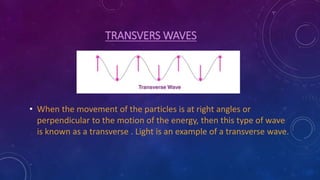
TRANSVERS WAVES
• When the movement of the particles is at right angles or
perpendicular to the motion of the energy, then this type of wave
is known as a transverse . Light is an example of a transverse wave.
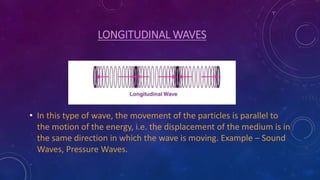
LONGITUDINAL WAVES
• In this type of wave, the movement of the particles is parallel to
the motion of the energy, i.e. the displacement of the medium is in
the same direction in which the wave is moving. Example – Sound
Waves, Pressure Waves.
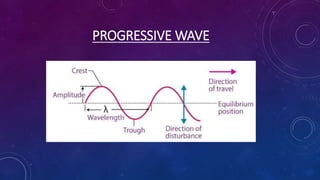
PROGRESSIVE WAVE
PROGRESSIVE WAVE
• A wave which travels continuously in a
medium in the same direction without a
change in its amplitude is called a travelling
wave or a progressive wave. In this section, we
will derive a function that will describe the
propagation of a wave in a medium and gives
the shape of the progressive wave at any
instant of time during its propagation.
STANDING WAVES |DEFINITION & FACT'S |
DISTINCTION BETWEEN LONGITUDINAL AND
TRANSVERSE WAVES
• These are the types of light waves. Broadly electromagnetic
waves are of this type.
• 2. These waves can travel through a vacuum.
• 3. The velocity of these waves is maximum in air or vacuum.
• 4. These waves are transmitted through the medium through
crests and troughs.
• 5.When this wave propagates through a medium.Particles of a
medium vibrate in a direction perpendicular to its direction of
motion
LONGITUDINAL WAVES
• 1.These are the types of sound waves in air.
• 2.These waves cannot pass through a vacuum.
• 3. The velocity of these waves is less in air. Solids are
higher in liquids.
• 4 These waves are transmitted in the medium through
compressions and rarefactions.
• 5. When this wave propagates through a medium, the
particles of the medium vibrate in the direction of its
motion.
WAVE SPEED FORMULA
• Having understood the different types of
waves, let us now understand Wave Speed
Formula. Wave speed is viewed as the distance
that any wave travels at a specified amount of
time. It implies the number of meters that a
wave travels in every second. Wave speed is
also related to wave frequency and
wavelength. It can be understood by the
following questions:
Speed = Frequency x
PROPERTIES OF WAVES
• A wave is characterized by different properties
of it. These properties are amplitude,
frequency, wavelength, velocity and period. To
get more clarity on these elements, let us
understand each of them one by one.
SOME DEFINITION ASSOCIATED WITH THE
WAVE
• 1. Amplitude of vibration – the maximum
displacement of a medium in any direction from
a central point during wave motion. As the area
of ​​the sound wave increases, so does its intensity
and frequency.
• 2. Periodic time – the period of time taken
for the movement to give one complete wave
during wave motion. The unit of measurement
is second.
• (T)=1/n
• T=1/f
• 3. (Frequency) n :The number of previous
vibrations made in the same second as the
vibration. Its unit is Hertz (Hz). It is also
denoted by
• 4. Wavelength:- the distance between two
successive waves oscillating in the same wave.
Its unit is meter. Wavelength is usually
expressed in angstrom units (A).
• 1 A°=10-¹⁰ M =10-⁸ Cm.
• For a perpendicular wave, the distance
between two successive crests or two
successive crests is called the wavelength.
• For a coherent wave, the distance between
two successive contractions or two successive
diffractions is called the wavelength.
• 5. v (Speed ​​of Sound Wave):The speed
of a sound wave through a medium in a unit
time says Its unit is meter/second.
• 6. SHM Simple Harmonic Motion-SHM : There is
periodic and non-oscillating motion and the motion
during which the acceleration of the sun is symmetrical
about its central position is called simple periodic
motion. This motion is a repetitive motion over a linear
path. The movement of a clock wheel, the vibrations of
a small arm, the motion of a piston, the ears of a sonic
pan, etc. are examples of this type of motion.
• 7. Phase: During wave motion, the direction of
motion and span of the vibrating fruit obtained
from the physical location and direction of motion
is called art. The information given by different
particles of the medium that experiences the
wave is different at a certain time, is called Art.
GROUP DETAILS
• 1. Name : LAKOD DIVYARAJ DHARMENDRASINH
• ENROLLMENT NO:229980319027

physics ppt.pptx

  • 1.
    THE TYPES OFWAVES PHYSICS MICRO PROJECT
  • 2.
    WHAT ARE WAVES? •A wave transmits information or energy from one point to another in the form of signals, but no material object makes this journey. The frequency of a wave is obtained by including a factor of time in the mix. We are completely dependent on waves for all of our wireless communications. For example, if you make a call to your friend in another city with your mobile phone, the entire communication is happening via audio, but the entire process of transmission of a signal from the talker to the receiver occurs as a waveform. The phone converts your voice into an electrical signal which then propagates either through copper wires or through antennae in wireless communication.
  • 3.
    THE TYPES OFWAVES • Types of waves are: • Longitudinal waves • Transverse waves
  • 4.
    TRANSVERS WAVES • Whenthe movement of the particles is at right angles or perpendicular to the motion of the energy, then this type of wave is known as a transverse . Light is an example of a transverse wave.
  • 5.
    LONGITUDINAL WAVES • Inthis type of wave, the movement of the particles is parallel to the motion of the energy, i.e. the displacement of the medium is in the same direction in which the wave is moving. Example – Sound Waves, Pressure Waves.
  • 6.
  • 7.
    PROGRESSIVE WAVE • Awave which travels continuously in a medium in the same direction without a change in its amplitude is called a travelling wave or a progressive wave. In this section, we will derive a function that will describe the propagation of a wave in a medium and gives the shape of the progressive wave at any instant of time during its propagation.
  • 8.
  • 9.
    DISTINCTION BETWEEN LONGITUDINALAND TRANSVERSE WAVES • These are the types of light waves. Broadly electromagnetic waves are of this type. • 2. These waves can travel through a vacuum. • 3. The velocity of these waves is maximum in air or vacuum. • 4. These waves are transmitted through the medium through crests and troughs. • 5.When this wave propagates through a medium.Particles of a medium vibrate in a direction perpendicular to its direction of motion
  • 10.
    LONGITUDINAL WAVES • 1.Theseare the types of sound waves in air. • 2.These waves cannot pass through a vacuum. • 3. The velocity of these waves is less in air. Solids are higher in liquids. • 4 These waves are transmitted in the medium through compressions and rarefactions. • 5. When this wave propagates through a medium, the particles of the medium vibrate in the direction of its motion.
  • 11.
    WAVE SPEED FORMULA •Having understood the different types of waves, let us now understand Wave Speed Formula. Wave speed is viewed as the distance that any wave travels at a specified amount of time. It implies the number of meters that a wave travels in every second. Wave speed is also related to wave frequency and wavelength. It can be understood by the following questions: Speed = Frequency x
  • 12.
    PROPERTIES OF WAVES •A wave is characterized by different properties of it. These properties are amplitude, frequency, wavelength, velocity and period. To get more clarity on these elements, let us understand each of them one by one.
  • 13.
    SOME DEFINITION ASSOCIATEDWITH THE WAVE • 1. Amplitude of vibration – the maximum displacement of a medium in any direction from a central point during wave motion. As the area of ​​the sound wave increases, so does its intensity and frequency.
  • 14.
    • 2. Periodictime – the period of time taken for the movement to give one complete wave during wave motion. The unit of measurement is second. • (T)=1/n • T=1/f
  • 15.
    • 3. (Frequency)n :The number of previous vibrations made in the same second as the vibration. Its unit is Hertz (Hz). It is also denoted by
  • 16.
    • 4. Wavelength:-the distance between two successive waves oscillating in the same wave. Its unit is meter. Wavelength is usually expressed in angstrom units (A). • 1 A°=10-¹⁰ M =10-⁸ Cm.
  • 17.
    • For aperpendicular wave, the distance between two successive crests or two successive crests is called the wavelength. • For a coherent wave, the distance between two successive contractions or two successive diffractions is called the wavelength.
  • 18.
    • 5. v(Speed ​​of Sound Wave):The speed of a sound wave through a medium in a unit time says Its unit is meter/second.
  • 19.
    • 6. SHMSimple Harmonic Motion-SHM : There is periodic and non-oscillating motion and the motion during which the acceleration of the sun is symmetrical about its central position is called simple periodic motion. This motion is a repetitive motion over a linear path. The movement of a clock wheel, the vibrations of a small arm, the motion of a piston, the ears of a sonic pan, etc. are examples of this type of motion.
  • 20.
    • 7. Phase:During wave motion, the direction of motion and span of the vibrating fruit obtained from the physical location and direction of motion is called art. The information given by different particles of the medium that experiences the wave is different at a certain time, is called Art.
  • 21.
    GROUP DETAILS • 1.Name : LAKOD DIVYARAJ DHARMENDRASINH • ENROLLMENT NO:229980319027