VIBRATORY MOTION AND
WAVE
PREPARED BY:
M USAMA ZAHID (045) HASSAN Raza (73)
M Inam (76) M Ikram (23)
DEFINITION OF VIBRATORY MOTION
Vibratorymotionoccurs at a fixed point as an object
moves back and forth.
Any motion that repeat itself after an interval of
time is called Vibratory Motion.
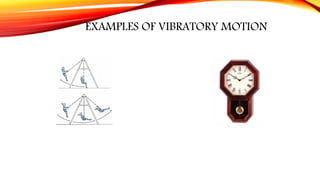
EXAMPLES OF VIBRATORY MOTION
PROPERTIES OF VIBRATING OBJECT
 Frequency
Amplitude
Time period
AMPLITUDE
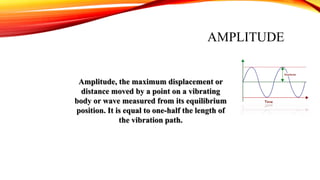
Amplitude, the maximum displacement or
distance moved by a point on a vibrating
body or wave measured from its equilibrium
position. It is equal to one-half the length of
the vibration path.
FREQUENCY
Frequency, number of cycle that pass a fixed
point in unit time.
Unit of frequency is hertz (Hz)
TIME PERIOD
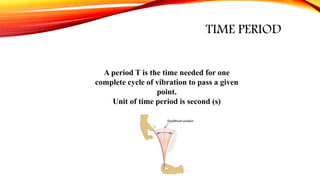
A period T is the time needed for one
complete cycle of vibration to pass a given
point.
Unit of time period is second (s)
TYPES OF VIBRATORY MOTION
Types Of
Vibratory motion
Free Vibration Forced vibration Damped Vibration
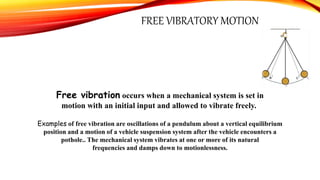
Free vibration occurs when a mechanical system is set in
motion with an initial input and allowed to vibrate freely.
Examples of free vibration are oscillations of a pendulum about a vertical equilibrium
position and a motion of a vehicle suspension system after the vehicle encounters a
pothole.. The mechanical system vibrates at one or more of its natural
frequencies and damps down to motionlessness.
FREE VIBRATORY MOTION
FORCED VIBRATION
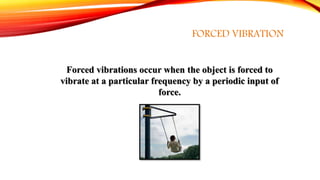
Forced vibrations occur when the object is forced to
vibrate at a particular frequency by a periodic input of
force.
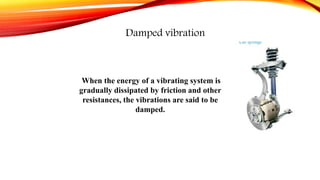
When the energy of a vibrating system is
gradually dissipated by friction and other
resistances, the vibrations are said to be
damped.
Damped vibration
INSTRUMENTS USED FOR MEASUREMENT OF
VIBRATION
VIBROMETER
VIBRATION ANALYSER
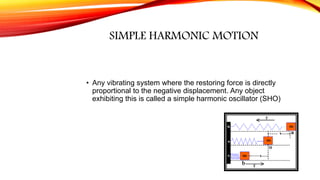
SIMPLE HARMONIC MOTION
• Any vibrating system where the restoring force is directly
proportional to the negative displacement. Any object
exhibiting this is called a simple harmonic oscillator (SHO)
RESTORING FORCE (F)
• Force exerted when away from equilibrium
• Directly proportional to the displacement (x)
F = - kx
• k – spring constant
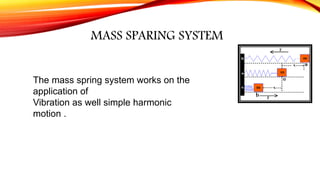
MASS SPARING SYSTEM
The mass spring system works on the
application of
Vibration as well simple harmonic
motion .
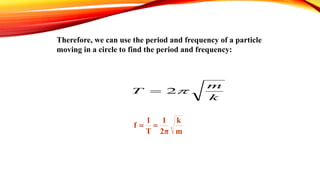
Therefore, we can use the period and frequency of a particle
moving in a circle to find the period and frequency:
m
k
π2
1
T
1
f 
k
m
T 2
PENDULUM
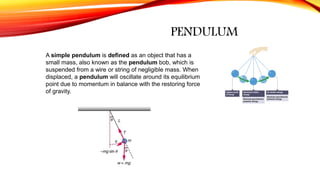
A simple pendulum is defined as an object that has a
small mass, also known as the pendulum bob, which is
suspended from a wire or string of negligible mass. When
displaced, a pendulum will oscillate around its equilibrium
point due to momentum in balance with the restoring force
of gravity.
WAVE
Wave – a disturbance that transfers energy
 the energy transferred through a wave can be carried
from the disturbance, through the wave, to another
object
 Ex: wind gives energy (a disturbance), creating
waves on an ocean, and the ocean carries that energy
to a boat, and the energy rocks the boat up and down
 the energy from the disturbance is transferred
through a medium
MECHANICAL TYPES OF WAVES
Transverse waves
 Longitudinal Waves
Transverse Waves
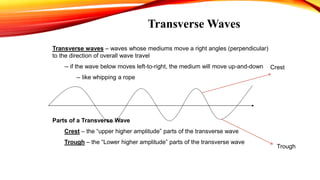
Transverse waves – waves whose mediums move a right angles (perpendicular)
to the direction of overall wave travel
-- if the wave below moves left-to-right, the medium will move up-and-down
-- like whipping a rope
Parts of a Transverse Wave
Crest – the “upper higher amplitude” parts of the transverse wave
Trough – the “Lower higher amplitude” parts of the transverse wave
Crest
Trough
LONGITUDINAL WAVES
Longitudinal Waves – waves whose mediums move in the same direction as
overall wave travel
-- like squeezing and releasing a slinky spring
-- longitudinal waves are often called compression waves
Parts of a Longitudinal wave
Compressions – areas where the molecules in the medium are tightly
squeezed together
Rarefactions – areas where the molecules in the medium are spread apart
WAVE PROPERTIES
Despite the different types of waves, all waves share the same basic properties:
 amplitude
 wavelength
 frequency
 speed
When figuring out these properties on either longitudinal or transverse waves, it
is necessary to remember the following:
Crests on a transverse wave are equal to compressions on a longitudinal wave
Troughs on a transverse wave are equal to rarefactions on a longitudinal wave
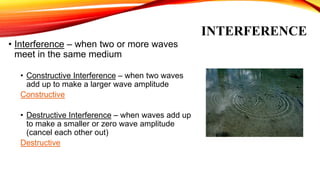
INTERFERENCE
• Interference – when two or more waves
meet in the same medium
• Constructive Interference – when two waves
add up to make a larger wave amplitude
Constructive
• Destructive Interference – when waves add up
to make a smaller or zero wave amplitude
(cancel each other out)
Destructive
CONSTRUCTIVE INTERFERENCE
DESTRUCTIVE INTERFERENCE
RESONANCE
•Resonance – occurs when
vibrations travelling through an
object match the object’s natural
frequency
•Also occurs when one object
vibrates another object without
touching it
RESULT OF RESONANCE
Glass shattering
Tacoma Narrows Bridge collapsing
REFLECTION
• Reflection occurs when a wave strikes an object and bounces
off of it.
• All types of waves can be reflected
• The angle of incidence of a wave is always equal to the angle of
reflection.
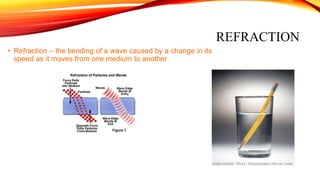
REFRACTION
• Refraction – the bending of a wave caused by a change in its
speed as it moves from one medium to another
DIFFRACTION
Spreading of waves that
happen when it passes
through a narrow opening or
when it passes round a
small obstacle along its
path.

Vibratry motion

  • 2.
    VIBRATORY MOTION AND WAVE PREPAREDBY: M USAMA ZAHID (045) HASSAN Raza (73) M Inam (76) M Ikram (23)
  • 3.
    DEFINITION OF VIBRATORYMOTION Vibratorymotionoccurs at a fixed point as an object moves back and forth. Any motion that repeat itself after an interval of time is called Vibratory Motion.
  • 4.
  • 5.
    PROPERTIES OF VIBRATINGOBJECT  Frequency Amplitude Time period
  • 6.
    AMPLITUDE Amplitude, the maximumdisplacement or distance moved by a point on a vibrating body or wave measured from its equilibrium position. It is equal to one-half the length of the vibration path.
  • 7.
    FREQUENCY Frequency, number ofcycle that pass a fixed point in unit time. Unit of frequency is hertz (Hz)
  • 8.
    TIME PERIOD A periodT is the time needed for one complete cycle of vibration to pass a given point. Unit of time period is second (s)
  • 9.
    TYPES OF VIBRATORYMOTION Types Of Vibratory motion Free Vibration Forced vibration Damped Vibration
  • 10.
    Free vibration occurswhen a mechanical system is set in motion with an initial input and allowed to vibrate freely. Examples of free vibration are oscillations of a pendulum about a vertical equilibrium position and a motion of a vehicle suspension system after the vehicle encounters a pothole.. The mechanical system vibrates at one or more of its natural frequencies and damps down to motionlessness. FREE VIBRATORY MOTION
  • 11.
    FORCED VIBRATION Forced vibrationsoccur when the object is forced to vibrate at a particular frequency by a periodic input of force.
  • 12.
    When the energyof a vibrating system is gradually dissipated by friction and other resistances, the vibrations are said to be damped. Damped vibration
  • 13.
    INSTRUMENTS USED FORMEASUREMENT OF VIBRATION VIBROMETER VIBRATION ANALYSER
  • 14.
    SIMPLE HARMONIC MOTION •Any vibrating system where the restoring force is directly proportional to the negative displacement. Any object exhibiting this is called a simple harmonic oscillator (SHO)
  • 15.
    RESTORING FORCE (F) •Force exerted when away from equilibrium • Directly proportional to the displacement (x) F = - kx • k – spring constant
  • 16.
    MASS SPARING SYSTEM Themass spring system works on the application of Vibration as well simple harmonic motion .
  • 17.
    Therefore, we canuse the period and frequency of a particle moving in a circle to find the period and frequency: m k π2 1 T 1 f  k m T 2
  • 18.
    PENDULUM A simple pendulumis defined as an object that has a small mass, also known as the pendulum bob, which is suspended from a wire or string of negligible mass. When displaced, a pendulum will oscillate around its equilibrium point due to momentum in balance with the restoring force of gravity.
  • 19.
    WAVE Wave – adisturbance that transfers energy  the energy transferred through a wave can be carried from the disturbance, through the wave, to another object  Ex: wind gives energy (a disturbance), creating waves on an ocean, and the ocean carries that energy to a boat, and the energy rocks the boat up and down  the energy from the disturbance is transferred through a medium
  • 20.
    MECHANICAL TYPES OFWAVES Transverse waves  Longitudinal Waves
  • 21.
    Transverse Waves Transverse waves– waves whose mediums move a right angles (perpendicular) to the direction of overall wave travel -- if the wave below moves left-to-right, the medium will move up-and-down -- like whipping a rope Parts of a Transverse Wave Crest – the “upper higher amplitude” parts of the transverse wave Trough – the “Lower higher amplitude” parts of the transverse wave Crest Trough
  • 22.
    LONGITUDINAL WAVES Longitudinal Waves– waves whose mediums move in the same direction as overall wave travel -- like squeezing and releasing a slinky spring -- longitudinal waves are often called compression waves Parts of a Longitudinal wave Compressions – areas where the molecules in the medium are tightly squeezed together Rarefactions – areas where the molecules in the medium are spread apart
  • 23.
    WAVE PROPERTIES Despite thedifferent types of waves, all waves share the same basic properties:  amplitude  wavelength  frequency  speed When figuring out these properties on either longitudinal or transverse waves, it is necessary to remember the following: Crests on a transverse wave are equal to compressions on a longitudinal wave Troughs on a transverse wave are equal to rarefactions on a longitudinal wave
  • 24.
    INTERFERENCE • Interference –when two or more waves meet in the same medium • Constructive Interference – when two waves add up to make a larger wave amplitude Constructive • Destructive Interference – when waves add up to make a smaller or zero wave amplitude (cancel each other out) Destructive
  • 25.
  • 26.
  • 27.
    RESONANCE •Resonance – occurswhen vibrations travelling through an object match the object’s natural frequency •Also occurs when one object vibrates another object without touching it
  • 28.
    RESULT OF RESONANCE Glassshattering Tacoma Narrows Bridge collapsing
  • 29.
    REFLECTION • Reflection occurswhen a wave strikes an object and bounces off of it. • All types of waves can be reflected • The angle of incidence of a wave is always equal to the angle of reflection.
  • 30.
    REFRACTION • Refraction –the bending of a wave caused by a change in its speed as it moves from one medium to another
  • 31.
    DIFFRACTION Spreading of wavesthat happen when it passes through a narrow opening or when it passes round a small obstacle along its path.