

Wastewater –
Its Journey to Treatment and
Return to the Environment
Water & wastewater management
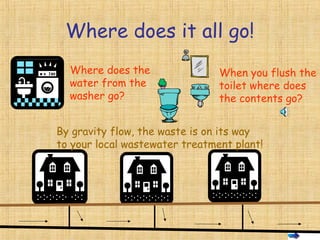
Where does it all go!
Where does the
water from the
washer go?
When you flush the
toilet where does
the contents go?
By gravity flow, the waste is on its way
to your local wastewater treatment plant!
Why treat wastewater?
• Causes a demand for dissolved oxygen
(lower DO levels of streams)
• Adds nutrients (nitrate and phosphate)
to cause excessive growth
• Increases suspended solids or sediments
in streams (turbidity increase)
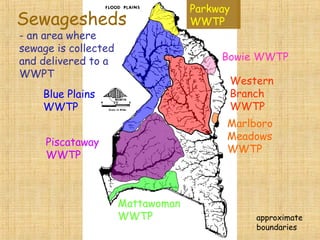
Western
Branch
WWTP
Blue Plains
WWTP
Mattawoman
WWTP
Sewagesheds
Piscataway
WWTP
Parkway
WWTP
Marlboro
Meadows
WWTP
Bowie WWTP
approximate
boundaries
- an area where
sewage is collected
and delivered to a
WWPT
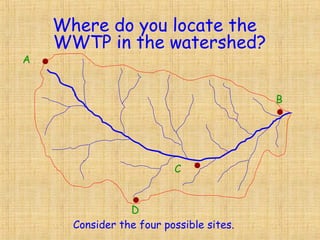
Where do you locate the
WWTP in the watershed?
A
B
C
D
Consider the four possible sites.
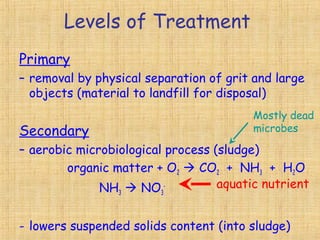
Levels of Treatment
Primary
– removal by physical separation of grit and large
objects (material to landfill for disposal)
Secondary
– aerobic microbiological process (sludge)
organic matter + O2  CO2 + NH3 + H2O
NH3  NO3
-
- lowers suspended solids content (into sludge)
aquatic nutrient
Mostly dead
microbes
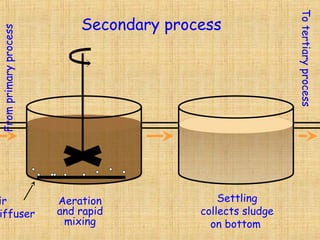
Aeration
and rapid
mixing
Settling
collects sludge
on bottom
Secondary process
ir
iffuser
Fromprimaryprocess
Totertiaryprocess
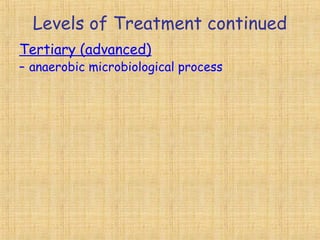
Levels of Treatment continued
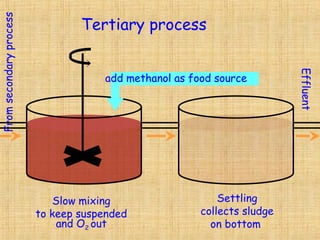
Tertiary (advanced)
– anaerobic microbiological process
Slow mixing
to keep suspended
and O2 out
Settling
collects sludge
on bottom
Tertiary process
Fromsecondaryprocess
Effluent
add methanol as food source
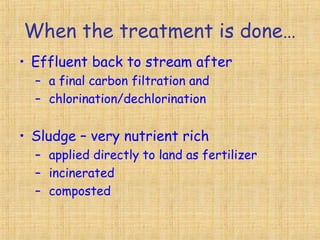
When the treatment is done…
• Effluent back to stream after
– a final carbon filtration and
– chlorination/dechlorination
• Sludge – very nutrient rich
– applied directly to land as fertilizer
– incinerated
– composted
• We all know that planet earth has more
water than land but sadly just about 3%
of the Earth’s total water is fresh
water and over two third of that is in
glaciers.
• That makes it about less than 0.5
percent of our fresh water available in
lakes, ponds and rivers
WATER MANAGEMENT
The availability and quality of water are being
improved.
•Rooftop rainwater harvesting systems, storage
tanks, bio-sand filters, and stand posts with
water taps in schools and homes provide water
for drinking and sanitation—
•Groundwater levels are augmented with check
dams, contour trenches, dug well recharging,
pressurized recharge wells, and pond
development; and
•Villagers and development committees are being
trained to effectively manage water resources,
and water literacy sessions motivate villagers to
conserve water.
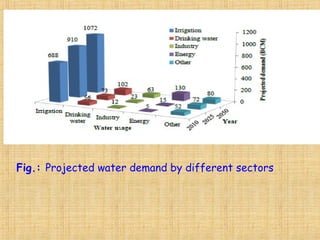
Fig.: Projected water demand by different sectors
BIOMEDICAL
WASTE
MANAGEMENT IN
INDIA
)
Let the waste of the
“sick” not contaminate
the lives of “The
Healthy”
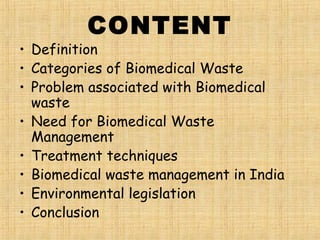
CONTENT
• Definition
• Categories of Biomedical Waste
• Problem associated with Biomedical
waste
• Need for Biomedical Waste
Management
• Treatment techniques
• Biomedical waste management in India
• Environmental legislation
• Conclusion
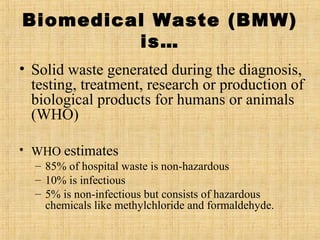
Biomedical Waste (BMW)
is…
• Solid waste generated during the diagnosis,
testing, treatment, research or production of
biological products for humans or animals
(WHO)
• WHO estimates
– 85% of hospital waste is non-hazardous
– 10% is infectious
– 5% is non-infectious but consists of hazardous
chemicals like methylchloride and formaldehyde.
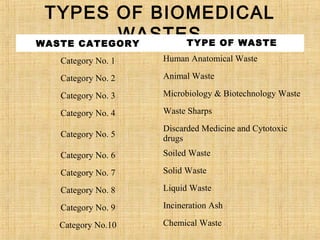
TYPES OF BIOMEDICAL
WASTESWASTE CATEGORY TYPE OF WASTE
Category No. 1 Human Anatomical Waste
Category No. 2 Animal Waste
Category No. 3 Microbiology & Biotechnology Waste
Category No. 4 Waste Sharps
Category No. 5
Discarded Medicine and Cytotoxic
drugs
Category No. 6 Soiled Waste
Category No. 7 Solid Waste
Category No. 8 Liquid Waste
Category No. 9 Incineration Ash
Category No.10 Chemical Waste
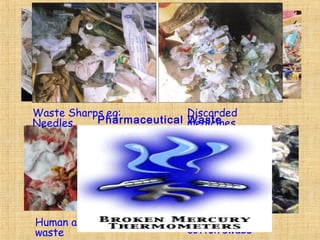
Waste Sharps eg:
Needles
Human anatomical
waste
Discarded
medicines
Solid waste eg:
cotton swabs
Pharmaceutical Waste
PROBLEM ASSOCIATED
WITH BMW
ORGANISM DISEASES CAUSED RELATED WASTE
ITEM
VIRUSES
 HIV, Hepatitis B,
Hepatitis A,C,
Arboviruses,
Enteroviruses
AIDS, Infectious
Hepatitis,
Infectious Hepatitis,
Dengue, Japanese
encephalitis, tick-borne
fevers, etc.
Infected needles, body
Fluids, Human excreta,
soiled linen, Blood, body
fluids.
BACTERIA
Salmonella typhi,
Vibrio cholerae,
Clostridium Tetani,
Pseudomonas,
Streptococcus
Typhoid, Cholera,
Tetanus
Wound infections,
septicemia, rheumatic
fever, endocarditis, skin
and soft tissue infections
Human excreta and
body fluid in landfills and
hospital wards, Sharps
such as needles, surgical
blades in hospital waste.
PARASITES
Wucheraria Bancrofti,
Plasmodium
Cutaneous leishmaniasis,
Kala Azar, Malaria
Human excreta, blood
and
body fluids in poorly
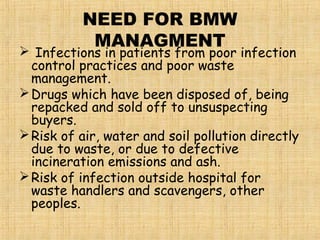
NEED FOR BMW
MANAGMENT
 Infections in patients from poor infection
control practices and poor waste
management.
Drugs which have been disposed of, being
repacked and sold off to unsuspecting
buyers.
Risk of air, water and soil pollution directly
due to waste, or due to defective
incineration emissions and ash.
Risk of infection outside hospital for
waste handlers and scavengers, other
peoples.
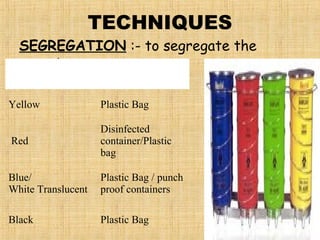
TECHNIQUES
SEGREGATION :- to segregate the
wastes.
Colour Coding Type of Container
Yellow Plastic Bag
Red
Disinfected
container/Plastic
bag
Blue/
White Translucent
Plastic Bag / punch
proof containers
Black Plastic Bag
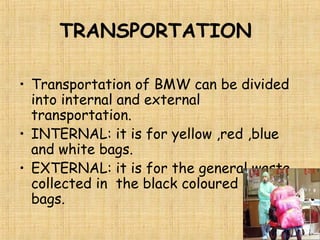
TRANSPORTATION
• Transportation of BMW can be divided
into internal and external
transportation.
• INTERNAL: it is for yellow ,red ,blue
and white bags.
• EXTERNAL: it is for the general waste
collected in the black coloured plastic
bags.
Bio medical waste
management in India
Biomedical waste (management and handling) rule
1998, prescribed by The Ministry of Environment and
Forests, Govt of India, came into force on 20th July
1998.
 This rule applies to those who generate, collect,
receive, store, dispose, treat or handle bio medical
waste in any manner.
Thus bio medical waste should be segregated into
containers/bags at the point of generation of waste.
Thus Colour Coding & type of containers used for
disposal of waste is came into existence which is
shown as follows.
26
27
Environmental LegislationEnvironmental Legislation
 The Environment (Protection) Act, 1986The Environment (Protection) Act, 1986
 The Biomedical Waste (Management &The Biomedical Waste (Management &
Handling) Rules, 1998Handling) Rules, 1998
 The Municipal Solid Waste (Management &The Municipal Solid Waste (Management &
Handling) Rules, 2000Handling) Rules, 2000
 The Hazardous Waste (Management &The Hazardous Waste (Management &
Handling) Rules, 1989Handling) Rules, 1989
 The National Environmental Tribunal Act, 1995The National Environmental Tribunal Act, 1995
 The Air (Prevention and Control of Pollution)The Air (Prevention and Control of Pollution)
Act, 1981Act, 1981

Water & Waste Water Management.

  • 1.
    Wastewater – Its Journeyto Treatment and Return to the Environment Water & wastewater management
  • 2.
    Where does itall go! Where does the water from the washer go? When you flush the toilet where does the contents go? By gravity flow, the waste is on its way to your local wastewater treatment plant!
  • 3.
    Why treat wastewater? •Causes a demand for dissolved oxygen (lower DO levels of streams) • Adds nutrients (nitrate and phosphate) to cause excessive growth • Increases suspended solids or sediments in streams (turbidity increase)
  • 4.
  • 5.
    Where do youlocate the WWTP in the watershed? A B C D Consider the four possible sites.
  • 6.
    Levels of Treatment Primary –removal by physical separation of grit and large objects (material to landfill for disposal) Secondary – aerobic microbiological process (sludge) organic matter + O2  CO2 + NH3 + H2O NH3  NO3 - - lowers suspended solids content (into sludge) aquatic nutrient Mostly dead microbes
  • 7.
    Aeration and rapid mixing Settling collects sludge onbottom Secondary process ir iffuser Fromprimaryprocess Totertiaryprocess
  • 8.
    Levels of Treatmentcontinued Tertiary (advanced) – anaerobic microbiological process
  • 9.
    Slow mixing to keepsuspended and O2 out Settling collects sludge on bottom Tertiary process Fromsecondaryprocess Effluent add methanol as food source
  • 10.
    When the treatmentis done… • Effluent back to stream after – a final carbon filtration and – chlorination/dechlorination • Sludge – very nutrient rich – applied directly to land as fertilizer – incinerated – composted
  • 11.
    • We allknow that planet earth has more water than land but sadly just about 3% of the Earth’s total water is fresh water and over two third of that is in glaciers. • That makes it about less than 0.5 percent of our fresh water available in lakes, ponds and rivers WATER MANAGEMENT
  • 12.
    The availability andquality of water are being improved. •Rooftop rainwater harvesting systems, storage tanks, bio-sand filters, and stand posts with water taps in schools and homes provide water for drinking and sanitation— •Groundwater levels are augmented with check dams, contour trenches, dug well recharging, pressurized recharge wells, and pond development; and •Villagers and development committees are being trained to effectively manage water resources, and water literacy sessions motivate villagers to conserve water.
  • 13.
    Fig.: Projected waterdemand by different sectors
  • 16.
  • 17.
    Let the wasteof the “sick” not contaminate the lives of “The Healthy”
  • 18.
    CONTENT • Definition • Categoriesof Biomedical Waste • Problem associated with Biomedical waste • Need for Biomedical Waste Management • Treatment techniques • Biomedical waste management in India • Environmental legislation • Conclusion
  • 19.
    Biomedical Waste (BMW) is… •Solid waste generated during the diagnosis, testing, treatment, research or production of biological products for humans or animals (WHO) • WHO estimates – 85% of hospital waste is non-hazardous – 10% is infectious – 5% is non-infectious but consists of hazardous chemicals like methylchloride and formaldehyde.
  • 20.
    TYPES OF BIOMEDICAL WASTESWASTECATEGORY TYPE OF WASTE Category No. 1 Human Anatomical Waste Category No. 2 Animal Waste Category No. 3 Microbiology & Biotechnology Waste Category No. 4 Waste Sharps Category No. 5 Discarded Medicine and Cytotoxic drugs Category No. 6 Soiled Waste Category No. 7 Solid Waste Category No. 8 Liquid Waste Category No. 9 Incineration Ash Category No.10 Chemical Waste
  • 21.
    Waste Sharps eg: Needles Humananatomical waste Discarded medicines Solid waste eg: cotton swabs Pharmaceutical Waste
  • 22.
    PROBLEM ASSOCIATED WITH BMW ORGANISMDISEASES CAUSED RELATED WASTE ITEM VIRUSES  HIV, Hepatitis B, Hepatitis A,C, Arboviruses, Enteroviruses AIDS, Infectious Hepatitis, Infectious Hepatitis, Dengue, Japanese encephalitis, tick-borne fevers, etc. Infected needles, body Fluids, Human excreta, soiled linen, Blood, body fluids. BACTERIA Salmonella typhi, Vibrio cholerae, Clostridium Tetani, Pseudomonas, Streptococcus Typhoid, Cholera, Tetanus Wound infections, septicemia, rheumatic fever, endocarditis, skin and soft tissue infections Human excreta and body fluid in landfills and hospital wards, Sharps such as needles, surgical blades in hospital waste. PARASITES Wucheraria Bancrofti, Plasmodium Cutaneous leishmaniasis, Kala Azar, Malaria Human excreta, blood and body fluids in poorly
  • 23.
    NEED FOR BMW MANAGMENT Infections in patients from poor infection control practices and poor waste management. Drugs which have been disposed of, being repacked and sold off to unsuspecting buyers. Risk of air, water and soil pollution directly due to waste, or due to defective incineration emissions and ash. Risk of infection outside hospital for waste handlers and scavengers, other peoples.
  • 24.
    TECHNIQUES SEGREGATION :- tosegregate the wastes. Colour Coding Type of Container Yellow Plastic Bag Red Disinfected container/Plastic bag Blue/ White Translucent Plastic Bag / punch proof containers Black Plastic Bag
  • 25.
    TRANSPORTATION • Transportation ofBMW can be divided into internal and external transportation. • INTERNAL: it is for yellow ,red ,blue and white bags. • EXTERNAL: it is for the general waste collected in the black coloured plastic bags.
  • 26.
    Bio medical waste managementin India Biomedical waste (management and handling) rule 1998, prescribed by The Ministry of Environment and Forests, Govt of India, came into force on 20th July 1998.  This rule applies to those who generate, collect, receive, store, dispose, treat or handle bio medical waste in any manner. Thus bio medical waste should be segregated into containers/bags at the point of generation of waste. Thus Colour Coding & type of containers used for disposal of waste is came into existence which is shown as follows. 26
  • 27.
    27 Environmental LegislationEnvironmental Legislation The Environment (Protection) Act, 1986The Environment (Protection) Act, 1986  The Biomedical Waste (Management &The Biomedical Waste (Management & Handling) Rules, 1998Handling) Rules, 1998  The Municipal Solid Waste (Management &The Municipal Solid Waste (Management & Handling) Rules, 2000Handling) Rules, 2000  The Hazardous Waste (Management &The Hazardous Waste (Management & Handling) Rules, 1989Handling) Rules, 1989  The National Environmental Tribunal Act, 1995The National Environmental Tribunal Act, 1995  The Air (Prevention and Control of Pollution)The Air (Prevention and Control of Pollution) Act, 1981Act, 1981