BY:
AMRUTHA P,
3rd YEAR BSC
NURSING,
KIDWAI COLLEGE
OF NURSING.
DISPOSAL OF WASTE
Introduction:
Waste management is the
collection, transport, processing or disposal,
managing and monitoring of waste materials.
The term usually relates to materials produced
by human activity and the process is generally
undertaken to reduce their effect on health , the
environment or aesthetics.
Waste management is a distinct practise from
resource recovery which focuses on delaying
the rate of consumption of natural resources.
Definition:
‘Removing & destroying or strong
damaged, used or other unwanted
domestic, agricultural or industrial
products and substances. Disposal
includes burning. Burial at landfill sites
or at sea and recycling.”
Objectives:
•Public hygiene and health
•Reuse, Recovery and Recycle
•Energy generation
•Sustainable development
•Aesthetics
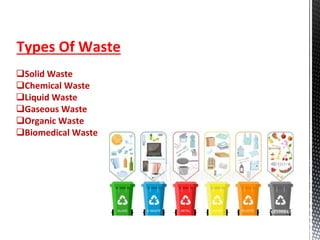
Solid Waste
Chemical Waste
Liquid Waste
Gaseous Waste
Organic Waste
Biomedical Waste
Types Of Waste
Waste generated during diagnosis, testing,
treatment, research or production of
biological products for humans or animals
Need For BMW Management
The hospital waste, in addition to the
risk for patients and person who
handle these wastes are threat to
public health and environment
BIOMEDICAL WASTE(MANAGEMENT &
HANDLING) RULES by Govt. of India ,1998
(Amended on 2000)
• Authoritative order to all the hospitals to
stop the indiscriminate disposal of waste and
ensure that it is treated in such a manner
that it should not harm the environment and
human health.
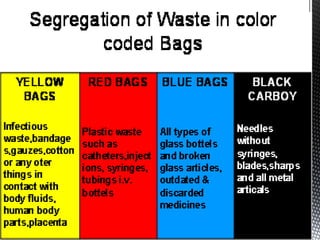
• All the BMW are to be segregated at the
point of generation
These rules apply to all persons who
generate, collect, receive, store, transport,
treat, dispose, or handle bio-medical waste
in any form includes a hospital, nursing
home, clinic, veterinary institutions,
animal house, pathological laboratory,
blood bank e.t.c.
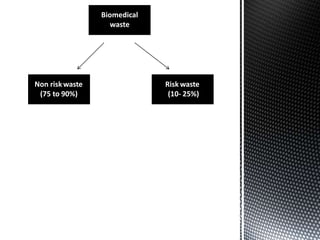
Biomedical
waste
Non riskwaste
(75 to 90%)
Risk waste
(10- 25%)
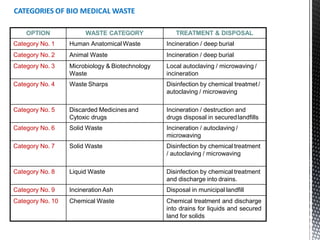
CATEGORIES OF BIO MEDICAL WASTE
OPTION WASTE CATEGORY TREATMENT & DISPOSAL
Category No. 1 Human AnatomicalWaste Incineration / deep burial
Category No. 2 Animal Waste Incineration / deep burial
Category No. 3 Microbiology & Biotechnology
Waste
Local autoclaving / microwaving /
incineration
Category No. 4 Waste Sharps Disinfection by chemical treatmet/
autoclaving / microwaving
Category No. 5 Discarded Medicinesand
Cytoxic drugs
Incineration / destruction and
drugs disposal in securedlandfills
Category No. 6 Solid Waste Incineration / autoclaving /
microwaving
Category No. 7 Solid Waste Disinfection by chemical treatment
/ autoclaving / microwaving
Category No. 8 Liquid Waste Disinfection by chemical treatment
and discharge into drains.
Category No. 9 Incineration Ash Disposal in municipal landfill
Category No. 10 Chemical Waste Chemical treatment and discharge
into drains for liquids and secured
land for solids
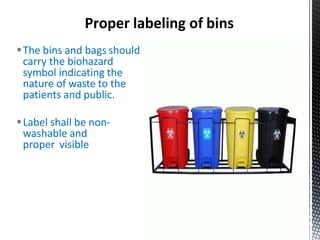
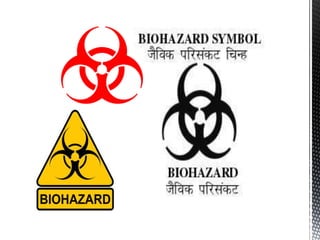
Proper labeling of bins
The bins and bags should
carry the biohazard
symbol indicating the
nature of waste to the
patients and public.
Label shall be non-
washable and
proper visible
In an area away from general traffic and
accessible only to authorized personnel
DO NOT store for more than 48 hours
If for any reason it becomes necessary to store
the waste beyond such period take measures
to ensure that the waste does not adversely
affect human health and environment
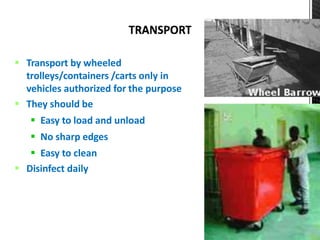
 Transport by wheeled
trolleys/containers /carts only in
vehicles authorized for the purpose
 They should be
 Easy to load and unload
 No sharp edges
 Easy to clean
 Disinfect daily
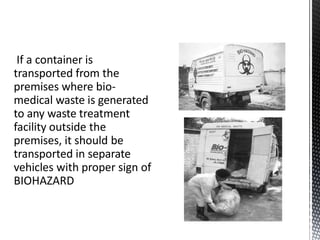
If a container is
transported from the
premises where bio-
medical waste is generated
to any waste treatment
facility outside the
premises, it should be
transported in separate
vehicles with proper sign of
BIOHAZARD
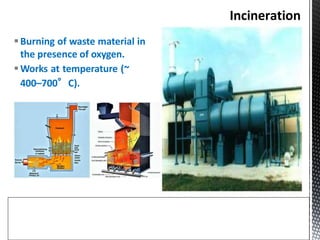
Incineration
Burning of waste material in
the presence of oxygen.
Works at temperature (~
400–700°C).
1 - THERMAL PROCESSES
A - Low-Heat Thermal Processes (93°C-177°C) Wet
heat (steam) disinfection - autoclave ,Dry heat (hot air)
disinfection - infrared heaters.
B - Medium-Heat Thermal Processes (177°C-
370°C) Chemical breakdown of organic material.
Reverse polymerization using high-intensity microwave
C - High-Heat Thermal Processes (540°C-8,300°C)
or higher Electrical resistance, induction, natural gas,
and/or plasma energy provide the intense heat ,total
destruction of the waste Significant change in the mass
and volume
2 - CHEMICAL PROCESSES
Dissolved chlorine dioxide, bleach (sodium
hypochlorite), or dry inorganic chemicals.
Toenhance exposure of the waste to the chemical
agent, chemical processes often involve shredding,
grinding, or mixing.
3 - IRRADIATIVE PROCESSES
Electron beams,Cobalt-60, or UV irradiation.
CONCLUSION
If we want to protect our
environment and health of
community we must sensitize
ourselves to this important
issue not only in the interest
of health managers but also
in the interest of community.
THANK YOU

Bio-medical waste management

  • 1.
    BY: AMRUTHA P, 3rd YEARBSC NURSING, KIDWAI COLLEGE OF NURSING.
  • 2.
    DISPOSAL OF WASTE Introduction: Wastemanagement is the collection, transport, processing or disposal, managing and monitoring of waste materials. The term usually relates to materials produced by human activity and the process is generally undertaken to reduce their effect on health , the environment or aesthetics. Waste management is a distinct practise from resource recovery which focuses on delaying the rate of consumption of natural resources.
  • 3.
    Definition: ‘Removing & destroyingor strong damaged, used or other unwanted domestic, agricultural or industrial products and substances. Disposal includes burning. Burial at landfill sites or at sea and recycling.”
  • 4.
    Objectives: •Public hygiene andhealth •Reuse, Recovery and Recycle •Energy generation •Sustainable development •Aesthetics
  • 5.
    Solid Waste Chemical Waste LiquidWaste Gaseous Waste Organic Waste Biomedical Waste Types Of Waste
  • 6.
    Waste generated duringdiagnosis, testing, treatment, research or production of biological products for humans or animals Need For BMW Management The hospital waste, in addition to the risk for patients and person who handle these wastes are threat to public health and environment
  • 7.
    BIOMEDICAL WASTE(MANAGEMENT & HANDLING)RULES by Govt. of India ,1998 (Amended on 2000) • Authoritative order to all the hospitals to stop the indiscriminate disposal of waste and ensure that it is treated in such a manner that it should not harm the environment and human health. • All the BMW are to be segregated at the point of generation
  • 8.
    These rules applyto all persons who generate, collect, receive, store, transport, treat, dispose, or handle bio-medical waste in any form includes a hospital, nursing home, clinic, veterinary institutions, animal house, pathological laboratory, blood bank e.t.c.
  • 9.
    Biomedical waste Non riskwaste (75 to90%) Risk waste (10- 25%)
  • 10.
    CATEGORIES OF BIOMEDICAL WASTE OPTION WASTE CATEGORY TREATMENT & DISPOSAL Category No. 1 Human AnatomicalWaste Incineration / deep burial Category No. 2 Animal Waste Incineration / deep burial Category No. 3 Microbiology & Biotechnology Waste Local autoclaving / microwaving / incineration Category No. 4 Waste Sharps Disinfection by chemical treatmet/ autoclaving / microwaving Category No. 5 Discarded Medicinesand Cytoxic drugs Incineration / destruction and drugs disposal in securedlandfills Category No. 6 Solid Waste Incineration / autoclaving / microwaving Category No. 7 Solid Waste Disinfection by chemical treatment / autoclaving / microwaving Category No. 8 Liquid Waste Disinfection by chemical treatment and discharge into drains. Category No. 9 Incineration Ash Disposal in municipal landfill Category No. 10 Chemical Waste Chemical treatment and discharge into drains for liquids and secured land for solids
  • 12.
    Proper labeling ofbins The bins and bags should carry the biohazard symbol indicating the nature of waste to the patients and public. Label shall be non- washable and proper visible
  • 14.
    In an areaaway from general traffic and accessible only to authorized personnel DO NOT store for more than 48 hours If for any reason it becomes necessary to store the waste beyond such period take measures to ensure that the waste does not adversely affect human health and environment
  • 15.
     Transport bywheeled trolleys/containers /carts only in vehicles authorized for the purpose  They should be  Easy to load and unload  No sharp edges  Easy to clean  Disinfect daily
  • 16.
    If a containeris transported from the premises where bio- medical waste is generated to any waste treatment facility outside the premises, it should be transported in separate vehicles with proper sign of BIOHAZARD
  • 17.
    Incineration Burning of wastematerial in the presence of oxygen. Works at temperature (~ 400–700°C).
  • 18.
    1 - THERMALPROCESSES A - Low-Heat Thermal Processes (93°C-177°C) Wet heat (steam) disinfection - autoclave ,Dry heat (hot air) disinfection - infrared heaters. B - Medium-Heat Thermal Processes (177°C- 370°C) Chemical breakdown of organic material. Reverse polymerization using high-intensity microwave C - High-Heat Thermal Processes (540°C-8,300°C) or higher Electrical resistance, induction, natural gas, and/or plasma energy provide the intense heat ,total destruction of the waste Significant change in the mass and volume
  • 19.
    2 - CHEMICALPROCESSES Dissolved chlorine dioxide, bleach (sodium hypochlorite), or dry inorganic chemicals. Toenhance exposure of the waste to the chemical agent, chemical processes often involve shredding, grinding, or mixing. 3 - IRRADIATIVE PROCESSES Electron beams,Cobalt-60, or UV irradiation.
  • 22.
    CONCLUSION If we wantto protect our environment and health of community we must sensitize ourselves to this important issue not only in the interest of health managers but also in the interest of community.
  • 23.